Gemini nabs US license to offer prediction markets

cointelegraph2025-12-11 tarihinde yayınlandı2025-12-11 tarihinde güncellendi

Özet

Crypto exchange Gemini, founded by the Winklevoss twins, has received a designated contract market license from the CFTC, allowing it to offer prediction markets in the US. Through its affiliate Gemini Titan, the company plans to let users trade event contracts and expand into crypto derivatives like futures and options. The announcement caused Gemini's stock to surge 13.7% in after-hours trading. The license marks the end of a five-year application process and could significantly boost the company, which has seen its stock decline since its public debut. President Cameron Winklevoss stated that prediction markets could potentially rival or exceed traditional capital markets in size.

Crypto exchange Gemini, founded by billionaire twins Tyler and Cameron Winklevoss, has scored a license from the Commodity Futures Trading Commission to offer prediction markets in the US.

Gemini said on Wednesday that its affiliate, Gemini Titan, received a designated contract market license from the CFTC and “plans to enter into the prediction markets space.”

The company said that “starting shortly,” its US users would be able to trade event contracts on its web platform and could expand its US derivatives offerings to include crypto futures, options, and perpetual contracts.

Gemini joins a number of crypto companies that have begun to offer prediction markets, allowing users to bet on the outcomes of a range of events, including sports and geopolitics.

Shares in Gemini (GEMI) shot up 13.7% in after-hours trading on Wednesday to $12.92 after ending the day’s trading session down 0.7%.
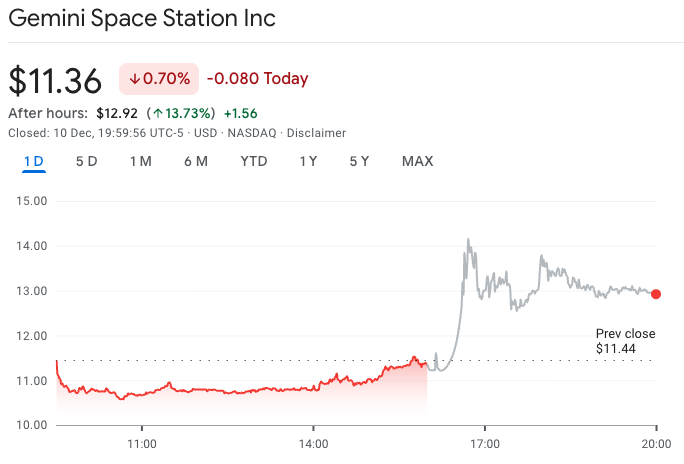
Shares in Gemini jumped on the company’s announcement that it will offer prediction markets. Source: Google Finance

The license could be a major boost for Gemini, whose stock is down 64.5% since its public debut on Sept. 12 as the crypto market has struggled to sustain a rally.

Related: ‘Elite’ traders hunt dopamine-seeking retail on prediction markets: 10x Research

“Prediction markets have the potential to be as big or bigger than traditional capital markets,” said Gemini’s president, Cameron Winklevoss.

Gemini CEO Tyler Winklevoss said it first applied for the license in March 2020, and the approval “marks the culmination of a 5-year licensing process and the beginning of a new chapter for Gemini.”

Magazine: Can Robinhood or Kraken’s tokenized stocks ever be truly decentralized?

İlgili Sorular

QWhat license did Gemini receive and from which US regulatory body?

AGemini received a designated contract market license from the Commodity Futures Trading Commission (CFTC).

QWhich Gemini affiliate was specifically granted the license to operate prediction markets?

AGemini Titan, an affiliate of the crypto exchange Gemini, was granted the license.

QHow did the announcement of the license affect Gemini's stock price in after-hours trading?

AGemini's stock (GEMI) shot up 13.7% in after-hours trading to $12.92.

QAccording to Cameron Winklevoss, how big does he believe prediction markets can become?

ACameron Winklevoss stated that prediction markets 'have the potential to be as big or bigger than traditional capital markets.'

QWhen did Gemini first apply for this license, according to CEO Tyler Winklevoss?

ACEO Tyler Winklevoss said the company first applied for the license in March 2020.

İlgili Okumalar

Bank of Korea Reveals Results of Tokenized Deposit Testing

The Bank of Korea has announced the results of its pilot test for tokenized deposits. Involving 28 central banks and international financial organizations, the project saw participation from major South Korean banks including KB Kookmin Bank, NH NongHyup Bank, Shinhan Bank, Woori Bank, and Hana Bank. Transactions, from payment orders to final settlement, were completed in real time, averaging just 80 seconds. The test involved 30 transactions across 17 different scenarios—such as corporate and interbank transfers—and was conducted in six currencies, including the Korean won, US dollar, and euro, with a total transaction value reaching approximately $995,000. The central bank reported that the platform operated stably throughout, despite being only partially connected to the existing banking infrastructure. Settlements using tokenized deposits were executed seamlessly, quickly, and transparently. An internal transfer of 20 million won (about $13,890) between NH NongHyup Bank and Shinhan Bank was also successfully processed via the Project Agora platform, which involved connecting to the Bank of Korea's CBDC test platform, Project Hangang. Additionally, KB Kookmin Bank and Japan's MUFG Bank tested cross-border payments using these deposit tokens—digital certificates issued by commercial banks within the pilot, not directly by the central bank. The Bank of Korea plans to continue testing payments with tokenized deposits. This follows last year's pledge by South Korean authorities to tighten regulations for won-based stablecoins, which will require approval from both the central bank and the Financial Services Commission.

cryptonews.ru56 dk önce

Bank of Korea Reveals Results of Tokenized Deposit Testing

cryptonews.ru56 dk önce

İşlemler

Spot
活动图片