Galaxy expands to UAE as part of Middle East push

cointelegraph2025-12-10 tarihinde yayınlandı2025-12-10 tarihinde güncellendi

Özet

Galaxy, a digital asset management firm, is expanding into the Middle East by establishing a new office and entity in Abu Dhabi under the Abu Dhabi Global Market (ADGM). The move aims to strengthen existing partnerships and tap into the region's growing financial hub, which is home to sophisticated investors. This expansion follows Galaxy's strong Q3 2025 performance, with $505 million net income and $3.2 billion in equity. The UAE has recently approved several crypto firms, including Binance, Bybit, and stablecoin issuers like Tether and Circle, further solidifying its role as a key market for digital assets.

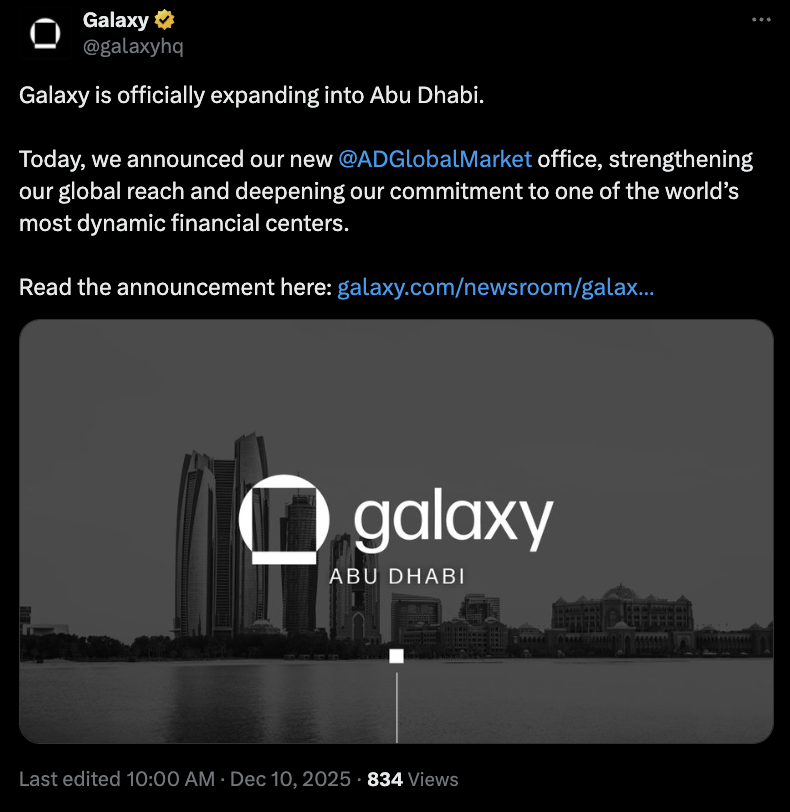
Galaxy, the digital asset management and infrastructure company, announced an upcoming office and a new arm in Abu Dhabi as part of its push into the Middle East.

In a Wednesday notice, Galaxy said it would establish an entity under the registration authority of the Abu Dhabi Global Market (ADGM), the area’s international financial center. According to Galaxy founder and CEO Mike Novogratz, the move was part of a strategy to expand the company’s existing partnerships and operations.

“The Middle East is a rapidly growing financial hub that is home to some of the world’s most sophisticated investors and innovators,” said Galaxy managing director Bouchra Darwazah. “It has become a particularly influential region for our investors, clients, and portfolio companies, and we believe this office will help establish new opportunities as a leading global digital assets investment and infrastructure firm.”
Source: Galaxy

The Middle East move followed Galaxy reporting a net income of $505 million in the third quarter of 2025, with $3.2 billion in equity. Since 2018, the company has been a major player in staying on top of crypto investments, including its plan to participate in a $1.65 billion Solana (SOL) treasury fund with Cantor Fitzgerald, Multicoin Capital and Jump Crypto.

Related: Tether’s USDt awarded key regulatory status in Abu Dhabi

UAE greenlighted several crypto companies looking to Middle East markets

Over the past year, numerous crypto companies have received regulatory approval to operate in key Middle East markets, including Dubai and Abu Dhabi, such as exchanges Binance and Bybit.

Some stablecoin issuers have had similar success. In November, ADGM cleared regulated companies to deploy Ripple’s stablecoin, Ripple USD (RLUSD). This week, the financial center also recognized Tether’s USDt (USDT) as an “accepted fiat-referenced token” and granted Circle regulatory approval to operate as a financial service provider, paving the way for its USDC (USDC) stablecoin.

Magazine: When privacy and AML laws conflict: Crypto projects’ impossible choice

İlgili Okumalar

How Does x402 V2 Enable Autonomous Payments for AI Agents?

The x402 protocol, initially developed by Coinbase, leverages the HTTP 402 status code to embed payment logic directly into web requests. The newly released V2 upgrade introduces significant improvements to address limitations in cross-chain support, scalability, identity authentication, and repeated payments experienced in V1. Key enhancements include: - **Wallet Identity and Reusable Sessions**: Supports wallet-based authentication (e.g., Sign-In-With-X via CAIP-122), allowing reusable sessions after initial payment. This reduces latency and costs for high-frequency use cases like AI agent tasks and LLM inference. - **Unified Payment Interface**: Enables multi-chain payments (e.g., Base, Solana) and compatibility with traditional systems (ACH, SEPA, credit cards) via Facilitators. Dynamic payTo routing allows context-aware pricing and complex market structures. - **Modular Architecture**: A plugin-driven SDK simplifies integration, supporting easy expansion to new chains and payment methods without core changes. Multi-Facilitator support automates optimal payment path selection based on preferences. - **Automatic Discovery**: Services can expose metadata for automatic synchronization, ensuring real-time pricing and availability updates without manual intervention. For end-users, V2 enables seamless, subscription-like access with reduced friction. Developers benefit from flexible, low-maintenance payment integration and dynamic pricing models. AI agents gain autonomy to make economic decisions, such as purchasing API calls or compute resources independently using allocated budgets. x402 V2 evolves from a pay-per-use tool into a versatile economic layer, though challenges like ecosystem adoption, modular risks, and regulatory uncertainty remain.

比推2 dk önce

How Does x402 V2 Enable Autonomous Payments for AI Agents?

比推2 dk önce

Bitcoin (BTC) Price Trend and Investor Sentiment Suggest a Bullish December

Bitcoin (BTC) is showing signs of a potential bullish December, challenging a decade-old bearish seasonal pattern where November losses typically extend into year-end declines. Key factors supporting this shift include reduced leverage, with open interest dropping from $94 billion to $60 billion, and Bitcoin’s price reclaiming its monthly volume-weighted average price (rVWAP), indicating controlled distribution. Liquidity dynamics have also shifted, with deep liquidity clusters moving upward, and around $3 billion in short positions set to liquidate near $96,000. Market structure diverges from historical cycles due to spot ETF inflows, introducing constant structural demand and accelerating price discovery. Analysts note that Bitcoin’s four-year cycle, while not obsolete, is no longer time-aligned, resembling extended accumulation phases like mid-2016 or late-2019. Macro liquidity (M2) growth has plateaued, creating a late-cycle environment where risk assets rally despite underlying economic softening. Supporting indicators, such as CNY/USD and ETH/BTC correlations, along with improving PMI data and gold’s relative strength, suggest continued risk-on momentum rather than cycle fatigue. While buy-sell ratios show urgency, analysts caution this may reflect positioning squeeze rather than sustainable accumulation. Overall, December’s performance may depend more on structural forces—ETF flows, liquidity rotation, and shifting macro correlations—than traditional halving-driven周期 patterns.

cointelegraph_中文18 dk önce

Bitcoin (BTC) Price Trend and Investor Sentiment Suggest a Bullish December

cointelegraph_中文18 dk önce

İşlemler

Spot
Futures
活动图片