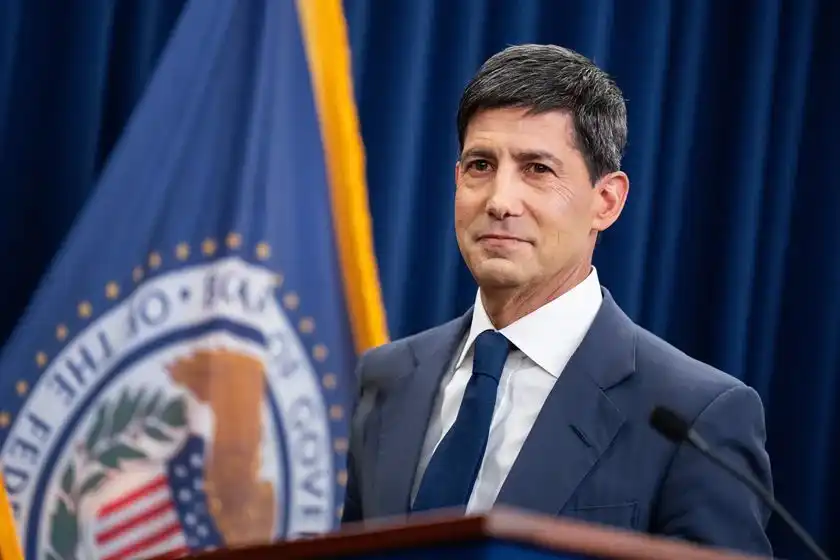
Full Text of the Fed Decision: 25 Basis Point Rate Cut, $40 Billion Treasury Bill Purchases Within 30 Days

比推2025-12-10 tarihinde yayınlandı2025-12-10 tarihinde güncellendi

Özet

The Federal Reserve lowered the target range for the federal funds rate by 25 basis points to 3.50%-3.75% on December 10, 2025, marking the third consecutive rate cut. The decision was approved by a 9-3 vote. The policy statement removed the description of unemployment as "low," and the latest dot plot maintained the projection of an additional 25 basis point rate cut in 2026. Additionally, the Fed will purchase $40 billion in Treasury bills over 30 days starting December 12 to maintain ample reserve levels. The policy stance reflects concerns over moderating economic activity, a rise in unemployment, and inflation that remains elevated. The committee emphasized its commitment to achieving maximum employment and a 2% inflation target, noting increased downside risks to employment. Voting against the decision were Stephen Miran, who preferred a 50 basis point cut, and Austan Goolsbee and Jeffrey Schmid, who favored no change. The Board also unanimously approved a reduction in the primary credit rate to 3.75%.

On December 10, 2025, local time, the Federal Reserve lowered the benchmark interest rate by 25 basis points to 3.50%-3.75% in a 9-3 vote, marking the third consecutive meeting with a rate cut. The policy statement removed the description of the unemployment rate as "low." The latest dot plot maintains the forecast of a 25 basis point rate cut in 2026.

Additionally, the Federal Reserve will purchase $40 billion in Treasury bills within 30 days starting December 12 to maintain ample reserve supply.

Full Text of the Interest Rate Decision

Available data indicate that economic activity is expanding at a moderate pace. Job growth has slowed this year, and the unemployment rate has risen as of September. More recent indicators are consistent with this situation. Inflation has increased compared to the beginning of the year and remains elevated.

The Committee's long-term goals are to achieve maximum employment and 2% inflation. Uncertainty about the economic outlook remains high. The Committee is closely monitoring risks on both sides of its dual mandate and believes that downside risks in employment have increased in recent months.

To support these goals and considering changes in the risk balance, the Committee decided to lower the target range for the federal funds rate by 25 basis points to 3.50% to 3.75%. In assessing the appropriate timing and magnitude of any further adjustments to the target range for the federal funds rate, the Committee will carefully evaluate incoming data, the evolving economic outlook, and the balance of risks. The Committee is strongly committed to supporting maximum employment and returning inflation to its 2% target.

In evaluating the appropriate monetary policy stance, the Committee will continue to monitor the implications of incoming information for the economic outlook. The Committee would be prepared to adjust the stance of monetary policy as appropriate if risks emerge that could impede the attainment of the Committee's goals. The Committee's assessments will take into account a wide range of information, including labor market conditions, inflationary pressures and inflation expectations, and financial and international developments.

The Committee believes that reserve balances have declined to ample levels and will initiate purchases of short-term U.S. Treasury securities as needed to maintain ample reserve supply on an ongoing basis.

Voting in favor of this monetary policy action were: Chair Jerome H. Powell, Vice Chair John C. Williams, Michael S. Barr, Michelle W. Bowman, Susan M. Collins, Lisa D. Cook, Philip N. Jefferson, Alberto G. Musalem, and Christopher J. Waller. Voting against were Stephen I. Miran, who preferred to lower the target range for the federal funds rate by 1/2 percentage point at this meeting; and Austan D. Goolsbee and Jeffrey R. Schmid, who preferred to maintain the target range for the federal funds rate unchanged at this meeting.
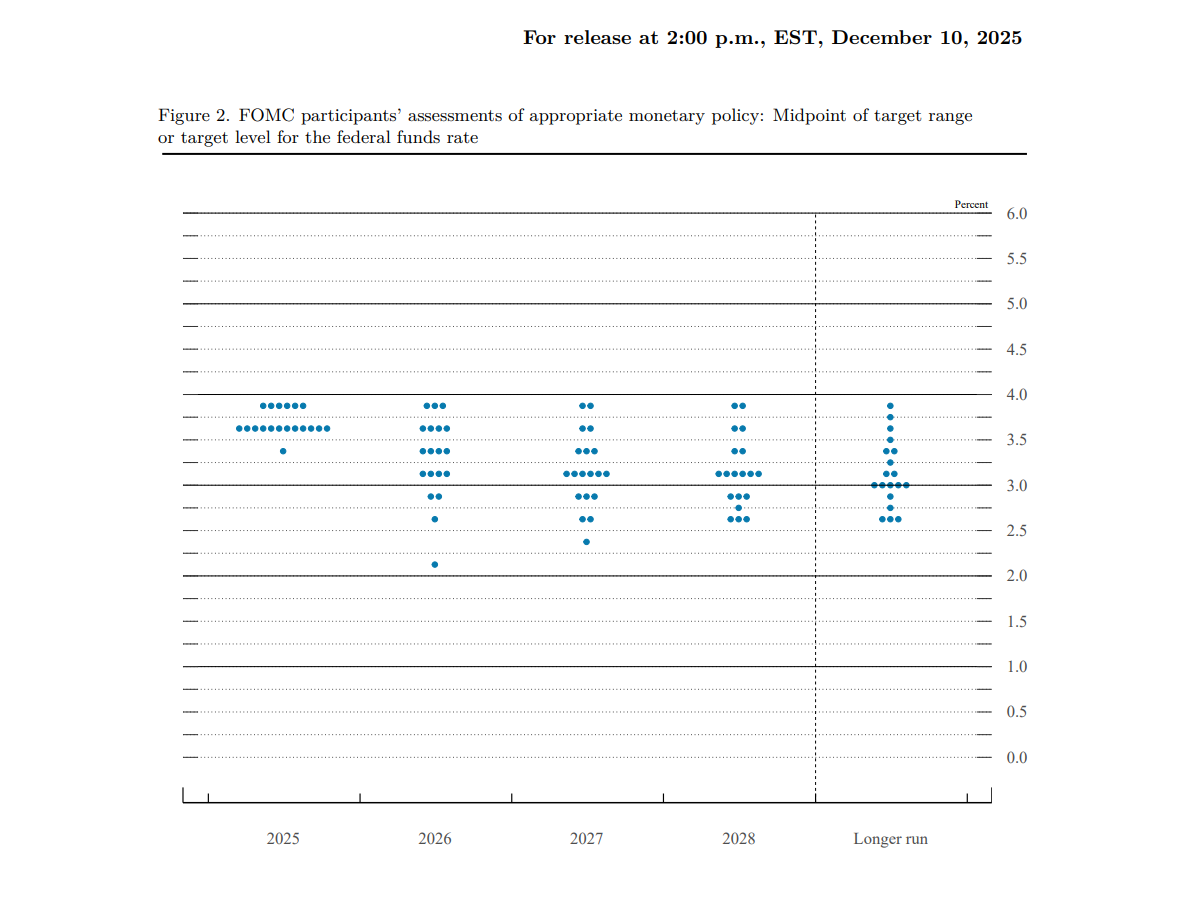
Median Fed Dot Plot: Cumulative 25 Basis Point Rate Cut in 2026

Decisions Regarding Monetary Policy Operations

To implement the monetary policy stance announced in the Federal Open Market Committee's statement on December 10, 2025, the Federal Reserve makes the following decisions:

The Board of Governors of the Federal Reserve System unanimously voted to lower the interest rate on reserve balances to 3.65%, effective December 11, 2025.

As part of the policy decision, the Federal Open Market Committee voted to direct the Open Market Trading Desk at the Federal Reserve Bank of New York, until further notice, to execute transactions in the System Open Market Account in accordance with the following domestic policy directive:

"Effective December 11, 2025, the Federal Open Market Committee directs the Desk:

To conduct open market operations as necessary to maintain the federal funds rate in a target range of 3.50% to 3.75%.

To conduct standing overnight repurchase agreement operations at an offering rate of 3.75%.

To conduct standing overnight reverse repurchase agreement operations at an offering rate of 3.50%, with a per-counterparty limit of $160 billion per day.

To increase the System Open Market Account's holdings of securities by purchasing Treasury bills and, if necessary, other U.S. Treasury securities with remaining maturities of three years or less, to maintain ample levels of reserves.

To reinvest all principal payments from the Federal Reserve's holdings of U.S. Treasury securities at auction. To roll over all principal payments from the Federal Reserve's holdings of agency securities into Treasury bills."

In related actions, the Board of Governors of the Federal Reserve System unanimously voted to approve a 25 basis point reduction in the primary credit rate to 3.75%, effective December 11, 2025. In taking this action, the Board approved requests submitted by the Boards of Directors of the Federal Reserve Banks of New York, Philadelphia, St. Louis, and San Francisco to set this rate.


Twitter:https://twitter.com/BitpushNewsCN

Bitpush TG Discussion Group:https://t.me/BitPushCommunity

Bitpush TG Subscription: https://t.me/bitpush

Original link:https://www.bitpush.news/articles/7594706

İlgili Sorular

QWhat was the new target range for the Federal Funds Rate after the December 10, 2025, Fed decision?

AThe new target range for the Federal Funds Rate is 3.50% to 3.75%.

QHow many members of the Federal Open Market Committee (FOMC) voted against the policy action, and what were their preferred actions?

AThree members voted against the policy action. Stephen I. Miran preferred to lower the target range by 1/2 percentage point, while Austan D. Goolsbee and Jeffrey R. Schmid preferred to maintain the target range unchanged.

QWhat specific action did the Fed announce regarding its balance sheet and Treasury securities?

AThe Fed announced it will purchase $40 billion in Treasury bills over 30 days starting December 12 to maintain ample reserve supplies. It will also reinvest principal payments from its holdings of U.S. Treasury securities and agency securities into Treasury bills.

QAccording to the latest dot plot, what is the median projection for interest rate changes in 2026?

AThe median projection from the latest dot plot is for a cumulative 25 basis point rate cut in 2026.

QWhat changes were made to the policy statement regarding the description of the labor market?

AThe policy statement removed the description of the unemployment rate as 'low'.

İlgili Okumalar

Dialogue with Epoch Ventures Founder: Large-Scale Capital Rotation Has Begun, the Four-Year Cycle Has Ended

Epoch Ventures founder Eric Yakes discusses why Bitcoin's traditional four-year boom-bust cycle may be ending. He argues that Bitcoin, with recent drawdowns limited to around 50% instead of 80%, is transitioning from a high-risk asset to a hedge against currency debasement due to institutional inflows and lower volatility. This shift allows for higher portfolio allocations and disconnects Bitcoin from general risk assets. Yakes outlines Bitcoin's path to global adoption through three monetary functions: store of value, medium of exchange, and unit of account. He believes Bitcoin is currently in the store-of-value phase. A massive capital rotation from gold into Bitcoin is imminent once Bitcoin achieves deeper liquidity, potentially seeing prices rise tenfold. A key mechanism for this transition involves stablecoins. Yakes posits that the U.S. Treasury, facing a debt spiral, will promote stablecoin adoption to create demand for U.S. Treasuries. As stablecoins grow, they will increasingly hold Bitcoin in their reserves to differentiate themselves, leading to a "Bitcoinization" of stablecoins. This sets the stage for "hyperbitcoinization" as fiat currencies become obsolete. Addressing concerns about centralization from ETFs and custodians, Yakes argues Bitcoin's easy self-custody creates a powerful exit threat that deters malicious control. Wealth concentration among early holders is seen as a natural, temporary phase in an emerging economy. Finally, Yakes explains his firm's investment focus: building Bitcoin-compatible financial infrastructure, particularly Bitcoin-backed lending, to bridge traditional finance with the Bitcoin ecosystem.

marsbit17 dk önce

Dialogue with Epoch Ventures Founder: Large-Scale Capital Rotation Has Begun, the Four-Year Cycle Has Ended

marsbit17 dk önce

Anthropic Eyes 'Training Chips'? Reportedly Considered Acquiring AI Chip Company MatX for $7 Billion

AI giant Anthropic reportedly discussed acquiring AI chip startup MatX for approximately $7 billion to accelerate its in-house chip development, specifically targeting "training chips" for large language models. This move follows OpenAI's recent unveiling of its own inference chip, "Jalapeño," highlighting a growing trend of major AI companies vertically integrating into hardware. However, the MatX deal was ultimately abandoned, with talks shifting toward potential collaboration instead. Anthropic's interest in MatX, a company founded in 2023 by former Google TPU engineers, underscores its strategic push to secure faster and more cost-efficient computing power for its Claude model. The company's broader chip ambitions are further evidenced by its recruitment of key industry veterans, including former Google TPU leader Amir Salek and ex-OpenAI chip engineer Clive Chan, to build an internal chip team. Anthropic is also actively meeting with several other AI chip startups to evaluate different architectures. Despite this significant investment in chip design capabilities, Anthropic reportedly plans to maintain a multi-vendor strategy, continuing its partnerships with major suppliers like Nvidia and Google. Developing advanced chips remains a costly and time-intensive endeavor, making the acquisition of an established startup like MatX an attractive, though currently unrealized, shortcut to gain expertise and potentially reduce long-term costs.

marsbit2 saat önce

Anthropic Eyes 'Training Chips'? Reportedly Considered Acquiring AI Chip Company MatX for $7 Billion

marsbit2 saat önce

İşlemler

Spot
活动图片