From the 'Babson Break' to AI and Meme Coins: A Global Bubble Driven by FOMO Is Taking Shape

marsbit2025-12-18 tarihinde yayınlandı2025-12-18 tarihinde güncellendi

Özet

The article draws a parallel between the 1929 "Babson Break" and current warnings about an AI bubble, suggesting a global FOMO-driven speculative mania is forming across multiple asset classes. It highlights concerns over unsustainable valuations in AI tech companies, where massive data center investments (projected near $1.6 trillion annually by 2030) are fueled by hype around unproven AGI capabilities. Beyond AI, bubbles are identified in gold, government bonds, private credit (dubbed "crap loans"), and particularly meme coins like TRUMP and MELANIA, which saw values plummet over 88%. The author argues speculative frenzy is amplified by social media, creating a global "attention economy" where collective obsession—from AI to pop culture trends—drives synchronized global market movements. While tech giants may withstand the AI investment rush, risky leverage by newer players and opaque financing structures (like SPVs buying Nvidia chips) raise systemic concerns. Experts warn that a collapse in AI or crypto could trigger a global crisis, emphasizing that productive eras historically follow only after speculative excesses are disciplined by regulation.

Two months before the stock market crash of "Black Monday" that triggered the Great Depression, an economist from Massachusetts named Roger Babson was deeply concerned about the frenzy of retail investors borrowing money to speculate in stocks. In a speech, he declared, "Sooner or later, a crash is coming, and it may be terrific." The market immediately fell by 3%, a drop that became known as the "Babson Break." But as Andrew Ross Sorkin writes in his captivating new book, "1929: The Inside Story of Wall Street's Worst Crash and How It Destroyed a Nation," in the following weeks, "the market shook off Babson's ominous prediction," partly due to optimistic expectations for new mass consumer goods like radios and cars. "Imaginative' investors once again gained the upper hand."

Today, there are many such "prophets of doom" like Babson warning of risks in the artificial intelligence (AI) sector, particularly regarding the valuations of public and private tech companies and their blind pursuit of the elusive goal of Artificial General Intelligence (AGI) — systems that can perform almost all human tasks, even surpassing human capabilities. Data from analytics firm Omdia shows that by 2030, tech companies will be spending nearly $1.6 trillion annually on data centers. The hype surrounding AI is immense, but its prospects as a profit-generating tool remain entirely hypothetical, leaving many clear-headed investors perplexed. Yet, just like a century ago, a "fear of missing out on the next big thing" mindset is driving many companies to ignore these "doomsday prophecies." Advait Arun, an analyst for climate finance and energy infrastructure at the Center for Public Enterprise, stated: "These companies are playing a game of 'Mad Libs,' believing these bold technologies can solve all existing problems." He recently published a report in the vein of Babson's views titled "It's a Bubble or It's Nothing," questioning the financing schemes behind data center projects and noting, "We are undoubtedly still in a phase of irrational exuberance."

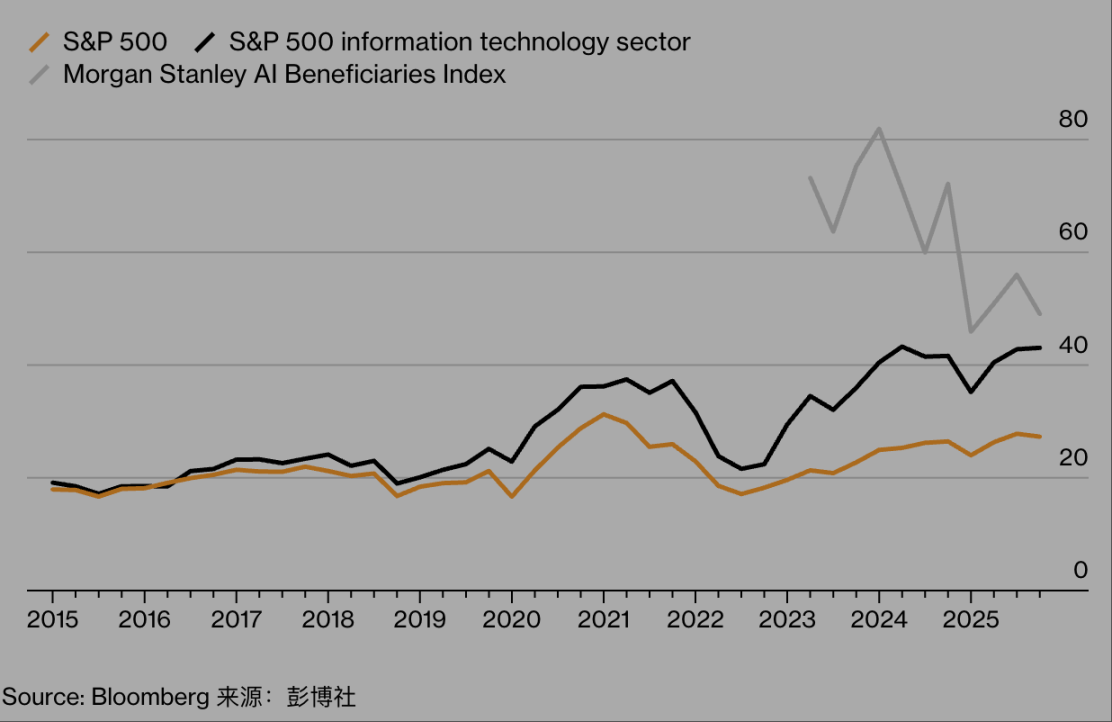
Tech stocks have been soaring:
Source: Bloomberg

(This chart uses three index lines (S&P 500, S&P 500 Information Technology Sector, Morgan Stanley AI Beneficiaries Index) to show the process in US stocks from 2015 to 2025 where AI-related concept stocks first surged significantly on hype, then fell back as the bubble receded, diverging from the trends of the broader market and traditional tech sectors, reflecting the speculative frenzy and retreat risks in the AI field.)

Journalists should generally avoid arguing whether a particular resource or technology is overvalued. I don't have a strong stance on whether we are in an "AI bubble," but I suspect the question itself might be too narrow. If we define a "speculative bubble" as "an unsustainable rise in the value of an asset detached from its determinable fundamentals," then looking around, bubbles seem to be almost everywhere, and they appear to be inflating and contracting in sync.

World Economic Forum CEO Børge Brende pointed out that bubbles may exist in gold and government bonds. He recently stated that overall national debt levels haven't been this severe since World War II; and as of December 12th, gold prices had surged nearly 64% in a year. Many financial practitioners believe a bubble also exists in the private credit sector. This market, worth $3 trillion, involves large investment institutions providing loans (many for building AI data centers) and operates outside the constraints of the strictly regulated commercial banking system. Jeffrey Gundlach, founder and CEO of asset management firm DoubleLine Capital, recently called this opaque, unregulated, chaotic lending phenomenon "junk loans" on Bloomberg's "Odd Lots" podcast; JPMorgan Chase CEO Jamie Dimon referred to it as a "fuse for a financial crisis."

The most absurd phenomena occur in areas where "intrinsic value is difficult to judge." For example, from the beginning of the year to October 6th, the total market capitalization of BTC increased by $636 billion, but by December 12th, not only had all those gains been erased, but it had fallen even further. According to data from cryptocurrency media company Blockworks, the trading volume of "Meme coins," virtual currencies commemorating internet trends, peaked at $170 billion in January but plummeted to $19 billion by September. Leading the decline were TRUMP and MELANIA — coins launched by the US First Family two days before the presidential inauguration, which have fallen 88% and 99% in value since January 19th, respectively.

Many investors evaluating these cryptocurrencies do not focus on their potential to create intrinsic value for shareholders and society (as one would when assessing a traditional company's stock that reports profits), but rather solely attracted by the opportunity to "quickly make a lot of money." Their attitude towards cryptocurrencies is purely speculative, like joining a craps table during a trip to Las Vegas.

There might be demographic reasons behind investors (especially those attracted to cryptocurrencies, sports betting, and online prediction markets) trying to "manipulate" financial markets like a casino. A recent survey by Harris Poll showed that 60% of Americans today desire to amass huge wealth; among Gen Z and Millennial respondents, 70% said they want to be billionaires, compared to only 51% among Gen X and Baby Boomers. A study last year by financial firm Empower found that Gen Z believes "financial success" requires an annual salary of nearly $600,000 and a net worth of $10 million.

Thanks to TikTok videos, group chats, Reddit, and the "instant and unavoidable" nature of the internet, people around the world can now learn about money-making opportunities simultaneously. In principle, this seems fine, but in practice, it triggers imitation frenzies, fierce competition, and "groupthink" — a phenomenon that makes the new Apple TV+ series "Pluribus" particularly timely. The traditional economy, with its complex and diverse dimensions, has been replaced by the "attention economy": what is collectively obsessed over by everyone globally at any given moment.

In the business world, the focus of this "collective obsession" is AI; in pop culture, following "Pedro Pascal fever," there's "Sydney Sweeney fever," and "6-7 fever" (if you don't have teenagers at home, try Googling it). Over the past year, thanks to celebrities like BLACKPINK member Lisa, the "cute but practically worthless animal-shaped plush toys" launched by Chinese toymaker Pop Mart International Group have become a global craze, which we might call "Labubble" (referring to Labubu fever).

There's also a clear "protein bubble" in the food sector: from popcorn makers to breakfast cereal producers, everyone is promoting the "protein content" of their products to attract health-conscious consumers and GLP-1 (a blood sugar-lowering drug often used for weight loss) users. In the media sector, there might be bubbles in Substack newsletters, podcasts hosted by celebrities (like Amy Poehler's "Say More" and Meghan Markle's "Archetypes"), and the almost weekly release of "authorized celebrity documentary biopics" (Netflix's latest include: "Being Eddie" about Eddie Murphy and a biopic about Victoria Beckham). W. David Marx, author of "Status and Culture: How Our Desire for Social Rank Creates Taste, Identity, Art, Fashion, and Constant Change," said: "Today, everyone's 'reference group' is global, far beyond their immediate surroundings and surpassing their actual class and status. In these markets, 'globally synchronized movements' that were absolutely impossible in the past can occur."

Of course, the risks in the AI field are far higher than those related to "Labubu fever" products. No company wants to fall behind, so all industry giants are pushing forward, building computing infrastructure through "complex financing arrangements." In some cases, this involves "special purpose vehicles" (remember those from the 2008 financial crisis?) — entities that take on debt to purchase graphics processing units (AI chips) from Nvidia, which some observers believe could depreciate faster than expected.

Tech giants have the capacity to withstand any consequences of this "FOMO-induced frenzy": they primarily rely on strong balance sheets to pay for data centers, and can handle it even if white-collar workers widely believe "the current version of ChatGPT is sufficient for writing annual self-evaluations." But other companies are taking riskier moves. Oracle — a conservative database provider unlikely to be a challenger in the AI boom — is raising $38 billion in debt to build data centers in Texas and Wisconsin.

Other so-called "new cloud providers" (like relatively young companies such as CoreWeave and Fluidstack) are building specialized data centers for AI, Bitcoin mining, and other uses, and they are also borrowing heavily. At this point, the "cumulative impact" of the AI bubble begins to look increasingly severe. Gil Luria, Managing Director at investment firm D.A. Davidson & Co., echoing Roger Babson from a century ago, said: "When some institutions borrow money to build multi-billion dollar data centers without even having real customers, I start to worry. Lending for speculative investments has never been wise."

Carlota Perez, a British-Venezuelan researcher who has studied economic boom and bust cycles for decades, is also concerned. She points out that technological innovation is being transformed into high-risk speculation within a "over-leveraged, fragile, casino-like economy where bubbles burst once doubts spread." She wrote in an email: "If the AI and cryptocurrency sectors crash, it could trigger a global crisis of unimaginable scale. Historically, truly productive golden ages only arrive when the financial sector pays for its own actions (rather than being consistently bailed out) and society constrains it through proper regulation." Until then, hold tight to your Labubu plush toy.


İlgili Sorular

QWhat historical event and figure does the article use as a parallel to the current AI investment frenzy, and what was the initial market reaction?

AThe article uses the 1929 stock market crash and the economist Roger Babson as a parallel. Babson warned of an impending crash, which initially caused a 3% market drop, an event known as the 'Babson Break.' However, the market soon recovered as optimistic investors took over.

QAccording to the article, what is the primary driver causing companies to ignore warnings about an AI bubble?

AThe primary driver is the 'Fear Of Missing Out' (FOMO) on the next big opportunity. This mindset, similar to a century ago, pushes companies to invest heavily despite the risks and unproven profitability of AI as a tool.

QBeyond AI, what other areas does the article identify as potential speculative bubbles?

AThe article identifies several other potential bubbles, including gold and government bonds (due to high global debt), the $3 trillion private credit market (called 'crap loans'), and the extreme volatility in cryptocurrencies and meme coins like TRUMP and MELANIA.

QWhat demographic trend does the article suggest is fueling the desire to treat financial markets like a casino?

AThe article cites a demographic trend where a significant majority of younger generations (70% of Gen Z and Millennials) aspire to become billionaires, compared to 51% of Gen X and Baby Boomers. This desire for immense wealth fuels speculative behavior in crypto, sports betting, and online prediction markets.

QWhat is the 'cumulative impact' of the AI bubble that the article suggests is becoming increasingly severe?

AThe 'cumulative impact' is the massive, and often risky, debt being taken on by companies to build AI infrastructure. This includes established giants and new 'cloud providers' borrowing billions, sometimes without confirmed customers, creating a fragile, over-leveraged system that could lead to a severe crisis if the bubble bursts.

İlgili Okumalar

İşlemler

Spot
Futures

Popüler Makaleler

MEME 2.0 Nedir

Memecoin 2.0: Kripto Para Dünyasında $MEME 2.0'ın Yükselişi Giriş Kripto para dünyasının sürekli gelişen yapısında, yeni bir rakip olarak Memecoin 2.0 ortaya çıktı. $MEME 2.0 sembolüyle öne çıkan bu proje, meme coinlerinin kavramını heyecan verici bir yeni seviyeye taşıyor. Orijinal Memecoin'in bir yan ürünü olarak, bu proje, odağını geleneksel finansal teşviklerden, katılımcı ve eğlenceli bir deneyime kaydırarak kripto topluluğunun dikkatini çekmeyi başardı. Ethereum blockchain'inde faaliyet gösteren Memecoin 2.0, kripto alanında topluluk katılımını cesurca yeniden tanımlıyor. Memecoin 2.0, $MEME 2.0 Nedir? Memecoin 2.0, temelinde topluluk ruhunu ve meme kültürüyle ilişkilendirilen eğlenceyi öncelikli olarak benimseyen bir kripto para projesidir. Pratik kullanım alanlarına ve somut faydalara odaklanan geleneksel kripto paralardan farklı olarak, Memecoin 2.0 dijital para biriminin daha hafif yönünü benimseyerek kendini gösteriyor. Proje, herhangi bir fayda, yapılandırılmış bir yol haritası veya finansal getiri vaadi olmadan varlığını sürdürüyor ve bunun yerine memelere ve ortak keyfe odaklanmış canlı bir topluluk oluşturmayı hedefliyor. Bu sayede, çevrimiçi alanda meme kültürünün artan trendine hitap ederek dijital varlıklar dünyasında benzersiz bir oyuncu haline geliyor. Memecoin 2.0'ın Yaratıcısı, $MEME 2.0 Memecoin 2.0'ın kökenleri üzerine yapılan kapsamlı araştırmalara rağmen, yaratıcısının kimliği belirsizliğini koruyor. Bu anonimlik, birçok projenin sahne arkasında kalmayı tercih eden bireyler veya gruplar tarafından yönetildiği kripto topluluğunda alışılmadık bir durum değil. Yaratıcının kamuya açık bilgilere sahip olmaması, topluluk katılımına odaklanarak bireysel ünlülük yerine topluluğun önemini vurgulayan stratejik bir hamle olarak görülebilir. Memecoin 2.0 Yatırımcıları, $MEME 2.0 Memecoin 2.0 için yatırımcılar veya mali destek ile ilgili bilgiler sınırlıdır. Bu bilgi eksikliği projenin ya kendi kendini finanse ettiğini ya da geleneksel yatırım yapılarına kıyasla topluluğa odaklanmasının farklı bir destekçi türünü çektiğini öne sürebilir. Meme coinlerinin dünyası tipik olarak daha fazla taban katılımı içerdiği için bu yaklaşım, topluluk odaklı projelerin etikleriyle uyumlu bir yapı sergiliyor. Memecoin 2.0, $MEME 2.0 Nasıl Çalışır? Memecoin 2.0 tamamen Ethereum blockchain'inde faaliyet gösteriyor ve bu sayede güvenlik özelliklerinden ve ölçeklenebilirliğinden yararlanıyor. Ethereum'un güçlü yönlerinden faydalanarak, Memecoin 2.0 kullanıcı etkileşimleri için güvenli bir ortam sunarken, işlemlerin hem verimli hem de maliyet etkili olmasını sağlıyor. Memecoin 2.0'ın benzersiz özelliklerinden biri topluluk odaklı yapısıdır. $MEME 2.0 tokeninin değeri ve popülaritesi, kullanıcıların aktif katılımlarından geliyor, içsel faydadan ziyade. Bu tasarım, projenin kripto para biriminin eğlence yönüne odaklanmasını pekiştirerek, gülmenin ve topluluk etkileşiminin başarısını sağlayan gerçek para birimleri olduğunu ima eder. Ayrıca, proje, meme coinlerinin daha geniş ekosisteminin bir parçası olarak yer alıyor; burada her meme coininin değeri, kültür, trendler ve topluluk katılımına göre dalgalanıyor, geleneksel ekonomik prensiplerden ziyade. Memecoin 2.0'ın Zaman Çizelgesi, $MEME 2.0 Memecoin 2.0'ın evrimini ve kilometre taşlarını daha iyi anlamak için, tarihindeki önemli olayları vurgulayan bir zaman çizelgesi: 2024: Memecoin 2.0'ın ortaya çıkışı, orijinal Memecoin'in bir yan ürünü olarak kabul edilir ve Ethereum blockchain'inde faaliyet gösterirken meme coinlerinin gelişen bağlamında kendini konumlandırır. 13 Temmuz 2024: Memecoin 2.0, Ethereum ağında topluluk odaklı bir meme coin olarak resmi bir konum alır ve kullanıcıların katılımını ve büyümeye katkı sağlamasını teşvik eden eğlence odaklı yaklaşımını vurgular. Memecoin 2.0'a Dair Anahtar Noktalar, $MEME 2.0 Memecoin 2.0'ı tanımlayan birkaç kritik özellik: Topluluk Merkezli Yaklaşım: Memecoin 2.0'ın temel misyonu, memetik kültürden elde edilen ortak keyfi kullanarak eğlenceli ve katılımcı bir topluluk deneyimi yaratmaktır. Ethereum Üzerinde İnşa Edilmiş: Ethereum blockchain'inde faaliyet göstermek, projeye güvenlik ve ölçeklenebilirlik sağlayan temel bir altyapı sunar. Fayda veya Yol Haritası Yokluğu: Geleneksel kripto paralardan çarpıcı bir şekilde farklı olarak, Memecoin 2.0 herhangi bir faydalı özellik veya finansal getiri vaadinde bulunmamakta, topluluk katılımı ve sosyal etkileşime olan bağlılığını pekiştirmektedir. Memetik Kültüre Odağı: Mem fenomeninin mizahi ve kültürel yönlerini benimseyerek, Memecoin 2.0 kullanıcıların kripto ile çevrimdışı ve çevrimiçi etkileşimde bulunması için bir platform sağlar. Ek Bağlam: Meme Coinlerinin Önemi Meme coinler, kabaca mizah ve ticarete yönelik hafif bir yaklaşım tarafından yönlendirilen belirgin bir kripto para sınıfı olarak ortaya çıkmıştır. Bu paralar genellikle önemli bir fayda veya gelişim yol haritasından yoksundur ve kullanıcıları eğlence, topluluk etkileşimi ve kültürel relevans vaadiyle çeker. Daha geniş kripto ekosisteminde, meme coinler topluluk katılımının önemini yeniden canlandırırken, yalnızca kar odaklı yaklaşımlara karşı bir duruş sergiliyor. Memecoin 2.0 gibi projeler, eğlencenin finansal hedeflerle uyum sağlamasını sağlayarak, blockchain'i yaratıcılık ve sosyal etkileşim için bir oyun alanı haline getiriyor. Sonuç Memecoin 2.0, veya $MEME 2.0, topluluk katılımını katı finansal yapıların üzerinde önceliklendirerek yeni bir kripto para dalgasını temsil ediyor. Mizah ve sosyal etkileşime odaklanarak, meme kültürü etrafındaki ilgiden faydalanıyor. Ethereum blockchain'inde faaliyet göstererek, Memecoin 2.0, teknolojinin yeteneklerinden yararlanırken dijital para biriminin eğlence değerine olan bağlılığında kararlılığını koruyor. Kripto para alanı gelişmeye devam ederken, Memecoin 2.0, dijital varlıkların geleceğinin ortak deneyimlere, gülmelere ve sağlam topluluk bağlantılarına bağlı olabileceğinin bir kanıtı olarak hizmet ediyor. Kripto dünyası belirsiz olsa da, belki de neşe, geleneksel finansal kazanç kadar değerli olabilir.

137 Toplam GörüntülenmeYayınlanma 2024.04.04Güncellenme 2024.12.03

MEME 2.0 Nedir

MEME Nasıl Satın Alınır

HTX.com’a hoş geldiniz! Memeland (MEME) satın alma işlemlerini basit ve kullanışlı bir hâle getirdik. Adım adım açıkladığımız rehberimizi takip ederek kripto yolculuğunuza başlayın. 1. Adım: HTX Hesabınızı OluşturunHTX'te ücretsiz bir hesap açmak için e-posta adresinizi veya telefon numaranızı kullanın. Sorunsuzca kaydolun ve tüm özelliklerin kilidini açın. Hesabımı Aç2. Adım: Kripto Satın Al Bölümüne Gidin ve Ödeme Yönteminizi SeçinKredi/Banka Kartı: Visa veya Mastercard'ınızı kullanarak anında Memeland (MEME) satın alın.Bakiye: Sorunsuz bir şekilde işlem yapmak için HTX hesap bakiyenizdeki fonları kullanın.Üçüncü Taraflar: Kullanımı kolaylaştırmak için Google Pay ve Apple Pay gibi popüler ödeme yöntemlerini ekledik.P2P: HTX'teki diğer kullanıcılarla doğrudan işlem yapın.Borsa Dışı (OTC): Yatırımcılar için kişiye özel hizmetler ve rekabetçi döviz kurları sunuyoruz.3. Adım: Memeland (MEME) Varlıklarınızı SaklayınMemeland (MEME) satın aldıktan sonra HTX hesabınızda saklayın. Alternatif olarak, blok zinciri transferi yoluyla başka bir yere gönderebilir veya diğer kripto para birimlerini takas etmek için kullanabilirsiniz.4. Adım: Memeland (MEME) Varlıklarınızla İşlem YapınHTX'in spot piyasasında Memeland (MEME) ile kolayca işlemler yapın.Hesabınıza erişin, işlem çiftinizi seçin, işlemlerinizi gerçekleştirin ve gerçek zamanlı olarak izleyin. Hem yeni başlayanlar hem de deneyimli yatırımcılar için kullanıcı dostu bir deneyim sunuyoruz.

605 Toplam GörüntülenmeYayınlanma 2024.12.12Güncellenme 2025.03.21

MEME Nasıl Satın Alınır

Tartışmalar

HTX Topluluğuna hoş geldiniz. Burada, en son platform gelişmeleri hakkında bilgi sahibi olabilir ve profesyonel piyasa görüşlerine erişebilirsiniz. Kullanıcıların MEME (MEME) fiyatı hakkındaki görüşleri aşağıda sunulmaktadır.

活动图片










