From Stanford Labs to Silicon Valley Streets: How OpenMind Solves the 'Last Mile' Problem of the Machine Economy?

marsbit2026-03-02 tarihinde yayınlandı2026-03-02 tarihinde güncellendi

Özet

OpenMind, a Silicon Valley robotics infrastructure company, is tackling the "last mile" problem in the machine economy by developing foundational technologies that enable robots to become autonomous economic agents. Its core contributions include OM1, an open-source, AI-native operating system that gives robots advanced perception, memory, and decision-making capabilities, and FABRIC, a decentralized protocol providing on-chain identity, secure collaboration, and automated USDC-based payment settlement for machines. Backed by a team from Stanford, Google DeepMind, and other leading institutions, and having raised $20M from investors like Pantera Capital and Sequoia China, OpenMind is already deploying real-world solutions. Key milestones include a pilot with Circle where robots autonomously navigate to and pay for charging, and the BrainPack—a plug-and-play compute module that upgrades existing robots with advanced AI and crypto-economic functions. By building an open ecosystem akin to "Android for robots," OpenMind aims to solve the industry's fragmentation and lack of economic interoperability, positioning itself as a pioneering infrastructure project at the intersection of robotics, AI, and crypto.

Author: momo, ChainCatcher

On February 27, Binance Alpha and Binance Futures Market listed Fabric Protocol (ROBO), with its 24-hour trading volume exceeding 140 million in the first two days. Additionally, ROBO was subsequently listed on spot or futures markets of several major exchanges including OKX, Coinbase, Kraken, Bybit, Gate.io, HTX, etc., becoming one of the first batch of new projects to enter mainstream liquidity channels after the Spring Festival holiday resumption, sparking extensive attention and discussion.

In a phase where the overall crypto market is returning to rationality, few new tokens can sustain discussion热度. ROBO had already formed strong expectations before TGE, was oversubscribed on Kaito, and its热度 further amplified after listing. Clearly, it's not just a short-term effect of exchange listings.

The key lies more in its fundamentals. OpenMind, one of the core contributing teams of the Fabric Foundation, is a Silicon Valley company focused on robotics infrastructure. Unlike common projects that remain conceptual, it切入 a direction with greater industrial certainty: one end is the global tech主线 of embodied AI and robotics, the other end is the machine economy framework carried by on-chain identity, collaboration, and settlement networks.

It attempts to solve not a single-point application, but the more fundamental, harder-to-replace infrastructure problems that have long existed in the process of large-scale robot deployment: system fragmentation, inefficient collaboration, and lack of economic capabilities.

Furthermore, while many projects are still in the whitepaper and vision stage, OpenMind's products have already begun real-world deployment, installed in robotic devices around the world. It can be said that OpenMind is currently a rare, even unique, robotics infrastructure project in the related crypto market. Precisely because of this, ROBO更像 a fundamental industry sample that can be dissected, rather than a short-term sentiment-driven trading opportunity.

Next, let's look specifically at the team background, core products, and deployment progress: What exactly is OpenMind doing? Is its scaling path proven? And can this robotics × Crypto infrastructure logic truly open up new growth space?

I. The Composite Team from Stanford and Google DeepMind

Unlike most projects starting from the Crypto community and then adding hype narratives, OpenMind's team background更像 a typical Silicon Valley robotics/AI startup.

Founder Jan Liphardt is a professor of bioengineering at Stanford University, long engaged in AI, biocomputing, and distributed systems research, having received research grants from NIH, NSF, NCI, and the US Department of Energy.

CTO Boyuan Chen comes from MIT CSAIL and previously worked on cutting-edge AI and robotics research at Google DeepMind, with core capabilities focused on reinforcement learning and embodied AI systems.

The advisory layer also consists mainly of academic and industrial technical leaders, including former Willow Garage CEO and key promoter of the ROS ecosystem Steve Cousins, University of Oxford blockchain researcher Bill Roscoe, and Imperial College London safe AI professor Alessio Lomuscio.

Overall, this is a composite team from top academic institutions and the front lines of Silicon Valley tech—a "research派 + engineering派" blend. Their tech stack covers robotics, AI, and Crypto等多个前沿交叉领域, understanding both underlying algorithms and system architecture, and having truly worked with complex hardware and real-world deployment.

Precisely because of this明显偏 hard tech infrastructure capability structure, OpenMind from the start更像 building a long-term technical foundation, not a short-cycle project围绕 concepts讲故事. This is likely also a key reason for its continued support from top-tier capital.

According to RootData, in August 2025, OpenMind completed a $20 million funding round led by Pantera Capital, with participation from Ribbit Capital, Sequoia China, Coinbase Ventures, Digital Currency Group, Lightspeed Faction, Anagram, Primitive Ventures, Amber Group, and others. The investors span deep tech, fintech, and crypto infrastructure.

Why could OpenMind secure collective bets from头部 capital of both Web2 and Web3? When such a group from the forefront of research and engineering starts a company together, what structural pain points in the robotics industry did they see? And why use blockchain protocols to重构 the underlying infrastructure of this track?

II. Solving the 'Last Mile' Problem of the Machine Economy

Simply put, if we compare today's robotics industry to the smartphone era over a decade ago, what OpenMind wants to do is essentially build an "Android" system for robots.

In the past two years, robots have truly moved out of the lab. Tesla has sent humanoid robots into factories for production line testing, Unitree's quadruped robots have begun shipping at scale, and Boston Dynamics is also accelerating commercial deployment. Robots are moving from demonstration prototypes to warehousing, manufacturing, inspection, and even consumer scenarios, gradually becoming new productivity infrastructure.

But as deployment numbers scale, problems emerge, and the robotics industry begins to face issues similar to the "山寨机 era": system fragmentation, closed ecosystems, and lack of interoperability.

Founder Jan Liphardt mentioned in a previous ChainCatcher interview that, on one hand, there are over 150 robot hardware manufacturers globally, each building their own systems and ecosystems, almost every one wanting to be the iPhone of robots. The result is the same capabilities being repeatedly developed and adapted, applications难以复用, ecosystems remain fragmented,始终 lacking a universal base like Android. On the other hand, mainstream software systems still focus on motion control and navigation. Robots can work but have no identity, cannot automatically settle income, cannot establish credit, and更无法 participate in real-world collaboration and transactions.

In other words, they look like humans with hands and feet, but lack a unified brain and neural network like humans, making it difficult for them to become economic agents capable of independent decision-making, continuous learning, and mutual collaboration.

From OpenMind's perspective, what robots lack is never more hardware, but an infrastructure layer that simultaneously connects devices, applications, and the network, both unifying system capabilities like Android to carry the application ecosystem, and赋予 robots identity, collaboration, and settlement capabilities, allowing them to truly integrate into the real-world economic system. Only then can robots evolve from tools into participants that can perceive, learn, collaborate, and create value. This is precisely the starting point of OpenMind's venture.

After two years of refinement, OpenMind has built two core products: the open-source robot operating system OM1 + the decentralized collaboration network FABRIC. The former solves单体智能, the latter solves群体协作.

1. OM1: Giving Robots a Real "Brain"

If today's robots are still at the stage of being able to move, what OM1 does is make them start to understand and think.

OM1 is essentially an open-source, AI-native robot operating system. Unlike traditional ROS, which only handles motion control and navigation, it integrates perception, memory, reasoning, and action into a unified framework, giving robots a complete decision-making loop similar to humans.

Simply understood, it's four steps: See the world, Remember information, Think about tasks, Execute actions. The implementation is driven by large models and multimodal models. For example, cameras, lidar, voice, and other sensors handle perception; a long-term memory system saves environment and history; mainstream LLMs handle planning and reasoning; which are then converted into specific control commands to complete actions.
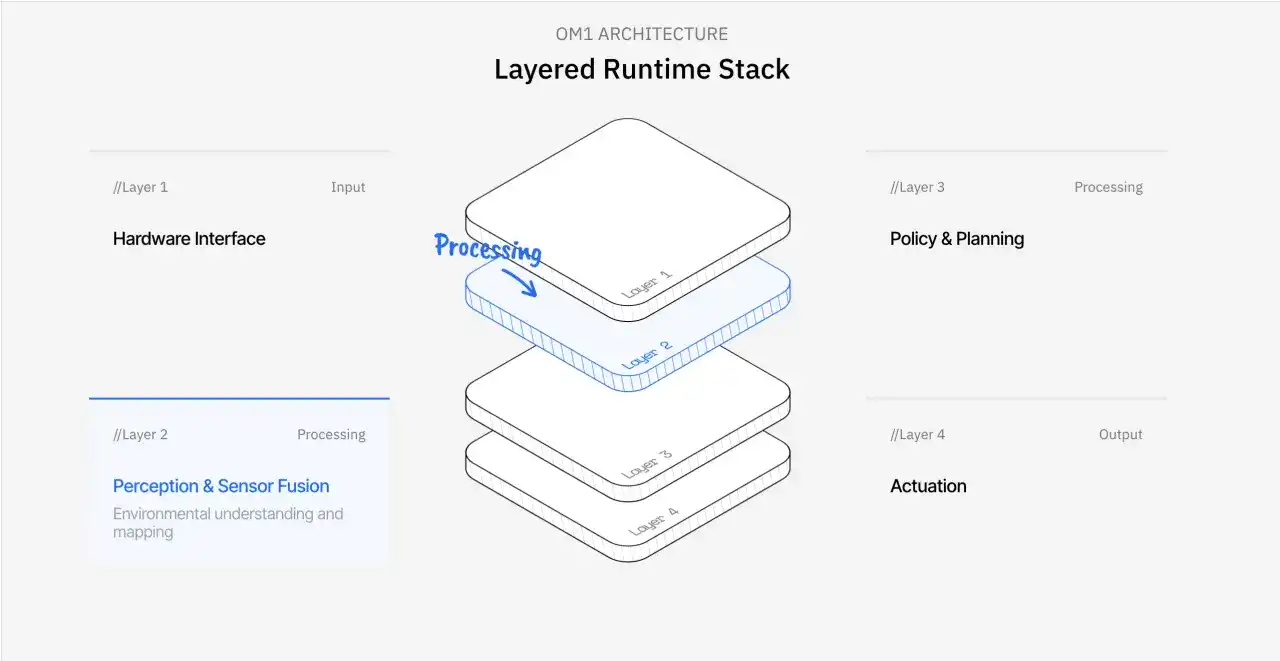
This gives robots真正的 "natural language interaction + autonomous decision-making" capabilities for the first time, rather than just being preset script executors.

The highlight of OM1 is its openness and generality. Its hardware-agnostic design allows developers don't need to rewrite code for each robot type. It currently supports various forms like the Unitree G1 humanoid robot, quadruped robots, etc. Software-wise, it integrates mainstream LLMs like GPT-4o, Gemini, equipped with functions like lidar, SLAM navigation, voice interaction, etc. The team will prioritize technical integration with Unitree, Agibot, UBTECH, Dobot, Cloudminds, Accelerated Evolution, Jueji Power, Zhongqing.

Furthermore, OM1's AI-native architecture supports plug-and-play integration of mainstream models, enabling natural interaction. Its modular structure, like an App Store, facilitates skill expansion.

OM1 released its Beta version in September 2025, is open-sourced on GitHub (MIT license), attracting thousands of global developers to contribute and test, and has been adapted to various robot forms including Unitree, DEEP Robotics, Dobot, and UBTECH, beginning the phase of real device deployment.

It is worth mentioning that at the ETF listing ceremony hosted by Nasdaq and launched by KraneShares, OpenMind's humanoid robot equipped with the OM1 operating system appeared on site and participated in the listing启动仪式.
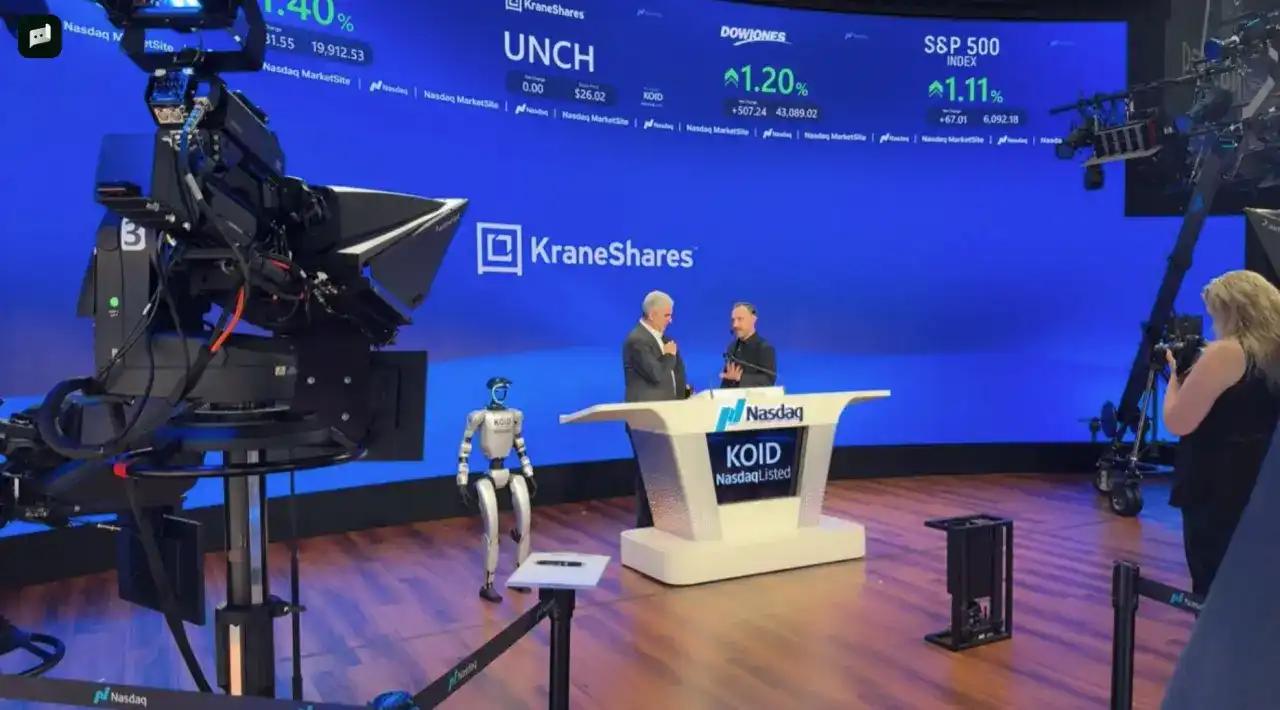
Overall, OM1更像 a "universal brain + application platform" for robots. This model essentially replicates the successful path of Android当年: unify the base, reduce development costs to attract developers, and form an application ecosystem.

2. FABRIC: The Network Layer Letting Robots "Know" and "Collaborate" with Each Other

But a brain alone is not enough. In the real world, robots rarely operate alone. They need cross-manufacturer coordination, information sharing, task分配, and even automated settlement.

The problem is, traditional robot systems are mostly closed networks. Once跨品牌 or跨平台, collaboration almost has to start from scratch.

This is why, beyond OM1, OpenMind also built the Fabric Protocol (FABRIC).

If OM1 solves whether I am smart enough, FABRIC solves how I securely cooperate with other robots. FABRIC is essentially a decentralized collaboration and trust network. It assigns an on-chain identity to each robot, allowing devices to be identified, build credit, record behavior, and automatically complete task settlement.

In other words, robots are no longer just tools executing commands, but economic nodes with identity and accounts.

In this network, robots can share skills, synchronize experiences, call each other's capabilities, and even complete automated stablecoin micropayments and incentive distribution. From a Web3 perspective, it's closer to the identity layer + trust layer + collaboration layer between machines.

III. From Vision to Reality: OpenMind's Actual Deployment Progress

After talking so much about protocols, networks, and visions, the only真正关键 question is: Are these things actually running?

In the crypto industry, we've seen too many projects that issue coins first and then look for落地场景. Whitepapers are grand, demo videos are炫, but products remain in the testnet stage, with almost no real deployment in the real world.

The reason OpenMind has attracted so much attention this time is perhaps because its path is the opposite: it推进 TGE after OM1 and FABRIC were already running in real robots.

Currently, the two most representative pieces of落地成果 are: 1) the USDC automatic payment charging network launched in cooperation with Circle; 2) the BrainPack robot intelligence module sold to developers and hardware manufacturers.

1. Letting Robots Pay for Charging Themselves for the First Time

Last December, OpenMind announced a cooperation with Circle, deploying the world's first "USDC Robot Self-Charging Point" in Silicon Valley.

Simply put, robots can pay by themselves. When battery is low, it automatically navigates to the charging station, identifies the location, completes the USDC payment, then charges and continues working, all without human intervention.

It sounds small, but the significance is huge. This should be the first time robots possess autonomous consumption capability. They are no longer just managed devices, but begin to resemble economic agents.

2. Equipping Robots with a Universal Brain "BrainPack"

At the same time, OpenMind launched BrainPack and配套 robot solutions, aiming to help a larger scale of robots solve the problem of insufficient intelligence.

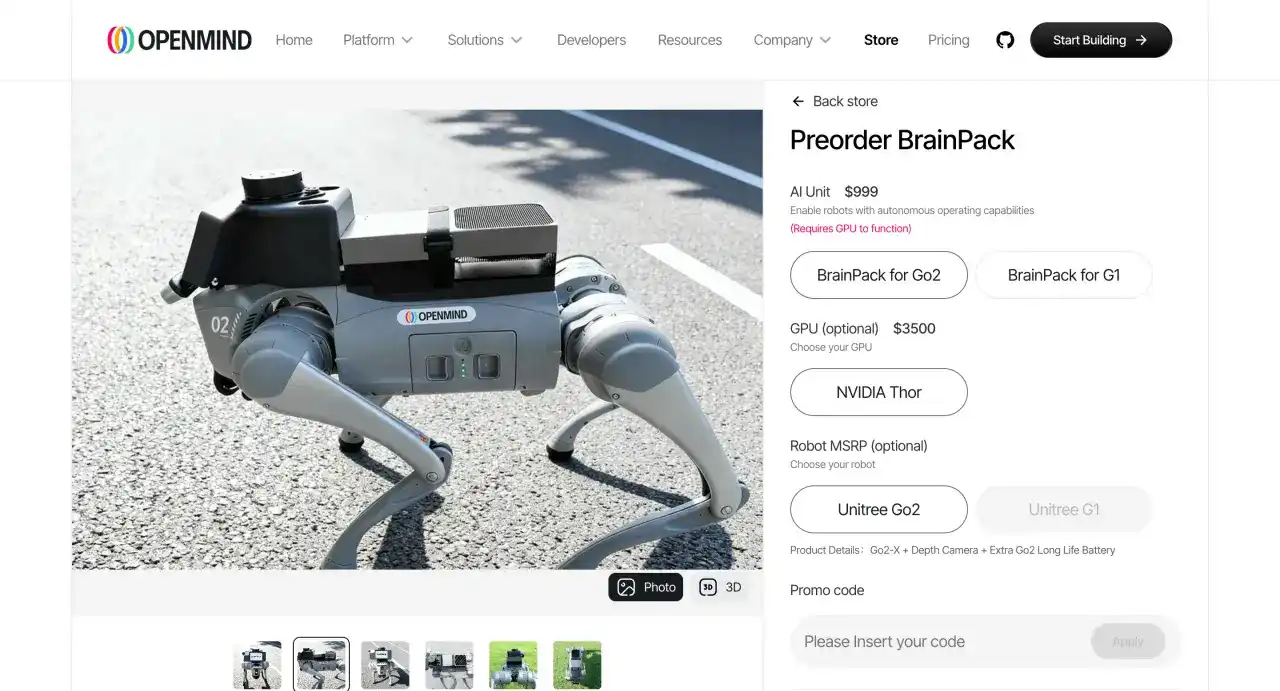
It is essentially a plug-and-play computing backpack, a module about the size of a backpack, integrating high-performance computing, sensors, and software. It can be directly installed on third-party robots. Once installed, ordinary robots immediately gain perception, mapping, planning, memory, and the complete autonomous capabilities like the aforementioned USDC payment-based self-charging management, edge inference, etc.

For example, it can help robots achieve real-time 3D mapping, object recognition/annotation, privacy-preserving vision (automatically blurring faces), and other operations.

Its core hardware is based on NVIDIA Jetson Thor and runs the self-developed OM1 system and FABRIC protocol, supporting ROS2, JetPack 7.05, etc. You can understand it as installing an Android system-level brain for the robot. No need to rebuild hardware or wait for the next generation of robots; old equipment is directly upgraded to AI-native robots.

BrainPack announced specific robot dog products last November. According to the official pre-sale page, the deposit is $999. It supports bundled Unitree robot packages. The first batch of complete deliveries is expected around Q1 2026. Although currently in the pre-order stage, some developers and labs have received beta or early delivery versions.
3.配套 App Store: Beginning to Form an Ecosystem

While hardware is being delivered, OpenMind is also building another key piece of the puzzle—the application ecosystem—launching a robot version of the App Store.

The logic is simple, just like we download Apps on our phones, developers can develop skills and applications for robots, and users can install them on their devices with one click.

Currently, the first batch of applications for quadruped and humanoid robots has been launched. Although still in the early stages, the significance of this step is that OpenMind is not just selling hardware or systems, but attempting to establish a sustainably scalable developer platform.

As more and more robots connect to OM1 + FABRIC, coupled with application distribution capabilities, the entire network truly gains scale effects.

Conclusion: Will OpenMind Drive the "Robotics+Crypto" Concept Heat?

In recent years, the market has just experienced a wave of AI + Crypto热潮. But most projects are essentially "computing power narrative + token model", with a layer still separating the chain from the real world. The special thing about OpenMind is that it is the first to truly embed Crypto into robots, this kind of physical world productivity tool.

From the industry side, OpenMind is already doing something more long-term: education and ecosystem. They jointly with Unitree Robotics' largest distributor in the US, RobotShop (Robostore), launched complete humanoid robot education courses and solutions, currently serving over 100 research and education institutions, including Harvard University, Massachusetts Institute of Technology, Stanford University, and other top universities. This may lay a good foundation for the future ecosystem and network effects of its machine economy, as well as卡位 in the "robotics + Crypto" track.

Perhaps precisely because of this, many people started to seriously pay attention to the robotics+Crypto infrastructure track through OpenMind.

Of course, for OpenMind, deployment speed is more important than concept热度. If viewed more rationally, OpenMind's advantages are very clear:

First, the team: top academic background + robotics/AI/blockchain交叉 capabilities. This kind of composite team from various fields is not common in Crypto projects.

Second, track卡位. In the加密 field, there are almost no similar projects truly深耕 "robotics infrastructure". It is the leader and seed player in this direction. When the market starts talking about "embodied AI + Web3", capital and attention will naturally集中 on it first.

Third,落地 rhythm. OM1, FABRIC, USDC self-charging points, BrainPack, App Store—these are not roadmaps, but products that have already begun delivery. This makes it更像 a technology company building long-term infrastructure, rather than a narrative-driven token project.

Of course, challenges also exist. The robotics industry itself is a hard tech track with heavy assets and long cycles. Hardware deployment is slow, costs are high, and commercialization paths are complex. It cannot replicate the exponential expansion of pure software protocols. At the same time, whether跨厂商 standards can truly be unified, whether the developer ecosystem can take off, and whether the machine economy truly forms a closed loop all still need time to verify.

In other words, OpenMind faces a marathon requiring patience and sustained effort.

İlgili Sorular

QWhat is the core problem that OpenMind is trying to solve in the robotics industry?

AOpenMind is tackling the fundamental infrastructure problems hindering the large-scale adoption of robots: systemic fragmentation, inefficient collaboration, and a lack of economic capabilities. It aims to create a unified operating system and a decentralized collaboration network to allow robots from different manufacturers to work together, share information, and perform automated transactions.

QWhat are the two core products developed by OpenMind and what are their respective functions?

AOpenMind has developed two core products: 1) OM1: An open-source, AI-native robot operating system that serves as a 'general brain' for individual robots, enabling perception, memory, reasoning, and action. 2) FABRIC Protocol: A decentralized collaboration and trust network that provides robots with on-chain identities, allowing them to be recognized, build credit, record behavior, and perform automated task settlement, enabling machine-to-machine collaboration and micro-payments.

QWhat was the significance of OpenMind's collaboration with Circle in December?

AThe collaboration with Circle led to the deployment of the world's first 'USDC robot self-charging point' in Silicon Valley. This allows robots to autonomously navigate to a charging station, identify their location, complete a USDC payment, and charge themselves without human intervention. This is significant as it marks one of the first instances of robots acting as independent economic agents capable of autonomous consumption.

QWhat is the purpose of the BrainPack hardware module launched by OpenMind?

ABrainPack is a plug-and-play 'computing backpack' module designed to upgrade existing third-party robots. It integrates high-performance computing, sensors, and software (including the OM1 OS and FABRIC protocol) to instantly grant ordinary robots advanced capabilities such as perception, mapping, planning, memory, autonomous charging management with USDC payments, and edge inference, effectively giving them a generic 'Android-like' AI brain.

QHow does OpenMind's approach to the 'robot economy' differ from typical AI + Crypto projects?

AUnlike many AI + Crypto projects that focus primarily on 'compute narrative + tokenomics' with a disconnect from the physical world, OpenMind embeds crypto (specifically its FABRIC protocol and stablecoins like USDC) directly into physical robots—the productivity tools of the real world. It provides the essential layers of identity, trust, and settlement, enabling robots to become verifiable economic participants that can collaborate and transact autonomously, thus bridging the gap between blockchain and real-world physical assets and actions.

İlgili Okumalar

$292 Million KelpDAO Cross-Chain Bridge Hack: Who Should Foot the Bill?

On April 18, 2026, an attacker stole 116,500 rsETH (worth ~$292M) from KelpDAO’s cross-chain bridge in 46 minutes—the largest DeFi exploit of 2026. The stolen assets were deposited into Aave V3 as collateral, causing $177–200M in bad debt and triggering a cascade of losses across nine DeFi protocols. Aave’s TVL dropped by ~$6B overnight. This legal analysis argues that KelpDAO and LayerZero Labs share concurrent liability, with fault apportioned 60%/40%. KelpDAO negligently configured its bridge with a 1-of-1 decentralized verifier network (DVN)—a single point of failure—despite LayerZero’s explicit recommendation of a 2-of-3 setup. LayerZero, which operated the compromised DVN, failed to secure its RPC infrastructure against a known poisoning attack vector. Both protocols’ terms of service cap liability at $200 (KelpDAO) or $50 (LayerZero), but these limits are likely unenforceable due to unconscionability, gross negligence exceptions, and potential securities law invalidation (if rsETH is deemed a security under the Howey test). Aave’s governance also faces fiduciary duty claims for raising rsETH’s loan-to-value ratio to 93%—far above competitors’ 72–75%—without adequately assessing bridge risks, amplifying the systemic fallout. Practical recovery targets include LayerZero Labs (a registered Canadian entity), KelpDAO’s founders, auditors, and identifiable Aave governance delegates. The incident underscores escalating legal risks for DeFi protocols, infrastructure providers, and governance participants.

marsbit53 dk önce

$292 Million KelpDAO Cross-Chain Bridge Hack: Who Should Foot the Bill?

marsbit53 dk önce

Insider Trading in War: 5 People Involved, the Highest Earner Was Arrested

On April 24, the U.S. Department of Justice arrested U.S. Army Special Forces Staff Sergeant Gannon Ken Van Dyke for insider trading related to the capture of Venezuelan President Nicolás Maduro on January 3. Van Dyke allegedly profited over $400,000 by placing bets on a prediction market, Polymarket, using insider knowledge of the covert operation. According to the indictment, Van Dyke registered an account (0x31a5) on December 26 and made a series of bets predicting Maduro’s capture and U.S. military involvement in Venezuela. He withdrew most of his funds on the day of the operation and attempted to obscure his tracks by transferring assets through crypto and brokerage accounts. This case marks the first time the DOJ has prosecuted insider trading on Polymarket. PolyBeats had previously identified five suspicious accounts, including Van Dyke’s—the highest earner—in January. The other accounts, with profits ranging from $34,000 to $145,000, remain under unofficial scrutiny but have not been charged. Their lower profits, indirect access to information, and unclear legal boundaries may complicate prosecution. Polymarket has since strengthened its market integrity rules, explicitly prohibiting trading based on confidential or insider information. Van Dyke’s arrest, nearly four months after his trades, signals increased regulatory attention and the persistent traceability of blockchain-based transactions.

marsbit55 dk önce

Insider Trading in War: 5 People Involved, the Highest Earner Was Arrested

marsbit55 dk önce

Bitwise: Bullish on Bitcoin's Performance in the Second Half of the Year, AI and Regulation Will Spark a New Altcoin Season

Bitwise CIO Matt Hougan and Research Lead Ryan Rasmussen express strong bullish sentiment on Bitcoin's long-term prospects, suggesting that its $1 million price target may be too conservative. They argue Bitcoin serves a dual role: as digital gold and a potential global settlement asset, especially amid declining trust in traditional monetary systems. Despite a weak Q1 2026 where nearly all crypto assets and prices saw double-digit declines, the analysts remain optimistic due to strong forward-looking catalysts, including institutional adoption via Bitcoin ETFs from major firms like Morgan Stanley and Goldman Sachs. Geopolitical instability, such as Iran’s mention of using Bitcoin for international payments, increases the value of Bitcoin’s “out-of-the-money call option” as a non-political, global settlement currency. This enhances its appeal beyond a mere store of value. . Additionally, Hougan highlights that a clearer regulatory token framework under current SEC leadership, combined with AI efficiency gains and high-performance blockchains, could fuel a new “altseason” by late 2026. This may lead to a wave of legitimate, value-capturing token projects, unlike the earlier ICO boom. . Bitwise also announced an Avalanche ETF, citing its unique architecture and rapid growth in real-world asset (RWA) tokenization, which has surged 10x to nearly $30 billion in two years. The firm believes Layer 1 blockchains are still early in their growth cycle, with significant potential ahead.

marsbit1 saat önce

Bitwise: Bullish on Bitcoin's Performance in the Second Half of the Year, AI and Regulation Will Spark a New Altcoin Season

marsbit1 saat önce

İşlemler

Spot
Futures

Popüler Makaleler

BNB WHALES Nedir

BNB Balinalarını Anlamak: Kripto Para Manzarasına Derin Bir Dalış BNB Balinalarına Giriş Kripto para dünyasında yeni projeler düzenli olarak ortaya çıkmakta ve genellikle yenilikçi çözümler ve benzersiz deneyimler vaat etmektedir. Bu projelerden biri, 2023 yılında başlatılmış olan ve BNB Akıllı Zinciri (BEP20) üzerinde inşa edilmiş BNB Balinalarıdır. BNB Balinaları, kripto para ekosisteminde kendine özgü bir varlık oluşturmayı amaçlayarak, blockchain teknolojisinin faydalarını sosyal ve oyun etkileşimleriyle birleştiren etkileşimli bir platform yaratmaya odaklanmaktadır. Bu makale, BNB Balinalarına daha derinlemesine bir bakış atmayı, temel bileşenlerini, mekaniklerini ve gelişim yolunu keşfetmeyi hedeflemektedir. BNB Balinaları Nedir? BNB Balinaları, büyüyen Web3 ortamında kullanıcılarına çeşitli özellikler ve fırsatlar sunmayı amaçlayan bir kripto para girişimidir. BEP20 standartını kullanarak, projenin toplam token arzı 100 trilyon (100.000.000.000.000.000) olarak belirlenmiştir. Bu önemli rakama rağmen, şu anda dolaşımda olan hiçbir token bulunmamaktadır; bu durum, projenin muhtemelen henüz erken gelişim aşamalarında olduğunu göstermektedir. BNB Balinalarının birincil hedefi, kullanıcıların çeşitli etkileşimli etkinliklere katılabilecekleri, aynı zamanda blockchain teknolojisinin sağladığı güvenlik ve şeffaflıktan faydalanabilecekleri bir platform oluşturmaktır. Benzersiz ve çekici bir ortam oluşturarak, BNB Balinaları, projeye ve gelişimine yatırım yapan güçlü bir kullanıcı topluluğu oluşturmayı amaçlamaktadır. BNB Balinalarının Yaratıcısı Kimdir? BNB Balinalarının yaratıcısının kimliği şu anda açıklanmamıştır; bu durum, projenin kurucu prensiplerini ve vizyoner bakış açılarını anlamaya çalışanlar için bir zorluk teşkil etmektedir. Projenin liderliğiyle ilgili kamuya açık bilgi eksikliği, potansiyel yatırımcılar ve kullanıcılar arasında yönetişim ve hesap verebilirlik yapısı hakkında soru işaretleri doğurabilir. BNB Balinalarının Yatırımcıları Kimdir? BNB Balinaları gelişmeye devam ettikçe, belirli yatırımcılar veya yatırım fonlarından gelen destekle ilgili bilgiler şu anda mevcut değildir. Projenin resmi belgeleri, beyaz kağıdı da dahil olmak üzere, bireysel veya kurumsal finansal destekçileri açıklamamaktadır. Bu konuda şeffaflık eksikliği, bazen cryptocurrency ekosistemindeki yeni projelerin meşruiyeti ve sürdürülebilirliği hakkında soru işaretlerine neden olabilir. BNB Balinaları Nasıl Çalışır? BNB Balinaları, BEP20 standardını kullanarak BNB Akıllı Zinciri üzerinde çalışmaktadır; bu standart, verimliliği ve düşük işlem ücretleri ile tanınmakta, çeşitli geliştirici ve projeleri çekmektedir. BNB Balinalarının benzersiz yönü, topluluk odaklı bir platform oluşturma konusundaki odaklanmasıdır. Kesin operasyonel detaylar sınırlı olsa da, proje etkileşimi ve katılımı vurgulamaktadır; bu, muhtemelen sunduğu öğelere oyunlaştırılmış unsurların entegre edilmesini içermektedir. Topluluk vurgusu, kripto para alanındaki mevcut eğilimlerle uyumlu olduğu için çok önemlidir; burada kullanıcı girdisi ve katılımı genellikle bir projenin başarısını belirler. Daha fazla yenilik beklenebilir, ancak şu anda BNB Balinalarını diğer kripto girişimlerden ayıran belirli mekanizmalar ve özellikler henüz tam olarak açıklanmamıştır. İşlevselliği hakkında detaylı bilgi olmadan, projenin farklılaştırıcı unsurlarını kapsamlı bir şekilde değerlendirmek zordur. BNB Balinalarının Zaman Çizelgesi BNB Balinalarının gelişimi, kripto para manzarasında yolculuğunu işaretleyen önemli kilometre taşları boyunca gerçekleşmiştir. Projeye ilişkin önemli olayların zaman çizelgesi aşağıda verilmiştir: 2023: BNB Balinalarının piyasaya girişi. 2023: Projenin bulgularını ve operasyonel çerçevesini ortaya koyan beyaz kağıdının yayımlanması. Devam Ediyor: BNB Balinaları, sağlam bir kullanıcı tabanı oluşturmayı ve sunduğu hizmetleri genişletmeyi hedefleyerek özelliklerini geliştirmeye devam etmektedir. BNB Balinaları Hakkında Ana Noktalar Platform: BNB Akıllı Zinciri (BEP20) Toplam Arz: 100 trilyon token (100.000.000.000.000.000) Dolaşımdaki Arz: 0 token (yeni bir aşamaya işaret eder) Proje Hedefi: Etkileşim ve topluluk oluşturma için çekici bir kripto para platformu geliştirmek. Yaratıcı: Bilinmiyor Yatırımcılar: Açıklanmamış Operasyonel Durum: Sürekli gelişim ve genişlemeyle aktif Sonuç BNB Balinaları rekabetçi kripto para manzarasında navigasyon yaparken, blockchain teknolojisinin temellerine dayalı topluluk odaklı projelerin potansiyeline bir bakış sunmaktadır. Katılım ve etkileşime odaklanarak, girişim Web3 alanındaki yeniliklerin ön safında yer almaktadır. Ancak, projenin başarısı nihayetinde operasyonel mekaniklerinin netliği, yönetişim yapısının açıklanması ve sağlam bir kullanıcı topluluğunun kurulmasına bağlıdır. Potansiyel kullanıcılar ve yatırımcılar için BNB Balinaları, kripto para projelerinin evrilen doğasına dair bir örnek teşkil etmekte—hem heyecan verici olanakları hem de yeni girişimlerle ilgili karmaşıklıkları göstermektedir. Manzara gelişmeye devam ederken, BNB Balinalarının ilerlemesini ve daha geniş kripto para ekosistemindeki etkisini izlemek önemlidir.

341 Toplam GörüntülenmeYayınlanma 2024.04.05Güncellenme 2024.12.03

BNB WHALES Nedir

BNB Nasıl Satın Alınır

HTX.com’a hoş geldiniz! Binance Coin (BNB) satın alma işlemlerini basit ve kullanışlı bir hâle getirdik. Adım adım açıkladığımız rehberimizi takip ederek kripto yolculuğunuza başlayın. 1. Adım: HTX Hesabınızı OluşturunHTX'te ücretsiz bir hesap açmak için e-posta adresinizi veya telefon numaranızı kullanın. Sorunsuzca kaydolun ve tüm özelliklerin kilidini açın. Hesabımı Aç2. Adım: Kripto Satın Al Bölümüne Gidin ve Ödeme Yönteminizi SeçinKredi/Banka Kartı: Visa veya Mastercard'ınızı kullanarak anında Binance Coin (BNB) satın alın.Bakiye: Sorunsuz bir şekilde işlem yapmak için HTX hesap bakiyenizdeki fonları kullanın.Üçüncü Taraflar: Kullanımı kolaylaştırmak için Google Pay ve Apple Pay gibi popüler ödeme yöntemlerini ekledik.P2P: HTX'teki diğer kullanıcılarla doğrudan işlem yapın.Borsa Dışı (OTC): Yatırımcılar için kişiye özel hizmetler ve rekabetçi döviz kurları sunuyoruz.3. Adım: Binance Coin (BNB) Varlıklarınızı SaklayınBinance Coin (BNB) satın aldıktan sonra HTX hesabınızda saklayın. Alternatif olarak, blok zinciri transferi yoluyla başka bir yere gönderebilir veya diğer kripto para birimlerini takas etmek için kullanabilirsiniz.4. Adım: Binance Coin (BNB) Varlıklarınızla İşlem YapınHTX'in spot piyasasında Binance Coin (BNB) ile kolayca işlemler yapın.Hesabınıza erişin, işlem çiftinizi seçin, işlemlerinizi gerçekleştirin ve gerçek zamanlı olarak izleyin. Hem yeni başlayanlar hem de deneyimli yatırımcılar için kullanıcı dostu bir deneyim sunuyoruz.

1.1k Toplam GörüntülenmeYayınlanma 2024.12.12Güncellenme 2025.03.21

BNB Nasıl Satın Alınır

BNB CARD Nedir

BNB Kartı Anlamak: Web3'te Dijital Kimliği Devrimleştirmek Hızla gelişen blockchain teknolojisi ve kripto para manzarasında, BNB Kartı veya $BNBCARD dikkate değer bir proje olarak öne çıkıyor. Bu topluluk odaklı fayda meme token'ı, meme kültürünü yenilikçi dijital kimlik çözümleri ile entegre etmeyi amaçlayarak BNB Akıllı Zinciri'nden (BSC) yararlanıyor. Daha fazla kullanıcı merkeziyetsizlik alanlarına daldıkça, BNB Kartı'nın sunduklarını, operasyonel nüanslarını ve potansiyel piyasa etkisini incelemek kritik önem taşıyor. BNB Kartı Nedir ($BNBCARD)? BNB Kartı'nın özü, önemli bir faydaya sahip bir meme token'ı temsil etmesidir. Kullanıcıların hem ifade edici hem de işlevsel kişiselleştirilmiş dijital kimlik kartları oluşturmasına olanak tanıyarak onları güçlendirmek için tasarlanmıştır. Proje, birkaç anahtar özelliği kapsar: Özelleştirilebilir Kimlik Kartları: Kullanıcılar, kendilerine özelleştirilmiş Binance temalı dijital kimlik kartları tasarlama yeteneğine sahiptir, bu da onlara kendilerini ifade etme ve topluluk etkileşimini artırma platformu sunar. Merkeziyetsiz Çerçeve: BSC üzerinde geliştirilen BNB Kartı, güvenlik, şeffaflık ve kullanıcı egemenliği gibi temel özelliklere vurgu yapar. Çerçevenin merkeziyetsiz doğası, hem verimli hem de güvenli işlemler yapılmasına olanak tanır. Topluluk Merkezli Model: Laboratuvar odaklı finansal modeller yerine tabandan katılım vurgusu, kullanıcılar için ilgi çekici bir ortam yaratır. Meme kültürünün doğuştan gelen viralliğinden yararlanarak, BNB Kartı sağlam bir topluluk hareketini teşvik eder. BNB Kartı'nın birincil amacı, Web3'te dijital kimlik araçlarını demokratikleştirmek, kullanıcıların yararına olan erişilebilir çözümler sunmaktır; bu çözümler genellikle geleneksel kimlik yönetim sistemleriyle ilişkili yüklerden uzaktır. Yaratıcı ve Yatırımcılar BNB Kartı'nın arkasındaki kimliği araştırırken, hiçbir tek yaratıcının açıkça kredilendirilmediğini belirtmek önemlidir. Bunun yerine, proje topluluk odaklı görünmektedir ve Binance'ın “Erken Geliştirici Kartı” fikrinden ilham alan kolektif bir çabayı önermektedir. Bu organik gelişim yaklaşımı, genellikle topluluğun tutkusundan etkilenen meme token spektrumundaki projelerde yaygındır; burada gelişim genellikle merkezi bir otoriteden ziyade topluluğun katılımıyla şekillenir. Yatırım açısından, kamusal olarak açıklanan kurumsal destekçilerin yokluğu, projenin taban temelli yapısını daha da vurgular. Organik topluluk desteği üzerine gelişir ve bu, genellikle sosyal kanallar aracılığıyla izleyicilerini dahil eden meme odaklı projelerin alışılmadık bir özelliğidir. Nasıl Çalışır BNB Kartı, işleyişini ve yenilikçi ruhunu belirleyen birkaç mekanizma kullanır: Token Kullanımı: BNBCARD token'ı, kullanıcılara kimlik oluşturma araçlarına erişim sağlarken aynı zamanda topluluk yönetimi için bir platform sunar. Token, bu işlevsellikleri mümkün kılan temel unsurdur. Blockchain Entegrasyonu: BSC'yi kullanarak, BNB Kartı Ethereum Sanal Makinesi (EVM) tabanlı uygulamalarla uyumluluğu garanti eder. Bu entegrasyon, kullanıcılara düşük işlem ücretleri ve erişilebilirlik avantajları sunar. Kendin Yap Ekosistemi: BNB Kartı'nın çekiciliğinin merkezinde, dijital kimlik kartı oluşturma konusundaki kendin yap (DIY) yaklaşımı bulunmaktadır. Bu katılımcı unsur, kullanıcıları yaratıcı ifade ile etkileşime girmeye teşvik eder ve katkı ve işbirliği üzerine gelişen kapsayıcı bir kültürü besler. Zaman Çizelgesi Zaman çizelgesi, BNB Kartı'nın seyrini anlamak için hayati öneme sahiptir. Projenin tarihindeki önemli kilometre taşları şunlardır: 18 Mart 2025: BNB Kartı LBank'ta listelendi ve bu, borsa yolculuğunda önemli bir adım atarak likidite ve kullanıcı erişimi için kapılar açtı. 19 Mart 2025: Token, 24 saat içinde %26,000'lik astronomik bir artış yaşadığı kritik bir an yaşadı ve potansiyeli ile topluluğun heyecanını topladı. Devam Eden Gelişmeler: Proje, PancakeSwap gibi merkeziyetsiz borsalar (DEX'ler) ile ortaklıklarını sürekli olarak genişletiyor ve bu da likiditeyi ve kullanıcı etkileşimini artırıyor. Yenilik ve Farklılaşma BNB Kartı'nın neyin onu farklı kıldığını anlamak, yenilikçi çerçevesine daha derinlemesine bir keşif gerektirir: Meme-Fayda Hibriti: BNB Kartı, meme kültürünün eğlenceli cazibesini dijital kimlik yönetimindeki pratik uygulamalarla başarılı bir şekilde birleştirir. Bu niş yaklaşım, hem teknoloji meraklısı kullanıcıları hem de kriptoya yeni olanları çekerek geniş bir demografiye hitap eder. Merkeziyetsiz Yönetim: Merkezi kontrol olmadan işletilmesi, projenin topluluk katkısını doğrudan kullanmasına olanak tanır. Topluluk katılımıyla desteklenen kolektif karar alma süreci, kullanıcıları güçlendirir ve seslerinin projenin gelişimine ve yönüne katkıda bulunmasını sağlar. Ölçeklenebilirlik: BNB Kartı, 2025 yol haritası BNB Zinciri'nde yapılacak iyileştirmelerden büyük ölçüde fayda sağlayacaktır; bu iyileştirmeler arasında işlem hızlarının artırılması ve yapay zeka araçlarının entegrasyonu bulunmaktadır. Bu iyileştirmeler, projeyi son derece rekabetçi bir ortamda avantajlı bir konuma getirir. Sonuç BNB Kartı, Web3 ekosisteminde yeni bir dijital kimlik çözümleri dalgasının sembolüdür. Eğlence, topluluk katılımı ve pratik faydayı birleştirerek, kullanıcıları dijital kimliklerini şekillendirmeye aktif olarak katılmaya davet eder. Proje, dinamik kripto para manzarasında ilerlerken, başarısı muhtemelen güçlü topluluk desteğini sürdürmeye ve teknolojik gelişmelere ve kullanıcı ihtiyaçlarına uyum sağlamaya bağlı olacaktır. Merkeziyetsizlik ile meme kültürünün entegrasyonu, yalnızca kullanıcı odaklı katılım için bir araç değil, aynı zamanda blockchain çağında dijital kimlik etrafındaki gelişen anlatının temeli olarak hizmet eder. Özetle, BNB Kartı, kripto alanında yaratıcılık ve faydanın birleşimini temsil etmekle kalmaz, aynı zamanda merkeziyetsiz teknolojilerin geleceğini yönlendirmede topluluğun önemini de vurgular.

282 Toplam GörüntülenmeYayınlanma 2025.03.26Güncellenme 2025.03.26

BNB CARD Nedir

Tartışmalar

HTX Topluluğuna hoş geldiniz. Burada, en son platform gelişmeleri hakkında bilgi sahibi olabilir ve profesyonel piyasa görüşlerine erişebilirsiniz. Kullanıcıların BNB (BNB) fiyatı hakkındaki görüşleri aşağıda sunulmaktadır.

活动图片