From Signal Monitoring to Strategy Copy Trading: How PPP Lowers the Barrier to Trading on Polymarket?

Odaily星球日报2026-06-26 tarihinde yayınlandı2026-06-26 tarihinde güncellendi

Özet

From Signal Monitoring to Strategy Copy Trading: How PPP Lowers the Barrier to Polymarket Trading The surge in trading demand on prediction markets like Polymarket, especially during events like the World Cup, exposes a common challenge for novice users: emotional and impulsive trading due to a lack of stable strategies and reliable signals. Prediction Position Platform (PPP) addresses this by serving as a Telegram-based tool for strategy discovery and automated copy-trading on Polymarket. PPP offers a suite of features through a subscription model. Key functionalities include 24/7 market signal monitoring (tracking smart money movements and rapid probability shifts), an "AI Address Analysis" tool to evaluate trader performance metrics, and specialized sections like a "World Cup Zone" for quick access to related markets. Its core value lies in two curated lists: the "Strategy Square," which identifies addresses suitable for long-term tracking based on comprehensive metrics like returns, win rate, and drawdowns, and the "Trading Leaderboard," highlighting recently outperforming addresses for short-term opportunities. Users can manually analyze any address or set up automated copy-trading with customizable parameters like investment amount and stop-loss. After initiating copy-trades, users can manage all positions from a unified dashboard, adjusting parameters or stopping follows as needed, and review historical performance data. Crucially, PPP employs a non-custodial wallet...

Original | Odaily Planet Daily(@OdailyChina)

Author | Asher(@Asher_ 0210)
Since the World Cup began, trading demand in prediction markets has surged rapidly. As of June 24th, the cumulative trading volume for the World Cup winner market alone on Polymarket has exceeded $30 billion.

But honestly, what percentage of these are trial-type newcomers?

The night before a match, you're scrolling through your phone and see Spain's win probability suddenly plummet. The group chat is buzzing with 'get in!' Your heart races, and you follow the crowd, rushing in. You wake up the next day, staring blankly at your zeroed-out account. This is the daily routine for 90% of new users on Polymarket—emotional trading.

Seasoned players, apart from late-night market watching and frequent position adjustments, also maintain a vast knowledge base of team form, injury updates, fixture pressures, odds fluctuations, and market sentiment.

What about rookies? Most decide on a whim after seeing a hot market, lacking a stable strategy or reliable trading signals to reference, ultimately falling into emotional trading—blindly buying strength, following trends, and adding positions impulsively. Once judgment falters and emotions run high, losses are often amplified.

Prediction Position Platform (Tool link:https://t.me/PredictPP_Bot), abbreviated as PPP, targets exactly this demand. As a strategy discovery and copy trading execution tool for Polymarket users, PPP helps users filter for noteworthy strategy accounts on Polymarket, continuously pushes potentially valuable trading opportunities, and supports automated copy trading and position management, making the process from signal discovery to trade execution smoother and more efficient.

Simply put, PPP solves the problems users face when participating in Polymarket: "incomplete view, inability to keep up, and slow execution."

A Tool Focused on Prediction Market Strategy Discovery and Copy Trading Execution

PPP uses a Telegram Bot as its primary interaction interface, focusing on the Polymarket trading scene, providing a full-chain prediction market tool: helping users discover addresses worth watching, receiving timely market changes, and executing trades and subsequent management according to preset parameters.

It adopts a subscription-based service (monthly fee of 59 USDC), which can be directly deducted from the user's securely hosted wallet balance. Currently, a limited-time discount offering it for only 1.99 USDC is ongoing.

After subscribing, users have access to PPP's full functionality, including round-the-clock trade signal monitoring, one-click trading for hot events, exclusive strategies and leaderboard copy trading address recommendations, AI address analysis, smart copy trading management, and more.
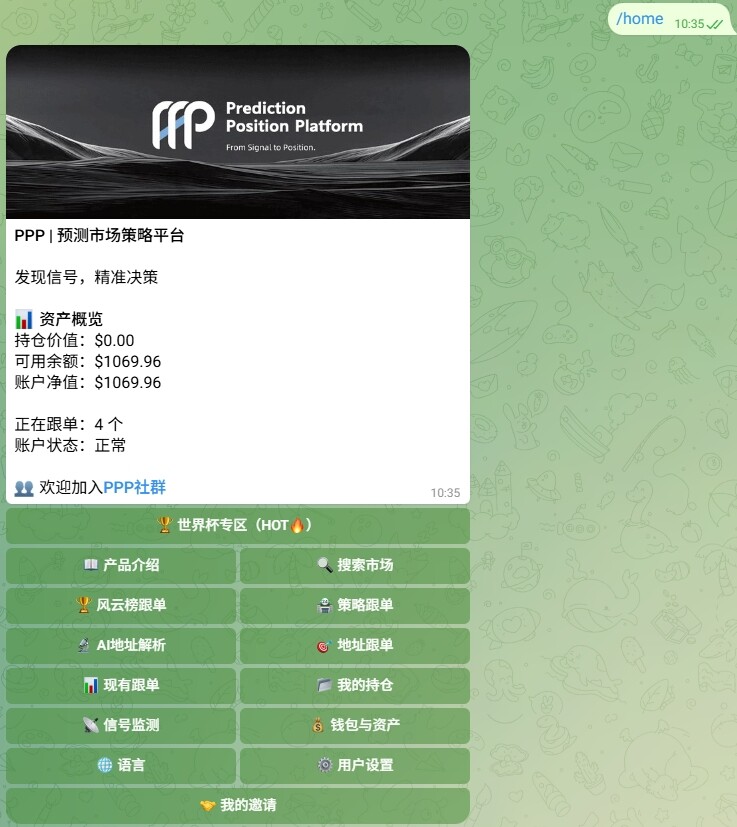
Currently, catering to World Cup trading demand, PPP has set up a "World Cup Zone." This zone displays upcoming matches and hot information, allowing users to directly view related prediction markets and quickly participate in relevant predictions via "Trade Now."
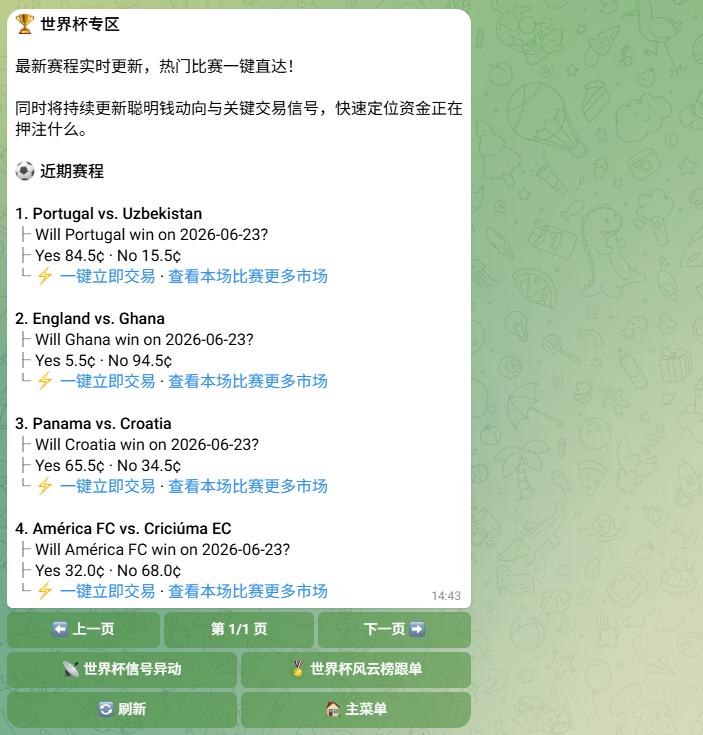
Beyond World Cup-related markets, PPP also supports broader event searches, covering Politics, Sports, Crypto, Finance, Technology, Weather, Hot, and Latest Events across 8 modules.
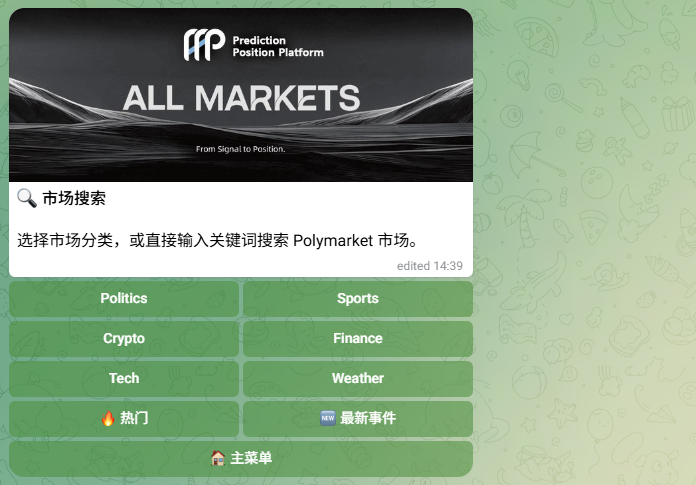
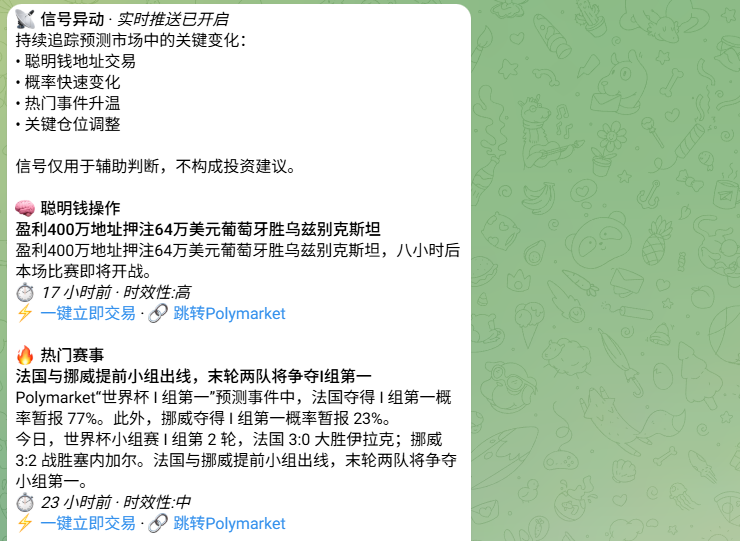
In "Signal Monitoring," PPP continuously tracks key changes in prediction markets and pushes more noteworthy trading signals to users. These signals include smart money address trades, significant short-term probability swings in prediction events, rising discussion heat around hot events, etc.

Compared to users repeatedly refreshing market pages on Polymarket, "Signal Monitoring" helps users discover potential trading opportunities faster and participate directly.
For users already tracking certain smart money addresses, PPP also offers an "AI Address Analysis" feature.

Users can manually input an address, and through PPP's model algorithm, get a one-click analysis of that address's historical trading performance, such as total P&L, win rate, profit/loss ratio, Sharpe ratio, maximum drawdown, and other analytical metrics. Simultaneously, manually entered addresses are compared against PPP's internal smart money database, providing users with more dimensional references.
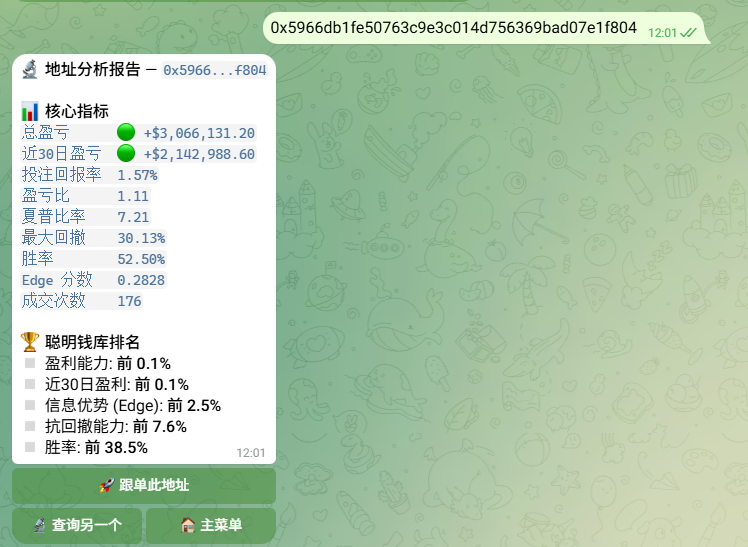
These features primarily solve two problems: helping users search and discover new trading opportunities faster; helping users make more comprehensive judgments about known addresses.

However, in prediction markets, not all profitable addresses are worth copying. Some addresses' gains might come from special information, extreme positions, a single favorable market move, or capital scale advantages. If users only look at profit rankings, they can easily overlook drawdowns, liquidity, holding style, and actual copy-ability.

Therefore, PPP's more prominent capabilities lie in its self-built address database and the derivative "Strategy Plaza" and "Trading Leaderboard."

Using the Strategy Plaza to Locate Prediction Masters Better Suited for Long-Term Tracking

On Polymarket, seeing that a single address is profitable isn't difficult. The hard part is judging whether that address is worth long-term tracking. Some addresses have high profits, perhaps from hitting a few high-odds events; others have decent win rates, but the drawdowns and position risks they take each time aren't suitable for ordinary users to replicate; still others rely on special information, capital scale, or extreme holding methods, appearing strong on the surface but offering limited actual copy-trading value.

Therefore, the accounts showcased in PPP's "Strategy Plaza" module are those that have undergone multi-dimensional filtering of traders on Polymarket, helping users find strategy accounts more suitable for long-term observation and tracking.

In its filtering logic, PPP synthesizes metrics like profit, win rate, drawdown, activity level, holding period, quality of market participation, and capital behavior to model and analyze addresses, combined with manual review. This aims to exclude as much as possible those with incidental profits, anomalous samples, and non-replicable extreme trading behaviors, and remains updated.
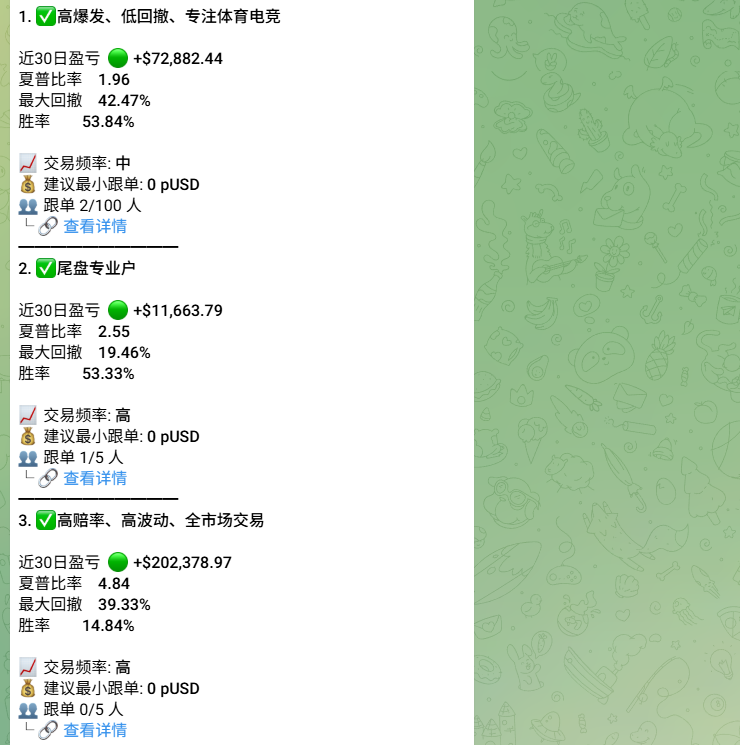
As shown in the figure above, if a user selects the second address in the Strategy Plaza, say "Closing Specialist," and clicks "View Details," they can see more dimensional data analysis for that address, including parameters like its trading frequency and current number of copy traders.
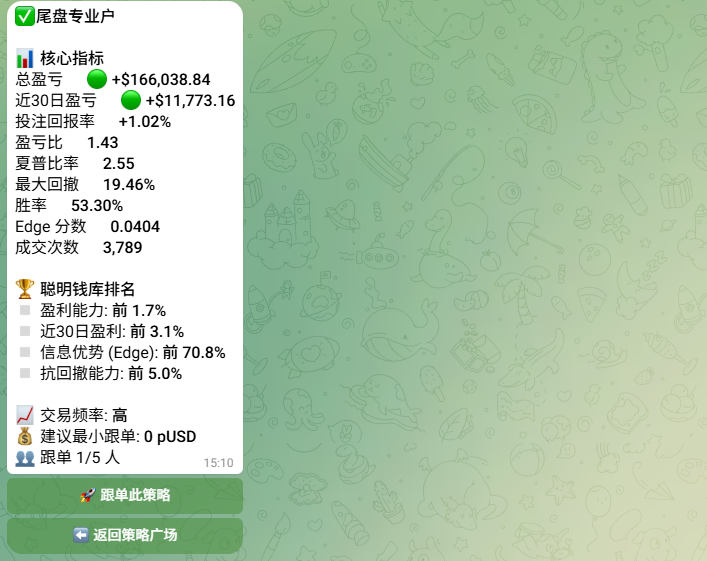
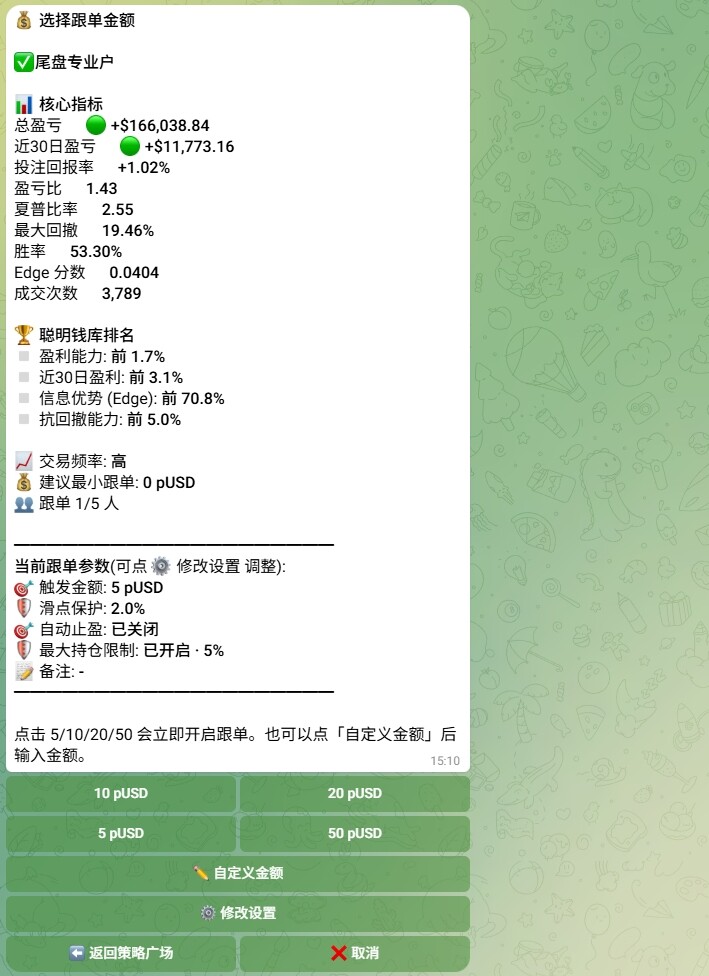
Clicking "Copy This Strategy" allows the user to set parameters like copy amount, maximum position percentage, automatic take-profit, etc.
Using the Trading Leaderboard to Recommend Addresses with Outstanding Recent Performance

If the Strategy Plaza leans more towards long-term observation, then the Trading Leaderboard is more suitable for users to capture recent opportunities.

The pace of prediction markets changes rapidly. Especially during events like the World Cup, major political events, crypto market movements, and macroeconomic data releases, certain traders might hit multiple markets consecutively in a short period or demonstrate stronger judgment in hot events. For users, such addresses might not be suitable for long-term following but are worth close observation in the short term.

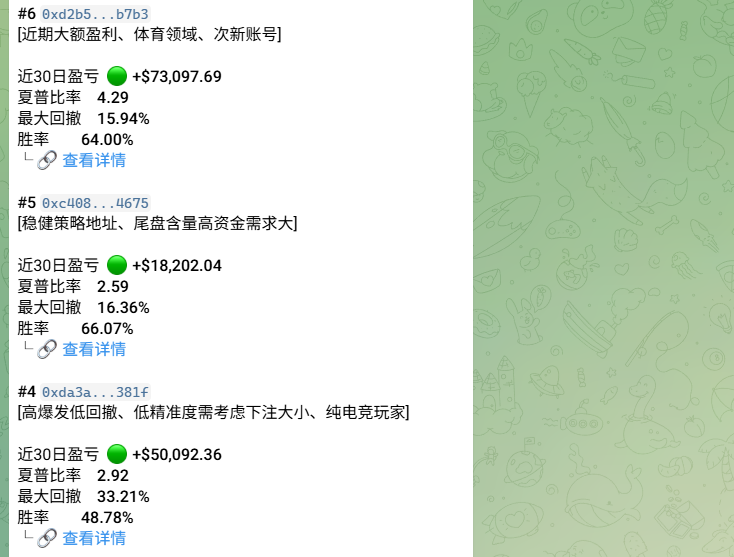
PPP filters traders currently standing out on Polymarket based on metrics like recent profit, win rate, activity level, quality of market participation, and capital behavior, helping users quickly discover addresses with stronger recent profitability and more active trading actions.

Specifically, PPP defines a label for each address on the Trading Leaderboard and provides data such as P&L for the last 30 days, Sharpe ratio, maximum drawdown, win rate, etc. Users can see not only how much an address recently made but also further judge if its profits are stable, if its drawdown is acceptable, and if its trading style suits their own copy trading.
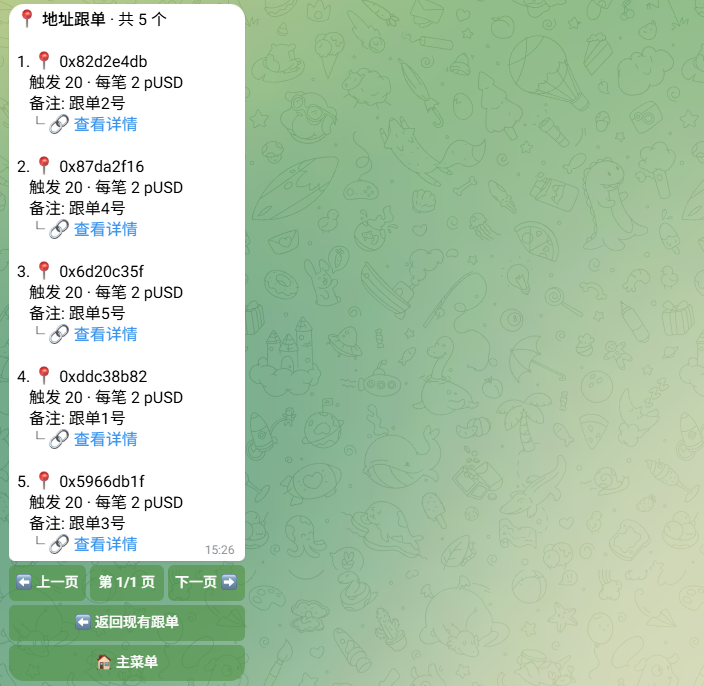
Beyond addresses filtered through the Strategy Plaza and Trading Leaderboard, PPP also supports users adding custom copy trading addresses.

Overall, the Strategy Plaza is for discovering accounts worth following long-term, the Trading Leaderboard is for capturing addresses with outstanding recent performance, custom address copy trading preserves users' own judgment space, and the exclusive AI model address analysis can assist users in making copy trading decisions.

Position Query and Management, Making Copy Trading Results More Controllable

Automatic copy trading doesn't mean users can't make adjustments after setup.

PPP provides position query and management features after copy trading execution. In most cases, users don't copy just one address. Without a unified holdings interface, users can easily lose track of which positions come from where or whether the copy logic is still suitable. For addresses already being copied, PPP consolidates them into "Current Copy Trades" for management, allowing adjustments to copy amount, risk parameters, or stopping the copy trade as needed.
Simultaneously, PPP supports viewing historical positions and P&L data. Through these records, users can further observe the actual performance of different copied addresses, such as which ones brought sustained profits, which had larger drawdowns, and which strategies are no longer suitable to follow.
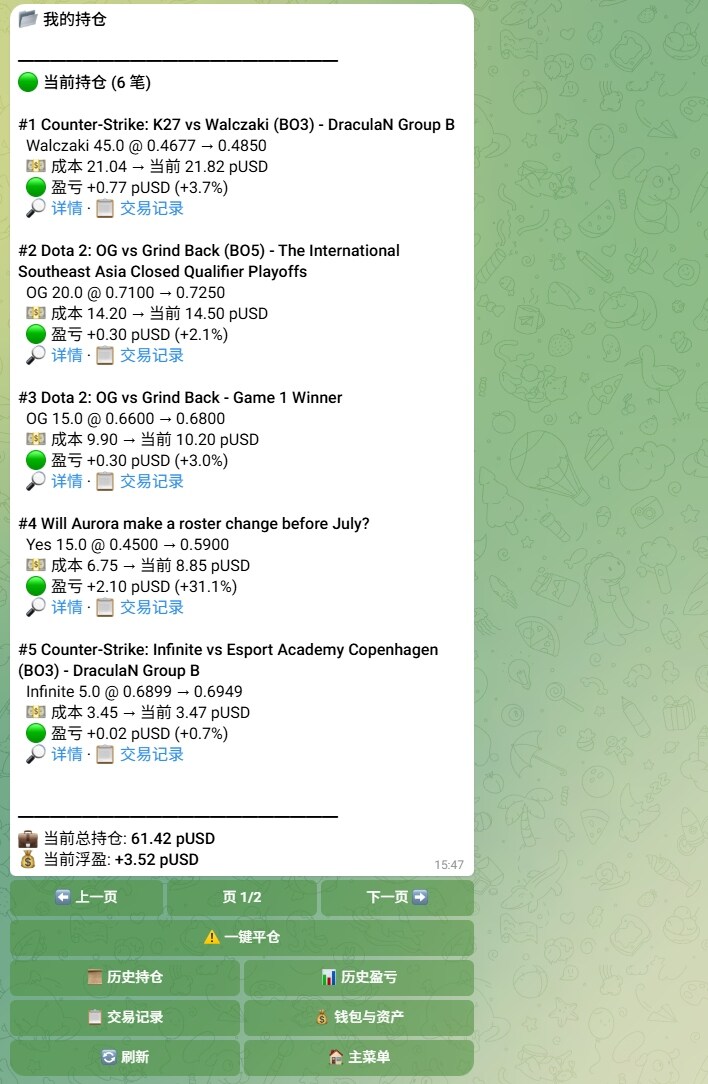
It can be said that PPP's copy trading process is not merely "automated trading after discovering an address" but forms a more complete closed loop—screening addresses worth watching, pushing trading signals, then completing copy execution, and finally continuously adjusting positions through holdings and copy management. For users looking to improve their long-term profitability odds on Polymarket, this process—viewable, adjustable, manageable—is more important than simple automatic copy trading.

Non-Custodial Wallet is PPP's Trust Foundation

For copy trading tools, beyond trading efficiency, user concern centers on fund security.

PPP adopts a non-custodial wallet model. User assets remain in their own on-chain wallets; the platform does not custody user assets and will not request private keys or seed phrases. Users can export the wallet autonomously and manage their private keys, login accounts, and device security themselves. PPP only undertakes services like address monitoring, signal aggregation, copy trade execution, and notification push; trading funds are not handed over to the platform for custody.

When a copy trading tool approaches trade execution, the key trust factor shifts from signal speed to whether asset control rights are clear. PPP's choice of a non-custodial wallet model draws a clearer line between efficiency and security, also laying a foundation of trust for subsequent automated copy trading and position management.

From Address Screening to Signal Push, PPP is Lowering the Trial-and-Error Cost of Copy Trading

Hot matches and market prices change daily, and active addresses quickly switch between different events. Ordinary users find it difficult to track a large number of accounts long-term and also struggle to judge whether an address's profit stems from a stable strategy or short-term luck, extreme positioning, or chance events.

PPP continuously screens traders on Polymarket based on metrics like profit, win rate, maximum drawdown, activity level, holding period, quality of market participation, and capital behavior, helping users quickly discover addresses with relatively stable performance and potential value for further research and tracking.

Building on this, PPP continuously monitors address trading behavior and hot market changes, filtering from these worthwhile signals like smart money movements and rapid market probability shifts, and promptly pushes them to users.

Users don't need to stay up all night watching the market or constantly switch between group chats, browsers, and trading pages to grasp potential market opportunities more efficiently.

Using tools effectively and leveraging the expertise of forecasters across various fields might be the evolutionary path for Polymarket newcomers that incurs the least tuition fees.


İlgili Sorular

QWhat is PPP and what problem does it aim to solve for Polymarket users?

APPP (Prediction Position Platform) is a Telegram bot tool designed for Polymarket users. It aims to address the challenges of 'not seeing everything, not being able to keep up, and slow execution' that new or casual users often face. It helps users discover worthwhile trading strategies, receive timely market signals, and execute automated copy-trading with position management.

QWhat are the main features provided by PPP to help users find trading opportunities?

APPP's main discovery features include: 1. A Signal Monitor that tracks key market changes like smart money trades and rapid probability shifts. 2. A Strategy Plaza, which showcases addresses suitable for long-term tracking based on multi-dimensional analysis (profit, win rate, drawdown, etc.). 3. A Trading Leaderboard, highlighting addresses with strong recent performance. 4. An AI Address Analysis tool to evaluate the historical performance of any specific address. 5. Custom event search across categories like sports, politics, and crypto.

QHow does PPP's 'Strategy Plaza' differ from its 'Trading Leaderboard' in function?

AThe Strategy Plaza focuses on identifying addresses that are suitable for long-term observation and copy-trading. It uses comprehensive metrics to filter out accounts that profit from luck, extreme positions, or non-replicable behaviors. The Trading Leaderboard, in contrast, is designed to help users capture short-term opportunities by highlighting addresses with outstanding recent performance, such as during major events like the World Cup.

QHow does PPP ensure the security of user funds during the copy-trading process?

APPP employs a non-custodial wallet model. User assets remain in their own on-chain wallets at all times. The platform does not hold user funds, nor does it request private keys or seed phrases. PPP only provides services like address monitoring, signal aggregation, trade execution, and notifications. Users have full control and ownership of their assets.

QWhat is the core value proposition of PPP for a new Polymarket user according to the article?

AThe core value is lowering the barrier to entry and the cost of trial-and-error for new users. By leveraging tools like PPP, beginners can 'borrow expertise' from proven traders in the prediction market. This allows them to discover reliable strategies, receive actionable signals, and execute trades efficiently without needing to constantly monitor markets or possess deep analytical knowledge themselves, potentially helping them avoid common pitfalls like emotional trading.

İlgili Okumalar

Trillion-Dollar Pension Fund Entry? Franklin Bitcoin Dividend Reinvestment ETF Comes with a Built-in Selling Pressure Ceiling

Franklin Templeton has filed to launch two ETFs that embed a "default configuration" logic into Bitcoin investment, aiming to tap into massive pension fund flows. These "Bitcoin Dividend Reinvestment Index ETFs" will initially hold 95% equities and 5% Bitcoin, automatically reinvesting stock dividends to buy Bitcoin. However, a quarterly rebalancing rule forces selling of Bitcoin if its allocation exceeds 5%, capping its maximum holding at 20%. While the product cleverly circumvents advisor reluctance and compliance hurdles by labeling itself as a U.S. equity product, its actual Bitcoin buying power is minimal. Given low dividend yields (e.g., ~1% for broad market indices), annual Bitcoin purchases from a fund the size of Franklin's existing Bitcoin ETF would be a mere $3.6 million—negligible against Bitcoin's daily trading volume. Crucially, during bull markets, the fund becomes a programmed, passive *seller* of Bitcoin, potentially creating sustained sell pressure if many similar funds emerge. The strategy leverages investor inertia and automatic enrollment, similar to the success of target-date funds in 401(k) plans. It also uses an offshore Cayman subsidiary for holding Bitcoin and raises a tax complication where investors must pay taxes on dividends they never receive as cash. Although recent U.S. regulatory changes allow crypto in retirement plans, widespread adoption as a default option faces legal hurdles. The core premise remains: the system doesn't need to convince anyone to buy Bitcoin actively; it simply relies on people doing nothing.

marsbit2 dk önce

Trillion-Dollar Pension Fund Entry? Franklin Bitcoin Dividend Reinvestment ETF Comes with a Built-in Selling Pressure Ceiling

marsbit2 dk önce

Bitcoin Hits 20-Month Low as Largest Bull Suffers $15 Billion Paper Loss

Bitcoin Hits 20-Month Low as Major Bull Loses $15 Billion On June 25th, Bitcoin fell below $60,000, hitting a low of $58,030—its lowest level since October 2024. The sell-off triggered over $1 billion in leveraged liquidations in 24 hours, with longs accounting for $788 million. This marks a more than 53% decline from the October 2025 all-time high of $126,198. A critical factor in the downturn is the weakening position of MicroStrategy, the largest corporate Bitcoin holder. With 847,363 BTC at an average cost of $75,651, the company now faces over $14.6 billion in unrealized losses. Its core financing flywheel—raising capital to buy Bitcoin—is stalling. Its variable-rate preferred shares (STRC), a key fundraising tool, have fallen 25% below their $100 target. This raises doubts about its ability to continue providing steady institutional demand for Bitcoin. Simultaneously, U.S. spot Bitcoin ETFs are experiencing significant outflows, with a single-day net outflow of $469 million on June 24th. This represents the most severe sustained capital flight since their launch. The macroeconomic backdrop remains restrictive, with persistent inflation delaying expected Fed rate cuts. Analysts note a shift in capital allocation, with institutional funds moving away from crypto towards AI infrastructure stocks. Immediate pressure comes from approximately $10 billion worth of Bitcoin options expiring on June 26th, which could increase market volatility. The combined effect of these factors—eroding core demand pillars, macro headwinds, and capital rotation—has decisively broken the $60,000 support level.

Foresight News9 dk önce

Bitcoin Hits 20-Month Low as Largest Bull Suffers $15 Billion Paper Loss

Foresight News9 dk önce

STRC Falls Below $80, Can Conservative Investors Still Buy the Dip?

The article analyzes whether the STRC (a perpetual preferred stock issued by MicroStrategy) presents a buying opportunity after its price fell below its $100 par value to around $80, offering a seemingly high yield of 13-15%. The core argument is that STRC's discount reflects market skepticism about the sustainability of MicroStrategy's capital structure model, not just temporary panic. This model relies on issuing securities (like STRC) to raise funds to buy more Bitcoin, a "flywheel" that works in a bull market. The recent small sale of BTC to fund dividends, while minor, broke the psychological "never sell" anchor and signaled potential strain. Key risks identified are not a traditional Ponzi collapse but a potential breakdown in the financing narrative: 1) If Bitcoin enters a deep bear market, crushing MicroStrategy's stock premium (mNAV), its ability to raise cheap capital weakens. 2) If STRC remains deeply discounted, it signifies permanently higher funding costs. 3) The high cash dividend yield represents a significant ongoing expense. 4) If selling BTC to pay dividends becomes routine, the bullish narrative reverses. The conclusion is that STRC is not a risk-free high-yield asset. It is a high-coupon bet on whether MicroStrategy's BTC treasury financing model can withstand a bear market. Buying it is a wager that the market will continue to believe in and fund this structure at acceptable costs. The current price asks if this cycle's "casualty" might be a BTC treasury company's融资 model itself.

marsbit24 dk önce

STRC Falls Below $80, Can Conservative Investors Still Buy the Dip?

marsbit24 dk önce

Why Do Crypto Projects Keep Changing Their Names?

**Why Do Crypto Projects Keep Changing Names?** In the crypto world, changing a project's name is common—over 16% of projects have done so, including major ones like Polygon (formerly Matic Network). This contrasts sharply with traditional businesses, which fiercely protect brand equity. The core reason is that in crypto, brand loyalty is often weak. Users are frequently investors, airdrop hunters, or yield seekers, not traditional consumers. A name associated with price crashes, hacks, or failed narratives becomes a liability, not an asset. Renaming can be a strategic reset to shed this baggage. Name changes serve as a potent marketing tool. They can signal a genuine pivot in strategy or scope (e.g., EthSign dropping "Eth" as it expanded). However, they are often used to "narrative surf," rebranding to align with hot trends like AI, RWA, or the metaverse (e.g., Elrond → MultiversX). Critically, renaming is also a PR tactic to distance a project from past failures like security breaches (e.g., Anyswap → Multichain). The most significant risk emerges when a name change is coupled with a token migration or swap. This process can allow projects to reset exchange price charts, erase visible historical downtrends, and create an illusion of a fresh start. It often facilitates liquidity resets, where low float can be exploited for pumps. More alarmingly, migrations sometimes mask overhauls to tokenomics, introducing substantial new token supply through "ecosystem funds" or "node rewards," effectively diluting existing holders. The fundamental issue isn't renaming itself, which can be valid for strategic evolution. The problem is when it functions as an escape from history—a way to avoid accountability for past mistakes, failed promises, and poor performance. When a project announces a rebrand, the critical questions are: What tangible new capability or strategy does it represent? Has the tokenomics changed? And what part of its past is it most trying to make users forget?

marsbit31 dk önce

Why Do Crypto Projects Keep Changing Their Names?

marsbit31 dk önce

A Trillion-Dollar Entry Point for Pension Funds? Franklin's Bitcoin Dividend Reinvestment ETFs Come with a Built-In Selling Pressure Ceiling

Franklin Templeton filed for two ETFs on June 18 that embed a "default option" logic into Bitcoin investing. These funds—the Franklin US Equity Bitcoin Dividend Reinvestment Index ETF and the Franklin US Innovative Equity Bitcoin Dividend Reinvestment Index ETF—aim to automatically allocate a portion of investor dividends to Bitcoin, initially with a 95% stock and 5% Bitcoin allocation. The mechanism is designed for financial advisors, not retail investors. By packaging Bitcoin exposure within a standard equity fund label, advisors can bypass internal compliance restrictions against direct cryptocurrency allocation for their clients. Dividends from the stock holdings are automatically used to buy Bitcoin via spot ETFs, futures, or options. However, the structure imposes strict rebalancing rules: if Bitcoin's allocation exceeds 5%, it is trimmed back to 4.5% quarterly, with a hard cap of 20%. This means the fund becomes a systematic seller during Bitcoin price rallies. Realistically, the potential buying pressure is minimal. Based on dividend yields (approximately 1.05% for broad market, 0.52% for innovative equity), the annual inflow into Bitcoin would be a tiny fraction of the fund's assets. For comparison, Franklin's existing Bitcoin ETF ($359 million AUM) would generate only about $3.6 million in annual Bitcoin purchases—negligible against Bitcoin's daily trading volume. The innovative equity fund, heavily weighted in low-dividend stocks like Nvidia, would have even weaker buying power. The product utilizes an offshore Cayman subsidiary to hold Bitcoin, a common compliance tactic for commodity exposure in mutual funds. A key drawback for investors is the tax liability: they must pay taxes on dividends that are automatically converted into Bitcoin, requiring out-of-pocket cash for a gain they never directly receive. For the strategy to scale significantly, such funds would need to become a default or near-default option in retirement plans like 401(k)s. Recent regulatory moves, including a Trump executive order and a Department of Labor proposal offering fiduciary safe harbors for including crypto assets, could pave the way. However, widespread employer adoption likely awaits further legal clarity. Ultimately, the fund's model leverages investor inertia and automated systems, rather than convincing anyone to actively choose Bitcoin. While it creates a new, albeit small, structural buyer, its rebalancing rules also establish a built-in "selling ceiling" that could dampen price upside if similar products proliferate.

Foresight News32 dk önce

A Trillion-Dollar Entry Point for Pension Funds? Franklin's Bitcoin Dividend Reinvestment ETFs Come with a Built-In Selling Pressure Ceiling

Foresight News32 dk önce

İşlemler

Spot
Futures
活动图片