From Safe Haven to Risk Basket: Why Gold, Silver, and BTC Are Becoming Increasingly Similar?

marsbit2026-02-06 tarihinde yayınlandı2026-02-06 tarihinde güncellendi

Özet

In January 2026, gold, silver, and Bitcoin experienced a synchronized sharp decline, challenging traditional asset classifications. The pricing of precious metals has shifted from physical demand to financialized markets, driven by the same macro factors—dollar liquidity, real interest rates, and risk appetite—that influence Bitcoin. Institutional investors and algorithmic trading systems now dominate marginal price movements, treating all three as "non-sovereign scarce assets" within the same risk basket. Silver, with its leverage and industrial role, acted as a volatility amplifier, while Bitcoin's decentralized narrative weakened due to institutionalization. Physical markets for gold and silver showed resilience with central bank buying and industrial demand, creating a two-tier structure: long-term support from physical buyers and short-term volatility from leveraged paper markets. The crypto ecosystem, including altcoins and DeFi, faces pressure as Bitcoin's value proposition aligns more with macro liquidity tools than decentralized ideals.

Author: Nikka / WolfDAO (X: @10xWolfdao)

In January 2026, gold, silver, and BTC plummeted simultaneously, breaking the classification of traditional safe-haven and speculative assets. The pricing power of precious metals has long shifted to financialized markets, driven by the same macro factors as BTC—such as dollar liquidity and real interest rates—and are bought and sold together by the same institutional funds. Silver, with its high leverage, acts as a volatility amplifier, and all three trigger leveraged liquidations at liquidity turning points. The paper market and physical market for precious metals are diverging, while BTC's decentralization narrative is being diluted by institutionalization, putting pressure on the crypto ecosystem.

Anomalous Synchronization

On January 30, 2026, gold plunged over 12% from its all-time high of $5,600 per ounce, marking its largest single-day drop in nearly 40 years. Silver fell even more sharply, dropping 27% in one day and another 6.7% the next day. Bitcoin fell below $75,000, touching the $70,000 range over the weekend, and as of this week, it has dropped below the $60,000 mark, with market panic intensifying.

In traditional understanding, this should not happen. Gold and silver are safe-haven assets—low volatility, risk-resistant, and wealth during crises. Bitcoin is a speculative asset—high volatility, high risk, and both loved and hated. They should fluctuate at different times, in different ways, and for different reasons.

But the real market is proving in the most direct way: this classification system has failed. At least in terms of pricing logic, precious metals and Bitcoin are being treated as the same type of asset.

The issue is not that gold and silver have "become unsafe" but that the forces determining their prices have fundamentally changed.

The Overlooked Shift

Let’s start with a key fact: The prices of gold and silver are no longer primarily determined by "safe-haven demand."
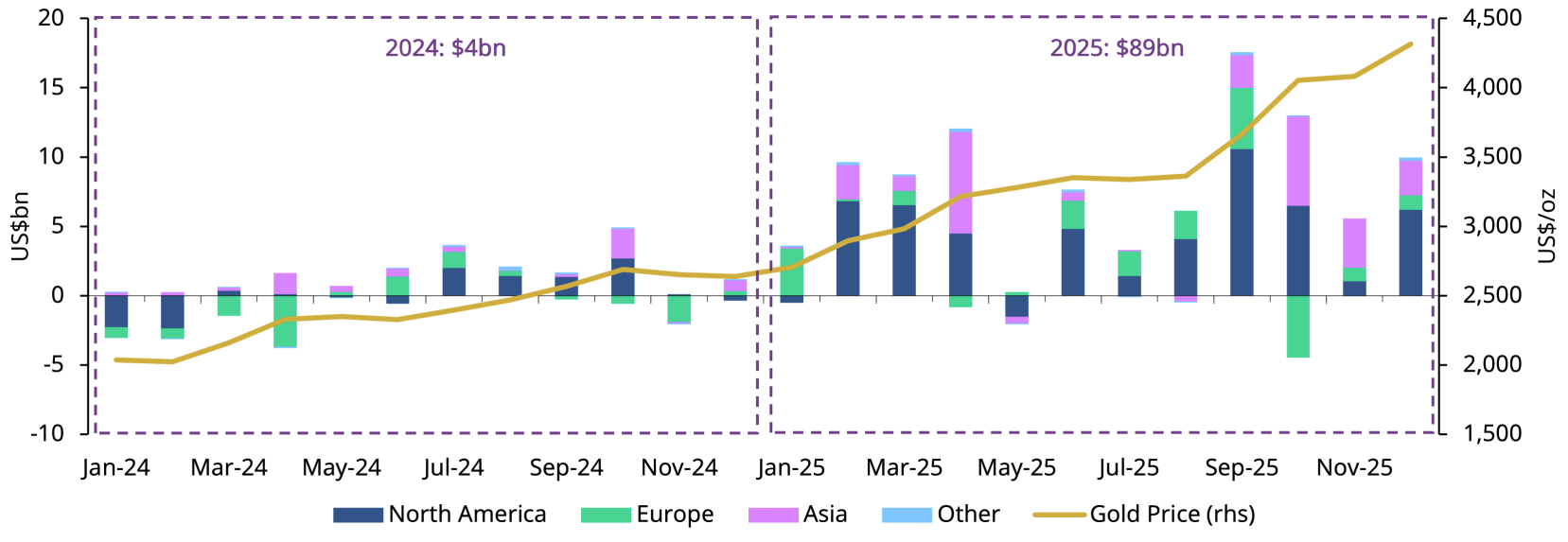
source: gold.org

In 2025, global gold ETF inflows hit a record $89 billion, doubling the assets under management to $559 billion. The proportion of gold in global financial assets has risen from its low in 2010 to 2.8% in the third quarter of 2025.

This 2.8% marks a profound structural shift: the pricing power of precious metals has shifted from physical demand to financialized markets.

Today, the marginal price fluctuations of gold and silver are driven by the same global macro funds: hedge funds, CTA strategies, systematic trend funds, and cross-market institutional accounts. These funds don’t care about "whether gold is a safe haven"; they only care about three variables:

  • Dollar liquidity
  • Real interest rates
  • The pace of risk appetite changes

JP Morgan research shows that changes in U.S. Treasury yields can explain about 70% of gold’s quarterly price fluctuations. This means gold pricing has become highly macro-driven and systematic. When you see gold price movements, they are no longer driven by India’s wedding season or Chinese retail investors’ buying enthusiasm but by Wall Street’s quantitative models and algorithmic trading systems.

The Same Button

This explains why gold, silver, and Bitcoin have recently fluctuated sharply at the same time.

They are all exposed to the same macro factor: violent swings in global liquidity expectations.

When the market bets on rate cuts, a weaker dollar, or diluted purchasing power, these three assets are bought simultaneously—not because they are "safe havens" but because, in quantitative models, they are all "non-sovereign scarce assets."

When inflation proves sticky, rate expectations rebound, the dollar strengthens, or risk models trigger deleveraging, they are sold off simultaneously—not because they are "high risk" but because they are in the same risk basket.

Price fluctuations are not due to "changes in asset attributes" but because the participants and trading methods driving pricing have become homogenized.

January 30 is the best proof. Trump nominated Kevin Warsh as Fed chair, which the market interpreted as a hawkish signal. The dollar rebounded, and immediately:

  • Gold fell from $5,600 to below $4,900
  • Silver plummeted from $120 to $75
  • Bitcoin slid from $88,000 to $81,000

Three assets, same moment, same direction, same violence. This is not a coincidence but direct evidence that they are priced by the same trading system.

Silver: The Amplifier Effect

Silver’s performance is particularly representative.

Compared to gold, silver has dual attributes as both a precious metal and an industrial metal, with higher leverage and more fragile liquidity. By the end of 2025, silver’s 30-day realized volatility surged above 50%, while Bitcoin’s compressed to the 40% range—a significant reversal.

Silver’s rapid rally and sharp decline were essentially due to concentrated inflows and outflows of macro long positions, not any structural change in fundamentals over the short term. In January 2026, the Chicago Mercantile Exchange raised silver futures margin requirements from historical lows to 15–16.5%, ending the era of low-cost "paper silver" speculation.

When prices fell, highly leveraged speculators couldn’t meet the new margin requirements and were forced to liquidate. This triggered cascading liquidations—prices fell further, and more positions were forcibly closed. This "margin trap" is identical to the 1980 move to crush the Hunt Brothers’ silver accumulation by raising margins.

This price action is almost identical to Bitcoin’s behavior near liquidity turning points.

The Truth of the Paradox

This also explains a seemingly contradictory phenomenon: safe-haven assets plummet when "risk arrives."

The reason is not that they have lost their safe-haven attributes but that when systemic risk rises to a certain level, the market prioritizes "cash" and "liquidity" over "long-term preservation logic."

When volatility spikes, liquidity often evaporates. Market makers narrow quote sizes, spreads widen, and price gaps appear. In such an environment, all highly financialized, quickly liquidatable assets with leveraged exposure are sold off simultaneously—whether they are called gold, silver, or Bitcoin.

As Saxo Bank’s Ole Hansen said: "Volatility reinforces itself." When prices fluctuate violently, market structure takes over everything. In this cycle, the "intrinsic attributes" of assets play almost no role.

A Tale of Two Markets

But this is not the whole truth.

While the paper market crashed, the physical market showed opposite signals. After silver’s plunge, physical silver premiums in Shanghai and Dubai soared to $20 above the Western spot price. Major silver miner Fresnillo has cut its 2026 production guidance to 42–46.5 million ounces. Industrial demand (solar, electric vehicles, semiconductors) remains strong.

This split reveals a key contradiction:

  • Paper market: Highly financialized, extremely volatile, driven by macro funds
  • Physical market: Supply-constrained, demand-supported, relatively stable

The same split exists in the gold market. In 2026, central banks are still expected to buy 750–950 tons of gold, marking the third consecutive year of purchases exceeding 1,000 tons. These "traditional" buyers—mainly emerging market central banks—buy gold for dedollarization, reserve diversification, and long-term value storage. They don’t engage in short-term trading, don’t use leverage, and aren’t forced to liquidate by margin calls.

This creates a two-tier structure:

  • Long-term floor: Central banks provide sustained buying, setting a price bottom
  • Short-term volatility: Institutional investors and algorithms dominate marginal pricing, creating extreme fluctuations

Narrative Collapse

A deeper issue: The narrative system long relied upon by the crypto market is collapsing.

The "decentralized safe haven" narrative is being diluted by institutionalization. When Bitcoin falls sharply over weekends with thin liquidity, it is largely due to leveraged trading and futures market liquidations—products of centralized finance. The fundamentalists who hold private keys and adhere to "not your keys, not your coins" have long been marginalized in pricing power.

This change affects not just Bitcoin but the entire crypto ecosystem.

Altcoins face greater pressure: If even Bitcoin has lost its unique value proposition and is grouped into the "macro liquidity trading tool" basket, where will altcoins with weaker narratives and more fragile fundamentals go? When institutions allocate crypto assets, will they choose the already "tamed" BTC or risk investing in Ethereum, Solana, or other public chains?

Ethereum fell 4% to $2,660 during the same period, underperforming Bitcoin. This hints at a brutal possibility: in macro risk models, funds will flow集中 to "the gold of the crypto market" (BTC) and abandon assets seen as "the silver or copper of the crypto market."

DeFi’s paradox: Decentralized finance was once seen as the most revolutionary innovation in crypto, promising lending, trading, and other services without relying on traditional financial intermediaries. But if the underlying assets (BTC, ETH) are entirely priced by traditional financial markets, how much "decentralization" do DeFi protocols really have left?

You can trade using decentralized protocols, but if price discovery happens on Wall Street trading desks, Chicago futures markets, and quantitative model servers, this decentralization is only superficial.


Trend Kriptolar

İlgili Sorular

QWhy did gold, silver, and Bitcoin experience a synchronized sharp decline in January 2026, breaking traditional asset classifications?

AThey experienced a synchronized sharp decline because their pricing is now driven by the same macro factors—such as dollar liquidity, real interest rates, and risk appetite—and are traded by the same institutional funds using similar quantitative models and algorithmic systems, rather than their traditional roles as safe-haven or speculative assets.

QWhat key structural shift in the precious metals market has led to gold and silver being priced like financial assets rather than physical commodities?

AThe key structural shift is the financialization of the precious metals market, where pricing power has moved from physical demand to financial markets. Global gold ETF inflows reached a record $89 billion in 2025, and institutional investors like hedge funds and CTAs now drive marginal price movements based on macro factors, not physical supply and demand.

QHow does silver act as a 'volatility amplifier' compared to gold and Bitcoin in the current market structure?

ASilver acts as a volatility amplifier due to its high leverage, lower liquidity, and dual role as both a precious and industrial metal. Its leverage makes it more susceptible to margin calls and cascading liquidations during market stress, as seen when CME raised margin requirements in January 2026, triggering sharp price swings.

QWhat contradiction exists between the 'paper market' and the 'physical market' for assets like gold and silver?

AThe paper market is highly financialized, driven by macro funds and algorithms, leading to extreme volatility and leverage-induced price swings. In contrast, the physical market is supported by steady demand from banks and industrial users, with central banks buying gold for long-term reserve diversification, creating a stable price floor despite paper market turbulence.

QHow has the institutionalization of Bitcoin diluted its 'decentralized haven' narrative and impacted the broader ecosystem?

AInstitutionalization has diluted Bitcoin's decentralized narrative because its price is now heavily influenced by traditional financial mechanisms like futures markets, leverage trading, and macro liquidity factors. This shift marginalizes core 'not your keys, not your coins' holders and pressures the broader crypto ecosystem, as altcoins and DeFi protocols lose their unique value propositions when underlying asset pricing is dominated by Wall Street.

İlgili Okumalar

Must-Watch Events Next Week|CLARITY Act Could Face Senate Vote; SpaceX, Circle to Report Earnings (8.3-8.9)

**Summary: Key Events and Developments to Watch (August 3-9)** The upcoming week is marked by significant financial disclosures, key legislative deadlines, and notable product updates. **Major Financial Events:** Several companies are scheduled to release their Q2 2026 earnings. American Bitcoin (ABTC) will report on August 3, followed by SpaceX and Hut 8 Mining Corp. on August 4, and Circle on August 5. Notably, a significant portion of SpaceX shares (up to 12% of total shares) will be unlocked on August 6 following their earnings release. **Key Legislative Deadline:** The U.S. Senate faces an August 7 deadline to secure 60 votes for the CLARITY Act, a bipartisan bill aiming to establish a federal regulatory framework for cryptocurrencies. The Senate may hold a full vote on the bill during the week. **Economic Data:** The U.S. July Non-Farm Payrolls report will be released on August 7, providing crucial labor market data. **Technology & Product Updates:** * **Shutdowns:** DeFi portfolio tracker Zapper and wallet app Ctrl Wallet will cease operations on August 3. * **Upgrades:** LayerZero will deprecate its v1 relayers on August 3. XRP Ledger's new version 3.3.0, featuring five new functions, is expected next week. * **AI:** Elon Musk announced that the advanced Grok 4.6 AI model is set for release around August 7. * **Bitcoin:** The BIP-110 forced signaling for a potential Bitcoin network change is scheduled to begin around August 8. **Other Notable Events:** Chinese robotics firm Unitree Tech has set its preliminary price inquiry for its IPO for August 5. South Korean exchange Upbit will delist AQT and AERGO tokens on August 3.

marsbit1 dk önce

Must-Watch Events Next Week|CLARITY Act Could Face Senate Vote; SpaceX, Circle to Report Earnings (8.3-8.9)

marsbit1 dk önce

Stocks Are Plummeting More Sharply Than Cryptocurrencies. Where Has the Money Gone?

Stock Markets Plunge Deeper Than Cryptocurrencies: Where Did the Money Go? In late July, Seoul's Kospi index triggered circuit breakers for two consecutive days, plummeting over 40% from its June high. The collapse was led by heavyweight stocks like SK Hynix, whose record profits still disappointed investors, and devastating leveraged ETFs, with one major product losing over 83% of its value. This signaled a global, forced deleveraging targeting the most crowded trades. Interestingly, while stocks exhibited extreme volatility akin to crypto markets, Bitcoin rose nearly 15% in July after a prior steep drop. Analysis shows the money fleeing equities did not flow into Bitcoin. Instead, Bitcoin had already absorbed its sell-off in May-June, when U.S. spot Bitcoin ETFs saw historic outflows. The true safe-haven beneficiary was gold, whose price rose over 20% year-on-year, highlighting a decoupling between Bitcoin and gold as "digital gold." The sell-off was a targeted unwinding of leveraged positions in tech and semiconductors, accelerated by broker-dealer risk management and shifts in the AI narrative, including new competition from Chinese memory chipmakers. The retreat path was clear: from high-valuation tech stocks to cash and U.S. Treasuries, then to gold. For Bitcoin to attract sustained institutional inflows, conditions like eased global liquidity pressure, a "soft-landing" Fed rate cut, and U.S. regulatory clarity via legislation like the stalled CLARITY Act are needed. Currently, Bitcoin is not a safe haven but an already-cleared asset. Its low correlation with tech stocks, however, makes it a potential diversification play for institutional portfolios once the storm passes. The money isn't here yet, but the positioning is underway.

marsbit1 dk önce

Stocks Are Plummeting More Sharply Than Cryptocurrencies. Where Has the Money Gone?

marsbit1 dk önce

In Conversation with Ray Dalio: We Are Currently in an AI Bubble, with 1% of My Portfolio in Bitcoin

Ray Dalio, founder of Bridgewater Associates, warns in an interview that the current AI boom shows classic bubble characteristics, which could lead to significant economic downturns as seen in past cycles like 1929 or 2000. He explains that speculative enthusiasm, fueled by debt and overvaluation, often precedes a crash when rising rates or taxation force asset sales, causing widespread losses and recession. Dalio also outlines his "Big Cycle" theory, describing an approximate 80-year pattern where widening wealth gaps, massive government deficits, and shifting geopolitical power (like China's rise) create internal conflict and global instability. He emphasizes that we are in a late-cycle, transitional phase where traditional powers like the US and UK face decline. For personal wealth protection, Dalio advises diversification beyond cash into assets like stocks, bonds, real estate, and particularly gold, which he prefers over Bitcoin. While he holds about 1% of his portfolio in Bitcoin as a non-printable hard asset, he views gold as more secure from technological or governmental threats. Regarding AI's impact, Dalio believes it will disproportionately benefit capital owners, worsening inequality by replacing both physical and cognitive labor. He suggests that human intuition and emotional intelligence, combined with AI, will be key for future workers. On taxation, Dalio argues that wealth taxes are impractical and risk triggering asset sell-offs, reducing productive investment. He points to the UK as a cautionary example of debt, low productivity, and political strife. Geopolitically, Dalio foresees a more regionalized world, with the US showing weakness in prolonged conflicts like with Iran, akin to past imperial declines. The ideal outcome, he suggests, is coexisting powerful blocs (e.g., Americas, China-Asia Pacific) without major war.

marsbit3 saat önce

In Conversation with Ray Dalio: We Are Currently in an AI Bubble, with 1% of My Portfolio in Bitcoin

marsbit3 saat önce

Daily 7.2 Trillion KRW: Foreign Capital's Record Net Buying on Friday! Wall Street Says Headwinds for Korean Stock Fund Flows Have Subsided

South Korean stock market sees a dramatic shift in fund flows. On July 31, foreign investors made a record net purchase of approximately KRW 7.2 trillion in KOSPI stocks, marking a fundamental reversal from the persistent large-scale net outflows seen in previous months. This contributed to a significant narrowing of foreign net selling in July to KRW 9.8 trillion, down sharply from KRW 48.4 trillion in June and KRW 44.5 trillion in May. Simultaneously, domestic institutional pressure eased. South Korean pension funds and asset managers turned to a net buying position in July, purchasing KRW 1.0 trillion worth of KOSPI shares, contrasting with net sales in May and June. Market volatility is expected to be dampened by new financial regulations. Effective July 31, the Financial Services Commission tightened access for retail investors to single-stock leveraged ETFs by raising the minimum cash deposit requirement. Trading volumes for these products subsequently dropped to about 50% of their monthly average. Citigroup Research maintains its year-end KOSPI target of 10,000 points. The firm cites several supportive factors: the substantial easing of headwinds from capital outflows, a robust fundamental outlook for the semiconductor sector, historically low market valuations, strong economic fundamentals, and the potential for policy support from financial authorities if needed.

marsbit3 saat önce

Daily 7.2 Trillion KRW: Foreign Capital's Record Net Buying on Friday! Wall Street Says Headwinds for Korean Stock Fund Flows Have Subsided

marsbit3 saat önce

İşlemler

Spot

Popüler Makaleler

BITCOIN Nedir

HarryPotterObamaSonic10Inu (ERC-20)'yu ve Kripto Alanındaki Yerini Anlamak Son yıllarda, kripto para piyasası, hem ticaret yapanların hem de topluluk etkileşimi ve eğlence değeri arayanların ilgisini çeken meme coin'lerin popülaritesinde bir artış gördü. Bu benzersiz token'lar arasında, kripto para dokusuna kültürel referansları harmanlayan ilginç bir proje olan HarryPotterObamaSonic10Inu (ERC-20) bulunmaktadır. Bu makale, HarryPotterObamaSonic10Inu'nun temel yönlerini, mekanizmalarını, topluluk odaklı ethosunu ve daha geniş kripto manzarasıyla etkileşimini incelemektedir. HarryPotterObamaSonic10Inu (ERC-20) Nedir? Adından da anlaşılacağı gibi, HarryPotterObamaSonic10Inu, Ethereum blok zinciri üzerinde inşa edilen bir meme coin'dir ve ERC-20 standardı altında sınıflandırılmaktadır. Geleneksel kripto paraların pratik kullanılabilirlik veya yatırım potansiyeline odaklandığı durumların aksine, bu token eğlence değeri ve topluluğunun gücü üzerine kuruludur. Proje, bağlı kullanıcıların bir araya gelebileceği, fikirlerini paylaşabileceği ve çeşitli kültürel fenomenlerden ilham alan etkinliklere katılabileceği bir ortam yaratmayı hedeflemektedir. HarryPotterObamaSonic10Inu'nun dikkate değer özelliklerinden biri işlemlerde sıfır vergi olmasıdır. Bu çekici unsur, küçük ölçekli yatırımcıları caydırabilecek ek ücretlerden yoksun olarak ticareti ve topluluk katılımını teşvik etmeyi amaçlamaktadır. Coin'in toplam arzı bir milyar token olarak belirlenmiştir; bu, topluluk içinde önemli bir dolaşım sağlama niyetini göstermektedir. HarryPotterObamaSonic10Inu (ERC-20) Yaratıcısı HarryPotterObamaSonic10Inu'nun kökenleri bir miktar gizemlidir; yaratıcısı hakkında spesifik bilgilerin ne olduğu bilinmemektedir. Bu token'ın geliştirilmesi, belirli bir ekip veya açık bir plan eksikliği ile gerçekleşmiştir; bu durum, meme coin sektöründe oldukça yaygındır. Proje, topluluğunun heyecanı ve katılımına dayalı olarak organik bir şekilde ortaya çıkmıştır. HarryPotterObamaSonic10Inu (ERC-20) Yatırımcıları Dış yatırımlar ve destekler söz konusu olduğunda, HarryPotterObamaSonic10Inu da belirsiz kalmaktadır. Token, bilinen herhangi bir yatırım fonunu veya önemli bir kurumsal desteği listelememektedir. Bunun yerine, projenin can damarı, kolektif eylem ve kripto alanındaki katılım yoluyla büyüme ve sürdürülebilirlik sağlayan temel topluluğudur. HarryPotterObamaSonic10Inu (ERC-20) Nasıl Çalışır? Bir meme coin olarak, HarryPotterObamaSonic10Inu, genellikle varlık değerini yöneten geleneksel çerçevelerin dışında çalışmaktadır. Projenin nasıl çalıştığını tanımlayan birkaç özelliği vardır: Sıfır Vergi İşlemleri: İşlemlerde vergi ücreti olmadan, kullanıcılar gizli maliyet endişesi olmadan token'ı serbestçe alıp satabilirler. Topluluk Etkileşimi: Proje, topluluk etkileşimi üzerine kuruludur ve sosyal medya platformlarını kullanarak heyecan yaratarak katılımı kolaylaştırır. Tartışmalar, içerik paylaşımı ve katılım, projenin erişimini genişletmeye ve destekleyiciler arasında sadakat oluşturmaya yardımcı olan kritik unsurlardır. Pratik Kullanılabilirlik Yok: HarryPotterObamaSonic10Inu'nun mali ekosistem içinde somut bir kullanılabilirlik sunmadığı belirtilmelidir. Daha ziyade, eğlence ve topluluk etkinlikleri için bir token olarak sınıflandırılmaktadır. Kültürel Referans: Token, popüler kültürden unsurları zekice harmanlayarak ilgi çekmektedir ve hem meme meraklıları hem de kripto takipçileriyle bağlantı kurmaktadır. HarryPotterObamaSonic10Inu, meme coin'lerin, daha geleneksel kripto para projelerinden nasıl farklı çalıştığını örneklendirmektedir; bu projeler, utilitarist varlıklar yerine yenilikçi sosyal yapıların bir parçası olarak piyasaya girmektedir. HarryPotterObamaSonic10Inu (ERC-20) Zaman Çizelgesi HarryPotterObamaSonic10Inu'nun tarihi, birkaç dikkate değer kilometre taşı ile işaretlenmiştir: Oluşum: Token, birçok kripto meraklısının hayal gücünü yakalayan bir viral meme'den ortaya çıkmıştır. Spesifik yaratım tarihleri mevcut değildir ve bu onun organik yükselişini vurgulamaktadır. Borsa Listelemeleri: HarryPotterObamaSonic10Inu, topluluğun daha kolay erişim ve ticaret yapabilmesini sağlamak için çeşitli borsalarda yer bulmuştur. Topluluk Katılım İnisiyatifleri: Yarışmalar, sosyal medya kampanyaları ve hayranlar ile destekçilerden içerik üretimini içeren topluluk etkileşimini artırmayı amaçlayan devam eden etkinlikler. Gelecek Genişleme Planları: Projenin yol haritası, kültürel temalarına ilişkin bir NFT koleksiyonu, ticari ürünler ve bir e-ticaret sitesi başlatılmasını içermektedir; bu da topluluğun daha fazla katılımını sağlamayı ve ekosistemine daha fazla boyut kazandırmayı hedeflemektedir. HarryPotterObamaSonic10Inu (ERC-20) Hakkında Kilit Noktalar Topluluk Odaklı Doğası: Proje, kullanıcı katılımını geliştirme önceliği taşır ve böylece kullanıcıların sürecin en önünde yer almasını sağlar. Meme Coin Sınıflandırması: Eğlenceye dayalı kripto paranın doruk noktasıdır ve geleneksel yatırım araçlarından ayrılmaktadır. Bitcoin ile Doğrudan İlişki Yok: Ticker ismindeki benzeliğe rağmen, HarryPotterObamaSonic10Inu ayırt edicidir ve Bitcoin veya diğer yerleşik kripto paralarla herhangi bir ilişkisi yoktur. İşbirliğine Odaklanma: HarryPotterObamaSonic10Inu, sahipleri arasında işbirliği ve hikaye paylaşımı için bir alan oluşturmak üzere tasarlanmıştır ve bu da yaratıcılık ve topluluk bağlarını sağlamaktadır. Gelecek Beklentileri: Başlangıçta belirlendiği temalardan NFTs ve ticari ürünlere genişleme arzusu, projenin dijital kültürde daha ana akıma girebilmesi için bir yol haritası çizmektedir. Meme coin'ler, kripto para topluluğunun hayal gücünü çalmaya devam ederken, HarryPotterObamaSonic10Inu (ERC-20), kültürel bağları ve topluluk merkezli yaklaşımıyla öne çıkmaktadır. Geleneksel bir hizmet odaklı token modeliyle uyumlu olmasa da, özünde destekçileri arasında sağlanan neşe ve dostluğu vurgulayarak, giderek dijitalleşen bir çağda kripto paraların evrilen doğasını göstermektedir. Proje gelişmeye devam ettikçe, topluluk dinamiklerinin blockchain teknolojisi dünyasındaki seyrini nasıl etkilediğini izlemek önemli olacaktır.

2.4k Toplam GörüntülenmeYayınlanma 2024.04.01Güncellenme 2024.12.03

BITCOIN Nedir

BTC Nasıl Satın Alınır

HTX.com’a hoş geldiniz! Bitcoin (BTC) satın alma işlemlerini basit ve kullanışlı bir hâle getirdik. Adım adım açıkladığımız rehberimizi takip ederek kripto yolculuğunuza başlayın. 1. Adım: HTX Hesabınızı OluşturunHTX'te ücretsiz bir hesap açmak için e-posta adresinizi veya telefon numaranızı kullanın. Sorunsuzca kaydolun ve tüm özelliklerin kilidini açın. Hesabımı Aç2. Adım: Kripto Satın Al Bölümüne Gidin ve Ödeme Yönteminizi SeçinKredi/Banka Kartı: Visa veya Mastercard'ınızı kullanarak anında Bitcoin (BTC) satın alın.Bakiye: Sorunsuz bir şekilde işlem yapmak için HTX hesap bakiyenizdeki fonları kullanın.Üçüncü Taraflar: Kullanımı kolaylaştırmak için Google Pay ve Apple Pay gibi popüler ödeme yöntemlerini ekledik.P2P: HTX'teki diğer kullanıcılarla doğrudan işlem yapın.Borsa Dışı (OTC): Yatırımcılar için kişiye özel hizmetler ve rekabetçi döviz kurları sunuyoruz.3. Adım: Bitcoin (BTC) Varlıklarınızı SaklayınBitcoin (BTC) satın aldıktan sonra HTX hesabınızda saklayın. Alternatif olarak, blok zinciri transferi yoluyla başka bir yere gönderebilir veya diğer kripto para birimlerini takas etmek için kullanabilirsiniz.4. Adım: Bitcoin (BTC) Varlıklarınızla İşlem YapınHTX'in spot piyasasında Bitcoin (BTC) ile kolayca işlemler yapın.Hesabınıza erişin, işlem çiftinizi seçin, işlemlerinizi gerçekleştirin ve gerçek zamanlı olarak izleyin. Hem yeni başlayanlar hem de deneyimli yatırımcılar için kullanıcı dostu bir deneyim sunuyoruz.

8.4k Toplam GörüntülenmeYayınlanma 2024.12.12Güncellenme 2026.06.02

BTC Nasıl Satın Alınır

$BITCOIN Nedir

DİJİTAL ALTIN ($BITCOIN): Kapsamlı Bir Analiz DİJİTAL ALTIN ($BITCOIN) Tanıtımı DİJİTAL ALTIN ($BITCOIN), geleneksel değerli metallerin özelliklerini merkeziyetsiz teknolojilerin yeniliği ile birleştirmeyi amaçlayan Solana ağı üzerinde çalışan blockchain tabanlı bir projedir. Bitcoin ile aynı isme sahip olmasına rağmen, genellikle bir değer saklama aracı olarak algılandığı için “dijital altın” olarak anılmaktadır; DİJİTAL ALTIN, Web3 ortamında benzersiz bir ekosistem yaratmak için tasarlanmış ayrı bir tokendir. Hedefi, uygulanabilir bir alternatif dijital varlık olarak kendini konumlandırmaktır, ancak uygulamaları ve işlevleri ile ilgili ayrıntılar hala gelişmektedir. DİJİTAL ALTIN ($BITCOIN) Nedir? DİJİTAL ALTIN ($BITCOIN), Solana blockchain'inde kullanılmak üzere açıkça tasarlanmış bir kripto para tokenidir. Bitcoin'in yaygın olarak tanınan bir değer saklama rolü sağlamasının aksine, bu token daha geniş uygulamalara ve özelliklere odaklanıyor gibi görünmektedir. Dikkate değer yönler şunlardır: Blockchain Altyapısı: Token, yüksek hızlı ve düşük maliyetli işlemleri yönetme kapasitesi ile bilinen Solana blockchain'inde inşa edilmiştir. Arz Dinamikleri: DİJİTAL ALTIN'ın maksimum arzı 100 katrilyon token (100P $BITCOIN) ile sınırlıdır, ancak dolaşımdaki arzı ile ilgili ayrıntılar şu anda açıklanmamıştır. Kullanım Alanı: Kesin işlevler açıkça belirtilmemiş olsa da, token'ın merkeziyetsiz uygulamalar (dApps) veya varlık tokenizasyon stratejileri ile ilgili çeşitli uygulamalar için kullanılabileceğine dair işaretler bulunmaktadır. DİJİTAL ALTIN ($BITCOIN) Yaratıcısı Kimdir? Şu anda, DİJİTAL ALTIN ($BITCOIN) arkasındaki yaratıcıların ve geliştirme ekibinin kimliği bilinmemektedir. Bu durum, merkeziyetsiz finans ve meme coin fenomenleriyle uyumlu olan birçok yenilikçi proje arasında yaygındır. Böyle bir anonimlik, topluluk odaklı bir kültürü teşvik edebilirken, yönetişim ve hesap verebilirlik konusundaki endişeleri artırmaktadır. DİJİTAL ALTIN ($BITCOIN) Yatırımcıları Kimlerdir? Mevcut bilgiler, DİJİTAL ALTIN ($BITCOIN) için bilinen herhangi bir kurumsal destekçi veya önde gelen risk sermayesi yatırımı olmadığını göstermektedir. Proje, geleneksel finansman yolları yerine topluluk desteği ve benimsemeye odaklanan bir eşler arası modelde çalışıyor gibi görünmektedir. Faaliyetleri ve likiditesi esas olarak PumpSwap gibi merkeziyetsiz borsalarda (DEX'ler) yer almakta olup, bu da onun taban hareketine vurgu yapmaktadır. DİJİTAL ALTIN ($BITCOIN) Nasıl Çalışır DİJİTAL ALTIN ($BITCOIN) 'ın operasyonel mekanikleri, blockchain tasarımı ve ağ özellikleri temelinde açıklanabilir: Konsensüs Mekanizması: Solana'nın benzersiz tarih kanıtı (PoH) ile bir hisse kanıtı (PoS) modelini birleştirerek, proje ağın yüksek performansına katkıda bulunan verimli işlem doğrulamasını sağlar. Tokenomik: Belirli deflasyonist mekanizmalar kapsamlı bir şekilde detaylandırılmamış olsa da, geniş maksimum token arzı, henüz tanımlanmamış mikro işlemler veya niş kullanım durumlarına hitap edebileceğini ima etmektedir. Etkileşim: Solana'nın daha geniş ekosistemi ile entegrasyon potansiyeli bulunmaktadır; bu, çeşitli merkeziyetsiz finans (DeFi) platformlarını içermektedir. Ancak, belirli entegrasyonlarla ilgili ayrıntılar belirtilmemiştir. Önemli Olayların Zaman Çizelgesi DİJİTAL ALTIN ($BITCOIN) ile ilgili önemli kilometre taşlarını vurgulayan bir zaman çizelgesi: 2023: Token'ın Solana blockchain'inde ilk dağıtımı, sözleşme adresi ile işaretlenmiştir. 2024: DİJİTAL ALTIN, PumpSwap gibi merkeziyetsiz borsalarda işlem görmeye başladıkça görünürlük kazanır ve kullanıcıların bunu SOL karşısında ticaret yapmasına olanak tanır. 2025: Proje, topluluk odaklı etkileşimlere yönelik potansiyel ilgi ve ara sıra ticaret faaliyetleri görür, ancak şu ana kadar dikkate değer ortaklıklar veya teknik ilerlemeler belgelenmemiştir. Kritik Analiz Güçlü Yönler Ölçeklenebilirlik: Temel Solana altyapısı, yüksek işlem hacimlerini destekleyerek $BITCOIN'in çeşitli işlem senaryolarındaki faydasını artırabilir. Erişilebilirlik: Token başına potansiyel düşük ticaret fiyatı, perakende yatırımcıları çekebilir ve parçalı mülkiyet fırsatları sayesinde daha geniş katılımı kolaylaştırabilir. Riskler Şeffaflık Eksikliği: Kamuya açık olarak bilinen destekçilerin, geliştiricilerin veya bir denetim sürecinin olmaması, projenin sürdürülebilirliği ve güvenilirliği konusunda şüpheler doğurabilir. Piyasa Volatilitesi: Ticaret faaliyeti büyük ölçüde spekülatif davranışa dayanmakta olup, bu da yatırımcılar için önemli fiyat dalgalanmalarına ve belirsizliklere yol açabilir. Sonuç DİJİTAL ALTIN ($BITCOIN), hızla gelişen Solana ekosisteminde ilginç ama belirsiz bir proje olarak ortaya çıkmaktadır. “Dijital altın” anlatısını kullanmaya çalışırken, Bitcoin'in değer saklama rolünden ayrılması, amaçlanan faydasının ve yönetişim yapısının daha net bir şekilde tanımlanması gerekliliğini vurgulamaktadır. Gelecekteki kabul ve benimseme, mevcut belirsizliklerin giderilmesine ve operasyonel ile ekonomik stratejilerinin daha açık bir şekilde tanımlanmasına bağlı olacaktır. Not: Bu rapor, Ekim 2023 itibarıyla mevcut olan sentezlenmiş bilgileri kapsamaktadır ve araştırma döneminin ötesinde gelişmeler yaşanmış olabilir.

282 Toplam GörüntülenmeYayınlanma 2025.05.13Güncellenme 2025.05.13

$BITCOIN Nedir

Tartışmalar

HTX Topluluğuna hoş geldiniz. Burada, en son platform gelişmeleri hakkında bilgi sahibi olabilir ve profesyonel piyasa görüşlerine erişebilirsiniz. Kullanıcıların BTC (BTC) fiyatı hakkındaki görüşleri aşağıda sunulmaktadır.

活动图片













