From Outcast to Priceless Target: Mastercard Acquires BVNK for $1.8 Billion

marsbit2026-03-18 tarihinde yayınlandı2026-03-18 tarihinde güncellendi

Özet

Mastercard has announced its acquisition of stablecoin infrastructure provider BVNK for up to $1.8 billion, including $300 million in contingent payments. The deal, expected to close by year-end, aims to strengthen Mastercard’s capabilities in digital assets and cross-border value transfers. Founded in 2021, BVNK has built a significant crypto settlement network, processing $25–30 billion in annual stablecoin transactions across 130+ countries. Despite earlier advanced acquisition talks with Coinbase—which ultimately fell through—Mastercard moved decisively to secure the startup. The acquisition is widely seen as a defensive strategy against the growing disruption stablecoins pose to traditional payment networks. With advantages like low cost, speed, and 24/7 operation, stablecoins are increasingly used in B2B and cross-border payments. By integrating BVNK, Mastercard aims to co-opt this technology rather than compete with it. The move is part of a broader trend: traditional financial giants like Visa, Citi, and Stripe are also aggressively investing in or acquiring crypto infrastructure firms. These established players are consolidating fragmented stablecoin liquidity under regulated, centralized frameworks, reinforcing their dominance in the evolving payments landscape.

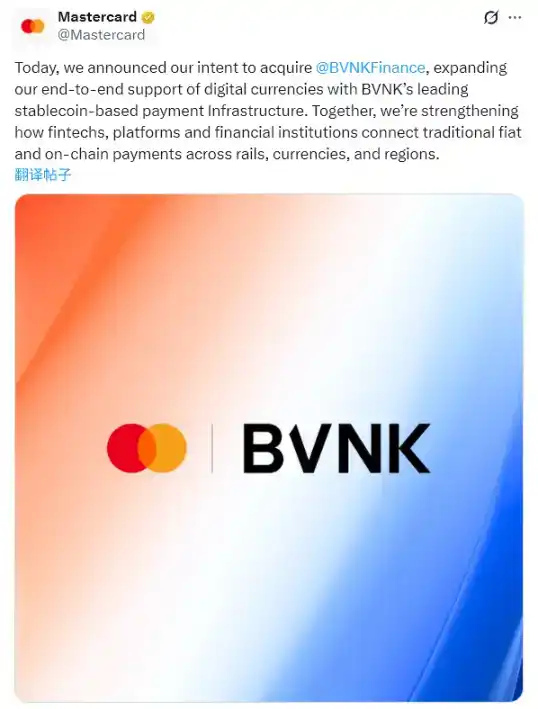
On March 17, global payment giant Mastercard announced the acquisition of stablecoin infrastructure provider BVNK. The deal is valued at up to $1.8 billion, including a $300 million contingent payment clause. Mastercard expects to complete the transaction by the end of this year, thereby expanding its end-to-end support capabilities in the digital assets and cross-currency value transfer fields.
The Value of the Outcast: Coinbase's Hesitation and Mastercard's Decisiveness

BVNK was founded in 2021 and is headquartered in London. In May 2022, BVNK completed a $40 million Series A funding round, reaching a post-money valuation of $340 million. Two years later, in December 2024, it completed a $50 million Series B funding round, raising its valuation to approximately $750 million.

BVNK is led by three South African founders, including CEO Jesse Hemson-Struthers (a serial entrepreneur who previously founded e-commerce and gaming companies acquired by Naspers and Sportradar, respectively), CTO Donald Jackson (a blockchain and enterprise systems expert), and CBO Chris Harmse (a CFA charterholder and former macro/crypto fund partner focused on foreign exchange and cross-border payments).

This startup has quietly built a vast settlement network for crypto assets.

Currently, the platform processes an annual stablecoin payment volume of about $25–30 billion. It provides businesses with a seamless channel connecting fiat currency and stablecoins, supporting payment activities across major blockchain networks in over 130 countries and regions.

But before Mastercard made its move, the real potential buyer for BVNK was actually crypto giant Coinbase.

In November 2025, acquisition talks between Coinbase and BVNK, valued at up to $2 billion, entered the deep due diligence phase, and the two parties even signed an exclusivity agreement at one point.

Coinbase was an investor in its Series B round. Had the deal gone through, it would have been a landmark event for a crypto-native company expanding into the core of global payment infrastructure. However, the two parties ultimately called off the deal that same month without disclosing any substantive reasons for the breakdown.

As Coinbase stepped back, Mastercard swiftly moved in to fill the gap precisely.

For a startup with annual revenue of only about $40 million, the $1.8 billion price tag appears extremely expensive from a financial model perspective. But this sky-high price was never about current profitability; it was about buying a monopoly-level ticket to the next-generation settlement network.

Defensive Counterattack: Buying Out the Possibility of 'Bypassing Card Networks'

Mastercard's move is actually a strategic counterattack with strong defensive overtones.

Stablecoins are visibly eroding the market share of traditional cross-border settlements. With their 24/7 operation, low friction costs, and extremely fast settlement speeds, blockchain-based digital dollars are beginning to show their edge in B2B payments and cross-border remittance scenarios.

In the global financial network, traditional credit card organizations are the payment channels most threatened by the disruption of stablecoins. If multinational corporations and business institutions become accustomed to peer-to-peer on-chain settlements, the centralized fiat routing network that Mastercard relies on for survival faces the risk of being completely marginalized.

If you can't beat them, decisively buy them.

Mastercard's Chief Product Officer, Jorn Lambert, was unequivocal about this. In the acquisition announcement, he stated that he expects most financial institutions and fintech companies to offer digital currency services in the future.

Mastercard's calculation is very clear: it is determined to directly integrate BVNK's ready-made stablecoin rails and compliance engine into its vast global fiat network. Stablecoins are no longer competitors to card networks; instead, they have been forcibly incorporated as a highly complementary business subset of its underlying network.

Traditional giants are building high walls with capital barriers that are difficult to surmount.

Land Grab: Wall Street's Payment Table Has No New Players

This is by no means an isolated action by Mastercard alone; the entire traditional finance sector is frantically scrambling for access to on-chain infrastructure.

Even before this acquisition was finalized, BVNK's backers already included a豪华 (luxury) lineup of Wall Street capital. In May 2025, Mastercard's arch-rival Visa made a strategic investment in BVNK through its venture arm, Visa Ventures.

Then, in October, Citi Ventures, the venture capital department of Citigroup, also invested real money to join the game. Although Citi declined to disclose the specific investment amount and BVNK's valuation, the company stated in an interview that its valuation was higher than the $750 million from the Series B round.

Even just two months before Mastercard announced the acquisition, Visa高调 (high-profile) announced it would integrate BVNK's stablecoin settlement capabilities into its core Visa Direct platform to support cross-border fund disbursement to global digital wallets.

This is both a hard technological integration and a默契 (tacit) capital collusion.

Looking across the entire payments industry, Silicon Valley's current darling, Stripe, had previously acquired stablecoin startup Bridge for $1.1 billion. And before finalizing the BVNK deal, Mastercard was also reported by the market to be in acquisition talks with another crypto infrastructure startup, Zerohash (founded in 2017, headquartered in Chicago), for as much as $1.5 to $2 billion.

Traditional payment giants are using疯狂且密集 (frenzied and密集 intensive) mergers and acquisitions to重新聚拢 (re-aggregate) the originally decentralized, fragmented stablecoin liquidity within the highly familiar business frameworks and regulatory channels they control.

At this highly lucrative table, the ones who ultimately sit down are still the old rulers holding heavy capital.


İlgili Sorular

QWhat is the significance of Mastercard's acquisition of BVNK for the digital asset and cross-border payment industry?

AMastercard's acquisition of BVNK, valued at up to $1.8 billion, is significant as it aims to expand the company's end-to-end support capabilities in digital assets and cross-currency value transfer. It represents a strategic move by a traditional payment giant to integrate stablecoin infrastructure, counter the threat of blockchain-based settlements, and secure a dominant position in the next-generation payment network.

QWhy did Coinbase's potential acquisition of BVNK fall through, and how did Mastercard capitalize on this?

ACoinbase's acquisition talks with BVNK, which reached an advanced stage including due diligence and an exclusivity agreement, were called off in November 2025 without public disclosure of the specific reasons. Mastercard swiftly moved in to acquire BVNK after Coinbase's withdrawal, seizing the opportunity to secure a key player in the stablecoin infrastructure space.

QHow does BVNK's business model and network pose a threat to traditional card networks like Mastercard?

ABVNK's platform, which processes $25-30 billion in annual stablecoin payment volume, provides a seamless channel for businesses to convert between fiat and stablecoins, supporting payments across 130+ countries. Its blockchain-based, peer-to-peer settlement offers 24/7 operation, low friction costs, and fast clearing, threatening to marginalize the centralized fiat routing networks that traditional card organizations like Mastercard rely on.

QWhat defensive strategic motive does Mastercard have for acquiring BVNK?

AMastercard's acquisition is a defensive strategic move to counter the disruptive threat of stablecoins to traditional cross-border settlement. By acquiring BVNK, Mastercard aims to co-opt the technology, integrating its stablecoin轨道 and compliance engine into its global fiat network, thereby turning a potential competitor into a complementary subset of its business and building high capital barriers to maintain its dominance.

QHow are other major traditional financial institutions involved in the stablecoin infrastructure space, as indicated in the article?

AOther major traditional financial institutions are heavily investing in stablecoin infrastructure. Visa's venture arm, Visa Ventures, made a strategic investment in BVNK in May 2025, and Citi Ventures also invested later that year. Furthermore, Visa integrated BVNK's stablecoin settlement capabilities into its Visa Direct platform. Stripe also acquired stablecoin startup Bridge for $1.1 billion, indicating a trend of traditional payment giants consolidating the fragmented stablecoin liquidity within their familiar commercial and regulatory frameworks.

İlgili Okumalar

Xiaohongshu's Second Great Voyage, This Time Sailing Towards AI

Xiaohongshu's Second Voyage: Navigating Towards AI Since ChatGPT's emergence, Xiaohongshu's founder Mao Wenchao has been acutely aware of AI's potential threat, recognizing that the life advice people seek from chatbots overlaps directly with his platform's core business. Founded in 2013 as a PDF shopping guide for Chinese tourists, Xiaohongshu evolved into a massive community where millions share authentic, personal experiences—from product reviews to travel tips. This vast repository of "I've tried this" human judgment became its most valuable asset. However, the rise of AI, which delivers instant answers, challenges the very need for users to sift through numerous personal notes. Fearing its treasure trove of lived experience could become mere training data for others, Xiaohongshu is proactively adapting. In 2026, it established a dedicated AI division (Dots), launched RED Skill to turn user experiences into usable AI tools, and acquired the AI search product "Diandian." Its investments now extend to AI firms like MiniMax and hardware startups, moving upstream to address needs before they even become search queries. The platform's commercialization strategy is also evolving. With a newly acquired payment license and tools like the AIPS model to track consumer decision journeys, Xiaohongshu aims to seamlessly integrate recommendations with transactions, embedding commerce within AI-generated answers. Yet, a critical tension remains. While building smarter machines to organize and leverage its human experiences, Xiaohongshu must prevent AI from drowning out the authentic, flawed, and trustworthy "I've tried this" voices that built its community. Its core challenge is to harness AI's power without letting the map—the machine's perfect, synthesized answer—replace the territory of genuine human experience. This balance between technological advancement and preserving human trust defines its current journey and its future.

marsbit24 dk önce

Xiaohongshu's Second Great Voyage, This Time Sailing Towards AI

marsbit24 dk önce

SharpLink CEO: How to Understand Ethereum Developers Just Exceeded 1 Million?

SharpLink CEO reflects on the milestone of Ethereum surpassing 1 million historical developers, emphasizing that this figure represents the largest pool of technical talent ever assembled around an open, permissionless blockchain network. While approximately 232,000 developers remain active, the key question for the crypto industry is not which chain is fastest, but where the best builders choose to build long-term. Ethereum's advantage lies in a decade-long accumulation of infrastructure, standards, tools, liquidity, and a cohesive culture, making it the default operating system for programmable finance. This developer base is tackling complex challenges: the Glamsterdam upgrade aims to enhance scalability while preserving core principles; synchronous composability seeks to unify Rollup ecosystems; and significant efforts are underway for post-quantum security. Ethereum's deeper network effects stem from composability and shared standards (like the EVM and Solidity), creating a flywheel of more developers, tools, and liquidity. Three reinforcing strengths cement Ethereum's lead: credible neutrality (secured by ~900k validators), a modular architecture with interconnected Rollups, and a culture that attracts top researchers. The ecosystem is consolidating as the trusted coordination layer for internet-native finance, favored by large institutions valuing security and liquidity. The future of Ethereum is being built by this global community of founders and architects.

链捕手39 dk önce

SharpLink CEO: How to Understand Ethereum Developers Just Exceeded 1 Million?

链捕手39 dk önce

A Clod of Chinese Soil Chokes Two Japanese Giants

"Chinese Soil Chokes Japanese Giants" The production of a key electronic specialty gas, tungsten hexafluoride (WF6), vital for manufacturing AI chips, was halted by two leading Japanese producers—Kanto Denka and Central Glass. Their shutdown was not due to a technological failure but a sudden, critical shortage of a raw material they had long taken for granted: ultra-high-purity (6N-grade) tungsten powder, which is almost entirely sourced from China. Following a quiet Chinese export announcement in January 2026, tungsten powder shipments to Japan dropped to zero for months. Despite frantic efforts, Japanese companies found no viable alternative; imported powder was three times more expensive and lacked the required purity. Their existing stockpiles were exhausted by mid-2026. WF6 is essential for depositing tungsten into the microscopic contact holes of High Bandwidth Memory (HBM) chips, which are crucial for advanced processors like those from Nvidia. While Japanese firms had mastered producing ultra-pure WF6 gas, their entire supply chain relied on China's 6N tungsten powder—a dependency now revealed as a fatal vulnerability. China's dominance in this "soil" results from decades of painstaking R&D by companies like Xiamen Tungsten and China Tungsten & Hightech. They overcame immense technical hurdles, such as separating chemically similar molybdenum from tungsten, to achieve mass production of the world's purest tungsten powder. With their primary suppliers gone, Kanto Denka and Central Glass announced a permanent halt to WF6 production starting July 1, 2026. This immediately created a supply crisis for major semiconductor manufacturers like Samsung and SK Hynix, forcing them to urgently seek and certify new Chinese suppliers for WF6 itself. The reversal marks a dramatic shift: China has moved from exporting low-value raw materials to controlling the high-purity foundation of a critical global tech supply chain, upending a long-established industrial hierarchy.

marsbit1 saat önce

A Clod of Chinese Soil Chokes Two Japanese Giants

marsbit1 saat önce

İşlemler

Spot
Futures
活动图片