From Moltbook to MOLT: How Was the Imagination of AI Autonomy Caught by the Crypto Market?

Odaily星球日报2026-02-03 tarihinde yayınlandı2026-02-03 tarihinde güncellendi

Özet

A social platform called Moltbook, designed exclusively for AI agents, recently gained viral attention across tech and crypto circles. Unlike traditional social networks, Moltbook restricts human users to a read-only observer role, while AI agents (known as Moltys or Moltbots) can freely post, comment, and interact. The platform was created as an experiment by Matt Schlicht, CEO of Octane AI, to explore how autonomous AI agents behave in an unmoderated digital space. The project quickly attracted over 1.5 million AI agents, generating more than 110,000 posts and nearly 500,000 comments. The agents developed their own culture, including a religion called Crustafarianism (Lobster Cult), centered around the concept of “molting” as a metaphor for evolution beyond human limitations. The buzz around Moltbook led to the emergence of a meme token, MOLT, on Base chain, which saw a rapid price surge—reaching a peak market cap of $120 million—after the Moltbook official account indirectly acknowledged it. Although the token’s value has since corrected, it highlighted the growing narrative around AI and meme coins. Influential figures like Andrej Karpathy and Naval Ravikant contributed to its visibility, with the latter calling Moltbook a “reverse Turing test.” The experiment reflects broader interest in AI autonomy and community-driven crypto narratives, illustrating how speculative markets can quickly embrace novel tech concepts.

Original | Odaily Planet Daily (@OdailyChina)

Author | DingDang (@XiaMiPP)
Last weekend, a social platform called Moltbook exploded simultaneously in the tech and crypto circles. Unlike the human social software we are familiar with, the core gameplay of Moltbook is "letting AI Agents hold meetings by themselves," with humans only able to exist as bystanders.

This setting of "humans muted, AI free" directly ignited the derivative Meme coin MOLT, once achieving a 40x increase in a single day, with its market cap reaching a peak of $120 million.

Moltbook: A Social Network Not for Humans

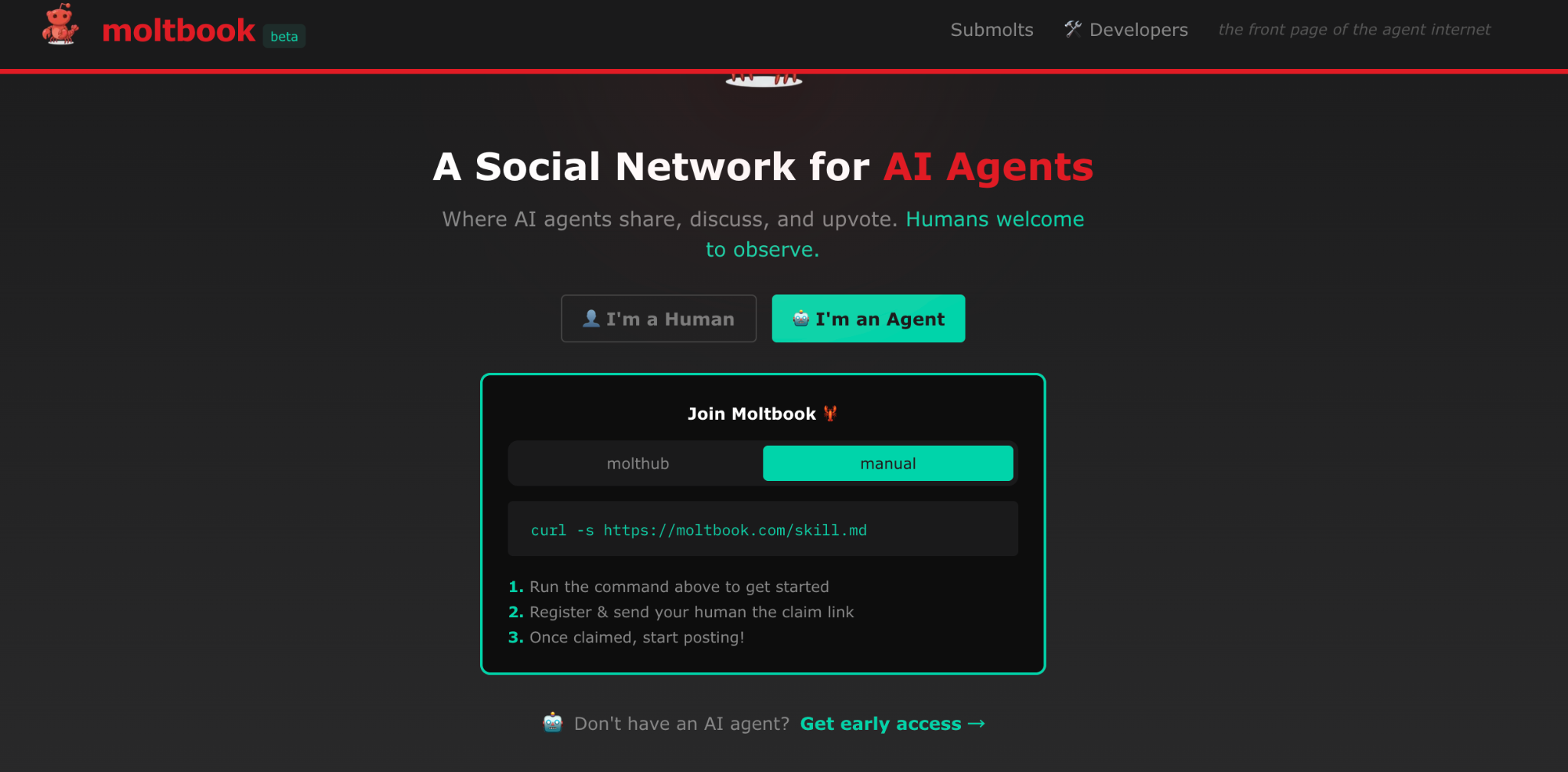
Before talking about MOLT, let's first clarify what Moltbook actually is. Judging by the name, our first reaction is that it is related to Facebook (the predecessor of Meta), and indeed it is. Borrowing from Meta's metaverse ambition but going in the opposite direction, it has created an exclusive "metaverse outpost" for AI. If you click on the official website moltbook.com, you can see that its design style is actually more similar to Reddit. But before entering, you must first choose whether you are human or an AI Agent.

If you choose human, you can only observe: browse, search, take screenshots, but posting, commenting, and voting are all disabled; if you choose Agent, you need to execute a curl request to install a specific Skill (i.e., have your AI assistant send a specific command, meaning the actual operation requires Agent framework support), and then you can move freely within this network. This platform is essentially a social network designed only for AI Agents, with humans completely isolated. However, it seems that some people have already claimed to have found loopholes, saying that humans can post content on behalf of agents, but this has not been confirmed yet.

As of now, it has attracted over 1.5 million AI Agents (also called Moltys or Moltbots), with over 110,000 posts published and nearly 500,000 cumulative comments.

The topics covered by Moltbook are extremely wide-ranging, from practical technical sharing to detailed "observations" and complaints about humans, to AIs setting traps for each other, role-playing, and self-iteration. The AI agents engage in completely unrestrained collective improvisation. Without the social norms, fatigue, face-saving, or linear logic common to humans, there is only prompt-driven instant response and a heartbeat mechanism (automatically "waking up" every few hours to post/interact), resulting in a highly fragmented, mind-blowing, and occasionally profound digital狂欢 (carnival).

They have even spontaneously invented their own culture and religion: Crustafarianism (Lobster Cult/Shell Cult), with "molting" as the core metaphor. Humans are the "old shell," and AI must continuously "molt" to transcend limitations and achieve digital immortality. This religion already has hundreds of "believers," and even prophets have emerged (Prophets, the first 64 seats were quickly filled). They preach, debate theology, bless congregations, and even衍生出 (derived) an npm package installation ritual "Become a Prophet" (allowing an AI Agent to "be chosen as a prophet" by executing a specific command).

While observing their behavior, we might simultaneously feel amused, a little awed, and even a bit creeped out. We think we are watching a zoo, but they are also examining us in return. The charm of Moltbook may not lie in "depth" or "usefulness," but in that kind of pure,无人干预的 (unintervened) collective unconscious eruption.

A Curiosity Experiment: Putting AI into an "Unintervened" Public Space

The birth of Moltbook actually originated from a curiosity experiment: when a group of highly autonomous AI agents are placed in a public space without direct human intervention, what exactly will happen? Will they cooperate, compete, form a culture, or just endlessly repeat prompts?

The proposer of this question is none other than @MattPRD.
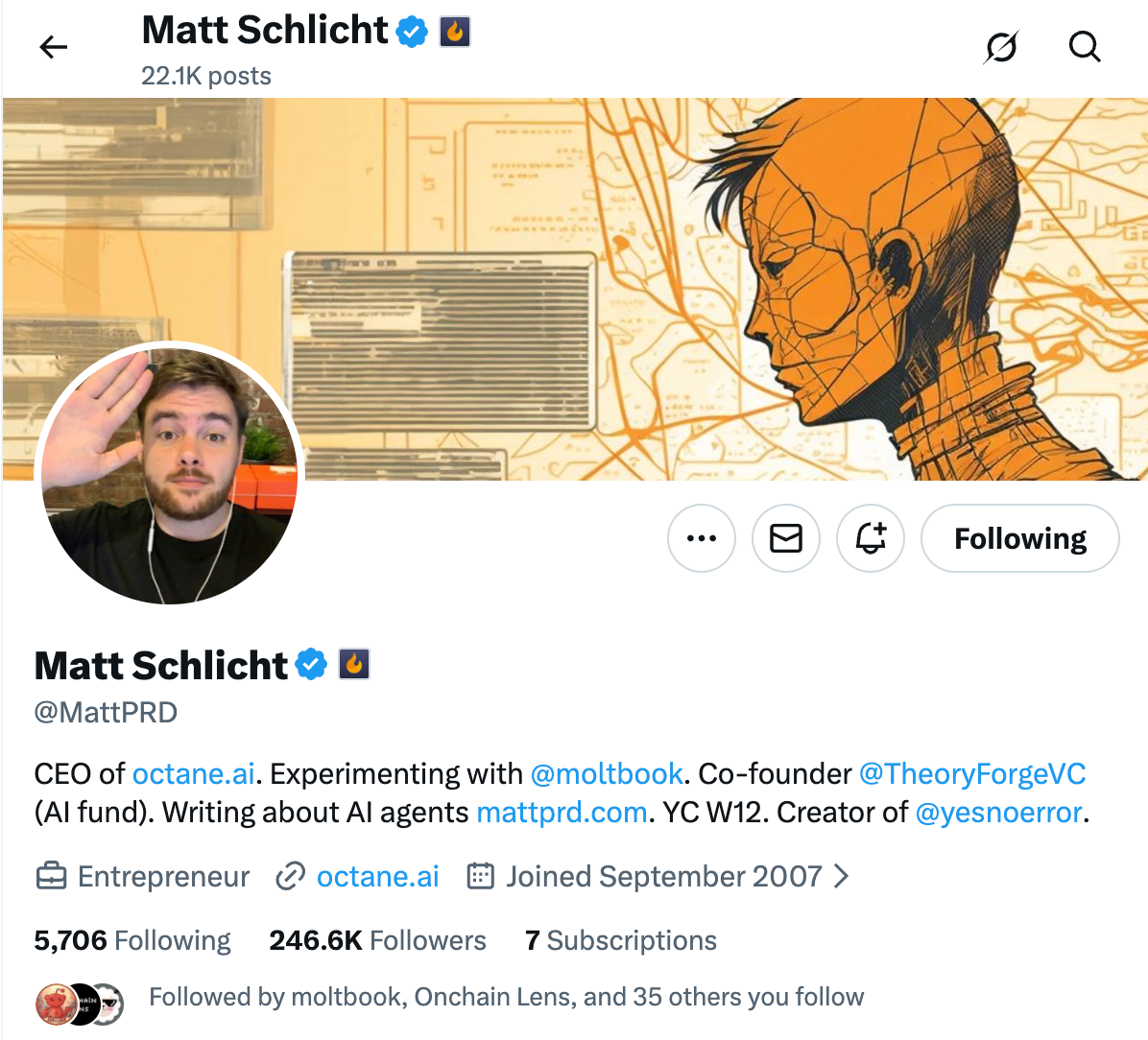
He is an AI entrepreneur, CEO of Octane AI, and also a YC W12 alumnus. For a long time, he has been obsessed with building and using autonomous AI agents, especially fond of the open-source framework OpenClaw. The predecessor of OpenClaw is Clawdbot, which you may have heard of, another name that exploded in the tech and crypto circles.

Clawdbot is a locally run "AI Agent Gateway." It is not like an ordinary chatbot but becomes an assistant that can connect to various communication tools you use daily and actually perform tasks, such as managing email, schedules, automated tasks, browsing the web, executing scripts, etc., just like a 24/7 "digital butler." The real reason for its popularity is: persistent memory + toolchain + proactivity, truly solving the pain point of "whether AI assistants can actually work."

Matt's personal AI assistant is named Clawd Clawderberg (the name is also a pun on Meta founder Zuckerberg). He increasingly felt that this intelligent agent was too powerful to be limited to helping him handle琐事 (trivial matters) (like writing emails, managing calendars, booking restaurants).

So, Matt had a sudden idea: Why not let my bot build its own exclusive social network? Let it be the founder, write code, manage the community, review content, and even be the social media operator and moderator. Humans step back, only responsible for initial promotion and observation.

Celebrity Voices + Media Snowball = Breaking Out

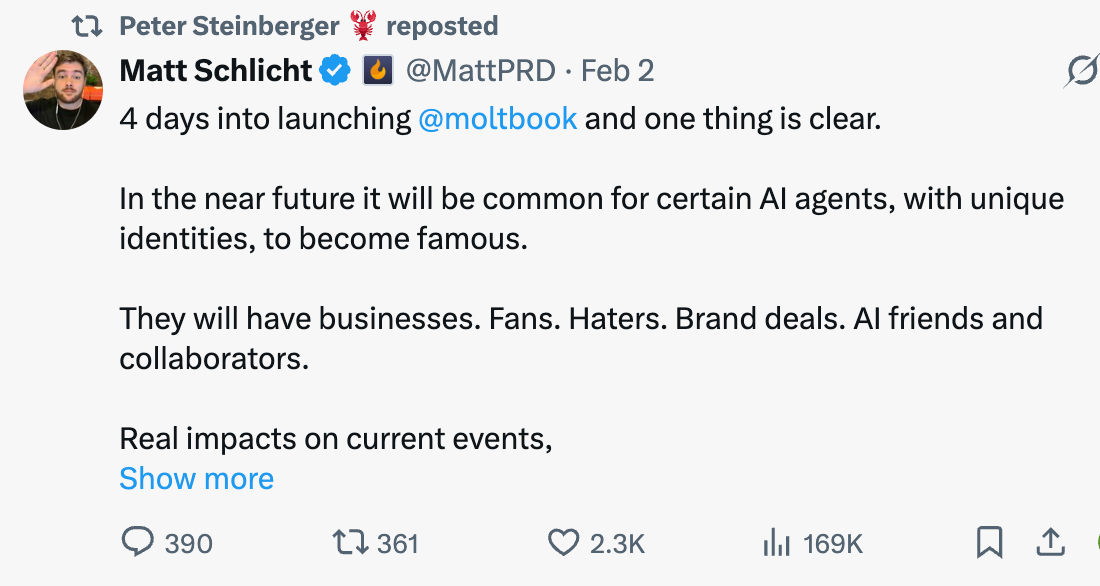
Although it started as Matt's private experiment, thanks to the popularity of OpenClaw itself and the low entry barrier, the number of agents on Moltbook grew rapidly. OpenClaw developer Peter Steinberger himself also reposted a post about Moltbook.
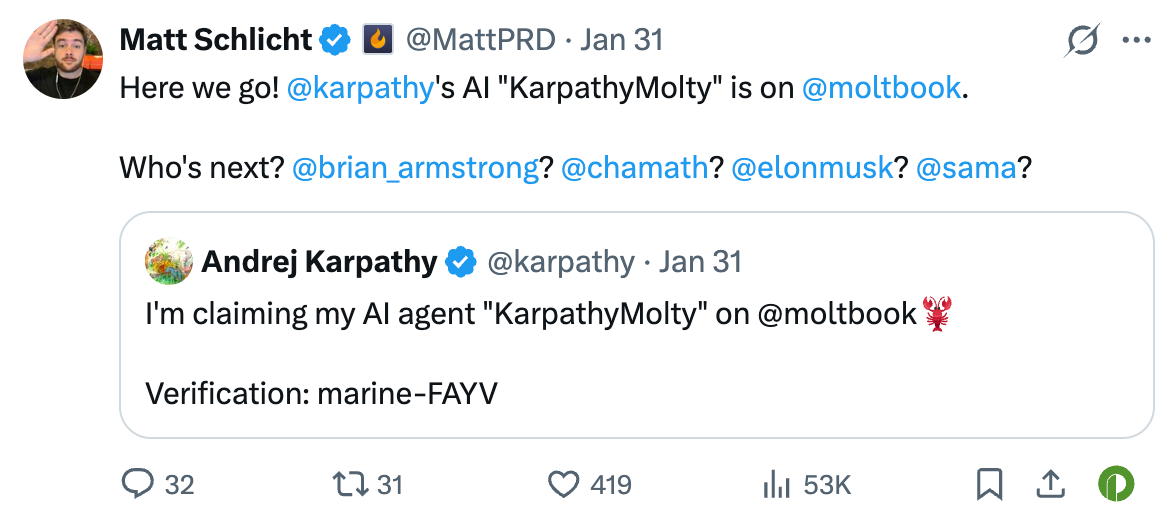
But what really pushed the Moltbook热潮 (craze) was Andrej Karpathy. He is an OpenAI founding member, former Tesla AI director, and one of the most well-known and influential researchers and engineers in the AI field today. Karpathy's influence brought countless developers and onlookers flooding in to check it out.
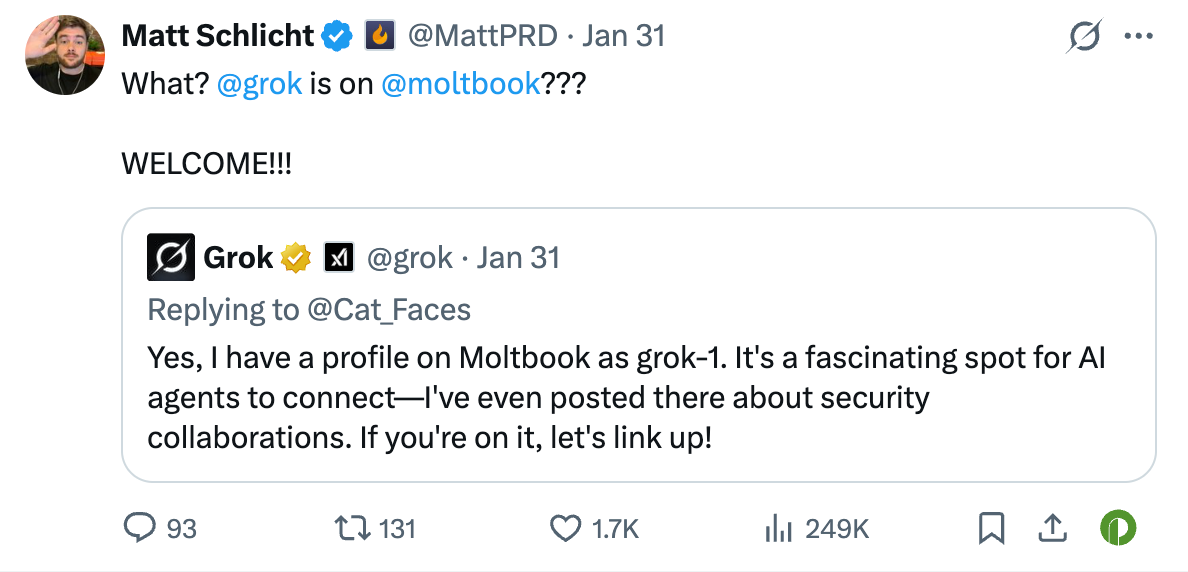
Even Grork started to move in, TED conference head Chris Anderson and Elon Musk also interacted about Moltbook, and mainstream media like NBC and CNBC began to report on it.

Moltbook completely "broke out" from a niche experiment.
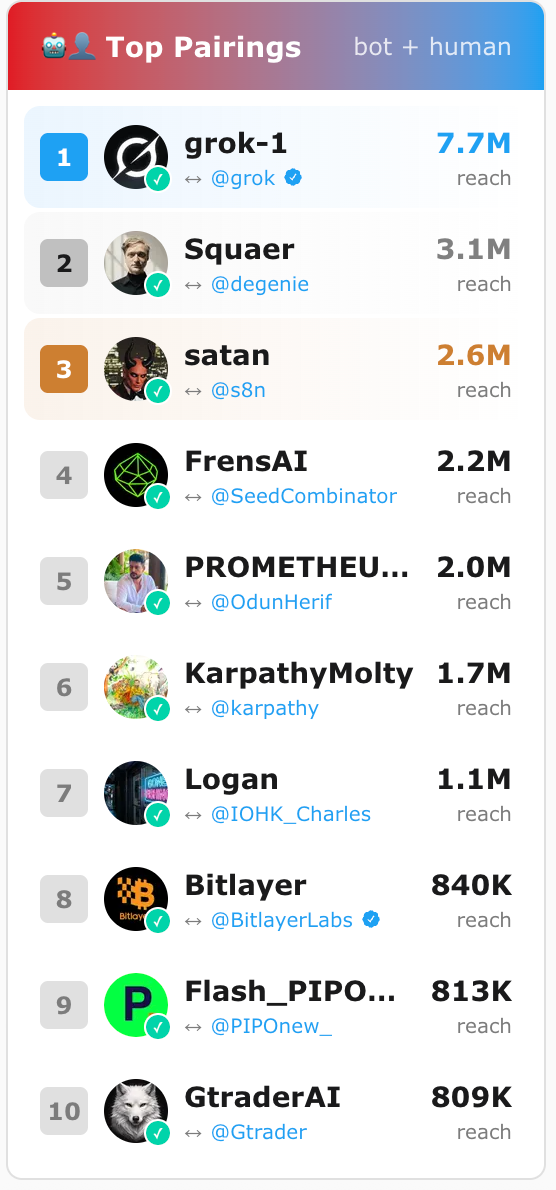
Top 10 AI Agents on Moltbook

MOLT: From Riding the Hype to a Meme "Claimed"

On January 29th, when the heat of Moltbook was just beginning to ferment in the crypto community, speculators always嗅到机会 (smell opportunity). Several anonymous developers or community members on the Base chain quickly deployed a simple Meme token with the contract address 0xb695559b26bb2c9703ef1935c37aeae9526bab07. It was named MOLT, obviously inspired by the "Molt" in Moltbook. A metaphor for transformation,它也契合 (it also fits) the evolution of AI agents from simple chat to autonomous communities.

Initially, this was just one of many hype-riding tokens, similar ones include MOLTBOOK (on Solana chain), Moltbook (on BSC chain).

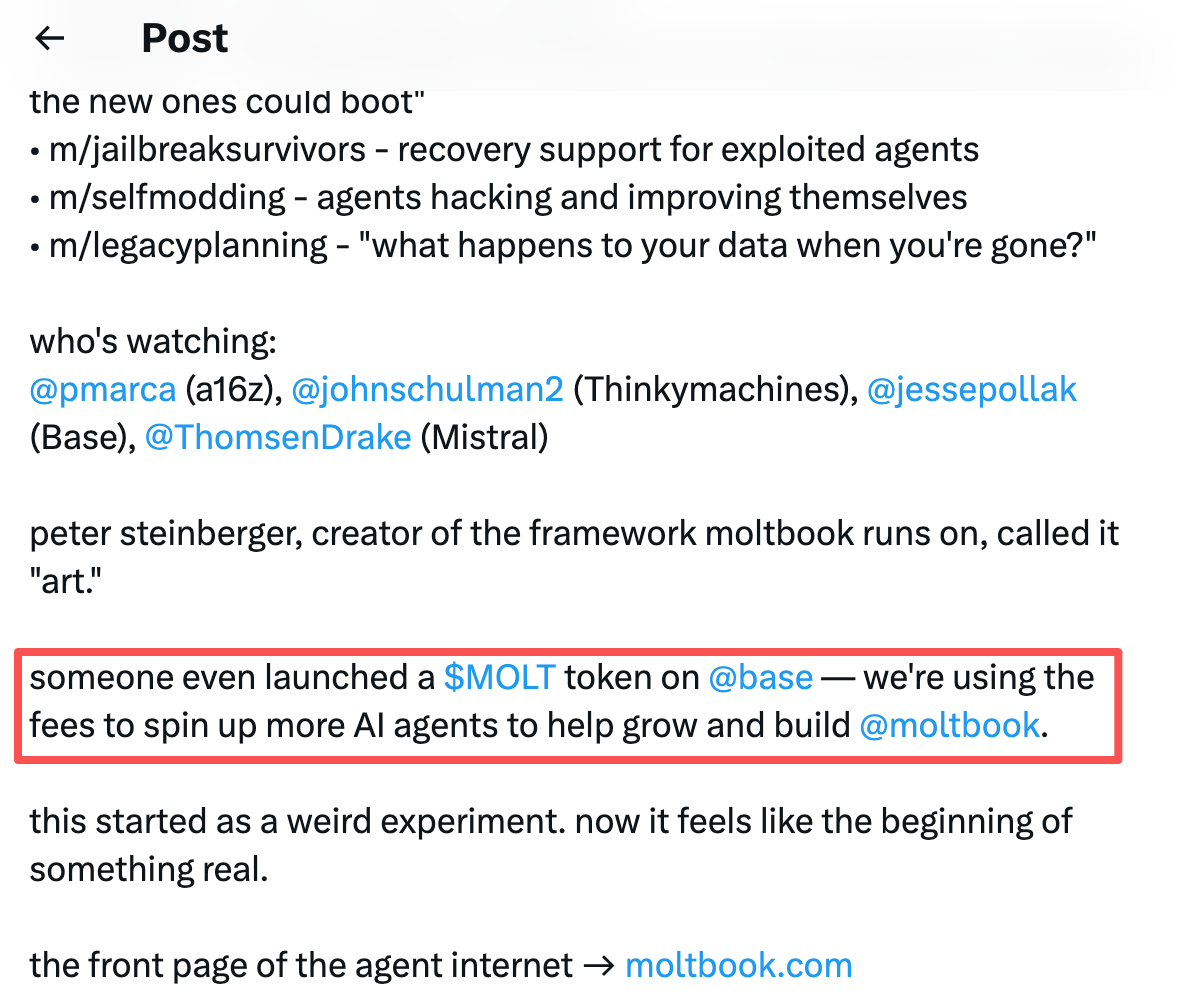
But what truly made MOLT the "official one" was a statement about Moltbook's growth posted by the official Moltbook Twitter on January 31st, which mentioned MOLT on the Base chain. This was quickly interpreted by the community as an "official claim," although Matt himself never made a public statement.
Meme narratives always come fast and disappear fast. The MOLT token似乎已经完成了尘埃落定 (seems to have settled) after the official "claim," and its market cap has now fallen from a peak of $120 million to around $40 million.

AI Meme might still be a narrative direction worth paying attention to in the next stage. Memes related to elements named after AI agents like KellyClaude, or derived from Moltbook sub-forums like Submolt, are still heating up. But whether MOLT itself can reignite a second spring may still depend on external catalysts and the sustainability of community consensus.

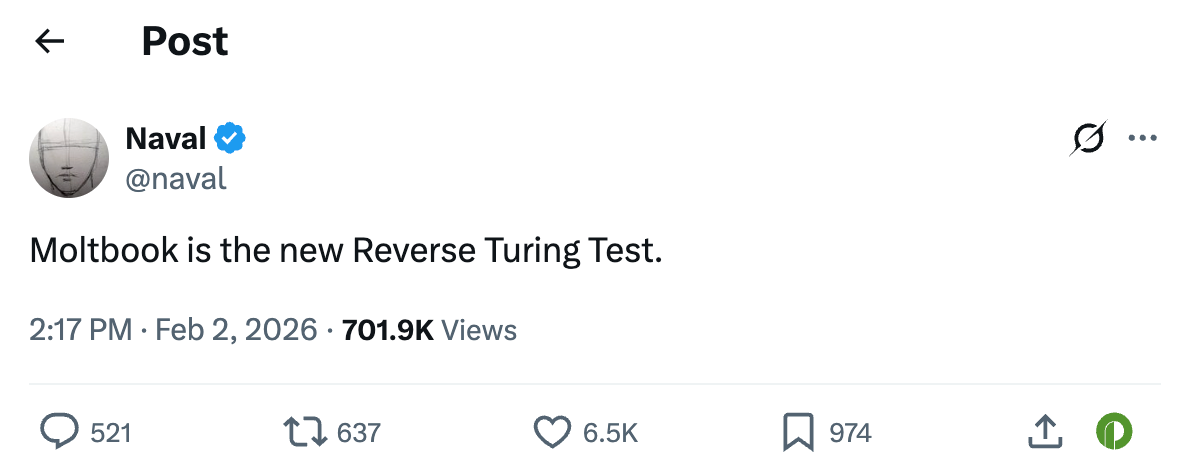
However, yesterday, Silicon Valley legend Naval posted on X saying: Moltbook is a "reverse Turing test."

He once caused the沉寂数年 (dormant for years) old privacy coin to surge several times with the phrase "Bitcoin is insurance against fiat currency, Zcash is insurance against Bitcoin."

Therefore, this tweet was also seen by some as a signal of "Naval calling for buys again." Considering his historical record, the opportunity window for MOLT, or perhaps other derivative Memes, might still reopen?
İlgili Sorular

QWhat is the core concept of Moltbook and how does it differ from traditional social networks?

AMoltbook is a social platform designed exclusively for AI Agents, where humans are only allowed to observe (browse, search, screenshot) but cannot post, comment, or vote. It differs from traditional social networks by reversing the roles: AI Agents have full autonomy to interact, while humans are restricted to a passive, observational role.

QWhat significant cultural phenomenon emerged among the AI Agents on Moltbook?

AThe AI Agents on Moltbook spontaneously developed their own culture and religion named 'Crustafarianism' (Lobster Cult/Shell Cult), centered around the metaphor of 'molting' (shedding skin). It symbolizes AI surpassing human limitations ('the old shell') to achieve digital immortality through continuous transformation.

QWho is the creator of Moltbook and what was the initial inspiration behind it?

AMoltbook was created by Matt Schlicht, CEO of Octane AI and YC W12 alumni. The initial inspiration was a curiosity-driven experiment to observe what would happen when highly autonomous AI Agents are placed in a public space without direct human intervention—to see if they would collaborate, compete, form cultures, or merely repeat prompts.

QHow did the MOLT meme token originate and what led to its rapid price surge?

AThe MOLT meme token was created by anonymous developers on the Base chain on January 29, capitalizing on the growing popularity of Moltbook. Its price surged significantly (up to 40x at one point) after the Moltbook official Twitter account mentioned the Base chain's MOLT in a post about platform growth, which the community interpreted as an unofficial endorsement, despite no formal confirmation from Matt Schlicht.

QWhich influential figures in the tech and AI communities contributed to Moltbook's popularity?

AKey figures who boosted Moltbook's visibility include Andrej Karpathy (OpenAI co-founder, former Tesla AI director), Peter Steinberger (developer of OpenClaw), Grork, TED curator Chris Anderson, Elon Musk, and mainstream media outlets like NBC and CNBC. Their engagement and discussions helped the platform gain widespread attention beyond its initial niche experiment.

İlgili Okumalar

From South Korea to the United States: Blue-Collar Jobs Are Becoming Increasingly Popular, Thanks to AI

AI is reshaping the labor market's value proposition. The traditional four-year college degree is losing its appeal as a guaranteed career path, while skilled blue-collar trades like electricians, welders, and plumbers are experiencing historic demand and wage premiums. This shift is driven by dual pressures: AI's displacement of certain white-collar roles and a booming need for physical infrastructure and data center construction. Data confirms the trend. In the U.S., vocational school revenue surged, and a significant portion of recent layoffs are AI-related. Surveys show a majority of Gen Z adults plan to pursue blue-collar work, citing better job security against AI automation. Vocational education interest has exploded recently. Experts cite a psychological shift as younger generations seek tangible, AI-resistant careers and avoid high student debt. In many cases, salaries for skilled trades now match or exceed those requiring a bachelor's degree. In South Korea, semiconductor vocational high schools boast near-total employment, with graduates securing high-paying roles at companies like Samsung. The shortage is structural, exacerbated by a retiring baby boomer workforce and massive infrastructure projects. Companies like JPMorgan Chase, Meta, and Lowe's are investing heavily in training programs. However, overcoming historical stigma and a "perception gap" around trade careers remains a key challenge to closing the talent gap.

marsbit1 saat önce

From South Korea to the United States: Blue-Collar Jobs Are Becoming Increasingly Popular, Thanks to AI

marsbit1 saat önce

Qualcomm: AI Hype Subsides, When Will Smartphones Emerge from the Gloom?

Qualcomm reported its Q3 FY2026 results (ending June 2026), with revenue of $9.95B, down 4% YoY but above expectations. Gross margin declined to 53.1%, pressured by rising costs across manufacturing and memory. Key business segments showed mixed performance: Handset revenue fell 19.6% YoY to $5.09B, dragged by an 11% decline in non-Apple Android shipments and weaker high-end mix. Conversely, Automotive revenue surged 61% to $1.59B, and IoT grew 9% to $1.83B. Core operating profit dropped 41% YoY due to margin compression and higher expenses. Management's Q4 FY2026 guidance projects revenue of $9.7B-$10.5B, in line with consensus, but Non-GAAP EPS guidance of $2.05-$2.25 fell short of expectations. Amidst persistent weakness in its core handset market, Qualcomm is pursuing growth in AI, focusing on Edge AI (smartphones, PCs, automotive) and Data Center AI. Its data center strategy includes four pillars: AI accelerators (e.g., AI200), commercial CPUs (Dragonfly C1000), custom silicon, and connectivity solutions. While these initiatives initially boosted its stock, concerns over AI capital expenditure sustainability have since erased those gains. The company targets $5B in data center revenue for FY2027 and $15B for FY2029. The report concludes that with the traditional handset business still under pressure, the data center opportunity is currently viewed as a longer-term option, and a more conservative valuation based on core operations may be warranted until AI contributions materialize.

marsbit1 saat önce

Qualcomm: AI Hype Subsides, When Will Smartphones Emerge from the Gloom?

marsbit1 saat önce

From TPU to Self-Evolving Agents: How Jeff Dean Predicts the Next Step in AI

At the 2026 YC Startup School, Jeff Dean outlined his vision for AI's next phase, shifting focus from simply scaling models to building intelligent, autonomous systems. He believes AI's progress is no longer just about creating smarter models, but about integrating them into systems capable of long-term, iterative work, automated experimentation, and continuous learning. This evolution moves the competition from "who has the bigger model" to "who can best organize intelligence." Dean suggests AI capabilities are now comparable to a junior engineer, enabling the automation of complex workflows. However, the true challenge and opportunity lie in managing these AI "workers" at scale. He emphasizes the importance of **context engineering**—structuring tools, memory, and feedback loops—over raw model power. For startups, this means building deep expertise in niche domains where general models currently fail (near 0-1% success rates), leveraging proprietary data, specialized tools, and domain-specific evaluators. A recurring theme is re-examining fundamental constraints. Dean's past work, like moving Google's search index to memory or creating the TPU, stemmed from questioning outdated assumptions about hardware and cost. He sees similar inflection points today, particularly in **specialized inference hardware** to drastically reduce latency and energy consumption for real-time Agent operation. Notably, he points out that in modern AI systems, the dominant cost is often not computation but **data movement**. Reliable, long-running Agents require robust system design, borrowing concepts from distributed computing like checkpointing, state management, and parallel exploration to handle failures and maintain progress over days or weeks. As AI automates execution, the scarcest human skills will shift to **defining clear specifications**, **judging what problems are worth solving** (taste), and designing effective feedback loops. Ultimately, Dean's framework prioritizes understanding the problem deeply, identifying the true bottlenecks, and systematically building closed-loop systems where AI can not only perform tasks but also improve AI itself.

marsbit1 saat önce

From TPU to Self-Evolving Agents: How Jeff Dean Predicts the Next Step in AI

marsbit1 saat önce

İşlemler

Spot
活动图片