From "Manual Rules" to "AI Mind Reading": X's New Algorithm Reshapes the Information Flow, More Accurate and More Dangerous

比推2026-01-20 tarihinde yayınlandı2026-01-20 tarihinde güncellendi

Özet

Elon Musk's X (formerly Twitter) has transitioned from a recommendation system based on "manually stacked rules and heuristic algorithms" to one that relies entirely on a large AI model to predict user preferences. The new algorithm, For You," mixes content from accounts a user follows with posts from across the platform that the AI believes the user will like. The process begins by building a user profile based on historical interactions (likes, retweets, dwell time) and user features (following list, preferences). The system then gathers candidate posts from two sources: the user's direct network ("Thunder") and a broader network of potentially interesting content from strangers ("Phoenix"). After data hydration and an initial filtering step to remove duplicates, old posts, or content from blacklisted authors, the core scoring process begins. A Transformer model (Phoenix Grok) predicts the probability of a user taking various positive actions (like, retweet, reply, click) or negative ones (block, mute, report) on each post. A final score is calculated by weighting these probabilities. An Author Diversity Scorer is then applied to reduce the visibility of multiple posts from the same author in a single batch. The highest-scoring posts undergo a final filter to remove policy-violating content and remove duplicates from the same thread before being sorted into the user's feed. The shift represents a move from "telling the machine what to do" to "letting the machine learn ...

Written by: KarenZ, Foresight News

Original title: Plain Language Breakdown of X's New Recommendation Algorithm: From "Data Fishing" to "Scoring"


Has Musk changed Twitter's recommendation system from "manually stacking rules and mostly heuristic algorithms" to "purely relying on AI large models to guess what you like"?

On January 20, Twitter (X) officially disclosed the new recommendation algorithm, which is the logic behind the "For You" timeline on the Twitter homepage.

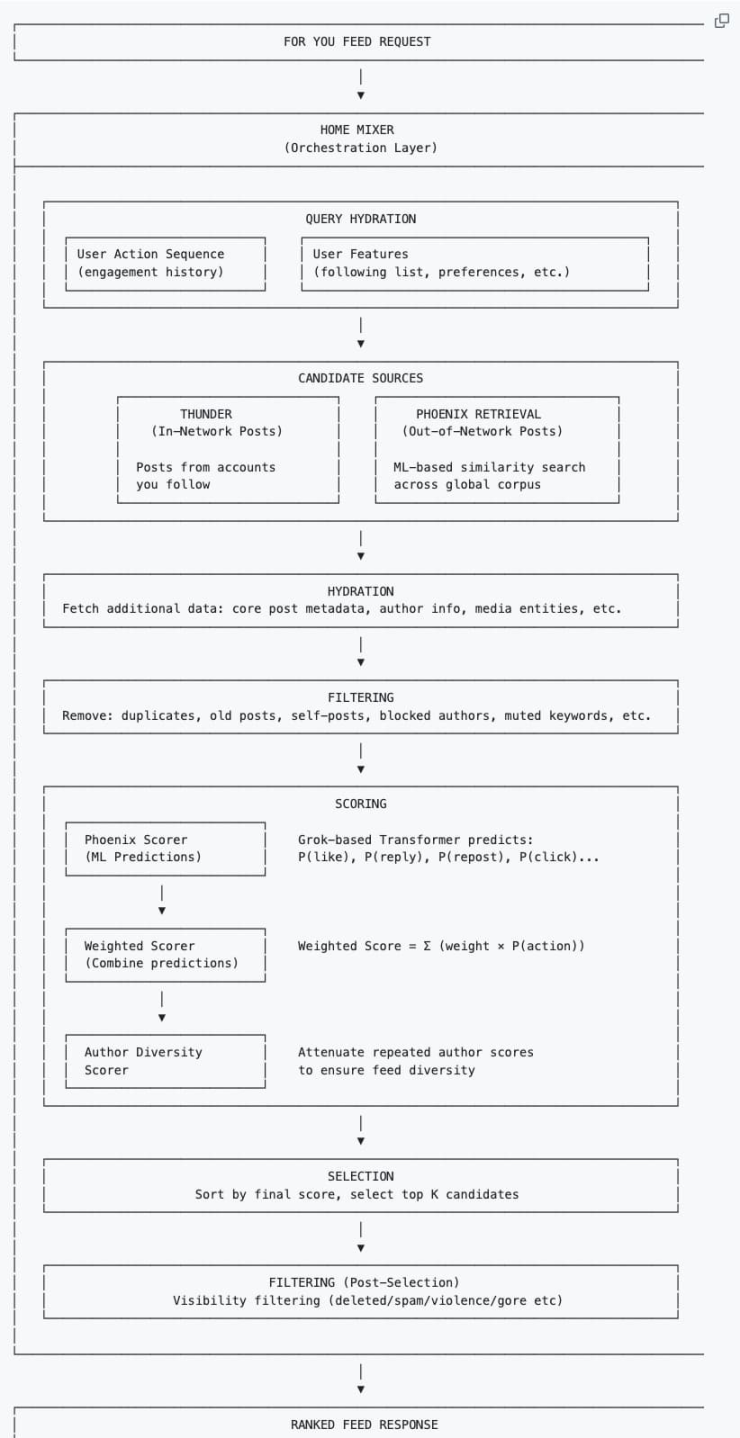
Simply put, the current algorithm is: mixing "content posted by people you follow" and "content from the entire network that might suit your taste," then sorting it based on a series of your previous actions on X, such as likes, comments, etc., according to its appeal to you. After two rounds of filtering, it eventually becomes the recommended information flow you see.

Below is the core logic translated into plain language:
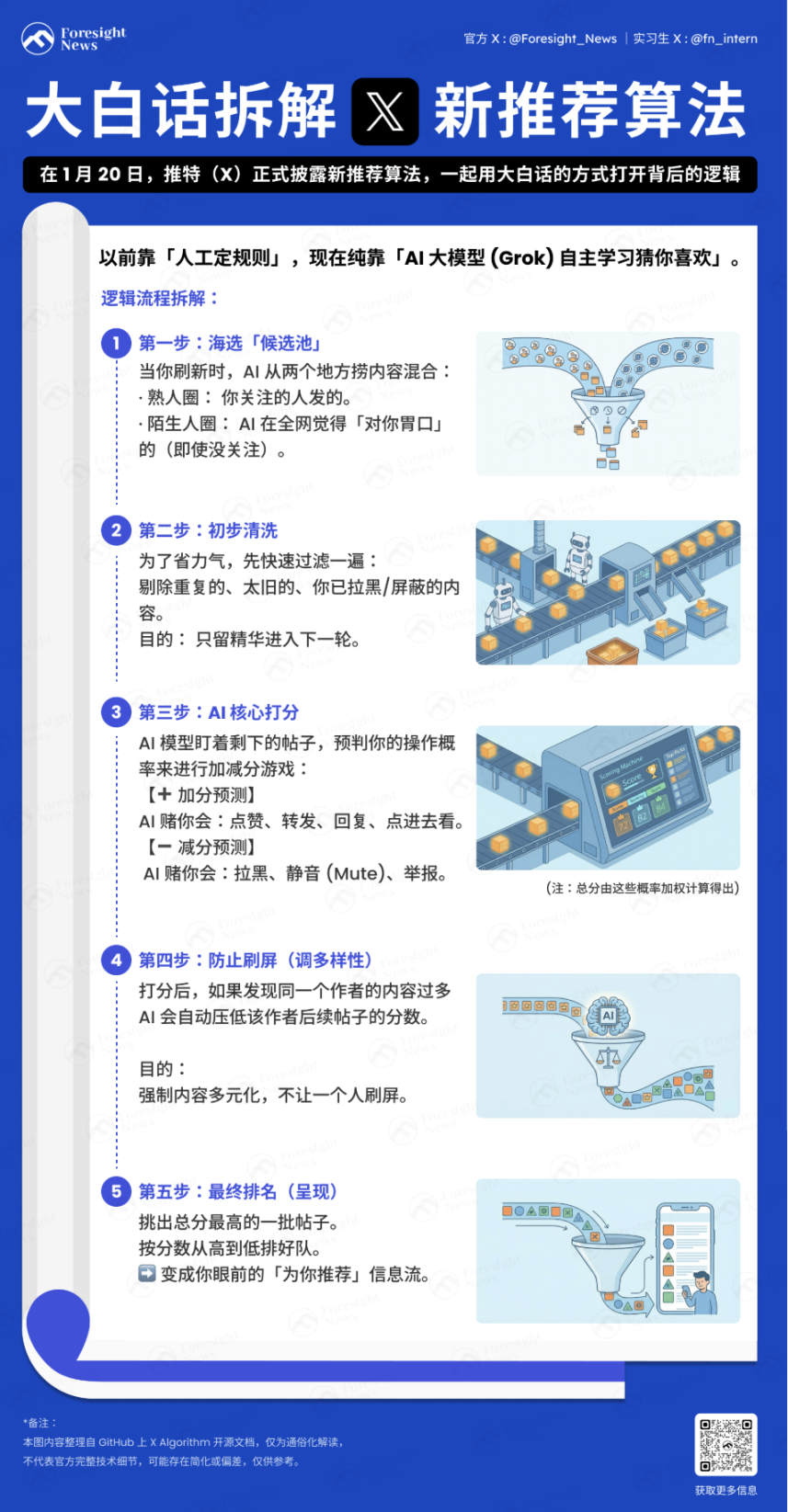
Building a Profile

The system first collects the user's contextual information to build a "profile" for subsequent recommendations:

  • User behavior sequence: Historical interaction records (likes, retweets, dwell time, etc.).

  • User features: Follow list, personal preference settings, etc.

Where does the content come from?

Every time you refresh the "For You" timeline, the algorithm fetches content from the following two sources:

  • Inner Circle (Thunder): Tweets from people you follow.

  • Outer Circle (Phoenix): Posts from people you don't follow, but which the AI, based on your taste, fishes out from the vast sea of people as posts you might be interested in (even if you don't follow the author).

These two piles of content are mixed together to form the candidate tweets.

Data Completion and Preliminary Filtering

After fishing up thousands of posts, the system pulls the complete metadata of the posts (author information, media files, core text). This process is called Hydration. Then it performs a quick cleaning round, eliminating duplicate content, old posts, posts the user themselves posted, content from blocked authors, or content containing muted keywords.

This step is to save computing resources and prevent invalid content from entering the core scoring phase.

How is scoring done?

This is the most crucial part. The Transformer model based on Phoenix Grok scrutinizes each remaining candidate post after filtering and calculates the probability of you performing various actions on it. It's a game of adding and subtracting points:

Plus points (Positive feedback): The AI thinks you are likely to like, retweet, reply, click on the image, or click to view the profile.

Minus points (Negative feedback): The AI thinks you are likely to block the author, mute, or flag the post.
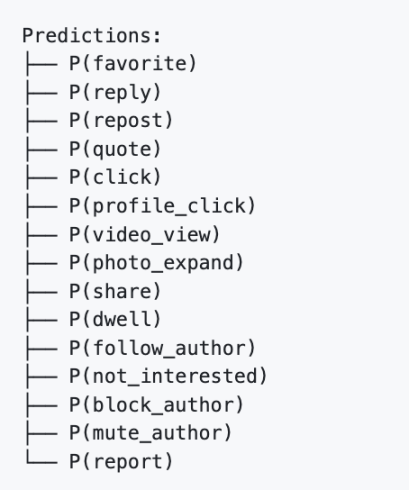
Final Score = (Like probability × weight) + (Reply probability × weight) – (Block probability × weight)...

It is worth noting that in the new recommendation algorithm, the Author Diversity Scorer usually intervenes after the AI calculates the final score. When it detects multiple pieces of content from the same author in a batch of candidate posts, this tool automatically "downgrades" the score of that author's subsequent posts, making the authors you see more diverse.

Finally, sort by score and pick the batch of posts with the highest scores.

Secondary Filtering

The system re-checks the top-scoring posts, filters out violations (such as spam, violent content), deduplicates multiple branches of the same thread, and finally arranges them in order from highest to lowest score, becoming the information flow you see.
Summary

X has removed all manually designed features and most heuristic algorithms from the recommendation system. The core advancement of the new algorithm lies in "letting the AI autonomously learn user preferences," achieving a leap from "telling the machine what to do" to "letting the machine learn how to do it itself."

First, recommendations are more accurate, and "multi-dimensional prediction" fits real needs better. The new algorithm relies on the Grok large model to predict various user behaviors—not only calculating "whether you will like/retweet" but also calculating "whether you will click the link to view," "how long you will stay," "whether you will follow the author," and even predicting "whether you will report/block." This refined judgment allows the recommended content to fit users' subconscious needs with unprecedented precision.

Second, the algorithm mechanism is relatively fairer and can, to some extent, break the curse of "big account monopoly," giving new and small accounts more opportunities: The old "heuristic algorithm" had a fatal problem: big accounts, relying on historically high interaction volumes, could get high exposure no matter what content they posted, while new accounts, even with high-quality content, were buried due to "lack of data accumulation." The candidate isolation mechanism allows each post to be scored independently, unrelated to "whether other content in the same batch is a hit." At the same time, the Author Diversity Scorer also reduces the spamming behavior of subsequent posts by the same author in the same batch.

For X the company: This is a cost-reducing and efficiency-increasing measure, using computing power to replace manpower, and using AI to improve retention. For users, we are dealing with a "super brain" that constantly tries to read our minds. The more it understands us, the more we rely on it. But precisely because it understands us too well, we will sink deeper into the "information cocoon" woven by the algorithm and become more easily targeted by emotionally charged content.


Twitter:https://twitter.com/BitpushNewsCN

Bitpush TG Discussion Group:https://t.me/BitPushCommunity

Bitpush TG Subscription: https://t.me/bitpush

Original link:https://www.bitpush.news/articles/7604412

İlgili Sorular

QWhat is the core change in X's new recommendation algorithm compared to the old system?

AThe core change is shifting from 'manually designed rules and mostly heuristic algorithms' to a system that 'relies purely on AI large models to guess user preferences', allowing the AI to autonomously learn user preferences.

QFrom which two sources does the new algorithm gather candidate content for a user's 'For You' timeline?

AIt gathers content from the 'Thunder' circle (posts from people the user follows) and the 'Phoenix' circle (posts from accounts the user doesn't follow but that the AI predicts they might be interested in).

QWhat is the purpose of the 'Author Diversity Scorer' in the new algorithm?

AThe Author Diversity Scorer detects when multiple posts from the same author are in a batch of candidate content and automatically lowers the score of that author's subsequent posts to ensure the user sees a more diverse range of authors.

QHow does the AI model determine the final score for a piece of content?

AA Transformer model calculates the probability of the user performing various actions on the content. It adds points for predicted positive feedback (like, retweet, reply) and subtracts points for predicted negative feedback (block, mute, report), with each action weighted. The final score is the sum of these weighted probabilities.

QWhat are two main potential consequences for users mentioned in the article regarding the new algorithm?

AThe consequences are: 1) More accurate and personalized content that better fits the user's subconscious needs. 2) A deeper entrapment in an 'information cocoon' and a higher likelihood of being precisely targeted by emotional content because the algorithm understands them so well.

İlgili Okumalar

North Korean Hackers Loot $500 Million in a Single Month, Becoming the Top Threat to Crypto Security

North Korean hackers, particularly the notorious Lazarus Group and its subgroup TraderTraitor, have stolen over $500 million from cryptocurrency DeFi platforms in less than three weeks, bringing their total theft for the year to over $700 million. Recent major attacks on Drift Protocol and KelpDAO, resulting in losses of approximately $286 million and $290 million respectively, highlight a strategic shift: instead of targeting core smart contracts, attackers are now exploiting vulnerabilities in peripheral infrastructure. For instance, the KelpDAO attack involved compromising downstream RPC infrastructure used by LayerZero's decentralized validation network (DVN), allowing manipulation without breaching core cryptography. This sophisticated approach mirrors advanced corporate cyber-espionage. Additionally, North Korea has systematically infiltrated the global crypto workforce, with an estimated 100 operatives using fake identities to gain employment at blockchain companies, enabling long-term access to sensitive systems and facilitating large-scale thefts. According to Chainalysis, North Korean-linked hackers stole a record $2 billion in 2025, accounting for 60% of all global crypto theft that year. Their total historical crypto theft has reached $6.75 billion. Post-theft, they employ specialized money laundering methods, heavily relying on Chinese OTC brokers and cross-chain mixing services rather than standard decentralized exchanges. Security experts, while acknowledging the increased sophistication, emphasize that many attacks still exploit fundamental weaknesses like poor access controls and centralized operational risks. Strengthening private key management, limiting privileged access, and enhancing coordination among exchanges, analysts, and law enforcement immediately after an attack are critical to improving defense and fund recovery chances. The industry's challenge now extends beyond secure smart contracts to safeguarding operational security at the infrastructure level.

marsbit55 dk önce

North Korean Hackers Loot $500 Million in a Single Month, Becoming the Top Threat to Crypto Security

marsbit55 dk önce

Circle CEO's Seoul Visit: No Korean Won Stablecoin Issuance, But Met All Major Korean Banks

Circle CEO Jeremy Allaire's recent activities in Seoul indicate a strategic shift for the company, moving away from issuing a Korean won-backed stablecoin and instead focusing on embedding itself as a key infrastructure provider within Korea’s financial and crypto ecosystem. Despite Korea accounting for nearly 30% of global crypto trading volume—with a market characterized by high retail participation and altcoin dominance—Circle has chosen not to compete for the role of stablecoin issuer. Instead, Allaire met with major Korean banks (including Shinhan, KB, and Woori), financial groups, leading exchanges (Upbit, Bithumb, Coinone), and tech firms like Kakao. This approach reflects a broader industry transition: the core of stablecoin competition is shifting from issuance rights to systemic positioning. With Korean regulators still debating whether banks or tech companies should issue stablecoins, Circle is avoiding regulatory uncertainty by strengthening its role as a service and technology partner. The company is deepening integration with trading platforms, building connections, and promoting stablecoin infrastructure. This positions Circle to benefit regardless of which entity eventually issues a won stablecoin. Allaire also noted the potential for a Chinese yuan stablecoin in the next 3–5 years, underscoring a regional trend of stablecoins becoming more regulated and integrated with traditional finance. Ultimately, Circle’s strategy highlights that future influence in the stablecoin market will belong not necessarily to the issuers, but to the foundational infrastructure layers that enable cross-system transactions.

marsbit1 saat önce

Circle CEO's Seoul Visit: No Korean Won Stablecoin Issuance, But Met All Major Korean Banks

marsbit1 saat önce

SpaceX Ties Up with Cursor: A High-Stakes AI Gambit of 'Lock First, Acquire Later'

SpaceX has secured an option to acquire AI programming company Cursor for $60 billion, with an alternative clause requiring a $10 billion collaboration fee if the acquisition does not proceed. This structure is not merely a potential acquisition but a strategic move to control core access points in the AI era. The deal is designed as a flexible, dual-path arrangement, allowing SpaceX to either fully acquire Cursor or maintain a binding partnership through high-cost collaboration. This "option-style" approach minimizes immediate regulatory and integration risks while ensuring long-term alignment between the two companies. At its core, the transaction exchanges critical AI-era resources: SpaceX provides its Colossus supercomputing cluster—one of the world’s most powerful AI training infrastructures—while Cursor contributes its AI-native developer environment and strong product adoption. This synergy connects compute power, models, and application layers, forming a closed-loop AI capability stack. Cursor, founded in 2022, has achieved rapid growth with over $1 billion in annual revenue and widespread enterprise adoption. Its value lies in transforming software development through AI agents capable of coding, debugging, and system design—positioning it as a gateway to future software production. For SpaceX, this move is part of a broader strategy to evolve from a aerospace company into an AI infrastructure empire, integrating xAI, supercomputing, and chip manufacturing. Controlling Cursor fills a gap in its developer tooling layer, strengthening its AI narrative ahead of a potential IPO. The deal reflects a shift in AI competition from model superiority to ecosystem and entry-point control. With programming tools as a key battleground, securing developer loyalty becomes crucial for dominating the software production landscape. Risks include questions around Cursor’s valuation, technical integration challenges, and potential regulatory scrutiny. Nevertheless, the deal underscores a strategic bet: controlling both compute and software development access may redefine power dynamics in the AI-driven future.

marsbit2 saat önce

SpaceX Ties Up with Cursor: A High-Stakes AI Gambit of 'Lock First, Acquire Later'

marsbit2 saat önce

İşlemler

Spot
Futures
活动图片