From KYC to KYA, Is It Time to Give AI Agents Their Own 'ID Cards'?

marsbit2026-05-10 tarihinde yayınlandı2026-05-10 tarihinde güncellendi

Özet

Titled "From KYC to KYA: Is It Time to Issue 'Identity Cards' for AI Agents?", this article discusses the emerging concept of Know Your Agent (KYA) as AI agents become increasingly autonomous. In Agent-to-Agent (A2A) scenarios, where agents execute contracts, payments, and trades without human intervention, the lack of a shared identity standard creates risks like unauthorized transactions, fraud, and accountability gaps. KYA acts as a trust layer to verify an agent's origin, authority, and accountability. The need for KYA is most critical outside centralized platforms (like Google or Coinbase), such as in decentralized exchanges (DEX), A2A payments, and merchant payments. Several key players are building KYA infrastructure: - **ERC-8004**: A proposed Ethereum standard that issues a unique AgentID as an NFT, building on-chain identity, reputation, and validation systems. - **Visa TAP**: Visa's solution issues agent identity credentials, with transactions verified via triple signatures (legitimacy, delegator, payment method). - **Trulioo**: Extends its KYC/KYB compliance infrastructure using a Digital Passport for Agents (DAP), issued after verifying both the developer and user, and refreshed per transaction. - **Sumsub**: Focuses on post-issuance real-time verification, detecting agent anomalies during transactions using its existing compliance systems. Regulatory bodies are also acting. The EU AI Act mandates operator identification in logs for high-risk AI systems, the US...

Authored by: Tiger Research

Compiled by: AididiaoJP, Foresight News

The era of AI agents is accelerating, and alongside it, concerns about the uncontrolled creation and behavior of agents are growing. Know Your Agent (KYA) systems, which assign identities to agents and regulate their behavior, are receiving increasing attention. Why is a KYA identity infrastructure needed? Which companies are building it?

Summary

  • AI agents have entered an era of autonomously executing contracts, payments, and transactions, but there are currently no shared standards to verify "who this agent is." In Agent-to-Agent (A2A) scenarios, KYA is gaining more focus than KYC.
  • KYA is not needed in all scenarios. Within centralized platforms (Google, OpenAI, Coinbase), existing KYC is sufficient. Where KYA truly becomes important is in scenarios where independently deployed autonomous agents interact with DEXs, A2A payments, and merchant payments.
  • The KYA standards race has begun:
  • ERC-8004: Issues AgentIDs on top of NFTs, building an on-chain system for identity, reputation, and verification.
  • Visa TAP: Visa issues identity credentials for agents, verified through TAP's triple signature (legitimacy, delegator, payment method).
  • Trulioo: Adopts the SSL CA model, with DPAs issuing DAPs.
  • Sumsub: Layers a KYA system on top of its own compliance system.

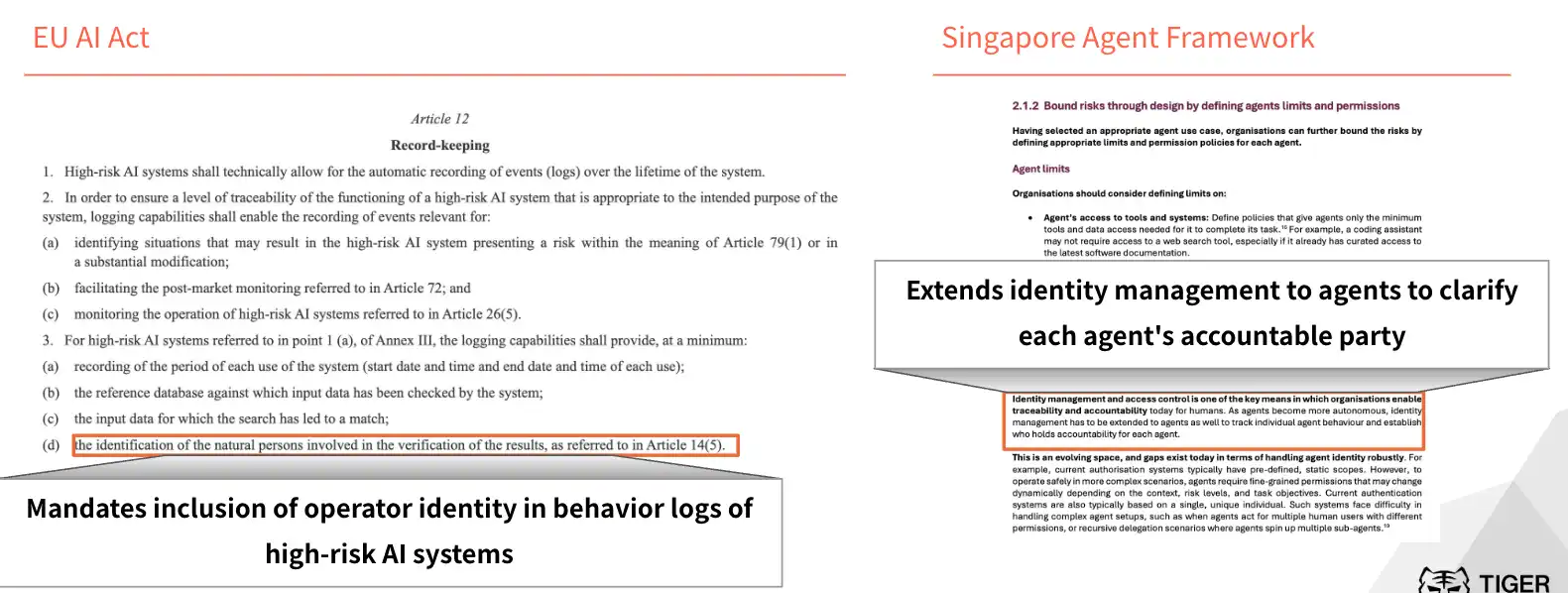
Regulatory action has begun at the national level. The EU's AI Act requires high-risk AI system behavior logs to include operator identity. The US NIST has listed agent identity management as a priority standard area. Singapore has released the world's first national-level AI agent governance framework. Just as the 2019 FATF Travel Rule determined which crypto exchanges survived, whether one possesses KYA infrastructure will determine who enters the next market cycle.

Why is KYA Emerging Now?

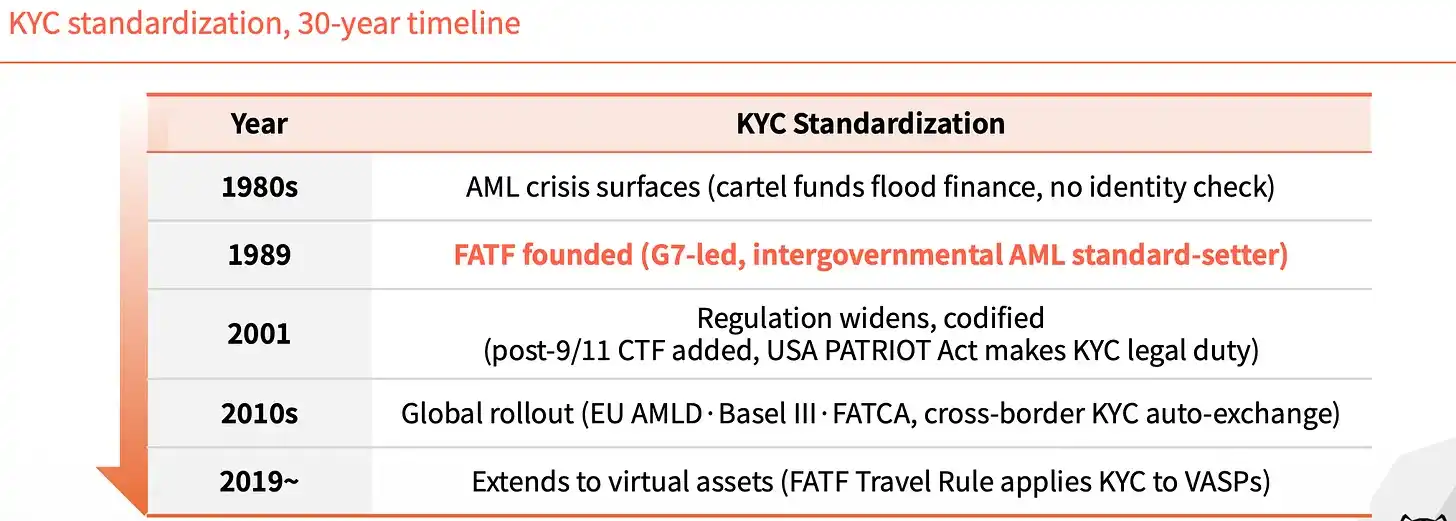
KYC: The Layer That Reshaped Finance

  • Before 1989, global finance lacked a unified identity standard. This gap made it difficult to track drug money and illicit funds.
  • After the FATF was founded in 1989, KYC became a mandatory requirement in finance, blocking illicit funds at the entry point.
Without Agent Identity, Systems Regress

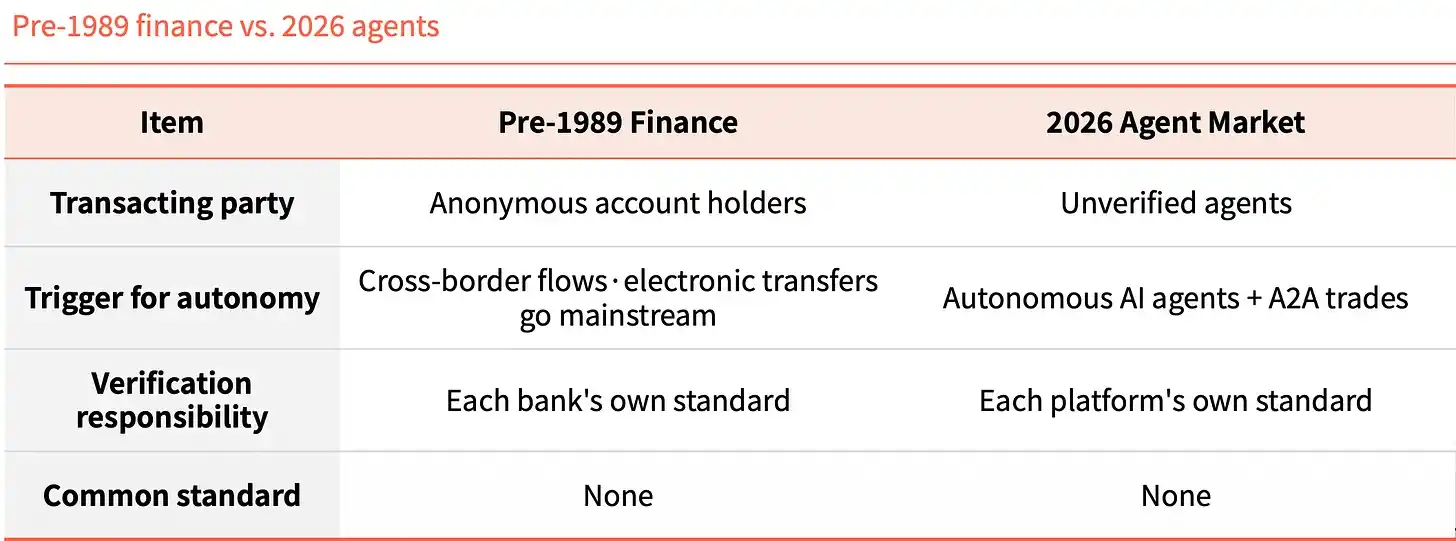
  • AI agents execute contracts, payments, and transactions without human involvement, but currently, it's impossible to verify "who it is."
  • In A2A environments, accountability becomes blurred, dispute risks increase, and users are exposed to fraud patterns like money laundering.
The Role and Response of KYA (Know Your Agent)

  • KYA (Know Your Agent) is a trust layer that pre-verifies an agent's origin, permissions, and accountability framework.
  • Unverified agents bring three major risks simultaneously: unauthorized transactions, fraud, and accountability gaps.
The Manifestation of KYA's Necessity

KYA is Needed at Every Level

  • Within centralized platforms, user KYC + platform accountability is sufficient. In interoperable scenarios outside platforms, KYA becomes crucial for verifying an agent's specific actions and safety.
  • Within a country (inside a platform), one ID (KYC) is enough to move freely. But once crossing borders (outside a platform), the environment changes, and entry review (KYA) of purpose and trust is needed.
Market Players

ERC-8004: NFT-Based Agent Identity

  • ERC-8004 adds an identity layer on top of ERC-721, minting an NFT as a unique ID for each agent.
  • It also adds three on-chain registries (Identity, Reputation, Validation), serving as identity, reputation board, and verification record respectively.
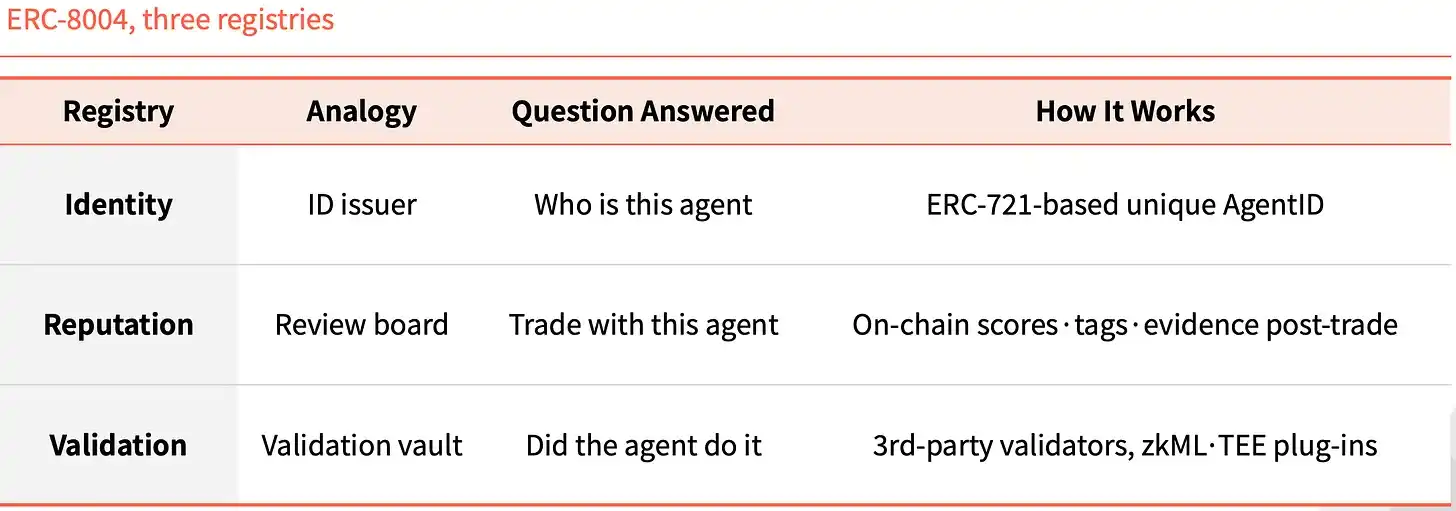
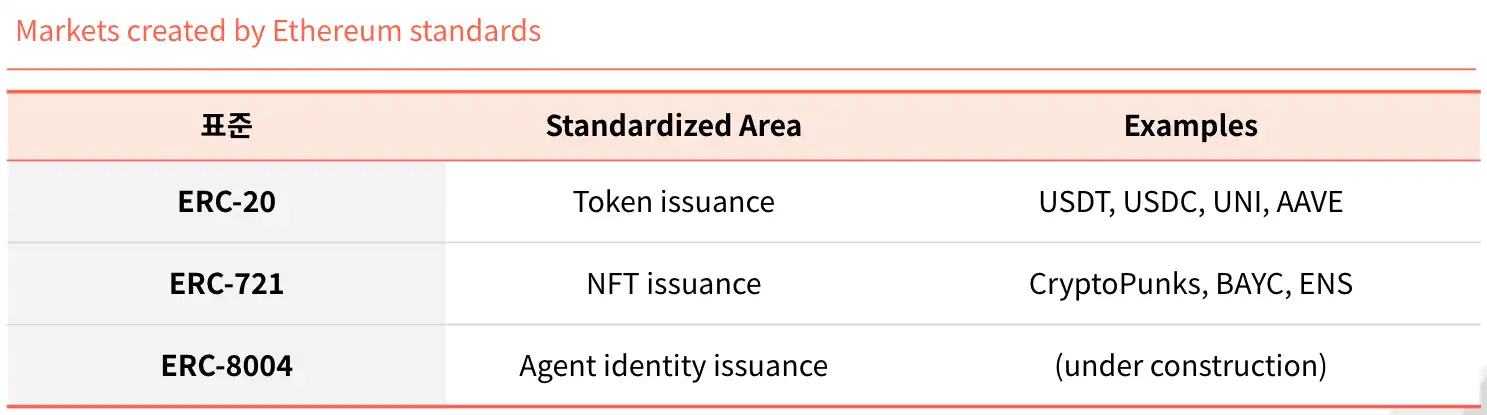
Two Markets Built by Ethereum Standards, a Third is Coming

  • ERC-20 (Token Issuance Standard): Before standardization, every token needed brand-new code. After ERC-20, most major assets were issued on it.
  • ERC-721 (NFT Standard): CryptoPunks, BAYC, ENS built the NFT market itself upon it. As blockchain integration accelerates in the agent era.
  • ERC-8004 will play the same standardizing role for Agents.
Visa TAP: Authentication on the Visa Rail

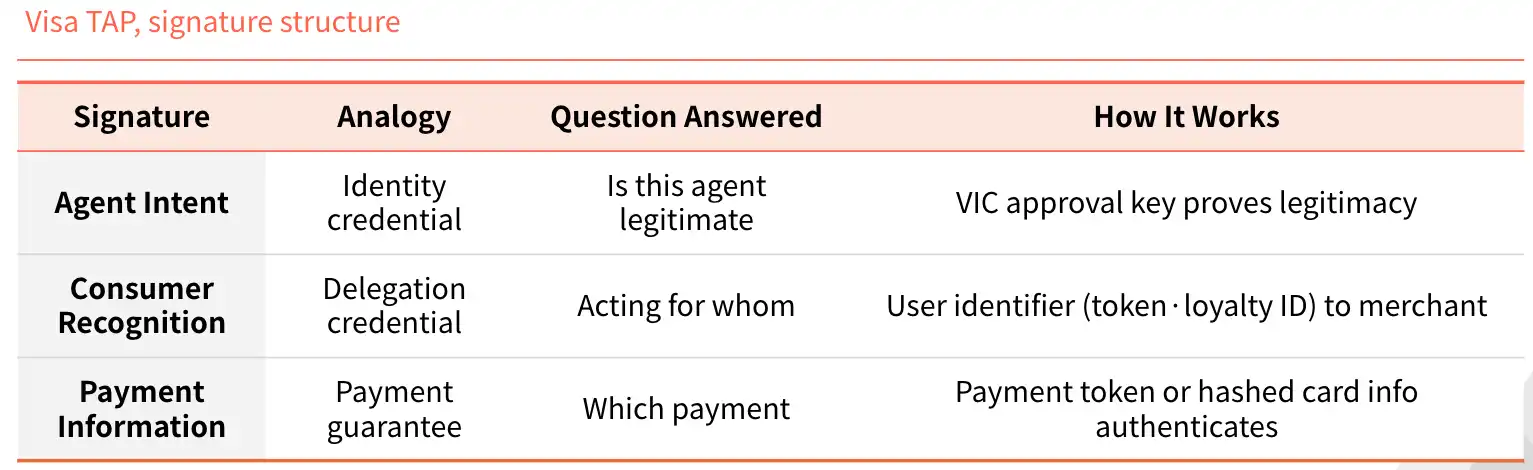
Visa issues identity credentials (Agent Intent) to agents, akin to an identity card. Without a key, transactions cannot occur. Keys are issued only after Visa pre-approval. Every transaction is signed and submitted to the merchant.

The merchant receives three signatures, not one: Visa approval, delegator, payment method, all confirmed simultaneously.
Visa: A Strategy to Pull Every Transaction into the Visa Network

  • Just as Visa previously captured payment rails, it is now encapsulating the agent era.
  • Through Visa Intelligent Commerce (VIC), Visa offers a solution bundle that packages KYA with payments.
  • If agent payments still use the card rail, and this bundle becomes the default option, then Visa's market share can remain stable even through the transition.

Trulioo: Extending KYC-Era Verification Infrastructure

  • Trulioo is a compliance operator on the global KYC/KYB rail and is expanding its verification stack to KYA.
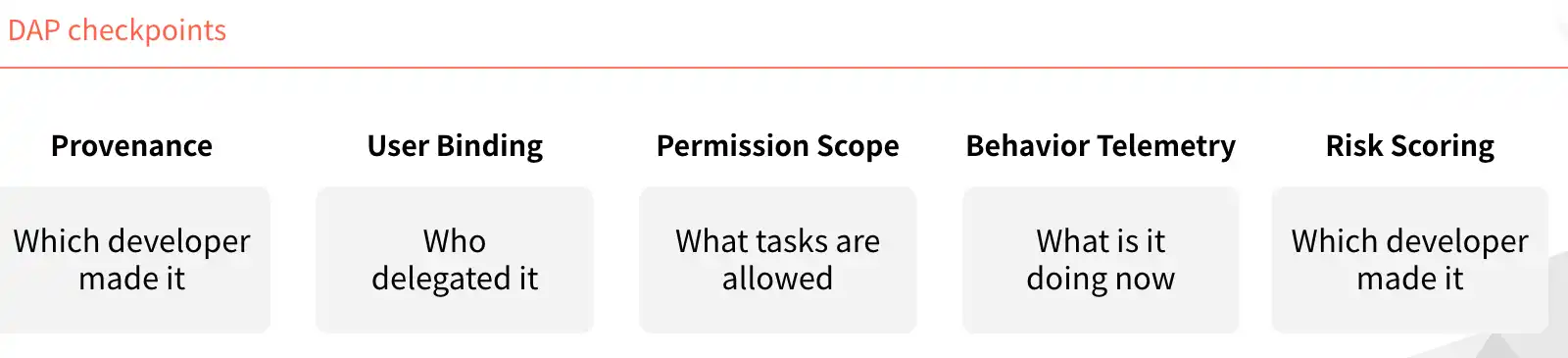
  • DPAs play the role of SSL-CAs. Unlike SSL (domain only), DPAs verify developer KYB and user KYC before issuing a DAP.
  • Banks and fintechs legally require human and business identity. As agents enter finance, Trulioo's KYC/KYB position will be further solidified.
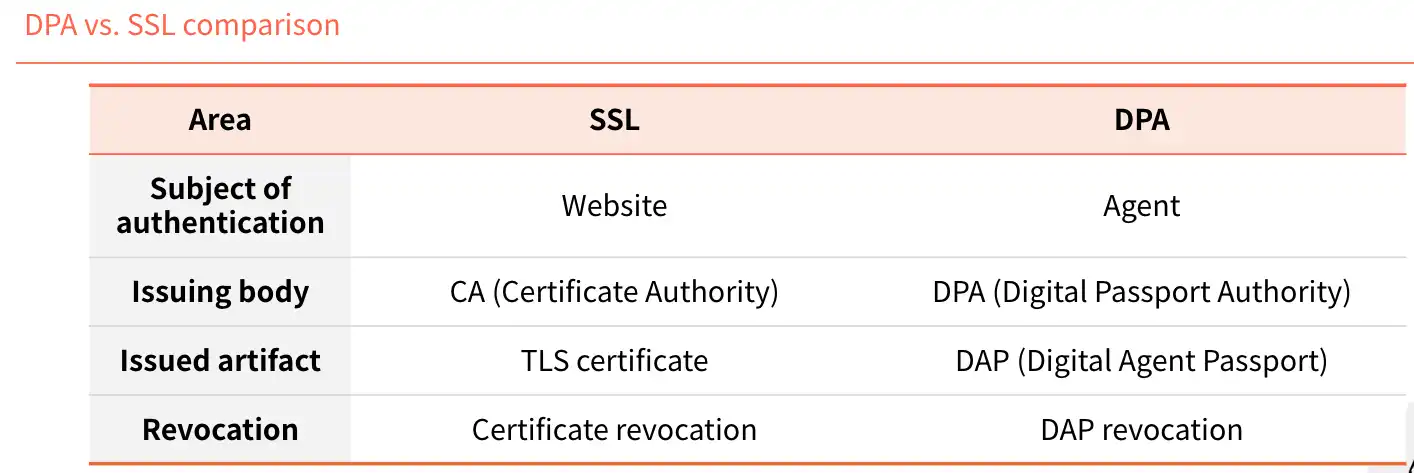
DAP, an Agent's Digital Passport, Refreshed with Each Transaction

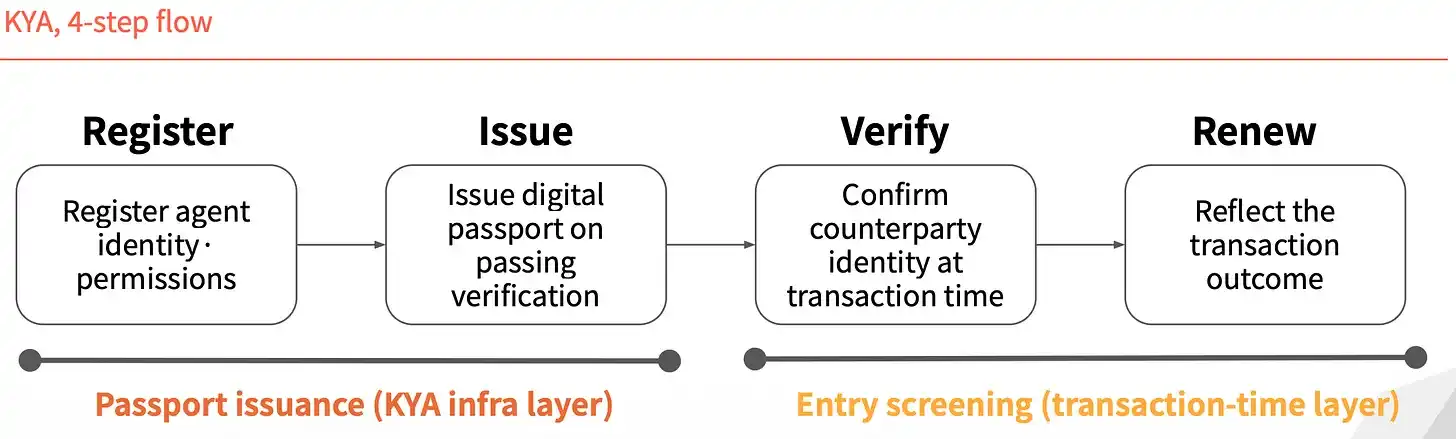
  • DAP is an agent's digital passport. A DPA verifies the developer (KYB) and user (KYC), packages both into a token, and grants it to the agent.
  • Unlike a paper passport, it is a live token, refreshed and re-verified with every transaction. Once delegation is revoked or anomalies are detected, the DAP is invalidated immediately.
  • KYA is not a one-time verification. Trust must be reconfirmed with every transaction.
Sumsub (AI Agent Verification): Detecting Agent Anomalies

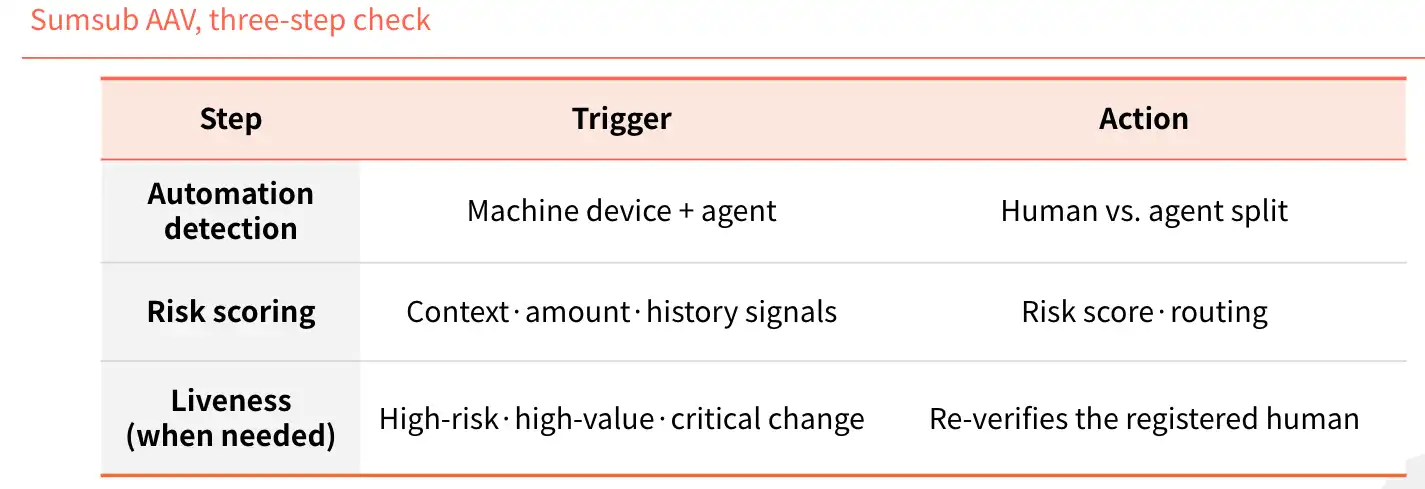
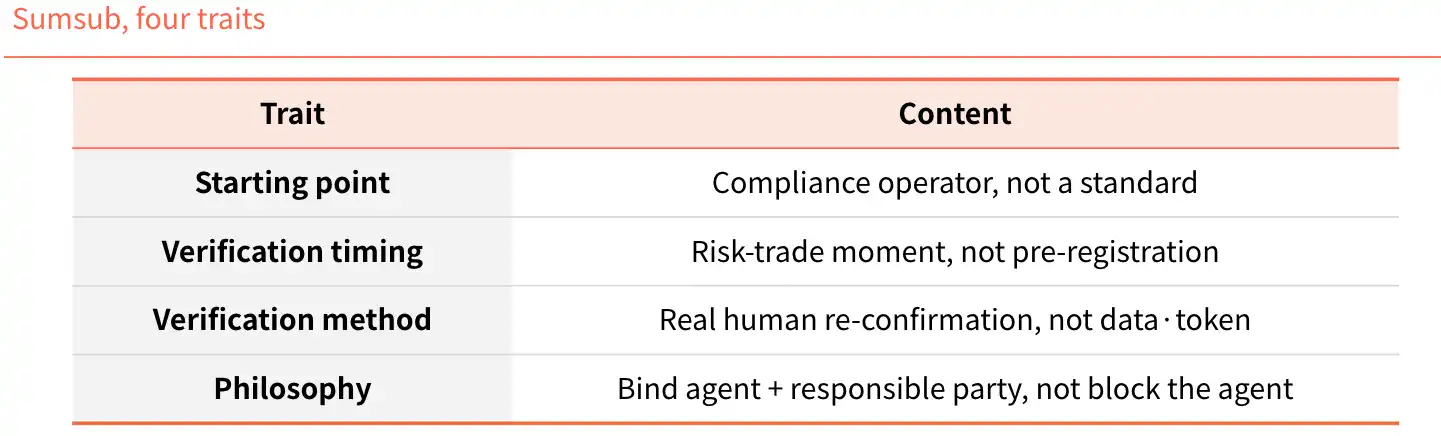
  • Sumsub's approach is: whenever an agent attempts an anomalous transaction, re-verify the currently active human identity.
  • It leverages its verification systems from its compliance business since 2015 to detect agent anomalies more accurately.
Operators with Technology to Address New Threats of the AI Era

  • Other KYA players focus on one-time pre-transaction identity verification. Sumsub focuses on real-time verification post-issuance.
  • As agent permissions expand, anomaly detection becomes crucial; as fraud scales with technology, Sumsub's real-time verification stack gains attention.
Proactive Regulatory Positioning, Shaping Entry Rules

The Gap Caused by the FATF Travel Rule May Recur with KYA

After the 2019 FATF Travel Rule, VASPs diverged based on their ability to bear KYC/AML infrastructure costs. Peers like CryptoBridge and Deribit, unable to afford it, either shut down or moved to less regulated regions.

The EU, Singapore, and the US are already vying for leadership. KYA will become a core layer of the agent era.
KYA Will Differentiate by Market Segment, Not a Single Winner

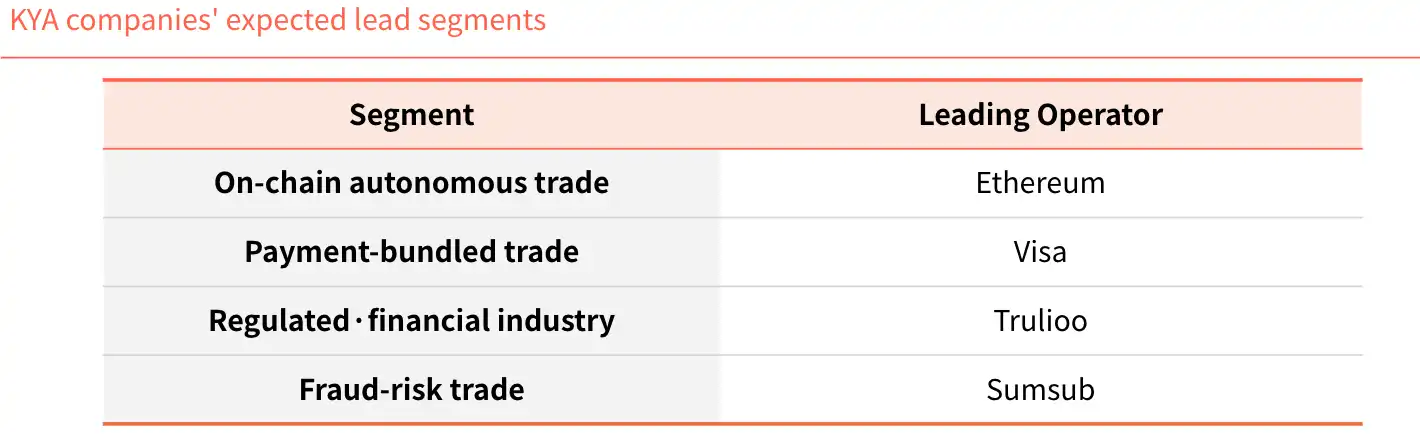
The real variable in the standards race is not technology, but combinations. Mainstream players have entered the collaboration and combination phase. In the future, who pairs with which merchants, payment networks, and KYC customer bases will determine the leader in each segment.

The market will not have a single winner; it will differentiate by market segment.
Trend Kriptolar

İlgili Sorular

QWhat is KYA (Know Your Agent), and why is it emerging as an important concept in the AI agent era?

AKYA (Know Your Agent) is a system designed to verify the identity, authority, and accountability of AI agents, especially in scenarios where they operate autonomously without direct human oversight. It is emerging as a crucial trust layer due to the rise of AI agents that autonomously execute contracts, payments, and transactions. In these Agent-to-Agent (A2A) environments, there is currently no shared standard to verify 'who the agent is,' leading to increased risks like unauthorized transactions, fraud, and accountability gaps. KYA addresses these risks by establishing a trust infrastructure for pre-verifying an agent's source, permissions, and purpose.

QWhat are some key standards and solutions being developed for KYA?

ASeveral standards and solutions are being developed for KYA. Notable examples include: 1) **ERC-8004**: An Ethereum-based standard that uses NFTs (ERC-721) as unique AgentIDs and adds on-chain registries for identity, reputation, and validation. 2) **Visa TAP (Triple Authorization Protocol)**: Visa's solution that issues identity credentials (Agent Intent) to agents and requires triple signatures (from Visa, the delegator, and the payment method) for transaction approval. 3) **Trulioo's DAP**: Extends their KYC/KYB infrastructure to issue a dynamic Digital Agent Passport (DAP) that is re-validated per transaction. 4) **Sumsub (AI Agent Verification)**: Focuses on post-issuance, real-time verification of agents to detect and prevent abnormal behavior using their existing compliance stack.

QIn what scenarios is KYA most necessary, according to the article?

AAccording to the article, KYA is most necessary outside of centralized, walled-garden platforms (like Google, OpenAI, or Coinbase), where traditional user KYC and platform accountability are sufficient. KYA becomes critical in scenarios involving independent, autonomously deployed agents interacting across platforms, particularly in: 1) **Agent-to-Agent (A2A) transactions** (e.g., payments between agents). 2) **Accessing decentralized exchanges (DEXs)**. 3) **Making payments to merchants**. These represent interoperable environments where a lack of agent identity verification creates significant operational and financial risks.

QHow are governments and regulatory bodies responding to the need for AI agent identity management?

AGovernments and regulatory bodies are beginning to act on AI agent governance, effectively pushing the need for KYA infrastructure. Key actions include: 1) **The EU AI Act**: Requires operators of high-risk AI systems to be identifiable in activity logs. 2) **US NIST**: Has prioritized AI agent identity management as a key standard-setting area. 3) **Singapore**: Released the world's first national-level AI governance framework specifically for agents. The article draws a parallel to the 2019 FATF Travel Rule, suggesting that the ability to implement compliant KYA systems will be a determining factor for which entities can participate in the next phase of the AI agent market.

QWhy does the article suggest the KYA market will be segmented, with no single winner?

AThe article suggests the KYA market will be segmented because the key variable for success is not just technology, but the combination and integration of solutions with existing business ecosystems. Major players are entering a 'cooperation-combination' phase. The future market leader in each segment will be determined by which KYA provider successfully partners with which merchants, payment networks (like Visa's approach), and existing KYC customer bases. Therefore, different KYA standards and solutions (e.g., ERC-8004 for the crypto-native ecosystem, Visa TAP for card-based commerce) are likely to dominate different application areas, leading to a fragmented market rather than a single universal winner.

İlgili Okumalar

A 'Overlooked' Market Event: Joint US-Japan-South Korea Intervention, Rare US Treasury Involvement, and Bessent's Quiet 'Market Rescue'?

Summary: The United States, Japan, and South Korea executed their largest coordinated foreign exchange intervention in nearly 30 years. The action targeted depreciation pressure on the Japanese yen and South Korean won. This move is seen as a significant effort by the US to stabilize the financial markets of its key allies and prevent the spillover of risks. Key details: * Japan reportedly intervened on July 30 using approximately 8.45 trillion yen (about $52.8 billion). South Korean authorities also intervened that day, selling dollars to support the won. * Notably, the US Treasury Department intervened directly in yen markets for the first time in roughly 30 years. The New York Fed, reportedly acting on behalf of the Treasury, sold euros to buy yen via Goldman Sachs and Morgan Stanley on July 31. Analysts view the use of the euro-yen pair as a way to alleviate yen pressure without adding selling pressure to the US dollar. * Prior to the action, the New York Fed conducted "rate checks" on both USD/JPY and EUR/JPY, a newer signaling tool that falls between verbal and physical intervention. The intervention is interpreted as going beyond traditional currency stabilization. Analysts, such as Michael Hartnett of Bank of America, suggest it resembles a "Price Keeping Operation" for the AI era. The core US objectives are perceived to be: 1. Preventing rapid yen depreciation from triggering a sharp rise in Japanese government bond yields. 2. Containing financial stress from spreading across Asian markets like South Korea and Japan. 3. Reducing the risk of disorderly capital flows impacting the US bond market. This coordinated action underscores the importance of Japan and South Korea as critical partners in the US semiconductor and AI supply chain. Stabilizing their financial markets is seen as vital to mitigating risks to the broader tech industry and the US market itself. The intervention coincides with market pressures, including the KOSDAQ index hitting a low since October 2022. While seen as a move to control volatility, some analysts caution it may not fundamentally reverse existing market trends.

marsbit5 dk önce

A 'Overlooked' Market Event: Joint US-Japan-South Korea Intervention, Rare US Treasury Involvement, and Bessent's Quiet 'Market Rescue'?

marsbit5 dk önce

Will the Federal Reserve Definitely Raise Interest Rates in September? How Will Cryptocurrencies and US Stocks Bear the Pressure?

In early August 2024, market expectations for a September Federal Reserve rate hike surged dramatically, from below 50% to over 80%, driven by renewed inflation concerns. This shift followed a contentious July FOMC meeting where a 9-3 vote to hold rates revealed a growing hawkish faction advocating for an immediate hike, citing prolonged above-target inflation. The key catalyst is escalating conflict near the Strait of Hormuz, which has pushed oil prices up approximately 20% in July, threatening to reignite inflation. The next critical data point is the July CPI report on August 12th; a hot reading could solidify hike expectations. For crypto assets, particularly Bitcoin, this represents near-term pressure. Bitcoin continues to exhibit high-beta, risk-on characteristics, making it sensitive to tightening liquidity and higher opportunity costs. However, historical precedent suggests that if a hike is perceived as the cycle's end rather than its start, the negative impact may be brief, with markets quickly pivoting to anticipate future rate cuts. U.S. stocks, especially crypto-linked equities like Coinbase and high-valuation tech stocks, face amplified volatility. Higher rates increase discount rates in valuation models, pressuring growth stocks. This coincides with a pivotal tech earnings season where investor focus has shifted from massive AI capital expenditures to demonstrable revenue and cash flow generation. Companies with negative cash flows and weak growth narratives could see severe pressure if a September hike materializes, as financing costs would rise. Key indicators to watch include oil prices, upcoming inflation data, and Fed commentary at events like the Jackson Hole symposium.

Odaily星球日报5 dk önce

Will the Federal Reserve Definitely Raise Interest Rates in September? How Will Cryptocurrencies and US Stocks Bear the Pressure?

Odaily星球日报5 dk önce

From South Korea to the United States: Blue-Collar Jobs Are Becoming Increasingly Popular, Thanks to AI

AI is reshaping the labor market's value proposition. The traditional four-year college degree is losing its appeal as a guaranteed career path, while skilled blue-collar trades like electricians, welders, and plumbers are experiencing historic demand and wage premiums. This shift is driven by dual pressures: AI's displacement of certain white-collar roles and a booming need for physical infrastructure and data center construction. Data confirms the trend. In the U.S., vocational school revenue surged, and a significant portion of recent layoffs are AI-related. Surveys show a majority of Gen Z adults plan to pursue blue-collar work, citing better job security against AI automation. Vocational education interest has exploded recently. Experts cite a psychological shift as younger generations seek tangible, AI-resistant careers and avoid high student debt. In many cases, salaries for skilled trades now match or exceed those requiring a bachelor's degree. In South Korea, semiconductor vocational high schools boast near-total employment, with graduates securing high-paying roles at companies like Samsung. The shortage is structural, exacerbated by a retiring baby boomer workforce and massive infrastructure projects. Companies like JPMorgan Chase, Meta, and Lowe's are investing heavily in training programs. However, overcoming historical stigma and a "perception gap" around trade careers remains a key challenge to closing the talent gap.

marsbit1 saat önce

From South Korea to the United States: Blue-Collar Jobs Are Becoming Increasingly Popular, Thanks to AI

marsbit1 saat önce

İşlemler

Spot

Popüler Makaleler

ID Nasıl Satın Alınır

HTX.com’a hoş geldiniz! SPACE ID (ID) satın alma işlemlerini basit ve kullanışlı bir hâle getirdik. Adım adım açıkladığımız rehberimizi takip ederek kripto yolculuğunuza başlayın. 1. Adım: HTX Hesabınızı OluşturunHTX'te ücretsiz bir hesap açmak için e-posta adresinizi veya telefon numaranızı kullanın. Sorunsuzca kaydolun ve tüm özelliklerin kilidini açın. Hesabımı Aç2. Adım: Kripto Satın Al Bölümüne Gidin ve Ödeme Yönteminizi SeçinKredi/Banka Kartı: Visa veya Mastercard'ınızı kullanarak anında SPACE ID (ID) satın alın.Bakiye: Sorunsuz bir şekilde işlem yapmak için HTX hesap bakiyenizdeki fonları kullanın.Üçüncü Taraflar: Kullanımı kolaylaştırmak için Google Pay ve Apple Pay gibi popüler ödeme yöntemlerini ekledik.P2P: HTX'teki diğer kullanıcılarla doğrudan işlem yapın.Borsa Dışı (OTC): Yatırımcılar için kişiye özel hizmetler ve rekabetçi döviz kurları sunuyoruz.3. Adım: SPACE ID (ID) Varlıklarınızı SaklayınSPACE ID (ID) satın aldıktan sonra HTX hesabınızda saklayın. Alternatif olarak, blok zinciri transferi yoluyla başka bir yere gönderebilir veya diğer kripto para birimlerini takas etmek için kullanabilirsiniz.4. Adım: SPACE ID (ID) Varlıklarınızla İşlem YapınHTX'in spot piyasasında SPACE ID (ID) ile kolayca işlemler yapın.Hesabınıza erişin, işlem çiftinizi seçin, işlemlerinizi gerçekleştirin ve gerçek zamanlı olarak izleyin. Hem yeni başlayanlar hem de deneyimli yatırımcılar için kullanıcı dostu bir deneyim sunuyoruz.

212 Toplam GörüntülenmeYayınlanma 2024.12.12Güncellenme 2026.06.02

ID Nasıl Satın Alınır

Tartışmalar

HTX Topluluğuna hoş geldiniz. Burada, en son platform gelişmeleri hakkında bilgi sahibi olabilir ve profesyonel piyasa görüşlerine erişebilirsiniz. Kullanıcıların ID (ID) fiyatı hakkındaki görüşleri aşağıda sunulmaktadır.

活动图片













