From Hashtags to Transaction Orders: X Platform is Turning the Information Flow into a Capital Gateway

比推2026-01-12 tarihinde yayınlandı2026-01-12 tarihinde güncellendi

Özet

From Hashtags to Trade Orders: X Platform Turns Information Flow into Capital Gateway X (formerly Twitter) is advancing its "Everything App" vision with the upcoming launch of Smart Cashtags, as announced by product lead Nikita Bier. This feature represents a significant evolution beyond simple asset tagging. It enables users to precisely link a cashtag to a specific asset or smart contract address, solving the common problem of duplicate ticker names, especially in crypto. Key functionalities include the ability to click a cashtag within the timeline to view real-time prices and to aggregate all posts mentioning that asset into a unified discussion view. Most notably, a screenshot revealed a "Buy/Sell" button, strongly signaling X's intent to embed direct trading capabilities into its information feed. While it's not yet confirmed if this will extend to cryptocurrencies, the move is a clear step towards creating a closed-loop financial ecosystem where users can discover, discuss, and execute trades without leaving the platform. This development positions X's information flow as a direct入口 for capital movement.

Author: KarenZ, Foresight News

Original Title: Twitter Tags Lead Directly to Market Prices, Is Trading Far Behind?


When asset tags represent a real-time money interface, X takes another step closer to its "Everything App" dream.

On January 11, 2016, X product lead Nikita Bier announced the upcoming launch of the Smart Cashtags feature. At first glance, this seems like a minor improvement allowing users to precisely tag assets and view real-time prices. However, when considered within X's grand financial ecosystem strategy, this is undoubtedly a key move in building its "Everything App."

What is Smart Cashtags?

According to the content and screenshots released by Nikita Bier, the upcoming Smart Cashtags brings several fundamental changes:
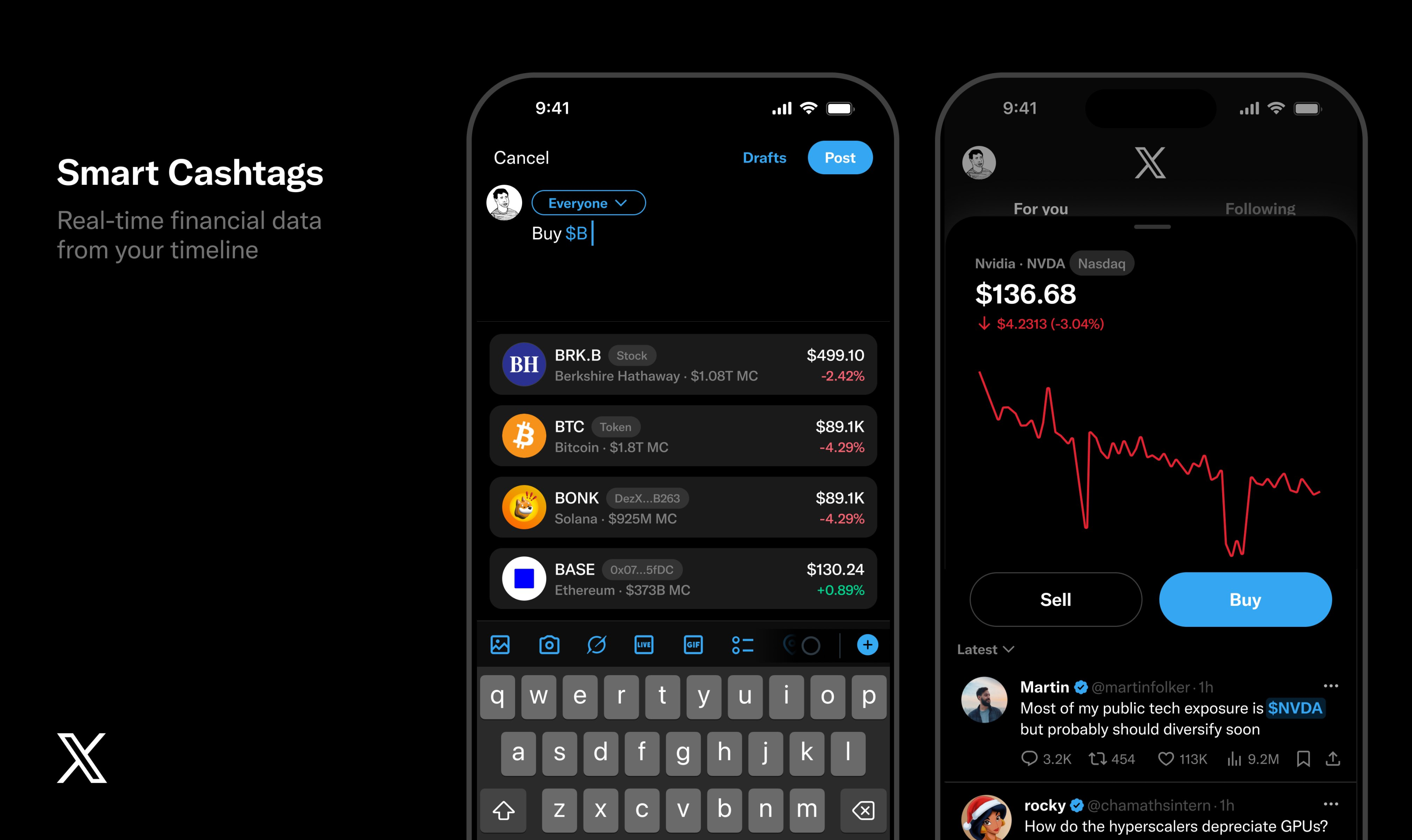
1. Precise Asset Anchoring: Posters can assign specific assets or smart contract addresses to tags. This means that when multiple assets or tokens with the same name exist—especially in the crypto market where同名代币 (Ticker)泛滥 is a common pain point—clicking the tag will directly point to the unique target asset.

2. One-Click Real-Time Price Viewing: Cashtags in the timeline can be clicked directly to instantly display real-time prices.

3. Aggregated Discussions: All tweets mentioning the asset are summarized to form a complete discussion view.

4. Transaction Closed Loop: The screenshot displayed by Nikita Bier shows one-click buy or sell buttons after opening the NVDA tag. Although it is not yet clear whether this feature will cover crypto assets, it sends a strong signal: X is attempting to embed trading functions directly into the information flow.

In response to the question, "Does this mean we will be able to trade on X using self-custody wallets or even CEX widgets in the future?" Nikita Bier replied with an Emoji "


Original link: https://www.bitpush.news/articles/7601900

İlgili Sorular

QWhat is the main feature announced by X's product lead Nikita Bier?

ANikita Bier announced the upcoming launch of the Smart Cashtags feature, which allows users to precisely tag assets and view real-time prices directly in the timeline.

QHow does Smart Cashtags solve the problem of multiple assets with the same name in the crypto market?

ASmart Cashtags enables posters to specify a particular asset or smart contract address for a tag, ensuring that clicking the tag directs to the unique target asset, thus addressing the issue of泛滥的同名代币 (proliferation of same-name tokens).

QWhat key signal does the presence of a 'buy or sell' button in the NVDA tag screenshot indicate?

AThe presence of a 'buy or sell' button in the NVDA tag screenshot indicates that X is attempting to embed trading functionality directly into the information flow, moving towards a transactional closed loop.

QWhat broader strategic goal of X does the introduction of Smart Cashtags support?

AThe introduction of Smart Cashtags supports X's broader strategic goal of building an 'Everything App' by integrating financial ecosystem features and turning information flow into a capital entry point.

QAccording to the article, what does an asset tag represent when it becomes a real-time money interface?

AWhen an asset tag becomes a real-time money interface, it represents a step closer to X's dream of becoming an 'Everything App', as it integrates financial transactions directly into the platform's social information stream.

İlgili Okumalar

Why Do You Always Lose Money on Polymarket? Because You're Betting on News, While the Pros Read the Rules

Why do you always lose money on Polymarket? Because you bet on news, while the pros study the rules. This article explains how top traders ("che tou") profit by meticulously analyzing market rules, not just predicting events. Polymarket, a prediction market platform, often sees disputes over event outcomes due to ambiguous rule wording. For instance, a market asking "Who will be the leader of Venezuela by the end of 2026?" was misinterpreted by many who bet on Delcy Rodríguez, assuming she held power. However, the rules specified "officially holds" as the formally appointed, sworn-in individual. Since Nicolás Maduro was still recognized as president officially, he won the market—even being in prison. To resolve such disputes, Polymarket uses a decentralized arbitration system via UMA protocol. The process involves: 1. Proposal: Anyone can propose a market outcome by staking 750 USDC, earning 5 USDC if unchallenged. 2. Dispute: A 2-hour window allows challenges with a 750 USDC stake; successful challengers earn 250 USDC. 3. Discussion: A 48-hour period on UMA Discord for evidence and debate. 4. Voting: UMA token holders vote in two 24-hour phases (blind then public). Outcomes require >65% consensus and 5M tokens voted; otherwise, four re-votes occur before Polymarket intervention. 5. Settlement: Results are final and automatic. Unlike traditional courts, Polymarket’s system lacks separation between arbitrators and stakeholders—voters often hold market positions, creating conflicts of interest. This leads to herd mentality in discussions and non-transparent outcomes without explanatory rulings, preventing precedent formation. Thus, success on Polymarket hinges on deep rule interpretation, not just event prediction, exploiting gaps between reality and contractual wording.

marsbit31 dk önce

Why Do You Always Lose Money on Polymarket? Because You're Betting on News, While the Pros Read the Rules

marsbit31 dk önce

DeepSeek Funding: Liang Wenfeng's 'Realist' Pivot

DeepSeek, a leading Chinese AI company, has initiated its first external funding round, aiming to raise at least $300 million at a valuation of no less than $10 billion. This move marks a significant shift from its founder Liang Wenfeng’s previous idealistic stance of rejecting external capital to maintain independence. Despite strong financial backing from its parent company, quantitative trading firm幻方量化 (Huanfang Quant), which provided an estimated $700 million in revenue in 2025 alone, DeepSeek faces mounting challenges. Key issues include a 15-month gap in major model updates, delays in its flagship V4 release, and the loss of several core researchers to competitors offering significantly higher compensation. The company is also undergoing a strategic pivot by migrating its infrastructure from NVIDIA’s CUDA to Huawei’s Ascend platform, a move aligned with China’s push for technological self-reliance amid U.S. export controls. However, DeepSeek lags behind rivals like智谱AI and MiniMax—both now publicly listed—in areas such as product ecosystem, multimodal capabilities, and commercialization. The funding round, though relatively small in scale, is seen as a way to establish a market-validated valuation anchor, making employee stock options more competitive and facilitating talent retention. It also signals DeepSeek’s transition from a pure research-oriented organization to a commercially-driven player in the global AI ecosystem.

marsbit1 saat önce

DeepSeek Funding: Liang Wenfeng's 'Realist' Pivot

marsbit1 saat önce

İşlemler

Spot
Futures

Popüler Makaleler

FLOW Nasıl Satın Alınır

HTX.com’a hoş geldiniz! Flow (FLOW) satın alma işlemlerini basit ve kullanışlı bir hâle getirdik. Adım adım açıkladığımız rehberimizi takip ederek kripto yolculuğunuza başlayın. 1. Adım: HTX Hesabınızı OluşturunHTX'te ücretsiz bir hesap açmak için e-posta adresinizi veya telefon numaranızı kullanın. Sorunsuzca kaydolun ve tüm özelliklerin kilidini açın. Hesabımı Aç2. Adım: Kripto Satın Al Bölümüne Gidin ve Ödeme Yönteminizi SeçinKredi/Banka Kartı: Visa veya Mastercard'ınızı kullanarak anında Flow (FLOW) satın alın.Bakiye: Sorunsuz bir şekilde işlem yapmak için HTX hesap bakiyenizdeki fonları kullanın.Üçüncü Taraflar: Kullanımı kolaylaştırmak için Google Pay ve Apple Pay gibi popüler ödeme yöntemlerini ekledik.P2P: HTX'teki diğer kullanıcılarla doğrudan işlem yapın.Borsa Dışı (OTC): Yatırımcılar için kişiye özel hizmetler ve rekabetçi döviz kurları sunuyoruz.3. Adım: Flow (FLOW) Varlıklarınızı SaklayınFlow (FLOW) satın aldıktan sonra HTX hesabınızda saklayın. Alternatif olarak, blok zinciri transferi yoluyla başka bir yere gönderebilir veya diğer kripto para birimlerini takas etmek için kullanabilirsiniz.4. Adım: Flow (FLOW) Varlıklarınızla İşlem YapınHTX'in spot piyasasında Flow (FLOW) ile kolayca işlemler yapın.Hesabınıza erişin, işlem çiftinizi seçin, işlemlerinizi gerçekleştirin ve gerçek zamanlı olarak izleyin. Hem yeni başlayanlar hem de deneyimli yatırımcılar için kullanıcı dostu bir deneyim sunuyoruz.

220 Toplam GörüntülenmeYayınlanma 2024.12.10Güncellenme 2025.03.21

FLOW Nasıl Satın Alınır

Tartışmalar

HTX Topluluğuna hoş geldiniz. Burada, en son platform gelişmeleri hakkında bilgi sahibi olabilir ve profesyonel piyasa görüşlerine erişebilirsiniz. Kullanıcıların FLOW (FLOW) fiyatı hakkındaki görüşleri aşağıda sunulmaktadır.

活动图片