From FOMO to Apathy: Altcoin Volumes Reflect Deepening Market Fatigue

bitcoinist2026-03-21 tarihinde yayınlandı2026-03-21 tarihinde güncellendi

Özet

The altcoin market is experiencing sustained weakness and declining trading volumes, reflecting deep investor fatigue and a risk-off environment. Analysis by CryptoQuant highlights a significant drop in activity, with Binance's altcoin volumes falling to around $7.7 billion and other major exchanges totaling approximately $18.8 billion—a sharp contrast to the $40–$50 billion and $63–$91 billion seen during more active periods in late 2024 and early 2025. This contraction signals reduced participation from both retail and institutional traders. Capital continues to flow into Bitcoin rather than altcoins, exacerbating the downturn. Macroeconomic uncertainty and geopolitical tensions are further suppressing risk appetite. Historically, such low-volume environments have often preceded opportunity, but current conditions suggest a prolonged phase of apathy rather than imminent recovery.

The altcoin market continues to struggle under sustained selling pressure, with weakness persisting for several months as broader conditions remain unfavorable for risk assets. Despite intermittent relief rallies, most altcoins have failed to establish meaningful recoveries, reflecting a market still dominated by caution rather than conviction.

Recent insights shared by CryptoQuant analyst Darkfost reinforce this view. The analysis of trading volumes across Binance and other major exchanges highlights a clear and persistent decline in investor interest. Activity levels have dropped significantly compared to previous expansion phases, signaling reduced participation from both retail and institutional traders.

This trend comes as the broader bear market remains firmly in place. Altcoins are not only failing to recover but are also underperforming Bitcoin, which continues to absorb the majority of available liquidity. In risk-off environments, capital typically consolidates into stronger assets, leaving higher-beta altcoins more exposed to prolonged downside.

At the same time, macro conditions continue to weigh on sentiment. Ongoing geopolitical tensions and global economic uncertainty are limiting risk appetite, discouraging aggressive positioning in speculative assets. In this context, the altcoin market reflects a structural contraction, where declining volumes and sustained selling pressure point to a prolonged phase of weakness rather than an imminent recovery.

Altcoin Volumes Collapse as Market Participation Contracts

Darkfost further contextualizes the current weakness by pointing to a sharp decline in altcoin trading volumes across major exchanges. On Binance, volumes have dropped to approximately $7.7 billion, while other leading platforms combined account for around $18.8 billion. These figures mark a significant contraction in activity, reinforcing the view that investor participation has materially declined.
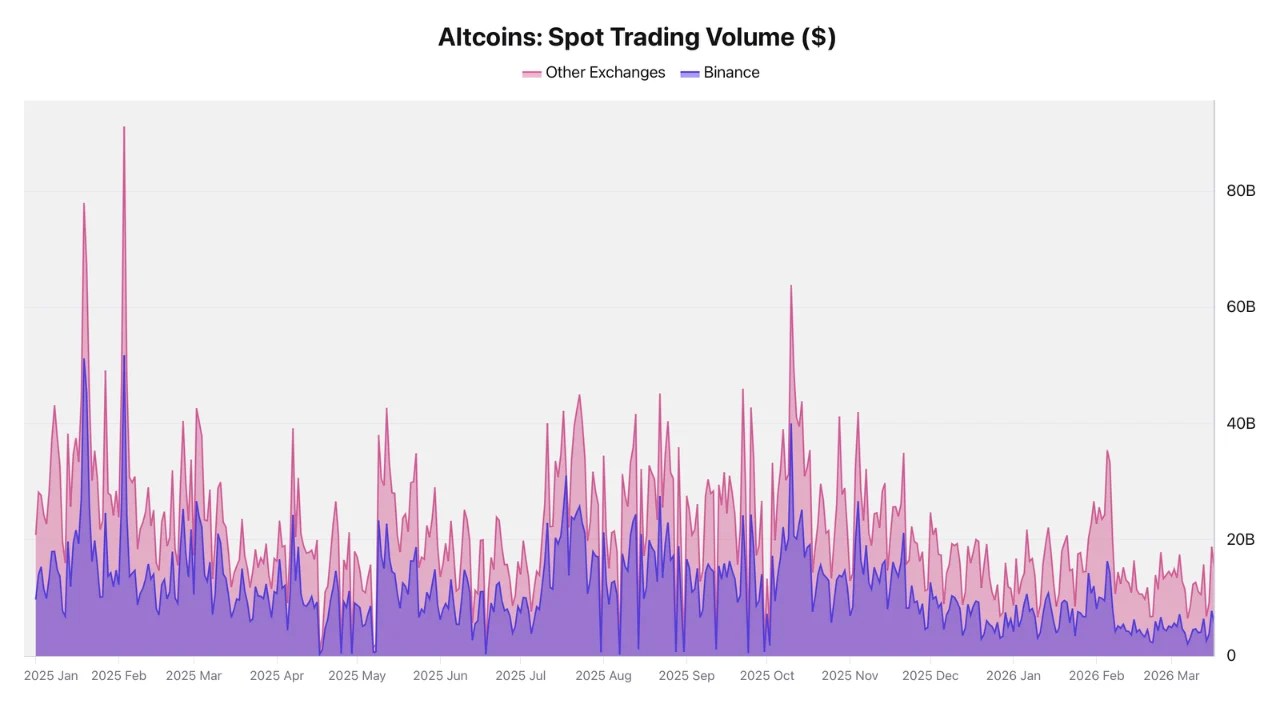
Altcoin Spot Trading Volume | Source: CryptoQuant

The contrast with previous market phases is stark. During more active periods such as October and February 2025, Binance recorded between $40 billion and $50 billion in altcoin trading volume, while other exchanges reached levels between $63 billion and $91 billion. The current environment, therefore, reflects a substantial loss of liquidity and engagement.

In relative terms, Binance now represents roughly 40% of total altcoin trading volume, underscoring its dominance as the primary venue for activity. This concentration suggests that liquidity is not only shrinking but also becoming more centralized.

Importantly, prior volume spikes coincided with local market tops, often driven by FOMO, where late entrants provided exit liquidity for more strategic participants. In contrast, today’s depressed volumes indicate a lack of speculative demand. Historically, however, such conditions have often preceded opportunity, as the most attractive setups tend to emerge when interest is minimal and positioning remains light.


İlgili Sorular

QWhat is the main trend observed in the altcoin market according to the article?

AThe altcoin market is experiencing sustained selling pressure and a persistent decline in trading volumes, reflecting deepening market fatigue and reduced investor participation.

QHow do current altcoin trading volumes on Binance compare to previous active phases?

ACurrent altcoin trading volumes on Binance have dropped to approximately $7.7 billion, a significant decline from the $40 billion to $50 billion recorded during more active periods like October and February 2025.

QWhat broader market conditions are contributing to the weakness in altcoins?

ABroader bear market conditions, ongoing geopolitical tensions, and global economic uncertainty are limiting risk appetite and discouraging aggressive positioning in speculative assets like altcoins.

QWhy are altcoins underperforming Bitcoin in the current environment?

AIn risk-off environments, capital typically consolidates into stronger assets like Bitcoin, which continues to absorb the majority of available liquidity, leaving higher-beta altcoins more exposed to prolonged downside.

QWhat does the concentration of altcoin trading volume on Binance indicate about market liquidity?

ABinance now represents roughly 40% of total altcoin trading volume, indicating that liquidity is not only shrinking but also becoming more centralized on a single exchange.

İlgili Okumalar

Within Strategy's Framework, STRC's Dividend Yield Remains at 12% as Share Price Stays Below Par Value

Michael Saylor, Executive Chairman of Strategy (MSTR), confirmed that the dividend rate for its STRC perpetual preferred shares will remain at 12.00% through August 2026. The rate has increased from 9% at its July 2025 launch to the current high via a "ratchet" mechanism, which permanently raises the rate by 0.5% whenever the share price falls below $95. This mechanism is intended to push the price back toward its $100 par value and support Strategy's "at-the-market" (ATM) program for issuing new shares to fund Bitcoin purchases. However, the mechanism has not worked as intended. STRC shares closed at $89.46 on July 31, remaining about 10-11% below par value despite the record-high dividend. Competition from rival Strive's higher-yielding SATA securities has pressured demand. The persistent discount has forced Strategy to suspend new STRC issuances via its ATM program, limiting this funding channel for Bitcoin acquisitions. STRC's struggles reflect Bitcoin's own volatility, as the preferred shares historically move in tandem. Analysts have warned the ratchet structure carries long-term, one-way risk. A law firm is investigating Strategy's ability to maintain dividend payments if Bitcoin's price stays low. Retail investors own roughly 83% of outstanding STRC shares, a group seen as prone to panic selling during downturns. In response, Strategy has established financial reserves, including a liquidity cushion covering about 26 months of dividend/interest obligations, and a $2 billion share buyback program alongside a Bitcoin monetization framework, though the company emphasized it is not obligated to sell any Bitcoin.

cryptonews.ru8 dk önce

Within Strategy's Framework, STRC's Dividend Yield Remains at 12% as Share Price Stays Below Par Value

cryptonews.ru8 dk önce

Analyst: Bitcoin's Price Will Drop to $60k in August, Then Rebound to $70k

Financial analyst Andrey Poroshin has provided a new forecast for Bitcoin's price dynamics in August. Poroshin, an analyst at the Bitbanker exchange, expects the cryptocurrency market to experience a downturn this month, with prices retesting the $60,000 level due to a lack of supportive macroeconomic catalysts. He noted that the recent US Federal Reserve decision to hold interest rates did not significantly impact the market, while inflation remains above the 2% target. Poroshin stated that Bitcoin is ending July under pressure from moderate volatility and a lack of new macroeconomic stimuli, leading to continued market caution. According to his base scenario, Bitcoin will drop to a range of $60,000 to $62,000 before recovering to $70,000. He pointed out that even $70,000 remains below the cost of mining in the US, which has prompted some miners to shift towards AI data center operations. Poroshin cited the winding down of BitMEX's operations as a potential catalyst for a price rebound, suggesting the exit of weaker players often coincides with market reversals and reduced short-term selling pressure. He believes Bitcoin is currently less susceptible to geopolitical shocks, such as the Iran-US conflict, and does not expect significant market changes in August related to the pending CLARITY Act. Looking ahead, Poroshin forecasts that September will bring more active price fluctuations driven by potential Fed rate decisions and possible discussions or approval of the CLARITY Act.

cryptonews.ru8 dk önce

Analyst: Bitcoin's Price Will Drop to $60k in August, Then Rebound to $70k

cryptonews.ru8 dk önce

İşlemler

Spot
活动图片




