From Exchanges to Hotels: USDT is Penetrating Real-World Consumption Scenes

比推2025-12-26 tarihinde yayınlandı2025-12-26 tarihinde güncellendi

Özet

Trip.com, the overseas version of Chinese travel giant Ctrip, has begun accepting stablecoin payments in USDT and USDC for global users. A real-world test in Vietnam confirmed the functionality, allowing a hotel booking to be completed in under 10 minutes using USDT. Notably, payments with USDT offered significant savings, with flight bookings being approximately 18% cheaper and hotel bookings around 2.35% cheaper compared to traditional payment methods. The service, powered by Singapore-based licensed payment gateway Triple-A, supports multiple blockchains including Ethereum, Tron, and Solana. A key privacy benefit was noted: booking a hotel with USDT required only a name and email, minimizing personal data collection. This development is particularly significant for the vast global population without access to international credit cards. The article contextualizes this move within a broader trend of major corporations, from PayPal and Ant Group to automakers like BYD and Toyota, adopting stablecoins. This shift is often driven by practical necessity in countries experiencing severe local currency devaluation, where stablecoins like USDT have become a critical tool for maintaining financial stability and facilitating cross-border commerce.

Original Author: Joe Zhou, Foresight News

Original Title: Save 18% on Hotel Bookings with USDT, Trip.com's Overseas Version Strongly Promotes Stablecoin Payments


Trip.com, the overseas version of Ctrip, is quietly entering the stablecoin payment track.

On December 25, 2025, Foresight News learned that Trip.com, the overseas version of Ctrip, has launched a stablecoin payment function for global users, currently supporting two USD stablecoins: USDT and USDC. Two sources close to Trip confirmed this information to Foresight News.

After downloading and logging into Trip.com in Vietnam, the author successfully completed a hotel reservation in Nha Trang, Vietnam, using USDT payment in less than 10 minutes.

More notably, after checking the prices of several local hotels, it was found that the price of some hotels on the Trip.com App when paying with USDT was even lower than using the Ctrip official website or traditional payment methods.

Trip.com Overseas Version Already Supports USDT/USDC

On December 24, 2025, the author booked a hotel in Nha Trang, Vietnam, using USDT on the Trip.com overseas version APP, and on December 25, purchased a plane ticket from Nha Trang to Ho Chi Minh City with USDT, both showing successful payment. The author has now successfully checked into the hotel.

The author found that the flight ticket purchased with USDT on Trip.com saved approximately 18% of the cost compared to the ticket purchased on Ctrip. The hotel booked with USDT saved 2.35% of the cost.
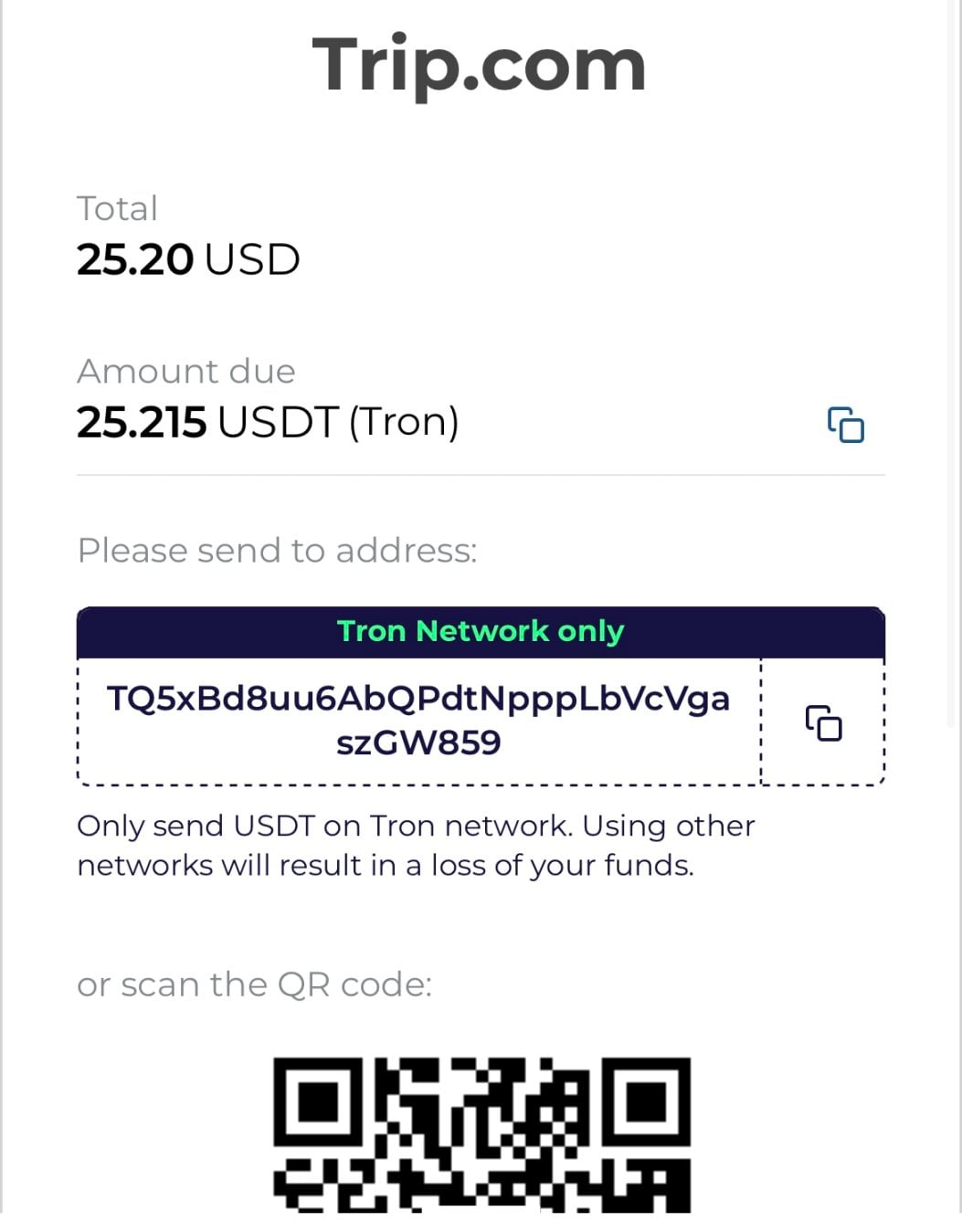
Trip has enabled USDT and USDC payments

Currently, Trip.com's crypto payments support multiple public chains including Ethereum, Tron, Polygon, Solana, Arbitrum One, and TON.

During the actual payment process, the author noticed the presence of another payment company, Triple-A. This company provides crypto payment-related services to Trip.com. Public information shows that Triple-A is a licensed crypto payment institution headquartered in Singapore, mainly providing payment gateway and settlement services for cryptocurrencies and stablecoins.

Furthermore, the author learned that Triple-A is also cooperating with Singapore's internet giant Grab as a technical partner for the crypto payment channel, enabling GrabPay users to directly use crypto assets to top up their wallet balance within the Grab app.

Additionally, the author noticed a detail:

When booking a hotel on Trip.com using USDT, there is no need to fill in detailed personal information; only a name and email are required to complete the order. This means that when using USDT for payment in hotel scenarios, the platform can hardly obtain the user's complete privacy information. Of course, if purchasing a flight ticket, information such as nationality, passport number, and phone number are still required—this is a compliance requirement of the aviation industry itself.

Privacy and data security have become major social issues.

Just this month, the Ctrip Group encountered a relatively significant "public trust incident." In December, Ctrip Group and the Cambodia National Tourism Administration signed a marketing cooperation agreement in Shanghai. After the news was announced, it sparked concerns among some users about local security, telecom fraud risks, and personal information security. A large number of screenshots of uninstalling the Ctrip App appeared on social media.

In many overseas regions, users are far more sensitive to privacy and information security than in the domestic market. This may also be an important practical background for Trip.com's promotion of stablecoin payments.

For travelers around the world without international credit cards, stablecoin payment is a new path. According to public information, the number of people globally who own credit cards is approximately 125 million to 130 million, and the number of people with international credit cards is even lower, which also means that over 80% of the global population cannot smoothly use the international credit card system.

Credit cards are not merely "payment tools" but an entry point to the credit system; however, most people globally are not within this system. In many countries and regions, such as Southeast Asia, Latin America, Africa, and India, many people cannot be incorporated into the credit system. This also prevents them from having credit cards.

Stablecoin payments are providing these people with a global payment path that bypasses the credit system.

Of course, the practical problems of stablecoins still exist: transaction fees remain relatively high and unstable.

During the actual payment process, the author found significant differences in fees between different wallets. When paying to Trip.com's USDT收款码 (receiving QR code) via Binance, a fee of 1 USDT was required, with a minimum transfer threshold of 10 USDT; whereas when using Bitget Wallet, the first transaction showed a fee of 0, the second showed a fee of 2.39 USDT, and no minimum transfer amount was set. The differences may be related to the public chain used (Tron) and its fee mechanism.

Why Are Giants Entering the Stablecoin Space One After Another?

Ctrip Group is not the first company to enter the stablecoin track.

Previously, several global internet and payment giants have clearly布局 (laid out plans for) stablecoins, including Ant Group, JD.com, Paypal, Stripe, Meta (Facebook), Grab, and TADA.

Several banking giants have also publicly stated their entry into the stablecoin field, for example, Bank of America and Morgan Stanley.

Some实体制造业企业 (physical manufacturing companies) are also接入 (integrating) stablecoin payments. Public reports show that some dealers of BYD (Build Your Dreams) in Bolivia already support USDT payments; manufacturing companies like Toyota and Yamaha also accept stablecoin settlements in overseas markets. Tether CEO Paolo Ardoino has publicly confirmed this.

Advertisement for cooperation between BYD dealers and USDT

Internet giants,实体制造业巨头 (physical manufacturing giants), banking giants are all布局 (laying out plans for) stablecoins... Their use cases for stablecoins vary.

An obvious trend is that payment giants like PayPal and Ant Group are no longer satisfied with仅仅作为 (merely being) the payment entry for stablecoins but hope to directly become the issuers of stablecoins. PayPal has already launched PYUSD; Ant Group is also promoting the application for a Hong Kong dollar stablecoin license. The boundary between payment institutions and currency issuance is being reshaped.

For实体制造业企业 (physical manufacturing enterprises) like BYD and Toyota, there is no ideological judgment about stablecoins or crypto payments, only one practical question: which method are users more willing to pay with.

Fiat Currency Continues to Depreciate, Stablecoins Become the "Practical Solution"

In Bolivia, the official fiat currency, the Boliviano (BOB), depreciated against the US dollar by 65%–137% from the end of 2024 to mid-2025. It can be said that Bolivia's fiat currency depreciates every day.

In this environment, any company expanding overseas cannot long bear the exchange losses brought by settlement in the local currency. USDT has gradually become the de facto payment tool locally.

And Bolivia is not an isolated case but a phenomenon simultaneously上演 (playing out) in multiple countries around the world.

The author visited Iran, Turkey, Egypt, and other countries this year and found that the cumulative depreciation of these economies' national currencies against the US dollar over the past three years generally exceeded 80%; stretched over a five-year周期 (cycle), the currencies of Iran, Turkey, and Egypt have all depreciated by more than 200% against the US dollar.

Currency depreciation is evolving from a "local risk" in a few countries to a broader, more structural global phenomenon.
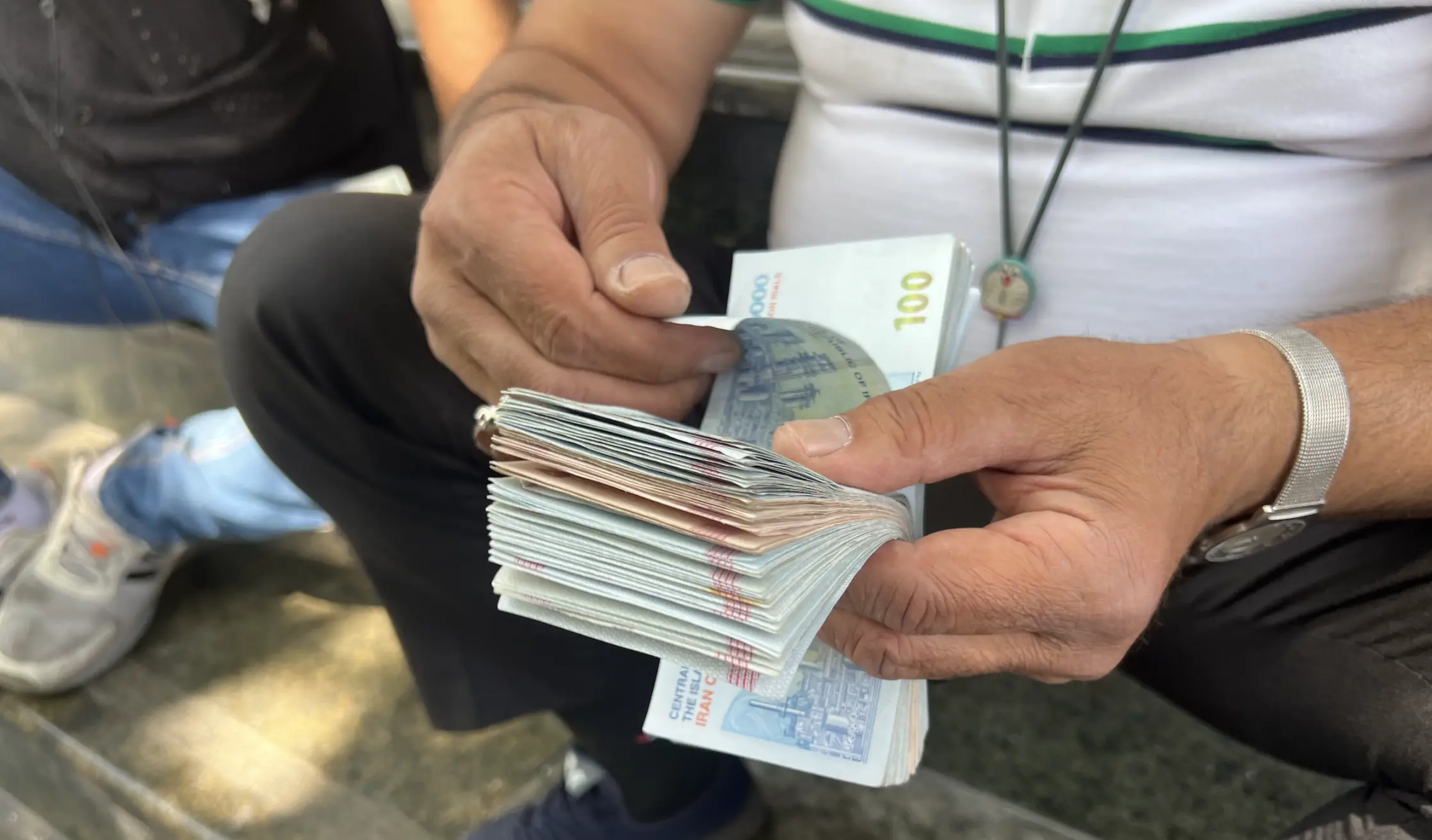
At the black market in Tehran, Iran's capital, the author is witnessing a currency transaction

More残酷的是 (cruelly), in the aforementioned countries (the countries mentioned above), the speed of local currency depreciation has long far exceeded the income growth rate of ordinary people. In real transactions, monetary disorder is directly changing people's payment methods.

This is precisely why consumer internet platforms like Trip.com Overseas Version and Grab; payment giants like PayPal and Ant Group; and physical manufacturing companies like BYD and Toyota have begun to尝试引入 (try to introduce) USDT and other stablecoins in different markets.

The world is partially collapsing, with some regions率先失衡 (becoming unbalanced first).

When the existing financial system can no longer perform the functions of stability, settlement, and trust, a new economic system is pushed to the forefront by reality.

The new economic system is not designed but is "forced" out by reality where the old system fails. The spread of stablecoins is not because they are ideal enough, but because in some places, they are already the least bad choice available.


Twitter:https://twitter.com/BitpushNewsCN

Bitpush TG Discussion Group:https://t.me/BitPushCommunity

Bitpush TG Subscription: https://t.me/bitpush

Original Article Link:https://www.bitpush.news/articles/7598412

İlgili Sorular

QWhat is the main development announced regarding Trip.com and stablecoins?

ATrip.com, the overseas version of Ctrip, has globally launched a stablecoin payment feature, supporting both USDT and USDC for hotel and flight purchases.

QWhich payment processing company is mentioned as providing crypto payment services for Trip.com?

ATriple-A, a licensed crypto payment institution based in Singapore, is the payment company providing crypto payment gateway and settlement services for Trip.com.

QWhat practical benefit did the author experience when using USDT to book a flight on Trip.com?

AThe author saved approximately 18% on a flight ticket purchased with USDT on Trip.com compared to the price when using traditional payment methods on the Ctrip website.

QAccording to the article, what is a major global issue that is driving the adoption of stablecoins like USDT?

ARapid and severe devaluation of national currencies in many countries (e.g., Bolivia, Iran, Turkey, Egypt) is making stablecoins a more reliable payment and store of value, as they are pegged to the US dollar.

QBesides Trip.com, name two other types of major companies that are adopting or exploring stablecoin payments.

APayment giants like PayPal and Ant Group, as well as manufacturing companies like BYD and Toyota, are adopting or exploring stablecoin payments in various markets.

İlgili Okumalar

KOL's Perspective: Why Is SOL Set to Rise from This Point?

**Summary: Why SOL is Positioned for Growth at This Level** The article argues that SOL is poised for an upward move from its current price point, citing several key factors. Primarily, SOL has just broken out of a 4-month consolidation phase. This breakout signals a return of risk appetite to the broader crypto market, as SOL is seen as a key indicator of overall crypto health. The token's ownership has reportedly shifted from short-term traders and tourists to long-term accumulators, leading to low volume. Any meaningful increase in trading activity could thus trigger significant upward momentum. Fundamental strengths include strong institutional adoption, integration with DeFi and RWAs (Real-World Assets), and the potential benefits from the Clarity Act. Despite its high volatility—having dropped 70% from its all-time high but still up 12x from its bear market low—SOL is highlighted as one of the few tokens from the last cycle to reach new highs. It boasts a robust ecosystem of applications, users, and protocols. Future catalysts include the expected influx of AI developers following the Miami Accelerate conference, which focused on AI on Solana. Furthermore, Solana is positioned as the premier chain for memecoin activity, a trend expected to continue and drive network usage and fees. The article concludes that recent price action reflects a healthy transfer to long-term holders, setting the stage for growth.

marsbit15 dk önce

KOL's Perspective: Why Is SOL Set to Rise from This Point?

marsbit15 dk önce

Those Pre-Bitcoin PoW Protocols Have Recently Been Reimplemented

This article details a recent surge in replicating pre-Bitcoin Proof-of-Work (PoW) protocols, specifically focusing on Hal Finney's 2004 RPOW (Reusable Proofs of Work). Within five days in May 2026, multiple independent builders in the Bitcoin/cypherpunk community launched projects inspired by this early electronic cash proposal. The initiative began with Fred Krueger's `rpow2.com`, a centralized but auditable system that replaced RPOW's original IBM 4758 hardware with Ed25519 signatures. Initially a faithful replica, it later adopted Bitcoin-like features (21M supply cap, difficulty adjustment) and a controversial 5.24% founder allocation. This sparked rapid forks, including `rpow4.com` which incorporated full Bitcoin parameters, a prediction market (`rpowmarket.com`), and a DEX (`rpow2swap.com`). Concurrently, Mike In Space created a prototype of Wei Dai's 1998 b-money proposal (`b-money.replit.app`), pushing the historical exploration even further back. The article contrasts these centralized, server-dependent experiments with Bitcoin's core innovation of decentralized, trustless consensus. It also highlights a parallel development: the `HASH` project on Ethereum, which uses smart contract hooks to enable a purely fair-launch, browser-mineable PoW token with 0% allocations to team or VCs. The collective activity is framed as a meme-driven, educational exploration of cypherpunk history rather than a serious financial movement, with all projects heavily disclaiming any investment value.

marsbit20 dk önce

Those Pre-Bitcoin PoW Protocols Have Recently Been Reimplemented

marsbit20 dk önce

South Korean Exchanges 'Battle' Regulators, Challenging the Boundaries of Enforcement and Legislation

South Korea's cryptocurrency industry is engaged in a rare, direct confrontation with regulators. The Financial Intelligence Unit (FIU), the primary anti-money laundering (AML) watchdog, has recently imposed heavy penalties on major exchanges like Upbit and Bithumb for alleged violations involving unregistered overseas VASPs and AML procedures. However, exchanges are now actively challenging these actions in court and through industry associations. In a significant shift, the Seoul Administrative Court ruled in favor of Upbit's operator, Dunamu, overturning part of an FIU-ordered business suspension. The court found the FIU's penalty criteria and justification insufficiently clear. Similarly, the court suspended the enforcement of a six-month business suspension against Bithumb pending a final ruling, citing potential irreversible harm to the exchange. Beyond legal battles, the industry is contesting proposed legislative amendments. The Digital Asset eXchange Alliance (DAXA) strongly opposes a draft rule that would mandate Suspicious Transaction Reports (STRs) for all crypto transfers over 10 million KRW (~$6,800). DAXA argues this "poison pill" clause violates legal principles and would overwhelm the STR system, increasing reports from 63,000 to an estimated 5.45 million annually for major exchanges, thereby crippling effective AML monitoring. This conflict highlights a structural tension in South Korea's crypto governance: comprehensive digital asset laws are still developing, while regulators rely heavily on AML enforcement. The industry's move from passive compliance to active legal and legislative challenges signifies a new phase, pressing for clearer rules and more proportionate enforcement. While short-term disputes may intensify, this clash could ultimately lead to a more mature and sustainable regulatory framework for South Korea's vibrant crypto market.

marsbit1 saat önce

South Korean Exchanges 'Battle' Regulators, Challenging the Boundaries of Enforcement and Legislation

marsbit1 saat önce

After 50x Storage Surge, Justin Sun Always Looks to the Next Decade

Sun Yuchen, known for his controversial stunts like a $30 million lunch with Warren Buffett (canceled due to a kidney stone) and eating a $6.2 million duct-taped banana, is often overshadowed by a significant fact: his decade-long track record of spotting major investment trends. In 2016, he famously advised young people to invest in Bitcoin, Nvidia, Tesla, and Tencent instead of buying property. A hypothetical $20,000 investment in Nvidia and Tesla from that list would now be worth over 50 million RMB. His latest major call was on November 6, 2025, predicting a "50x storage opportunity" tied to the AI boom, which materialized with Sandisk's stock surging nearly 50-fold by 2026. Looking ahead, Sun now focuses on the next frontier: Physical AI. He identifies four key areas: 1. **Embodied AI/Robotics**: He sees this reaching its "iPhone moment," with companies like UBTech and Galaxy General leading in commercialization. 2. **Drones**: Viewed as the first commercially viable form of Physical AI, revolutionizing sectors from warfare (e.g., AeroVironment's Switchblade) to logistics. 3. **Spatial Computing**: Beyond VR, it's about AI understanding physical space, a foundational technology for robotics and autonomous systems, exemplified by Apple's Vision Pro. 4. **Space Exploration**: After a 2025 suborbital flight with Blue Origin, Sun advocates for space as the ultimate frontier, discussing blockchain's potential role in space asset management and data transactions. His investment philosophy involves betting on entire, inevitable trends rather than single companies. For robotics, he sees Tesla (the body/manufacturer) and Nvidia (the brain/AI platform) as complementary plays. In defense drones, he highlights companies making tanks obsolete (AeroVironment) and those augmenting fighter jets (Kratos). For space, he participated in Blue Origin's flight and anticipates SpaceX's potential IPO to redefine the sector's valuation. Sun Yuchen's vision frames the next two decades not as a revolution in information flow (like the internet), but in the fundamental operation of the physical world through AI-powered robots, autonomous systems, and spatial intelligence, ultimately extending human and AI activity into space. While many still focus on conventional assets, he continues to look toward the next technological horizon.

marsbit2 saat önce

After 50x Storage Surge, Justin Sun Always Looks to the Next Decade

marsbit2 saat önce

İşlemler

Spot
Futures
活动图片





