From Aztec to Zcash: Privacy Evolving from 'Gray Industry Tool' to 'Institutional Necessity'

比推2025-12-26 tarihinde yayınlandı2025-12-26 tarihinde güncellendi

Özet

From Aztec to Zcash: The Rise of Pragmatic Privacy in Blockchain In 2025, blockchain privacy evolved from a niche concern to a mainstream priority, driven by the concept of "pragmatic privacy" that balances individual anonymity with regulatory compliance. This shift is marked by the strong performance of privacy-focused assets like Zcash and new institutional initiatives. Several new privacy-centric blockchains launched or advanced significantly. Aztec Network's Ignition L2 mainnet went live, raising over 6,100 ETH. Nillion launched its "blind computer" mainnet for encrypted data computation. Cosmos-based Namada introduced a "composable privacy" L1, while Miden spun out from Polygon to build its own privacy chain. Umbra raised $154.9 million in an ICO to build on Solana. Horzen transitioned to a Base L3 privacy solution. Institutions are actively embracing privacy. Coinbase hired a team from Iron Fish to develop privacy primitives for Base. Circle is testing a privacy-preserving wrapped USDC (USDCx) on Aleo. The Canton Network and EY's Nightfall L2 are focusing on confidential enterprise solutions. The Ethereum Foundation formed a dedicated "Privacy Cluster" and an "Institutional Privacy Working Group." Vitalik Buterin also launched Kohaku, an open-source wallet framework for compliant privacy. At the application layer, tools like 0xbow's Privacy Pools (based on Vitalik's research) and Railgun (using "proof of innocence") allow users to anonymize transactions without aidi...

Source: The Block

Original Title: From Aztec to Zcash: The year 'pragmatic privacy' took root

Compiled and Edited by: BitpushNews


Since Satoshi Nakamoto wrote the Bitcoin whitepaper, the privacy limitations of blockchain have been evident. The cryptocurrency pioneer pointed out at the time: despite using anonymous mechanisms, Bitcoin addresses could still be traced back to real-world identities.

For many years since, this "pseudo-anonymous" characteristic has been tacitly accepted as "acceptable enough," causing most blockchain privacy projects to remain on the margins for a long time.

However, this year has seen a renewed interest in blockchain privacy, with Zcash becoming one of the best-performing assets of the year, and the Ethereum Foundation launching multiple end-to-end encryption initiatives. The concept of "Pragmatic Privacy" has also begun to take root, aiming to balance individual privacy with compliance considerations.

Emerging Privacy Chains

2025 has witnessed the launch of several new privacy-focused blockchains at various stages of development.

Perhaps the most notable is the Aztec Network's Ignition chain going live on mainnet in November. This is not only because it is the "first fully decentralized L2 on Ethereum," with multiple innovations in consensus and ZK technology, but also because it has overcome numerous obstacles since the project's inception in 2017.

Earlier this month, Ignition also raised 19,476 ETH (approximately $61 million) from 16,741 participants using a new "Continuous Clearing Auction" mechanism co-developed with Uniswap Labs.

Nillion is another blockchain project that launched its mainnet in 2025. This so-called "blind computer" aims to perform computations on encrypted data and has already integrated with multiple networks, including Layer 1's Near and Layer 2's Arbitrum, to enhance privacy at the application layer.

Namada, built on Cosmos, also launched its Layer 1 mainnet in June, focusing on "composable privacy" and supporting multiple blockchain ecosystems—including Bitcoin L2s (like Lombard and Babylon), Ethereum, and Solana—via cross-chain bridges.

Miden, which has been in development since at least 2022, is preparing to launch its mainnet next year. Even so, the project took a huge step towards independence this year: spinning off from Polygon and raising $25 million to build the privacy-focused blockchain Edge.

Similarly, the privacy protocol Umbra, powered by Arcium, conducted its Initial Coin Offering (ICO) on MetaDAO in October, raising $154.9 million. Umbra plans to launch concurrently with Arcium's mainnet Alpha, becoming one of the first privacy protocols built on Solana utilizing its infrastructure.

Horizen, one of the oldest crypto privacy projects, also underwent a major transformation this year: it shut down its proprietary Layer 1 and L2 incubator and relaunched as a Layer 3 privacy solution on Base, the network incubated by Coinbase.

Grayscale, which manages the ZEN token fund, also filed a registration statement with the U.S. Securities and Exchange Commission (SEC) to convert its Grayscale Zcash Trust into the first ZEC ETF. Zcash, which launched the Zebra 3.1 upgrade, has been one of the best-performing tokens in the second half of the year.

Institutional Privacy Initiatives

Coinbase signaled multiple times this year that privacy is not optional for Base. Earlier this year, the company announced it had hired a development team from Iron Fish (a long-standing PoW privacy project) to provide "privacy-preserving primitives" for Base.

Circle, the largest U.S. stablecoin issuer, also made waves by announcing it was testing a privacy-preserving wrapped USDC called USDCx on the Aleo testnet.

USDCx appears to focus on "configurable compliance," aiming to support enterprise-level use cases such as payroll management and e-commerce.

Meanwhile, the Canton Network, backed by Goldman Sachs and BNY Mellon, and Nightfall, an Ethereum L2 incubated by EY, focus on enterprise blockchain solutions that require extreme confidentiality. Nightfall has already announced support for two blockchains: the real-world asset (RWA) network Plume and CELO.

The Ethereum Foundation initiated multiple privacy programs this year, signaling that the topic has moved from a niche research area to a core concern for Ethereum developers. In October, the Foundation formed the so-called "Privacy Cluster," a dedicated team of dozens of engineers aimed at consolidating its privacy efforts, including a roadmap for achieving native end-to-end encryption. The Foundation also launched the "Institutional Privacy Working Group" to guide institutions and enterprises into Ethereum.

Ethereum's Vitalik Buterin also introduced Kohaku, an open-source centralized wallet framework for privacy, aimed at fostering "default and compliant" privacy features.

Pragmatic Privacy

The concept of "pragmatic privacy" is perhaps most fully realized at the application layer. This year, 0xbow launched Privacy Pools, a tool for ordinary blockchain users to erase transaction records without running into legal trouble.

Privacy Pools are based on research published by Buterin and several other senior cryptographers on "association lists," designed to prevent bad actors from profiting from crypto mixers. The 0xbow team recently raised a $3.5 million seed round, expanded support for Sky's USDS stablecoin, and provided a method for Tornado Cash users to remain anonymous "without helping hackers." It is also part of the Ethereum Foundation's Kahaku software framework.

Similarly, Railgun is listed in Kahaku's GitHub repository as a means of shielding funds. Railgun achieves blockchain privacy through a "proof of innocence" system, where users generate ZK proofs showing their funds/transactions do not belong to a preset list of flagged/malicious addresses.
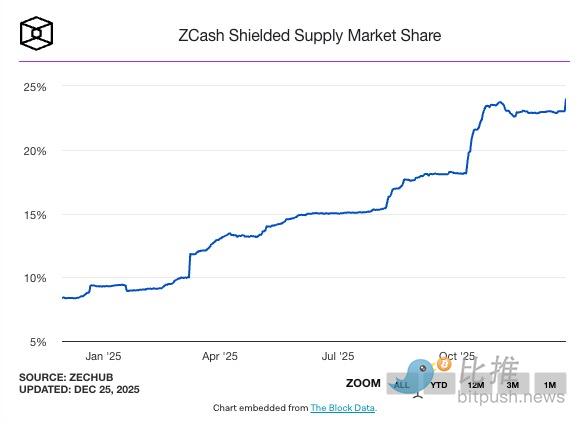
Finally, it's worth noting that as a standard-bearer for crypto privacy, Zcash's anonymous pool supply has grown to nearly 25%, marking a steady increase in network privacy adoption. Zcash provides users with functional privacy and the ability to achieve compliance through selective disclosure of information.


Twitter:https://twitter.com/BitpushNewsCN

Bitpush TG Discussion Group:https://t.me/BitPushCommunity

Bitpush TG Subscription: https://t.me/bitpush

Original link:https://www.bitpush.news/articles/7598558

İlgili Sorular

QWhat is the main concept that has gained traction in blockchain privacy in 2025, as discussed in the article?

AThe main concept is 'Pragmatic Privacy', which aims to balance individual privacy with compliance considerations.

QWhich privacy-focused blockchain launched its mainnet in November 2025 and is noted as 'Ethereum's first fully decentralized L2'?

AAztec Network's Ignition chain launched its mainnet in November 2025 and is described as Ethereum's first fully decentralized L2.

QWhat significant step did the Ethereum Foundation take in October 2025 regarding privacy?

AIn October 2025, the Ethereum Foundation formed a 'Privacy Cluster', a dedicated team of dozens of engineers to consolidate its privacy efforts, including a roadmap for native end-to-end encryption.

QWhat is the purpose of Privacy Pools, as mentioned in the article?

APrivacy Pools is a tool for ordinary blockchain users to erase transaction records without getting into legal trouble, based on research about 'association lists' to prevent bad actors from benefiting from crypto mixers.

QWhich stablecoin issuer is testing a privacy-preserving wrapped version of USDC called USDCx on the Aleo testnet?

ACircle, the largest U.S. stablecoin issuer, is testing a privacy-preserving wrapped version of USDC called USDCx on the Aleo testnet.

İlgili Okumalar

MSX US Stock Daily Insight: Amazon 2026 Q2 Earnings: AWS Records Fastest Growth in Five Years

**MSX Daily US Stock Observation: Amazon's Q2 2026 Earnings: AWS Achieves Fastest Growth in Five Years** Amazon's latest quarterly results exceeded expectations, driven by a strong performance from its cloud computing unit. The company reported revenue of $200.66 billion, surpassing estimates of approximately $197 billion. The key highlight was Amazon Web Services (AWS), which generated $42.232 billion in revenue, surging 37% year-over-year. This marked the segment's fastest growth pace in 18 quarters, indicating robust demand for cloud services. Reported Earnings Per Share (EPS) of $5.75 significantly exceeded the $1.84 forecast. However, this figure included a substantial one-time, non-operating gain of $53.4 billion, primarily from the revaluation of Amazon's investment in AI company Anthropic. Excluding this item, core operating profit was $27.461 billion, a strong increase of 43% compared to the same period last year. Despite the positive results, Amazon provided guidance for the upcoming third quarter that fell short of market expectations. The company's revenue guidance midpoint is $199.5 billion, below the consensus estimate of around $204 billion. Operating profit guidance of $24.5 billion also slightly missed expectations of approximately $247.9 billion. Furthermore, Amazon raised its forecast for full-year capital expenditures to $220 billion, citing rising memory chip costs, which weighed on investor sentiment regarding future profitability. In summary, Amazon's quarter showcased accelerating momentum in its core AWS business. The underlying operational profit growth remains solid. However, cautious forward guidance and increased investment spending present key areas for monitoring in the coming quarters, as the market assesses whether the current growth phase will translate into sustained profit margin expansion.

Odaily星球日报4 dk önce

MSX US Stock Daily Insight: Amazon 2026 Q2 Earnings: AWS Records Fastest Growth in Five Years

Odaily星球日报4 dk önce

Cyclical Stock or Growth Stock? Coinbase's Q2 Earnings Report Reveals 'Valuation Disagreement'

Coinbase's Q2 2026 financial results revealed a mixed performance, reigniting debate over whether the company should be valued as a cyclical stock tied to crypto markets or a growth stock with future potential. Total revenue missed expectations at $1.22 billion, down 19% year-over-year. Transaction revenue fell to $599 million, with retail crypto spot trading revenue dropping 30% to $452 million, back to 2023 levels. The company reported a net loss of $359 million, marking its third consecutive quarterly loss. Despite CEO Brian Armstrong's positive commentary on metrics like a 10.3% overall crypto trading market share and 106% growth in prediction markets, the market reacted negatively, with shares dropping over 5% after-hours. A key issue is the decline in core retail trading. While Coinbase touted record market share, this figure includes derivatives and new products. Its traditional crypto spot trading share is likely shrinking. New ventures like prediction markets, while growing, contributed less than $30 million, insufficient to offset the core revenue decline. The valuation debate hinges on perspective. As a cyclical stock, Coinbase remains deeply tied to the crypto bear market, with user attrition and competitive pressures justifying a lower valuation. The company's strategy appears focused on surviving until the next bull cycle. Viewed as a growth stock, however, Coinbase shows promising diversification. Subscription and service revenue reached $555 million, nearly matching transaction revenue. Stablecoin revenue, its second-largest source at $292 million, remains strong through its partnership with Circle. Critically, Coinbase is positioning itself as a leader in the emerging on-chain "agent economy." Over 90% of agent-based stablecoin transactions occur on its Base network, which it believes could handle trillions in future agent transactions. The recent acquisition of Deribit also aims to boost its international derivatives offering. In summary, Coinbase's present struggles are clear, but its future hinges on whether its investments in revenue diversification, stablecoins, and the agent economy can ultimately transform its business model and justify a growth premium.

Odaily星球日报24 dk önce

Cyclical Stock or Growth Stock? Coinbase's Q2 Earnings Report Reveals 'Valuation Disagreement'

Odaily星球日报24 dk önce

Global Market Share Survey: Japanese Firms Lead in Semiconductor Materials

Global Market Share Survey: Japanese Firms Lead in Semiconductor Materials According to the 2025 "Major Goods and Services Market Share Survey" by Nikkei, Japanese companies maintain strong positions in semiconductor-related materials. In silicon wafers, Shin-Etsu Chemical ranks first with a 26.3% share, followed by SUMCO at 17.8%. Together, they hold 44.1% of the market, widening their lead over competitors from Taiwan, Germany, and South Korea. In photoresists, Tokyo Ohka Kogyo, JSR, and Shin-Etsu Chemical occupy the top three spots, with a combined share of 60.5%. Despite their strength in materials, Japanese firms have a weaker presence in core semiconductor segments like DRAM and NAND flash memory, where South Korean and U.S. companies dominate. For instance, SK Hynix and Samsung lead in DRAM, while China’s CXMT doubled its share to 6% in 2025. The semiconductor market is projected to grow rapidly, with WSTS forecasting a 90% increase to $1.5112 trillion by 2026. Major players like Samsung, SK Hynix, and Micron are making massive investments to expand capacity. To maintain their edge in materials, Japanese companies must similarly commit to large-scale, risk-taking investments. In contrast, Japan’s automotive sector shows stagnation. Toyota remains the global leader but with only a slight share increase to 12.3%, while Japanese brands are absent from the top five in the EV market. In shipbuilding, Imabari Shipbuilding rose to third place globally with a 7.2% share, benefiting from large container ship deliveries. However, Chinese and South Korean firms dominate the sector, holding the top two positions. Japan aims to revitalize its shipbuilding industry through government and corporate efforts, targeting a near doubling of output by 2035. Addressing labor shortages and adopting advanced technologies like physical AI will be critical for competitiveness.

marsbit48 dk önce

Global Market Share Survey: Japanese Firms Lead in Semiconductor Materials

marsbit48 dk önce

İşlemler

Spot
活动图片