From a $70 Million Sky-High Transaction to a First-Day Crash: The "Amateur" Debut of ai.com

Odaily星球日报2026-02-09 tarihinde yayınlandı2026-02-09 tarihinde güncellendi

Özet

An article titled "From a $70 Million Record-Bomain Deal to Launch Day Downtime: The Rocky Debut of AI.com" reports that the highly sought-after domain AI.com, which had been at the center of speculation and bidding among AI giants, was acquired for $70 million in April 2025 by Kris Marszalek, co-founder and CEO of cryptocurrency exchange Crypto.com. The transaction, paid for in cryptocurrency, set a new public record for domain sales. The domain, first registered in 1993, had previously been linked to OpenAI and later to Elon Musk’s xAI in what was seen as a marketing tactic to drive up its value. Marszalek stated that he received even higher offers after the purchase but chose to retain the domain, believing it would be crucial for future business credibility. Over Super Bowl weekend, Marszalek launched AI.com, promoting it as a platform where users could deploy AI agents for tasks like stock trading and workflow automation. However, within 48 hours of going live, the site experienced significant downtime, drawing criticism and mockery online, particularly from an Nvidia engineer who highlighted the irony of such a high-value domain failing under load. The article also touches on how other crypto executives are diversifying their investments—from buying real estate and power plants to expanding business operations—signaling a broader trend of cryptocurrency leaders integrating into mainstream economic and technological landscapes.

Original|Odaily Planet Daily(@OdailyChina)

Author|Wenser(@wenser 2010)

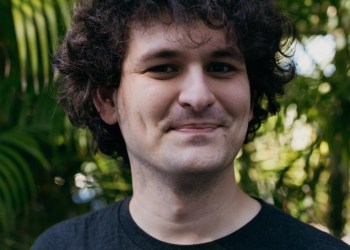
Last weekend, besides the "Bithumb airdrops 620,000 BTC" misinformation incident, another breaking news story sparked widespread discussion: the mysterious buyer behind the premium domain ai.com has finally been revealed. Contrary to many expectations, the buyer was not from an AI giant but Kris Marszalek, co-founder and CEO of the cryptocurrency exchange Crypto.com.

This transaction, finalized in April 2025, amounted to a staggering $70 million, giving the outside world a direct glimpse into the astonishing financial power of crypto big shots. This deal not only ended the ownership battle surrounding the domain but also drew a conclusion to the previous "premium domain pointing war" among giants like OpenAI and xAI.

The Battle for ai.com: A Three-Year, Sky-High Transaction War

In November 2022, with the groundbreaking launch of ChatGPT (GPT 3.5), AI instantly became the prominent field of the era, and the prices of related domain names naturally soared.

In February 2023, rumors suggested that OpenAI, the parent company behind ChatGPT, had purchased ai.com. This was later confirmed as fake news, though the domain's listed selling price of $11 million in 2021 was still jaw-dropping.

In August 2023, the ai.com domain's pointing address was changed to xAI, the AI company under Musk's umbrella, which again attracted significant attention.

From then on, more information about this premium domain was uncovered: the domain was first registered in May 1993, making it over 30 years old, a veteran in the domain world. However, Musk remained indifferent to the matter, making the market realize once again that changing the domain's pointing address was merely a marketing tactic by the ai.com holder to "wait for the highest bidder."

It reappeared in the public eye recently with the news that it was "sold for a whopping $70 million."

Public information reveals that Crypto.com co-founder and CEO Kris Marszalek successfully acquired this premium domain, setting one of the highest publicly disclosed domain sale records to date; the transaction was facilitated by domain broker Larry Fischer and was paid for in cryptocurrency. For reference, this sky-high price is double the previous sale price of the premium domain voice.com.

As an established crypto exchange founded in 2016, Crypto.com has long been renowned in the industry for its "massive marketing moves," having previously engaged in market promotion through sports sponsorships and celebrity endorsements; in 2021, it even splurged $700 million just to secure the naming rights for a sports stadium in Los Angeles.

In an interview with the media, Kris Marszalek revealed that he had "received even more outrageous resale offers but chose to hold onto the domain" because he believes it will be crucial for the future business's trust and recognition. Moreover, he boldly declared: "We fought our way to the top among thousands of crypto exchanges back then, and this time we will make ai.com a success again."

Thus, the years-long battle over the ai.com premium domain came to an end; just as the market was anticipating and speculating on how Kris Marszalek would use this domain, he unexpectedly "pulled a big one."

The Botched "Product Launch": ai.com Went Down Within 48 Hours of Going Live

Crypto.com co-founder and CEO Kris Marszalek posted that after buying the domain, he had been building quietly and would launch the product during the Super Bowl on Sunday (February 8). He later stated that with the AI Agent on the ai.com platform, users would soon be able to deploy their own agents to perform a series of actions on their behalf, such as stock trading, automating workflows, using calendars to schedule and execute daily tasks, all while maintaining privacy, based on user permissions, and entirely under user control.

But amidst great anticipation, ai.com staged a "downtime drama" within less than 48 hours of its launch.

This morning, NVIDIA engineer yuhang posted, "This $70m domain, after $8m in ads(Odaily Planet Daily note: the general price of a Super Bowl ad), 504'd".
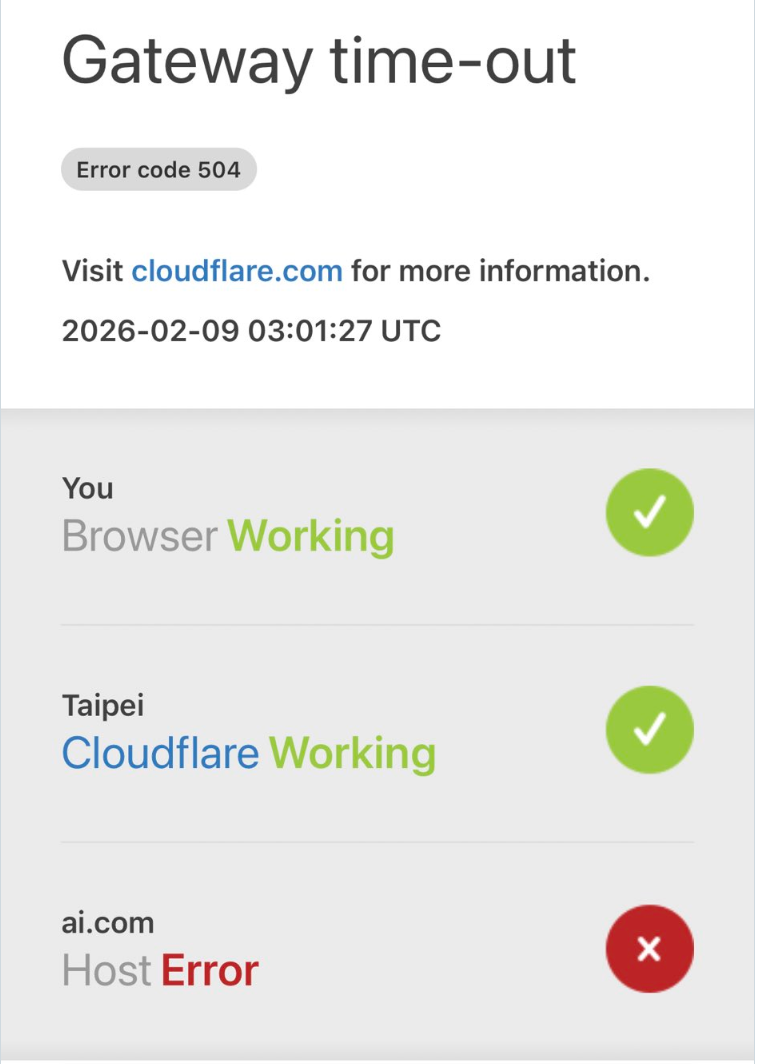
It has to be said, this incident once again confirms that saying—"The whole world is just a slightly larger amateur operation."

As of the time of writing, the ai.com website has returned to normal. Users can抢先 register personal subdomains and AI Agent subdomains to experience the platform's corresponding functions later; as for whether it can deliver on the "autonomous AI Agent" promised in Kris Marszalek's grand vision, the author will reserve judgment for now.
The "Mainstreaming Path" of Crypto Big Shots: Some Buy Houses, Some Buy Power Plants

Another hot topic brought up by the Crypto.com co-founder and CEO spending $70 million on a premium domain is the various paths to mainstreaming that crypto big shots choose for themselves.

Previously, there was Justin Sun spending millions on a lunch with Warren Buffett. Recently, the moves by crypto大佬 have become more diverse:

Aave founder Stani Kulechov bought a mansion worth £22 million (approximately $30 million) in London's Notting Hill last November.

Tether CEO Paolo focuses more on "putting eggs in different baskets." Reliable sources indicate that Tether has invested profits from its stablecoin business into 140 investments covering fields from agriculture to sports and plans to expand its workforce to 450 people; additionally, Tether's gold reserves exceed $23 billion.

Last November, Justin Sun, through his family office SunFund Energy, acquired two small hydropower plants in Norway at once, with a total installed capacity of 86 MW and an annual electricity generation of about 350 GWh, equivalent to the annual electricity consumption of 40,000 European households. In the era of the AI great navigation, the ever-bold Justin Sun chose to hold a "power ticket" to board this era's train.

Regardless of the investment outcomes, cryptocurrency is thereby becoming known to more people through its various forms in news—as a payment currency, a character symbol, an asset class, etc. Perhaps this is an indispensable part of cryptocurrency's journey into the mainstream.

İlgili Sorular

QWho purchased the ai.com domain and for how much?

AKris Marszalek, the co-founder and CEO of Crypto.com, purchased the ai.com domain for $70 million.

QWhat was the initial reaction to the launch of the ai.com platform?

AThe ai.com platform experienced a宕机 (downtime) within 48 hours of its launch, leading to public criticism and being described as a botched 'product launch'.

QWhat was the historical significance of the ai.com domain prior to its sale?

AThe ai.com domain was first registered in May 1993, making it over 30 years old. It was at the center of a bidding war among AI giants like OpenAI and xAI after the rise of ChatGPT, and its pointing address was once changed to Musk's xAI company as a marketing tactic.

QHow did Kris Marszalek justify the enormous cost of the ai.com domain?

AKris Marszalek stated that he believed the domain was crucial for the future trust and recognition of his business. He also mentioned receiving even higher resale offers but chose to keep it, confident in his ability to succeed with it as he did with Crypto.com.

QWhat are some examples of how other crypto billionaires are diversifying their investments?

AOther crypto billionaires are diversifying in various ways: Aave's founder bought a £22 million mansion in London; Tether's CEO invested profits into 140 ventures ranging from agriculture to sports and expanded gold reserves; and Sun Yuchen acquired two small hydropower plants in Norway to secure a 'power ticket' for the AI era.

İlgili Okumalar

Apple Also Has to Pay Rent Now

Apple Pays Rent Too: The Two-Way Flow of "Traffic Tax" and "AI Capability Rent" Between Tech Giants For over two decades, Google has paid Apple an estimated $20 billion annually to remain the default search engine on Safari, a "traffic tax" for a critical user entry point. However, in 2026, the direction of this cash flow partially reversed. Apple agreed to pay Google roughly $1 billion per year to license its Gemini AI models, as Apple's own models reportedly struggled with complex tasks. This creates a unique dynamic: Apple acts as the "landlord" in the established search ecosystem, collecting rent from Google for access. Simultaneously, in the emerging AI arena, Apple becomes the "tenant," paying Google for access to cutting-edge AI capabilities it cannot currently match internally. While Apple claims its new models are "distilled" from Gemini outputs and contain "not a drop" of Google's original code, core dependencies remain. Its knowledge base is refined using Gemini's outputs, and its most powerful cloud model runs on Google's infrastructure. Apple has structured the deal as non-exclusive, allowing it to theoretically switch AI suppliers—a hedge against over-reliance. The future hinges on whether advanced AI models become a commodity (cheap and abundant) or remain a concentrated, scarce resource (expensive and controlled by few). Apple is betting on the former, leveraging its massive device ecosystem to be a powerful, choosy customer. If the latter proves true, its bargaining power could erode. This power dynamic is extending to developers. Apple, Google, and WeChat are all pushing for apps to expose their core functions as standardized "actions" or "intents" that their respective AI assistants (Siri, Gemini, WeChat AI) can directly call. The new scarce resource is no longer just app store visibility, but "being selected by the AI." The currency of "rent" has changed from a 30% revenue share to ceding control over how users interact with an app's functions.

marsbit1 saat önce

Apple Also Has to Pay Rent Now

marsbit1 saat önce

Missed the SpaceX IPO? WEEX's "First Trade Protection" Lets You Experience US Stock Trading Risk-Free.

With the excitement around SpaceX's recent public listing reigniting interest in the US stock market, Chinese investors face significant challenges accessing compliant and convenient trading channels following regulatory actions against major online brokers. This article explores the available options, highlighting their risks and limitations. Traditional paths for US stock investments remain problematic. Qualified Domestic Institutional Investor (QDII) and Listed Open-Ended Fund (LOF) products, while compliant, suffer from high fees, significant purchase premiums, and a very limited selection of assets. Small, unregulated offshore brokers pose substantial risks, including potential insolvency. While secure, VIP accounts at banks in Hong Kong or Singapore require high minimum deposits (often 1-2 million RMB) and in-person visits, placing them out of reach for most retail investors. The article positions cryptocurrency exchanges, specifically their TradFi (traditional finance on-chain) offerings, as a compelling alternative. Platforms like WEEX are noted for providing access to a wide range of US stocks and ETFs, including SpaceX (SPCXON), through tokenized assets. This method offers advantages such as a single account for both crypto and traditional assets, USDT-based settlement avoiding fiat complexities, flexible leverage, and robust risk management. To attract users, WEEX is promoting a "First Trade Guarantee" campaign. Running from June 15 to July 8 (UTC+8), it features a $30,000 prize pool. Users who trade $500 worth of US stock contracts can qualify for a guarantee on their first eligible trade: 100% loss coverage up to $30 or a 20% bonus on profits up to $30. The campaign is presented as a low-risk opportunity for both crypto natives and traditional investors to experience US stock trading.

marsbit1 saat önce

Missed the SpaceX IPO? WEEX's "First Trade Protection" Lets You Experience US Stock Trading Risk-Free.

marsbit1 saat önce

How Difficult is Chip Making? A Division Error Costs 475 Million Dollars

How Hard Is It to Make a Chip? A Division Error Cost $475 Million Chip expert Shi Kan, a researcher at the Chinese Academy of Sciences and a popular tech creator, explains the immense challenges of chip development. Chips are foundational to modern technology, but their creation is extraordinarily difficult. The journey from sand to a functional chip involves complex design and manufacturing, but a critical bottleneck is verification—ensuring the design works flawlessly before costly production. A single, undetected bug can have catastrophic consequences, as illustrated by the infamous 1994 Intel Pentium FDIV bug. A flaw in the floating-point division unit forced a recall costing $475 million. Unlike software, chips cannot be easily patched after manufacture, making "first-time success" paramount. However, industry surveys show only 24% of chip projects achieve this; over three-quarters require at least one costly re-spin due to design flaws. Verification has thus become the dominant phase, consuming up to 70% of the design cycle. The core challenge is a "verification impossible triangle" between high performance, good debuggability, and low cost. Exhaustively verifying a modern CPU core could take 15,000 years with software simulation, or 30 years with advanced hardware emulation—timeframes utterly impractical for development. Despite being essential, verification is often seen as unglamorous "dirty work," receiving less academic attention than fields like AI. Shi and his team are tackling this by developing an agile verification research framework called ENCORE, based on FPGA technology, to improve verification efficiency and debug capability. Beyond research, Shi engages in public science communication through long-form video content, aiming to demystify chip technology, AI, and computer science. He argues for the value of pursuing "hard and long-term" endeavors, whether in the meticulous world of chip verification or in creating substantive educational content, believing such sustained effort is likely the right path forward.

marsbit1 saat önce

How Difficult is Chip Making? A Division Error Costs 475 Million Dollars

marsbit1 saat önce

İşlemler

Spot
Futures
活动图片