From 100,000 Losses to Tens of Red Envelopes: Why Are Crypto Enthusiasts Turning to 'Yuanbao Wool'?

比推2026-02-04 tarihinde yayınlandı2026-02-04 tarihinde güncellendi

Özet

Amidst a significant downturn in global financial markets and cryptocurrency prices in early February, many crypto traders, facing substantial losses, have turned to a seemingly more reliable source of small gains: the "Yuanbao Cash Redemption" event. This campaign by Yuanbao, backed by Tencent, offers cash红包 (red envelopes) typically ranging from a few to tens of RMB for simple tasks like referrals and product interactions, providing a psychological escape from market volatility. In contrast, the traditional crypto airdrop landscape has become increasingly fraught with risk and disappointment. The article highlights cases like Infinex, where users invested significant time and money (e.g., over $11,900 and 406 days of engagement) only to face heavy losses during token generation events, with some unable to even recoup costs. This has led to frustration, silent resignation, or even public维权 (rights protection) efforts. The core issue is framed as a shift in the purpose of airdrops: from rewarding early users to merely serving as a growth hack for project teams seeking exits or funding, often with unreliable token promises. Web2 companies like Tencent can offer cash rewards with certainty due to strong cash flow and legal frameworks, whereas Web3 airdrops often come with high costs (time, effort, capital), risks like sybil attacks, unlock periods, and rule changes, resulting in lower effective returns. Both Web2 and Web3 use airdrops for user acquisition, but long-term rete...

Author: Golem

Original Title: The Biggest Airdrop for Crypto Enthusiasts Comes from Yuanbao


"xxx has sent you a cash red envelope!"

After the Yuanbao cash red envelope activity began on February 1st, many long-dead project/research exchange groups have completely transformed into "Yuanbao wool-pulling" mutual aid groups.

For crypto enthusiasts, transitioning from esteemed crypto traders to Yuanbao red envelope wool-pullers is a move born out of necessity.

Starting January 31st, global financial markets plummeted. Precious metals, which had previously surged, crashed rapidly. Spot silver nearly erased its year-to-date gains, and spot gold once fell below $4500. The crypto market fared no better. On February 2nd, Bitcoin broke below the $75,000 support level, hitting a low of $74,604. ETH dropped to a low of $2157.14, and SOL even fell below $100, touching a low of $95.95.

According to Coinglass data, the crypto market saw a total liquidation of $2.5615 billion on January 31st, setting a record for the highest single-day liquidation since the "10/11 crash." Thus, "too devastated to speak" became the true psychological state of many crypto enthusiasts (like the silent Yi Lihua).

For those who just experienced a bloodbath, pulling Yuanbao red envelopes, though a drop in the bucket for recouping losses, offers some psychological comfort and a temporary escape from the harsh market reality.
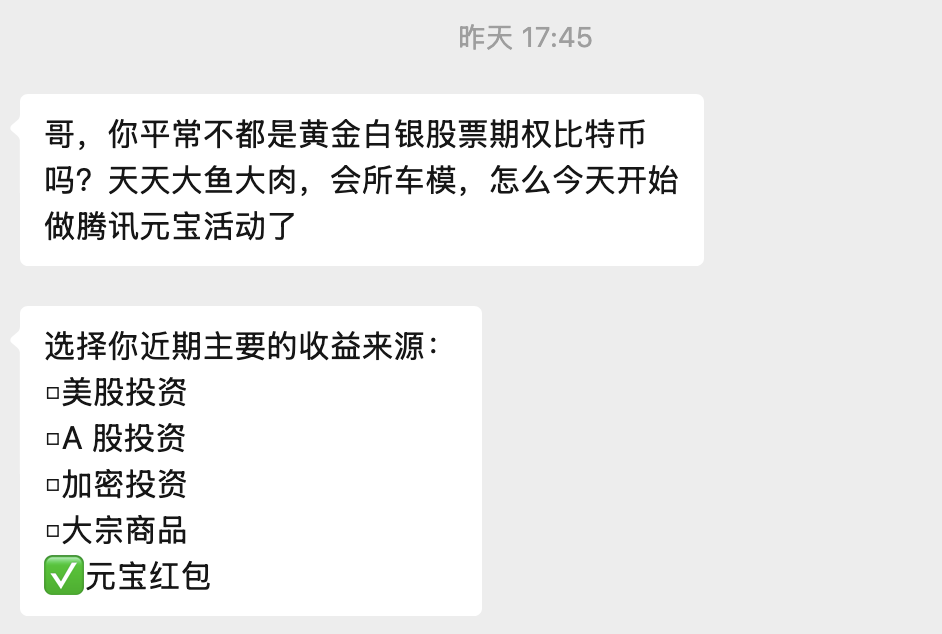
Jokes in group chats

Crypto Airdrops: From Swallowing Losses to Passionate Rights Defense

Calling Yuanbao's cash red envelopes the biggest airdrop for crypto enthusiasts today is not just a gimmick.

The cash red envelope amount Yuanbao distributes to each user isn't large, mostly ranging from a dozen to several tens of RMB. However, its value lies in its simplicity and truly zero cost. Users only need to spend a little time recruiting people and systematically experiencing product features to receive cash red envelopes. The task cycle is short, allowing for quick returns.

In contrast, airdrops from crypto projects are first distributed in the form of tokens. Profit is only realized after the tokens are sold. While the nominal amount received is often much larger than Yuanbao's, after deducting the costs of time, research, opportunity, friction, and potential losses from being stuck with unsellable tokens, how much remains?

A user who accompanied Infinex for 406 days deeply feels this. On January 31st, the decentralized perpetual contract trading platform Infinex announced its TGE and airdrop claims. The project team successfully reached shore, but the community was collectively "rug-pulled."

"Ten Million is a Cat" (X: @RXu107) is a typical example of being rug-pulled. On February 1st, they posted that they spent over $11,900 (approximately 82,000 RMB) participating in this project (4400 U for an NFT, 7500 U for the public sale), and as a community member, deeply accompanied it for 406 days. But on TGE day, not only did they not recoup their costs, but they also faced a paper loss of over 100,000 RMB (2900 U + 11,284 locked INX tokens).

Faced with the rug-pull, the blogger had no choice but to repeatedly express their distress to friends.
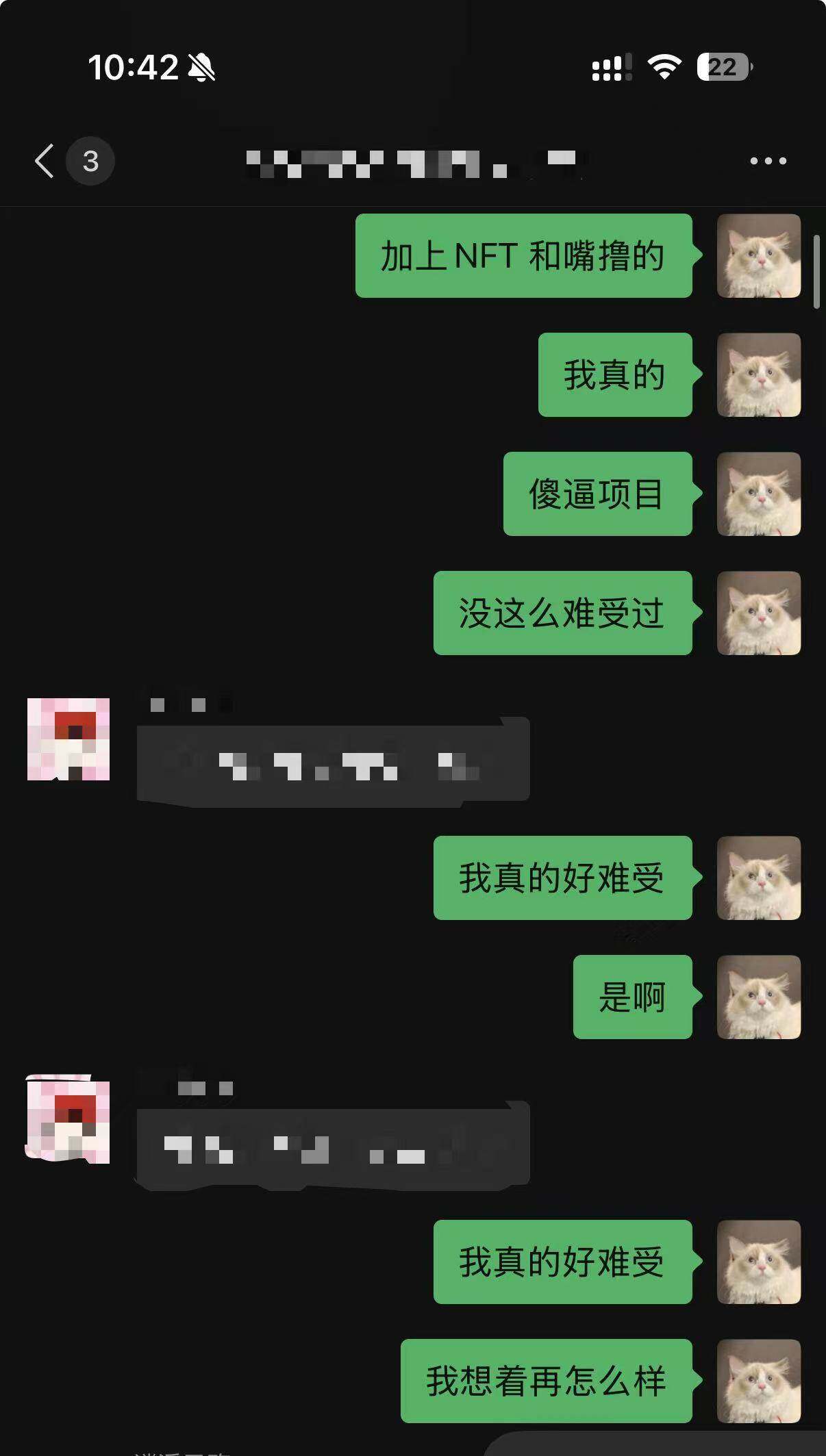
The rug-pulled blogger expresses distress to a friend

At its TGE, Infinex's fully diluted valuation was only $150 million. The total investment in Yuanbao's New Year red envelope activity is approximately $140 million USD. What does this mean? It's equivalent to Tencent directly buying Infinex at its maximum valuation and giving it away for free to the entire nation.

Faced with the pain of being rug-pulled and deceived, most people in the community choose the same approach as "Ten Million is a Cat"—swallowing the bitter pill. However, some choose to stand up and confront the project team.

Crypto blogger Ice Frog (X: @Ice_Frog666666) is a typical representative. He started by airdrop farming, but ironically, in 2025, Ice Frog was either defending airdrop rights or on his way to do so. He is currently still negotiating with the prediction market project Space (Odaily Note: Space raised $20 million in public sale, the team privately took $13 million) and has even taken legal measures.

Web2 Can Afford Airdrops, Web3 Can't Fulfill Promises

The most ironic point is that today's imbalance between "input and return" in crypto airdrops is not due to the "moral bankruptcy" of a single project, but rather the result of a整套 (entire set of) structural changes in the industry.

In 2020, Uniswap opened the era of crypto project airdrops. Since then, there have been constant major "drops" (large airdrops) in the crypto space. Stories of getting a car, buying a house, or reaching A8 (wealth level) from airdrops attracted batch after batch of people into the airdrop farming track, presenting an illusion of "the industry is on the rise."

But by 2025, this changed. Market narratives dried up, primary financing weakened, secondary buying power was insufficient. Airdrops were no longer about sharing the future with early users, but more like mortgaging the future for present data, creating an exit path for the project team itself or securing the next round of financing. Thus, major drops disappeared, small drops shrank, and "being rug-pulled" became the industry norm.

So-called airdrops are essentially just advertising budgets rewritten as reward pools, bypassing third parties to directly establish growth relationships with users. Whether it's the 1 billion RMB from Web2's Yuanbao or the fixed airdrop allocation in Web3 project tokenomics, the essence is the same logic.

But the difference is that Web2 giants use cash to buy user certainty, while Web3 offers token returns as a promise that might be fulfilled. This results in the same tactic leading to two different fates.

The certainty of Yuanbao's cash red envelopes comes from cash flow and constraint mechanisms. Tencent's strong cash flow determines that Yuanbao "can pay out," and the constraint mechanisms under mature law determine that Yuanbao "cannot renege." Coupled with the "simple and brainless" zero-threshold interaction, users naturally perceive it as a "welfare benefit."

In contrast, crypto enthusiasts not only incur costs several times higher than Web2羊毛党 (wool-pullers) (e.g., capital, time, energy) but also worry about being sybil attacked, token lock-up periods, and ever-changing airdrop rules. The most ironic part is that the returns from all this effort ultimately might not even match Yuanbao's.

Therefore, today's crypto airdrops have long degenerated from direct growth rewards into promises where the fulfillment of obligations is constantly postponed, or even unfulfilled. If this situation does not change in 2026, user retention will be sacrificed along with it.

From User Acquisition to Retention, Airdrop Utility Only Lasts the First Half

Using airdrops for user acquisition has always been one of the most common and direct tactics in the business world to compete against powerful rivals.

Tencent invested 1 billion RMB cash to support Yuanbao because its competitor Doubao is strong enough—by the end of 2025, Doubao was the first AI product in China to reach 100 million daily active users. The same goes for Web3. In the prediction market赛道 (track), Polymarket dominates. To compete for users, Opinion, predict.fun, and Limitless also use points airdrops for user acquisition, directly pulling users into their products.

In the short term, airdrops can indeed create a massive user influx. But in the long run, what determines user retention remains product-market fit, user experience, and ecological synergy, among other factors. In Web3's business history, there are no shortage of project cases that were bustling before the airdrop but deserted afterward. Therefore, both Web2 and Web3 face the same "post-airdrop problem": how to retain users.

Ten years ago, Tencent, a company adept at imitating and then surpassing, used "WeChat Red Envelopes" to push WeChat Pay into a national-level入口 (entry point), proving its familiarity with the "user acquisition → retention → habit" chain. Whether they can recreate Yuanbao's miracle in the same way is众说纷纭 (debatable), but they at least have ample experience in "how to convert airdrops into retention."

To this end, Odaily Planet Daily contacted an internal Yuanbao staff member and asked, from a product perspective, how Web3 project airdrops should be improved. The answer was pragmatic:

"As one of the internet companies with the largest market cap, Tencent's experience might not be directly applicable to Web3 projects. But the core of using airdrops for user acquisition is still improving retention. This requires a series of post-airdrop联动 (linkages/synergies). For example, PR and marketing need to think about how to further propagate the玩法 (gameplay/mechanisms), and the product side also needs to take more actions to achieve this."

From the perspective of Web3 practitioners, merely discussing traffic tactics feels superficial. What product features, beyond the token, can actually retain users is worth pondering more deeply.


Twitter:https://twitter.com/BitpushNewsCN

Bitpush TG Discussion Group:https://t.me/BitPushCommunity

Bitpush TG Subscription: https://t.me/bitpush

Original article link:https://www.bitpush.news/articles/7608686

İlgili Sorular

QWhy are cryptocurrency investors turning to 'Yuanbao' cash red packets according to the article?

ADue to significant losses in the cryptocurrency market, with Bitcoin dropping below $75,000 and a record $2.56 billion in liquidations on January 31, investors are seeking psychological comfort and a temporary escape by participating in Yuanbao's simple, no-cost cash red packet activities.

QWhat is the key difference between Web2 projects like Yuanbao and Web3 projects in terms of airdrop rewards?

AWeb2 projects like Yuanbao use cash rewards backed by strong cash flow and legal constraints, ensuring certainty and reliability, while Web3 projects often offer token-based airdrops that are uncertain, subject to changes, and may not be honored, leading to potential losses for users.

QHow does the article describe the Infinex airdrop incident and its impact on users?

AThe Infinex airdrop incident resulted in users being 'reverse fleeced,' with one user spending over $11,900 (approximately 82,000 RMB) and suffering a loss of more than 100,000 RMB, highlighting the high costs and risks associated with Web3 airdrops compared to the minimal returns.

QWhat challenge do both Web2 and Web3 projects face after conducting airdrops?

ABoth face the challenge of user retention post-airdrop; while airdrops can drive initial user growth, long-term retention depends on product-market fit, user experience, and ecological integration, rather than just the airdrop incentives.

QWhat suggestion does the Yuanbao insider offer to Web3 projects for improving airdrops?

AThe insider suggests that Web3 projects should focus on improving user retention through post-airdrop initiatives, such as enhancing public relations and marketing efforts to spread awareness, and product-side actions to engage users beyond just token rewards.

İlgili Okumalar

The Essence of AI Layoffs: Why More AI Adoption Leads to More Corporate Anxiety?

The author, awaiting potential inclusion on an 8000-person layoff list, analyzes the true nature of recent "AI-driven" layoffs. They argue that while AI use, particularly tools like Claude for code generation, has skyrocketed and boosted developer output (e.g., 2-5x more code commits), this has not translated into proportional business growth or revenue. The core issue is a misalignment between increased "Input" (code) and tangible "Outcomes" (user value, revenue). AI acts as a costly B2B SaaS, inflating operational expenses without guaranteed returns. Two key problems emerge: 1) The friction that once filtered out bad ideas is gone, as AI allows cheap pursuit of even weak concepts. 2) Organizational "alignment tax"—the difficulty of coordinating across teams—becomes crippling when development velocity outpaces consensus-building. Thus, layoffs serve two immediate purposes: 1) To offset ballooning AI costs (Token consumption) and maintain cash flow, as rising input costs without outcome growth destroys unit economics. 2) To reduce organizational bloat and alignment friction by simply removing teams, thereby speeding up execution in the short term. Therefore, these layoffs are fundamentally caused by AI, even if AI doesn't directly replace roles. They represent a painful correction until companies learn to convert AI-driven productivity into real business outcomes and streamline organizational coordination to match the new pace of work. The cycle will continue until this learning curve is mastered.

marsbit37 dk önce

The Essence of AI Layoffs: Why More AI Adoption Leads to More Corporate Anxiety?

marsbit37 dk önce

Can the Solana Foundation and Google's Collaboration on Pay.sh Bridge the Payment Link Between Web2 and Web3 in the Agent Economy?

Solana Foundation, in collaboration with Google Cloud, has launched Pay.sh, a payment gateway designed to bridge the gap between AI agents and enterprise-grade service infrastructure. The initiative aims to solve a key bottleneck in the "agent economy": existing payment systems are ill-suited for autonomous AI agents. Traditional methods like credit cards require human verification, while newer on-chain protocols like x402 and MPP create a separate, Web3-native system that raises barriers for service providers. Pay.sh functions as a universal payment layer. It allows users to fund a Solana wallet via credit card or stablecoin, which then acts as an identity and payment proxy for AI agents. When an agent needs to access a paid API service (e.g., Google Cloud, Alibaba Cloud), Pay.sh handles the transaction seamlessly. It leverages the HTTP 402 status code ("Payment Required") to initiate payments, intelligently choosing between one-time transfers (x402-style) or session-based authorizations (MPC-style) based on the service's billing model. This spares agents from manual account registration and API key management. A key feature for service providers is low integration effort. They can adopt Pay.sh by providing a declarative configuration file, enabling features like tiered pricing, free tiers, and automatic revenue splitting to multiple addresses (e.g., for royalties, cloud costs). Providers can also list their APIs in a central Pay Skill Registry for agent discovery. The collaboration with Google Cloud provides crucial infrastructure for API proxying, traffic routing, and compliance logging, aiming to keep agent activities within regulated boundaries. By connecting Web2 services with Web3 payment rails, Pay.sh positions the Solana wallet as a foundational identity and payment tool for AI agents, potentially driving more transaction volume to the Solana ecosystem. However, the report notes challenges. The service registry currently lacks robust vetting, risking exposure to unauthorized or malicious third-party APIs. Pay.sh also inherits security and compatibility risks from its underlying payment protocols (x402, MPC). Furthermore, adoption may be hindered by varying regional data privacy and payment compliance regulations among API providers. Despite these hurdles, Pay.sh represents a significant step towards integrating Web2 and Web3 for autonomous agent commerce.

marsbit43 dk önce

Can the Solana Foundation and Google's Collaboration on Pay.sh Bridge the Payment Link Between Web2 and Web3 in the Agent Economy?

marsbit43 dk önce

Bitcoin's Bull-Bear Cycle Indicator Turns Positive for the First Time in 7 Months: End of Bear Market or False Breakout?

Bitcoin's "Bull-Bear Market Cycle Indicator" from CryptoQuant has turned positive for the first time since October 2025. This gauge, based on the P&L Index relative to its 365-day moving average, suggests a potential shift from a bear market phase. Concurrently, the Bull Score Index rose to a neutral reading of 50 in late April. The indicator's move into positive territory follows a roughly 35% price rebound from a low near $60,000 in February to above $81,000. The recovery over approximately three months was faster than the 12-month period observed during the 2022 bear market. However, analysts caution against premature optimism, citing a historical precedent from March 2022. Back then, the Bull Score Index briefly hit 50, but it proved to be a false signal as Bitcoin's price subsequently plunged further. Structural differences exist in the current cycle, including consistent inflows into spot Bitcoin ETFs and an increase in large holder addresses. Yet, some models, referencing the four-year halving cycle, suggest a potential deeper bottom near $50,000 might still be possible around late 2026. In summary, while on-chain data shows marked improvement and the worst panic may be over, market participants remain cautious. A convincing trend reversal confirmation likely requires Bitcoin to sustainably break above key resistance, such as the 200-day moving average near $82,000.

marsbit51 dk önce

Bitcoin's Bull-Bear Cycle Indicator Turns Positive for the First Time in 7 Months: End of Bear Market or False Breakout?

marsbit51 dk önce

How to Automate Any Workflow with Claude Skills (Complete Tutorial)

This is a comprehensive guide to mastering Claude Skills, a feature for creating permanent, reusable instruction sets that automate specific workflows. Unlike simple saved prompts, Skills function like trained employees, delivering consistent, high-quality outputs by defining the entire task process, standards, error handling, and output format. The guide is structured in four phases: **Phase 1: Installation (5 minutes).** Skills are folders containing a `SKILL.md` file. The user is instructed to find a relevant Skill online, install it, test it on a real task, and compare its performance to one-off prompts. **Phase 2: Building Your First Custom Skill.** Start by rigorously defining the Skill's purpose, trigger phrases, and providing a concrete example of perfect output. The `SKILL.md` file has two parts: a YAML frontmatter with a specific name/description/triggers, and a detailed, step-by-step workflow written in natural language with examples and quality standards. **Phase 3: Testing & Optimization for Production.** Test the Skill in three scenarios: 1) a standard, common task; 2) edge cases with missing or conflicting data; and 3) a pressure test with maximum complexity. Any failure indicates a needed instruction. Implement a weekly optimization cycle to continuously refine the Skill based on real usage. **Phase 4: Building a Complete Skill Library.** The goal is to create a team of Skills for all repetitive tasks. Examples are given for industries like real estate, marketing, finance, consulting, and e-commerce. The user should list their tasks, prioritize them, and build one new Skill per week, maintaining a master document to track their library. The conclusion emphasizes the compounding time savings: ten Skills saving 30 minutes each per week reclaims over 260 hours (6.5 work weeks) per year, fundamentally transforming one's work system.

marsbit1 saat önce

How to Automate Any Workflow with Claude Skills (Complete Tutorial)

marsbit1 saat önce

İşlemler

Spot
Futures

Popüler Makaleler

F Nasıl Satın Alınır

HTX.com’a hoş geldiniz! Synfutures (F) satın alma işlemlerini basit ve kullanışlı bir hâle getirdik. Adım adım açıkladığımız rehberimizi takip ederek kripto yolculuğunuza başlayın. 1. Adım: HTX Hesabınızı OluşturunHTX'te ücretsiz bir hesap açmak için e-posta adresinizi veya telefon numaranızı kullanın. Sorunsuzca kaydolun ve tüm özelliklerin kilidini açın. Hesabımı Aç2. Adım: Kripto Satın Al Bölümüne Gidin ve Ödeme Yönteminizi SeçinKredi/Banka Kartı: Visa veya Mastercard'ınızı kullanarak anında Synfutures (F) satın alın.Bakiye: Sorunsuz bir şekilde işlem yapmak için HTX hesap bakiyenizdeki fonları kullanın.Üçüncü Taraflar: Kullanımı kolaylaştırmak için Google Pay ve Apple Pay gibi popüler ödeme yöntemlerini ekledik.P2P: HTX'teki diğer kullanıcılarla doğrudan işlem yapın.Borsa Dışı (OTC): Yatırımcılar için kişiye özel hizmetler ve rekabetçi döviz kurları sunuyoruz.3. Adım: Synfutures (F) Varlıklarınızı SaklayınSynfutures (F) satın aldıktan sonra HTX hesabınızda saklayın. Alternatif olarak, blok zinciri transferi yoluyla başka bir yere gönderebilir veya diğer kripto para birimlerini takas etmek için kullanabilirsiniz.4. Adım: Synfutures (F) Varlıklarınızla İşlem YapınHTX'in spot piyasasında Synfutures (F) ile kolayca işlemler yapın.Hesabınıza erişin, işlem çiftinizi seçin, işlemlerinizi gerçekleştirin ve gerçek zamanlı olarak izleyin. Hem yeni başlayanlar hem de deneyimli yatırımcılar için kullanıcı dostu bir deneyim sunuyoruz.

191 Toplam GörüntülenmeYayınlanma 2024.12.21Güncellenme 2025.03.21

F Nasıl Satın Alınır

Tartışmalar

HTX Topluluğuna hoş geldiniz. Burada, en son platform gelişmeleri hakkında bilgi sahibi olabilir ve profesyonel piyasa görüşlerine erişebilirsiniz. Kullanıcıların F (F) fiyatı hakkındaki görüşleri aşağıda sunulmaktadır.

活动图片













