From 100% Rebate to 20%: The Game Theory Behind Polymarket's Fee Adjustment

marsbit2026-01-14 tarihinde yayınlandı2026-01-14 tarihinde güncellendi

Özet

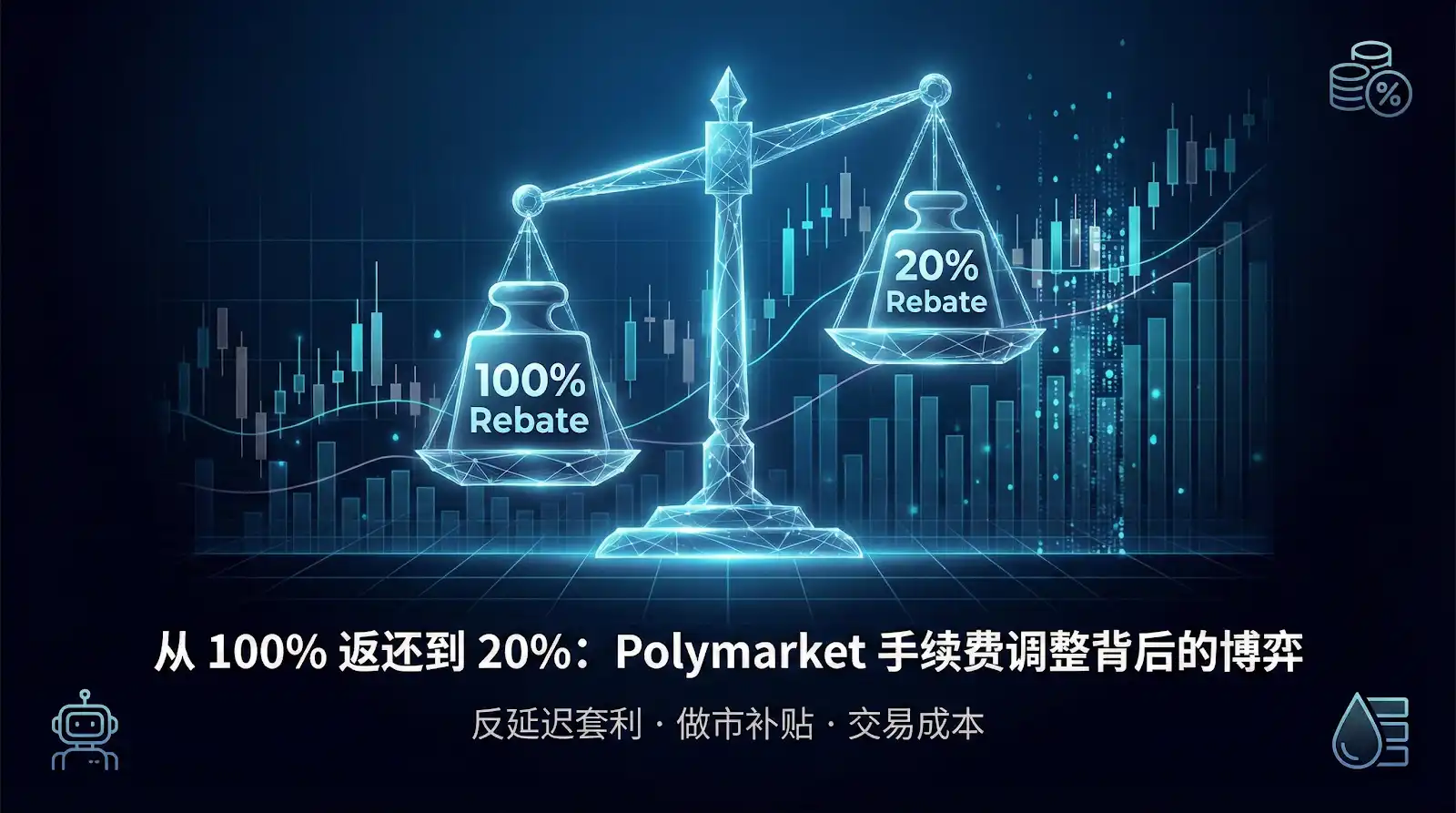
Polymarket recently adjusted its fee structure for 15-minute cryptocurrency prediction markets, moving from a 100% fee rebate to a 20% rebate for market makers. This change aims to combat "latency arbitrage" bots that exploited tiny time delays between exchange price updates and Polymarket’s price adjustments, harming market makers and reducing liquidity. Initially, full rebates were introduced to incentivize market makers to stay despite bot activity. After data showed a significant drop in fee volume—indicating reduced bot activity—the platform reduced rebates to 20% for a trial period. This reflects an ongoing effort to balance fairness among market makers, automated traders, and regular users. The article also references ongoing "money printer" strategies used by some successful traders and emphasizes Polymarket’s role in providing a competitive, strategy-driven environment.

Author: DFarm

First, let's sort out the recent timeline of events related to Polymarket's transaction fees.

  1. Polymarket suddenly announced that it would charge a transaction fee for 15-minute cryptocurrency price prediction markets, but all fees collected would be rebated to market makers (those placing limit orders).

  2. The fee rebate was changed from a 100% rebate to a partial rebate.

  3. Until the 11th, the 100% fee rebate stopped. From the 12th to the 18th, 20% of the fees are being rebated.

Why Charge a Fee?

We all know that Polymarket previously did not charge any fees for basic transactions. Why did it specifically start charging fees on the 15-minute cryptocurrency markets this time?

This requires explaining what "latency arbitrage" bots are.

In very short-cycle markets like 15-minute intervals, outcomes are determined based on prices from major exchanges.

In the absence of fees, high-frequency trading bots exploit millisecond-level time delays to place orders on Polymarket before its price has had a chance to update, thereby securing profits.

For example, suppose the current probability for BTC going UP in the next 15 minutes on Polymarket is 90%. Suddenly, the BTC price on exchanges drops by 5%. A bot detects this and immediately buys the cheap DOWN shares. After it finishes buying, subsequent bots or traders come in to buy and drive the price, allowing the initial bot to profit and exit.

What is the consequence of this behavior? Market makers consistently get exploited by these high-frequency bots. Naturally, market makers become unwilling to continue providing liquidity by placing orders in these markets, ultimately leading to poorer liquidity in the 15-minute cryptocurrency markets.
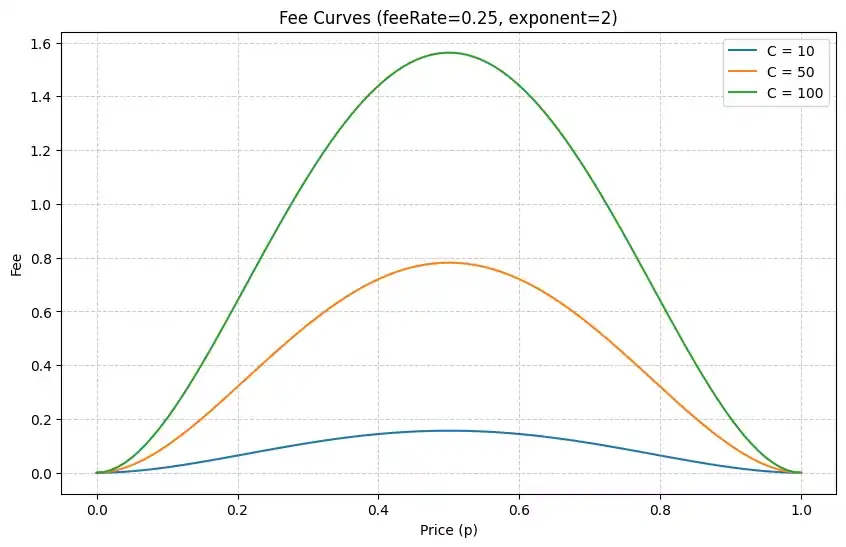
Therefore, the platform introduced a fee mechanism, with the highest fees specifically applied when the odds are 50:50 (as shown in the image). This directly makes the arbitrage cost for many bots higher than their potential profit, so these bots naturally shut down.

Why Subsidize Market Makers?

As mentioned earlier, market makers had too much capital extracted from them previously. To retain market makers, the platform distributes the collected fees to those placing limit orders (market makers).

So why was the rebate reduced from 100% to 20%?

The detail is in this phrase: "From the 12th to the 18th, 20% of fees are rebated." This tells us that the rebate percentage after the 18th is to be determined.

When fees were first introduced, market makers were actually uncertain—they didn't know if the fees would effectively block the bots. The platform initially rebated 100% of the fees to market makers to cover their risks and retain liquidity.

Why only 20% now? Let's look at the data first:
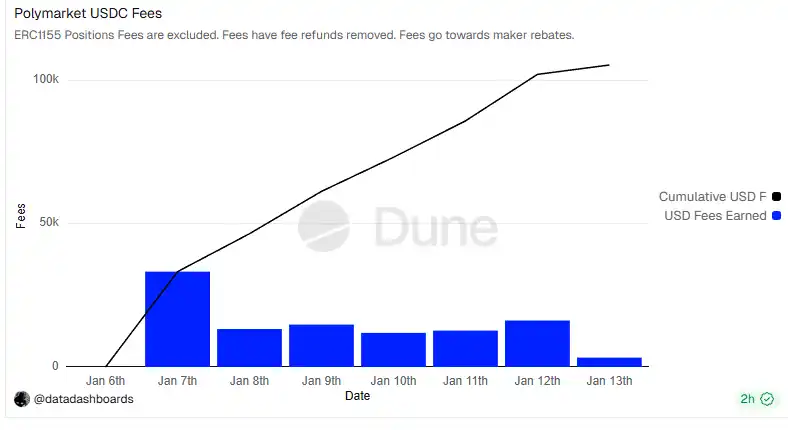
After fees were enabled, the total fee volume halved. What does this indicate? It confirms that many high-frequency bots indeed shut down.

Seeing that the bots are gone and the risk for market makers has decreased, the platform likely concluded that a 100% fee rebate is no longer necessary. They are trying 20% first to see the data performance.

This is why they are trialing a 20% fee rebate for one week first, to observe the data before deciding on the subsequent rebate ratio.

Ultimately, all this is about balancing the interests of market makers, bots, and regular traders.

The "Money Printer" Bots

There are many "money printer" entities present across various markets on Polymarket. Very few people in the market truly understand how they operate.

A very popular example is a post by X user: @the_smart_ape:
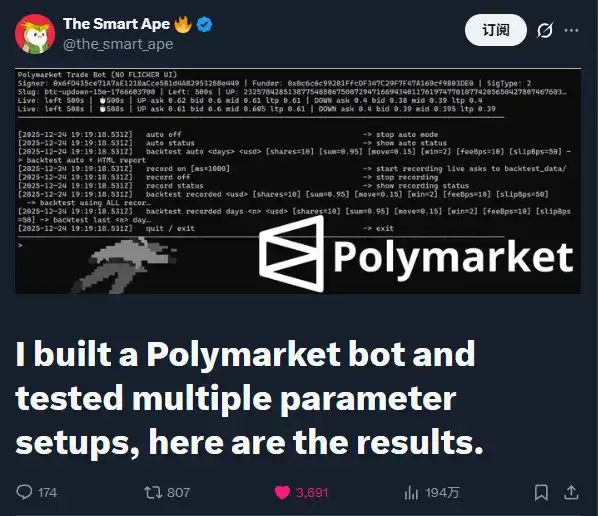
This post has nearly 2 million views. Many friends have tried the strategy described in the article, and indeed some have made profits.

But just a few days later, the fees were introduced, and many friends could no longer profit...

So have the "money printers" disappeared? Not entirely. Interested friends can check out these "money printers":

https://polymarket.com/@gabagool22?via=dfarm

https://polymarket.com/@distinct-baguette?via=dfarm

https://polymarket.com/@livebreathevolatility?via=dfarm

If you can decipher their strategies, your "money printer" isn't far away. But remember, don't tell anyone else—though you can secretly tell me.

Finally

Actually, on Polymarket, since there are no third-party commissions or fees, we are essentially betting against each other. Therefore, the platform's responsibility is to provide a fair playing field for both sides.

Players who enjoy PVP games also know that absolute fairness doesn't exist; it can only be approached through iterative version updates, striving for relative fairness.

This situation also shows us that "money printers" do exist on Polymarket, and it's all about competing on technology and strategy.

If this article was helpful to you, please help share it. Thank you.

If you are a newbie to Polymarket, be sure to check out this article → 《Beginner's Tutorial: Hand-Holding Guide to Getting Started with Polymarket from Scratch (Includes Anti-Ban + Low-Friction Deposit/Withdrawal Strategies)》


İlgili Sorular

QWhy did Polymarket introduce fees specifically for the 15-minute cryptocurrency price prediction markets?

APolymarket introduced fees to combat 'latency arbitrage' bots that exploited millisecond delays in price updates to profit at the expense of market makers, which was degrading liquidity in these short-term markets.

QWhat was the initial fee rebate policy, and how did it change?

AInitially, Polymarket implemented a 100% fee rebate to market makers (those placing limit orders). This was later reduced to a 20% rebate for a trial period from the 12th to the 18th.

QWhat effect did the introduction of fees have on the trading activity of arbitrage bots?

AThe total amount of fees collected dropped by half after their introduction, indicating that a significant number of high-frequency arbitrage bots were no longer profitable and stopped operating.

QWhat is the purpose of the fee rebate given to market makers?

AThe rebate is an incentive to compensate market makers for the risks they faced from arbitrage bots and to encourage them to continue providing liquidity (placing limit orders) on the platform.

QAccording to the article, what is the ultimate goal of Polymarket's fee policy adjustments?

AThe goal is to balance the interests of market makers, arbitrage bots, and regular traders to create a fairer trading environment, akin to how game developers balance PVP games through iterative updates.

İlgili Okumalar

Circle CEO's Seoul Visit: No Korean Won Stablecoin Issuance, But Met All Major Korean Banks

Circle CEO Jeremy Allaire's recent activities in Seoul indicate a strategic shift for the company, moving away from issuing a Korean won-backed stablecoin and instead focusing on embedding itself as a key infrastructure provider within Korea’s financial and crypto ecosystem. Despite Korea accounting for nearly 30% of global crypto trading volume—with a market characterized by high retail participation and altcoin dominance—Circle has chosen not to compete for the role of stablecoin issuer. Instead, Allaire met with major Korean banks (including Shinhan, KB, and Woori), financial groups, leading exchanges (Upbit, Bithumb, Coinone), and tech firms like Kakao. This approach reflects a broader industry transition: the core of stablecoin competition is shifting from issuance rights to systemic positioning. With Korean regulators still debating whether banks or tech companies should issue stablecoins, Circle is avoiding regulatory uncertainty by strengthening its role as a service and technology partner. The company is deepening integration with trading platforms, building connections, and promoting stablecoin infrastructure. This positions Circle to benefit regardless of which entity eventually issues a won stablecoin. Allaire also noted the potential for a Chinese yuan stablecoin in the next 3–5 years, underscoring a regional trend of stablecoins becoming more regulated and integrated with traditional finance. Ultimately, Circle’s strategy highlights that future influence in the stablecoin market will belong not necessarily to the issuers, but to the foundational infrastructure layers that enable cross-system transactions.

marsbit4 dk önce

Circle CEO's Seoul Visit: No Korean Won Stablecoin Issuance, But Met All Major Korean Banks

marsbit4 dk önce

SpaceX Ties Up with Cursor: A High-Stakes AI Gambit of 'Lock First, Acquire Later'

SpaceX has secured an option to acquire AI programming company Cursor for $60 billion, with an alternative clause requiring a $10 billion collaboration fee if the acquisition does not proceed. This structure is not merely a potential acquisition but a strategic move to control core access points in the AI era. The deal is designed as a flexible, dual-path arrangement, allowing SpaceX to either fully acquire Cursor or maintain a binding partnership through high-cost collaboration. This "option-style" approach minimizes immediate regulatory and integration risks while ensuring long-term alignment between the two companies. At its core, the transaction exchanges critical AI-era resources: SpaceX provides its Colossus supercomputing cluster—one of the world’s most powerful AI training infrastructures—while Cursor contributes its AI-native developer environment and strong product adoption. This synergy connects compute power, models, and application layers, forming a closed-loop AI capability stack. Cursor, founded in 2022, has achieved rapid growth with over $1 billion in annual revenue and widespread enterprise adoption. Its value lies in transforming software development through AI agents capable of coding, debugging, and system design—positioning it as a gateway to future software production. For SpaceX, this move is part of a broader strategy to evolve from a aerospace company into an AI infrastructure empire, integrating xAI, supercomputing, and chip manufacturing. Controlling Cursor fills a gap in its developer tooling layer, strengthening its AI narrative ahead of a potential IPO. The deal reflects a shift in AI competition from model superiority to ecosystem and entry-point control. With programming tools as a key battleground, securing developer loyalty becomes crucial for dominating the software production landscape. Risks include questions around Cursor’s valuation, technical integration challenges, and potential regulatory scrutiny. Nevertheless, the deal underscores a strategic bet: controlling both compute and software development access may redefine power dynamics in the AI-driven future.

marsbit44 dk önce

SpaceX Ties Up with Cursor: A High-Stakes AI Gambit of 'Lock First, Acquire Later'

marsbit44 dk önce

İşlemler

Spot
Futures
活动图片