FRNT, the First State-Backed Stablecoin in the U.S.: Can It Save Wyoming from Energy Decline?

marsbit2026-01-09 tarihinde yayınlandı2026-01-09 tarihinde güncellendi

Özet

Wyoming, the least populous U.S. state, has launched $FRNT, the first state government-backed dollar stablecoin, issued on Solana and six EVM-compatible chains. This move is a response to a deep fiscal crisis triggered by the decline of its coal industry, which once funded its tax-free status but has seen revenue halve since its peak. Facing an urgent need to diversify, Wyoming is leveraging its history of legislative innovation—like pioneering LLCs in 1977—to become a crypto hub. Previous steps included creating the SPDI banking license for crypto custodians and legalizing DAOs. The $FRNT stablecoin is 102% backed by U.S. Treasuries and cash, managed by Franklin Templeton, with interest funding public education. However, the state suffers from stark inequality. Wealthy enclaves like Jackson Hole contrast with widespread economic hardship, raising questions about who truly benefits from such financial innovations. While aiming to build a digital future from the ashes of coal, Wyoming’s experiment highlights the tension between technological ambition and social reality.

On the map of the United States, Wyoming is often an overlooked "Western asset."

When mentioned, most people's first thought is the erupting Old Faithful in Yellowstone National Park or the perpetual snow atop the Grand Teton peaks.

It is the least populous state in the U.S., with less than 600,000 people living across nearly 260,000 square kilometers—a number even smaller than the population of a distant suburban town in Shanghai.

In literary and cinematic memory, it is the cruel wilderness described by Annie Proulx as "unfixable, only endurable," the mountains that trapped the struggling cowboys in "Brokeback Mountain," and the blood-stained border town besieged by a blizzard in Quentin Tarantino's "The Hateful Eight."

It is contradictory and distinct: deeply conservative, it is the "deepest red" state in the U.S., with the Republican Party monopolizing power for forty years. In the 2024 U.S. election, over 70% of voters cast their ballots for Trump. Yet it has also been at the forefront of progress, becoming the "Equality State" as early as 1869 when it was the first to grant women the right to vote.

But Wyoming is by no means a financial desert. Every summer, the world's "most powerful" people gather here: at the serene Jackson Hole resort in Wyoming, the global central bank annual meeting hosted by the Federal Reserve Bank of Kansas City takes place. From Greenspan (the 13th Chair of the Federal Reserve) to Powell, every key turning point in global monetary policy has been set amidst these snow-capped meadows.

It is this aloof and unique "Western spirit" that once again thrust Wyoming into the spotlight in early 2026.
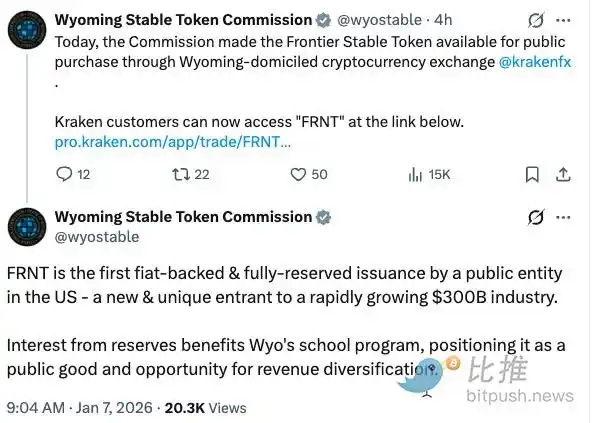
On January 7, local time, the state officially announced the launch of the $FRNT stablecoin, initially released on the Solana blockchain and supporting six EVM-compatible chains. This is the world's first dollar stablecoin backed by "state government credit."

Mining for Light: The Path to Regeneration in Energy Transition

Wyoming's radical move stems from a deep fiscal anxiety: the "underground wealth" that has sustained this land for a century is drying up.

As the energy heartland supplying 40% of the nation's coal, it once created the myth of a "tax-free paradise" through mineral resource taxes: residents pay no personal income tax, and businesses pay no corporate tax.

One key reason is that, thanks to the continuous export of resources from the Powder River Basin, this sparsely populated state generated astonishing wealth: its per capita GDP has long ranked among the top ten in the U.S., rivaling New York and California during peak energy years.

This prosperity once gave Wyoming the confidence to refuse to levy personal income tax, corporate tax, and estate tax. However, this is a fragile prosperity built on heavy industry.
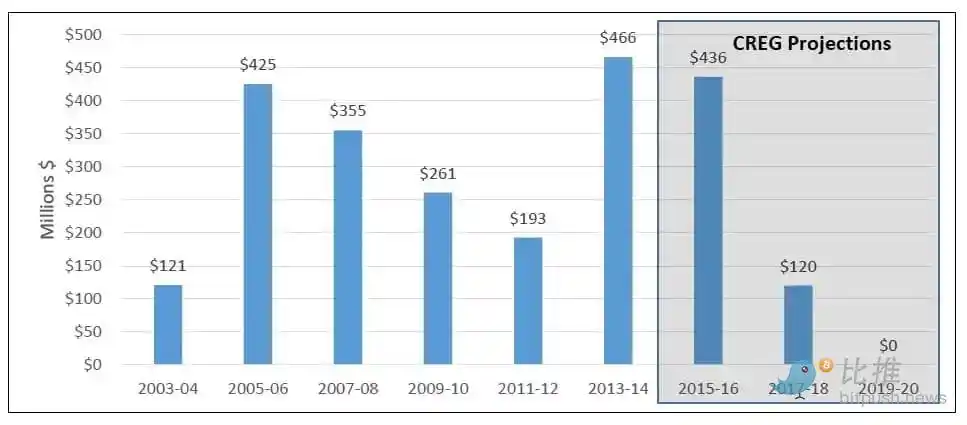
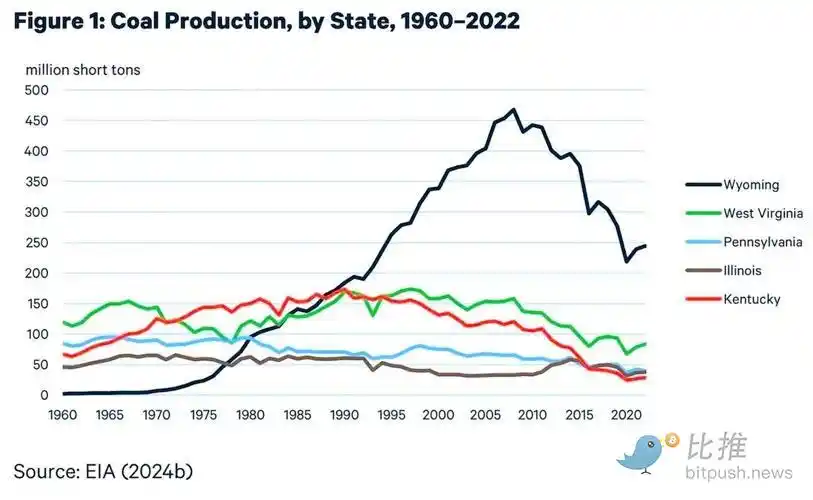
Since 2011, Wyoming's pillar industry began a decade-long "avalanche":

Ruthless market displacement: The rise of low-cost shale gas and renewable energy delivered a crushing blow to coal in terms of power generation costs.

Tightening environmental constraints: The advancement of federal carbon emission regulations (such as the Clean Power Plan) led to the closure of coal-fired power plants across the U.S.

A cliff-like fiscal gap: According to CREG official data cited by Wyoming Public Media, the state's coal resource tax plummeted from $290 million in 2011 to $170 million in 2022. In 2025, the state's coal production is expected to fall to the second-lowest point in history, only half of the peak in 2008. The "coal lease bonuses," once a significant source of school infrastructure funding, have even dropped to zero.
"If we don't shake things up, we'll be the next West Virginia (note: a traditional mining region in the U.S. that became one of the poorest states after the coal industry declined)."—This visceral fear has instilled a sense of urgency even in the most conservative cowboy politicians.

They realized that since they cannot change the trend of energy transition, they must leverage Wyoming's core asset—its extremely liberal business legislation.

In fact, Wyoming's innovative基因 has precedent. In 1977, it pioneered the LLC (Limited Liability Company), now the most popular business entity in the U.S.

Starting in 2018, to save itself, this deeply "red" conservative state was forced to embark on a long journey of institutional innovation in the crypto world.

In 2019, Wyoming passed House Bill 74 (HB 74), creating a new type of financial entity: the SPDI license (Special Purpose Depository Institution). This is not a traditional bank but an institution that "does not engage in lending and only handles custody and settlement."

In September 2020, the crypto exchange Kraken obtained the first SPDI license in the U.S., establishing Kraken Bank. This marked the first time crypto assets received "bank" status under state law.

In 2021, the state率先 passed the DAO Act, allowing code-controlled organizations to register as legal LLC entities.

As for the recently launched $FRNT, according to the Wyoming Stable Token Commission (WST) plan, the $FRNT stablecoin is over-collateralized by 102% in U.S. Treasuries and cash.

Reserve management is handled by the investment giant Franklin Templeton, which manages approximately $1.6 trillion in assets, while custody is provided by its affiliate, Fiduciary Trust Company International. Its core business logic is: the state government absorbs U.S. dollars, buys U.S. Treasuries, and the interest generated is directly allocated to the "School Foundation Fund" to support local public education.

Stablecoins: Who Actually Benefits?

Wyoming's leap actually marks the entry of the stablecoin赛道 into the second half: transitioning from a "credit game" of private companies to a "public good" at the government level.

In the past, discussions about stablecoins focused on the compliance risks of Tether or Circle; but in Wyoming's narrative, stablecoins are回归 to their essence—an extremely efficient, low-cost payment channel (settlement fees are typically below $0.01)—and they are beginning to take on public fiscal attributes.

However, this "digital highway" has encountered invisible barriers in the real world.

In Wyoming's Jackson Hole resort area, the monthly rent for an ordinary two-bedroom apartment has reached $4,000, 25% higher than in Los Angeles. Although the local per capita GDP ranks among the highest in the U.S., about 10% of residents still face food shortages. For blue-collar workers who catch the morning commute bus and rely on two or three jobs to make ends meet, "stablecoins" seem more like a distant technological concept.

This divide is not accidental but is meticulously designed and maintained. A state finance official admitted to prospect.org that through land acquisition and planning thresholds, the landscape here is shaped to be "poverty invisible."

Writer Annie Proulx once described the harshness of Wyoming's land; today, that harshness is folded by technology and capital into two layers of reality that do not penetrate each other.

On one side is the tax-avoidance utopia created by the wealthy in the mountains; on the other are the ordinary Americans who支撑这一切 but have nowhere to call home—their lives are quietly folded away in both reality and online narratives.

Looking through discussions about Wyoming on Reddit, complaints from locals are everywhere:
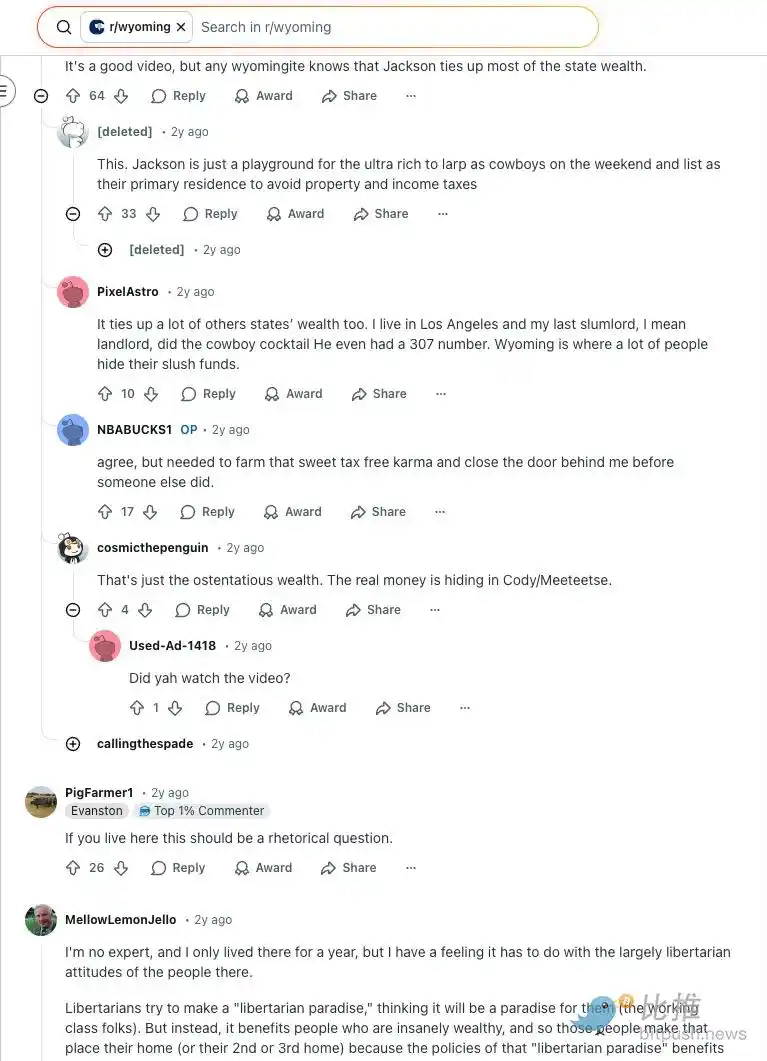
"Jackson is just a playground for super-rich people to play cowboy on weekends. They list it as their primary residence to escape property and income taxes."

"The people here are libertarians trying to create a 'libertarian paradise.' They think it will be a paradise for them (the working class). But in reality, it benefits the filthy rich, who make it their home (or second, third residence) because the policies of the 'libertarian paradise,' such as less regulation, lower taxes, etc., favor them."
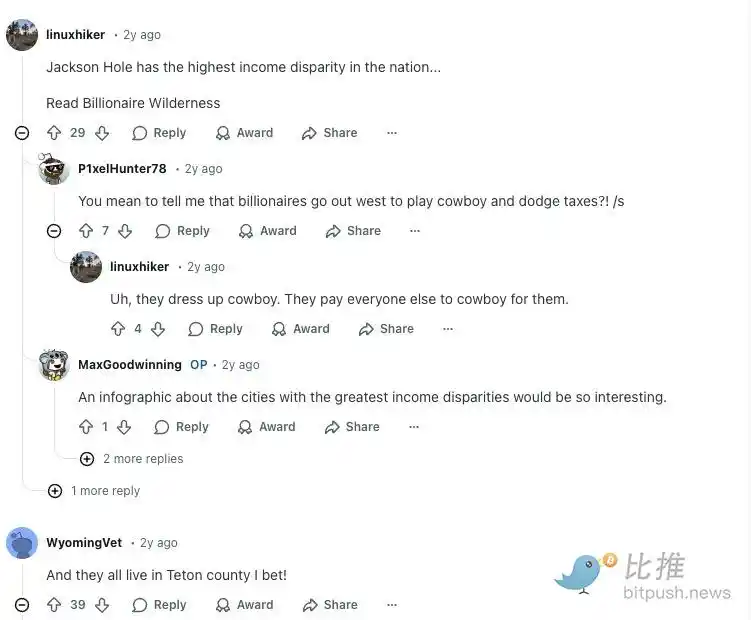
Amid such撕裂, the state government is attempting to build digital-era fiscal autonomy on the ruins of the coal mining industry using laws and stablecoins. Data shows that Wyoming has 348 limited liability companies per thousand adults, surpassing Delaware to become the new institutional洼地 in the U.S.

But will this digital revenue flowing to the "Cowboy State" truly缝合 the cracks in this land?

İlgili Sorular

QWhat is the significance of Wyoming's $FRNT stablecoin in the context of U.S. state governments?

A$FRNT is the first U.S. dollar stablecoin to be backed by the full faith and credit of a state government, marking a significant shift from private company-issued stablecoins to a government-level public financial instrument.

QWhat major economic challenge is Wyoming facing that prompted the creation of $FRNT?

AWyoming is experiencing a severe decline in its coal industry, which has been its economic pillar, leading to a dramatic drop in coal severance tax revenue from $290 million in 2011 to $170 million in 2022, creating a pressing fiscal need for new revenue sources.

QHow does the $FRNT stablecoin mechanism generate revenue for the state of Wyoming?

AThe $FRNT stablecoin is over-collateralized by 102% with U.S. Treasuries and cash. The interest income generated from these reserve assets is directed into the state's School Foundation Fund to support public education.

QWhich companies are involved in the management and custody of the reserves for the $FRNT stablecoin?

AThe investment management giant Franklin Templeton, which oversees approximately $1.6 trillion in assets, manages the reserves, and its affiliate, Fiduciary Trust Company International, provides custody services.

QWhat previous legislative innovations has Wyoming pioneered, demonstrating its history of financial and business law experimentation?

AWyoming invented the Limited Liability Company (LLC) in 1977. More recently, it created the SPDI (Special Purpose Depository Institution) banking charter for crypto businesses in 2019 and passed the first DAO法案 (DAO Act) in 2021, allowing decentralized autonomous organizations to register as legal LLCs.

İlgili Okumalar

Different Choices After the Plunge: Institutions Buy the Dip, Traders Shift to US Stocks

Title: Diverging Strategies After the Crash: Institutions Buying the Dip, Traders Shifting to US Stocks Following a sharp decline where Bitcoin briefly fell below $60,000 on June 6th, market sentiment remains "extreme fear" despite a partial recovery. This has led to varied responses from major market participants. Several institutional figures and analysts present a cautiously optimistic long-term view for Bitcoin. Glassnode's co-founder identifies $46k-$54k as a probable key bottom range based on historical on-chain models, while a Standard Chartered executive suggests the bottom is nearly formed. Strive's CEO points to Bitcoin touching its 200-week moving average as a historically reliable buy signal. Analysts highlight metrics like MVRV ratio and the "Power Law" model indicating Bitcoin is in an extremely undervalued zone. Conversely, some traders are exiting the crypto space. One trader cited a more attractive risk/reward profile and deeper research opportunities in US stocks, particularly with AI-related equities outperforming and capital rotating away from crypto. This shift is partly attributed to perceived ongoing risks, including those related to Strategy's Bitcoin sales. Market prediction data suggests a high probability (72%) of Bitcoin falling below $55,000, but lower odds for a deeper crash below $35k-$40k. The overall picture is one of division: institutions and long-term analysts see a accumulating opportunity, while some active traders are seeking alpha elsewhere amidst the volatility and shifting capital flows.

marsbit43 dk önce

Different Choices After the Plunge: Institutions Buy the Dip, Traders Shift to US Stocks

marsbit43 dk önce

Tech Stocks in the Midst of Deleveraging: Rather Than Rushing to Buy the Dip, Wait for the Macro Environment to Stabilize First

"Technology Stocks in Deleveraging Phase: Wait for Macro Stability Before Buying the Dip" The current sell-off in tech/AI stocks is primarily driven by macro headwinds, not a breakdown in AI fundamentals. After a parabolic rise, the market faced a perfect storm: an overcrowded trade, a massive SpaceX IPO draining liquidity, pre-CPI/PPI/FOMC hedging, and strong jobs data renewing "higher-for-longer" rate fears. This triggered a concentrated deleveraging in hot tech names. Key historical context: Unlike the December 2023 sell-off focused on AI capex returns, the current correction centers on the "denominator" – rising concerns over rates, inflation, the Fed, geopolitics, and liquidity. Leading memory stocks like Micron have seen ~20% pullbacks, significant but not yet at panic levels seen in March. The intense selling wave may be largely over, but a quick V-shaped recovery is unlikely. The market will likely churn in high volatility, awaiting clarity. The immediate catalyst needed for a sustainable reversal is a "stop-bleeding" signal from macro conditions. This doesn't require a major positive shock (like the April Iran ceasefire), but simply a halt to further deterioration: CPI not surprising hotter, Treasury yields stabilizing, the Fed not turning more hawkish, and post-SpaceX IPO liquidity easing. Once macro pressure plateaus, the intact AI investment thesis – centered on persistent compute/memory shortages and accelerating commercialization – can quickly regain market focus. The strategy is clear: prioritize monitoring macro stabilization over rushing to bottom-fish individual AI stories. Patience is key.

marsbit50 dk önce

Tech Stocks in the Midst of Deleveraging: Rather Than Rushing to Buy the Dip, Wait for the Macro Environment to Stabilize First

marsbit50 dk önce

South Korean Stocks Plunge, Global Funds Liquidate: Has the Semiconductor Fundamentals Really Changed?

South Korean stocks experienced their sharpest decline of the year, with the KOSPI index plunging nearly 9% on Monday, triggering a market circuit breaker. Leading semiconductor firms Samsung Electronics and SK Hynix were heavily sold off, raising questions about whether the AI-driven bull market has reached an inflection point. This sell-off was largely triggered by a significant drop in the U.S. semiconductor sector late last week. Concurrently, NVIDIA CEO Jensen Huang visited Seoul over the weekend, meeting with top executives from SK Group, Samsung, LG, and NAVER. He announced a new multi-year partnership with SK Hynix to co-develop next-generation memory products for AI data centers. Huang emphasized that AI infrastructure build-out remains in its early stages, creating a stark contrast between market panic and ongoing, strengthened industry collaboration. The article argues that South Korea has become one of the most sensitive markets for global AI-related capital flows, functioning like a large AI memory ETF due to the heavy weighting of its chipmakers. The current market turmoil reflects a shift in investor focus: from simply betting on overall AI growth to scrutinizing which companies will actually capture the profits from that growth. This "profit pool reassessment" phase is causing high volatility based on supply chain news and earnings guidance. Ultimately, the direction of the Korean market will be determined by external factors—NVIDIA's orders, HBM supply-demand dynamics, and capital expenditures from cloud service providers—rather than domestic conditions. The disconnect between sharp price corrections and continued strong signals from the industry core leaves the market at a crossroads, awaiting clearer data on the durability of AI infrastructure demand.

marsbit1 saat önce

South Korean Stocks Plunge, Global Funds Liquidate: Has the Semiconductor Fundamentals Really Changed?

marsbit1 saat önce

Trump in Talks with AI Companies Over Profit Sharing, A Narrative Pressure of Industrial Revolution Scale Begins

In recent AI market discussions, a new dimension beyond growth and profits has emerged: the question of how the immense wealth potentially generated by AI should be shared with the wider public. Triggered by reports of White House officials discussing "voluntary equity transfers" with top AI firms, similar to models like Alaska's Permanent Fund, the conversation focuses on public wealth funds. OpenAI's own whitepaper proposes such funds, allowing households without direct tech stock ownership to benefit from AI gains. More radical proposals, like Bernie Sanders' call for high public equity stakes and board seats, represent an extreme end of the spectrum. Currently, these are early-stage policy probes, not enacted laws. OpenAI's initiative is seen as an attempt to secure "social license" for its future expansion, mitigating risks of public backlash, stricter regulation, or anti-trust actions as AI's economic impact grows. The core market implication is the introduction of a "policy discount" to AI valuations, particularly for private model companies like OpenAI, Anthropic, and xAI. Investors must now consider not just future earnings but also what portion might be allocated to public mechanisms. The impact varies greatly based on the mechanism. A small, voluntary transfer of non-voting economic rights (e.g., 5%) acts as a quantifiable long-term cost. Government acquisition of economic rights via warrants tied to support differs from direct equity with governance power. The most disruptive scenario would be forced high-percentage public ownership affecting control and innovation incentives. Key signals to watch include whether other AI companies follow suit, if the White House formalizes proposals, related disclosures in future IPO documents, and any market price reactions. For now, this represents a shift from pricing pure AI growth to pricing its potential distribution. A manageable, voluntary economic share is akin to an insurance cost for societal acceptance, while a forced shift toward control and governance would fundamentally alter valuation logic.

marsbit1 saat önce

Trump in Talks with AI Companies Over Profit Sharing, A Narrative Pressure of Industrial Revolution Scale Begins

marsbit1 saat önce

From Record Highs to a Two-Week Low: Why Did AI Concept Stocks Suddenly Pull Back?

From Record Highs to Two-Week Lows: Why Did AI Stocks Suddenly Pull Back? U.S. stock indices, led by the tech-heavy Nasdaq 100, fell sharply to two-week lows. This marked a reversal from earlier in the week when AI infrastructure and semiconductor stocks had propelled major indices to record highs. Investors are rotating out of these previously high-flying tech sectors into other areas. The sell-off was driven by profit-taking and concerns that the AI rally had become overextended, exacerbated by chipmaker Broadcom's sales outlook falling short of lofty market expectations. The decline accelerated following a stronger-than-expected U.S. May nonfarm payrolls report, which showed 172,000 jobs added versus an estimated 88,000. This data sparked a jump in bond yields, with the 10-year Treasury yield rising to 4.553%, as it reinforced market speculation that the Federal Reserve's next move could be a rate hike rather than a cut. Globally, equities also declined, with European and Asian markets falling. Within the U.S. market, chip and AI-related stocks like Super Micro Computer and Arm Holdings led the losses, dropping over 7%. Cryptocurrency-linked stocks and mining shares also fell sharply amid drops in Bitcoin and commodity prices. While the overall Q1 earnings season remained solid, with 83% of S&P 500 companies beating estimates, the weakness was concentrated in tech. Excluding the tech sector, Q1 earnings growth was around 3%, the weakest in two years.

marsbit1 saat önce

From Record Highs to a Two-Week Low: Why Did AI Concept Stocks Suddenly Pull Back?

marsbit1 saat önce

İşlemler

Spot
Futures
活动图片