Four-Dimensional Resonance: Hong Kong Web3 Carnival Sub-Forum Co-Creates Blueprint for Global Financial New Infrastructure

marsbit2026-04-23 tarihinde yayınlandı2026-04-23 tarihinde güncellendi

Özet

The "Four-Dimensional Resonance: 2026 Global Financial New Infrastructure" forum, a core event of the Hong Kong Web3 Festival, was successfully held at the Hong Kong Convention and Exhibition Centre. Co-hosted by Web3Labs and DeShang Singularity Tech, with joint support from Bitroot, Injective, Microsoft, and Z Oracle, the event gathered policymakers, industry leaders, and investors to explore the integration and innovation of global financial infrastructure, focusing on RWA, AI, DeFi, and compliant payments. Policy speakers, including Hong Kong Legislative Council Member Mr. Wu Jiezhuang, South Korean National Assembly Member Mr. Min Byung-duk, and ACED Chairman Mr. Yun Seok-hun, emphasized the importance of cross-border regulatory collaboration and an open policy environment for fintech innovation. Web3Labs CEO Caspar and DeShang Singularity Tech CEO Chang Shuai highlighted Hong Kong’s role as a financial innovation center and the approaching "singularity moment" for global financial infrastructure. Technical insights were shared by MagnetX, Bitroot, Microsoft, and Injective on topics including AI Agent economies, the evolution of public blockchains, and AI’s transformative role in finance. Key partnerships and initiatives were launched: - GWDC 2026 Korea collaboration between Hong Kong and South Korea. - A strategic agreement between Web3Labs and Microsoft. - The launch of a public anti-fraud alliance by Z Oracle and partners. - The "Injective Rising Star" program to s...

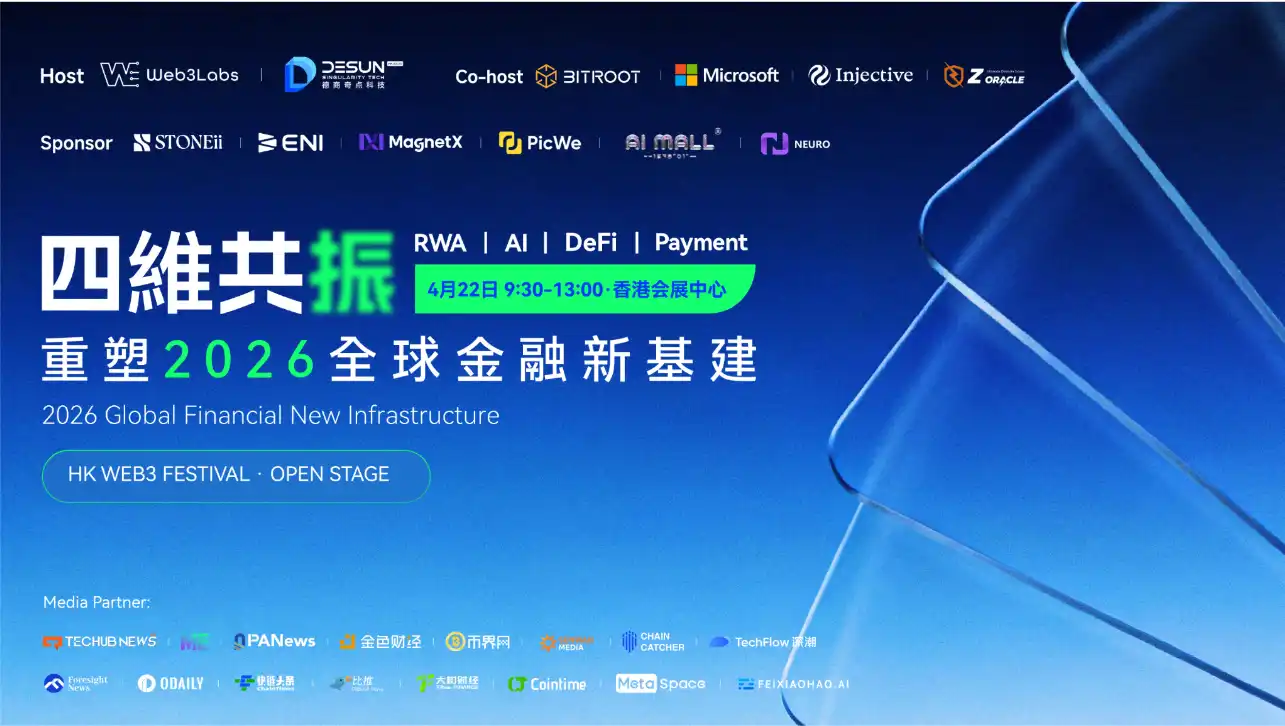
As one of the core sub-forums of the Hong Kong Web3 Carnival, the "Four-Dimensional Resonance: 2026 Global Financial New Infrastructure" forum was successfully held today at the OpenStage of the Hong Kong Convention and Exhibition Centre. The forum was jointly hosted by Web3Labs and DeShang Singularity Technology, co-hosted by Bitroot, Injective, Microsoft, and Z Oracle, and received strong support from Stoneii, ENI Network, MagnetX, Picwe, AI Mall, and NeuroLabs. The event gathered heavyweight guests from the political, industrial, and investment sectors, focusing on four core areas: RWA (Real World Assets), AI (Artificial Intelligence), DeFi (Decentralized Finance), and compliant payments, to jointly explore the integrated innovation and implementation paths of global financial infrastructure.

Policy Leadership: Cross-Border Collaboration to Build an Inclusive Innovation Environment

The forum specially invited Wu Jiezhuang, Member of the National Committee of the Chinese People's Political Consultative Conference and Chairman of the Hong Kong Legislative Council's Commerce and Innovation Technology Committee, South Korean National Assembly Member Min Byung-deok, and Asia Economic Development Committee Chairman Yoon Seok-hoon to deliver speeches. The three policy guests unanimously emphasized that cross-border regulatory collaboration and policy inclusivity are key to the development of financial technology, calling for the establishment of a more open international financial innovation ecosystem to provide institutional guarantees for the new financial infrastructure in Asia and globally.

Technology-Driven: Outlining the New Blueprint for Financial Infrastructure

Web3Labs CEO Caspar pointed out in the opening speech that Hong Kong, as an international financial innovation hub, needs to drive the synergy of industry, capital, and policy to accelerate the digital upgrade of financial infrastructure. DeShang Singularity Technology CEO Chang Shuai, with the theme "Consensus·Resonance·Symbiosis," proposed that the global financial new infrastructure is ushering in a "singularity moment."

In the keynote speech session, MagnetX Vice President Jerry Yu analyzed the infrastructure construction of the AI Agent economy, pointing out that intelligent agents will become the underlying support for financial operations; Bitroot CEO Juan proposed the "Third Public Chain Revolution of Web3," believing that the evolution of public chain technology will drive financial infrastructure toward a more efficient and trustworthy stage. Microsoft Strategic Technology Lead Jerry Lu and Injective representative Vincent Jin shared insights on "AI's Restructuring from Tool to Operational Layer" and "The New Era of Finance Under the AI Wave," respectively, jointly outlining a new technology-driven vision for financial infrastructure.

Ecosystem Co-Construction: Four Major Cooperation Outcomes Inject New Momentum for Development

The forum featured multiple important launch and signing ceremonies, injecting substantive momentum into the global financial new infrastructure:

· GWDC 2026 Korea Launch: Representatives from Hong Kong and South Korea jointly announced cooperation, marking the beginning of in-depth collaboration between the two regions in the fields of AI and Web3 to accelerate the internationalization process of Asia's financial new infrastructure.

· Web3Labs and Microsoft Strategic Cooperation Signing: The two parties will engage in deep collaboration in cloud computing, AI technology integration, and industrial resource alignment, achieving a powerful combination of tech giants and the Web3 ecosystem.

· Launch of the Civil Anti-Fraud Alliance Platform: Promoted by Z Oracle, the Blockchain Compliance Professionals Association, and SlowMist, among other institutions, the platform aims to build an industry security defense line and create a trustworthy financial ecosystem.

· Injective Rising Star Program Launch: Injective, in collaboration with Web3Labs and Microsoft, officially launched the program. The three parties will engage in deep cooperation in infrastructure, cloud computing, and resource incubation, providing targeted support for global developers working on AI and Web3 integration projects with industrial-level potential.

In-Depth Dialogue: Promoting the Global Layout of Asia's Financial Technology Ecosystem

In the panel discussion session, the forum delved into three core topics: "Web3×AI×Payment," "Institutional-Grade RWA," and "RWA×DeFi." Participants engaged in multi-dimensional discussions on AI-driven payment scenario intelligence, compliant paths for cross-border transactions, and the challenges faced by RWA in institutional applications, such as trust building and liquidity enhancement. There was a consensus that the deep integration of RWA and DeFi will become the core driving force of financial infrastructure, promoting a revolutionary shift from physical to digital paradigms. Through multi-dimensional resonance in policy leadership, technical discussions, and ecosystem co-construction, this forum provided a clear path for the development of global financial new infrastructure. As an international financial and innovation hub, Hong Kong continues to play a bridging role, promoting the global layout and sustainable development of Asia's financial technology ecosystem.


Trend Kriptolar

İlgili Sorular

QWhat was the main focus of the 'Four-Dimensional Resonance: 2026 Global Financial New Infrastructure' forum at the Hong Kong Web3 Festival?

AThe forum focused on four core areas: RWA (Real World Assets), AI (Artificial Intelligence), DeFi (Decentralized Finance), and compliant payments, exploring the integrated innovation and implementation paths of global financial infrastructure.

QWhich policy figures delivered speeches at the forum, and what key point did they emphasize?

AThe policy figures were Wu Jiezhuang (Member of the National Committee of the Chinese People's Political Consultative Conference and Chairman of the Hong Kong Legislative Council's Commerce and Innovation Technology Committee), South Korean National Assembly Member Min Byung-duk, and Asian Economic Development Committee Chairman Yoon Seok-hoon. They emphasized that cross-border regulatory collaboration and policy inclusivity are crucial for fintech development.

QWhat significant collaborations or initiatives were announced during the forum?

AKey announcements included the launch of GWDC 2026 Korea (a collaboration between Hong Kong and South Korea in AI and Web3), a strategic partnership between Web3Labs and Microsoft, the launch of the Civil Anti-Fraud Alliance Platform, and the initiation of the Injective Rising Star Program.

QHow did speakers like Jerry Yu and Juan contribute to the forum's discussion on technology-driven financial infrastructure?

AJerry Yu, Vice President of MagnetX, analyzed AI Agent economy infrastructure, stating that intelligent agents will become the underlying support for financial operations. Juan, CEO of Bitroot, proposed the 'Third Public Chain Revolution in Web3,' arguing that public chain technology evolution will drive financial infrastructure towards greater efficiency and trust.

QWhat were the core topics of the panel discussions, and what consensus was reached regarding RWA and DeFi?

AThe panel discussions centered on 'Web3 × AI × Payment,' 'Institutional-Grade RWA,' and 'RWA × DeFi.' Participants agreed that the deep integration of RWA and DeFi will be a core driver of financial infrastructure, facilitating a revolutionary shift from physical to digital finance paradigms.

İlgili Okumalar

A 'Overlooked' Market Event: Joint US-Japan-South Korea Intervention, Rare US Treasury Involvement, and Bessent's Quiet 'Market Rescue'?

Summary: The United States, Japan, and South Korea executed their largest coordinated foreign exchange intervention in nearly 30 years. The action targeted depreciation pressure on the Japanese yen and South Korean won. This move is seen as a significant effort by the US to stabilize the financial markets of its key allies and prevent the spillover of risks. Key details: * Japan reportedly intervened on July 30 using approximately 8.45 trillion yen (about $52.8 billion). South Korean authorities also intervened that day, selling dollars to support the won. * Notably, the US Treasury Department intervened directly in yen markets for the first time in roughly 30 years. The New York Fed, reportedly acting on behalf of the Treasury, sold euros to buy yen via Goldman Sachs and Morgan Stanley on July 31. Analysts view the use of the euro-yen pair as a way to alleviate yen pressure without adding selling pressure to the US dollar. * Prior to the action, the New York Fed conducted "rate checks" on both USD/JPY and EUR/JPY, a newer signaling tool that falls between verbal and physical intervention. The intervention is interpreted as going beyond traditional currency stabilization. Analysts, such as Michael Hartnett of Bank of America, suggest it resembles a "Price Keeping Operation" for the AI era. The core US objectives are perceived to be: 1. Preventing rapid yen depreciation from triggering a sharp rise in Japanese government bond yields. 2. Containing financial stress from spreading across Asian markets like South Korea and Japan. 3. Reducing the risk of disorderly capital flows impacting the US bond market. This coordinated action underscores the importance of Japan and South Korea as critical partners in the US semiconductor and AI supply chain. Stabilizing their financial markets is seen as vital to mitigating risks to the broader tech industry and the US market itself. The intervention coincides with market pressures, including the KOSDAQ index hitting a low since October 2022. While seen as a move to control volatility, some analysts caution it may not fundamentally reverse existing market trends.

marsbit4 dk önce

A 'Overlooked' Market Event: Joint US-Japan-South Korea Intervention, Rare US Treasury Involvement, and Bessent's Quiet 'Market Rescue'?

marsbit4 dk önce

Will the Federal Reserve Definitely Raise Interest Rates in September? How Will Cryptocurrencies and US Stocks Bear the Pressure?

In early August 2024, market expectations for a September Federal Reserve rate hike surged dramatically, from below 50% to over 80%, driven by renewed inflation concerns. This shift followed a contentious July FOMC meeting where a 9-3 vote to hold rates revealed a growing hawkish faction advocating for an immediate hike, citing prolonged above-target inflation. The key catalyst is escalating conflict near the Strait of Hormuz, which has pushed oil prices up approximately 20% in July, threatening to reignite inflation. The next critical data point is the July CPI report on August 12th; a hot reading could solidify hike expectations. For crypto assets, particularly Bitcoin, this represents near-term pressure. Bitcoin continues to exhibit high-beta, risk-on characteristics, making it sensitive to tightening liquidity and higher opportunity costs. However, historical precedent suggests that if a hike is perceived as the cycle's end rather than its start, the negative impact may be brief, with markets quickly pivoting to anticipate future rate cuts. U.S. stocks, especially crypto-linked equities like Coinbase and high-valuation tech stocks, face amplified volatility. Higher rates increase discount rates in valuation models, pressuring growth stocks. This coincides with a pivotal tech earnings season where investor focus has shifted from massive AI capital expenditures to demonstrable revenue and cash flow generation. Companies with negative cash flows and weak growth narratives could see severe pressure if a September hike materializes, as financing costs would rise. Key indicators to watch include oil prices, upcoming inflation data, and Fed commentary at events like the Jackson Hole symposium.

Odaily星球日报4 dk önce

Will the Federal Reserve Definitely Raise Interest Rates in September? How Will Cryptocurrencies and US Stocks Bear the Pressure?

Odaily星球日报4 dk önce

From South Korea to the United States: Blue-Collar Jobs Are Becoming Increasingly Popular, Thanks to AI

AI is reshaping the labor market's value proposition. The traditional four-year college degree is losing its appeal as a guaranteed career path, while skilled blue-collar trades like electricians, welders, and plumbers are experiencing historic demand and wage premiums. This shift is driven by dual pressures: AI's displacement of certain white-collar roles and a booming need for physical infrastructure and data center construction. Data confirms the trend. In the U.S., vocational school revenue surged, and a significant portion of recent layoffs are AI-related. Surveys show a majority of Gen Z adults plan to pursue blue-collar work, citing better job security against AI automation. Vocational education interest has exploded recently. Experts cite a psychological shift as younger generations seek tangible, AI-resistant careers and avoid high student debt. In many cases, salaries for skilled trades now match or exceed those requiring a bachelor's degree. In South Korea, semiconductor vocational high schools boast near-total employment, with graduates securing high-paying roles at companies like Samsung. The shortage is structural, exacerbated by a retiring baby boomer workforce and massive infrastructure projects. Companies like JPMorgan Chase, Meta, and Lowe's are investing heavily in training programs. However, overcoming historical stigma and a "perception gap" around trade careers remains a key challenge to closing the talent gap.

marsbit1 saat önce

From South Korea to the United States: Blue-Collar Jobs Are Becoming Increasingly Popular, Thanks to AI

marsbit1 saat önce

İşlemler

Spot

Popüler Makaleler

CORE Nasıl Satın Alınır

HTX.com’a hoş geldiniz! CORE (CORE) satın alma işlemlerini basit ve kullanışlı bir hâle getirdik. Adım adım açıkladığımız rehberimizi takip ederek kripto yolculuğunuza başlayın. 1. Adım: HTX Hesabınızı OluşturunHTX'te ücretsiz bir hesap açmak için e-posta adresinizi veya telefon numaranızı kullanın. Sorunsuzca kaydolun ve tüm özelliklerin kilidini açın. Hesabımı Aç2. Adım: Kripto Satın Al Bölümüne Gidin ve Ödeme Yönteminizi SeçinKredi/Banka Kartı: Visa veya Mastercard'ınızı kullanarak anında CORE (CORE) satın alın.Bakiye: Sorunsuz bir şekilde işlem yapmak için HTX hesap bakiyenizdeki fonları kullanın.Üçüncü Taraflar: Kullanımı kolaylaştırmak için Google Pay ve Apple Pay gibi popüler ödeme yöntemlerini ekledik.P2P: HTX'teki diğer kullanıcılarla doğrudan işlem yapın.Borsa Dışı (OTC): Yatırımcılar için kişiye özel hizmetler ve rekabetçi döviz kurları sunuyoruz.3. Adım: CORE (CORE) Varlıklarınızı SaklayınCORE (CORE) satın aldıktan sonra HTX hesabınızda saklayın. Alternatif olarak, blok zinciri transferi yoluyla başka bir yere gönderebilir veya diğer kripto para birimlerini takas etmek için kullanabilirsiniz.4. Adım: CORE (CORE) Varlıklarınızla İşlem YapınHTX'in spot piyasasında CORE (CORE) ile kolayca işlemler yapın.Hesabınıza erişin, işlem çiftinizi seçin, işlemlerinizi gerçekleştirin ve gerçek zamanlı olarak izleyin. Hem yeni başlayanlar hem de deneyimli yatırımcılar için kullanıcı dostu bir deneyim sunuyoruz.

394 Toplam GörüntülenmeYayınlanma 2024.12.13Güncellenme 2026.06.02

CORE Nasıl Satın Alınır

Tartışmalar

HTX Topluluğuna hoş geldiniz. Burada, en son platform gelişmeleri hakkında bilgi sahibi olabilir ve profesyonel piyasa görüşlerine erişebilirsiniz. Kullanıcıların CORE (CORE) fiyatı hakkındaki görüşleri aşağıda sunulmaktadır.

活动图片












