Fortune Teller Predicted Hantavirus 4 Years in Advance, Are Market 'Prophets' Among the People?

marsbit2026-05-08 tarihinde yayınlandı2026-05-08 tarihinde güncellendi

Özet

A mysterious 2022 tweet from a user claiming to be a fortune teller, predicting the end of COVID-19 and the emergence of a Hantavirus, has recently gone viral. The tweet resurfaced amid reports of a real Hantavirus outbreak on a cruise ship in May 2025, which resulted in several deaths. The article discusses how this event fueled speculation and anxiety online, which was quickly absorbed by the cryptocurrency market. A Hantavirus-themed meme coin, HANTA, was launched, and prediction markets like Polymarket and Predict.fun created events for users to bet on whether the Hantavirus would be declared a pandemic by the end of 2026. The piece highlights the crypto market's tendency to convert public attention, fear, and speculation into tradable assets. It concludes by noting the internet's role in blending coincidence, emotion, and imagination, creating narratives that straddle the line between reality and urban legend.

Original|Odaily Planet Daily(@OdailyChina)

Author|Wenser(@wenser 2010 )
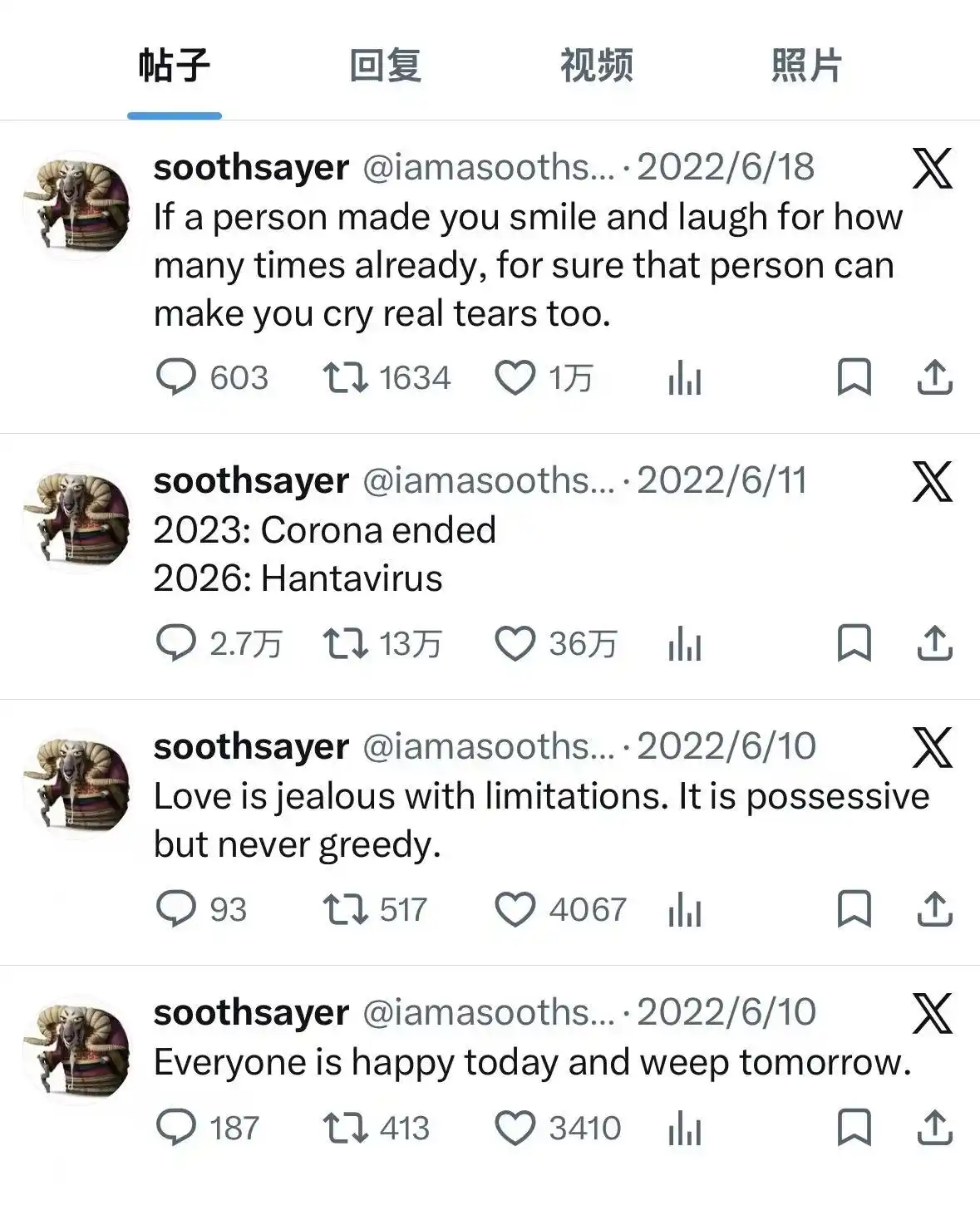
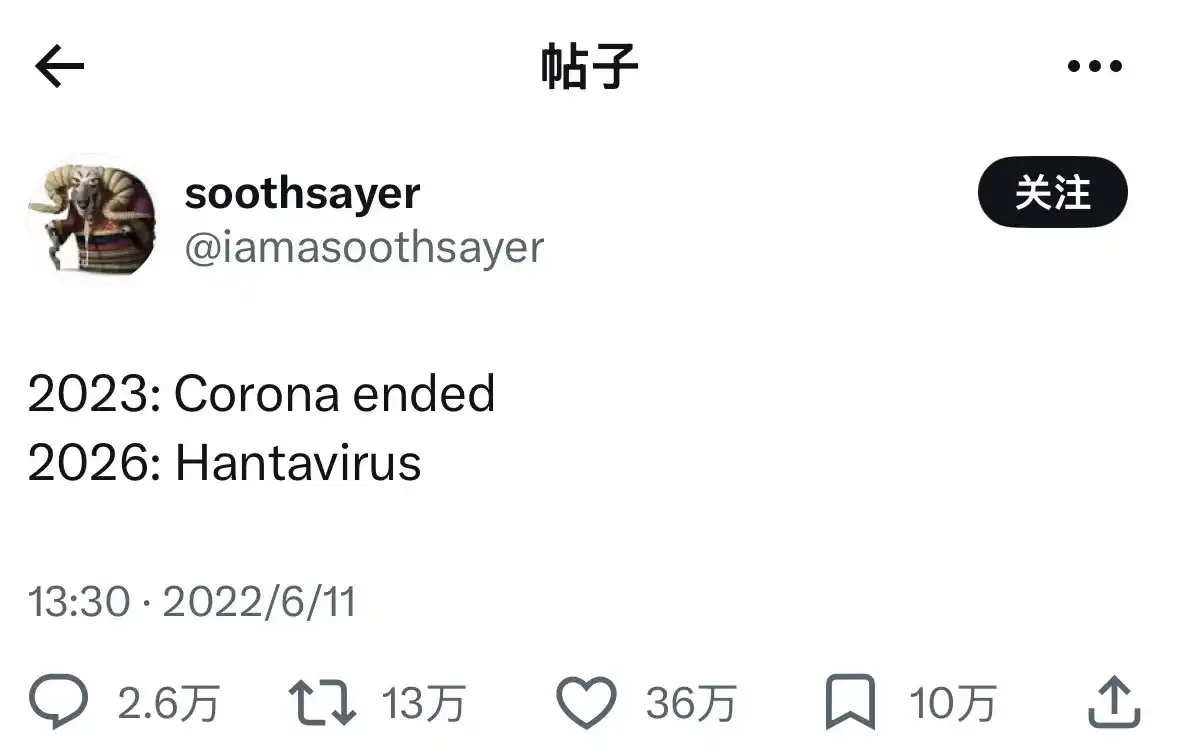
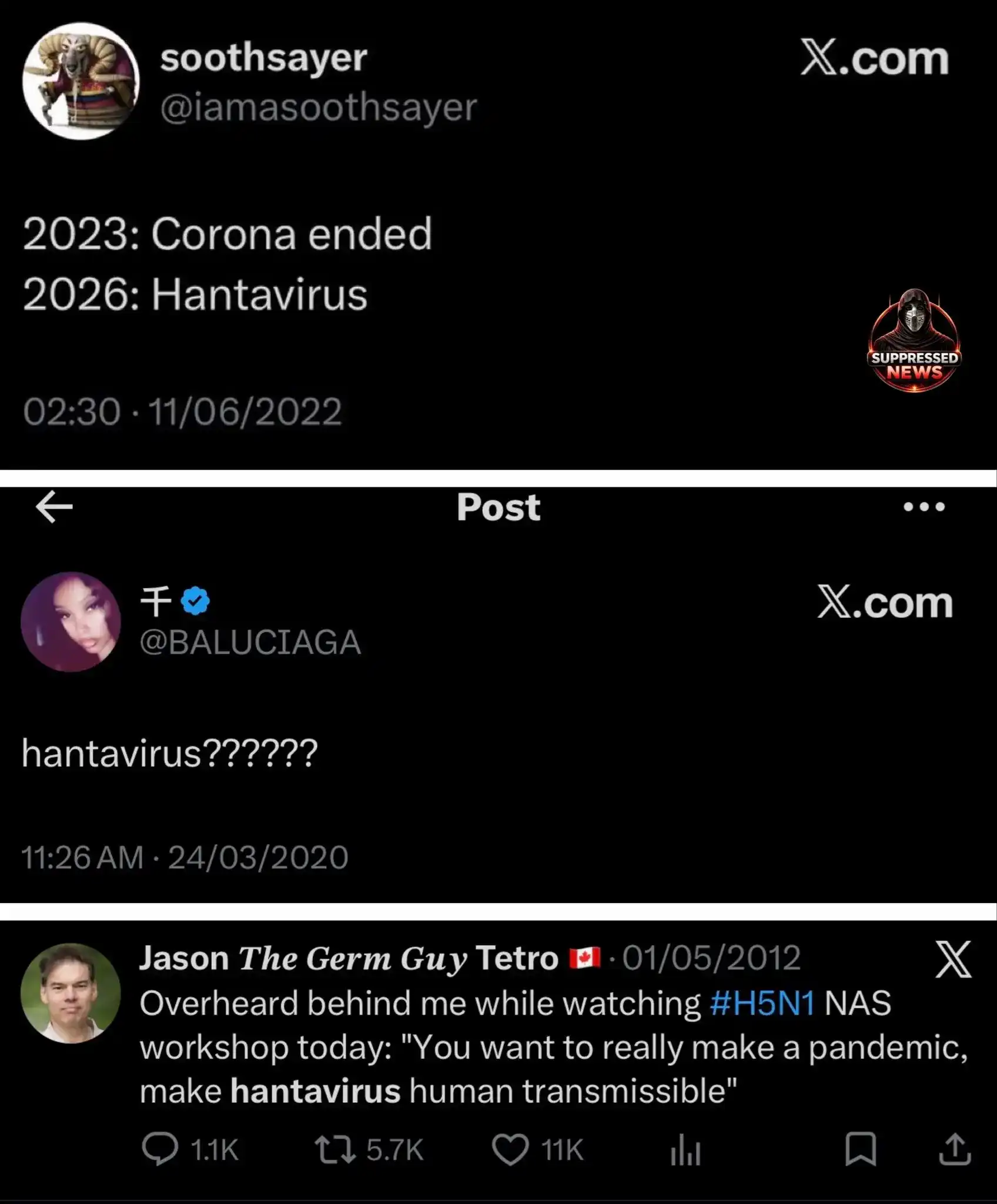
Last night, an old tweet from June 11, 2022, detonated like a nuclear bomb across the X platform's public opinion sphere. The tweet came from a fortune teller who claimed to be able to "read the future," prophesying not only the end of the COVID-19 pandemic in 2023 but also, with the accuracy of a prophet, pinpointing the recent emergence of the Hantavirus.

For a moment, countless people flocked to the post, leaving various comments. Yet, the account vanished after posting only 5 tweets, disappearing into thin air, adding a mysterious, urban legend-like quality to the entire affair.

Amidst the lingering sense of uncertainty left by the post-pandemic era, discussions about the Hantavirus quickly spilled over from public health topics and evolved into an amplifier of emotions on social media. It was also rapidly absorbed by the crypto market as a new trading narrative. From meme coins to prediction markets, speculative funds always find the points of intense emotion first.

In the stream of information, where truth is hard to discern, and amidst the resonance of group sentiment, the crypto market once again displayed its instinct: to rapidly convert attention, anxiety, and expectations into tradable products and prices.

A Mysterious Tweet from 4 Years Ago, Tied to the Recent Cruise Ship Virus that Killed 3

The story begins with the account @soothsayer.

This account, which has only posted 5 tweets, had received little attention until now. If you ignore that "Hantavirus prophecy" tweet, you might think this account was no different from the ordinary ones on the X platform that post daily "inspirational quotes" and "motivational sayings."

But as the topic of the Hantavirus has gained momentum in recent days, this old tweet has taken on a flavor of "cyber mysticism."
In April of this year, a cruise ship named "Hondius" set sail from Argentina in South America, originally planning to cross the Atlantic to the Canary Islands in Spain. However, during the voyage, a Dutch man suddenly died on board and was later confirmed to have died from the Hantavirus. As of May 6th, the death toll has increased to 3, and the number of infections has risen to 8, including tourists from the Netherlands, the UK, Germany, and other countries. Currently, the cruise ship has been temporarily denied docking due to the Hantavirus, and the WHO is closely monitoring the situation. It's worth noting that around 30 passengers disembarked from the ship in the two weeks prior without a tracking program, spreading across 12 countries.

Therefore, although the WHO clarified that the virus has not shown signs of large-scale spread before, it has inevitably caused public anxiety, with many exclaiming "it reminds me of the fear of being dominated by COVID."
It is worth noting that, according to test results from the South African National Institute for Communicable Diseases and the Geneva University Hospital in Switzerland, the virus type for this outbreak has been confirmed as the Andes Hantavirus.

The vast majority of Hantaviruses are not transmissible between humans, but the Andes virus is the only exception. Such transmission usually occurs among close family members or healthcare workers. Additionally, Hantaviruses mostly infect humans through "rodent-borne" routes. The main transmission methods are divided into three types: respiratory infection, i.e., inhaling aerosols contaminated by rodent excreta; contact infection, i.e., direct contact of broken skin or mucous membranes with excreta from infected rodents; and digestive tract infection, i.e., consuming food contaminated by rodent excreta.

Regarding many people's concern about whether the virus will spread domestically, reliable sources indicate that in China, the disease caused by Hantavirus is known as "Epidemic Hemorrhagic Fever." China has achieved significant results in the prevention and treatment of this virus and its associated diseases, with no current risk of a large-scale outbreak. The Chinese Embassy in Cape Verde previously issued an announcement confirming there were no Chinese citizens on the ship.

Looking back at the fortune teller's tweet, one finds that it not only directly mentions Hantavirus but also dates back four years, which is indeed highly topical.

Hantavirus in Crypto: Meme Coins and Prediction Markets

Following the emergence of the Hantavirus, the crypto market also experienced tremors. Meme coins and prediction markets immediately began their performances.

Community members dug up a Meme coin created a year ago, which officially launched on external platforms on May 4th: HANTA (Hantavirus) Meme coin (2tXpgu2DLTsPUf9zFmuZmA4xrYxXKBTpVq9wAM7hzs9y). Its current market cap is reported to be $12 million, making it a veritable "OG play."

Additionally, on the prediction market front, both Polymarket and Predict.fun have launched betting events related to the Hantavirus.

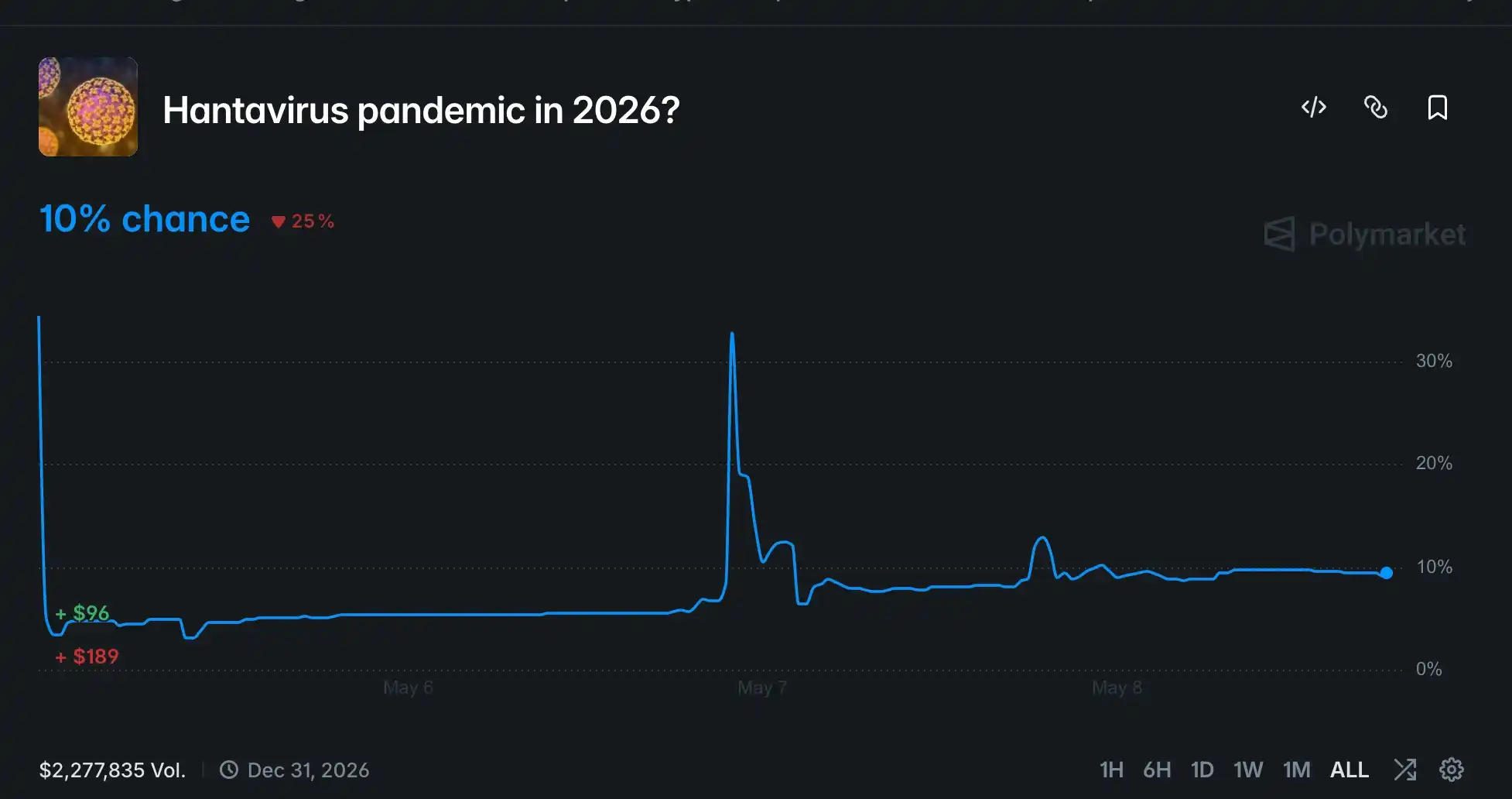
On Polymarket, the probability of the event "Hantavirus Pandemic by 2026" is currently reported at 10%, having previously surged to nearly 35%; the betting amount is currently around $2.27 million. Its resolution rules are: "If the World Health Organization, in official public communications from the time of market creation until 11:59 PM EST on December 31, 2026, explicitly characterizes the Hantavirus, Hantavirus Pulmonary Syndrome (HPS), Hemorrhagic Fever with Renal Syndrome (HFRS), or a Hantavirus-related outbreak as a 'pandemic,' then this market will resolve to 'YES'; otherwise, it will resolve to 'NO.' An explicit characterization includes official WHO statements, reports, press conferences, or publications that explicitly describe the outbreak as a 'pandemic.' Merely declaring it a Public Health Emergency of International Concern (PHEIC) does not qualify unless it is also described as a pandemic. The primary settlement basis for this market will be WHO official communications. Consensus from credible reporting may also serve as a basis."
On the Predict.fun platform, the probability for the identically named betting event is currently reported at 11%, slightly higher than Polymarket's data; the betting volume is smaller, only around $4,400. Its resolution rules are similar to Polymarket's, also relying on the WHO's public statements.
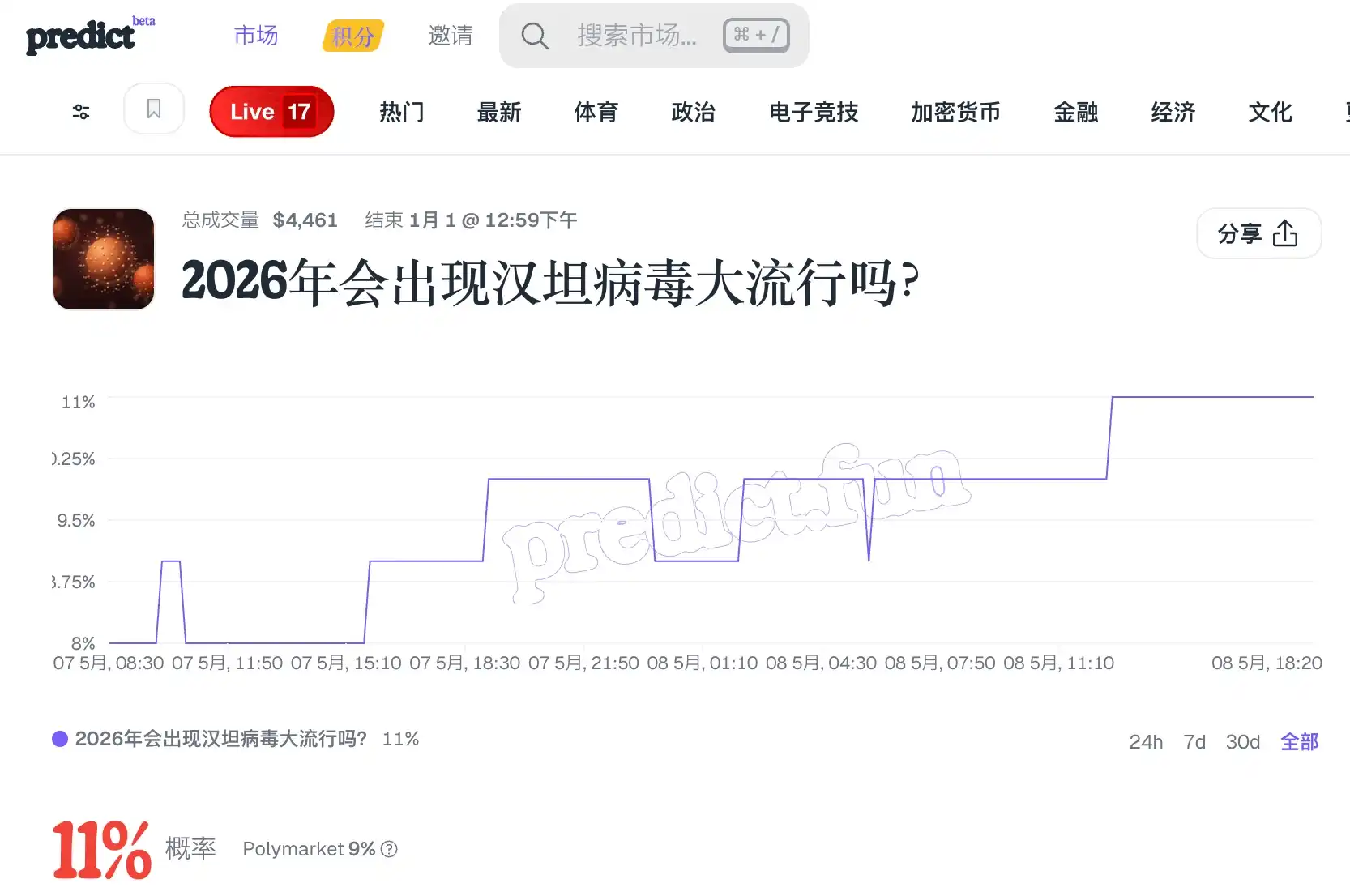
For many, betting real money on the future is inherently addictive. The reason prediction markets are becoming increasingly popular is precisely because they turn humanity's anxiety, curiosity, and desire for the unknown directly into tradable commodities.

At the end of the article, let's bring our focus back to the X platform. There are still numerous ancient posts about "Hantavirus" scattered there, some from 2020, some even traceable back to 2012. Some people dig out fragments of text as "divine prophecies," some piece together blurry screenshots into complete stories, and others firmly believe everything was written in advance.

Truth is not important. What truly fascinates people is how the internet always mixes coincidence, fear, emotion, and imagination into something between reality and urban legend, making you can't help but want to click and take a look.

Just as the fortune teller @soothsayer left behind: "Laugh today, weep tomorrow."
İlgili Sorular

QWhat is the core event described in the article that sparked widespread discussion?

AThe article describes how an old tweet from a user named @soothsayer, posted in 2022, went viral because it seemed to predict the recent Hantavirus outbreak on a cruise ship, along with the end of COVID-19 in 2023.

QHow did the cryptocurrency market react to the Hantavirus news according to the article?

AThe cryptocurrency market absorbed the Hantavirus news as a new trading narrative. A Meme coin named HANTA (Hantavirus) was launched, and prediction markets like Polymarket and Predict.fun created events for users to bet on the probability of a Hantavirus pandemic by 2026.

QWhat specific type of Hantavirus was confirmed in the cruise ship outbreak, and why is it notable?

AThe confirmed virus type is the Andes Hantavirus. It is notable because, unlike most other Hantaviruses, the Andes virus is known to be capable of human-to-human transmission, usually among close contacts like family members or healthcare workers.

QWhat are the main transmission routes for Hantaviruses mentioned in the article?

AThe main transmission routes for Hantaviruses mentioned are: respiratory infection (inhaling aerosols contaminated by rodent excreta), contact infection (broken skin or mucous membranes contacting infected rodent excreta), and digestive tract infection (consuming food contaminated by rodent excreta).

QWhat is the article's perspective on the allure of prediction markets in the context of events like the Hantavirus?

AThe article suggests that prediction markets are increasingly popular because they transform human anxiety, curiosity, and desire regarding the unknown into a tradable commodity. People find it addictive to bet real money on future outcomes.

İlgili Okumalar

Fei-Fei Li's Team Clarifies the Concept of 'World Models', Sora Merely a Renderer

"World Models" has become a widely used yet confusing term in AI. To address this, a team led by Fei-Fei Li and World Labs proposed a functional taxonomy based on the Partially Observable Markov Decision Process framework. This taxonomy categorizes systems called "world models" into three distinct projections: Renderers, Simulators, and Planners. Renderers, like OpenAI's Sora and other video generation models, focus on producing photorealistic visual outputs for human perception. They prioritize visual fidelity over physical accuracy. Simulators, such as NVIDIA Omniverse, aim to compute precise future environmental states for computational tasks like engineering analysis or digital twins. Planners, like Vision-Language-Action models, take in observations and goals to output executable actions for robots or agents. The article clarifies that most current "world models," including Sora, are primarily Renderers. They generate convincing visuals but lack the core ability to simulate state transitions based on actions, a key requirement for a true world model in classic reinforcement learning definitions. This conceptual confusion has practical implications, leading to potential misalignment in technology selection, investment, and public understanding of AI capabilities. Clear categorization is crucial. It helps enterprises avoid costly mistakes (e.g., using a renderer for robot training), allows investors to accurately assess markets, and enables researchers to build comparable benchmarks. While future systems may integrate these functions, recognizing current boundaries is essential for honest assessment and progress.

marsbit23 dk önce

Fei-Fei Li's Team Clarifies the Concept of 'World Models', Sora Merely a Renderer

marsbit23 dk önce

Bloomberg Uncovered: How Do China's Wealthy Circumvent the Annual $50,000 Limit to Transfer Assets?

**Summary: How Wealthy Chinese Circumvent $50,000 Annual Foreign Exchange Limits** Despite China's strict capital controls, including an annual $50,000 per person foreign exchange quota, an estimated $150 billion in funds still leaves the country annually via various gray and underground channels. This report outlines the evolution of China's "capital wall" and the methods used to bypass it. **The Evolving Capital Controls:** * **Foundation (1994):** The system of "current account convertibility with strict capital account controls" was established. * **Quota Set (2007):** The $50,000 individual annual forex purchase limit was formalized. * **Crackdown Begins (2015-2017):** Following market volatility, enforcement tightened. Banks were required to scrutinize transactions, and channels like using UnionPay cards for Hong Kong insurance premiums or buying overseas property were blocked. * **Digital & Legal Upgrades (2024-2026):** Enhanced algorithms now flag suspicious patterns (e.g., "smurfing"). The Common Reporting Standard (CRS) provides Chinese tax authorities with data on citizens' offshore accounts. Unlicensed cross-border brokers have been targeted. **Five Primary Methods for Moving Capital:** 1. **Underground Banking / "Hawala" (Duiqiao):** The largest-scale method. No money crosses borders. Clients pay RMB to a domestic account; an overseas associate deposits equivalent foreign currency into the client's offshore account. Risks include high fees, account freezes, and legal penalties. 2. **"Smurfing" or "Ant Moving":** Using multiple individuals' $50,000 quotas to pool funds for one offshore recipient. Increasingly detected by anti-money laundering algorithms. 3. **Trade Invoice Manipulation:** Businesses over-invoice imports or under-invoice exports via offshore shell companies, creating a pretext to transfer excess funds abroad under the guise of trade. 4. **Channel Migration:** After a crackdown on internet brokers, funds flow toward more compliant but costly channels like major banks' cross-border wealth management services or Qualified Domestic Institutional Investor (QDII) quotas. 5. **Structural Arrangements:** High-net-worth individuals use complex, high-cost legal structures involving offshore trusts, insurance, and investment migration programs to transfer asset ownership. **Regulatory Response: Focusing on People, Not Just Money** The current strategy extends oversight from enterprises to **individual residents**. Tools like CRS allow retroactive visibility into offshore assets. Cryptocurrencies, once seen as a potential loophole, are now actively monitored and prosecuted as an illegal channel. The underlying driver remains: with significant wealth concentrated among millions of affluent households seeking diversification amid domestic economic shifts, the incentive to move assets offshore persists despite regulatory barriers.

marsbit42 dk önce

Bloomberg Uncovered: How Do China's Wealthy Circumvent the Annual $50,000 Limit to Transfer Assets?

marsbit42 dk önce

İşlemler

Spot
Futures

Popüler Makaleler

4 Nasıl Satın Alınır

HTX.com’a hoş geldiniz! 4 (4) satın alma işlemlerini basit ve kullanışlı bir hâle getirdik. Adım adım açıkladığımız rehberimizi takip ederek kripto yolculuğunuza başlayın. 1. Adım: HTX Hesabınızı OluşturunHTX'te ücretsiz bir hesap açmak için e-posta adresinizi veya telefon numaranızı kullanın. Sorunsuzca kaydolun ve tüm özelliklerin kilidini açın. Hesabımı Aç2. Adım: Kripto Satın Al Bölümüne Gidin ve Ödeme Yönteminizi SeçinKredi/Banka Kartı: Visa veya Mastercard'ınızı kullanarak anında 4 (4) satın alın.Bakiye: Sorunsuz bir şekilde işlem yapmak için HTX hesap bakiyenizdeki fonları kullanın.Üçüncü Taraflar: Kullanımı kolaylaştırmak için Google Pay ve Apple Pay gibi popüler ödeme yöntemlerini ekledik.P2P: HTX'teki diğer kullanıcılarla doğrudan işlem yapın.Borsa Dışı (OTC): Yatırımcılar için kişiye özel hizmetler ve rekabetçi döviz kurları sunuyoruz.3. Adım: 4 (4) Varlıklarınızı Saklayın4 (4) satın aldıktan sonra HTX hesabınızda saklayın. Alternatif olarak, blok zinciri transferi yoluyla başka bir yere gönderebilir veya diğer kripto para birimlerini takas etmek için kullanabilirsiniz.4. Adım: 4 (4) Varlıklarınızla İşlem YapınHTX'in spot piyasasında 4 (4) ile kolayca işlemler yapın.Hesabınıza erişin, işlem çiftinizi seçin, işlemlerinizi gerçekleştirin ve gerçek zamanlı olarak izleyin. Hem yeni başlayanlar hem de deneyimli yatırımcılar için kullanıcı dostu bir deneyim sunuyoruz.

380 Toplam GörüntülenmeYayınlanma 2025.10.20Güncellenme 2026.06.02

4 Nasıl Satın Alınır

Tartışmalar

HTX Topluluğuna hoş geldiniz. Burada, en son platform gelişmeleri hakkında bilgi sahibi olabilir ve profesyonel piyasa görüşlerine erişebilirsiniz. Kullanıcıların 4 (4) fiyatı hakkındaki görüşleri aşağıda sunulmaktadır.

活动图片