Fortune Investigates Binance's Iran Fund Flow: $439 Million Chinese VIP Accounts Surface

marsbit2026-03-14 tarihinde yayınlandı2026-03-14 tarihinde güncellendi

Özet

Binance, the world's largest cryptocurrency exchange, is facing renewed scrutiny over its compliance practices following a Fortune investigation. The report reveals that a VIP account, registered under the name of a 79-year-old Chinese resident, transferred $439 million in Tether stablecoins to external wallets. These funds were subsequently moved to wallets linked to Iranian entities, including the Islamic Revolutionary Guard Corps. Despite Binance's $4.3 billion plea deal with the U.S. government in 2023, which it committed to strengthen its compliance programs, these massive transactions did not trigger immediate alerts. A second Chinese VIP account, held by a 38-year-old woman, transferred nearly $200 million to the same Iranian-linked network. Internal investigators found that both accounts were likely accessed from the same device, suggesting possible common control. The funds were funneled through a Hong Kong-based entity, Blessed Trust, which also handled back-office operations for Binance. The exchange has denied that internal investigators were fired for uncovering these activities, stating their departures were due to violations of data policies. The U.S. Department of Justice is reportedly investigating whether Iran used Binance to evade sanctions, though the exchange says it is unaware of any such probe. These findings have prompted a U.S. Senate investigation and raised serious questions about the effectiveness of Binance's compliance program.

Author: Fortune

Compiled by: Deep Tide TechFlow

Deep Tide Introduction: This article is compiled from Fortune's investigative report on March 12. Readers are reminded to note the following background:

Since February this year, Western media outlets including Fortune, The Wall Street Journal, and The New York Times have reported that Binance's internal investigators discovered over $1 billion in funds flowing to entities linked to Iran, and were subsequently fired.

Binance denied firing employees due to compliance whistleblowing, stating that the departures were due to violations of internal data protection policies. On March 11, Binance filed a defamation lawsuit against The Wall Street Journal, demanding a retraction of the related reports.

Concurrently, Binance won two civil lawsuits filed under the U.S. Anti-Terrorism Act—federal courts in the Southern District of New York and Alabama dismissed all claims from the plaintiffs. However, these cases were civil claims by victims' families, which belong to a different legal category than the sanctions compliance disputes discussed in this article.

This article was written by Fortune author Leo Schwartz, who for the first time disclosed specific details of two Chinese VIP accounts: an account under the name of a 79-year-old individual transferred out $439 million, and the two accounts were suspected of sharing the same device.

Binance's stance is: platform accounts did not directly trade with sanctioned entities; the suspicious activity was discovered by Binance itself and reported to law enforcement agencies; the involved accounts have been taken offline. Currently, the U.S. Department of Justice is investigating whether Iran used Binance to evade sanctions, but it is unclear whether Binance itself is the target of the investigation.

Below is the full compilation of the Fortune article:

In early 2025, the embattled Iranian regime increasingly relied on cryptocurrency to circumvent economic sanctions. During this period, a VIP account on the Binance platform, registered under the name of a 79-year-old Chinese resident, transferred $439 million worth of digital tokens from the exchange to external wallets through a series of transactions. These wallets subsequently transferred most of the funds to other wallets—which Binance's internal investigators later identified as being associated with Iranian sanctioned entities, including the Islamic Revolutionary Guard Corps.

As noted in documents reviewed by Fortune, the transfer of hundreds of millions of dollars by an elderly individual was itself highly suspicious. More concerning was that the transactions involved transferring Tether stablecoins on the Tron blockchain—a preferred payment method for cybercriminals and money launderers.

Surprisingly, however, these transfers did not trigger any immediate alerts at Binance. This was despite Binance having reached a $4.3 billion plea agreement with the U.S. government in late 2023, promising to implement a series of stringent compliance procedures.

Amanda Wick, Head of Americas at crypto compliance software firm VerifyVASP and a former federal prosecutor, stated after learning the details of these transactions from Fortune: "This is not just a red flag; it's a trigger event that requires immediate reporting."

The details of this VIP account had not been publicly disclosed before, and its emergence is particularly sensitive for Binance. In February, a series of media reports revealed that Binance had dismissed internal investigators who had reported to senior management—these individuals had discovered that over $1 billion in funds flowed through the platform to wallets linked to Iran, and that a close business partner of Binance—a Hong Kong-based entity responsible for arranging conversions between cryptocurrency and fiat currency—was also involved in these transfers.

These reports have prompted an investigation by the U.S. Senate. Binance responded that the investigators' departures were unrelated to the discovery of Iranian transfers and that the company has been adhering to its 2023 compliance commitments. However, new details involving Chinese and Iranian accounts have again raised doubts about the effectiveness of this compliance program.

Binance did not deny the specific methods investigators used to trace the fund flows. The exchange defended the platform's handling of the违规 (non-compliant) transactions and stated that its compliance program is functioning normally. Meanwhile, according to The Wall Street Journal, the Department of Justice is investigating whether Iran used Binance to evade sanctions. A Binance spokesperson said the exchange is unaware of any such investigation. A DOJ spokesperson declined to comment.

Binance Chief Compliance Officer Noah Perlman said in a statement provided to Fortune: "Binance's compliance program is continuously improving and evolving, with the goal of constantly strengthening and preventing issues from recurring."

China-Linked Network

Like traditional financial institutions, crypto exchanges have specialized compliance procedures to verify user identities and screen for illegal activities. In a February blog post, Binance stated that its compliance program has nearly 600 full-time employees and is "industry-leading."

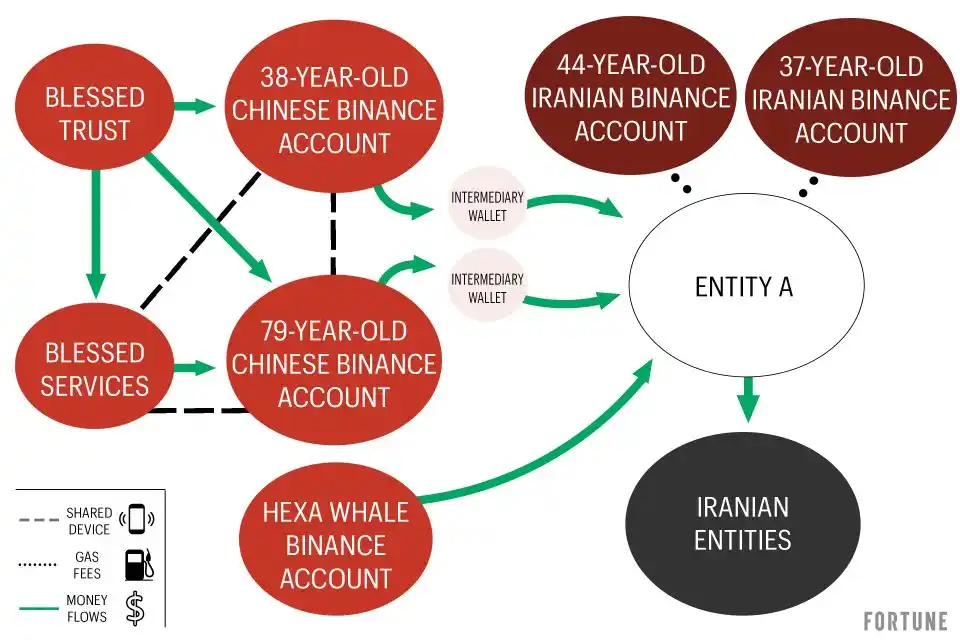
As part of this process, Binance required this 79-year-old Chinese man to upload identification documents to open a VIP account. (A Binance spokesperson said VIP status is automatically granted based on asset holdings and trading volume.) It was through this ID that the exchange's internal investigators ultimately determined that he had indirectly transferred approximately $400 million to a previously unidentified group of Iran-linked wallets outside Binance—which investigators referred to as "Entity A." Former prosecutor Wick said this type of activity should have been automatically flagged by the system.

"If nearly half a billion dollars moves from a customer account to a single non-custodial wallet and then quickly flows to wallets associated with a sanctioned jurisdiction... this is exactly the type of activity a compliance team should capture," she said.

However, Binance allowed this VIP account to trade freely for months. These transactions, which began in January 2025, were not flagged by the compliance department until August 11 of that year, after Seychelles law enforcement submitted a request to Binance regarding "a serious terrorism financing case." A Binance spokesperson told Fortune that the 79-year-old VIP user's account was blocked in September 2025 and fully taken offline by January 2026.

Other compliance experts expressed surprise that Binance did not handle the account more quickly. Robert Appleton, a partner at law firm Olshan and former head of the Iran sanctions task force at the DOJ, told Fortune that especially given Binance's checkered past and previous legal troubles over sanctions evasion, he would have expected the exchange to be more vigilant about any form of suspicious activity. "The agreement with the government changes everything because it raises their obligations," he said.

Meanwhile, the $439 million transfer in the name of this Chinese elderly individual was only part of the Iran-related activity. Documents reviewed by Fortune show that former Binance employees discovered in their investigation that the Iran-linked wallet cluster, referred to as "Entity A," received a total of $1.7 billion from companies and individuals holding Binance accounts. "Entity A" then transferred part of these funds to Nobitex, Iran's largest cryptocurrency exchange, and to digital wallets associated with U.S.-designated terrorist organizations such as the Islamic Revolutionary Guard Corps and the Houthis). The Binance spokesperson said that at the time of the transactions, none of these wallets were on sanctions lists maintained by global law enforcement agencies, so they did not trigger any alerts.

Although the wallets controlled by "Entity A" and related sanctioned entities were not on the Binance platform, crypto compliance experts told Fortune that the nature of the funds flowing out of Binance itself should have raised alarms.

After receiving the request from Seychelles, Binance investigators opened a case and subsequently characterized this series of fund flows as part of a "China-Linked Network"—which also involved another VIP trader. This VIP client was a 38-year-old Chinese woman who transferred nearly $200 million in Tether stablecoins to an intermediate wallet between November and December 2024, which then transferred the funds to "Entity A." (The Binance spokesperson said the term "China-Linked Network" was "an internal, informal designation, not precise, and may have evolved over time," and stated that this VIP account was also taken offline by January 2026.)

More intriguingly, documents reviewed by Fortune indicate that these two VIP accounts were highly likely accessed from the same device—suggesting that the same person, or a third-party entity, might have controlled both accounts. Wick said: "If two ostensibly unrelated VIP clients are found accessing their accounts from the same device, it raises serious questions about beneficial ownership."

In any case, investigators found from blockchain data that both accounts had received funds from Blessed Trust. Blessed Trust is a Hong Kong-based enterprise that helps companies convert crypto funds into fiat currency and also handles back-office tasks like payroll and taxes for Binance. Investigators ultimately concluded that of the total $1.2 billion flowing through Blessed Trust into "Entity A," approximately half came from these two Chinese VIP traders.

Binance attempted to downplay the connection between the platform accounts and the Iran-linked wallets, stating in a recent blog post that there were multiple intermediaries between the exchange and the sanctioned wallets. The post also noted that $1.1 billion of the funds originated from "a large, regulated stablecoin issuer." Investigators concluded in their findings that most of the funds from the two Chinese VIP accounts likely came from stablecoins issued by Circle—a U.S.-listed crypto company. A Circle spokesperson told Fortune: "We take our regulatory obligations seriously," adding that Circle had designated Blessed Trust for termination in 2025.

However, Binance, in its blog post and responses to Fortune and other media, consistently avoided addressing the specific details of these two Chinese VIP accounts on its platform. Furthermore, investigators also found that these two accounts and Blessed Services (another company related to Blessed Trust, which was intermediary in the fund flow to "Entity A") also shared the same device. This evidence suggests the same group might have operated all these accounts. The Binance spokesperson declined to comment on the device-sharing details and stated that Blessed Services has no business relationship with the exchange.

Email addresses associated with Blessed Trust and Blessed Services did not respond to Fortune's requests for comment.

The "China-Linked Network" involved one final link: a Hong Kong-registered company, Hexa Whale Trading Limited, which operated on the Binance platform and transferred approximately $500 million to "Entity A." By the time Binance investigators discovered Hexa Whale's activity, other members of the company's compliance team had already taken the account offline. The Wall Street Journal and The New York Times had previously reported details related to Hexa Whale and Blessed Trust.

Fortune's attempts to contact Hexa Whale and the two Chinese VIP users were unsuccessful.

The investigators involved in the preliminary report were fired by Binance weeks after submitting their initial findings. Binance denied that these employees were dismissed for raising compliance issues and stated in a blog post that the departure of some personnel was decided "after an internal review found violations of company data protection and confidentiality policies." The exchange insisted that it continued the relevant investigation and completed the takedown of Blessed Trust in January 2026.

The investigators declined to comment.
Iran-Linked Clues

Another, smaller set of transaction records also caught the investigators' attention. These transactions were operated by two individuals suspected of Iranian nationality. Compliance experts stated that the mere fact that these two individuals were able to successfully open accounts on Binance and complete transfers already raises questions about the strictness of the company's screening procedures.

The first account was opened in 2021, held by a 44-year-old male whose Dominica ID indicated Iran as his place of birth, and whose name appeared in a 2020 UN Security Council report—a report concerning a gold and cash smuggling network serving Iran and North Korea. The second account was also opened in 2021, held by a 37-year-old male whose uploaded Iraqi ID also indicated Iran as his place of birth. By the time Binance investigators discovered these accounts, they had already been restricted.

The relevant transactions included: each of the two accounts transferring around $100 worth of TRX cryptocurrency to the Iran-linked wallet cluster in 2024—TRX is the native currency used to pay transaction fees on the Tron blockchain. Although the total amount was negligible, this TRX transfer was significant because it likely paid the fees for transfers between the "Entity A" wallet cluster. This situation is roughly analogous to tracking credit card records used to pay for car fuel: if the same card repeatedly pays for gas, it doesn't tell you who is driving, but it can reveal who is footing the bill for the journey.

Lex Fisun, Co-founder and CEO of blockchain analytics firm Global Ledger, said: "Most people only look at large transactions, but small transactions are equally important. On the blockchain, you often can't link a wallet to a real identity. However, when an address repeatedly sends TRX to another wallet to pay fees, it indicates a connection between the two."

Furthermore, Wick pointed out that the association of these accounts with Iran should have triggered more immediate scrutiny. After all, Binance had already pleaded guilty for similar transactions and promised to eradicate such behavior on its platform.

"When multiple high-risk indicators appear simultaneously—especially involving a heavily sanctioned jurisdiction like Iran, or individuals appearing in UN Security Council reports—a properly functioning compliance program should report in real-time," she said. "Account restrictions, enhanced due diligence, blockchain tracing, sanctions risk assessments, these measures should be triggered immediately when the issue occurs, not months later."

The Binance spokesperson said one of the Iranian accounts has been completely taken offline, and the other has been restricted from trading and is in the process of being taken offline. The exchange did not specify whether these accounts were restricted at the time the transactions occurred.

Fortune's attempts to contact the two relevant individuals were unsuccessful.

Exposure to sanctioned entities is a significant risk for any financial institution, and Binance has already paid a heavy price for it. In 2023, it reached a $4.3 billion plea agreement with the U.S. government, partly for failing to maintain an effective anti-money laundering and sanctions compliance program.

Under the plea agreement, co-founder Changpeng Zhao stepped down as CEO and spent four months in federal prison. Binance also agreed to cooperate with a monitor reporting to the Justice and Treasury Departments on its internal operations.

However, the recent dismissal of investigators and the potential Iranian exposure have raised concerns among members of Congress. In late February, Senator Richard Blumenthal (D-Conn.) launched a preliminary investigation into Binance and sent a letter to co-CEO Richard Teng requesting information on the findings of the dismissed investigators and other Iran-related activities.

Blumenthal also specifically mentioned President Trump's pardon of Changpeng Zhao in October—a move that raised conflict-of-interest allegations due to Binance's increasingly close ties to the Trump family's cryptocurrency business.

A White House spokesperson told Fortune: "President Trump's assets are held in a trust managed by his children, and there is no conflict of interest."

However, Blumenthal told Fortune that Binance's connection to the White House presents ongoing ethical concerns: "One of my biggest concerns is that the relationship between Binance and the administration could deter or discourage compliance monitors from exposing and reporting violations, or could hinder the Justice Department from pursuing prosecution."


İlgili Sorular

QWhat were the key findings of the Fortune investigation regarding Binance's VIP accounts linked to Iran?

AThe investigation revealed that a VIP account under the name of a 79-year-old Chinese resident transferred $439 million in digital tokens to external wallets, which were later linked to Iranian sanctioned entities, including the Islamic Revolutionary Guard Corps. Another VIP account, a 38-year-old Chinese woman, transferred nearly $200 million in Tether to the same network. Both accounts were suspected of being accessed from the same device, indicating potential common control.

QHow did Binance respond to the allegations of facilitating transactions linked to Iranian sanctions?

ABinance denied that employees were fired for compliance reporting, attributing their departures to violations of internal data protection policies. The exchange stated that its compliance program is continuously improving and that it had offboarded the involved accounts. Binance also filed a defamation lawsuit against The Wall Street Journal for related articles and emphasized that the sanctioned wallets were not on its platform at the time of transactions.

QWhat role did Blessed Trust and Hexa Whale Trading Limited play in the transactions?

ABlessed Trust, a Hong Kong-based entity, facilitated the conversion of crypto to fiat and handled backend operations for Binance. It was involved in transferring $1.2 billion to the Iranian-linked 'Entity A,' with about half originating from the two Chinese VIP accounts. Hexa Whale Trading Limited, another Hong Kong-registered firm, transferred approximately $500 million to Entity A. Both entities were part of the 'China-linked network' identified by investigators.

QWhat were the compliance failures highlighted in the investigation?

AThe investigation pointed out that Binance's compliance systems failed to automatically flag suspicious activities, such as large transfers to wallets linked to sanctioned jurisdictions, despite the 2023 plea agreement with the U.S. government. The exchange did not restrict the VIP accounts until months after the transactions, and it missed red flags like accounts with Iranian identifiers transferring small amounts of TRX to pay for transaction fees related to Entity A.

QWhat broader implications did the investigation have, including U.S. government actions?

AThe findings prompted a U.S. Senate investigation led by Senator Richard Blumenthal, who expressed concerns about Binance's compliance and potential conflicts of interest due to its ties with the Trump administration following the pardon of former CEO Changpeng Zhao. The U.S. Department of Justice is also investigating whether Iran used Binance to evade sanctions, though Binance claims no knowledge of such an investigation.

İlgili Okumalar

İşlemler

Spot
Futures

Popüler Makaleler

$S$ Nedir

SPERO'yu Anlamak: Kapsamlı Bir Genel Bakış SPERO'ya Giriş İnovasyonun manzarası gelişmeye devam ederken, web3 teknolojilerinin ve kripto para projelerinin ortaya çıkışı dijital geleceği şekillendirmede önemli bir rol oynamaktadır. Bu dinamik alanda dikkat çeken projelerden biri SPERO, $$s$$ olarak adlandırılmaktadır. Bu makale, SPERO hakkında ayrıntılı bilgi toplamak ve sunmak amacıyla, meraklılar ve yatırımcıların web3 ve kripto alanlarındaki temellerini, hedeflerini ve yeniliklerini anlamalarına yardımcı olmayı amaçlamaktadır. SPERO,$$s$$ Nedir? SPERO,$$s$$, kripto alanında merkeziyetsizlik ve blok zinciri teknolojisi ilkelerini kullanarak etkileşimi, faydayı ve finansal kapsayıcılığı teşvik eden bir ekosistem yaratmayı amaçlayan benzersiz bir projedir. Proje, kullanıcıların yenilikçi finansal çözümler ve hizmetler sunarak eşler arası etkileşimleri yeni yollarla kolaylaştırmayı hedeflemektedir. SPERO,$$s$$'nin temel amacı, bireyleri güçlendirmek ve kripto para alanındaki kullanıcı deneyimini artıran araçlar ve platformlar sağlamaktır. Bu, daha esnek işlem yöntemlerini mümkün kılmayı, topluluk odaklı girişimleri teşvik etmeyi ve merkeziyetsiz uygulamalar (dApp'ler) aracılığıyla finansal fırsatlar yaratmayı içermektedir. SPERO,$$s$$'nin temel vizyonu kapsayıcılık etrafında dönmekte olup, geleneksel finansal sistemlerdeki boşlukları kapatmayı ve blok zinciri teknolojisinin faydalarından yararlanmayı hedeflemektedir. SPERO,$$s$$'nin Yaratıcısı Kimdir? SPERO,$$s$$'nin yaratıcısının kimliği bir miktar belirsizdir, çünkü kurucusu(ları) hakkında ayrıntılı arka plan bilgisi sağlayan sınırlı kamuya açık kaynaklar bulunmaktadır. Bu şeffaflık eksikliği, projenin merkeziyetsizlik taahhüdünden kaynaklanabilir—birçok web3 projesinin paylaştığı bir etik anlayışı, bireysel tanınmanın yerine kolektif katkıları önceliklendirmektedir. Topluluk ve onun kolektif hedefleri etrafında tartışmaları merkezileştirerek, SPERO,$$s$$, belirli bireyleri öne çıkarmadan güçlendirme özünü taşımaktadır. Bu nedenle, SPERO'nun etik anlayışını ve misyonunu anlamak, tek bir yaratıcının kimliğini belirlemekten daha önemlidir. SPERO,$$s$$'nin Yatırımcıları Kimlerdir? SPERO,$$s$$, kripto sektöründe yeniliği teşvik etmeye adanmış girişim sermayedarlarından melek yatırımcılara kadar çeşitli yatırımcılar tarafından desteklenmektedir. Bu yatırımcıların odak noktası genellikle SPERO'nun misyonuyla uyumlu olup, toplumsal teknolojik ilerlemeyi, finansal kapsayıcılığı ve merkeziyetsiz yönetimi vaat eden projeleri önceliklendirmektedir. Bu yatırımcı temelleri, yalnızca yenilikçi ürünler sunan projelere değil, aynı zamanda blok zinciri topluluğuna ve ekosistemlerine olumlu katkılarda bulunan projelere de ilgi duymaktadır. Bu yatırımcıların desteği, SPERO,$$s$$'yi hızla gelişen kripto projeleri alanında dikkate değer bir rakip haline getirmektedir. SPERO,$$s$$ Nasıl Çalışır? SPERO,$$s$$, onu geleneksel kripto para projelerinden ayıran çok yönlü bir çerçeve kullanmaktadır. İşte benzersizliğini ve yeniliğini vurgulayan bazı temel özellikler: Merkeziyetsiz Yönetim: SPERO,$$s$$, kullanıcıların projenin geleceğiyle ilgili karar alma süreçlerine aktif olarak katılmalarını sağlayan merkeziyetsiz yönetim modellerini entegre etmektedir. Bu yaklaşım, topluluk üyeleri arasında sahiplik ve hesap verebilirlik duygusunu teşvik etmektedir. Token Kullanımı: SPERO,$$s$$, ekosistem içinde çeşitli işlevler sunmak üzere tasarlanmış kendi kripto para token'ını kullanmaktadır. Bu token'lar, işlemleri, ödülleri ve platformda sunulan hizmetlerin kolaylaştırılmasını sağlayarak genel etkileşimi ve faydayı artırmaktadır. Katmanlı Mimari: SPERO,$$s$$'nin teknik mimarisi, modülerlik ve ölçeklenebilirliği destekleyerek projenin evrimi sırasında ek özelliklerin ve uygulamaların sorunsuz bir şekilde entegrasyonuna olanak tanımaktadır. Bu uyum sağlama yeteneği, sürekli değişen kripto manzarasında geçerliliği sürdürmek için hayati öneme sahiptir. Topluluk Katılımı: Proje, işbirliği ve geri bildirim teşvik eden mekanizmalar kullanarak topluluk odaklı girişimlere vurgu yapmaktadır. Güçlü bir topluluk oluşturarak, SPERO,$$s$$, kullanıcı ihtiyaçlarını daha iyi karşılayabilir ve piyasa trendlerine uyum sağlayabilir. Kapsayıcılığa Odaklanma: Düşük işlem ücretleri ve kullanıcı dostu arayüzler sunarak, SPERO,$$s$$, daha önce kripto alanında yer almamış bireyler de dahil olmak üzere çeşitli bir kullanıcı tabanını çekmeyi hedeflemektedir. Bu kapsayıcılık taahhüdü, erişilebilirlik yoluyla güçlendirme misyonuyla uyumludur. SPERO,$$s$$ Zaman Çizelgesi Bir projenin tarihini anlamak, gelişim yolculuğu ve kilometre taşları hakkında kritik bilgiler sağlar. Aşağıda, SPERO,$$s$$'nin evriminde önemli olayları haritalayan önerilen bir zaman çizelgesi bulunmaktadır: Kavram Geliştirme ve Fikir Aşaması: SPERO,$$s$$'nin temelini oluşturan ilk fikirler, blok zinciri endüstrisindeki merkeziyetsizlik ve topluluk odaklılık ilkeleriyle yakından uyumlu olarak geliştirildi. Proje Beyaz Kağıdının Yayınlanması: Kavramsal aşamayı takiben, SPERO,$$s$$'nin vizyonunu, hedeflerini ve teknolojik altyapısını ayrıntılı bir şekilde açıklayan kapsamlı bir beyaz kağıt yayımlandı ve topluluk ilgisini ve geri bildirimini toplamak amacıyla sunuldu. Topluluk Oluşturma ve Erken Katılımlar: Projenin hedefleri etrafında tartışmalar yürüterek destek toplamak ve erken benimseyenler ile potansiyel yatırımcılar için bir topluluk oluşturmak amacıyla aktif iletişim çabaları gerçekleştirildi. Token Üretim Etkinliği: SPERO,$$s$$, yerel token'larını erken destekçilere dağıtmak ve ekosistem içinde başlangıç likiditesini sağlamak amacıyla bir token üretim etkinliği (TGE) gerçekleştirdi. İlk dApp'in Yayınlanması: SPERO,$$s$$ ile ilişkili ilk merkeziyetsiz uygulama (dApp) faaliyete geçti ve kullanıcıların platformun temel işlevleriyle etkileşimde bulunmalarını sağladı. Sürekli Gelişim ve Ortaklıklar: Projenin tekliflerine sürekli güncellemeler ve iyileştirmeler yapılmakta olup, blok zinciri alanındaki diğer oyuncularla stratejik ortaklıklar, SPERO,$$s$$'yi rekabetçi ve gelişen bir oyuncu haline getirmiştir. Sonuç SPERO,$$s$$, web3 ve kripto paranın finansal sistemleri devrim niteliğinde dönüştürme ve bireyleri güçlendirme potansiyelinin bir kanıtıdır. Merkeziyetsiz yönetime, topluluk katılımına ve yenilikçi tasarlanmış işlevselliğe olan bağlılığıyla, daha kapsayıcı bir finansal manzaraya doğru bir yol açmaktadır. Hızla gelişen kripto alanındaki herhangi bir yatırımda olduğu gibi, potansiyel yatırımcılar ve kullanıcılar, SPERO,$$s$$ içindeki devam eden gelişmelerle ilgili olarak kapsamlı bir araştırma yapmaları ve düşünceli bir şekilde katılmaları teşvik edilmektedir. Proje, kripto endüstrisinin yenilikçi ruhunu sergileyerek, sayısız olasılığını keşfetmeye davet etmektedir. SPERO,$$s$$'nin yolculuğu hala devam ederken, temel ilkeleri, teknoloji, finans ve birbirimizle etkileşim biçimimizi etkileyebilir.

89 Toplam GörüntülenmeYayınlanma 2024.12.17Güncellenme 2024.12.17

$S$ Nedir

AGENT S Nedir

Agent S: Web3'te Otonom Etkileşimin Geleceği Giriş Web3 ve kripto para dünyasında sürekli gelişen manzarada, yenilikler bireylerin dijital platformlarla etkileşim biçimlerini sürekli olarak yeniden tanımlıyor. Bu tür öncü projelerden biri olan Agent S, açık ajans çerçevesi aracılığıyla insan-bilgisayar etkileşimini devrim niteliğinde değiştirmeyi vaat ediyor. Otonom etkileşimlerin yolunu açarak, Agent S karmaşık görevleri basitleştirmeyi ve yapay zeka (AI) alanında dönüştürücü uygulamalar sunmayı hedefliyor. Bu detaylı inceleme, projenin karmaşıklıklarına, benzersiz özelliklerine ve kripto para alanındaki etkilerine dalacaktır. Agent S Nedir? Agent S, bilgisayar görevlerinin otomasyonunda üç temel zorluğu ele almak üzere özel olarak tasarlanmış çığır açıcı bir açık ajans çerçevesidir: Alan Spesifik Bilgi Edinimi: Çerçeve, çeşitli dış bilgi kaynaklarından ve iç deneyimlerden akıllıca öğrenir. Bu çift yönlü yaklaşım, alan spesifik bilgi açısından zengin bir veri havuzu oluşturmasını sağlar ve görev yürütmedeki performansını artırır. Uzun Görev Ufukları Üzerinde Planlama: Agent S, karmaşık görevlerin verimli bir şekilde parçalanmasını ve yürütülmesini kolaylaştıran deneyim artırımlı hiyerarşik planlama kullanır. Bu özellik, çoklu alt görevleri etkili ve verimli bir şekilde yönetme yeteneğini önemli ölçüde artırır. Dinamik, Homojen Olmayan Arayüzlerle Başlama: Proje, ajanlar ve kullanıcılar arasındaki etkileşimi geliştiren yenilikçi bir çözüm olan Ajan-Bilgisayar Arayüzü'ni (ACI) tanıtmaktadır. Çok Modlu Büyük Dil Modellerini (MLLM'ler) kullanarak, Agent S çeşitli grafik kullanıcı arayüzlerini sorunsuz bir şekilde gezinebilir ve manipüle edebilir. Bu öncü özellikler aracılığıyla, Agent S, makinelerle insan etkileşimini otomatikleştirmede karşılaşılan karmaşıklıkları ele alan sağlam bir çerçeve sunarak, AI ve ötesinde birçok uygulama için zemin hazırlıyor. Agent S'nin Yaratıcısı Kimdir? Agent S'nin kavramı temelde yenilikçi olsa da, yaratıcısı hakkında spesifik bilgiler belirsizliğini koruyor. Yaratıcı şu anda bilinmiyor, bu da projenin yeni aşamasını veya kurucu üyeleri gizli tutma stratejik tercihini vurguluyor. Anonimlikten bağımsız olarak, odak çerçevenin yetenekleri ve potansiyeli üzerinde kalıyor. Agent S'nin Yatırımcıları Kimlerdir? Agent S, kriptografik ekosistemde oldukça yeni olduğundan, yatırımcıları ve finansal destekçileri hakkında ayrıntılı bilgiler açıkça belgelenmemiştir. Projeyi destekleyen yatırım temelleri veya organizasyonları hakkında kamuya açık bilgilerdeki eksiklik, finansman yapısı ve gelişim yol haritası hakkında sorular doğuruyor. Destekleyicilerin anlaşılması, projenin sürdürülebilirliğini ve potansiyel pazar etkisini değerlendirmek için kritik öneme sahiptir. Agent S Nasıl Çalışır? Agent S'nin temelinde, çeşitli ortamlarda etkili bir şekilde çalışmasını sağlayan son teknoloji bir sistem yatmaktadır. İşleyiş modeli birkaç ana özellik etrafında inşa edilmiştir: İnsan Benzeri Bilgisayar Etkileşimi: Çerçeve, bilgisayarlarla etkileşimleri daha sezgisel hale getirmeyi amaçlayan gelişmiş AI planlaması sunar. Görev yürütmedeki insan davranışını taklit ederek, kullanıcı deneyimlerini yükseltmeyi vaat eder. Anlatı Belleği: Yüksek düzeyde deneyimlerden yararlanmak için kullanılan Agent S, görev geçmişlerini takip etmek amacıyla anlatı belleğini kullanarak karar verme süreçlerini geliştirir. Episodik Bellek: Bu özellik, kullanıcılara adım adım rehberlik sağlayarak, çerçevenin görevler gelişirken bağlamsal destek sunmasına olanak tanır. OpenACI Desteği: Yerel olarak çalışabilme yeteneği ile Agent S, kullanıcıların etkileşimleri ve iş akışları üzerinde kontrol sağlamasına olanak tanır ve Web3'ün merkeziyetsiz felsefesiyle uyumlu hale gelir. Dış API'lerle Kolay Entegrasyon: Çeşitli AI platformlarıyla uyumluluğu ve çok yönlülüğü, Agent S'nin mevcut teknolojik ekosistemlere sorunsuz bir şekilde entegre olmasını sağlar ve geliştiriciler ile organizasyonlar için cazip bir seçenek haline getirir. Bu işlevsellikler, Agent S'nin kripto alanındaki benzersiz konumuna katkıda bulunarak, karmaşık, çok aşamalı görevleri minimum insan müdahalesi ile otomatikleştirir. Proje geliştikçe, Web3'teki potansiyel uygulamaları dijital etkileşimlerin nasıl gelişeceğini yeniden tanımlayabilir. Agent S'nin Zaman Çizelgesi Agent S'nin gelişimi ve kilometre taşları, önemli olaylarını vurgulayan bir zaman çizelgesinde özetlenebilir: 27 Eylül 2024: Agent S'nin kavramı, “Bilgisayarları İnsan Gibi Kullanan Açık Bir Ajans Çerçevesi” başlıklı kapsamlı bir araştırma makalesi ile tanıtıldı ve projenin temelini sergiledi. 10 Ekim 2024: Araştırma makalesi arXiv'de kamuya açık olarak yayınlandı ve çerçevenin derinlemesine bir incelemesini ve OSWorld benchmark'ına dayalı performans değerlendirmesini sundu. 12 Ekim 2024: Agent S'nin yetenekleri ve özellikleri hakkında görsel bir içgörü sağlayan bir video sunumu yayımlandı ve potansiyel kullanıcılar ve yatırımcılarla daha fazla etkileşim sağlandı. Bu zaman çizelgesindeki işaretler, sadece Agent S'nin ilerlemesini değil, aynı zamanda şeffaflık ve topluluk katılımına olan bağlılığını da göstermektedir. Agent S Hakkında Ana Noktalar Agent S çerçevesi gelişmeye devam ederken, birkaç ana özellik öne çıkmakta ve yenilikçi doğasını ve potansiyelini vurgulamaktadır: Yenilikçi Çerçeve: İnsan etkileşimine benzer bir bilgisayar kullanımı sağlamak üzere tasarlanan Agent S, görev otomasyonuna yeni bir yaklaşım getiriyor. Otonom Etkileşim: GUI aracılığıyla bilgisayarlarla otonom olarak etkileşim kurabilme yeteneği, daha akıllı ve verimli hesaplama çözümlerine doğru bir sıçrama anlamına geliyor. Karmaşık Görev Otomasyonu: Sağlam metodolojisi ile karmaşık, çok aşamalı görevleri otomatikleştirerek süreçleri daha hızlı ve daha az hata payı ile gerçekleştirebilir. Sürekli İyileştirme: Öğrenme mekanizmaları, Agent S'nin geçmiş deneyimlerden öğrenmesini sağlar ve sürekli olarak performansını ve etkinliğini artırır. Çok Yönlülük: OSWorld ve WindowsAgentArena gibi farklı işletim ortamlarında uyumlu olması, geniş bir uygulama yelpazesine hizmet edebilmesini sağlar. Agent S, Web3 ve kripto alanında kendini konumlandırırken, etkileşim yeteneklerini artırma ve süreçleri otomatikleştirme potansiyeli, AI teknolojilerinde önemli bir ilerlemeyi temsil etmektedir. Yenilikçi çerçevesi aracılığıyla, Agent S dijital etkileşimlerin geleceğini örneklemekte ve çeşitli sektörlerde kullanıcılar için daha sorunsuz ve verimli bir deneyim vaat etmektedir. Sonuç Agent S, AI ve Web3'ün birleşiminde cesur bir sıçramayı temsil ediyor ve teknoloji ile etkileşim biçimimizi yeniden tanımlama kapasitesine sahip. Henüz erken aşamalarında olmasına rağmen, uygulama olanakları geniş ve çekici. Kritik zorlukları ele alan kapsamlı çerçevesi ile Agent S, otonom etkileşimleri dijital deneyimin ön plana çıkmasına taşımayı hedefliyor. Kripto para ve merkeziyetsizlik alanlarına daha derinlemesine girdikçe, Agent S gibi projelerin teknoloji ve insan-bilgisayar işbirliğinin geleceğini şekillendirmede önemli bir rol oynayacağı kesin.

426 Toplam GörüntülenmeYayınlanma 2025.01.14Güncellenme 2025.01.14

AGENT S Nedir

S Nasıl Satın Alınır

HTX.com’a hoş geldiniz! Sonic (S) satın alma işlemlerini basit ve kullanışlı bir hâle getirdik. Adım adım açıkladığımız rehberimizi takip ederek kripto yolculuğunuza başlayın. 1. Adım: HTX Hesabınızı OluşturunHTX'te ücretsiz bir hesap açmak için e-posta adresinizi veya telefon numaranızı kullanın. Sorunsuzca kaydolun ve tüm özelliklerin kilidini açın. Hesabımı Aç2. Adım: Kripto Satın Al Bölümüne Gidin ve Ödeme Yönteminizi SeçinKredi/Banka Kartı: Visa veya Mastercard'ınızı kullanarak anında Sonic (S) satın alın.Bakiye: Sorunsuz bir şekilde işlem yapmak için HTX hesap bakiyenizdeki fonları kullanın.Üçüncü Taraflar: Kullanımı kolaylaştırmak için Google Pay ve Apple Pay gibi popüler ödeme yöntemlerini ekledik.P2P: HTX'teki diğer kullanıcılarla doğrudan işlem yapın.Borsa Dışı (OTC): Yatırımcılar için kişiye özel hizmetler ve rekabetçi döviz kurları sunuyoruz.3. Adım: Sonic (S) Varlıklarınızı SaklayınSonic (S) satın aldıktan sonra HTX hesabınızda saklayın. Alternatif olarak, blok zinciri transferi yoluyla başka bir yere gönderebilir veya diğer kripto para birimlerini takas etmek için kullanabilirsiniz.4. Adım: Sonic (S) Varlıklarınızla İşlem YapınHTX'in spot piyasasında Sonic (S) ile kolayca işlemler yapın.Hesabınıza erişin, işlem çiftinizi seçin, işlemlerinizi gerçekleştirin ve gerçek zamanlı olarak izleyin. Hem yeni başlayanlar hem de deneyimli yatırımcılar için kullanıcı dostu bir deneyim sunuyoruz.

1.3k Toplam GörüntülenmeYayınlanma 2025.01.15Güncellenme 2025.03.21

S Nasıl Satın Alınır

Tartışmalar

HTX Topluluğuna hoş geldiniz. Burada, en son platform gelişmeleri hakkında bilgi sahibi olabilir ve profesyonel piyasa görüşlerine erişebilirsiniz. Kullanıcıların S (S) fiyatı hakkındaki görüşleri aşağıda sunulmaktadır.

活动图片