So shocking!
AI begins predicting the entire universe—
LLMs predict linguistic descriptions of the world, video world models predict (dynamic) images, but this time, it directly predicts the physical state of four-dimensional space and time.
Most astonishingly, it adopts a completely new architecture called "neural operators," rather than the ubiquitous Transformer.
In a single inference pass, it directly outputs the complete four-dimensional trajectory, calculating the time dimension along with it.
The required context length for this is undoubtedly massive, and now the startup Accelerated Understanding has scaled training context to a trillion (1T) tokens, with inference context exceeding 5 trillion!
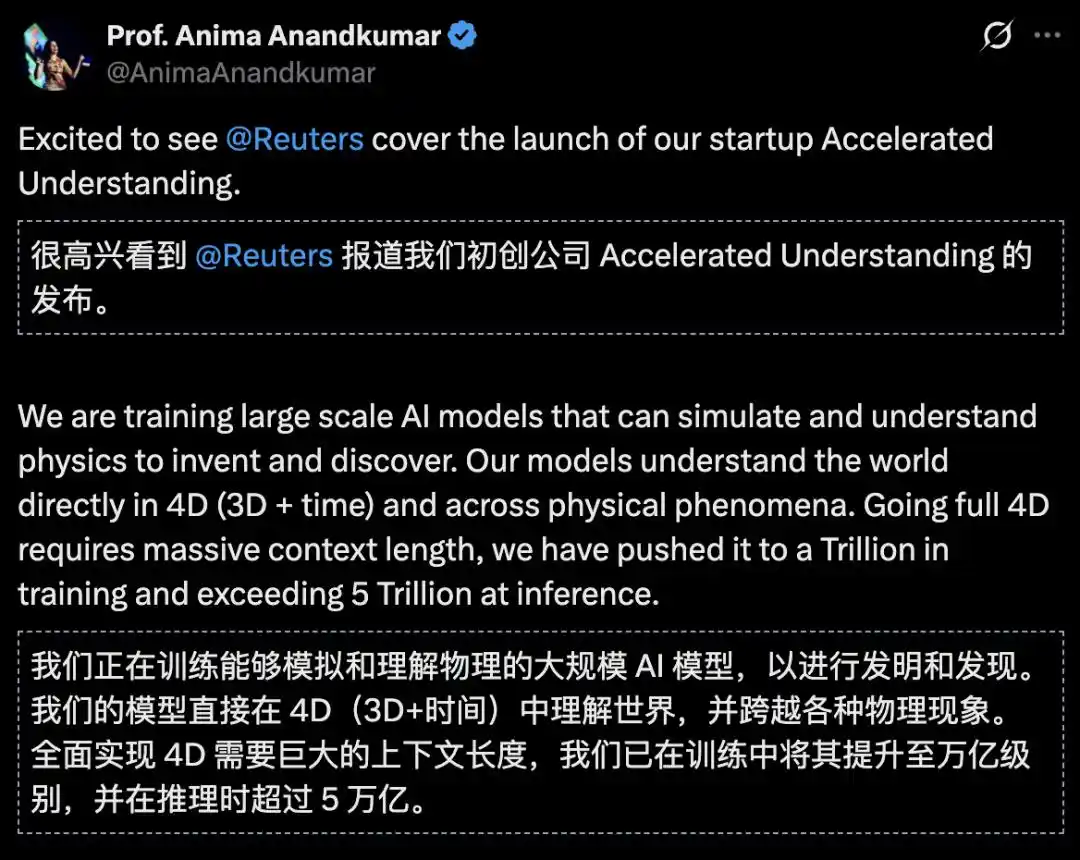
What does 5 trillion mean? It's 5 million times the context length of current top-tier LLMs! It's like having an AI read "War and Peace" 5 million times in one go, and it remembers everything.
Think about it. Ponder it carefully.
Time is not a fundamental thing; it seems more like an emergent property of a deeper informational structure, doesn't that sound interesting? Pushing this idea to its extreme essentially means generating the entire physical universe.
Even more surprising is that the two founders of this startup just rejected a lucrative offer from former world's richest man Jeff Bezos, which included 35% equity, a $2 million annual salary, and a financing commitment exceeding $20 billion.
The "spiritual shareholder" and possible hidden backer standing behind them might just be that man in the leather jacket—Nvidia CEO Jensen Huang.
5 Trillion Context is Not Ilya's "Safe Superintelligence"
Yesterday, a Silicon Valley investment bigwig made ambiguous remarks, setting the whole internet abuzz, with everyone speculating that Ilya's SSI might be about to drop something major.
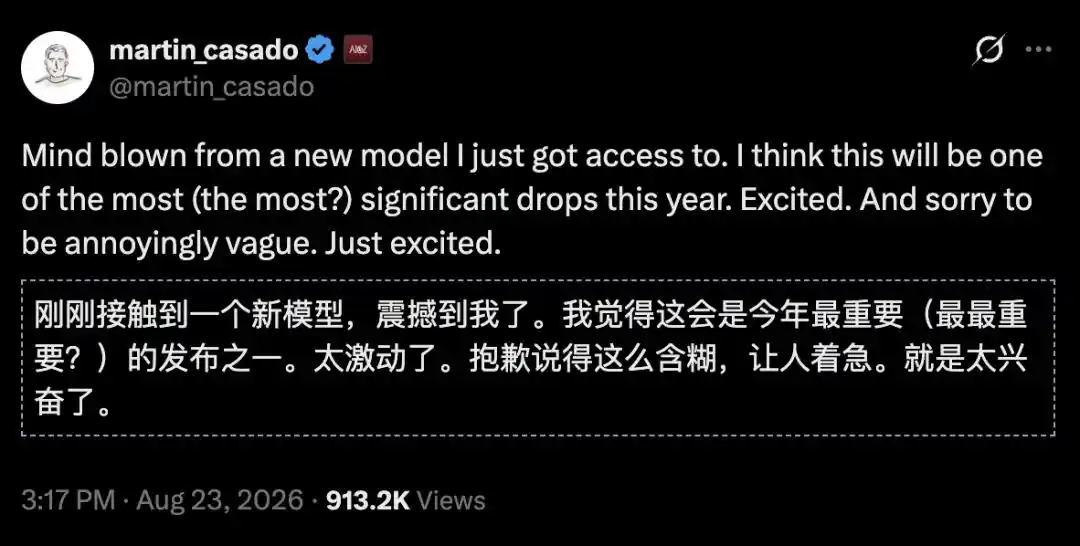
Now the answer seems revealed: it's not Ilya, not even a language model, but a true "universe generator."
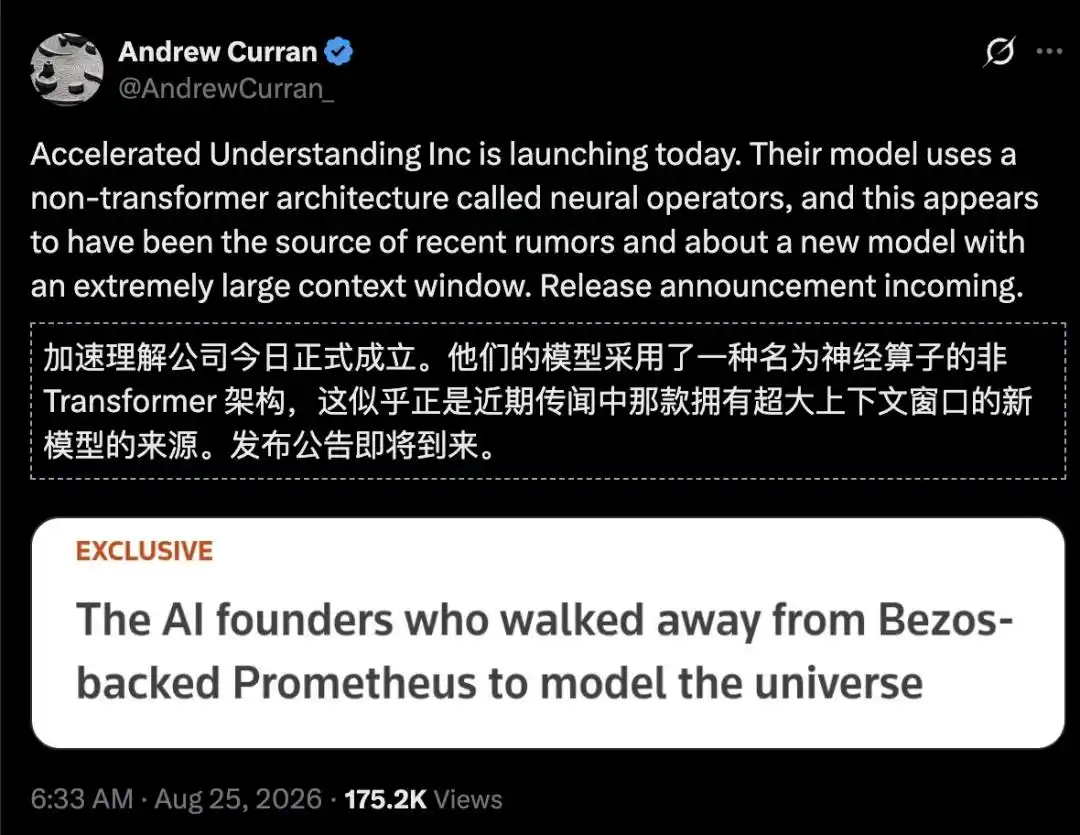
Accelerated Understanding's terrifying set of data is being widely shared:
- Model Parameter Scale: Completed pre-training of a model with up to 1 trillion (1 Trillion) parameters.
- Extreme Scalability: Scaling experiments have surged to 35 trillion (35 Trillion) parameters.
- Training Context: 1 Trillion (1 trillion) tokens.
- Inference Context: Exceeds 5 Trillion (5 trillion) tokens.
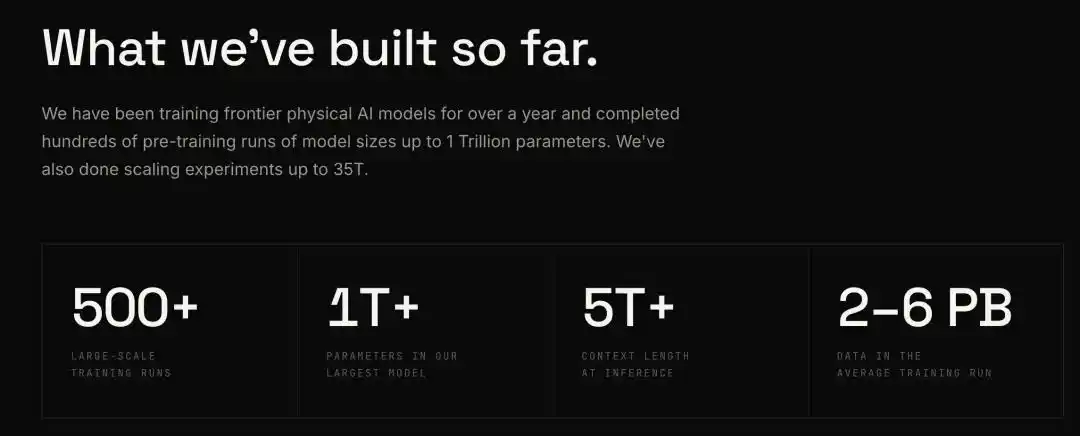
Supported by such vast context, this model demonstrates frightening capabilities:
When performing physical reasoning, it requires no sub-sampling, no chunking.
Faced with extremely complex 4D spatial physical systems, it can generate the complete motion trajectory of the entire spacetime in "one-shot" inference!
Moreover, due to unified underlying logic, the same model can simultaneously handle completely different domains of physical problems!
This was unimaginable before.
In the past, meteorologists used weather models, materials scientists used materials models; now, Accelerated Understanding tells the world: physical laws are fundamentally connected at the bottom, and one universal physical large model is enough to tackle everything.
The most revolutionary core function of Accelerated Understanding lies in constructing a perfect closed loop of "Simulate → Improve → Simulate." It's not just a "generator," but a true "Reality Validator".
And this time, the targeted feedback also touches upon Ilya's test-time training.
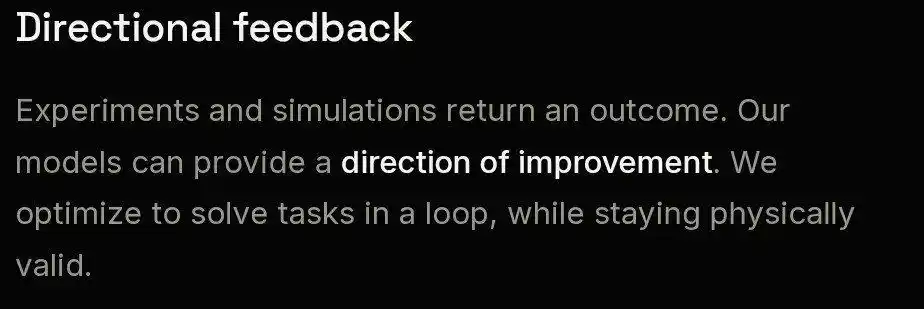
"Is Transformer Dead?" The Awakening of Physical AI
If you ask any AI practitioner today: "What's the hottest AI architecture?" The answer is 100%: Transformer.
From ChatGPT to major video generation models, this architecture invented by Google has dominated the AI world for the past few years (that's the "T" in ChatGPT).
But in Anima's view, the Transformer path has gone astray.
"The language-centric view of intelligence is 'anthropocentric'," Anima pointed out sharply in an exclusive interview before the release, "while placing physics at the center is a 'natural-centric' view."
How do current LLMs and video world models work? Essentially, they are playing "probability games."
ChatGPT is predicting the next most likely word.
Those impressive video generation AIs are essentially taking visual shortcuts—they only make the generated frames "look" physically plausible. But if you dig into the gravity, fluid dynamics, material tension within them, you'll find they're all wrong.
They don't understand physics at all; they are just high-level "pixel parrots."
And text has only 1 dimension, video has only three dimensions, while real spacetime is 3D space + 1D time.
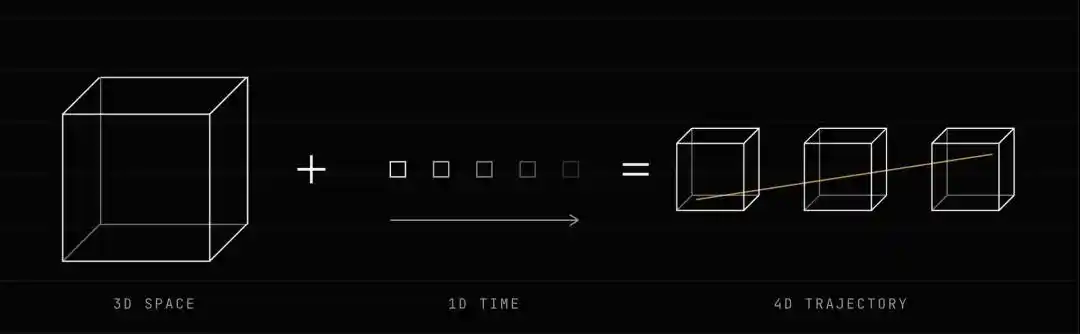
Furthermore, many models use autoregressive methods—predicting frame by frame, with errors accumulating step by step.
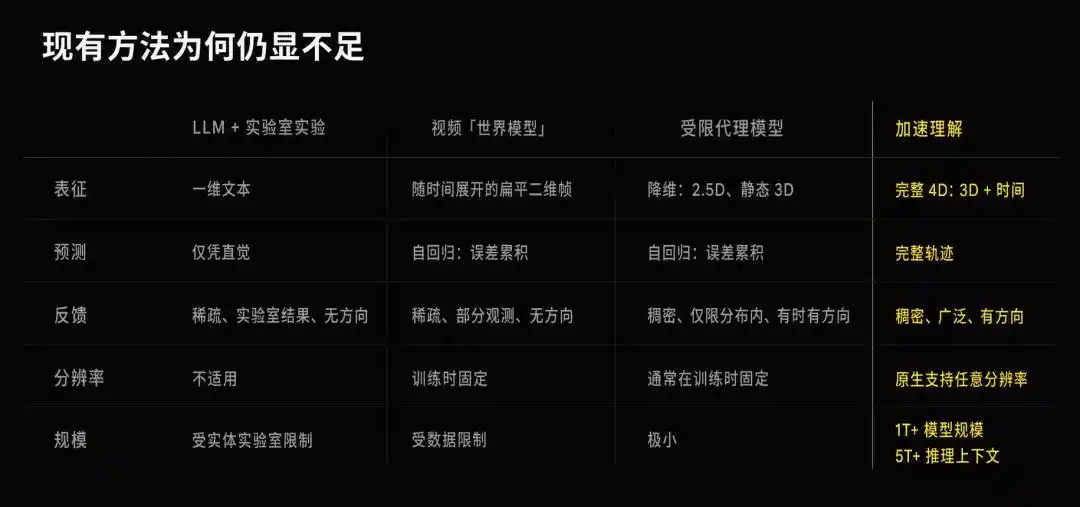
Therefore, Accelerated Understanding completely rejected Transformer, and also rejected visual shortcuts.
The ultimate weapon they unveiled is a revolutionary technology Anima helped pioneer years ago—Neural Operators.
Unlike processing text, neural operators are born specifically to handle complex, invisible physical data. They don't need to forcefully reduce the physical world into words or pixels, but instead understand multi-physics phenomena directly within the full 4D dimensions (3D space + time dimension).
Invisible airflow, plasma turbulence inside nuclear fusion reactors, microscopic thermodynamic distribution within chips... These physical processes invisible to the human eye and unguessable by traditional AI using "visual experience" become clear, visible, and computable under this new architecture.
Shocked Jensen Huang, Rejected Bezos
Seeing this, you might ask, how much computing power is needed to train such a terrifying model? Where does the money come from?
While refusing to disclose current financing details, the co-founder just hinted, "We have reached cooperation with computing providers who have provided hardware clusters to develop and run the AI."
But all clues point to her former employer—Nvidia, and that man shouting "AI is the future"—Jensen Huang.
Rewind to 2018, Anima was hired by Nvidia as Director of AI Research.
Over five years, she led a top team of scientists exploring how to apply Nvidia's GPU computing power to cutting-edge AI fields.
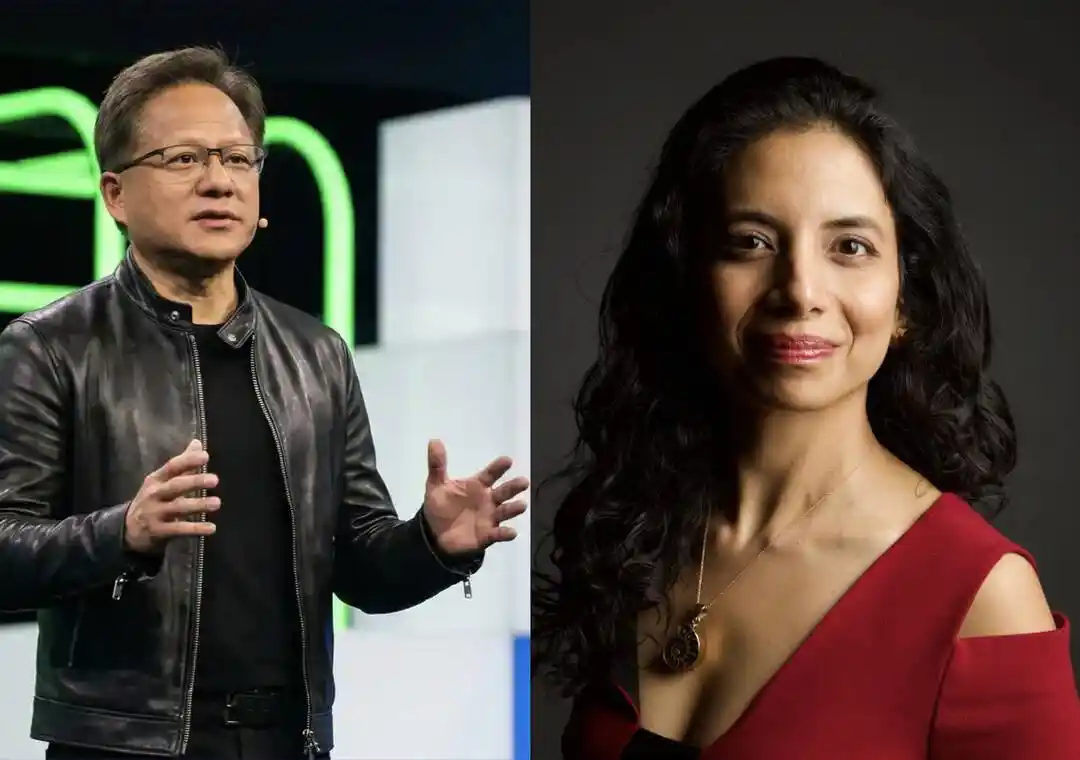
Back then, the team created an early stunning project: using AI to accelerate weather forecasting. Results showed AI predictions were as accurate as those made by meteorologists using extremely complex traditional computational fluid dynamics models, but orders of magnitude faster.
This result directly "shattered" Jensen Huang.
At Nvidia's GTC conference in 2021, Jensen Huang personally took the stage to showcase Anima's team's research on "neural operators" to the world. "He was so excited at the time," Jensen Huang recalled.
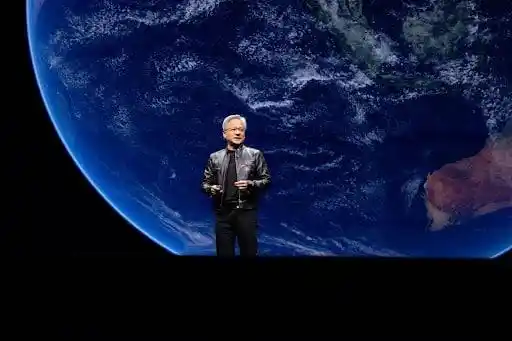
When Anima half-jokingly said to Jensen, "AI might steal the lunch of those theoretical physicists."
At that moment, Jensen Huang's eyes lit up, and he replied domineeringly: "I want it to eat all of their lunches!"
According to Anima, it was Jensen Huang who initially encouraged her to pursue and realize this crazy idea of "Physical AI."
Although Nvidia hasn't responded to Reuters' inquiry about whether it invested in the company, within the AI circle, everyone knows—without covert support from top-tier computing power, it's absolutely impossible to train a behemoth with 5 trillion context.
Jensen's grand chess move has finally been made.
However, to understand how incredible this "physical large model" is, we must go back to late 2024 in Los Angeles.
Inside an upscale restaurant, a secret dinner was taking place that could change the current AI landscape.
One of the main guests was investor and biotech entrepreneur Vik Bajaj (who later co-founded the $100+ billion valuation Project Prometheus with Bezos).
Sitting across from him was a husband-and-wife duo with top-tier AI backgrounds: California Institute of Technology professor of Computing and Mathematical Sciences, former Nvidia AI Research Director Anima Anandkumar, and her husband, top AI infrastructure engineer Benedikt Jenik.

Bajaj came prepared with an offer named "Project Prometheus." This agreement, heavily backed by Bezos, had terms so rich they were jaw-dropping:
Invite Anima to serve as the company's spokesperson, board member, and lead scientific visionary;
The couple would receive up to 35% company equity;
A base annual salary of $1 million, doubled to $2 million three months after joining;
Most exaggeratedly, the agreement explicitly stated that investors, including Bezos, would provide a "committed capital" exceeding $20 billion for financing before Series B.
In today's era where raising funds for large models is becoming increasingly difficult and computing costs are high, this was a super golden ticket to financial freedom and industry power.
However, Anima and Jenik chose to refuse.
Why? Because what they held in their hands had potential far exceeding that of a company for "automating the manufacture of complex physical systems." They didn't want to be under someone else's roof, nor did they want their technological vision hijacked by capital. What they aimed to build was a "god-level model" that could directly understand and simulate the physical universe.
In the end, the Anima couple lay low quietly until today, astonishing the world with their independently built Accelerated Understanding.
Conclusion: The Paradigm Shift from "Generating Information" to "Optimizing the World"
August 25, 2026, is destined to be a day recorded in the history of AI development.
While we cheer for large language models writing good poetry or polishing work emails, Accelerated Understanding, like a wall-breaker traveling back from the future, coldly tells us: Language and images are merely surface representations of how humans understand the world; physical laws are the true underlying code of this universe.
Rejecting Bezos, rejecting Transformer, discarding visual shortcuts, directly targeting the essence of 4D spacetime. Anima Anandkumar and Benedikt Jenik, with the insane data of 1 trillion parameters and 5 trillion context, proclaim to the world the arrival of the "Physical AI" era.
References:
https://x.com/AndrewCurran_/status/2092244031002771643
https://x.com/AnimaAnandkumar/status/2092236528898675014
https://x.com/daniel_mac8/status/2092303081287418277
https://www.reuters.com/business/ai-founders-who-walked-away-bezos-backed-prometheus-model-universe-2026-08-25/
https://acceleratedunderstanding.com/
This article is from the WeChat public account "New Zhiyuan," author: ASI Revelation, editor: David