Former New York Fed Expert: Powell May Announce $45 Billion Bond Purchase Plan

深潮2025-12-08 tarihinde yayınlandı2025-12-08 tarihinde güncellendi

Özet

Former New York Fed expert Mark Cabana predicts that, in addition to the widely anticipated 25 basis point rate cut, Fed Chair Powell will announce a $45 billion per month Treasury bill purchase program at the upcoming December FOMC meeting. This plan, set to begin in January 2026, aims to inject liquidity and prevent a further surge in repo market rates. Cabana warns that markets are underestimating the scale of the Fed's balance sheet actions, as money market rates indicate bank reserves are no longer "abundant." The move is seen as necessary to address liquidity shortages caused by previous quantitative tightening. UBS also forecasts a similar $40 billion monthly purchase program. The policy shift comes amid a critical leadership transition at the Fed, with Powell's term ending and expectations rising for Kevin Hassett to potentially succeed him.

Author: Zhang Yaqi

Source: Wall Street News

As the Federal Reserve's December 10th policy meeting approaches, the market is not only focused on the widely anticipated interest rate cut but also on a potential major balance sheet expansion plan, according to senior Wall Street strategists.

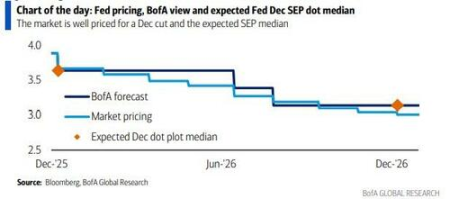
Recently, Mark Cabana, a former New York Fed repo expert and now a rates strategist at Bank of America, predicted that, in addition to the widely expected 25 basis point rate cut, Fed Chair Jerome Powell will announce a plan next Wednesday to purchase $45 billion per month in Treasury bills (T-bills). This bond-buying operation is set to be implemented in January 2026, aiming to inject liquidity into the system and prevent a further surge in repo market rates.

Cabana warned in a report that while the interest rate market has reacted tepidly to the rate cut, investors are generally "underestimating" the scale of the Fed's actions regarding its balance sheet. He pointed out that current money market rates indicate that reserves in the banking system are no longer "abundant," and the Fed must restart purchases of securities to fill the liquidity gap. Meanwhile, UBS's trading desk has made a similar prediction, expecting the Fed to begin purchasing about $40 billion in Treasury bills per month starting in early 2026 to maintain stability in the short-term interest rate market.
This potential policy adjustment comes at a critical time of impending leadership transition at the Fed. With Powell's term nearing its end and market expectations rising that Kevin Hassett might succeed him as Fed Chair, next week's meeting is not only about short-term liquidity but will also set the tone for the monetary policy path in the coming year.

Former New York Fed Expert Predicts: $45 Billion Monthly Purchases

Although market consensus is locked in on a 25 basis point rate cut next week, Mark Cabana believes the real variable lies in balance sheet policy. In his weekly report titled "Hasset-Backed Securities," he noted that the size of the RMP (Reserve Management Purchases) the Fed is likely to announce could be as high as $45 billion per month, a prediction that significantly exceeds current general market expectations.

Cabana detailed the composition of this figure: the Fed needs to purchase at least $20 billion monthly to cope with the natural growth of its liabilities, plus an additional $25 billion to reverse the reserve drain caused by previous "excessive quantitative tightening." He expects purchases of this magnitude to continue for at least 6 months. This announcement is expected to be included in the Fed's implementation note, with detailed operation sizes and frequency published on the New York Fed's website, focusing purchases on the Treasury bill market.

As previously reported by Wall Street News, since the balance sheet peaked at nearly $9 trillion in 2022, the Fed's quantitative tightening (QT) policy has reduced its size by approximately $2.4 trillion, effectively draining liquidity from the financial system. However, even with QT halted, signs of funding stress remain evident.

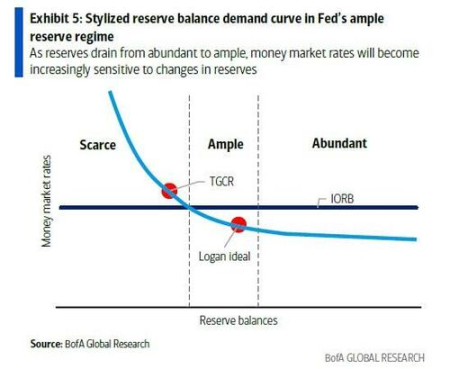
The clearest signals come from the repo market. As the short-term financing hub of the financial system, overnight reference rates in the repo market, such as the Secured Overnight Financing Rate (SOFR) and the Tri-Party General Collateral Rate (TGCR), have frequently and sharply breached the upper limit of the Fed's policy rate corridor in recent months. This indicates that reserve levels in the banking system are sliding from once "abundant" to "ample," with a risk of further moving towards "scarce." Given the systemic importance of the repo market, this situation is considered intolerable for the Fed in the long term, as it could weaken the transmission efficiency of monetary policy.

Against this backdrop, recent comments from Fed officials have also hinted at the urgency for action. New York Fed President John Williams stated that "we expect to reach ample reserve levels before long," while Dallas Fed President Lorie Logan noted that "I expect it will be appropriate to resume balance sheet growth before long." Cabana interprets "before long" as referring to the December FOMC meeting.

Auxiliary Tool Aimed at Smoothing Year-End Volatility

In addition to the long-term purchase plan, to address the impending year-end funding volatility, Bank of America also expects the Fed to announce term repo operations lasting 1-2 weeks. Cabana believes the pricing for these operations could be set at par with or 5 basis points above the Standing Repo Facility (SRF) rate, aiming to trim tail risks in the year-end funding market.

Regarding administered rates, although clients have inquired about the possibility of lowering the Interest on Reserve Balances (IORB), Cabana believes that simply cutting IORB "solves nothing," as banks generally prefer to hold higher cash buffers following the Silicon Valley Bank (SVB) collapse. He thinks it's more likely that the IORB and SRF rates could be cut synchronously by 5 basis points, but this is not the base case scenario.

Another important context for this meeting is the upcoming personnel changes at the Fed. The market currently views Kevin Hassett as a strong contender for the next Fed Chair. Cabana pointed out that once the new chair is confirmed, the market will price the medium-term policy path more based on guidance from the new appointee.
UBS also agrees with the view that balance sheet expansion is returning. UBS's sales and trading desk noted that by purchasing Treasury bills, the Fed can shorten the duration of its assets, thereby better matching the average duration of the Treasury market. Whether this operation is called RMP or quantitative easing (QE), its ultimate goal is clear: through direct liquidity injection, to ensure the financial market can maintain smooth operation during this critical period of political and economic transition.

Trend Kriptolar

İlgili Sorular

QWhat major policy action does former New York Fed expert Mark Cabana predict the Fed will announce, in addition to the widely expected rate cut?

AMark Cabana predicts that Fed Chair Powell will announce a plan to purchase $45 billion per month in Treasury bills (T-bills), set to be implemented in January 2026.

QWhat is the primary goal of the Fed's potential new Treasury bill purchase program according to the article?

AThe primary goal is to inject liquidity into the system to prevent a further surge in repo market rates and to address signs that bank reserves are no longer 'abundant'.

QWhat key signal from the repo market indicates that the banking system's reserve levels are becoming less ample?

AKey short-term funding rates like the Secured Overnight Financing Rate (SOFR) and the Tri-Party General Collateral Rate (TGCR) have frequently and sharply breached the upper limit of the Fed's policy rate corridor.

QWhat additional short-term tool does Bank of America expect the Fed to announce to handle year-end funding volatility?

ABank of America expects the Fed to announce term repo operations lasting 1-2 weeks, priced at or 5 basis points above the Standing Repo Facility (SRF) rate, to mitigate tail risks in the year-end funding market.

QHow does the article connect the Fed's potential policy actions to the upcoming leadership change?

AThe article states that the upcoming FOMC meeting is happening as Chair Powell's term nears its end, with expectations that Kevin Hassett may succeed him. The meeting's decisions will set the tone for monetary policy in the coming year, and the new Treasury purchases aim to ensure market stability during this period of political and economic transition.

İlgili Okumalar

Why Does 'AGI Godfather' Ben Goertzel Believe the Future of AI Relies on Blockchain?

Ben Goertzel, known as the "AGI Godfather," argues that the future of Artificial General Intelligence (AGI) must be built on blockchain to prevent its control by a few corporations or venture capital firms. He believes the core AGI code should be free and open-source, but that this alone is insufficient without a decentralized infrastructure to run it affordably. His blockchain project, SingularityNET, and the broader Artificial Superintelligence Alliance aim to create a user-owned, decentralized network for hosting and deploying AGI, contrasting with the closed models of companies like OpenAI and Anthropic. Goertzel criticizes the shift of other labs from open to closed development. He argues that while a closed path is simpler, an open, decentralized model—akin to Linux and the internet—is both possible and ultimately better for humanity. He envisions an "Agent economy" where individuals orchestrate teams of AI agents to perform tasks, including transactions, on an open network rather than corporate clouds. While his current model relies on cryptocurrency, plans include offering paid AI services to businesses with the decentralized blockchain as the backend. Goertzel predicts human-level AGI could arrive by 2029 and warns that a gap in understanding and access to AGI could drastically worsen inequality. The first test of his decentralized approach will be the upcoming release of the Agent Omega Claw.

Foresight News18 dk önce

Why Does 'AGI Godfather' Ben Goertzel Believe the Future of AI Relies on Blockchain?

Foresight News18 dk önce

A Company Once on the Brink of Bankruptcy Just Surpassed Bitcoin in Market Cap

On June 22nd, driven by rising stock prices, SK Hynix’s market capitalization reached $1.35 trillion, surpassing Bitcoin's total market cap of approximately $1.29 trillion. This temporarily made it South Korea's highest-valued company. The core driver of this surge is HBM (High Bandwidth Memory), for which SK Hynix is the primary supplier to NVIDIA, holding over 60% market share. AI's demand for high memory bandwidth has translated into immense profitability, with SK Hynix reporting a 72% operating profit margin in Q1. The company's success follows a 13-year bet on HBM technology, beginning in 2009. It nearly failed after the 2001 dot-com bubble, was acquired by SK Group in 2012, and was subsequently recapitalized to continue its long-term HBM development. The article contrasts this with the Crypto AI narrative. Capital currently favors AI infrastructure players like SK Hynix due to "real orders, physical barriers, and quantifiable profit margins." In comparison, Crypto AI projects, promising decentralized compute and data markets, remain largely conceptual with limited tangible progress. Examples include Bittensor, whose core mechanisms are still under development, and Bitcoin miners transitioning to AI, who face significant funding gaps and execution challenges. The piece cites analysis suggesting the AI sector has absorbed nearly all new market liquidity since 2022, leaving little for crypto. It concludes that the current AI infrastructure红利 is captured by entities with proven technical barriers and supply capabilities, while crypto networks still need to define their concrete role in the value chain.

链捕手58 dk önce

A Company Once on the Brink of Bankruptcy Just Surpassed Bitcoin in Market Cap

链捕手58 dk önce

Bittensor Moves Towards Ultimate Decentralization: The Critical 18 Months for the TAO Ecosystem is Here?

Bittensor, a decentralized AI protocol, is accelerating its transition to full decentralization over the next 18 months, as outlined in a recent post by co-founder Const. The project currently operates in a "semi-decentralized" state: ownership and network participation are open and permissionless, with TAO distribution based on competitive contribution. However, protocol upgrades and governance have remained under core team control to enable rapid iteration in the fast-evolving AI sector. This strategic shift comes as the ecosystem matures, boasting 128 subnets and a large community. Const argues that continued centralization now poses risks, including single points of failure and regulatory scrutiny. The upcoming decentralization roadmap includes optimizing validator competition, opening liquidity pools, introducing governance rights for Alpha holders, and refining economic models. The move could fundamentally reshape TAO's value proposition, adding governance premiums to its existing valuation based on AI narrative and scarcity. It also signals a potential maturation of the AI crypto sector, where competition may shift from hype to sustainable protocol design and real economic activity. Bittensor positions itself not just as another AI token, but as foundational infrastructure aiming to decentralize intelligence production—analogous to Bitcoin's role in decentralizing money—with the goal of creating a resilient "Millennium Intelligence Federation."

marsbit1 saat önce

Bittensor Moves Towards Ultimate Decentralization: The Critical 18 Months for the TAO Ecosystem is Here?

marsbit1 saat önce

İşlemler

Spot
Futures

Popüler Makaleler

MAY Nasıl Satın Alınır

HTX.com’a hoş geldiniz! Mayflower (MAY) satın alma işlemlerini basit ve kullanışlı bir hâle getirdik. Adım adım açıkladığımız rehberimizi takip ederek kripto yolculuğunuza başlayın. 1. Adım: HTX Hesabınızı OluşturunHTX'te ücretsiz bir hesap açmak için e-posta adresinizi veya telefon numaranızı kullanın. Sorunsuzca kaydolun ve tüm özelliklerin kilidini açın. Hesabımı Aç2. Adım: Kripto Satın Al Bölümüne Gidin ve Ödeme Yönteminizi SeçinKredi/Banka Kartı: Visa veya Mastercard'ınızı kullanarak anında Mayflower (MAY) satın alın.Bakiye: Sorunsuz bir şekilde işlem yapmak için HTX hesap bakiyenizdeki fonları kullanın.Üçüncü Taraflar: Kullanımı kolaylaştırmak için Google Pay ve Apple Pay gibi popüler ödeme yöntemlerini ekledik.P2P: HTX'teki diğer kullanıcılarla doğrudan işlem yapın.Borsa Dışı (OTC): Yatırımcılar için kişiye özel hizmetler ve rekabetçi döviz kurları sunuyoruz.3. Adım: Mayflower (MAY) Varlıklarınızı SaklayınMayflower (MAY) satın aldıktan sonra HTX hesabınızda saklayın. Alternatif olarak, blok zinciri transferi yoluyla başka bir yere gönderebilir veya diğer kripto para birimlerini takas etmek için kullanabilirsiniz.4. Adım: Mayflower (MAY) Varlıklarınızla İşlem YapınHTX'in spot piyasasında Mayflower (MAY) ile kolayca işlemler yapın.Hesabınıza erişin, işlem çiftinizi seçin, işlemlerinizi gerçekleştirin ve gerçek zamanlı olarak izleyin. Hem yeni başlayanlar hem de deneyimli yatırımcılar için kullanıcı dostu bir deneyim sunuyoruz.

370 Toplam GörüntülenmeYayınlanma 2025.07.01Güncellenme 2026.06.02

MAY Nasıl Satın Alınır

Tartışmalar

HTX Topluluğuna hoş geldiniz. Burada, en son platform gelişmeleri hakkında bilgi sahibi olabilir ve profesyonel piyasa görüşlerine erişebilirsiniz. Kullanıcıların MAY (MAY) fiyatı hakkındaki görüşleri aşağıda sunulmaktadır.

活动图片