Former Bankless Member Lucas: Why I Still Bullish on Ethereum

foresightnews_api2026-06-05 tarihinde yayınlandı2026-06-05 tarihinde güncellendi

Özet

Former Bankless member Lucas explains why he remains bullish on Ethereum despite widespread pessimism. He acknowledges ETH's poor price performance over the past five years compared to Bitcoin and traditional markets, but draws parallels to historical multi-year consolidations seen in tech giants like Amazon and NVIDIA before major breakouts. Fundamentally, Ethereum is stronger than ever: record-high daily transactions (2.27 million in May 2026), significantly lower average gas fees ($0.27), over 400 million total addresses, and more than 32% of ETH staked, securing the network. Lucas's core thesis remains unchanged: all valuable assets will eventually be tokenized, Ethereum will become the primary settlement layer for these assets, and ETH will capture the resulting value. This transition is already underway. Stablecoins, the first proven tokenized real-world asset (RWA), have a $300+ billion market cap, with 54% settled on Ethereum. The broader RWA sector has surpassed $30 billion, with over 53% deployed on Ethereum. He compares the current RWA adoption phase to early DeFi in 2019-20, suggesting immense growth potential. Key catalysts like the potential passage of the U.S. CLARITY Act in 2026 could accelerate institutional adoption. While other blockchains will share the market, Lucas argues that traditional finance prioritizes Ethereum's security, stability, and established ecosystem for trillion-dollar asset tokenization. He concludes that as global assets migrate on-c...


Author:Lucas, former Bankless member

Compiled by:Saoirse, Foresight News


Core Summary:


  • All assets will be tokenized in the future;
  • Ethereum becomes the settlement layer for various tokenized assets;
  • ETH is used for network security staking, capturing all value generated by settlement business;
  • The global financial system is transitioning towards asset tokenization;
  • Relying on security, stability, and long-accumulated ecosystem barriers, Ethereum will capture a significant market share in the tokenization track.


The ‘Ethereum is Dead’ Narrative is Rampant


Currently on crypto social platforms, market pessimism towards Ethereum has hit a historical low. Many colleagues I've worked with for years have gradually faded from the Ethereum scene, some have even left the crypto industry entirely, and the vast majority no longer hold significant ETH positions. The core reason is they no longer recognize its investment value. This is not targeting any individual or circle, but a common phenomenon I've personally witnessed within the industry.


The large-scale capital outflow is partly because cryptocurrency is no longer cutting-edge hot technology, with AI, robotics, and longevity research taking over as capital darlings; but the poor returns from ETH's weak price action are the key driver for market bearishness. To put it bluntly, holding ETH over the past few years has been a terrible experience.


However, I remain steadfastly bullish on Ethereum and ETH, with even more confidence than at any previous stage, and I recommend readers to be bullish together. In fact, Ethereum is entering the most promising adoption and growth cycle in its own history.


Talking About the Poor Price Performance


First, let's address the most obvious issue: the price performance of ETH has been quite poor over the past nearly five years. Investors who entered and held positions in 2021 are, at best, breaking even, with most being deeply underwater. Even with the recent market correction, Bitcoin's current price still stands firm above the 2021 bull market high, with its 2025 peak directly doubling that high; in contrast, ETH's current price has plummeted about 60% from its previous all-time high, failed to set a new all-time high in 2025, and couldn't even break through the $5,000 mark.


During the same period, the S&P 500 index almost hit new all-time highs daily, with hot Wall Street sectors like AI, semiconductors, and energy seeing stocks surge across the board, making ETH's performance even more embarrassing in comparison.


The good news, however, is that when looking at a longer cycle, ETH's chart is merely stuck in a multi-year range-bound consolidation. Ethereum's current market cap exceeds $200 billion, with its price holding the $2,000 level for years, firmly placing it among the top 100 global assets by market cap. Looking at the development patterns of capital markets, it's quite normal for high-quality growth assets to experience years of sideways consolidation and bottom grinding before launching a long bull run.
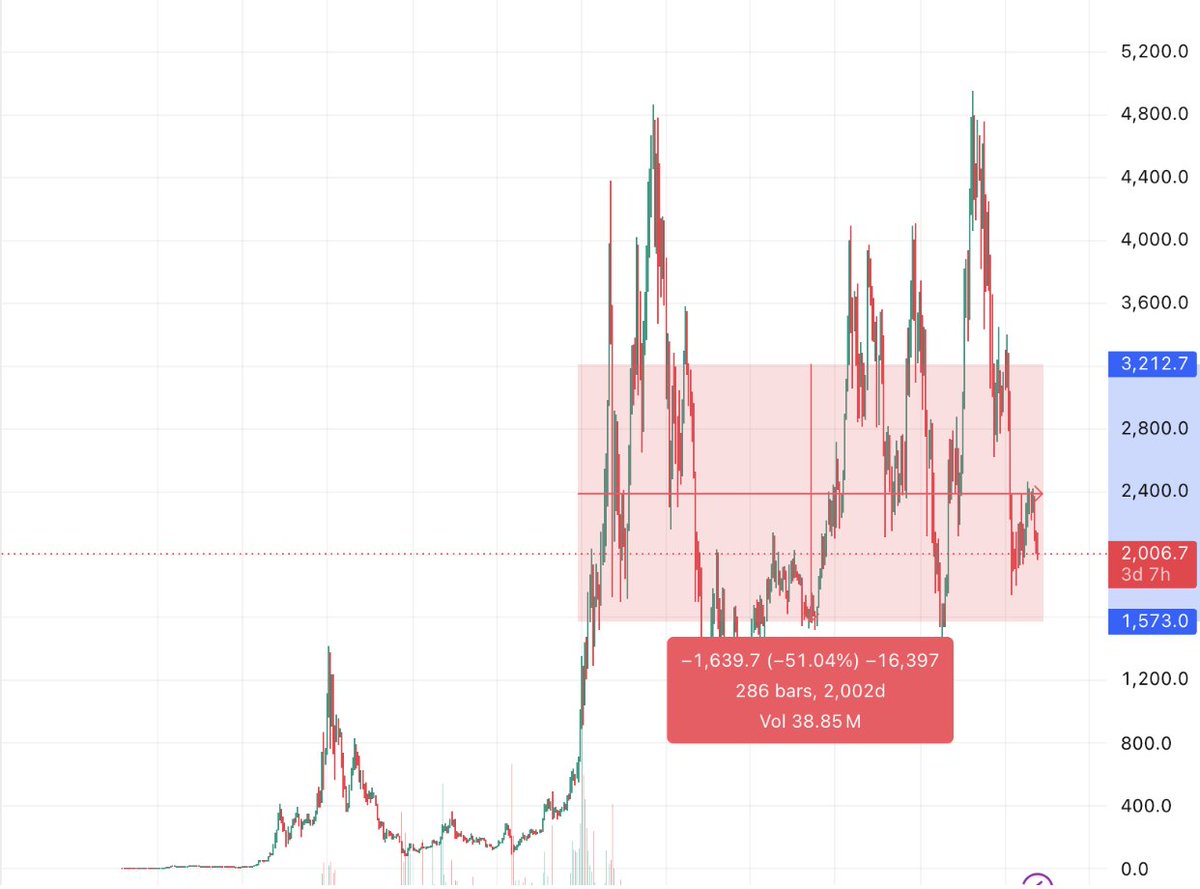

Ignore the percentage change values; focus mainly on measuring the length of time the price stayed within that range.


Global giants like Amazon, NVIDIA, Apple, and Microsoft have all walked the same path:


  • Amazon: Led by Bezos, the company consolidated sideways for nearly a decade in the 2000s after the dot-com bubble burst, weathered the industry winter, and grew into a global top-tier enterprise;
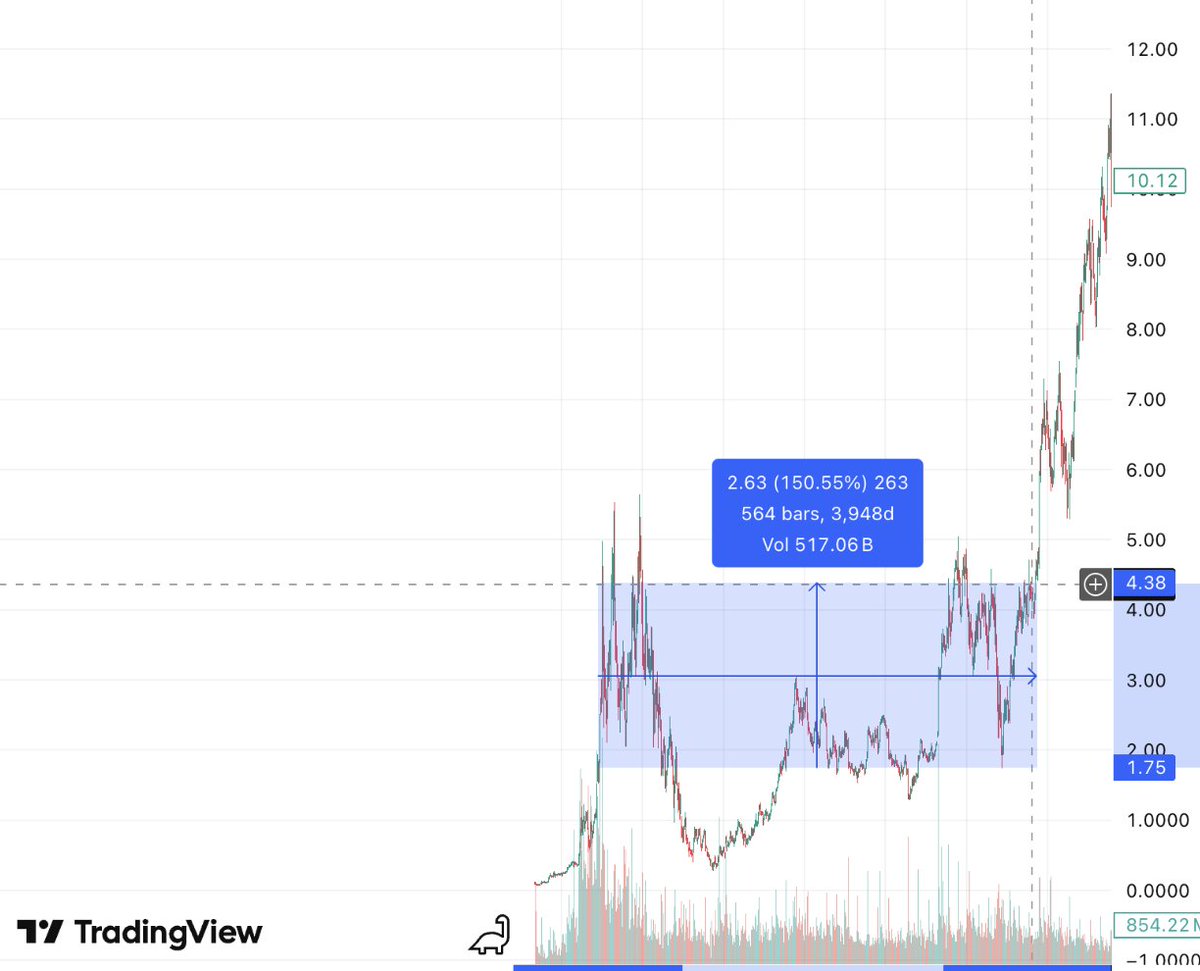


  • NVIDIA: Experienced seven long years of consolidation in the 2010s, then saw an epic stock price surge riding the AI wave, joining the global top tier by market cap;
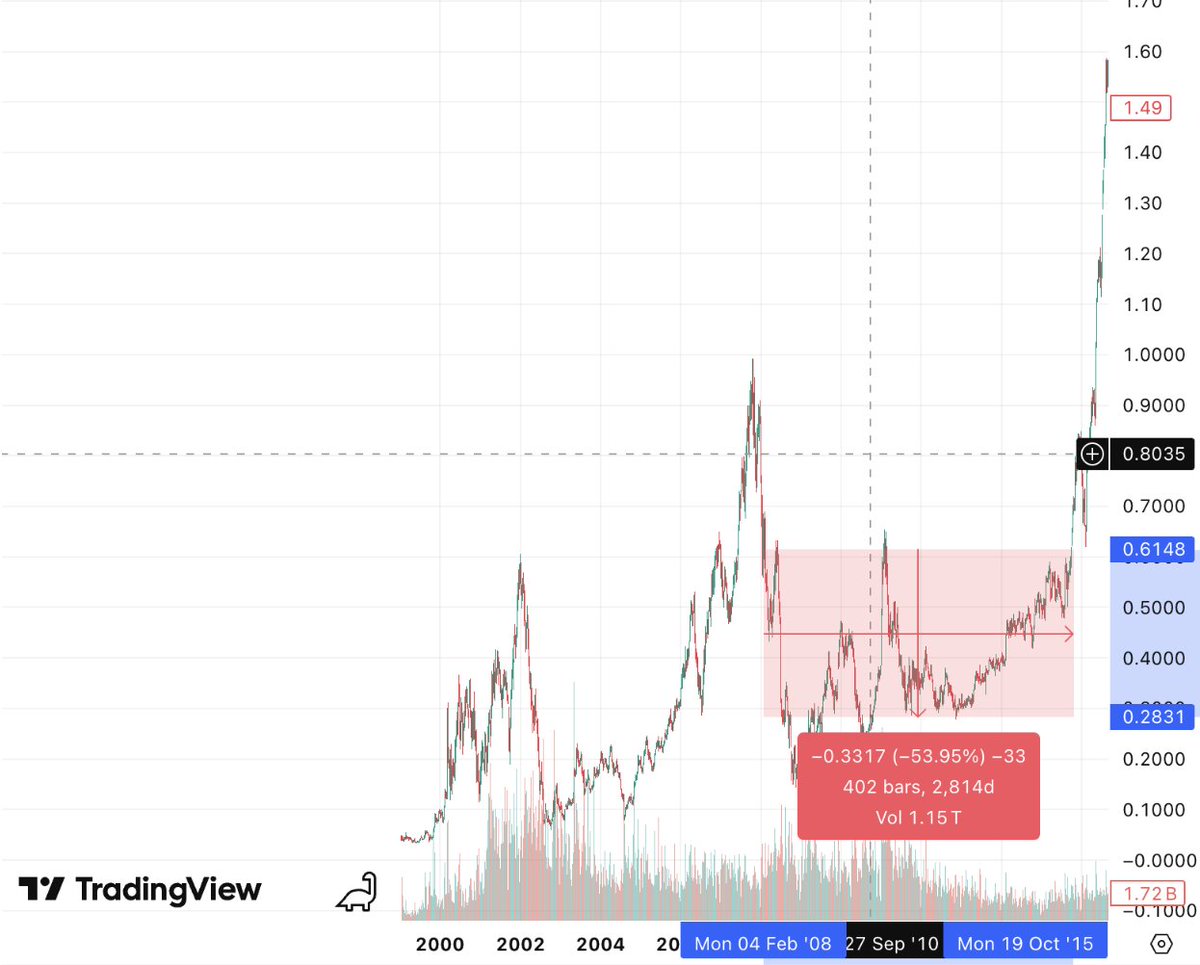


  • Apple: Was in long-term迷茫 (confusion/consolidation) throughout the 80s and 90s, only taking off after Jobs returned to the company in 1997;
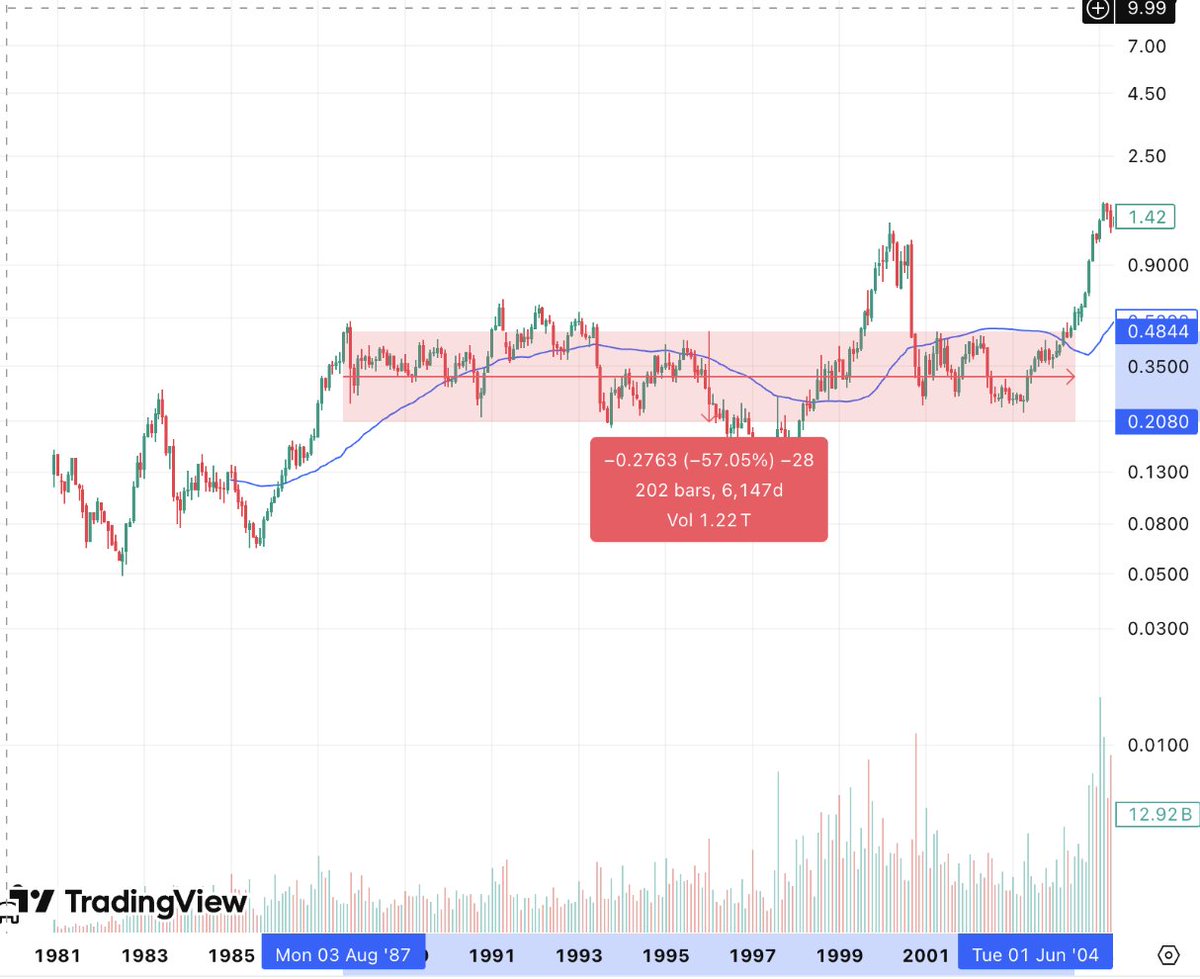


  • Microsoft: Its stock price consolidated sideways for about 15 years after 2000; investors who entered in 2000 didn't break even until 2015, and now it's the world's second-largest company by market cap.
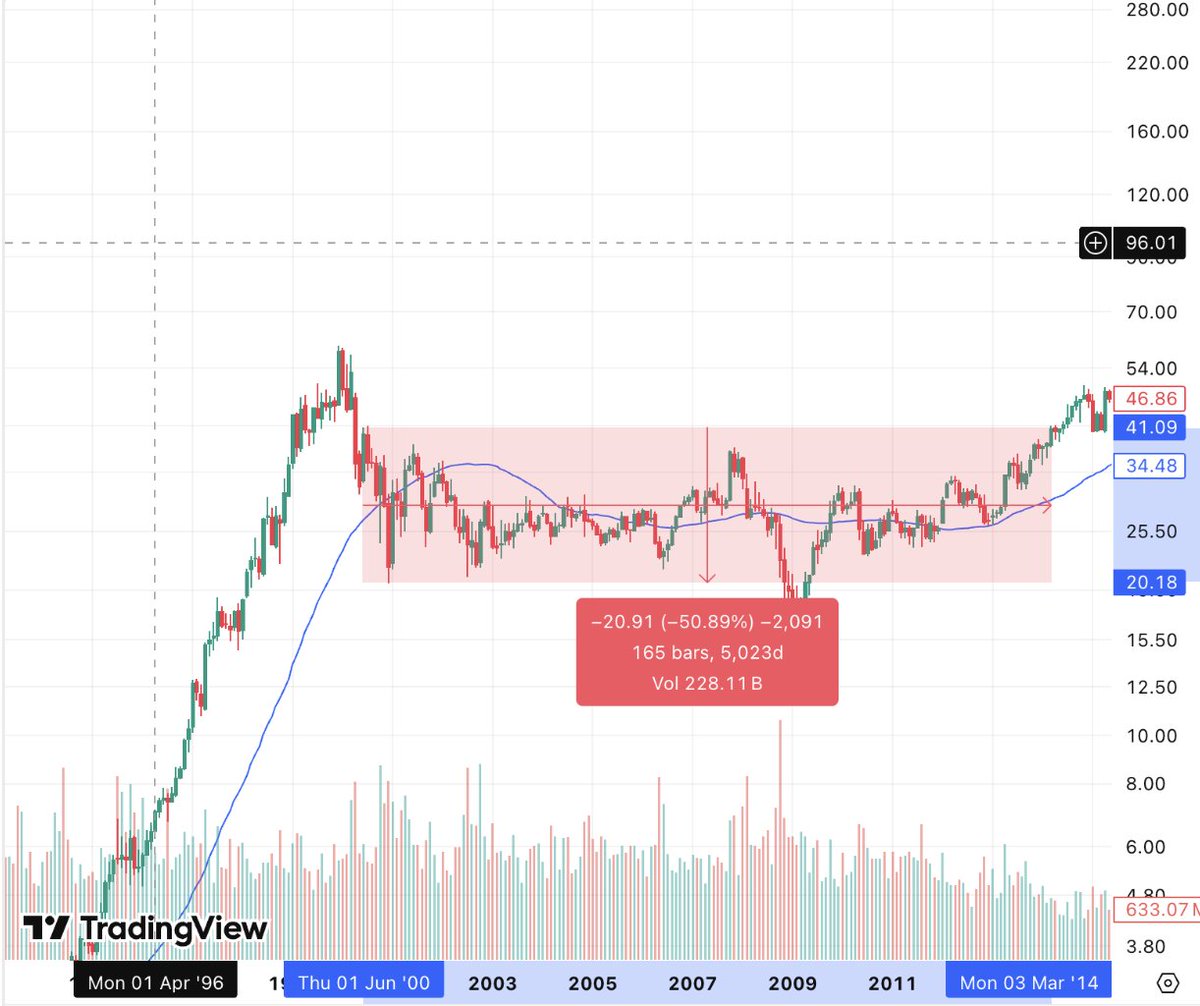


It's not hard to summarize the pattern: most of the world's top-tier assets undergo long, boring consolidation periods. Some assets briefly spike to new highs before pulling back again, then wait for industry catalysts to start a new bull cycle. Moreover, during the consolidation/bottom-grinding phases of these companies, the broader US stock market was often still making new highs. Within this logic, ETH's weak performance over the past five years is not abnormal in financial history.


Setting aside the chart price, Ethereum's current fundamentals are actually at their historical best.


On-Chain Ecosystem Data Continues to Improve


According to the market's bearish narrative, weak price action must be accompanied by a decline in on-chain activity: decreasing transaction volume, high fees, and stalled practical applications. However, the actual data is completely opposite. Ethereum's on-chain transaction volume is steadily climbing, fees are hitting new lows, and the pace of asset tokenization is continuously accelerating.
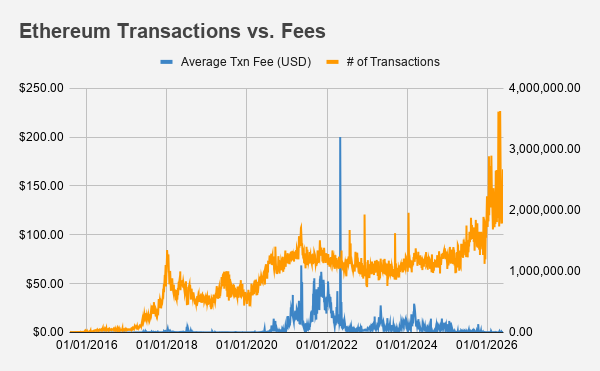

Data source: Etherscan


Based on Etherscan data: In May 2026, Ethereum's average daily transaction count reached 2.27 million, setting a new historical peak for the network. During the same period, the average transaction fee per transaction was only $0.27. Compared to the high gas fees of $50~$100 during the 2021 bull market, costs have significantly decreased despite transaction volume doubling.


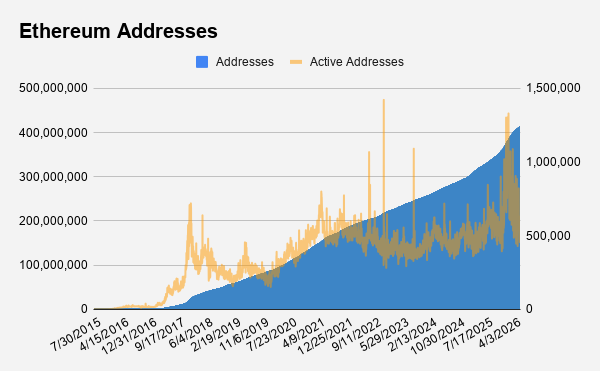
The total number of on-chain addresses has exceeded 400 million, with a daily growth rate of about 0.08% in 2026. Daily active users on-chain have stabilized above 1 million in recent months. At the current growth rate, without major industry catalysts, Ethereum's total address count may break 1 billion around mid-2029.


Staking is also continuously setting new records: over 32% of ETH supply is staked and locked, continuously underpinning network security.
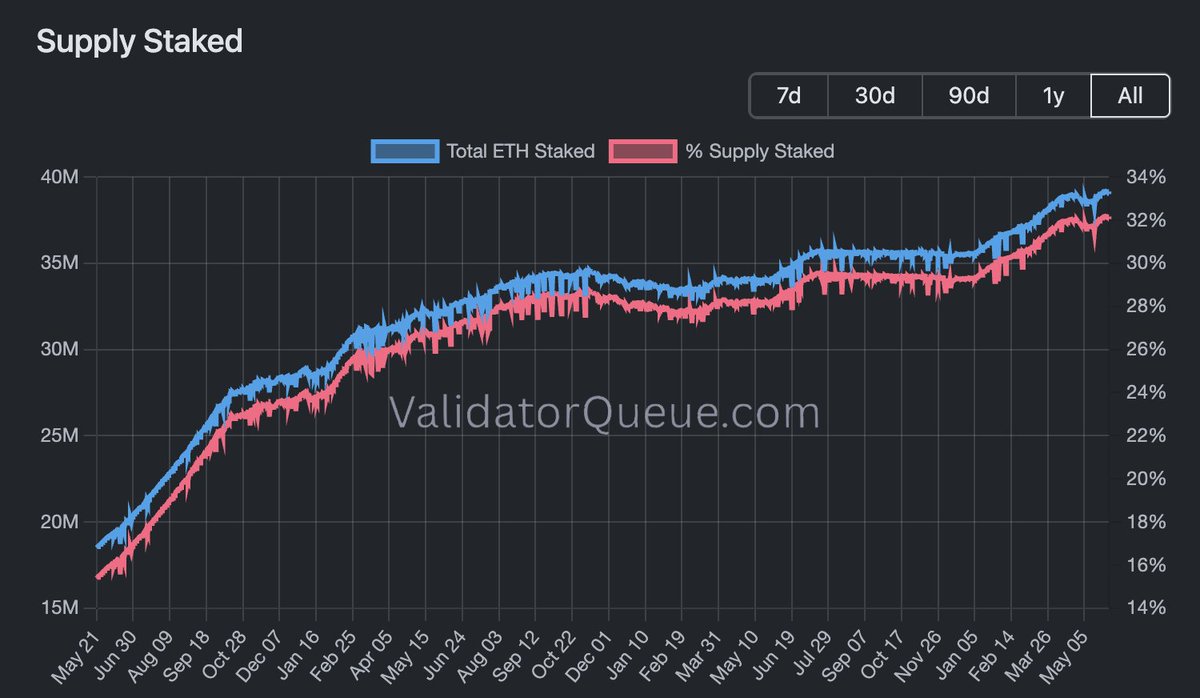

Data source: validatorqueue.com


In summary, Ethereum has completed its scaling iteration while maintaining the bottom line of decentralization and security. It has never experienced a full network outage in over a decade of operation. Relying on its extremely neutral, secure, and programmable block space, it has secured the core chips to compete as the underlying infrastructure for global finance, which is also a prerequisite for subsequently hosting the massive tokenization of traditional assets.


Becoming the Underlying Infrastructure of the Global Financial System


Since entering the industry in 2017, my long-term logic for Ethereum has never changed:


  • Eventually, all valuable assets in the world will be tokenized;
  • Ethereum becomes the unified settlement layer for all types of tokenized assets;
  • ETH captures the entire value increment brought by the settlement layer's business.


In its first decade, Ethereum primarily served as a testing ground for crypto-native assets, with sectors like DeFi, NFTs, and meme coins born and developed on it, solidifying its foundational ecosystem. In the upcoming development phase, Ethereum will embark on a new journey towards a trillion-dollar market cap.


For veteran crypto-native players, traditional finance going on-chain might seem somewhat dull, but it is an indispensable step for blockchain to go mainstream, worthy of the entire industry's promotion. In the future, the vast majority of the world's $700 trillion worth of traditional physical assets will ultimately be tokenized on-chain, and Ethereum will become the preferred hosting network.


Many counter: Ethereum's scaling capacity is insufficient to handle massive assets; other public chains will carve up the market. But current implementation data already disproves this view: traditional financial institutions are onboarding the Ethereum ecosystem in large batches.
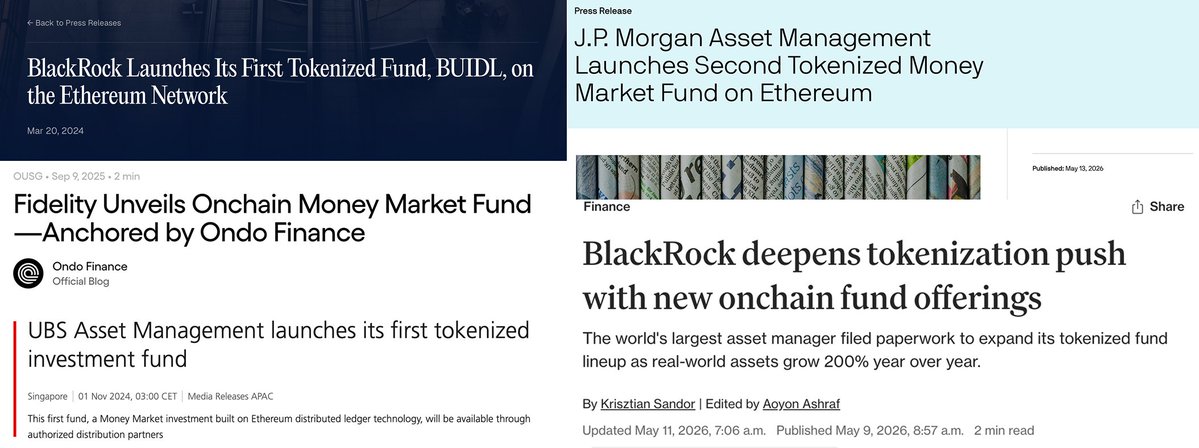

A series of news headlines from the past ~2 years, notice they have one thing in common.


The core demand of institutions entering is certainty: for banks, asset managers, and clearinghouses, choosing a blockchain to custody trillions in assets is a major strategic decision. They need to capture the tokenization红利 (dividend/benefit) while avoiding career risks from decision-making mistakes.


Of course, public chains like Hyperliquid and Solana can also get a piece of the pie. The tokenization track is large enough to accommodate multiple public chains developing together; it cannot be monopolized by one. However, traditional institutions pursuing stability will prioritize Ethereum when implementing RWA.


Implementation data supports the view: Stablecoins are the first tokenized real-world asset to achieve product-market fit, with a total circulating market cap exceeding $300 billion. Tom Lee called stablecoins the "ChatGPT moment" for the crypto industry, with Ethereum holding a 54% market share of the total stablecoin market cap.
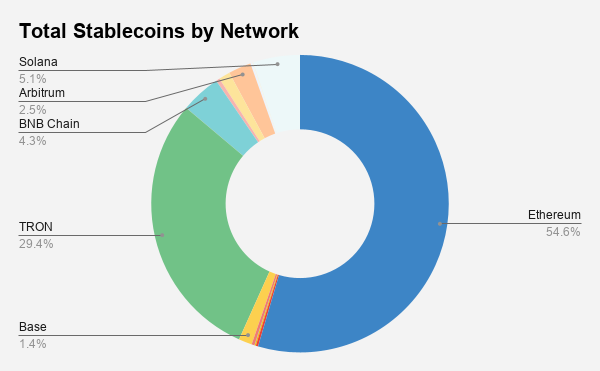

Data source: rwa.xyz


As of June 1, 2026, the total scale of all-category Real-World Asset (RWA) tokenization has exceeded $30 billion, with the growth curve steeply rising; over 53% of these RWA assets are deployed on the Ethereum chain. Even if other public chains start from scratch to compete for non-stablecoin RWA份额 (market share), Ethereum still firmly holds the dominant position.
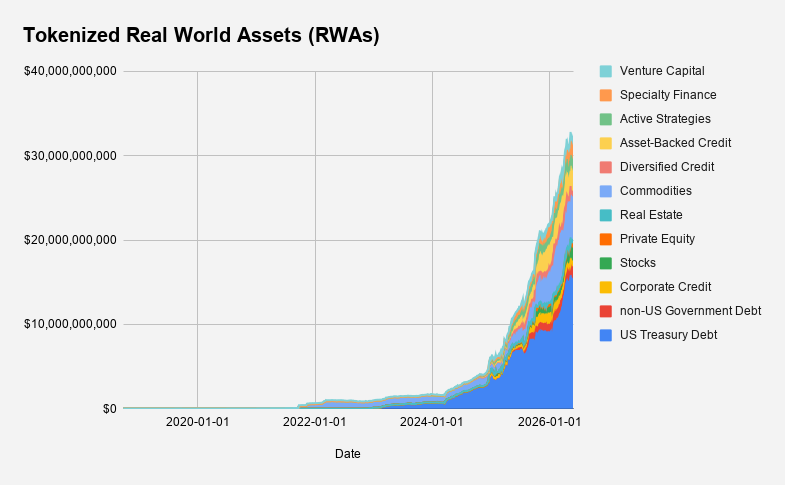
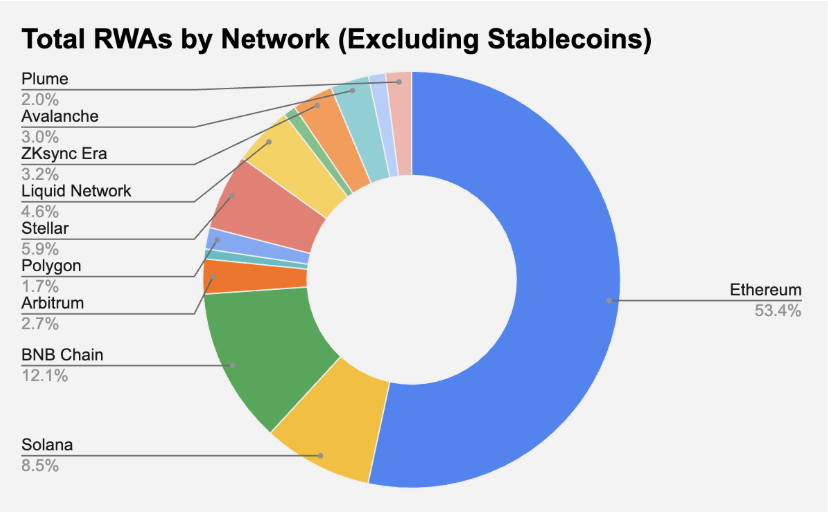

Data source: rwa.xyz


The current development stage of the RWA track is comparable to DeFi in its萌芽期 (germination/early stage) of 2019~2020: the logic of the new track is clear, and early data is steadily rising. Looking back at DefiLlama's past data, DeFi's total value locked (TVL) saw exponential growth in the first half of 2020, while ETH's chart was also in long-term sideways consolidation at that time.
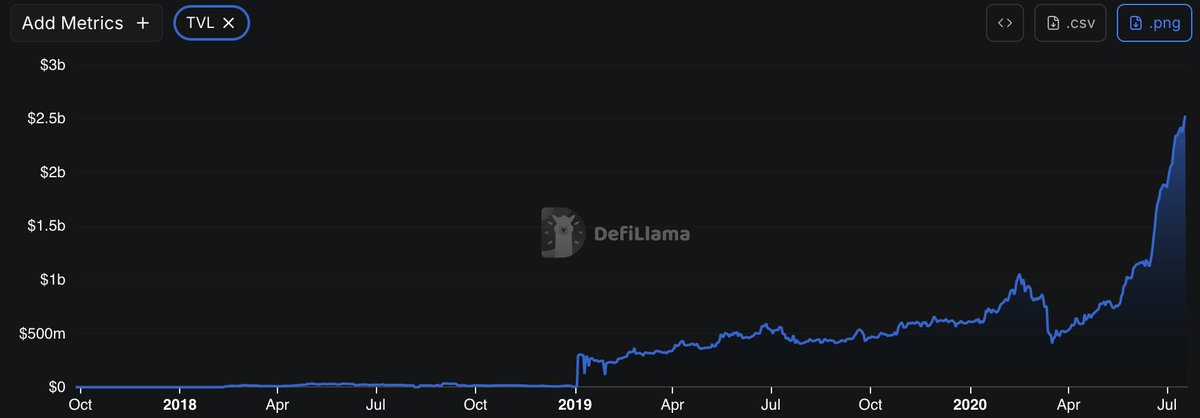


When the DeFi bull market fully erupted and liquidity mining swept the network, ETH, dragged down by the Covid行情 (market situation), had a market cap of only $20~25 billion, ten times smaller than its current $230 billion market cap. Meanwhile, the newly born BNB Chain once threatened Ethereum's position with its advantage of low fees. It wasn't until the DeFi asset scale reached about 20% of Ethereum's total market cap that ETH launched from $300 to $4000 by year-end, experiencing a super bull run.


Comparing to the present: Excluding stablecoins, the total scale of non-stablecoin RWA on Ethereum is about $16 billion, accounting for only 7% of ETH's total market cap, positioning it similarly to DeFi's early germination stage, but with an overall scale ten times larger than back then: early DeFi started at $3 billion, now RWA starts at $30 billion; early ETH bottom at $200, now ETH bottom at $2,000; early competitor was BNB Chain, now the competitor is Hyperliquid.


Additional note: Early DeFi催生 (spawned/generated)大量 (a large amount of) ETH buy pressure through抵押需求 (collateral demand), and NFTs further strengthened the "ETH as Digital Gold" narrative. However, Ethereum had not yet implemented Proof-of-Stake (PoS) staking and the EIP-1559 burn mechanism at that time. Now both rules are fully implemented, and every on-chain transaction can directly bring deflation and value support to ETH.


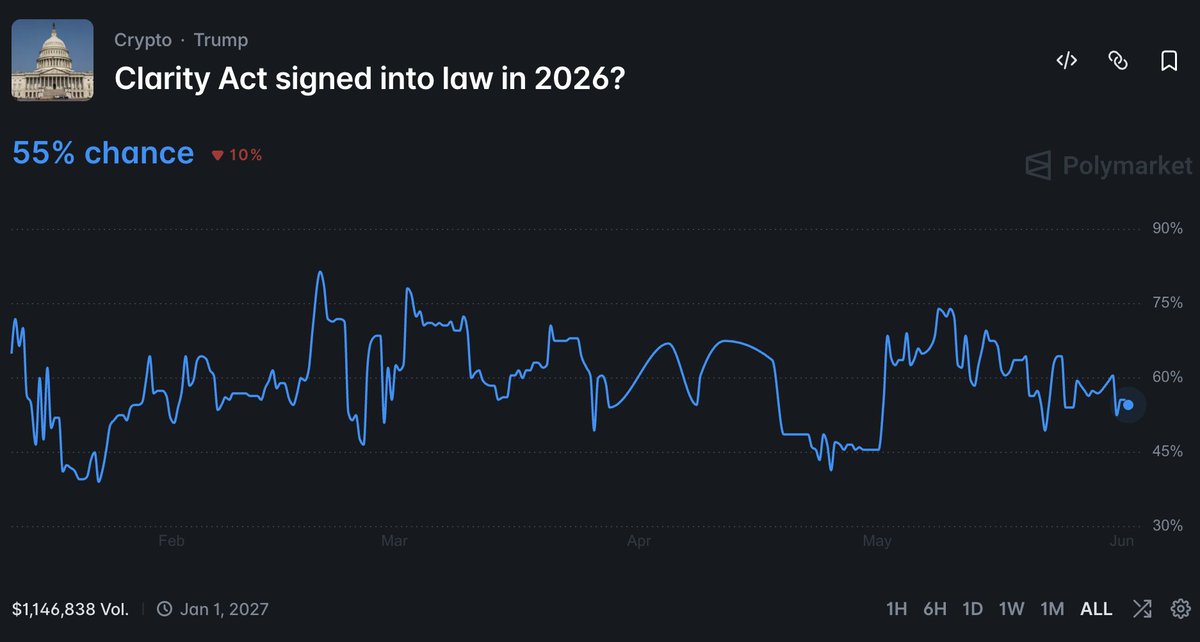
Projecting with a ten-fold space, the overall RWA (excluding stablecoins) scale in this cycle is expected to突破 (break through) $1 trillion. The U.S. "CLARITY Act" becomes a key catalyst. According to Polymarket data, the probability of the法案 (bill/act) being signed into law within 2026 is about 55%. Its passage will open channels for compliant on-chain listing of all U.S. financial assets, becoming a超级利好 (super positive catalyst) for Ethereum.


Ethereum's Vitality Remains Strong


Stocks, bonds, commodities, real estate, art, intellectual property—everything of value will ultimately move towards tokenization. This is the next major innovation in the global financial sector.


The first twenty years of the crypto industry focused on the issuance and innovation of crypto-native assets; the next twenty years will shift the industry's focus towards bringing traditional physical assets on-chain.


Even though the current crypto舆论圈 (discourse/opinion circle) is generally bearish on Ethereum, I am still convinced: Ethereum will become the承载底层 (hosting base layer) for the vast majority of the world's tokenized assets. Relying on its accumulated security, reliability, and liquidity barriers over the years, Ethereum's advantages cannot be短期复刻 (short-term replicated). Once massive global assets land on Ethereum, the market will finally reprice ETH, replicating the past valuation surge行情 (market trend).


İlgili Sorular

QWhat is Lucas's core thesis regarding Ethereum's future role in finance?

ALucas's core thesis is that all assets will eventually be tokenized, Ethereum will become the universal settlement layer for all tokenized assets, and ETH will capture all the value generated by this settlement activity by securing the network through staking.

QWhat does Lucas cite as the main reason for the market's bearish sentiment towards Ethereum in recent years?

ALucas cites ETH's poor price performance over the past five years, where it has failed to meaningfully surpass its 2021 all-time high, as the main reason for the market's widespread bearish sentiment and loss of conviction in its investment value.

QWhat positive on-chain data points does Lucas highlight to counter the bearish narrative about Ethereum's fundamentals?

ALucas highlights that Ethereum's daily transactions hit a new all-time high of 2.27 million in May 2026, average transaction fees have dropped significantly to $0.27, total addresses are growing (over 400 million), daily active users are consistently over 1 million, and over 32% of ETH is staked.

QAccording to the article, why do traditional financial institutions prefer to build tokenized asset (RWA) projects on Ethereum?

ATraditional financial institutions prefer Ethereum because they prioritize certainty and security for their trillion-dollar decisions. Ethereum offers proven, long-term stability, security, and reliability, which helps institutions mitigate career risk associated with strategic decisions on newer or less established chains.

QHow does Lucas compare the current stage of the RWA (Real World Asset) sector to the early days of DeFi, and what potential does he see?

ALucas compares the current RWA stage to the early DeFi phase of 2019-2020. He notes that non-stablecoin RWA on Ethereum has a $16 billion market cap (7% of ETH's market cap), similar to DeFi's early scale relative to ETH. He projects this sector could grow tenfold to over $1 trillion, potentially catalyzed by legislation like the US CLARITY Act.

İlgili Okumalar

BIT Research: ETF Purchases Have Slowed, Strategy (MicroStrategy) Has Slowed, What Else Can Drive Bitcoin's Rise?

Market Refocus on Inflation and Rate Expectations Weighs on Bitcoin Currently, the market is in a phase of macro-repricing dominated by inflation and interest rate expectations. Bitcoin, which previously benefited from easy liquidity and low inflation, is seeing its core bullish drivers weaken. These drivers were market expectations for interest rate cuts and strong inflows from Bitcoin ETFs and institutions like MicroStrategy (referred to as "Strategy" in the text). The logic has shifted. Recent high inflation data (e.g., CPI hitting 3.8% in a May 2026 report) has caused the market to sharply reduce its rate cut expectations for 2025 and even price in potential hikes. This is a key constraint for Bitcoin, as it lacks cash flows and is highly sensitive to rate expectations. Concurrently, institutional capital flows have slowed significantly. Following the hot CPI data, Bitcoin ETFs saw accelerated outflows, with around $4.3 billion leaving over a period. MicroStrategy's ability to keep adding substantial Bitcoin to its balance sheet is also diminishing. Together, ETF and MicroStrategy holdings total roughly $110 billion, but their momentum as growth engines is cooling. In summary, Bitcoin's current pressure stems not from its own fundamentals but from a changing macro environment. As long as inflation stays elevated, Bitcoin is likely to remain in a consolidating phase. However, historically, inflation eventually peaks. Once it recedes and rate cut expectations rebuild, institutional capital could return, potentially fueling a new and more robust recovery phase for Bitcoin.

marsbit8 dk önce

BIT Research: ETF Purchases Have Slowed, Strategy (MicroStrategy) Has Slowed, What Else Can Drive Bitcoin's Rise?

marsbit8 dk önce

Earning 1000 Trillion in Half a Year, 'Pocketing' 20 Million per Capita: This Round of Wealth Creation in the Korean Stock Market is Unprecedented in Scale

The South Korean stock market is experiencing an unprecedented wealth surge in 2026, with household equity and fund asset values soaring by over 1,000 trillion KRW (~$730bn) year-to-date. This translates to an average per capita wealth increase of roughly 20 million KRW, fueled by a historic 109% rally in the KOSPI index. The boom is driven by three converging forces: an AI-driven semiconductor supercycle boosting giants like Samsung and SK Hynix; the government's "Value-Up" market reforms addressing long-standing corporate governance issues; and aggressive real estate regulations that have locked capital within financial markets, preventing profits from flowing back into property. This has triggered a wealth effect, boosting high-end consumption significantly. However, the gains are highly concentrated. The two semiconductor behemoths account for over half the index's value, but retail investors own relatively low stakes in them, systematically missing the biggest rallies. Wealth and consumption benefits are skewed towards luxury goods and imported cars, bypassing mainstream retail. Further risks stem from excessive leverage, with high trading volume in leveraged ETFs, and a market sentiment heavily reliant on the AI sector's fortunes and speculative rumors. While this cycle marks a potential shift from real estate to equities as a primary wealth generator for Koreans, its sustainability, amid structural imbalances and leverage, remains a critical test.

marsbit14 dk önce

Earning 1000 Trillion in Half a Year, 'Pocketing' 20 Million per Capita: This Round of Wealth Creation in the Korean Stock Market is Unprecedented in Scale

marsbit14 dk önce

Behind ZEC's Over 30% Plunge: An 'Unlimited Minting' Vulnerability with No Way to Prove if It Was Ever Exploited

A critical vulnerability was discovered in Zcash's Orchard privacy pool, allowing for the theoretical creation of undetectable counterfeit ZEC. Researcher Taylor Hornby found the flaw on May 29th, 2024, within the Orchard circuit's cryptographic constraints, which could let an attacker bypass asset conservation rules. Although a rapid emergency fix was deployed within days via a coordinated soft and hard fork, a core uncertainty remains: due to Orchard's privacy features, it is impossible to cryptographically prove whether this "unlimited mint" flaw was exploited in the nearly four years since the pool's 2022 launch. This uncertainty, rather than the patched flaw itself, triggered a market panic, causing ZEC's price to drop over 30%. While the Zcash Foundation stated no evidence of exploitation was found, independent entity Shielded Labs emphasized the impossibility of definitively proving no counterfeit ZEC was ever created. The incident highlights the unique trust challenge in privacy systems. To address this, developers are proposing a new network upgrade with enhanced auditing to allow verifiable proof of supply integrity. Notably, the researcher utilized the newly released AI model Claude Opus 4.8 as a tool during the security review, signaling the growing role of advanced AI in uncovering complex cryptographic vulnerabilities.

marsbit16 dk önce

Behind ZEC's Over 30% Plunge: An 'Unlimited Minting' Vulnerability with No Way to Prove if It Was Ever Exploited

marsbit16 dk önce

imToken's 10th Anniversary Unveils Strategic Direction for the Next Decade: Evolving from a Trusted Main Wallet to a Personal Digital Hub

On its tenth anniversary, decentralized wallet imToken announced its strategic vision for the next decade: evolving from a "trusted main wallet" into a "personal control interface." This new direction aims to help users manage not only digital assets but also identity, permissions, and AI agent actions in an increasingly open and intelligent internet. imToken outlined that while the past decade focused on Store, Send, and Stake—securing assets, enabling transfers, and facilitating network participation—the future introduces a fourth core proposition: Sign. This expanded concept goes beyond transaction signing to encompass expressing intent, granting permissions, setting rules, delegating actions, and revoking authorizations. As AI agents gain autonomy, imToken emphasizes the need for clear, verifiable, and revocable user control over their actions. CEO Ben He stated that imToken's mission is shifting from enabling ownership of digital assets to ensuring user sovereignty over their entire digital world in the AI era. The company's core principle has been upgraded from "Digital Assets, Under Your Control" to "Your Digital World, Under Your Control." Future development will focus on three areas: upholding self-custody principles, extending security from transactions to authorizations and automated actions, and building product capabilities for managing permissions, delegations, policies, and revocations. imToken views the wallet's role as expanding into a trusted control interface for human-AI collaboration, where managing keys, signatures, and permissions forms the infrastructure for personal digital sovereignty. Founded in 2016, imToken serves millions of users across 150+ countries, providing non-custodial wallet services supporting over 50 blockchain networks.

marsbit17 dk önce

imToken's 10th Anniversary Unveils Strategic Direction for the Next Decade: Evolving from a Trusted Main Wallet to a Personal Digital Hub

marsbit17 dk önce

İşlemler

Spot
Futures

Popüler Makaleler

ETH 2.0 Nedir

ETH 2.0: Ethereum için Yeni Bir Dönem Giriş ETH 2.0, Ethereum 2.0 olarak da bilinir, Ethereum blok zincirinde önemli bir yükseltmeyi işaret eder. Bu geçiş yalnızca bir yüz değiştirme değil; ağın ölçeklenebilirliğini, güvenliğini ve sürdürülebilirliğini temelinden geliştirmeyi hedeflemektedir. Enerji yoğun Proof of Work (PoW) konsensüs mekanizmasından daha verimli olan Proof of Stake (PoS) mekanizmasına geçişle birlikte, ETH 2.0 blok zinciri ekosistemine dönüştürücü bir yaklaşım vaat etmektedir. ETH 2.0 Nedir? ETH 2.0, Ethereum'un yeteneklerini ve performansını optimize etmeye odaklanmış özel, birbirine bağlı güncellemelerin bir derlemesidir. Yenileme, mevcut Ethereum mekanizmasının karşılaştığı kritik zorlukları, özellikle işlem hızı ve ağ tıkanıklığı ile ilgili sorunları ele almak üzere tasarlanmıştır. ETH 2.0'ın Amaçları ETH 2.0'ın ana amaçları, üç temel unsuru geliştirmeye odaklanmaktadır: Ölçeklenebilirlik: Ağın saniye başına işleyebileceği işlem sayısını önemli ölçüde artırmayı hedefleyen ETH 2.0, mevcut yaklaşık 15 işlem/saniye sınırlamasını aşmayı ve potansiyel olarak binlerce işleme ulaşmayı planlamaktadır. Güvenlik: Geliştirilmiş güvenlik önlemleri, özellikle siber saldırılara karşı daha iyi direnç sağlama ve Ethereum'un merkeziyetsiz görünümünü koruma açısından ETH 2.0 için hayati öneme sahiptir. Sürdürülebilirlik: Yeni PoS mekanizması, sadece verimliliği artırmakla kalmayıp aynı zamanda enerji tüketimini de önemli ölçüde azaltma hedefiyle tasarlanmış olup, Ethereum'un operasyonel çerçevesini çevresel kaygılarla uyumlu hale getirmektedir. ETH 2.0'ın Yaratıcısı Kimdir? ETH 2.0'ın yaratılması Ethereum Vakfı'na atfedilebilir. Ethereum'un gelişimini destekleme konusunda kritik bir rol oynayan bu kar amacı gütmeyen kuruluş, dikkat çekici kurucu ortağı Vitalik Buterin tarafından yönetilmektedir. Daha ölçeklenebilir ve sürdürülebilir bir Ethereum vizyonu, bu yükseltmenin arkasındaki itici güç olmuştur ve protokolü geliştirmek için kendini adamış küresel bir geliştici ve meraklı topluluğunun katkılarını içermektedir. ETH 2.0'ın Yatırımcıları Kimlerdir? ETH 2.0 yatırımcıları ile ilgili detaylar kamuoyuna açıklanmamış olsa da, Ethereum Vakfı'nın blok zinciri ve teknoloji alanında çeşitli kuruluşlar ve bireyler tarafından desteklendiği bilinmektedir. Bu ortaklar arasında merkeziyetsiz teknolojilerin ve blok zinciri altyapısının geliştirilmesine karşılıklı ilgi duyan girişim sermayesi şirketleri, teknoloji firmaları ve hayır kurumları yer almaktadır. ETH 2.0 Nasıl Çalışır? ETH 2.0, onu öncüsünden ayıran bir dizi önemli özelliği tanıtmasıyla dikkat çekmektedir. Proof of Stake (PoS) PoS konsensüs mekanizmasına geçiş, ETH 2.0'ın en belirgin değişikliklerinden biridir. İşlem doğrulama için enerji yoğun madenciliğe dayanmak yerine, PoS kullanıcıların ağa yatırdıkları ETH miktarına göre işlemleri doğrulayıp yeni bloklar oluşturmalarına olanak tanır. Bu, enerji verimliliğinin artırılmasına yol açarak tüketimi yaklaşık %99,95 oranında azaltmakta ve Ethereum 2.0'ı önemli ölçüde daha çevre dostu bir alternatif haline getirmektedir. Shard Zincirleri Shard zincirleri, ETH 2.0'ın diğer bir kritik yeniliğidir. Bu daha küçük zincirler, ana Ethereum zinciri ile paralel olarak çalışarak birden fazla işlemin aynı anda işlenmesine olanak tanır. Bu yaklaşım, ağın genel kapasitesini artırarak Ethereum'u rahatsız eden ölçeklenebilirlik sorunlarını ele alır. Beacon Zinciri ETH 2.0'ın temelinde, ağı koordine eden ve PoS protokolünü yöneten Beacon Zinciri yer almaktadır. Bu, bir tür organizatör olarak işlev görür: doğrulayıcıları denetler, shard'ların ağa bağlı kalmasını sağlar ve blok zinciri ekosisteminin genel sağlığını izler. ETH 2.0 Zaman Çizelgesi ETH 2.0'ın yolculuğu, bu önemli yükseltmenin evrimini gösteren birkaç önemli dönüm noktası ile tanımlanmıştır: Aralık 2020: Beacon Zinciri'nin başlatılması, PoS'un tanıtımını işaret etmiş ve ETH 2.0’a geçiş için sahneyi hazırlamıştır. Eylül 2022: "The Merge" tamamlanması, Ethereum ağının başarılı bir şekilde PoW'den PoS çerçevesine geçiş yaptığı kritik bir anı temsil etmekte ve Ethereum için yeni bir dönemi müjdelemektedir. 2023: Shard zincirlerinin beklenen dağıtımı, Ethereum ağının ölçeklenebilirliğini daha da artırmayı hedeflemekte ve ETH 2.0'ı merkeziyetsiz uygulamalar ve hizmetler için sağlam bir platform haline getirmeyi pekiştirmektedir. Ana Özellikler ve Faydalar Geliştirilmiş Ölçeklenebilirlik ETH 2.0'ın en önemli avantajlarından biri, geliştirilmiş ölçeklenebilirliğidir. PoS ve shard zincirlerinin kombinasyonu, ağın kapasitesini artırarak, eski sistemle kıyaslandığında çok daha fazla işlem hacmi karşılayabilmesini sağlamaktadır. Enerji Verimliliği PoS'un uygulanması, blok zinciri teknolojisinde enerji verimliliği yönünde büyük bir adım teşkil etmektedir. Enerji tüketimini ciddi şekilde azaltarak, ETH 2.0 yalnızca işletme maliyetlerini düşürmekle kalmaz, aynı zamanda küresel sürdürülebilirlik hedefleriyle daha yakın bir uyum sağlar. Geliştirilmiş Güvenlik ETH 2.0'ın güncellenmiş mekanizmaları, ağ genelinde güvenliğin artırılmasına katkıda bulunmaktadır. PoS'un uygulanması ve shard zincirleri ile Beacon Zinciri aracılığıyla geliştirilen yenilikçi kontrol önlemleri, potansiyel tehditlere karşı daha yüksek bir koruma sağlar. Kullanıcılar için Düşük Maliyetler Ölçeklenebilirlik geliştikçe, işlem maliyetleri üzerindeki etkiler de belirgin hale gelecektir. Artan kapasite ve azalan tıkanıklığın, kullanıcılar için düşük ücretler anlamına gelmesi beklenmekte ve Ethereum'u günlük işlemler için daha erişilebilir hale getirmektedir. Sonuç ETH 2.0, Ethereum blok zinciri ekosisteminde önemli bir evrimi işaret etmektedir. Ölçeklenebilirlik, enerji tüketimi, işlem verimliliği ve genel güvenlik gibi temel sorunları ele alırken, bu güncellemenin önemi abartılamaz. Proof of Stake'e geçiş, shard zincirlerinin tanıtımı ve Beacon Zinciri'nin altyapı çalışmaları, Ethereum'un merkeziyetsiz piyasalarının artan taleplerini karşılayabileceği bir geleceği göstermektedir. Yenilik ve ilerleme ile şekillenen bir sektörde, ETH 2.0, blok zinciri teknolojisinin daha sürdürülebilir ve verimli bir dijital ekonomi için yol açmadaki yeteneklerinin bir kanıtıdır.

170 Toplam GörüntülenmeYayınlanma 2024.04.04Güncellenme 2024.12.03

ETH 2.0 Nedir

ETH 3.0 Nedir

ETH3.0 ve $eth 3.0: Ethereum'un Geleceği Üzerine Derinlemesine Bir İnceleme Giriş Hızla evrilen kripto para ve blok zinciri teknolojisi ortamında, ETH3.0, sıklıkla $eth 3.0 olarak adlandırılmakta, önemli bir ilgi ve spekülasyon konusu haline gelmiştir. Bu terim, netleştirilmesi gereken iki temel kavramı kapsamaktadır: Ethereum 3.0: Bu, mevcut Ethereum blok zincirinin yeteneklerini artırmayı hedefleyen olası bir gelecekteki güncellemeyi temsil eder, özellikle ölçeklenebilirlik ve performansı iyileştirmeye odaklanmaktadır. ETH3.0 Meme Token: Bu ayrı kripto para projesi, Ethereum blok zincirini kullanarak meme merkezli bir ekosistem oluşturmayı amaçlamakta ve kripto para topluluğu içinde etkileşimi artırmaktadır. ETH3.0'ün bu yönlerini anlamak, yalnızca kripto meraklıları için değil, aynı zamanda dijital alandaki daha geniş teknolojik trendleri gözlemleyenler için de hayati öneme sahiptir. ETH3.0 Nedir? Ethereum 3.0 Ethereum 3.0, zaten kurulmuş olan Ethereum ağına önerilen bir güncelleme olarak duyurulmaktadır; bu ağ, kuruluşundan bu yana birçok merkeziyetsiz uygulamanın (dApp'ler) ve akıllı sözleşmelerin belkemiği olmuştur. Tasarlanan iyileştirmeler, esasen ölçeklenebilirlik üzerine yoğunlaşmakta – shardlama ve sıfır bilgi kanıtları (zk-proofs) gibi ileri teknolojileri entegre etmektedir. Bu teknolojik yenilikler, saniyede eşi benzeri görülmemiş sayıda işlem (TPS) gerçekleştirmeyi kolaylaştırmayı amaçlamakta olup, muhtemelen milyonlara ulaşarak mevcut blok zinciri teknolojisinin karşılaştığı en büyük sınırlamalardan birine çözüm getirmektedir. İyileştirme yalnızca teknik değil, aynı zamanda stratejiktir; Ethereum ağını, merkeziyetsiz çözümlere olan artan talep ile belirginleşen bir geleceğe hazırlamak için tasarlanmıştır. ETH3.0 Meme Token Ethereum 3.0'ın aksine, ETH3.0 Meme Token, internet meme kültürünü kripto para dinamikleriyle birleştirerek daha hafif ve eğlenceli bir alanda hareket etmektedir. Bu proje, kullanıcıların Ethereum blok zincirinde meme alım, satım ve ticaret yapmalarına izin vererek, yaratıcılık ve ortak ilgi alanları aracılığıyla topluluk etkileşimini teşvik eden bir platform sunmaktadır. ETH3.0 Meme Token, blok zinciri teknolojisinin dijital kültürle nasıl kesişebileceğini göstererek, hem eğlenceli hem de finansal olarak sürdürülebilir kullanım senaryoları oluşturmayı hedeflemektedir. ETH3.0'un Yaratıcısı Kimdir? Ethereum 3.0 Ethereum 3.0'a yönelik girişim, esas olarak Ethereum topluluğundaki bir geliştirici ve araştırmacı konsorsiyumu tarafından yönlendirilmektedir ve bunlar arasında Justin Drake de bulunmaktadır. Ethereum'un evrimine yönelik içgörüleri ve katkılarıyla tanınan Drake, Ethereum'u “Beam Chain” olarak adlandırılan yeni bir konsensüs katmanına geçirme konusundaki tartışmalarda öne çıkan bir figür olmuştur. Geliştirmeye yönelik bu iş birliği yaklaşımı, Ethereum 3.0'ın tek bir yaratıcının ürünü olmadığını, aksine blok zinciri teknolojisini ilerletmeye odaklanmış kolektif bir dehanın tezahürü olduğunu göstermektedir. ETH3.0 Meme Token ETH3.0 Meme Token'ın yaratıcısına dair detaylar şu anda izlenemez durumdadır. Meme tokenların doğası, genellikle daha merkeziyetsiz ve topluluk odaklı bir yapıya yol açmakta olup, bu da spesifik bir atıf eksikliğini açıklayabilir. Bu durum, yeniliğin genellikle iş birliği yerine bireysel çabalardan ortaya çıktığı kripto topluluğunun genel felsefesiyle uyumludur. ETH3.0 Yatırımcıları Kimlerdir? Ethereum 3.0 Ethereum 3.0'a olan destek, esasen Ethereum Vakfı ve hevesli bir geliştirici ve yatırımcı topluluğu tarafından sağlanmaktadır. Bu temel birliktelik, yıllar süren ağ operasyonlarıyla inşa edilen güven ve itibarından yararlanarak önemli bir meşruiyet sağlamaktadır. Kripto para dünyasının hızla değişen ikliminde, topluluk desteği, gelişim ve benimsemeyi yönlendirmede kritik bir rol oynamakta ve Ethereum 3.0'ı gelecekteki blok zinciri ilerlemeleri için ciddi bir rakip haline getirmektedir. ETH3.0 Meme Token Mevcut kaynaklar, ETH3.0 Meme Token'ı destekleyen yatırım temelleri veya kuruluşları hakkında net bilgiler sağlamasa da, bu durum meme tokenlar için tipik olan finansman modelini göstermektedir; bu model genellikle tabandan destek ve topluluk katılımına dayanır. Bu tür projelerdeki yatırımcılar genellikle toplum odaklı yenilik potansiyeli ve kripto topluluğunda bulunan iş birliği ruhuyla motive olmuş bireylerden oluşmaktadır. ETH3.0 Nasıl Çalışır? Ethereum 3.0 Ethereum 3.0'ın ayırt edici özellikleri, önerilen shardlama ve zk-proof teknolojisinin uygulanmasında yatmaktadır. Shardlama, blok zincirini daha küçük, yönetilebilir parçalara veya “parçalara” ayırma yöntemidir; bu parçalar işlemleri ardışık değil, eşzamanlı olarak işleyebilir. Bu işlem yükünün merkeziyetsizliği, tıkanıklığı önlemeye yardımcı olur ve ağın yoğun yük altında bile yanıt verebilir olmasını sağlar. Sıfır bilgi kanıtı (zk-proof) teknolojisi, işleme katılan temel verileri ifşa etmeden işlem doğrulaması sağlamasıyla başka bir sofistike katman ekler. Bu yön, sadece gizliliği artırmakla kalmaz, aynı zamanda ağın genel verimliliğini de artırır. Bu güncellemeye, ağın yeteneklerini ve faydasını daha da artırarak sıfır bilgi Ethereum Sanal Makinesi (zkEVM) entegrasyonunun da eklenmesi gündeme gelmektedir. ETH3.0 Meme Token ETH3.0 Meme Token, meme kültürünün popülaritesinden yararlanarak kendini farklılaştırmaktadır. Kullanıcıların sadece eğlence için değil, aynı zamanda potansiyel ekonomik kazançlar için meme ticareti yapmalarına olanak tanıyacak bir pazar yeri oluşturur. Stake etme, likidite sağlama ve yönetim mekanizmaları gibi özelliklerin entegrasyonu sayesinde, proje topluluk etkileşimini ve katılımını teşvik eden bir ortam oluşturur. Eğlence ve ekonomik fırsatların eşsiz bir karışımını sunarak, ETH3.0 Meme Token, kripto tutkunlarından gündelik meme meraklılarına kadar çeşitli bir kitleyi çekmeyi hedeflemektedir. ETH3.0 Zaman Çizelgesi Ethereum 3.0 11 Kasım 2024: Justin Drake, ölçeklenebilirlik iyileştirmeleri etrafında şekillenen yaklaşan ETH 3.0 güncellemesine işaret ediyor. Bu duyuru, Ethereum'un gelecekteki mimarisi hakkında resmi tartışmaların başlangıcını simgeliyor. 12 Kasım 2024: Ethereum 3.0'a yönelik beklenen önerinin, Bangkok'taki Devcon'da açıklanması planlanıyor ve bu, daha geniş topluluk geri bildirimi ve gelişim için olası sonraki adımların zeminini hazırlıyor. ETH3.0 Meme Token 21 Mart 2024: ETH3.0 Meme Token, CoinMarketCap'ta resmi olarak listeleniyor, bu da kamusal kripto alanına adım atarak meme merkezli ekosisteminin görünürlüğünü artırıyor. Ana Noktalar Sonuç olarak, Ethereum 3.0, gelişmiş teknolojiler aracılığıyla ölçeklenebilirlik ve performansla ilgili sınırlamaların üstesinden gelmeye odaklanan Ethereum ağındaki önemli bir evrimi temsil etmektedir. Önerilen güncellemeleri, gelecekteki talepler ve kullanılabilirlik için proaktif bir yaklaşımı yansıtmaktadır. Öte yandan, ETH3.0 Meme Token, kripto para alanındaki topluluk odaklı kültürün özünü kapsamakta, meme kültürünü kullanarak kullanıcı yaratıcılığını ve katılımını teşvik eden etkileşimli platformlar oluşturmayı hedeflemektedir. ETH3.0 ve $eth 3.0'un farklı amaçlarının ve işlevlerinin anlaşılması, kripto alanındaki gelişmeleri takip eden herkes için hayati öneme sahiptir. Her iki girişim de benzersiz yollar çizerek, blok zinciri yeniliğinin dinamik ve çok yönlü doğasını birlikte vurgulamaktadır.

171 Toplam GörüntülenmeYayınlanma 2024.04.04Güncellenme 2024.12.03

ETH 3.0 Nedir

ETH Nasıl Satın Alınır

HTX.com’a hoş geldiniz! Ethereum (ETH) satın alma işlemlerini basit ve kullanışlı bir hâle getirdik. Adım adım açıkladığımız rehberimizi takip ederek kripto yolculuğunuza başlayın. 1. Adım: HTX Hesabınızı OluşturunHTX'te ücretsiz bir hesap açmak için e-posta adresinizi veya telefon numaranızı kullanın. Sorunsuzca kaydolun ve tüm özelliklerin kilidini açın. Hesabımı Aç2. Adım: Kripto Satın Al Bölümüne Gidin ve Ödeme Yönteminizi SeçinKredi/Banka Kartı: Visa veya Mastercard'ınızı kullanarak anında Ethereum (ETH) satın alın.Bakiye: Sorunsuz bir şekilde işlem yapmak için HTX hesap bakiyenizdeki fonları kullanın.Üçüncü Taraflar: Kullanımı kolaylaştırmak için Google Pay ve Apple Pay gibi popüler ödeme yöntemlerini ekledik.P2P: HTX'teki diğer kullanıcılarla doğrudan işlem yapın.Borsa Dışı (OTC): Yatırımcılar için kişiye özel hizmetler ve rekabetçi döviz kurları sunuyoruz.3. Adım: Ethereum (ETH) Varlıklarınızı SaklayınEthereum (ETH) satın aldıktan sonra HTX hesabınızda saklayın. Alternatif olarak, blok zinciri transferi yoluyla başka bir yere gönderebilir veya diğer kripto para birimlerini takas etmek için kullanabilirsiniz.4. Adım: Ethereum (ETH) Varlıklarınızla İşlem YapınHTX'in spot piyasasında Ethereum (ETH) ile kolayca işlemler yapın.Hesabınıza erişin, işlem çiftinizi seçin, işlemlerinizi gerçekleştirin ve gerçek zamanlı olarak izleyin. Hem yeni başlayanlar hem de deneyimli yatırımcılar için kullanıcı dostu bir deneyim sunuyoruz.

3.5k Toplam GörüntülenmeYayınlanma 2024.12.10Güncellenme 2026.06.02

ETH Nasıl Satın Alınır

Tartışmalar

HTX Topluluğuna hoş geldiniz. Burada, en son platform gelişmeleri hakkında bilgi sahibi olabilir ve profesyonel piyasa görüşlerine erişebilirsiniz. Kullanıcıların ETH (ETH) fiyatı hakkındaki görüşleri aşağıda sunulmaktadır.

活动图片