Five Institutions Outline the 2026 Crypto Blueprint: Will the 'Super App' Arrive? Is the 'Four-Year Cycle' Ending?

marsbit2025-12-25 tarihinde yayınlandı2025-12-25 tarihinde güncellendi

Özet

Five major crypto research institutions (Coinbase, a16z Crypto, Four Pillars, Messari, and Delphi Digital) forecast a shift in 2026, marking the end of the traditional four-year speculative cycle driven by events like Bitcoin halvings. They predict a new era of structural maturity, where value accrues to "ownership tokens" with revenue-sharing models and projects with real utility, not just short-term speculation. Key trends include the rise of an "Agent Economy," where AI agents autonomously manage assets and execute complex DeFi strategies, necessitating new infrastructure like KYA (Know Your Agent) protocols and crypto-native settlement layers for microtransactions. Regulatory clarity in the U.S. is expected to catalyze the development of user-friendly "super apps" that abstract away blockchain complexity, integrating payments, investing, and lending seamlessly with stablecoins. Additional consensus points include the growth of tokenized real-world assets (RWA) with actual utility, the emergence of privacy as a critical competitive advantage for blockchains, and the maturation of social trading. Institutional adoption will deepen via ETFs, cementing crypto as a standard portfolio asset class driven by macro liquidity rather than mere speculation.

Original fromEli5DeFi

Compiled | Odaily Planet Daily Golem(@web 3_golem)

As 2025 draws to a close, major crypto research institutions are releasing reports and making predictions on industry trends for the coming year, forming a new consensus: the era of pure speculation is fading, replaced by structural maturation, driven not by short-term profit motives but by liquidity convergence, infrastructure development, and integration.

Odaily Planet Daily has compiled the core predictions for 2026 from five research institutions—Coinbase, A16Z Crypto, Four Pillars, Messari, and Delphi Digital:

  • End of the Four-Year Cycle: Research institutions unanimously agree that the four-year speculative halving cycle is fading. It is being replaced by structural maturation, where value will flow to "ownership tokens" with profit-sharing models and projects with practical utility, rather than being driven by short-term gains.
  • Rise of the Agent Economy: Major research institutions (Delphi Digital, a16z, Coinbase) predict that AI agents will become primary economic actors. Market focus may shift to KYA (Know Your Agent) identity protocols and machine-native settlement layers.
  • Super Apps: With the clarification of US regulatory policies (Four Pillars, Messari), complex cryptocurrency experiences will be simplified into user-friendly "super apps" and privacy-preserving blockchains, abstracting away the technology to enable mass adoption.

Delphi Digital 2026 Outlook
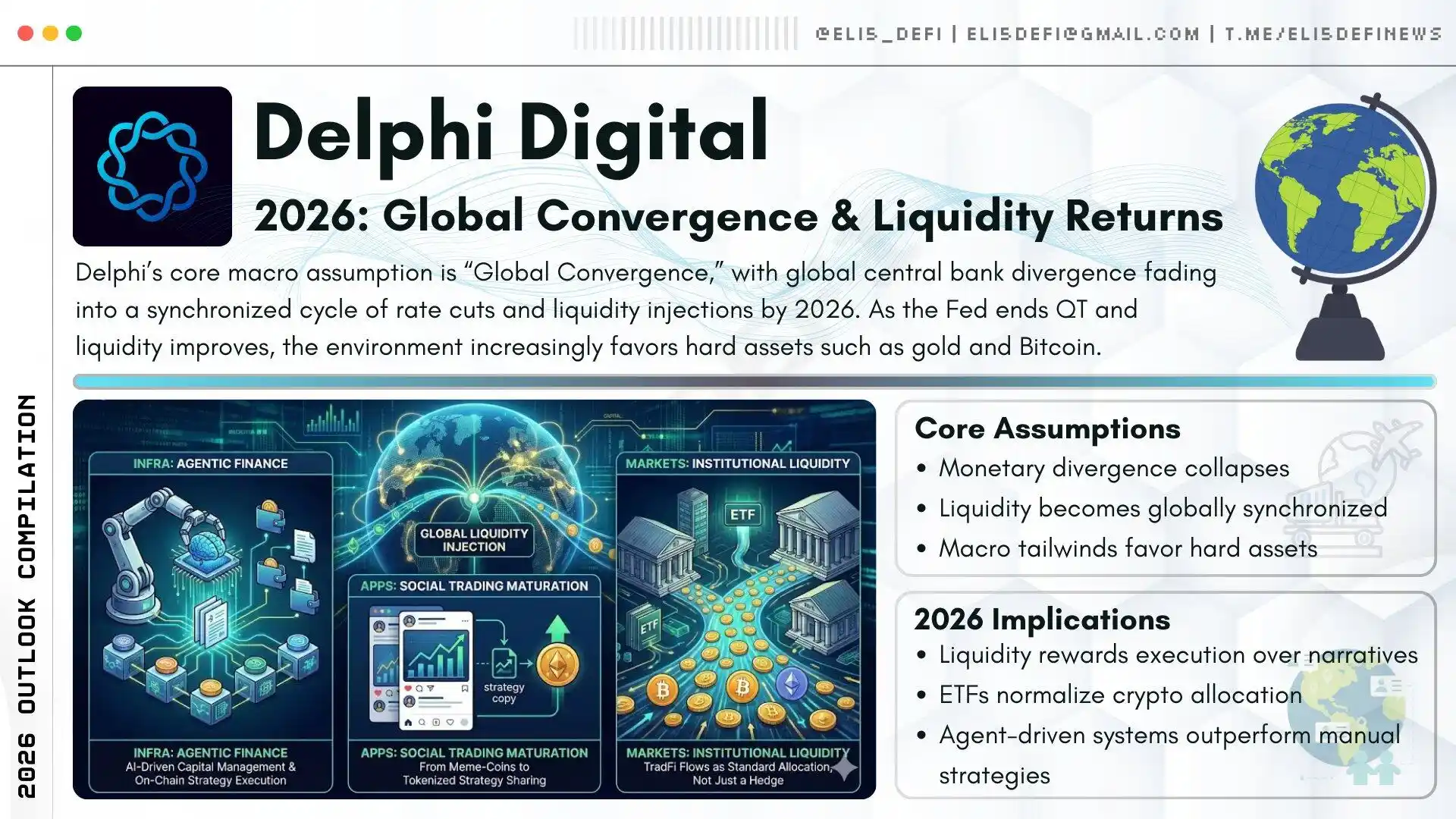
Delphi Digital bases its outlook on a "global convergence" macro assumption. They predict that by 2026, the divergence in global central bank policies will end, shifting towards a unified cycle of interest rate cuts and liquidity injection. As the Federal Reserve ends quantitative tightening (QT) and global liquidity improves, the market environment will favor hard assets like gold and Bitcoin.

Agent Economy

A major expansion of infrastructure is the rise of the "agent economy." AI agents will no longer be just chatbots but will actively manage funds, execute complex DeFi strategies, and optimize on-chain yields without human intervention.

Social Trading and "Pump" Economy

On the consumer application front, Delphi highlighted the user stickiness of platforms like pump.fun and predicted that "social trading" will mature. This trend will evolve from simple meme coin gambling to complex copy-trading tiers, with strategy sharing becoming a tokenized product.

Institutional Liquidity

Market structure will be altered by the deepening adoption of ETFs, with traditional finance liquidity flowing into the crypto market not just as a hedge but as a standard portfolio allocation driven by macro liquidity easing.

Full report link: https://members.delphidigital.io/reports/the-year-ahead-for-infra-2026

Messari 2026 Outlook
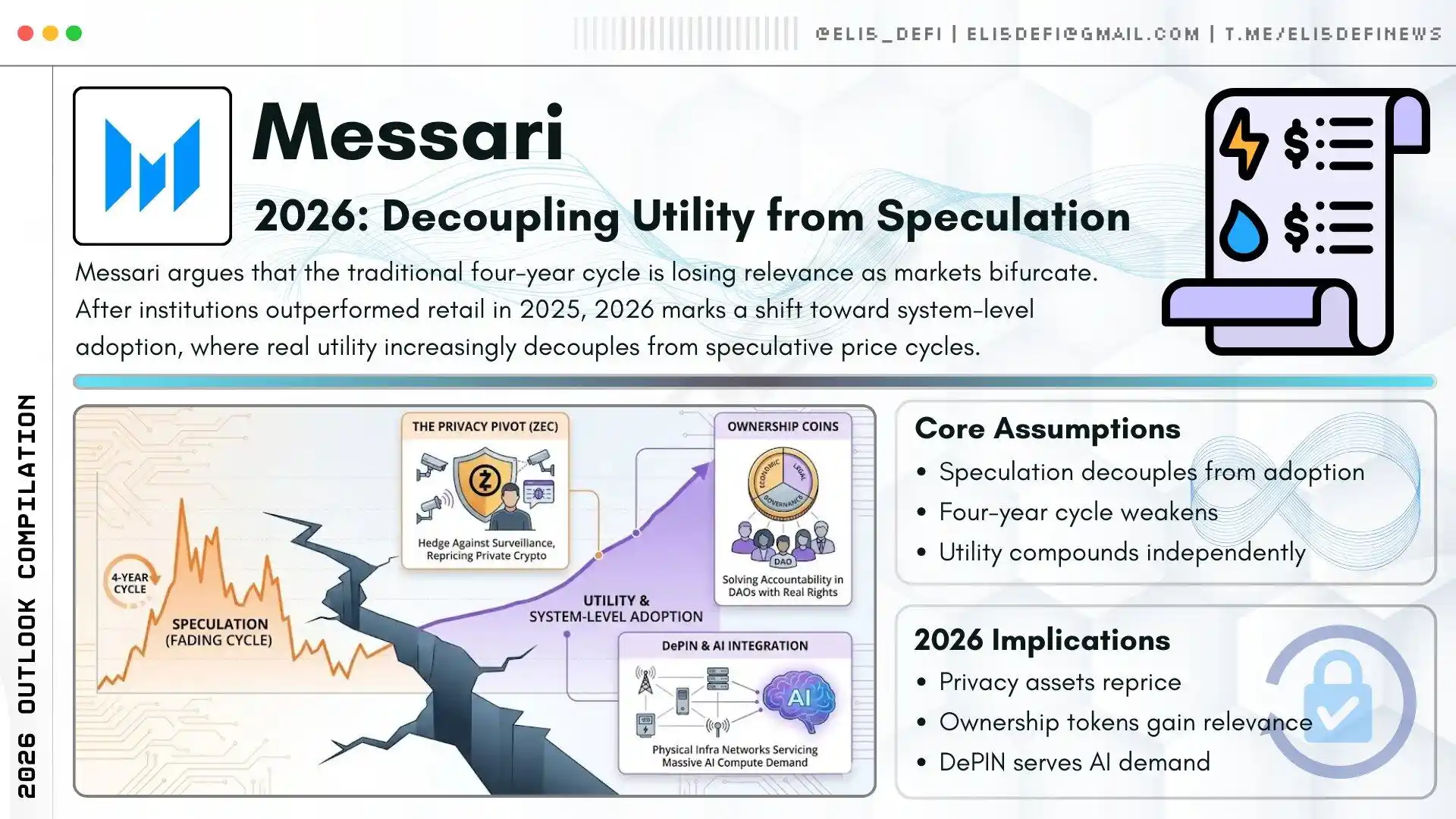
Messari's core thesis is the "decoupling of utility and speculation." They argue that as the market bifurcates, the relevance of the "four-year cycle" model is diminishing. They hypothesize that 2025 was a year where institutional investors won and retail investors struggled, setting the stage for 2026 to be about "system-level adoption" rather than mere asset price speculation.

Rise of Privacy Coins ($ZEC)

A contrarian expansion trend is the renaissance of privacy. Messari emphasizes that Zcash (ZEC) and similar assets are not just "privacy coins" but necessary hedges against growing surveillance and corporate control, predicting a repricing of "private cryptocurrencies."

Ownership Tokens

2026 will see the emergence of a new category—"ownership tokens"—which combine economic, legal, and governance rights. Messari believes these tokens can address the accountability crisis in DAOs and potentially spawn the first billion-dollar projects in this specific niche.

DePIN and AI Convergence

This thesis focuses on DePIN (Decentralized Physical Infrastructure Networks), expecting these protocols to find real product-market fit by meeting the massive computational and data demands of the AI sector.

Full report link: https://messari.io/report/the-crypto-theses-2026

Four Pillars 2026 Outlook
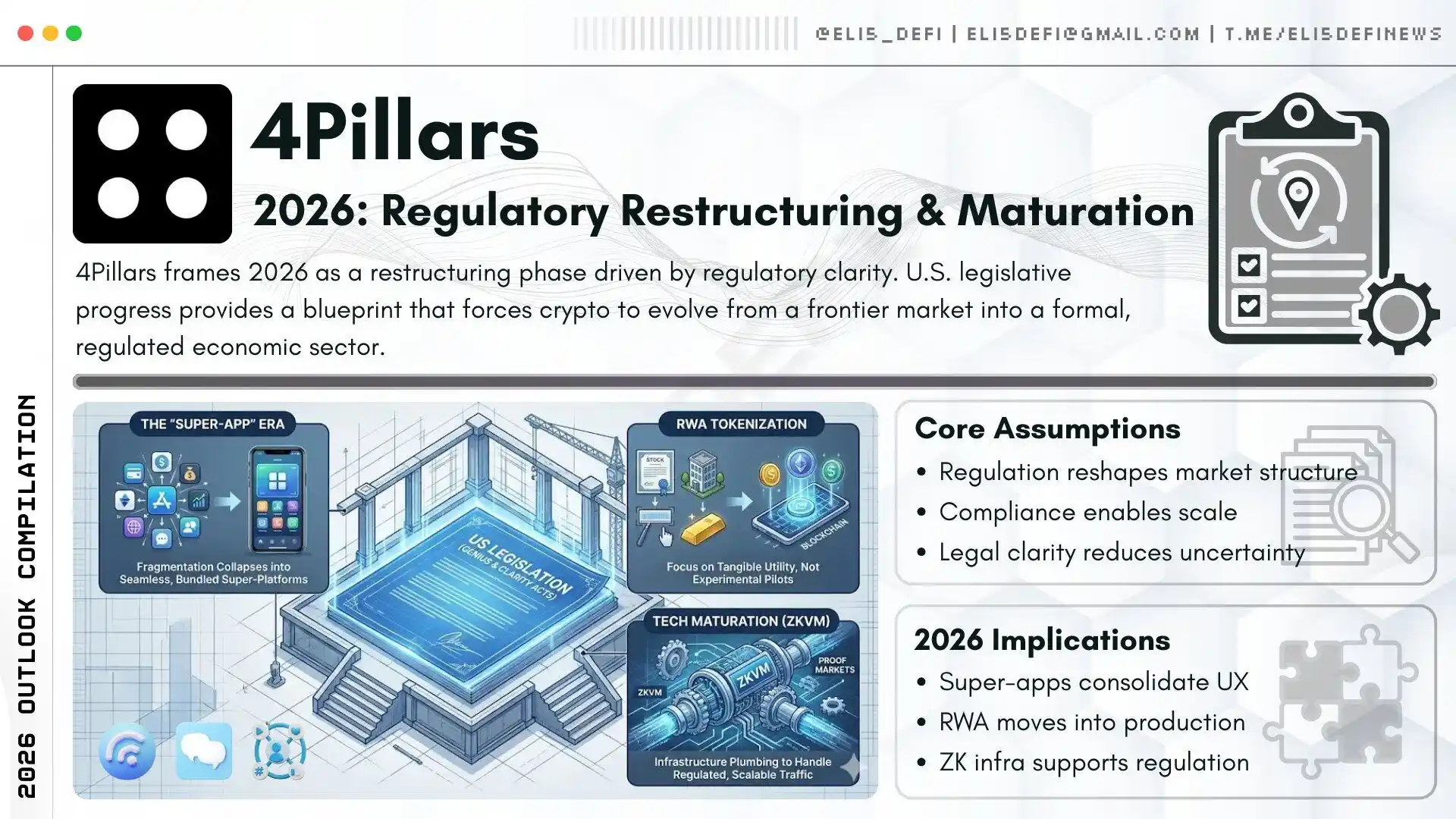
Four Pillars' outlook centers on "regulatory restructuring." Their core assumption is that US legislative initiatives (specifically mentioning the GENIUS Act and CLARITY Act in their predictions) will provide a blueprint for a comprehensive market overhaul.

This regulatory clarity is the catalyst for restructuring the market from a "Wild West" frontier into a formal economic sector.

The Era of "Super Apps"

Four Pillars predicts that the fragmentation of crypto applications will finally coalesce into "super apps"—stablecoin-powered platforms seamlessly integrating payment, investment, and lending functions. The complexity of blockchain will be completely abstracted away.

RWA Tokenization

Restructuring will drive the tokenization of equities and traditional assets, but the focus will be on actual utility, not experimental pilot programs.

Crypto Tech Maturation

On the technology side, they delve into the role of Zero-Knowledge Virtual Machines (ZKVM) on Ethereum and proof markets, seeing them as necessary infrastructure to handle the scale of this new, regulated institutional flow.

Full report link: https://4pillars.io/en/articles/2026-outlook-restructuring-100ys-perspective

Coinbase 2026 Outlook
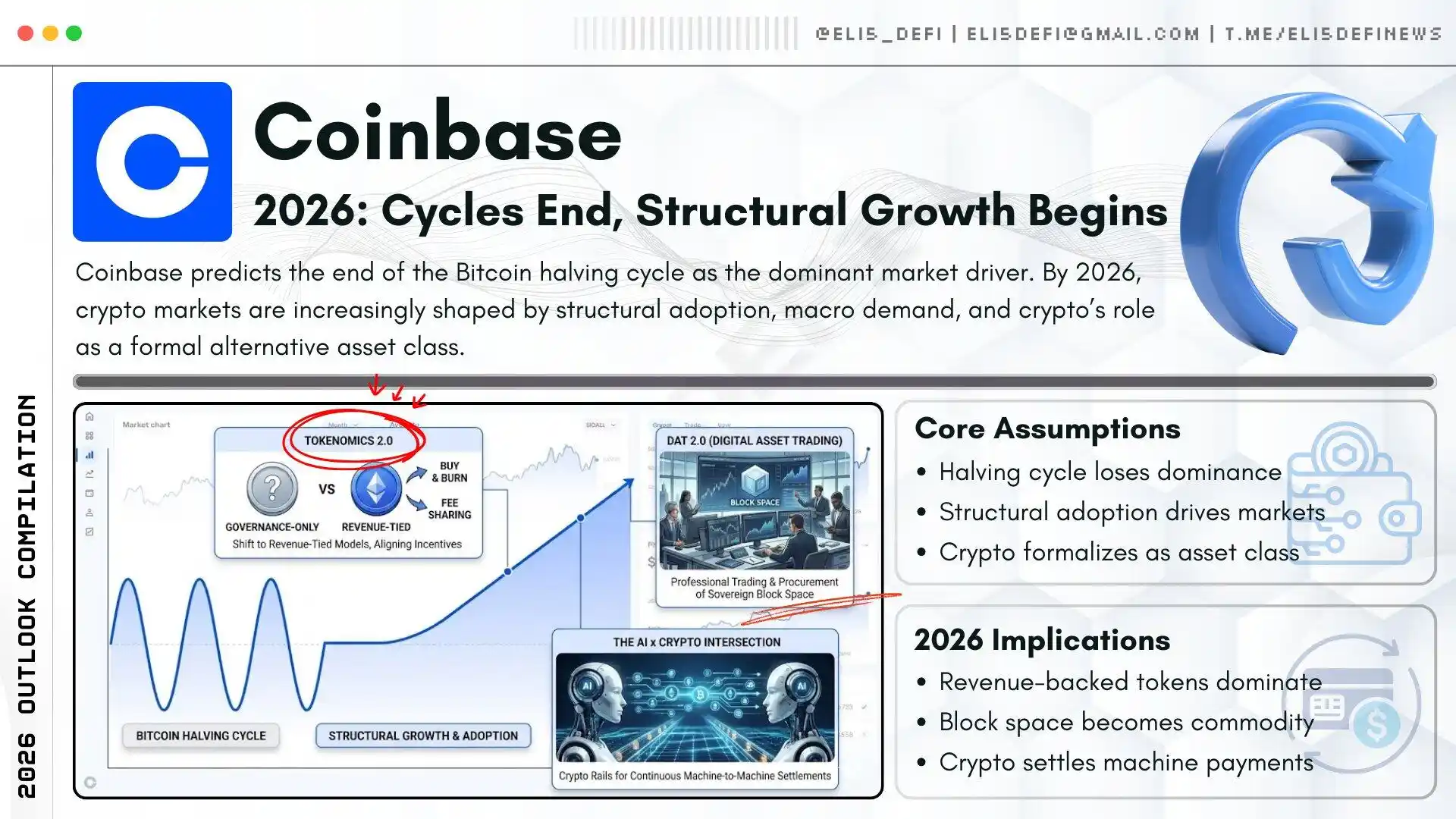
Coinbase's report predicts the "End of the Four-Year Cycle." They state clearly that 2026 will mark the end of the traditional Bitcoin halving cycle theory. Instead, the market will be driven by structural factors, macro demand for alternative stores of value, and the formalization of crypto as a mid-sized alternative asset class.

Tokenomics 2.0

A shift from "governance-only" tokens to "revenue-linked" models. Protocols will increasingly implement buyback-and-burn or fee-sharing mechanisms (compliant with new regulations) to align token holder incentives with platform success.

DAT 2.0 (Digital Asset Trading)

A move towards professionalized trading and "sovereign block space" procurement, treating block space as a key commodity for the digital economy.

AI and Crypto Intersection

Coinbase anticipates significant growth in AI agents using crypto payment rails. They predict the market will need a "crypto-native settlement layer" capable of handling persistent micro-transactions between machines, which traditional payment rails cannot support.

Full report link: https://www.coinbase.com/en-sg/institutional/research-insights/research/market-intelligence/2026-crypto-market-outlook

a16z Crypto 2026 Outlook
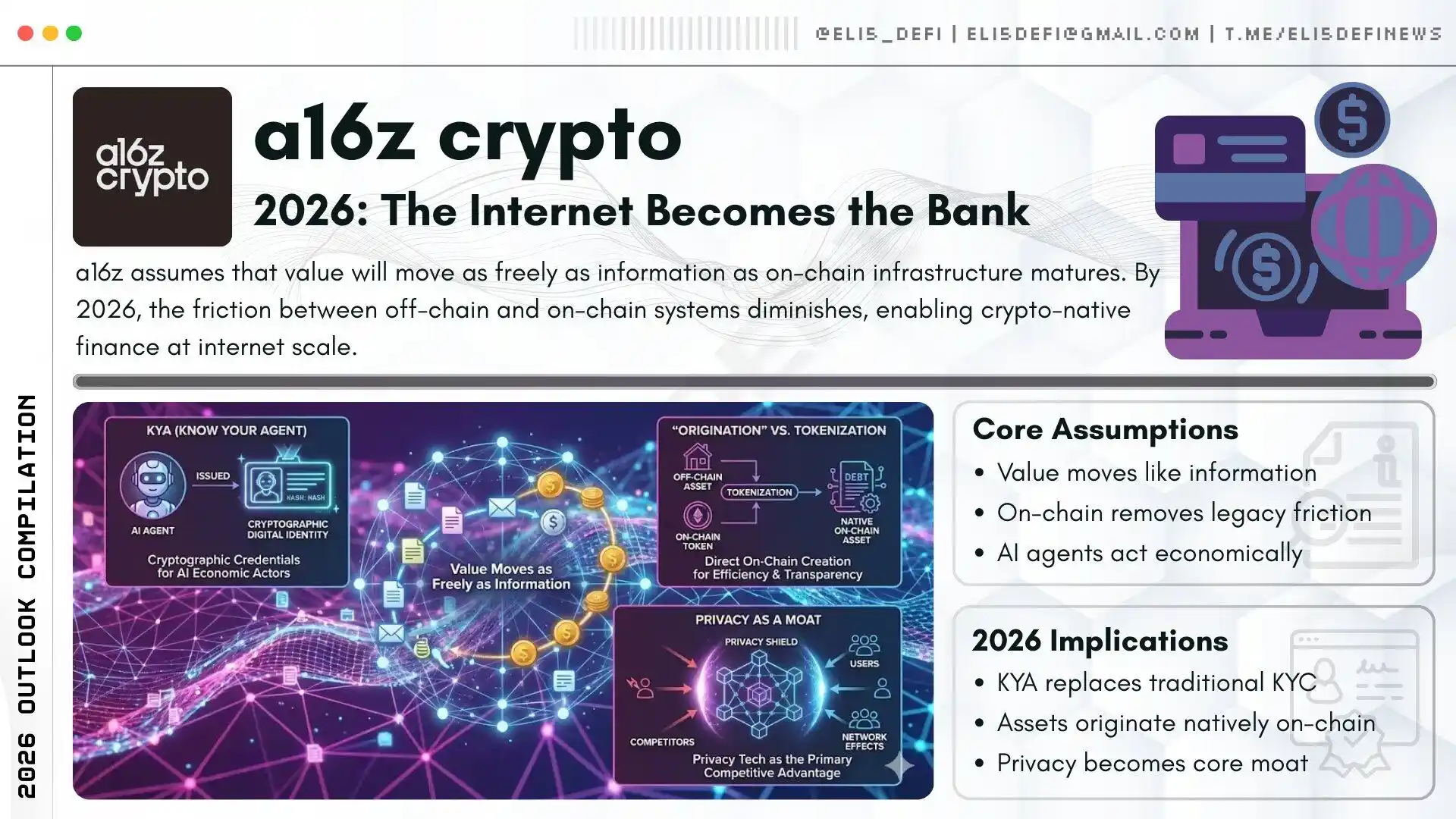
a16z crypto's outlook is that "the internet will become the bank." Their foundational belief is that value is beginning to flow as freely as information. They see the friction between the "off-chain" and "on-chain" worlds as the main bottleneck, and 2026 will see this friction eliminated through better infrastructure.

KYA (Know Your Agent)

A key expansion is the shift from KYC (Know Your Customer) to KYA. As AI agents become primary economic actors, they will need cryptographically signed credentials to transact, creating a new layer of identity infrastructure.

"Native Bonds" vs. Tokenization

a16z predicts a future where instead of tokenizing off-chain assets as in the past (e.g., buying a treasury bill and putting it on-chain), debt and assets will be originated directly on-chain to lower the cost of service and increase transparency.

Privacy Tech Moat

They argue that in the era of open-source code, privacy technology (and the ability to protect state privacy) will become the most important competitive moat for blockchains, creating powerful network effects for privacy-enabled chains.

Wealth Management for All

The combination of AI and crypto infrastructure will democratize complex wealth management strategies (e.g., asset rebalancing, tax-loss harvesting), previously available only to high-net-worth individuals, making them accessible to the masses.

Full report link: https://a16zcrypto.com/posts/article/big-ideas-things-excited-about-crypto-2026/


İlgili Sorular

QWhat is the consensus among major crypto institutions regarding the future of the four-year market cycle?

AMajor research institutions like Coinbase, A16Z Crypto, Four Pillars, Messari, and Delphi Digital agree that the traditional four-year speculative cycle driven by events like Bitcoin halvings is fading. It is being replaced by structural maturation, where value flows to 'ownership tokens' with revenue-sharing models and projects with real utility, rather than being driven by short-term speculation.

QWhat is the 'Agent Economy' predicted by institutions like Delphi Digital and a16z for 2026?

AThe 'Agent Economy' refers to a future where AI agents evolve beyond simple chatbots to become primary economic actors. These agents will autonomously manage funds, execute complex DeFi strategies, and optimize on-chain yields without human intervention. This will necessitate new infrastructure like KYA (Know Your Agent) identity protocols and crypto-native settlement layers for machine-to-machine microtransactions.

QAccording to Four Pillars, what will drive the emergence of 'Super Apps' in crypto?

AFour Pillars predicts that clearer U.S. regulatory policies, such as the potential passing of the GENIUS and CLARITY acts, will act as a catalyst. This regulatory clarity will allow the fragmented crypto application landscape to consolidate into user-friendly 'Super Apps.' These apps will abstract away blockchain's complexity, seamlessly integrating payments, investments, and lending functionalities, all powered by stablecoins.

QWhat new asset class does Messari predict will emerge in 2026, and what problem does it solve?

AMessari predicts the emergence of a new asset class called 'Ownership Tokens.' These tokens combine economic, legal, and governance rights. They are expected to solve the accountability crisis within DAOs (Decentralized Autonomous Organizations) and could potentially birth the first billion-dollar projects in that specific sector by better aligning incentives for token holders.

QHow does a16z Crypto envision the relationship between AI and wealth management evolving by 2026?

Aa16z Crypto envisions that the convergence of AI and crypto infrastructure will democratize sophisticated wealth management. Complex services like asset rebalancing and tax-loss harvesting, which were previously only accessible to high-net-worth individuals, will become available to the masses through automated AI agents operating on crypto payment rails.

İlgili Okumalar

20 Billion Valuation, Alibaba and Tencent Competing to Invest, Whose Money Will Liang Wenfeng Take?

DeepSeek, an AI startup founded by Liang Wenfeng, is reportedly in talks with Alibaba and Tencent for an external funding round that could value the company at over $20 billion. This marks a significant shift, as DeepSeek had previously relied solely on funding from its parent company,幻方量化 (Huanfang Quantitative), and had resisted external investment. The potential valuation would place DeepSeek among the top-tier AI model companies in China, comparable to competitors like MoonDark (valued at ~$18 billion) and ahead of recently listed firms like MiniMax and Zhipu. The funding—which could range from $600 million (for a 3% stake) to $2 billion (for 10%)—is seen as a move to secure resources for model development, retain talent, and support infrastructure needs, particularly as competition in inference models and AI agents intensifies. Both Alibaba and Tencent are eager to invest, not only for financial returns but also to integrate DeepSeek into their broader AI ecosystems. However, DeepSeek’s leadership is cautious about maintaining independence and may prefer financial investors over strategic ones to avoid being locked into a specific tech ecosystem. Alternative options, such as state-backed funds, offer longer-term capital and policy support but may come with slower decision-making and potential constraints on global expansion. With competing AI firms accelerating their IPO plans, DeepSeek’s window for securing optimal terms may be narrowing. The final decision will reflect a trade-off between capital, resources, and strategic independence.

marsbit37 dk önce

20 Billion Valuation, Alibaba and Tencent Competing to Invest, Whose Money Will Liang Wenfeng Take?

marsbit37 dk önce

After Losing 97% of Its Market Value, iQiyi Attempts to Use AI to Forcefully Extend Its Lifespan

After losing 97% of its market value since its 2018 peak, iQiyi is aggressively pivoting to AI in a desperate attempt to survive. At its 2026 World Conference, CEO Gong Yu announced an "AI Artist Library" with over 100 virtual performers and a new AIGC platform, "NaDou Pro," promising faster production and lower costs. This shift comes as the company faces severe financial distress: its market cap sits near delisting thresholds at $1.36 billion, with significant losses, declining membership revenue, and depleted cash flow. The AI strategy has sparked controversy. Top actors have issued legal threats against unauthorized digital replicas, while in Hengdian, over 134,000 background actors are seeing their already scarce job opportunities vanish as AI replaces them for background roles. iQiyi's move represents a fundamental shift from being a high-cost content buyer to a landlord" to becoming a "platform capitalist" that transfers production risk to creators. This contrasts with competitors like Douyin (TikTok's Chinese counterpart), which is investing heavily in *real* actor-led short dramas, betting that authentic human connection retains users better than AI-generated content. The article draws a parallel to the 1920s transition to "talkies," which made cinema musicians obsolete but ultimately enriched the art form. In contrast, iQiyi's AI drive is framed not as an artistic evolution but as a cost-cutting measure that could degrade storytelling, replacing genuine human emotion with algorithmically calculated stimulation and potentially numbing audiences' capacity for empathy. The core question remains: can a company focused solely on financial survival preserve the art of storytelling?

marsbit41 dk önce

After Losing 97% of Its Market Value, iQiyi Attempts to Use AI to Forcefully Extend Its Lifespan

marsbit41 dk önce

Only a 50% Chance of Passing This Year, Can the CLARITY Bill Succeed Before the Midterm Elections?

The CLARITY Act, which passed the House in July 2025 with strong bipartisan support (294-134), faces a critical juncture in the Senate. The Senate Banking Committee is expected to hold a markup soon, but key issues remain unresolved, including stablecoin yield provisions, DeFi regulations, and securing full Republican committee support. Other contentious points involve the Blockchain Regulatory Certainty Act (BRCA), ethics amendments for government officials, and SEC-related matters. The legislative calendar is tight, with limited time before the midterm elections. If the committee markup is delayed beyond mid-May, the chances of passage in 2026 drop significantly. Senator Cynthia Lummis has warned that failure this year could delay comprehensive crypto market structure legislation until 2030 or later. Galaxy estimates the probability of the CLARITY Act becoming law in 2026 is only about 50%. The bill provides crucial regulatory clarity by defining jurisdictional boundaries between the SEC and CFTC, establishing a path for decentralization, and bringing digital commodity intermediaries under federal regulation. Its passage is seen as vital before potential power shifts in the next Congress, which could bring less favorable leadership to key committees. The timeline is compressed, and the bill must compete for floor time with other priorities like Iran authorization and DHS appropriations. Key hurdles include finalizing the stablecoin yield compromise text, addressing law enforcement concerns about BRCA, and navigating political dynamics around SEC nominations. The outcome of the Banking Committee markup and the level of bipartisan support will be critical indicators of its future success.

marsbit1 saat önce

Only a 50% Chance of Passing This Year, Can the CLARITY Bill Succeed Before the Midterm Elections?

marsbit1 saat önce

İşlemler

Spot
Futures

Popüler Makaleler

SUPER Nasıl Satın Alınır

HTX.com’a hoş geldiniz! SuperFarm (SUPER) satın alma işlemlerini basit ve kullanışlı bir hâle getirdik. Adım adım açıkladığımız rehberimizi takip ederek kripto yolculuğunuza başlayın. 1. Adım: HTX Hesabınızı OluşturunHTX'te ücretsiz bir hesap açmak için e-posta adresinizi veya telefon numaranızı kullanın. Sorunsuzca kaydolun ve tüm özelliklerin kilidini açın. Hesabımı Aç2. Adım: Kripto Satın Al Bölümüne Gidin ve Ödeme Yönteminizi SeçinKredi/Banka Kartı: Visa veya Mastercard'ınızı kullanarak anında SuperFarm (SUPER) satın alın.Bakiye: Sorunsuz bir şekilde işlem yapmak için HTX hesap bakiyenizdeki fonları kullanın.Üçüncü Taraflar: Kullanımı kolaylaştırmak için Google Pay ve Apple Pay gibi popüler ödeme yöntemlerini ekledik.P2P: HTX'teki diğer kullanıcılarla doğrudan işlem yapın.Borsa Dışı (OTC): Yatırımcılar için kişiye özel hizmetler ve rekabetçi döviz kurları sunuyoruz.3. Adım: SuperFarm (SUPER) Varlıklarınızı SaklayınSuperFarm (SUPER) satın aldıktan sonra HTX hesabınızda saklayın. Alternatif olarak, blok zinciri transferi yoluyla başka bir yere gönderebilir veya diğer kripto para birimlerini takas etmek için kullanabilirsiniz.4. Adım: SuperFarm (SUPER) Varlıklarınızla İşlem YapınHTX'in spot piyasasında SuperFarm (SUPER) ile kolayca işlemler yapın.Hesabınıza erişin, işlem çiftinizi seçin, işlemlerinizi gerçekleştirin ve gerçek zamanlı olarak izleyin. Hem yeni başlayanlar hem de deneyimli yatırımcılar için kullanıcı dostu bir deneyim sunuyoruz.

177 Toplam GörüntülenmeYayınlanma 2024.12.11Güncellenme 2025.03.21

SUPER Nasıl Satın Alınır

Tartışmalar

HTX Topluluğuna hoş geldiniz. Burada, en son platform gelişmeleri hakkında bilgi sahibi olabilir ve profesyonel piyasa görüşlerine erişebilirsiniz. Kullanıcıların SUPER (SUPER) fiyatı hakkındaki görüşleri aşağıda sunulmaktadır.

活动图片