Firestorm erupts in Aave governance forum over CoW Swap fees

cointelegraph2025-12-14 tarihinde yayınlandı2025-12-14 tarihinde güncellendi

Özet

A dispute has erupted in the Aave governance forum regarding fee distribution from the protocol’s recent integration with CoW Swap. Aave DAO member EzR3aL raised concerns that swap fees—estimated at $200,000 weekly in ETH—are being sent to a private address controlled by Aave Labs rather than to the DAO treasury. They argue the DAO should receive this revenue, estimated at $10 million annually. Aave Labs responded that front-end components have always been under its control, while protocol-level changes remain under DAO oversight. It also claimed it funded the development of the integration adapters. However, several community members, including Aave-Chan Initiative founder Marc Zeller, criticized the move, arguing that the DAO funded the original adapter technology and that redirecting fees away from the treasury is unacceptable. The conflict underscores ongoing challenges in DAO governance and revenue distribution.

A dispute between the Aave decentralized autonomous organization (DAO), which governs the Aave decentralized finance (DeFi) protocol, and Aave Labs, the main development company for Aave products, over fees from the recently announced integration with decentralized exchange aggregator CoW Swap, continues to flare up.

The issue was raised by pseudonymous Aave DAO member EzR3aL, who said that the fees generated by crypto asset swaps using CoW Swap were going to a different onchain address, not the treasury of the Aave decentralized autonomous organization.

Instead, the fees are going to a private address controlled by Aave Labs. EzR3aL raised several questions, including why the DAO was not consulted before the fees were routed, and argued that the fees belong to the DAO.
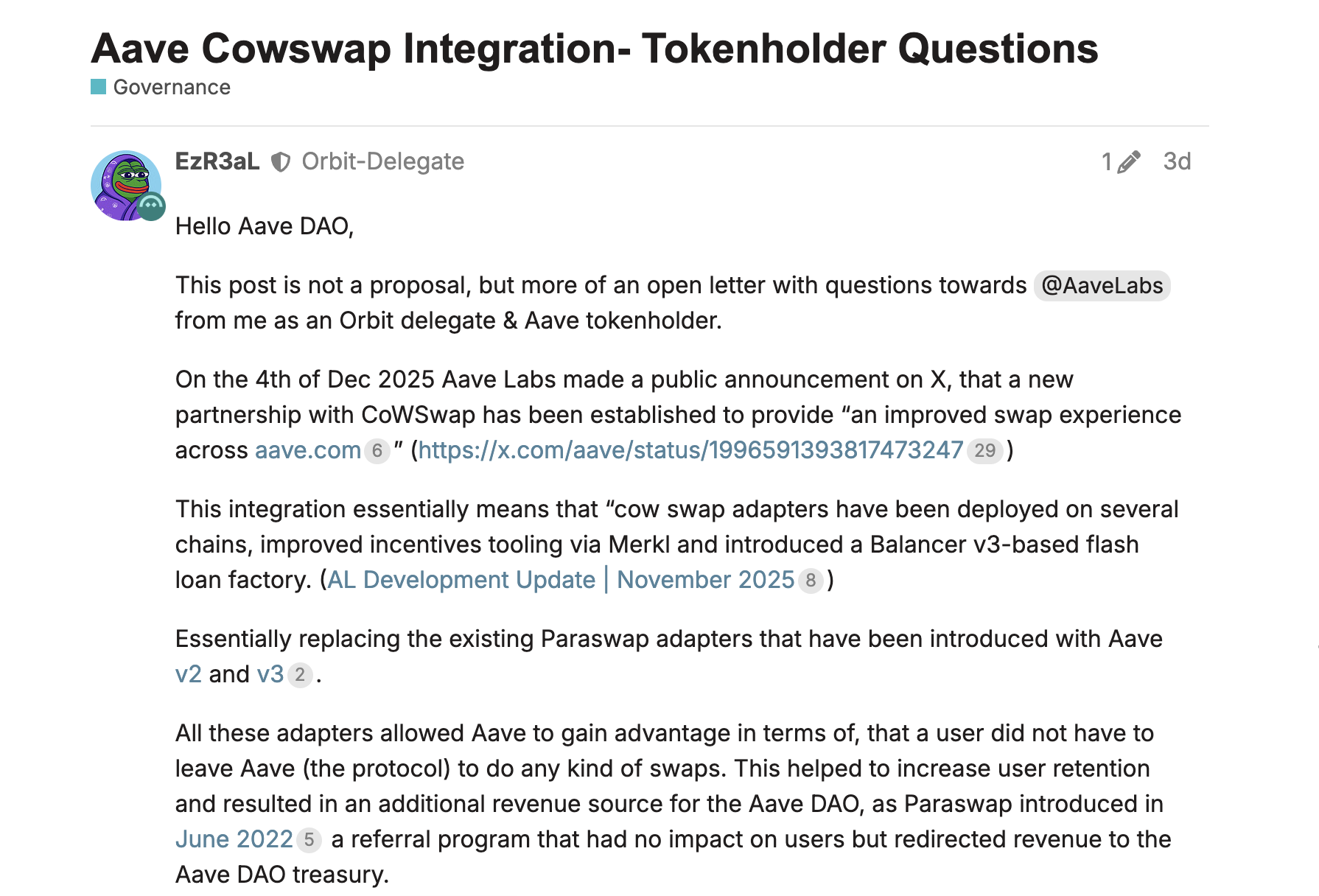
The governance forum post that sparked the debate. Source: Aave Governance

“Another entity, rather than the Aave DAO, is receiving at least $200,000 per week worth of Ether,” EzR3aL said, adding that this amounts to $10 million of potential annual revenue kept from the DAO.

Aave Labs responded that the front-end components for the website and application interfaces have always been the rightful purview of Aave Labs.

Related: Aave launches retail savings app with up to 9% APY to compete with banks

Protocol-level changes, like interest rate policies and approving changes to smart contract code, have always been subject to the DAO’s stewardship, Aave Labs said.

Aave Labs also claimed that it was the entity that funded the development of the “adapters,” the lines of code that allow swaps and other integrations to work.
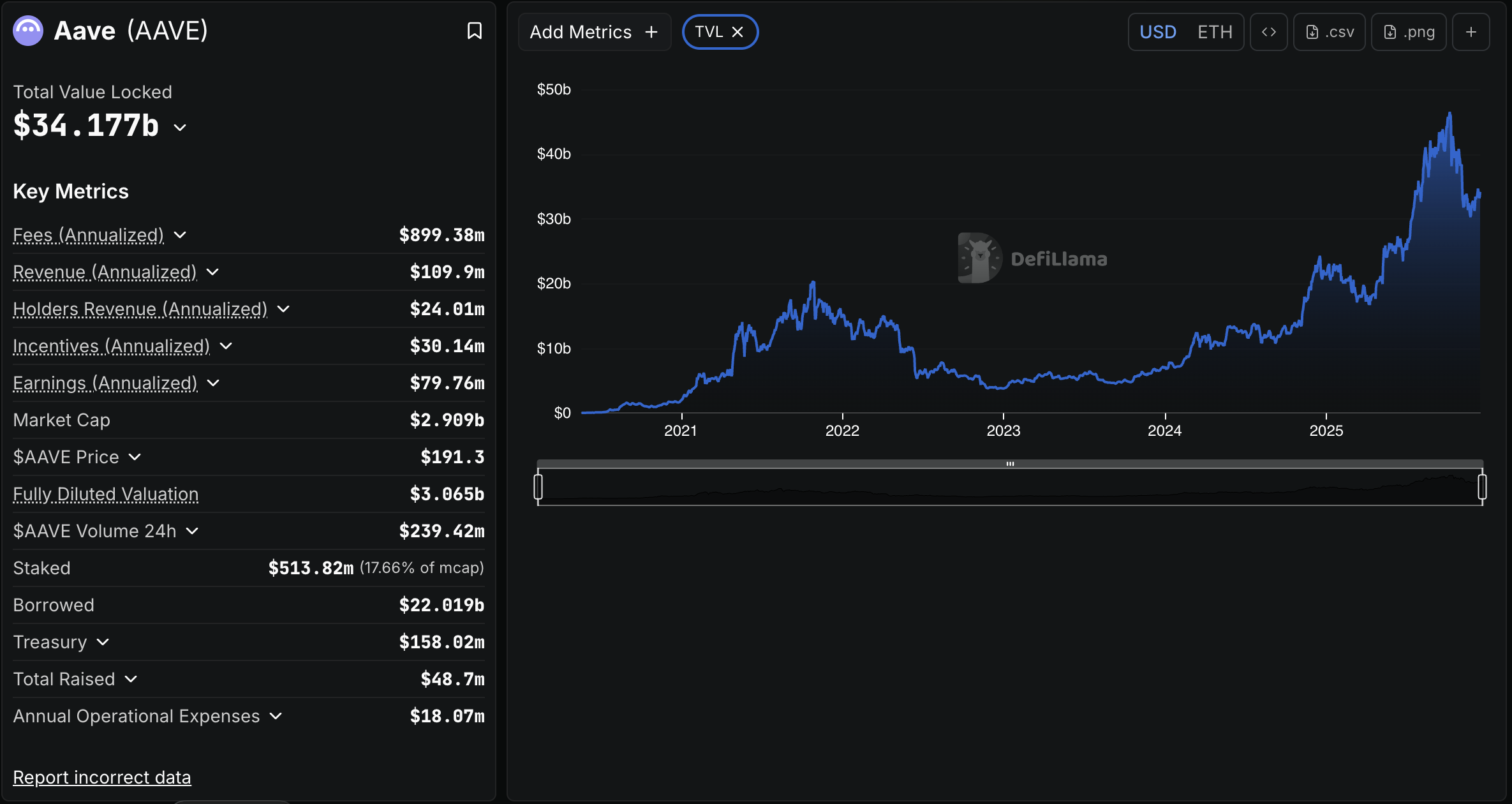
The total value locked in the Aave protocol and a financial overview of the DeFi platform. Source: DeFiLlama

However, the response did little to curb the tension, with several DAO members saying that the Aave DAO funded the development of the original adapter technology; therefore, the revenue from the integration should flow back to the DAO.

Marc Zeller, the founder of the Aave-Chan Initiative, a delegate platform serving the Aave governance community, said the decision to route the fees exclusively to Aave Labs is “extremely concerning.”

“Aave Labs, in the pursuit of their own monetization, redirected Aave user volume towards competition. This is unacceptable,” Zeller said.

Cointelegraph reached out to Aave Labs but did not obtain an immediate response by the time of publication.

The conflict highlights the complexities of running a DAO, which is a novel form of governance and organization that has benefits over traditional business structures but also brings its own unique challenges.

Magazine: The one thing these 6 global crypto hubs all have in common...

Trend Kriptolar

İlgili Okumalar

72-Hour Countdown: Can the CLARITY Act Pass 'Miracleously' Before the Senate Recess?

"CLARITY Act Faces 72-Hour Deadline as Senate Recess Looms The U.S. Senate has released its schedule for the week, omitting the crucial CLARITY Act and instead prioritizing another resolution for a procedural vote. With the Senate set to recess on August 7th, the bill now has only about 72 hours to advance. Senate procedural hurdles are steep. First, a cloture petition requires signatures from 16 Senators. Second, a vote requires 60 votes, meaning the Republican's 53 votes need at least 7 Democratic supporters—a key sticking point that has stalled the bill for two months. If passed, a further 30 hours of debate is required before a vote to proceed to consideration. If 16 signatures are not secured by Wednesday, the bill won't even face a vote. Even if filed Wednesday, the earliest vote would be Friday, leaving no time for actual consideration before recess. The major divide remains ethical provisions. The draft bans certain senior officials from issuing or sponsoring digital assets until 2029, but Democrats argue enforcement loopholes are too large, failing to constrain existing holdings and family arrangements. The White House has not formally responded to the revised draft. The Trump family's substantial crypto profits have further eroded Democratic trust. Stablecoin rewards remain contentious. Banks liken them to deposit interest, fearing capital flight, while crypto firms see them as anti-competitive protection for banks. A current compromise bans passive interest but allows rewards for trading, staking, and platform activity. Polymarket data shows the bill's probability of passing by 2026 has fallen to 31%, down 7 points in a week. Betting volume is around $3.7 million. Analyst Bernstein warns failure to advance the bill could trigger a 'bad news' sell-off, pressuring Bitcoin and crypto valuations. Industry advocates, including Grayscale and Treasury Secretary (presumably Yellen, though 'Besant' appears in text), have urged swift action with thousands of contacts to Congress, but progress remains slow. If missed this week, the bill delays until September, where a busier schedule and approaching midterms complicate passage. Democrats suggest a procedural vote this week could keep hope alive for September, but that hope is fading hourly. Market sentiment appears resigned to delay, though a surprise passage could trigger a significant positive reaction. The bill's arduous journey underscores its potential impact on the industry."

marsbit2 dk önce

72-Hour Countdown: Can the CLARITY Act Pass 'Miracleously' Before the Senate Recess?

marsbit2 dk önce

George Santos Settles Dispute with Commodity Futures Trading Commission (CFTC) Over Trading on His Own Kalshi Market

Former U.S. Representative George Santos has settled with the Commodity Futures Trading Commission (CFTC) over allegations he manipulated a futures contract on the Kalshi prediction market related to his potential attendance at a presidential State of the Union address. According to a July 31 order, Santos must repay $17,569.98, pay a $17,500 civil penalty, and is barred from trading on any CFTC-registered exchange for three years. The CFTC found that Santos made misleading public statements about his plans to attend the event while trading on the outcome. He first built a profitable position betting he would attend, then reversed course and profited by betting against his own attendance after travel disruptions. Santos earned profits totaling over $17,000 from these trades. Santos agreed to the settlement without admitting to the findings. His attorney stated Santos initially intended to attend but changed plans due to winter weather, denying any intent to mislead traders or manipulate the market. Kalshi detected the suspicious activity, froze his account, and provided evidence to the CFTC. The exchange is considering further actions and potential restitution for affected traders. While Kalshi also referred the matter to the Justice Department, a spokesperson has denied an investigation exists. The CFTC settlement remains the only confirmed federal action regarding these trades.

cryptonews.ru7 dk önce

George Santos Settles Dispute with Commodity Futures Trading Commission (CFTC) Over Trading on His Own Kalshi Market

cryptonews.ru7 dk önce

İşlemler

Spot

Popüler Makaleler

AAVE Nasıl Satın Alınır

HTX.com’a hoş geldiniz! Aave Protocol (AAVE) satın alma işlemlerini basit ve kullanışlı bir hâle getirdik. Adım adım açıkladığımız rehberimizi takip ederek kripto yolculuğunuza başlayın. 1. Adım: HTX Hesabınızı OluşturunHTX'te ücretsiz bir hesap açmak için e-posta adresinizi veya telefon numaranızı kullanın. Sorunsuzca kaydolun ve tüm özelliklerin kilidini açın. Hesabımı Aç2. Adım: Kripto Satın Al Bölümüne Gidin ve Ödeme Yönteminizi SeçinKredi/Banka Kartı: Visa veya Mastercard'ınızı kullanarak anında Aave Protocol (AAVE) satın alın.Bakiye: Sorunsuz bir şekilde işlem yapmak için HTX hesap bakiyenizdeki fonları kullanın.Üçüncü Taraflar: Kullanımı kolaylaştırmak için Google Pay ve Apple Pay gibi popüler ödeme yöntemlerini ekledik.P2P: HTX'teki diğer kullanıcılarla doğrudan işlem yapın.Borsa Dışı (OTC): Yatırımcılar için kişiye özel hizmetler ve rekabetçi döviz kurları sunuyoruz.3. Adım: Aave Protocol (AAVE) Varlıklarınızı SaklayınAave Protocol (AAVE) satın aldıktan sonra HTX hesabınızda saklayın. Alternatif olarak, blok zinciri transferi yoluyla başka bir yere gönderebilir veya diğer kripto para birimlerini takas etmek için kullanabilirsiniz.4. Adım: Aave Protocol (AAVE) Varlıklarınızla İşlem YapınHTX'in spot piyasasında Aave Protocol (AAVE) ile kolayca işlemler yapın.Hesabınıza erişin, işlem çiftinizi seçin, işlemlerinizi gerçekleştirin ve gerçek zamanlı olarak izleyin. Hem yeni başlayanlar hem de deneyimli yatırımcılar için kullanıcı dostu bir deneyim sunuyoruz.

445 Toplam GörüntülenmeYayınlanma 2024.12.11Güncellenme 2026.06.02

AAVE Nasıl Satın Alınır

Tartışmalar

HTX Topluluğuna hoş geldiniz. Burada, en son platform gelişmeleri hakkında bilgi sahibi olabilir ve profesyonel piyasa görüşlerine erişebilirsiniz. Kullanıcıların AAVE (AAVE) fiyatı hakkındaki görüşleri aşağıda sunulmaktadır.

活动图片