Firestorm erupts in Aave governance forum over CoW Swap fees

cointelegraph2025-12-14 tarihinde yayınlandı2025-12-14 tarihinde güncellendi

Özet

A dispute has erupted in the Aave governance forum regarding fee distribution from the protocol’s recent integration with CoW Swap. Aave DAO member EzR3aL raised concerns that swap fees—estimated at $200,000 weekly in ETH—are being sent to a private address controlled by Aave Labs rather than to the DAO treasury. They argue the DAO should receive this revenue, estimated at $10 million annually. Aave Labs responded that front-end components have always been under its control, while protocol-level changes remain under DAO oversight. It also claimed it funded the development of the integration adapters. However, several community members, including Aave-Chan Initiative founder Marc Zeller, criticized the move, arguing that the DAO funded the original adapter technology and that redirecting fees away from the treasury is unacceptable. The conflict underscores ongoing challenges in DAO governance and revenue distribution.

A dispute between the Aave decentralized autonomous organization (DAO), which governs the Aave decentralized finance (DeFi) protocol, and Aave Labs, the main development company for Aave products, over fees from the recently announced integration with decentralized exchange aggregator CoW Swap, continues to flare up.

The issue was raised by pseudonymous Aave DAO member EzR3aL, who said that the fees generated by crypto asset swaps using CoW Swap were going to a different onchain address, not the treasury of the Aave decentralized autonomous organization.

Instead, the fees are going to a private address controlled by Aave Labs. EzR3aL raised several questions, including why the DAO was not consulted before the fees were routed, and argued that the fees belong to the DAO.
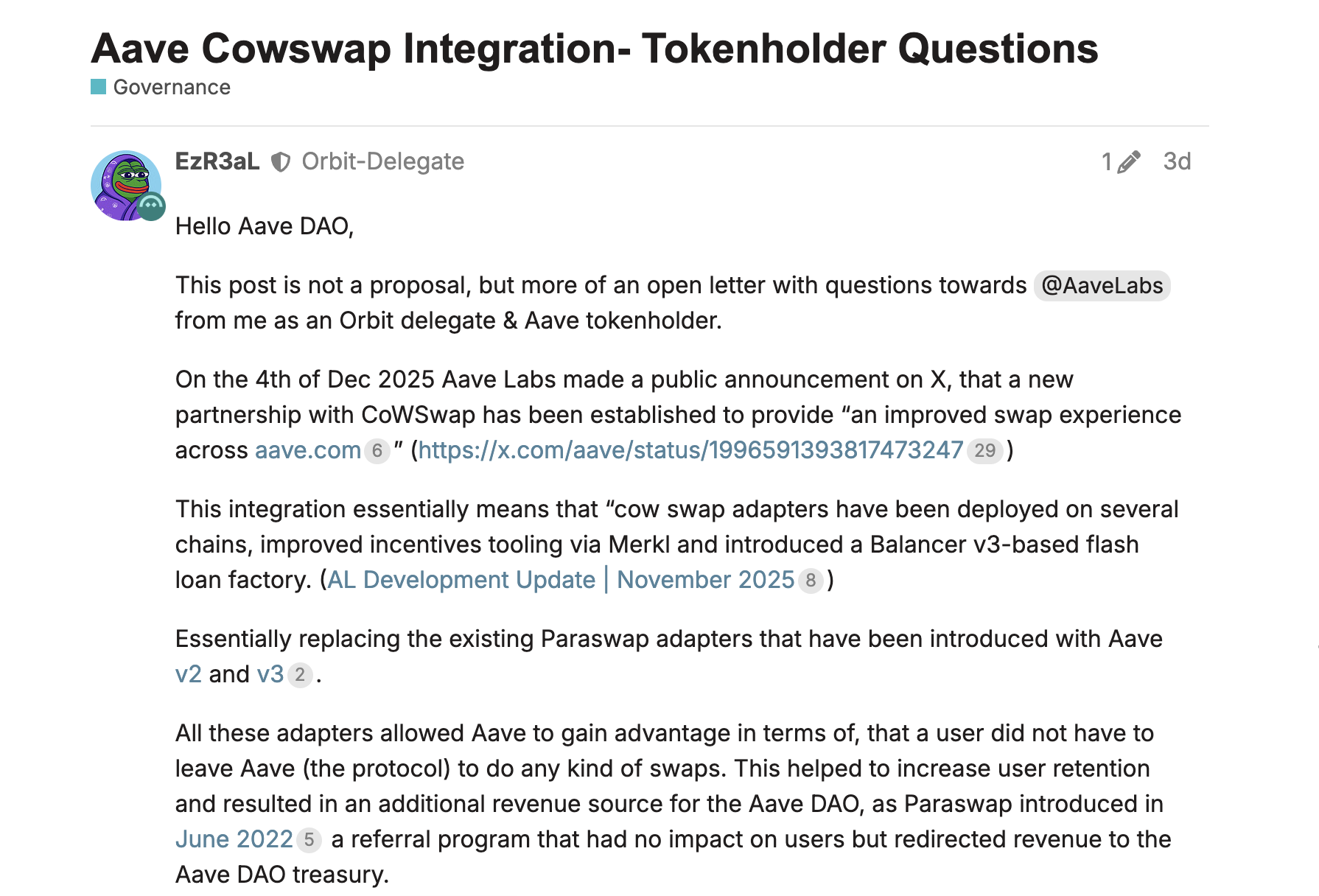
The governance forum post that sparked the debate. Source: Aave Governance

“Another entity, rather than the Aave DAO, is receiving at least $200,000 per week worth of Ether,” EzR3aL said, adding that this amounts to $10 million of potential annual revenue kept from the DAO.

Aave Labs responded that the front-end components for the website and application interfaces have always been the rightful purview of Aave Labs.

Related: Aave launches retail savings app with up to 9% APY to compete with banks

Protocol-level changes, like interest rate policies and approving changes to smart contract code, have always been subject to the DAO’s stewardship, Aave Labs said.

Aave Labs also claimed that it was the entity that funded the development of the “adapters,” the lines of code that allow swaps and other integrations to work.
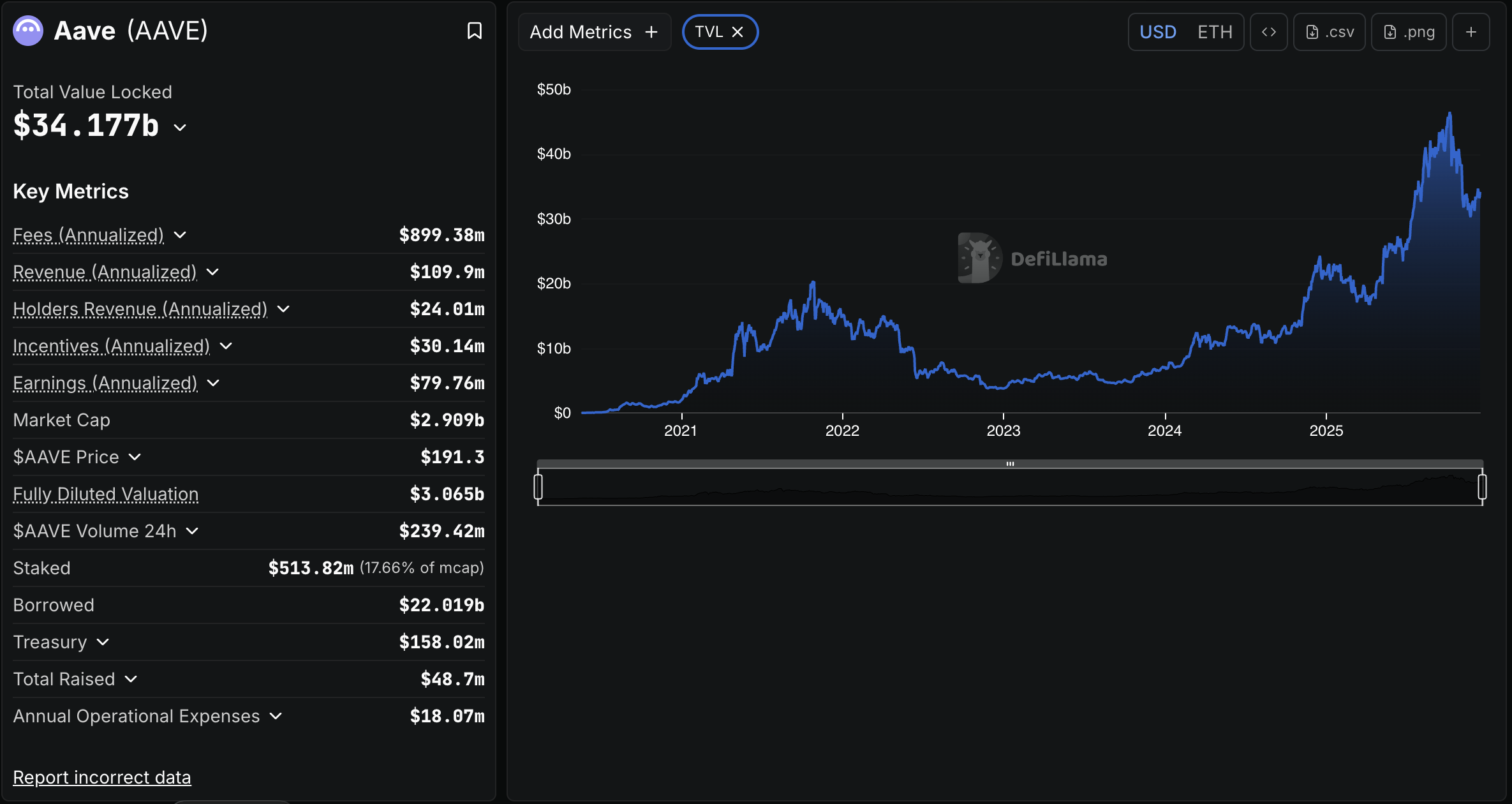
The total value locked in the Aave protocol and a financial overview of the DeFi platform. Source: DeFiLlama

However, the response did little to curb the tension, with several DAO members saying that the Aave DAO funded the development of the original adapter technology; therefore, the revenue from the integration should flow back to the DAO.

Marc Zeller, the founder of the Aave-Chan Initiative, a delegate platform serving the Aave governance community, said the decision to route the fees exclusively to Aave Labs is “extremely concerning.”

“Aave Labs, in the pursuit of their own monetization, redirected Aave user volume towards competition. This is unacceptable,” Zeller said.

Cointelegraph reached out to Aave Labs but did not obtain an immediate response by the time of publication.

The conflict highlights the complexities of running a DAO, which is a novel form of governance and organization that has benefits over traditional business structures but also brings its own unique challenges.

Magazine: The one thing these 6 global crypto hubs all have in common...

Trend Kriptolar

İlgili Okumalar

Token FOLD Auction Imminent, What is The Interfold, Supported by Vitalik?

**Title:** FOLD Token Auction Approaches: What is The Interfold, Supported by Vitalik? **Summary:** The Interfold, a "confidential coordination infrastructure" previously known as Enclave, is launching its functional token FOLD via a Uniswap Continuous Clearing Auction (CCA) starting July 8th. Endorsed by Ethereum co-founder Vitalik Buterin in May, the protocol tackles the core problem of governance bribery in decentralized voting (e.g., on platforms like Votium) by enabling multiple parties to compute a verifiable result without exposing their private input data. Its core technology, the Encrypted Execution Environment (E3), uses a distributed network of "Ciphernodes" that perform computations on fully encrypted data using Fully Homomorphic Encryption (FHE), with process integrity verified by Zero-Knowledge (ZK) proofs and decryption keys managed via Decentralized Threshold Cryptography (DTC) to eliminate a single point of trust. The primary application is CRISP (Coercion-Resistant Impartial Selection Protocol) for DAO governance, which ensures encrypted voting, "receipt-free" votes to prevent bribery, and verifiable tallying. The Interfold, developed by the Gnosis Guild team (creators of the Zodiac DAO tooling), positions itself as a focused solution to make on-chain voting truly un-buyable, realizing the vision of Vitalik's earlier MACI (Minimal Anti-Collusion Infrastructure) framework without its reliance on a single trusted coordinator. FOLD tokens will be used for Ciphernode staking, paying for computation requests, and protocol governance. Following the 48-hour auction, there is a 40-day cooling period where tokens can only be staked, with the official Token Generation Event (TGE) expected around August 19th.

Foresight News4 dk önce

Token FOLD Auction Imminent, What is The Interfold, Supported by Vitalik?

Foresight News4 dk önce

Bridging Traditional Funds and DeFi: Who Will Capture the Next Decade's RWA Dividends?

Bridging Traditional Funds and DeFi: Who Will Capture the RWA Decade's Value? Tokenization of real-world assets (RWA) is merging the 24/7, permissionless world of DeFi with the time-bound, regulated world of traditional finance. While the complexity is immense, the infrastructure layer enabling this fusion holds significant value. The total value of on-chain tokenized real-world assets now exceeds $33 billion. While tokenized U.S. Treasuries dominate, their share has fallen from 55% to under 45% in a year as other assets like institutional and private credit grow. The key differentiator for on-chain assets is *composability*, allowing capital to be recycled across multiple yield-generating strategies simultaneously. However, tokenized funds remain regulated products with daily NAV updates, KYC requirements, and redemption windows. Bridging these to DeFi requires solving core conflicts: pricing assets between NAV updates, enforcing compliance without stifling DeFi activity, and maintaining accurate accounting during cross-chain transfers. Solutions like the Centrifuge V3 architecture, in collaboration with LayerZero, propose a hub-and-spoke model. A single authoritative hub chain manages NAV, compliance, and accounting, while LayerZero's messaging layer syncs this data to spokechains where tokens can be freely composed in DeFi. This creates a high-barrier, essential middleware layer. The major incentive for institutions is the potential for recursive yield strategies—for example, depositing into a tokenized Treasury fund, borrowing stablecoins against it, and redeploying those funds into another yield-bearing asset, amplifying returns. Yet, risks remain: mismatches between on-chain instant redemptions and off-chain fund limits (as seen in recent private credit fund runs), pricing arbitrage due to NAV lags, and cross-chain settlement failures. Infrastructure must solve these while maintaining regulatory compliance. Just as SWIFT and Visa captured immense value as financial plumbing, the entities that build the robust middleware connecting traditional finance and DeFi are positioned to capture the next decade's value in the RWA space.

Foresight News29 dk önce

Bridging Traditional Funds and DeFi: Who Will Capture the Next Decade's RWA Dividends?

Foresight News29 dk önce

İşlemler

Spot

Popüler Makaleler

AAVE Nasıl Satın Alınır

HTX.com’a hoş geldiniz! Aave Protocol (AAVE) satın alma işlemlerini basit ve kullanışlı bir hâle getirdik. Adım adım açıkladığımız rehberimizi takip ederek kripto yolculuğunuza başlayın. 1. Adım: HTX Hesabınızı OluşturunHTX'te ücretsiz bir hesap açmak için e-posta adresinizi veya telefon numaranızı kullanın. Sorunsuzca kaydolun ve tüm özelliklerin kilidini açın. Hesabımı Aç2. Adım: Kripto Satın Al Bölümüne Gidin ve Ödeme Yönteminizi SeçinKredi/Banka Kartı: Visa veya Mastercard'ınızı kullanarak anında Aave Protocol (AAVE) satın alın.Bakiye: Sorunsuz bir şekilde işlem yapmak için HTX hesap bakiyenizdeki fonları kullanın.Üçüncü Taraflar: Kullanımı kolaylaştırmak için Google Pay ve Apple Pay gibi popüler ödeme yöntemlerini ekledik.P2P: HTX'teki diğer kullanıcılarla doğrudan işlem yapın.Borsa Dışı (OTC): Yatırımcılar için kişiye özel hizmetler ve rekabetçi döviz kurları sunuyoruz.3. Adım: Aave Protocol (AAVE) Varlıklarınızı SaklayınAave Protocol (AAVE) satın aldıktan sonra HTX hesabınızda saklayın. Alternatif olarak, blok zinciri transferi yoluyla başka bir yere gönderebilir veya diğer kripto para birimlerini takas etmek için kullanabilirsiniz.4. Adım: Aave Protocol (AAVE) Varlıklarınızla İşlem YapınHTX'in spot piyasasında Aave Protocol (AAVE) ile kolayca işlemler yapın.Hesabınıza erişin, işlem çiftinizi seçin, işlemlerinizi gerçekleştirin ve gerçek zamanlı olarak izleyin. Hem yeni başlayanlar hem de deneyimli yatırımcılar için kullanıcı dostu bir deneyim sunuyoruz.

413 Toplam GörüntülenmeYayınlanma 2024.12.11Güncellenme 2026.06.02

AAVE Nasıl Satın Alınır

Tartışmalar

HTX Topluluğuna hoş geldiniz. Burada, en son platform gelişmeleri hakkında bilgi sahibi olabilir ve profesyonel piyasa görüşlerine erişebilirsiniz. Kullanıcıların AAVE (AAVE) fiyatı hakkındaki görüşleri aşağıda sunulmaktadır.

活动图片