This Week's Highlights
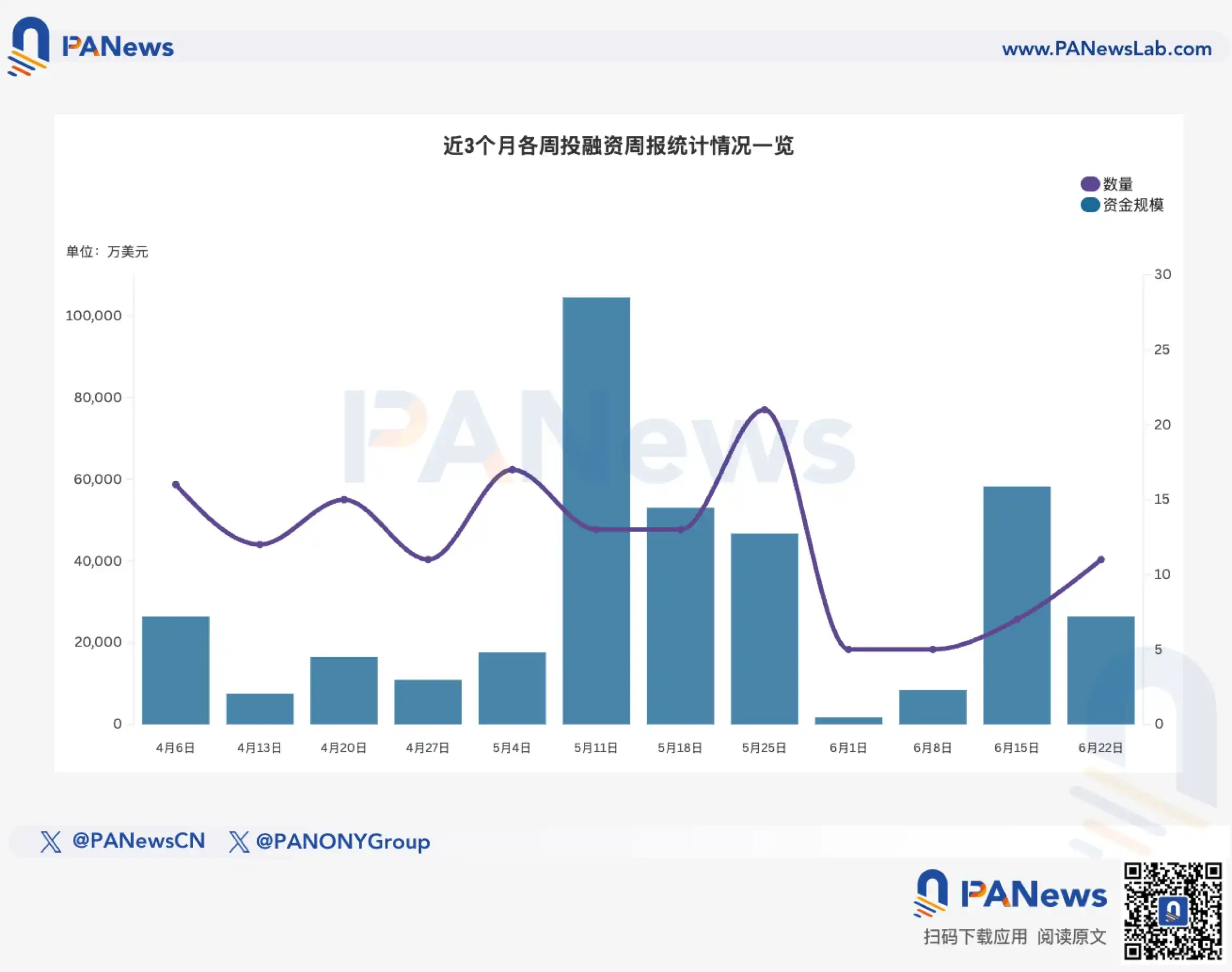
Stablecoin payments continue to heat up, with on-chain financial infrastructure and compliant asset sectors becoming the focal points of this week's financing. According to PANews' incomplete statistics, there were 11 blockchain financing events globally last week (6.15-6.21), with a total funding scale exceeding $264 million. An overview is as follows:
- The DeFi sector announced 1 financing event, with decentralized reinsurance protocol Re securing a strategic investment from Coinbase Ventures;
- Infrastructure & Tools announced 6 financing events, among which stablecoin payment infrastructure company Trace Finance completed a $32 million Series A round led by CoinFund;
- The Centralized Finance sector announced 3 financing events, with Galaxy Ventures announcing its co-leadership with CIM in a $140 million Series A round for Karta;
- The Prediction Market sector announced 1 financing event, with NewGen investing $10 million in prediction market platform K25.ai to complete its Pre-A round.
DeFi
Decentralized Reinsurance Protocol Re Secures Strategic Investment from Coinbase Ventures
The decentralized reinsurance protocol Re announced it has secured a strategic investment from Coinbase Ventures. This investment will support Re in bringing reinsurance capital on-chain, thereby opening up one of the world's largest and most traditional financial markets to a broader range of investors.
Infrastructure & Tools
Stablecoin Payment Infrastructure Company Trace Finance Completes $32 Million Series A Round Led by CoinFund
Stablecoin payment infrastructure company Trace Finance announced the completion of a $32 million Series A funding round, aimed at expanding its business in Latin America and the Asia-Pacific region. This round was led by CoinFund, with follow-on investments from Coinbase Ventures, Haun Ventures, Jump Capital, Paxos, Chainlink Labs, HOF Capital, and other institutional investors. Angel investors, including Circle co-founder Sean Neville, Solana Labs co-founder Anatoly Yakovenko, Mesh co-founder and CEO Bam Azizi, and Ricardo Villela Marino, partner and vice chairman of Latin America's largest bank Itaú Unibanco, also participated in this round.
Founded in 2021, Trace stated that it has processed over $10 billion in institutional cross-border transaction volume to date and is a primary infrastructure provider for four major global payment service providers in Latin America (including dLocal). Its CEO, Bernardo Brites, mentioned that Trace is developing new settlement products and has grown its staff from 25 at the beginning of the year to the current 48.
Stablecoin Compliance Startup Range Completes $8.3 Million Series A Round
Stablecoin compliance startup Range completed an oversubscribed $8.3 million Series A round, bringing its total funding to $11 million. This round saw participation from traditional fintech funds TX Ventures, SixThirty, and crypto VCs Maven 11 Capital, Onigiri Capital, among others. Range provides a unified platform for institutions that use both stablecoins and fiat currency. Its core products include: first, Unify, which integrates bank accounts, custodians, wallets, and exchanges into a real-time ledger system, currently safeguarding over $30 billion in client assets and connected to more than 10,000 institutions; second, Protect, a pre-transaction control layer that screens on-chain transactions for sanctions, fraud, compliance, and internal control rules. Range claims to track approximately 99.41% of stablecoin payments and tens of billions in monthly payment volume. The funding will be used to expand product, engineering, and commercial teams, and to integrate more networks.
Digital Asset Depository Receipt Issuer RDC Completes $7 Million Funding Round Led by LiveOak Ventures
Digital asset and alternative asset depository receipt issuer Receipts Depositary Corporation (RDC) completed a new $7 million funding round led by LiveOak Ventures, with participation from Hivemind Capital, Onigiri Capital, OTC Markets Group, GTS, and Redbeard Ventures, among others. The new funds are intended to accelerate the development of its digital asset depository receipt products and provide U.S. investors with compliant securitized products and infrastructure services covering multiple asset classes.
EarnOS Completes $6 Million Funding Round Led by 1kx
Digital advertising startup EarnOS announced the completion of a $6 million pre-Series A funding round led by 1kx, with participation from Coinbase Ventures, Circle Ventures, and Social Graph Ventures. The company stated that its application named "ero" is also nearing the end of its testing phase and will officially launch in the US, Canada, Australia, and the UK. Ero aims to help brands verify the authenticity of web traffic, reduce waste caused by bots, and reward "authentic digital behavior."
EarnOS also announced that it has received a four-year, $12.5 million non-dilutive strategic investment from Verona (formerly XION). EarnOS's ero application is partly powered by technology from Verona, which handles the application's "global verification, registration, and reward distribution."
On-Chain Collectibles Infrastructure Renaiss Completes $1.5 Million Funding Round Led by YZi Labs
RWA infrastructure project Renaiss raised $1.5 million in its first funding round, led by YZi Labs, with participation from Gate Ventures, Hash Global, XIN Family, and others. Built on BNB Chain, Renaiss uses RenaissOS to transform offline independent vaults and card shops into on-chain verification nodes, utilizing multi-signature mechanisms to achieve verifiable custody status and composable liquidity for physical collectibles. The project has launched trading card categories, allowing users to trade on-chain and transfer ownership on Renaiss.xyz. Since its test version went live in November 2025, the platform has recorded approximately $20 million in revenue and has over 260,000 users, with primary growth coming from the Asian market. The new funds will be used to expand the vault network, add more collectible categories, launch DeFi and AI agent integrations, and improve capital efficiency.
Litecoin Treasury Company Lite Strategy Leads $1 Million Strategic Investment in LitVM
Nasdaq-listed Litecoin treasury company Lite Strategy announced leading a $1 million strategic investment in LitVM, while also gaining governance participation rights and potential subscription opportunities for future tokens. LitVM is a zero-knowledge Layer 2 scaling network built on Litecoin. The new funding will support its efforts to introduce smart contract capabilities and a programmable application layer to Litecoin following its mainnet launch.
Prediction Market
NewGen Invests $10 Million in Prediction Market Platform K25.ai to Complete its Pre-A Round
Nasdaq-listed company NewGenIVF Group (stock ticker: NIVF) announced an additional $4 million investment in prediction market platform K25.ai, completing the company's $10 million Pre-A funding round. The company's valuation reaches $100 million, with NewGenIVF Group expected to hold a 10% stake. In addition to the equity investment, NewGenIVF Group also holds exclusive agency rights for K25.ai in the Asia-Pacific region.
K25.ai is an AI-native livestreaming and prediction market platform for the Asia-Pacific region. The company has not officially launched its product yet and is currently seeking relevant regulatory approvals in specific markets. This investment follows an initial $2 million round announced in May 2026 and a subsequent $4 million investment announced on June 4, 2026. With the completion of the Pre-A round, K25.ai has initiated its Series A financing. The company stated that this round will be used for product launch, obtaining regulatory approvals in specific Asian markets, and regional expansion.
Centralized Finance
Galaxy Ventures Announces Co-Leading Karta's $140 Million Series A Round with CIM
Galaxy Ventures announced its co-leadership with CIM in Karta's $140 million Series A funding round. Galaxy Ventures stated that Karta grew 10x in 2025, and its revenue and total payment volume increased 4x quarter-over-quarter in Q1 2026, with a target annualized total payment volume of $1.2 billion by year-end. Karta is a new type of US credit card for global travelers, requiring no US Social Security Number (SSN) for application.
Reportedly, Karta is dedicated to providing premium credit card products issued in the US for global high-net-worth (HNW) individuals. The platform combines stablecoin infrastructure with AI technology, breaking away from traditional FICO score reliance. Through partnerships with over 80 major global private banks and brokerages (such as Raymond James, Itaú, etc.), it offers unsecured credit underwriting based on users' verified assets at these institutions. Additionally, the card offers zero foreign transaction fees and 24/7 AI-native concierge service via WhatsApp.
Instant Payments Platform Interchecks Completes $50 Million Series C Round
Instant payments platform Interchecks announced the completion of a $50 million Series C funding round, with investors including Bettor Capital, Commerce Ventures, Decades Holdings, and Thayer Street Partners. The company also launched its debit card-based Account Funding Transactions (AFT) product, enabling real-time funding of compliant accounts via debit card networks, integrated with risk control features such as account verification, real-time duplicate card detection, custom limits, and suspicious activity monitoring. AFT, together with the previously launched Pay-by-Bank, is consolidated into a single API, targeting scenarios like account-to-account transfers, neobank, online brokerage, and crypto wallet funding. Interchecks claims to have processed over $50 billion in transactions since its founding a decade ago and has been profitable since 2023.
Paradigm Leads $9 Million Funding Round for El Dorado, Boosting Latin American Cross-Border Payment Infrastructure
Venture capital firm Paradigm led a $9 million Series A round for Latin American cross-border payment application El Dorado, with participation from Coinbase Ventures and Verda Ventures. El Dorado stated that the cross-border payment scale in Latin America is nearly $1 trillion, currently dominated by remittances from the US to Latin America, with about 60% related to B2B trade payments. The company focuses on covering "internal corridors" not serviced by traditional giants, such as Brazil-Bolivia, and already has over 100,000 active users and has processed more than 5 million transactions. El Dorado also launched cross-border payment services for businesses, integrating stablecoin and fiat channels, and has served over 100 enterprises, primarily for importing electric vehicles from China. This business is built on the Layer1 blockchain Tempo, incubated by Paradigm and Stripe.
Acquisition
MANTRA Acquired by Strategic Investor Inveniam, Betting on RWA and AI Data Integration
MANTRA, a public chain focused on RWA asset tokenization, will be fully acquired by its strategic investor Inveniam Capital Partners, with the transaction expected to be completed in the third quarter of this year. Inveniam previously invested $20 million in MANTRA before its restructuring in 2025. MANTRA holds a VASP license issued by the Dubai Virtual Assets Regulatory Authority (VARA), allowing it to operate a digital asset exchange and provide brokerage, proprietary management, and investment services. The two parties previously co-developed the Layer2 network NVNM Chain, positioned to register identities and define permissions for autonomous AI agents in compliant scenarios, while recording on-chain evidence for independent verification by regulators and counterparties.