Fidelity 2026 Crypto Market Outlook: We May Be Entering a Supercycle, Bull Market to Last for Years

marsbit2026-01-06 tarihinde yayınlandı2026-01-06 tarihinde güncellendi

Özet

Fidelity's 2026 crypto market outlook suggests the traditional four-year cycle may be ending as institutional adoption of digital assets accelerates. Key trends include growing national crypto reserves, exemplified by the US and Kyrgyzstan establishing strategic holdings, and increasing corporate adoption, with over 100 public companies now holding significant amounts. While short-term investors should remain cautious due to recent volatility, long-term holders may still benefit. The report speculates whether the market is entering a multi-year "super cycle" rather than facing an immediate bear market, though confirmation may come by mid-2026. Ultimately, Bitcoin's long-term proposition as a non-inflationary store of value remains compelling for patient investors.

Author: Fidelity Investments

Compiled by: Nicky, Foresight News

TL;DR:

Investors looking to enter the market for short-term gains should perhaps be cautious. However, those planning to hold for the long term may not have missed the opportunity yet. This year, more governments and corporations worldwide have incorporated digital assets into their balance sheets. Due to this new demand, some investors believe the traditional four-year cycle of cryptocurrency may have come to an end.

In March, President Trump signed an executive order establishing a strategic Bitcoin reserve for the U.S. government. The order formally designated all Bitcoin currently held by the government, along with several other cryptocurrencies, as reserve assets.

While the full impact of this executive order remains to be seen, 2025 made one thing clear: cryptocurrency is gaining mainstream acceptance. It is no longer viewed merely as a volatile form of speculation by "degens" (an abbreviation for "degenerate," a term cryptocurrency traders use to describe themselves due to the market's wild nature and the mindset required to survive it), but is now recognized by the U.S. government as a store of value.

What does this mean for the cryptocurrency market as we head into 2026? Does the significant price correction we are currently witnessing mean the bull market is over? Is it too late to invest in cryptocurrency now? Here are several key trends to watch.

Will More Countries Adopt Crypto Reserves?

Many countries around the world currently hold some amount of cryptocurrency, but few have formally established crypto reserves—designating their holdings as financial assets serving a strategic national interest.

This began to change in 2025 (most notably with President Trump's executive order in March) and is likely to continue progressing into 2026.

For example, in September, Kyrgyzstan passed a bill to establish its own cryptocurrency reserve. Elsewhere, more countries are beginning to explore this possibility. Brazil's Congress recently advanced a bill that would allow up to 5% of the country's international reserves to be held in Bitcoin (though it remains to be seen if the bill will become law).

"Fidelity Digital Assets believes that more countries may purchase Bitcoin in the future, driven by game theory," said Chris Kuiper, Vice President of Research at Fidelity Digital Assets. "If more countries hold Bitcoin as part of their foreign exchange reserves, other nations may feel competitive pressure, increasing the impetus for them to do the same."

What does this mean for prices? "From a simple supply and demand economics perspective, any additional demand for Bitcoin could push prices higher," Kuiper said. "Of course, the key is how large the incremental demand is and whether other investors are selling or holding."

Will Corporations Continue Buying Cryptocurrency?

Governments are not the only potential source of new demand in 2026. Corporations are likely to participate increasingly—some of which began adding Bitcoin and other cryptocurrencies to their balance sheets in 2025. To date, the most prominent example is software and analytics company Strategy (formerly MicroStrategy, stock ticker MSTR), which has been steadily purchasing Bitcoin since 2020. However, this year more companies adopted this practice, turning it into a trend. As of November, well over 100 publicly traded companies (both domestic and international) hold cryptocurrency. About 50 of these companies currently hold over 1 million Bitcoins.

"There is clearly an arbitrage opportunity where some companies can leverage their market position or financing channels to raise funds for purchasing Bitcoin," Kuiper said. "Part of this stems from investment mandates, as well as geographic and regulatory issues. For example, investors who cannot buy Bitcoin directly might choose to gain exposure through these companies or the securities they issue."

On the surface, corporate purchases of cryptocurrency add to market demand, which helps drive up asset prices. But investors should also be aware of the risks. "If these companies choose or are forced to sell some of their digital assets—for instance, during a bear market—this could certainly create downward pressure on the price of the Bitcoin or other digital assets they hold," Kuiper noted.
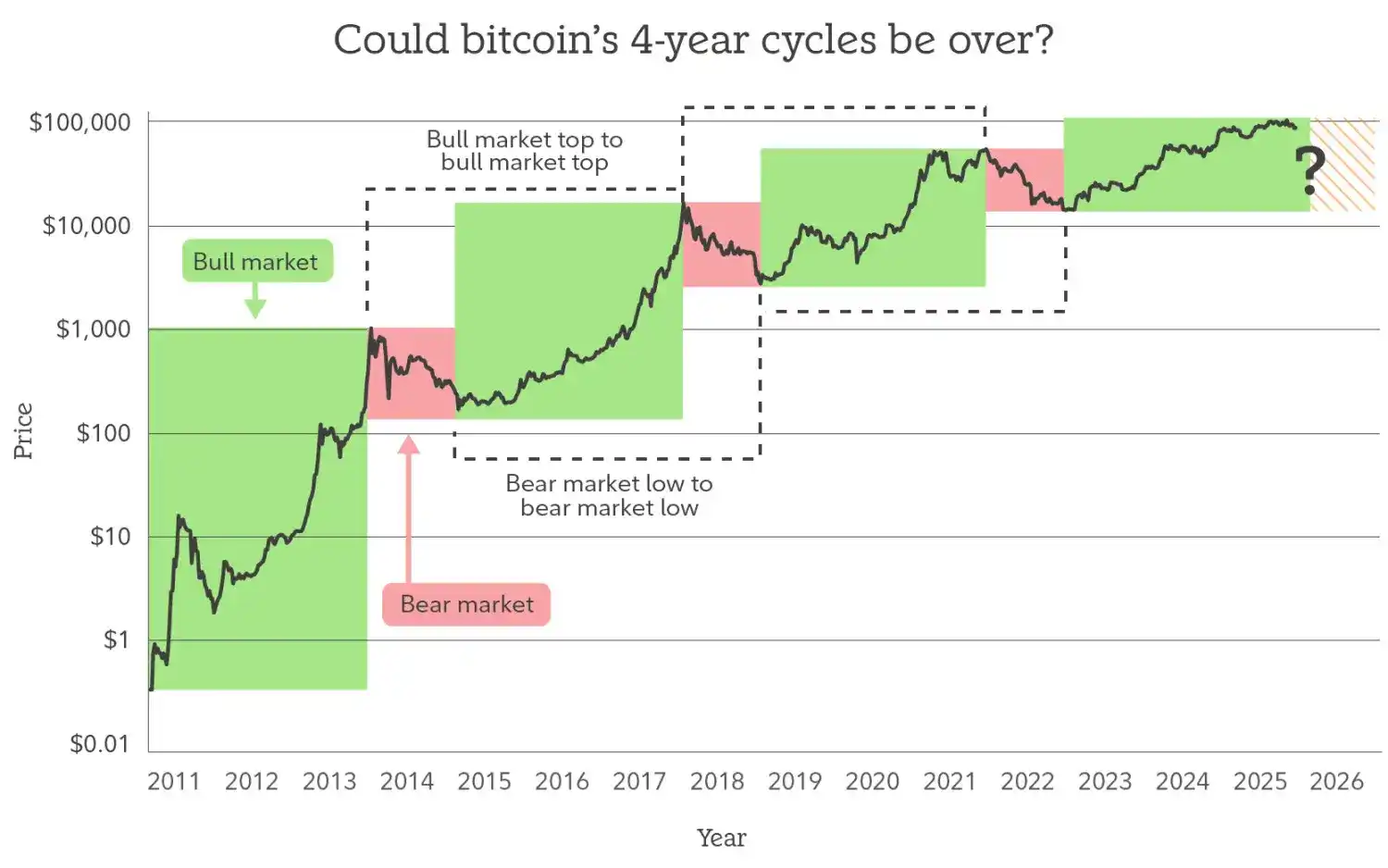
Source: Fidelity Investments. Past performance is not a reliable indicator of future results.

Will the Four-Year Cycle End?

Compared to traditional investments like stocks and bonds, Bitcoin's history is relatively short, but its price has roughly followed a four-year cycle (from bull market peak to peak, or bear market trough to trough). It reached bull market peaks in November 2013, December 2017, and November 2021, and formed bear market bottoms in January 2015, December 2018, and November 2022. These cycles were accompanied by significant price volatility: the first cycle dropped from $1,150 to $152, the second from $19,800 to $3,200, and the third from $69,000 to $15,500.

Bitcoin's movements often lead the entire cryptocurrency market to follow—in many cases, with even more volatility.

Currently, we are around the four-year mark of the current cycle, as the last bull market peaked in November 2021. And over the past month, cryptocurrency prices have continued to fall. So, has this bull market already peaked?

If the four-year cycle repeats, we might be at or near the end of Bitcoin's current bull run. However, some cryptocurrency investors believe this historical trend is about to end, and the current price pullback is merely a temporary retreat before the market resumes its upward trend.

What does this mean specifically? Some investors believe that while price pullbacks will still occur, the volatility of any decline will be much lower than in the past, and the magnitude may be so small that it doesn't feel like a full bear market. Others think we may be entering a supercycle where the bull market lasts for years. For reference, the supercycle in commodities during the 2000s lasted nearly a decade.

Kuiper doesn't believe these cycles will disappear entirely, as the fear and greed that drive them haven't magically vanished. But he points out that if the four-year cycle were to repeat, we should have already set the cycle's all-time high and entered a full bear market. Although the pullback since November has been quite severe so far, he says we might not know for sure until 2026 whether a four-year cycle has truly formed. The current price drop could be the start of a new bear market, or it could just be a correction within a bull market that will go on to set new all-time highs in the future—as we've already seen several times in this cycle.

Whether these predictions will come true remains to be seen, and we might not know until mid-2026.

Is It Too Late to Buy Bitcoin Now?

Despite the many unknowns still present in the cryptocurrency market, one thing has become clearer: the crypto market is entering a new paradigm. "We are seeing a fundamental shift in the structure and categories of investors, and I believe this will continue into 2026," Kuiper said. "Traditional fund managers and investors have started buying Bitcoin and other digital assets, but in terms of the amount of capital they could bring into this space, I think we've only scratched the surface."

In light of this, investors who haven't yet entered the market might ask: Is it still a good time to buy Bitcoin?

For Kuiper, it depends on your investment horizon. If you are looking for gains in the short or medium term (four to five years or less), you might be late, especially if this cycle ultimately follows historical patterns.

"However, from a very long-term perspective, I personally believe that if you view Bitcoin as a store of value, you are never fundamentally 'too late'," Kuiper said. "As long as its hard supply cap remains, I believe every purchase of Bitcoin is putting your labor or savings into something that won't be devalued by government monetary policy and inflation."


İlgili Sorular

QAccording to Fidelity's 2026 crypto market outlook, what new source of demand could potentially end the traditional four-year cycle?

AThe new sources of demand from more national governments and corporations adding digital assets to their balance sheets could potentially end the traditional four-year cycle.

QWhat significant action did the US government take regarding Bitcoin in March 2025, as mentioned in the article?

AIn March 2025, President Trump signed an executive order to establish a strategic Bitcoin reserve for the US government, formally designating all currently held Bitcoin and other cryptocurrencies as reserve assets.

QWhat is the 'super cycle' that some investors believe the crypto market might be entering?

AA 'super cycle' refers to a bull market that could last for many years, with the article citing the nearly decade-long super cycle in commodities during the 2000s as a reference.

QAccording to Fidelity Digital Assets Research VP Chris Kuiper, is it ever fundamentally 'too late' to buy Bitcoin for long-term investors?

ANo, Chris Kuiper states that from a very long-term perspective, if you view Bitcoin as a store of value, you are never fundamentally 'too late' to buy, as long as its hard supply cap remains.

QWhat risk does Chris Kuiper highlight regarding corporations holding cryptocurrencies on their balance sheets?

AHe highlights the risk that if these companies choose or are forced to sell their digital assets, such as during a bear market, it could create downward pressure on the price of those assets.

İlgili Okumalar

Has Hook Summer Truly Arrived? sato, Lo0p, FLOOD Ignite the New Uniswap v4 Narrative

With the broader market showing signs of recovery, a new wave of interest has emerged around Ethereum-based meme coins. Following ASTEROID, tokens like sato, sat1, Lo0p, and FLOOD, built upon the Uniswap v4 Hook protocol, are capturing market attention. Their market capitalizations range from millions to tens of millions of dollars, injecting much-needed focused liquidity into a market lacking narratives. This article explores whether this trend signifies an incoming "Hook Summer" and its potential impact on UNI's price. Hooks are essentially plug-in smart contracts for Uniswap v4 liquidity pools, allowing developers to inject custom logic at key points in a pool's lifecycle (like initialization, adding/removing liquidity, swaps). This transforms the AMM into programmable building blocks. Key highlighted projects include: * **sato**: Peaked over $38M market cap. It utilizes a v4 curve for minting/burning; buying locks ETH as reserve to mint new tokens, while selling redeems ETH from the reserve and burns tokens. * **sat1**: Market cap briefly exceeded $10M, promoted as an "optimized sato," but later declined significantly. * **Lo0p**: Reached nearly $6.6M. It's a lending AMM protocol where buying LO0P tokens locks them as collateral, allowing users to borrow ETH from the pool reserve at 40% LTV, aiming to improve capital efficiency for idle ETH in LPs. * **FLOOD**: Peaked near $6M. Its mechanism directs asset reserves from buys into Aave v3 to generate yield, with fees and interest retained in the pool to potentially influence the token's price long-term. In the long term, the development of the Hook ecosystem can attract users and liquidity to Uniswap v4, benefiting UNI's fundamentals—especially combined with the recent activation of the protocol fee switch, where a portion of fees is used to burn UNI. However, in the short term, these Hook-based tokens are unlikely to directly drive significant UNI price appreciation. Their impact is moderated by factors like token sustainability, price volatility, and broader market and regulatory conditions. Currently, Uniswap v4's TVL ($595M) still trails behind v2 and v3, indicating adoption and growth will take time. The article concludes that while the Hook ecosystem provides long-term "nourishment" for UNI, its short-term role is more of a "catalyst" than a "booster." Readers are cautioned that these are early-stage experimental tokens and may carry unknown risks.

Odaily星球日报12 dk önce

Has Hook Summer Truly Arrived? sato, Lo0p, FLOOD Ignite the New Uniswap v4 Narrative

Odaily星球日报12 dk önce

Interview with Michael Saylor: I Did Say I Would Sell Bitcoin, But Never a Net Sale

Interview with Michael Saylor: I Said We'd Sell Bitcoin, But Never Be a Net Seller In a recent podcast, MicroStrategy Executive Chairman Michael Saylor clarified the company's stance on potentially selling Bitcoin. Following MicroStrategy's earnings call statement about being prepared to sell BTC to fund dividends for its STRC (Strategic) credit product, Saylor emphasized the distinction between selling and being a "net seller." Saylor explained the core business model: MicroStrategy sells credit instruments like STRC and uses the proceeds to buy Bitcoin, which is viewed as "digital capital" expected to appreciate around 30-40% annually. A portion of these capital gains can then be used to pay the dividends on the credit products. He stressed that even if the company sells some Bitcoin for dividends, it simultaneously buys much more with new credit issuance. For example, after raising $3.2 billion from STRC sales in April, the dividend obligation was only $80-90 million, making the company a net buyer. The clarification aims to counter market narratives questioning the value of Bitcoin on MicroStrategy's balance sheet if it were never sold, and to dismiss claims of a "Ponzi scheme." Saylor reiterated his personal philosophy for investors: "Don't be a net seller of bitcoin" and ensure your Bitcoin holdings increase each year. Saylor also discussed Bitcoin's role as the foundation for "digital credit," noting that STRC has become the largest and most liquid preferred stock issue in the U.S., offering high risk-adjusted returns (Sharpe ratio). He highlighted Bitcoin's deep liquidity, stating that even large purchases by MicroStrategy do not move the market significantly, which is driven by macro factors, geopolitical tensions, and capital flows from ETFs and credit products. Finally, Saylor reflected on his early inspiration from sci-fi books, which motivated his path to MIT, and maintained his fundamental thesis on Bitcoin remains unchanged: it is superior digital capital enabling superior digital credit.

链捕手16 dk önce

Interview with Michael Saylor: I Did Say I Would Sell Bitcoin, But Never a Net Sale

链捕手16 dk önce

Beaten SK Hynix Employees in China: Year-end Bonus Less Than 5% of Korean Staff's

"SK Hynix Chinese Staff Hit Hard: Bonuses Less Than 5% of Korean Counterparts" Driven by the AI boom, South Korea's SK Hynix is experiencing record performance, with media reports predicting massive year-end bonuses for its employees, making them highly desirable in the matchmaking market. However, this prosperity starkly contrasts with the situation for the company's Chinese employees. According to reports, SK Hynix operates under a rule allocating 10% of operating profit for employee bonuses. While projections suggest Korean employees could receive bonuses reaching millions of RMB, a Chinese employee with over a decade of technical experience revealed the disparity: "If they get 3 million, Chinese staff get less than 5% of that." After adjustments based on KPI ratings, this employee's highest bonus was slightly over 100,000 RMB. Bonuses are paid annually in Korea but semi-annually in China. During the industry downturn in 2023-2024, Chinese employees received no bonus at all. The gap extends beyond bonuses. Recruitment posts for SK Hynix's Chinese factories (in Wuxi, Dalian, Chongqing) show engineer monthly salaries ranging from 10,000 to 35,000 RMB, with a 13th-month salary promised. Chinese employees also receive standard benefits like annual leave but lack stock incentives, which are reportedly unavailable to them. Furthermore, management positions in China are predominantly held by Korean personnel, though industry observers note a gradual increase in local middle managers over time. SK Hynix has confirmed the 10% bonus rule but cautioned that specific future bonus amounts remain unpredictable. The company forecasts strong demand for HBM and other high-value enterprise products for the next 2-3 years, driven by AI infrastructure investment. This focus on business-to-business markets may continue to constrain supply for consumer products, potentially prolonging price increases for components like memory.

链捕手30 dk önce

Beaten SK Hynix Employees in China: Year-end Bonus Less Than 5% of Korean Staff's

链捕手30 dk önce

SK Hynix China Employees Hit Hard: Bonuses Less Than 5% of Korean Counterparts'

"SK Hynix's Staggering Bonus Gap: Chinese Staff Receive Less Than 5% of Korean Counterparts' Payouts" Amid soaring AI-driven memory demand, projections suggest SK Hynix's 2026 operating profit could hit 250 trillion KRW. Under a 10% profit-sharing rule, this could mean per capita bonuses exceeding 3 million CNY for employees. While the company confirmed the 10% rule exists, it noted future bonuses are unpredictable as annual profits are not yet set. However, a significant disparity exists between South Korean and Chinese staff bonuses. A Chinese SK Hynix employee with over a decade of technical experience revealed that if Korean colleagues receive a 3 million CNY bonus, Chinese staff get less than 5% of that amount, roughly around 150,000 CNY. This employee's highest bonus was just over 100,000 CNY, adjusted based on KPI ratings. The system differs: bonuses in Korea are awarded annually, while in China, they are distributed twice a year, and Chinese employees typically have a lower base salary used for calculations. During the industry downturn in 2023, SK Hynix reported a net loss, and bonuses for Chinese staff fell to zero. Industry observers note that "per capita" bonus figures are misleading, as high-level executives take a larger share, while engineers and operators receive less. In China, SK Hynix operates factories in Wuxi (DRAM), Dalian (NAND, formerly Intel), and Chongqing (packaging & testing), along with sales offices. Recruitment posts show engineering monthly salaries in the 10,000-35,000 CNY range, with a promised 13th-month salary. Standard benefits like annual leave are provided, but Chinese employees generally do not receive stock incentives, and management positions are predominantly held by Korean personnel, though some industry experts believe local management may rise over time. Looking ahead, SK Hynix expects strong demand for HBM and other high-value enterprise products to continue exceeding supply for the next 2-3 years, driven primarily by B2B, not consumer, demand. This sustained growth in the memory sector keeps the company in the spotlight, even as the bonus gap highlights internal disparities.

marsbit50 dk önce

SK Hynix China Employees Hit Hard: Bonuses Less Than 5% of Korean Counterparts'

marsbit50 dk önce

İşlemler

Spot
Futures
活动图片




