Fed warns of ‘long, painful history’ – Why stablecoin oversight is urgent

ambcrypto2026-04-01 tarihinde yayınlandı2026-04-01 tarihinde güncellendi

Özet

Federal Reserve Governor Michael Barr has called for strict stablecoin oversight, citing risks to financial stability and a surge in illicit use. Chainalysis data shows stablecoins now account for 84% of illegal crypto activity, up from 15% in 2020, often facilitating terrorism financing and sanctions evasion. Barr warned that unregulated private money historically caused bank runs, emphasizing the need for tight reserve asset controls, supervision, and liquidity requirements. While illicit activity remains below 1% of all crypto transactions, regulators are advancing the GENIUS Act, aiming for finalized rules by mid-2026. Meanwhile, non-USD stablecoins are growing rapidly, and Asian markets—which drive over 60% of global stablecoin activity—may restrict USD-based options, potentially reshaping the $315 billion market.

Michael Barr, a member of the Federal Reserve Board of Governors, has called for caution and strict stablecoin oversight.

During a recent discussion on stablecoin law, the GENIUS Act, Barr singled out major uses of the products, including crypto trading, cheaper remittances, and savings overseas.

However, he raised concerns about stablecoins’ facilitation of terrorist financing and risk to financial stability.

Well, Chainalysis data estimates that stablecoins now account for 84% of illicit crypto activity. This is a massive spike from only 15% in 2020. Hackers are now embracing stablecoins and P2P transactions to evade sanctions.

To curb this, Barr recommended,

Both regulatory and technological solutions will need to be deployed to limit these risks.

Despite the surge, the overall illicit activity only accounts for less than 1% of total crypto transactions.

On financial stability risk, Barr cited the ‘long and painful history’ of competing private money (bank notes) in the 1800s that led to bank runs and financial panics because they traded below par.

The cause? Low-quality reserve assets and weak safeguards. Barr added,

Tight control over reserve assets, coupled with supervision, capital and liquidity requirements, and other measures, could enhance the stability of stablecoins and make them more viable payment instruments.

This is part of the rulemaking process as regulators race to meet the July 2026 deadline for implementing the GENIUS Act. So far, the OCC and NCUA have issued proposed rules for the same. The Fed and other regulators are expected to follow suit and finalize guidelines by early Q3.

Stablecoins: USD-based vs. others

For issuers, the GENIUS Act offers clear rules. But for the U.S. government, it’s an increasingly important demand line for Treasury Bills to finance its debt.
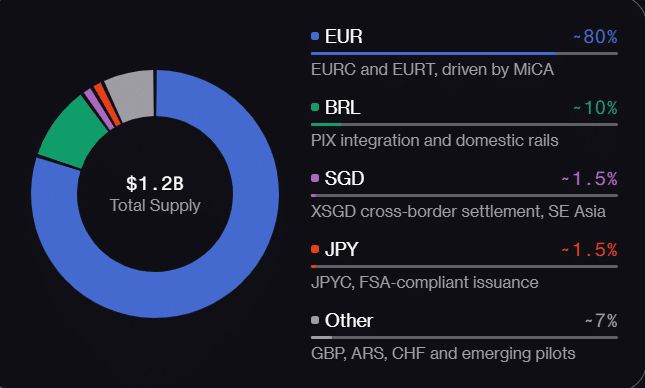
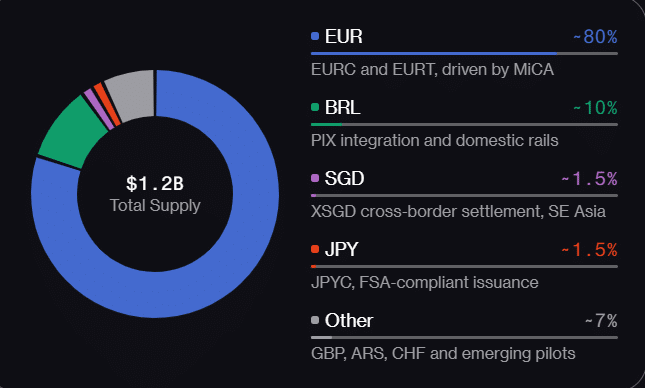
Source: Dune

Although USD-based versions (USDT, USDC) dominate the current $315 billion stablecoin market, non-USD alternatives have seen record growth. Since 2023, non-USD stablecoins have surged from $350 million to $1.2 billion. That’s a 3x expansion outpacing USD stablecoin growth, mostly dominated by Euro-based alternatives.

Beyond currency-based measures, Asia accounts for over 60% of global stablecoin activity, driven primarily by the Singapore–Japan–Hong Kong–China corridor. Interestingly, these jurisdictions are pushing for stablecoin rules that could restrict USD-based options. It’s unclear how these shifts will impact current stablecoin market dynamics in the upcoming months.


Final Summary

  • Fed’s Barr called for strong stablecoin oversight to avoid repeating the ‘painful’ bank runs of the 1800s due to private money.
  • The stablecoin market could be headed for major shifts as key global adoption jurisdictions mull restricting USD-based alternatives.


İlgili Sorular

QWhat are the main concerns raised by Michael Barr regarding stablecoins?

AMichael Barr raised concerns about stablecoins facilitating terrorist financing and posing risks to financial stability, citing their use in illicit activities and the historical precedent of private money causing bank runs and financial panics in the 1800s.

QWhat percentage of illicit crypto activity do stablecoins account for according to Chainalysis data?

AAccording to Chainalysis data, stablecoins now account for 84% of illicit crypto activity, a significant increase from 15% in 2020.

QWhat solutions did Michael Barr recommend to address the risks associated with stablecoins?

AMichael Barr recommended deploying both regulatory and technological solutions, including tight control over reserve assets, supervision, capital and liquidity requirements, and other measures to enhance the stability of stablecoins.

QHow has the non-USD stablecoin market grown since 2023?

ASince 2023, non-USD stablecoins have surged from $350 million to $1.2 billion, a 3x expansion that outpaced the growth of USD stablecoins, with Euro-based alternatives dominating this segment.

QWhich regions are driving global stablecoin activity, and what regulatory shifts are they considering?

AAsia accounts for over 60% of global stablecoin activity, primarily driven by the Singapore–Japan–Hong Kong–China corridor. These jurisdictions are considering stablecoin rules that could restrict USD-based options.

İlgili Okumalar

From South Korea to the United States: Blue-Collar Jobs Are Becoming Increasingly Popular, Thanks to AI

AI is reshaping the labor market's value proposition. The traditional four-year college degree is losing its appeal as a guaranteed career path, while skilled blue-collar trades like electricians, welders, and plumbers are experiencing historic demand and wage premiums. This shift is driven by dual pressures: AI's displacement of certain white-collar roles and a booming need for physical infrastructure and data center construction. Data confirms the trend. In the U.S., vocational school revenue surged, and a significant portion of recent layoffs are AI-related. Surveys show a majority of Gen Z adults plan to pursue blue-collar work, citing better job security against AI automation. Vocational education interest has exploded recently. Experts cite a psychological shift as younger generations seek tangible, AI-resistant careers and avoid high student debt. In many cases, salaries for skilled trades now match or exceed those requiring a bachelor's degree. In South Korea, semiconductor vocational high schools boast near-total employment, with graduates securing high-paying roles at companies like Samsung. The shortage is structural, exacerbated by a retiring baby boomer workforce and massive infrastructure projects. Companies like JPMorgan Chase, Meta, and Lowe's are investing heavily in training programs. However, overcoming historical stigma and a "perception gap" around trade careers remains a key challenge to closing the talent gap.

marsbit1 saat önce

From South Korea to the United States: Blue-Collar Jobs Are Becoming Increasingly Popular, Thanks to AI

marsbit1 saat önce

Qualcomm: AI Hype Subsides, When Will Smartphones Emerge from the Gloom?

Qualcomm reported its Q3 FY2026 results (ending June 2026), with revenue of $9.95B, down 4% YoY but above expectations. Gross margin declined to 53.1%, pressured by rising costs across manufacturing and memory. Key business segments showed mixed performance: Handset revenue fell 19.6% YoY to $5.09B, dragged by an 11% decline in non-Apple Android shipments and weaker high-end mix. Conversely, Automotive revenue surged 61% to $1.59B, and IoT grew 9% to $1.83B. Core operating profit dropped 41% YoY due to margin compression and higher expenses. Management's Q4 FY2026 guidance projects revenue of $9.7B-$10.5B, in line with consensus, but Non-GAAP EPS guidance of $2.05-$2.25 fell short of expectations. Amidst persistent weakness in its core handset market, Qualcomm is pursuing growth in AI, focusing on Edge AI (smartphones, PCs, automotive) and Data Center AI. Its data center strategy includes four pillars: AI accelerators (e.g., AI200), commercial CPUs (Dragonfly C1000), custom silicon, and connectivity solutions. While these initiatives initially boosted its stock, concerns over AI capital expenditure sustainability have since erased those gains. The company targets $5B in data center revenue for FY2027 and $15B for FY2029. The report concludes that with the traditional handset business still under pressure, the data center opportunity is currently viewed as a longer-term option, and a more conservative valuation based on core operations may be warranted until AI contributions materialize.

marsbit1 saat önce

Qualcomm: AI Hype Subsides, When Will Smartphones Emerge from the Gloom?

marsbit1 saat önce

From TPU to Self-Evolving Agents: How Jeff Dean Predicts the Next Step in AI

At the 2026 YC Startup School, Jeff Dean outlined his vision for AI's next phase, shifting focus from simply scaling models to building intelligent, autonomous systems. He believes AI's progress is no longer just about creating smarter models, but about integrating them into systems capable of long-term, iterative work, automated experimentation, and continuous learning. This evolution moves the competition from "who has the bigger model" to "who can best organize intelligence." Dean suggests AI capabilities are now comparable to a junior engineer, enabling the automation of complex workflows. However, the true challenge and opportunity lie in managing these AI "workers" at scale. He emphasizes the importance of **context engineering**—structuring tools, memory, and feedback loops—over raw model power. For startups, this means building deep expertise in niche domains where general models currently fail (near 0-1% success rates), leveraging proprietary data, specialized tools, and domain-specific evaluators. A recurring theme is re-examining fundamental constraints. Dean's past work, like moving Google's search index to memory or creating the TPU, stemmed from questioning outdated assumptions about hardware and cost. He sees similar inflection points today, particularly in **specialized inference hardware** to drastically reduce latency and energy consumption for real-time Agent operation. Notably, he points out that in modern AI systems, the dominant cost is often not computation but **data movement**. Reliable, long-running Agents require robust system design, borrowing concepts from distributed computing like checkpointing, state management, and parallel exploration to handle failures and maintain progress over days or weeks. As AI automates execution, the scarcest human skills will shift to **defining clear specifications**, **judging what problems are worth solving** (taste), and designing effective feedback loops. Ultimately, Dean's framework prioritizes understanding the problem deeply, identifying the true bottlenecks, and systematically building closed-loop systems where AI can not only perform tasks but also improve AI itself.

marsbit1 saat önce

From TPU to Self-Evolving Agents: How Jeff Dean Predicts the Next Step in AI

marsbit1 saat önce

İşlemler

Spot
活动图片




