Fed warns of ‘long, painful history’ – Why stablecoin oversight is urgent

ambcrypto2026-04-01 tarihinde yayınlandı2026-04-01 tarihinde güncellendi

Özet

Federal Reserve Governor Michael Barr has called for strict stablecoin oversight, citing risks to financial stability and a surge in illicit use. Chainalysis data shows stablecoins now account for 84% of illegal crypto activity, up from 15% in 2020, often facilitating terrorism financing and sanctions evasion. Barr warned that unregulated private money historically caused bank runs, emphasizing the need for tight reserve asset controls, supervision, and liquidity requirements. While illicit activity remains below 1% of all crypto transactions, regulators are advancing the GENIUS Act, aiming for finalized rules by mid-2026. Meanwhile, non-USD stablecoins are growing rapidly, and Asian markets—which drive over 60% of global stablecoin activity—may restrict USD-based options, potentially reshaping the $315 billion market.

Michael Barr, a member of the Federal Reserve Board of Governors, has called for caution and strict stablecoin oversight.

During a recent discussion on stablecoin law, the GENIUS Act, Barr singled out major uses of the products, including crypto trading, cheaper remittances, and savings overseas.

However, he raised concerns about stablecoins’ facilitation of terrorist financing and risk to financial stability.

Well, Chainalysis data estimates that stablecoins now account for 84% of illicit crypto activity. This is a massive spike from only 15% in 2020. Hackers are now embracing stablecoins and P2P transactions to evade sanctions.

To curb this, Barr recommended,

Both regulatory and technological solutions will need to be deployed to limit these risks.

Despite the surge, the overall illicit activity only accounts for less than 1% of total crypto transactions.

On financial stability risk, Barr cited the ‘long and painful history’ of competing private money (bank notes) in the 1800s that led to bank runs and financial panics because they traded below par.

The cause? Low-quality reserve assets and weak safeguards. Barr added,

Tight control over reserve assets, coupled with supervision, capital and liquidity requirements, and other measures, could enhance the stability of stablecoins and make them more viable payment instruments.

This is part of the rulemaking process as regulators race to meet the July 2026 deadline for implementing the GENIUS Act. So far, the OCC and NCUA have issued proposed rules for the same. The Fed and other regulators are expected to follow suit and finalize guidelines by early Q3.

Stablecoins: USD-based vs. others

For issuers, the GENIUS Act offers clear rules. But for the U.S. government, it’s an increasingly important demand line for Treasury Bills to finance its debt.
Source: Dune

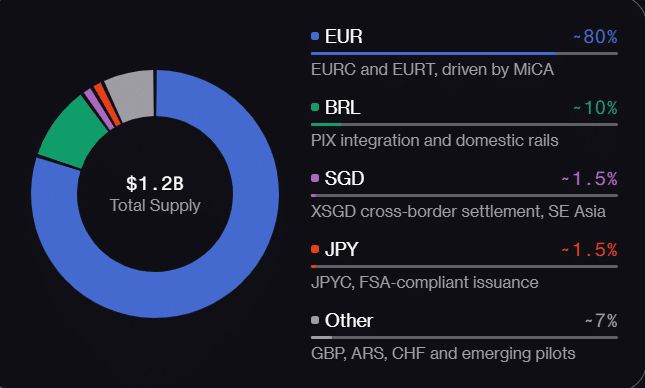
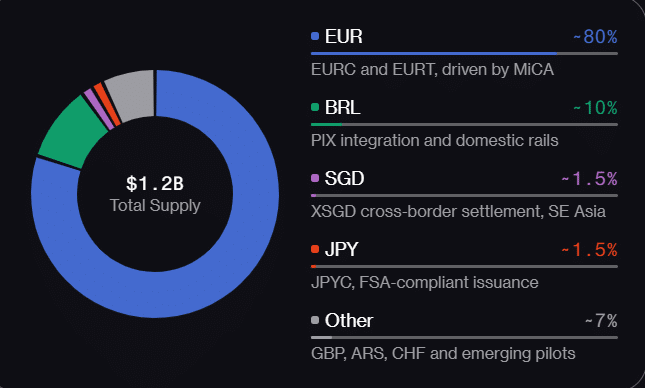
Although USD-based versions (USDT, USDC) dominate the current $315 billion stablecoin market, non-USD alternatives have seen record growth. Since 2023, non-USD stablecoins have surged from $350 million to $1.2 billion. That’s a 3x expansion outpacing USD stablecoin growth, mostly dominated by Euro-based alternatives.

Beyond currency-based measures, Asia accounts for over 60% of global stablecoin activity, driven primarily by the Singapore–Japan–Hong Kong–China corridor. Interestingly, these jurisdictions are pushing for stablecoin rules that could restrict USD-based options. It’s unclear how these shifts will impact current stablecoin market dynamics in the upcoming months.


Final Summary

  • Fed’s Barr called for strong stablecoin oversight to avoid repeating the ‘painful’ bank runs of the 1800s due to private money.
  • The stablecoin market could be headed for major shifts as key global adoption jurisdictions mull restricting USD-based alternatives.


İlgili Sorular

QWhat are the main concerns raised by Michael Barr regarding stablecoins?

AMichael Barr raised concerns about stablecoins facilitating terrorist financing and posing risks to financial stability, citing their use in illicit activities and the historical precedent of private money causing bank runs and financial panics in the 1800s.

QWhat percentage of illicit crypto activity do stablecoins account for according to Chainalysis data?

AAccording to Chainalysis data, stablecoins now account for 84% of illicit crypto activity, a significant increase from 15% in 2020.

QWhat solutions did Michael Barr recommend to address the risks associated with stablecoins?

AMichael Barr recommended deploying both regulatory and technological solutions, including tight control over reserve assets, supervision, capital and liquidity requirements, and other measures to enhance the stability of stablecoins.

QHow has the non-USD stablecoin market grown since 2023?

ASince 2023, non-USD stablecoins have surged from $350 million to $1.2 billion, a 3x expansion that outpaced the growth of USD stablecoins, with Euro-based alternatives dominating this segment.

QWhich regions are driving global stablecoin activity, and what regulatory shifts are they considering?

AAsia accounts for over 60% of global stablecoin activity, primarily driven by the Singapore–Japan–Hong Kong–China corridor. These jurisdictions are considering stablecoin rules that could restrict USD-based options.

İlgili Okumalar

Agents Take Over Traffic Distribution Power: What Are Tencent, ByteDance, and Alibaba Competing For?

In the race to dominate the AI era's entry point, China's tech giants—Tencent, ByteDance, and Alibaba—are aggressively deploying AI Agents to control the future of traffic distribution. Alibaba is pursuing a dual-track "closed loop + openness" strategy. Its Qianwen app is evolving into a super-Agent integrated across its ecosystem (Taobao, Alipay, etc.) to handle complex tasks like travel planning. Concurrently, it is opening its platform to external brands (Luckin Coffee, KFC) and has launched a B2B Agent platform, "Wukong," targeting enterprise automation. Its other flagship, Quark, aims to be an "AI super search box" for information and tasks. ByteDance is executing an omnipresent "sprawl strategy." Its Doubao app boasts over 300 million monthly active users and is evolving into a default AI entry point for daily life, with plans for paid versions and e-commerce integration. Its core weapon is the Kouzi platform, a visual "AI assembly factory" for developers to build custom Agents. ByteDance is also pushing hardware integration, collaborating on AI phones and developing smart glasses to embed Doubao everywhere. Tencent is playing its long-held "ultimate card" by quietly embedding an AI Agent directly into WeChat. This Agent, accessible via a swipe, can understand user commands and automatically execute tasks by calling upon WeChat's millions of mini-programs (e.g., finding and ordering coffee). This leverages WeChat's unparalleled 1.4-billion-user ecosystem to position the app as an AI-powered "service operating system," a move that could dramatically reshape the competitive landscape. The core battleground is shifting from competing for "user screen time" to competing to be the "default execution layer" for user intent. The business model is evolving from an "attention economy" to an "intent economy," where the Agent that can most efficiently fulfill a user's need gains control over service access and token flow. This represents a fundamental change in how users connect with digital services, making the fight for the Agent入口 (entry point) a pivotal moment for redefining industry leadership in the AI age.

marsbit1 saat önce

Agents Take Over Traffic Distribution Power: What Are Tencent, ByteDance, and Alibaba Competing For?

marsbit1 saat önce

From Banning Doubao to Embracing Honor: Why Did WeChat Suddenly 'Change Its Face'?

The article explores the sudden shift in WeChat's strategy towards AI assistants from mobile phone manufacturers, transitioning from strict opposition to active collaboration. For over a year, WeChat fiercely resisted attempts by phone AI assistants (like ByteDance's Doubao in late 2025) to control its features via GUI automation ("simulated clicking"), citing security and data control concerns. This stance created a significant barrier for system-level AI integration. Now, Tencent has initiated A2A (Agent-to-Agent) partnerships with major phone brands like Honor, Xiaomi, OPPO, and vivo. This model allows a phone's system AI (e.g., Honor's YOYO) to parse a user's voice command and send a structured request directly to WeChat's own internal AI agent via secure APIs. WeChat then executes the action (e.g., sending a message) and returns the result. The article attributes Tencent's "change of face" to strategic pressure. While leading in social app usage, Tencent trails rivals like ByteDance and Alibaba in standalone AI app popularity. WeChat, with its vast mini-program ecosystem, is Tencent's key asset for an AI comeback. The upcoming WeChat AI agent aims to handle tasks like booking and payments within the app. However, phone system assistants remain the primary AI entry point for most users. The A2A collaboration allows Tencent to extend WeChat's AI reach to this crucial system layer while maintaining control over its core functions and data. For phone manufacturers, embracing A2A is a pragmatic move. The GUI route proved unviable due to WeChat's blocks. A2A offers a compliant path to integrate a vital service, enhancing their AI assistants' usefulness. It allows them to focus on developing their own AI ecosystems for other services while cooperating on WeChat access. The collaboration is framed as a mutual, strategic necessity: Tencent gains a distribution channel, and manufacturers gain a key functionality. The partnership relies on a "dual authorization" mechanism for security, requiring both user and app consent for each action. While questions about long-term data privacy practices remain, experts note A2A is more secure and compliant than GUI automation. Ultimately, this cooperation is seen as a tentative, calculated truce. Tencent's long-term goal is to make WeChat an AI-powered "service OS." Phone manufacturers aim to make their system AI the central user interface. Their paths may converge or clash in the future, but for now, the A2A deal represents the opening chapter in the battle for the AI-era user入口, driven by necessity and strategic calculus on both sides.

marsbit2 saat önce

From Banning Doubao to Embracing Honor: Why Did WeChat Suddenly 'Change Its Face'?

marsbit2 saat önce

İşlemler

Spot
Futures
活动图片