February 2026 Crypto Market Recap: BTC's $60k Extreme Rebound, How Did the Market React on the US Military Airstrike Day?

marsbit2026-03-05 tarihinde yayınlandı2026-03-05 tarihinde güncellendi

Özet

February 2026 Crypto Market Recap: BTC rebounded strongly from a critical $60K support level after a sharp drop from $70K, establishing a trading range between $60K–$70K for most of the month. Key events included a U.S. airstrike on Iran, which caused a brief dip to $62K before a recovery to $68K, and the death of Iran’s leader, interpreted as a market-positive signal. $ZRO surged around its LayerZero conference due to major partnership announcements but later gave back gains. AI-related tokens like $VVV performed well, while scam coins like $PIPPIN and $POWER saw manipulated pumps. The market exhibited bearish traits—short squeezes were common, and altcoin rallies were often brief. Uniswap spiked 40% on a BlackRock partnership announcement but quickly retraced. Other notable events included Base abandoning Optimism, hurting $OP, and strong performances from $MORPHO and $STABLE.

Author: CryptoNarratives (Viktor)

Compiled by: Deep Tide TechFlow

Deep Tide Guide: This monthly recap thoroughly breaks down the key movements in the February crypto market: BTC's extreme $60k rebound, the panic and rapid recovery on the day Iran was attacked, the pre- and post-ZRO conference expectation games, and the manipulative coins thriving in the bear market. Dense with information, it serves as excellent background material for understanding the current market structure.

Full Text Below:

BTC Timeline

Below is the main timeline for February:

Gold saw a significant pullback after reaching a peak in late January, falling from $5600 to $4400. The bottom was hit on February 2nd, followed by a rapid rebound to $5100 within two days. Silver also experienced a peak collapse, plummeting nearly 50% from $121 to $64 on February 6th.

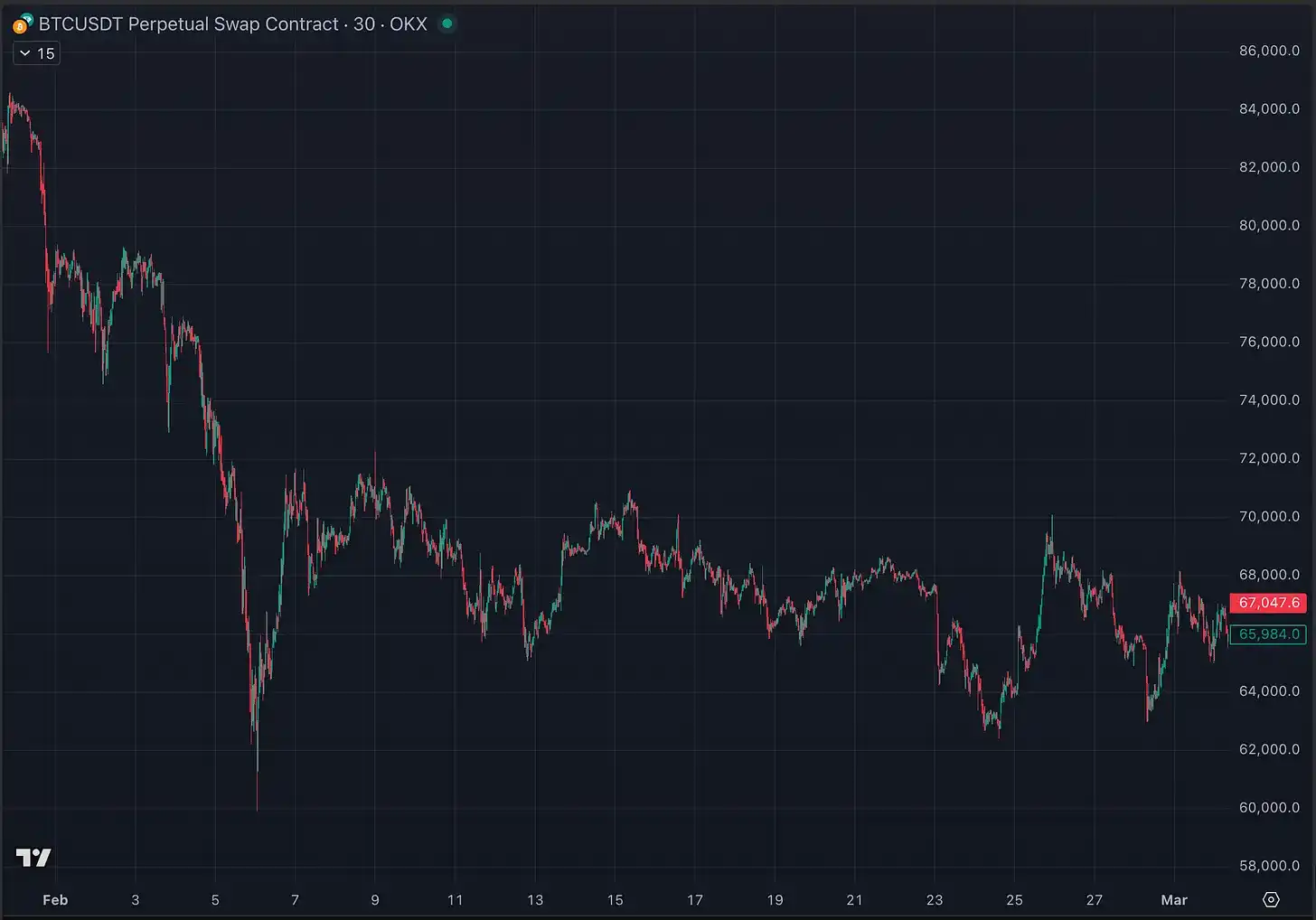
BTC started February on an extremely weak note. After hitting a high of $98k in January, it opened February at $78k, dropped to $70k within 4 days, and then experienced a single-day crash from $70k to $60k on February 5th.

BTC staged a strong rebound at the $60k level, recovering to nearly $72k in less than a day. This complete move defined the trading range for the entire subsequent month, largely fluctuating between $60k and $70k.

After the first week, BTC spent most of the month oscillating around $68k, with only two distinct periods of strength: February 13th-14th and February 25th. These periods each saw some stronger altcoin performances.

On February 27th, BTC dropped from $68k to $65k on rumors of an impending US airstrike on Iran. The attack was officially confirmed a day later. Upon the actual news landing, BTC fell further from $65k to $62k but was met with sustained buying pressure throughout the day, ultimately closing near $68k, which also marked the month's closing price. On the same day, the announcement of Khamenei's death was made, which the market generally interpreted as a bullish signal (as it suggested the US was unlikely to invest excessive resources in this conflict).
ZRO Conference

Almost the only significant narrative in the altcoin space in February was the LayerZero conference on February 10th. $ZRO had been strengthening consistently since the beginning of the year, primarily driven by anticipation for this event. I initially predicted this would be a typical 'sell the news' opportunity, but the reality was slightly different.

On the day, a video announcing the launch of their own blockchain was leaked early, triggering a sell-off and a roughly 20% drop within an hour, which also marked the day's low. Later that day, the official announcement was made – indeed, the launch of their own blockchain "Zero" – but it was accompanied by a slate of heavyweight partnership announcements, including Citadel Securities, Cathie Wood/ARK, DTCC, and ICE.
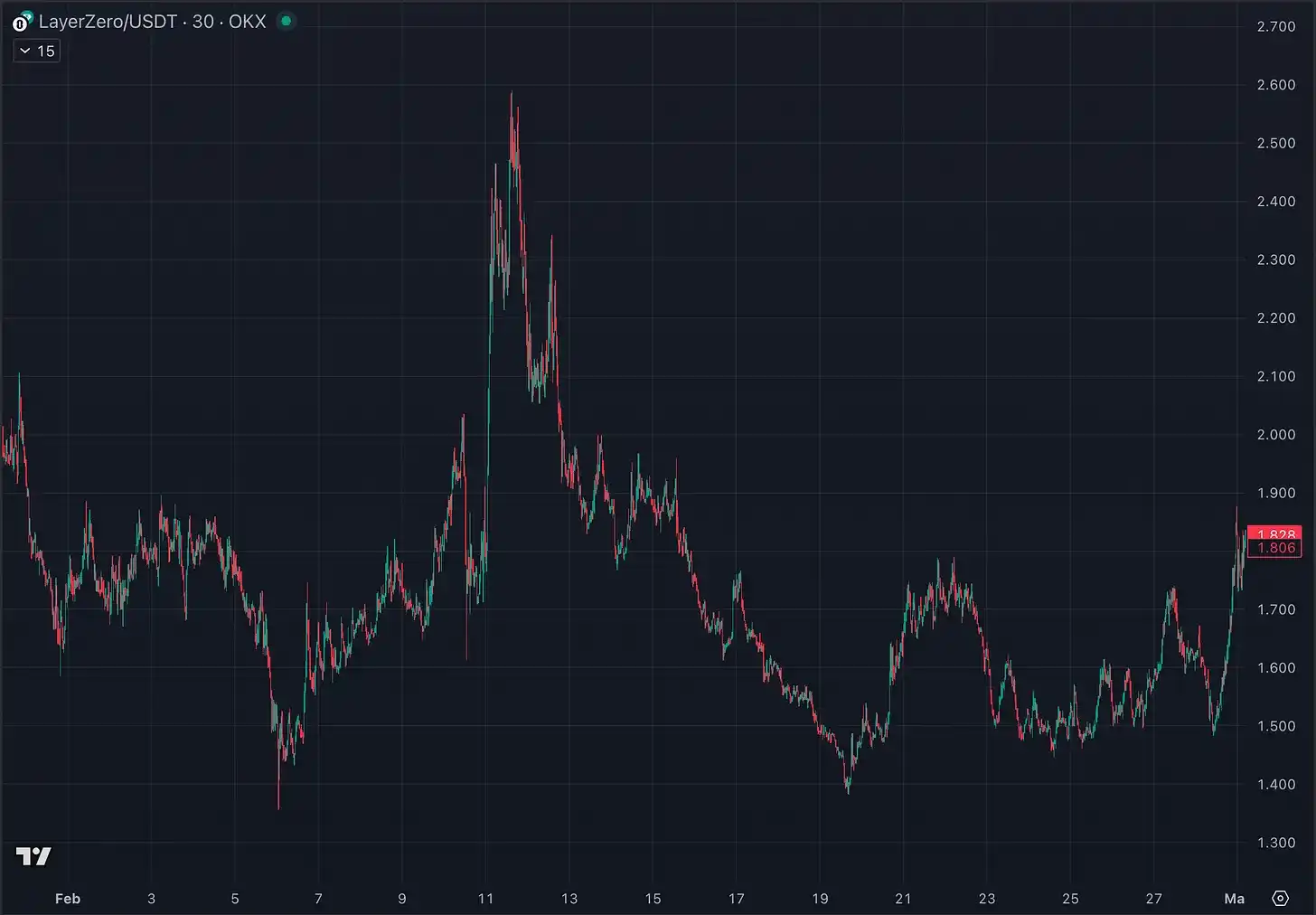
The result was a strong rally post-conference, with $ZRO gaining about 45% in 12 hours, catching many 'sell the news' traders off guard. But subsequently... all gains were erased, and the token slid all the way down to $1.5, a level that currently appears to be forming strong support.

VVV's Abnormal Strength

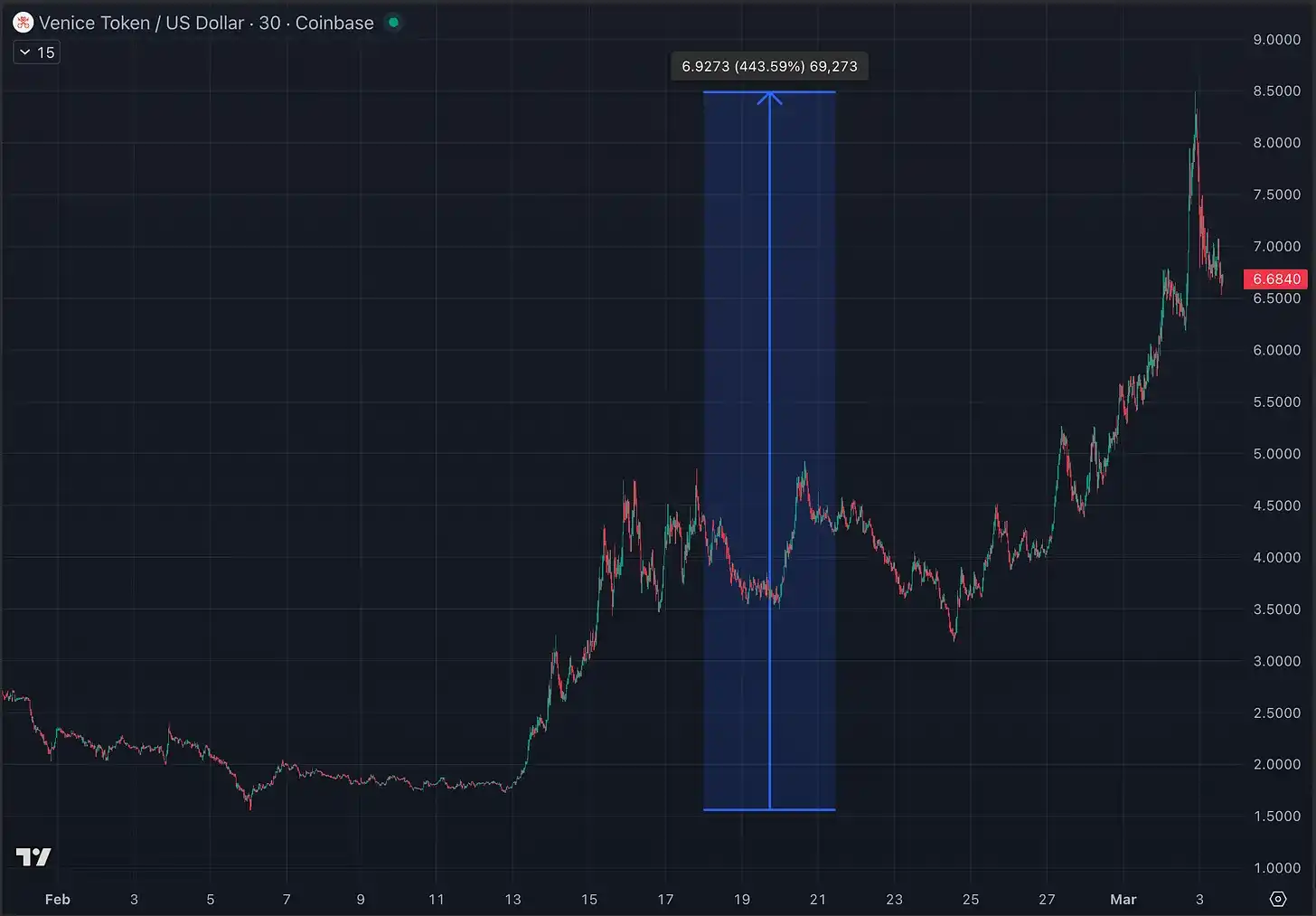
VVV was the best-performing "non-scam" token in February, rising from a bottom of $1.65 to $5.5 by month-end (with a further squeeze to $8 on March 2nd). One catalyst was its status as a legitimate project at the intersection of AI, privacy, and crypto, with a bottom valuation below $100M;另一方面, it also benefited from the tailwind of OpenClaw, as OpenClaw listed Venice as a recommended model supplier in its documentation until just yesterday.

(I'm inclined to think it peaked at the $8.4 squeeze in early March, but I could be wrong)
Other AI tokens briefly awakened late in February, with $SAHARA squeezing +70% in a single day and $GRASS gaining +70% over 4 days.

A Bountiful Month for Scam Coins: $PIPPIN, $SIREN, $POWER

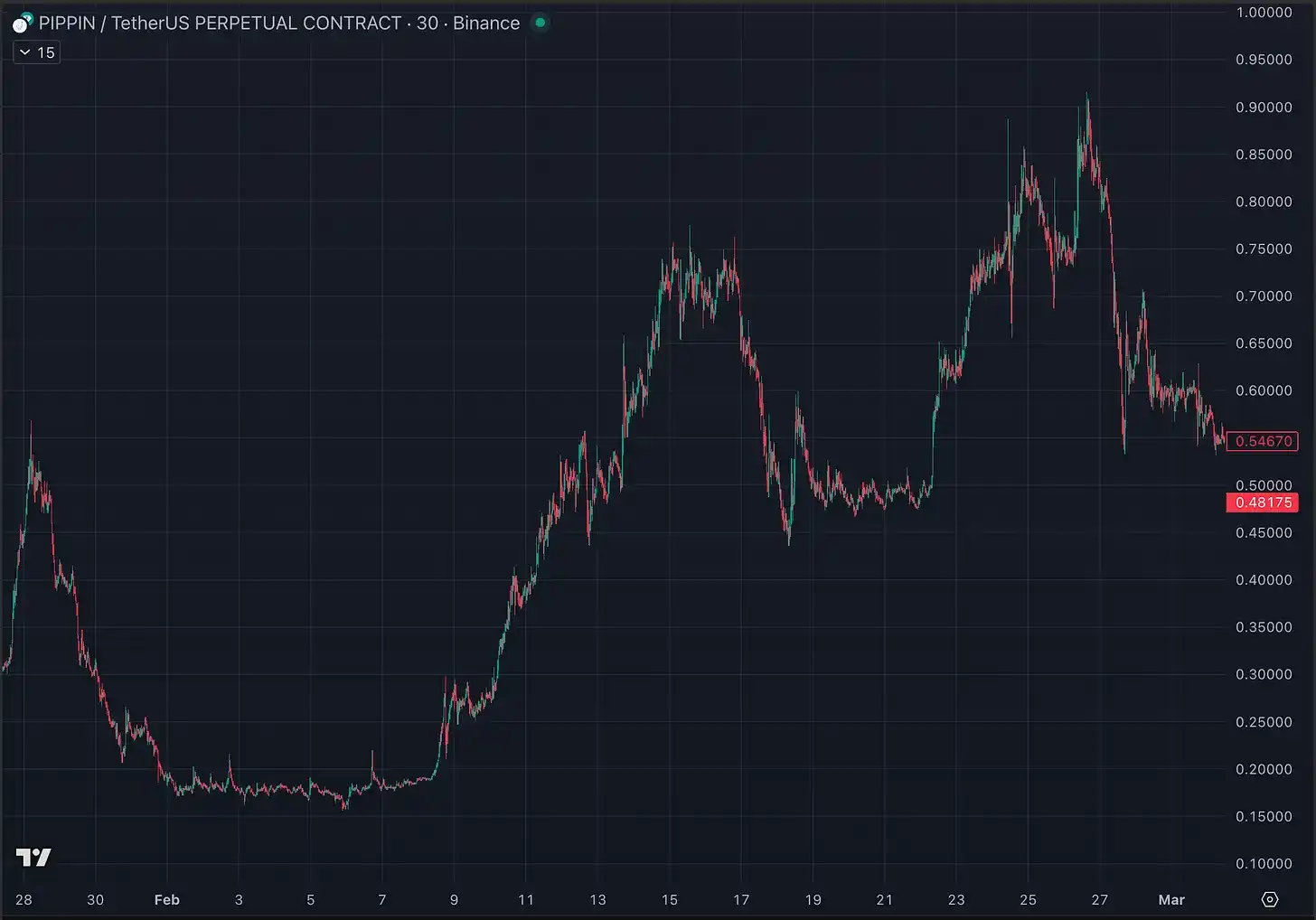
Bear markets seem to provide excellent breeding ground for scam coins. In February, the veteran AI Meme coin $PIPPIN made a comeback – its supply is completely locked by a single entity, and its price action is典型的 of manipulation. $PIPPIN started the month steadily at a $180M market cap, having already experienced a 70% crash over the previous 4 days. It began a strong rally from February 8th, rising +315% in 7 days to set a new high of $750M market cap, then pulled back to $500M before surging again to a new high of $900M. Strangely, its funding rate is no longer negative, making it a relatively less risky (though still risky) short target for a scam coin. Even so, I wouldn't be surprised to see it break the $1bn market cap.
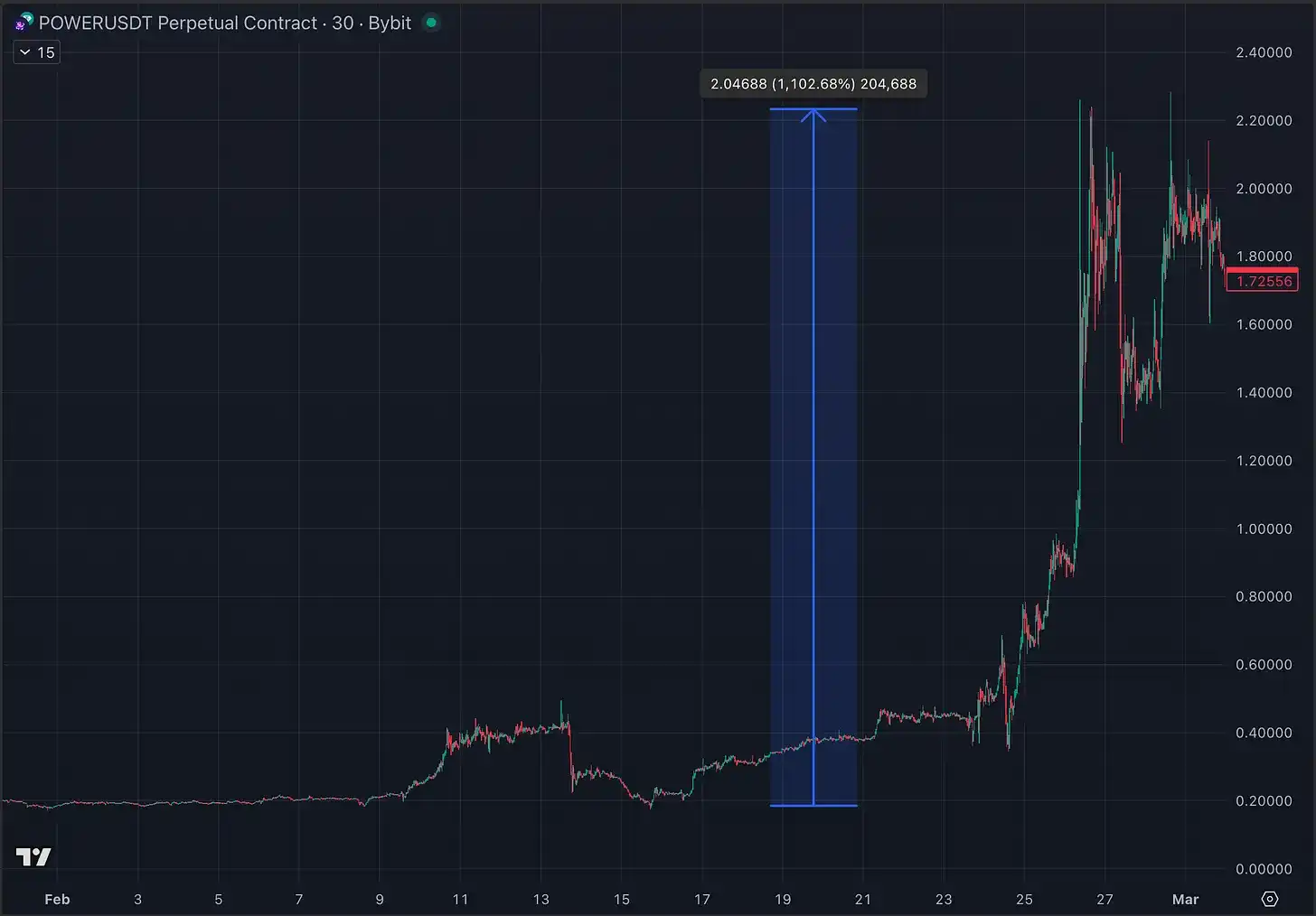
$POWER was one of the new manipulative plays emerging in February, with a 12x move from bottom to top, squeezing to a $2.3bn FDV, with extremely negative funding rates. Be very cautious shorting this.
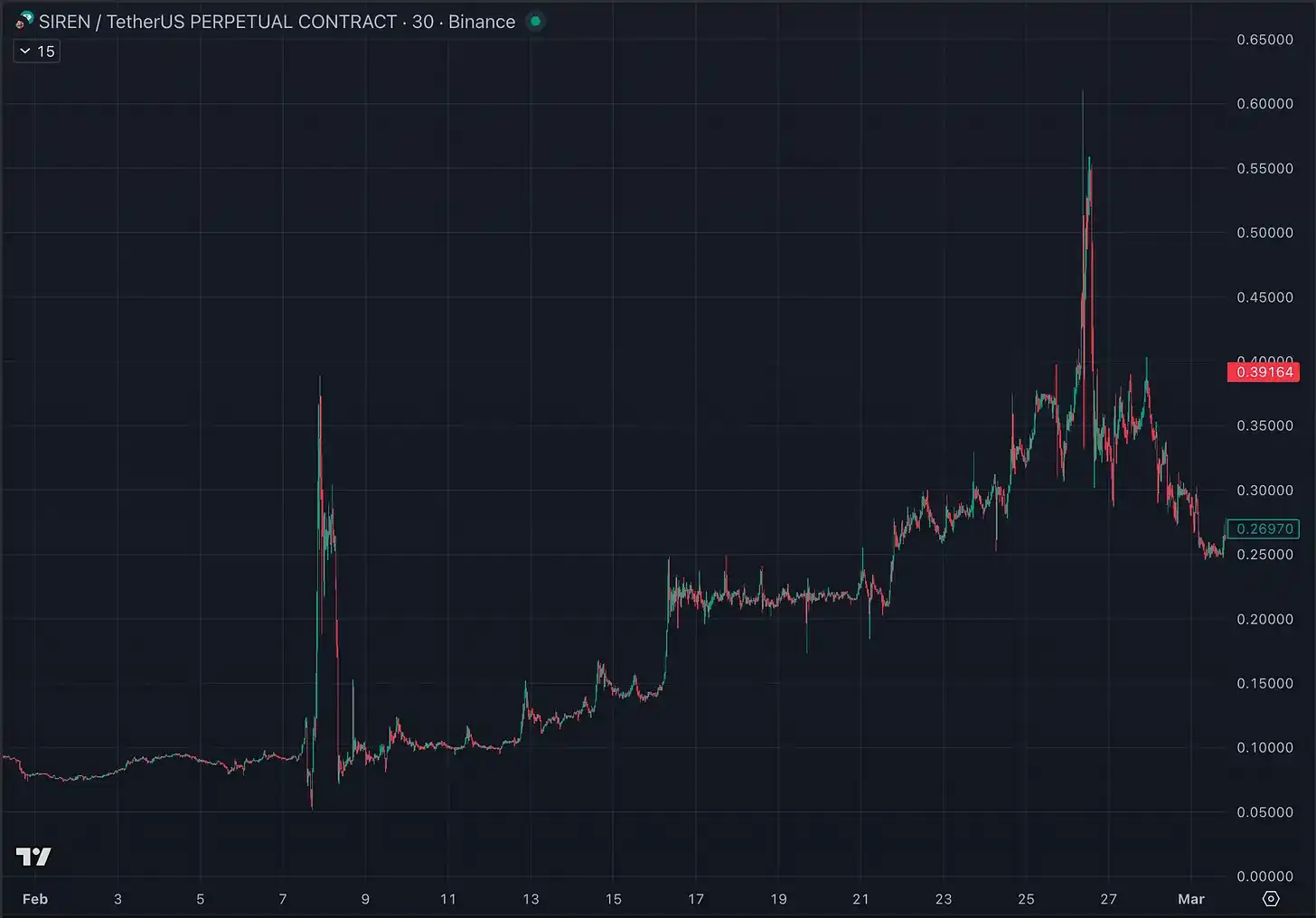
Another notable move was $SIREN, this BSC scam meme coin executed a pump and dump on February 8th – running from $100M market cap to $400M and back to $100M – then spent the rest of February slowly climbing to new highs, eventually executing a major squeeze at a $600M market cap.
It's also worth mentioning $BULLA, which did a 13x run in late January, then crashed 95% in a single day on February 1st, falling from $450M FDV to $25M FDV. $ARC also experienced an 80% collapse after rising from $40M to $130M.

Bear Market Characteristics

We are in a bear market environment: most bullish moves in altcoins are short squeezes that are quickly given back. Here are tokens that exhibited this behavior in February: ZK ZIL LA NIL SONIC DYM ME MOVE 0G INIT RPL ESP AZTEC BIO AGLD SAHARA. These moves typically involve +50% to +100% gains within a single day, accompanied by negative funding rates (making it difficult for shorts), followed by weakness over subsequent days.

Aside from post-crash bounces, altcoins only had two brief periods of strength. The first was February 13th-15th, led by Meme coins (USELESS+50%, PEPE+35%) and AI tokens ($TAO+35%, $VVV+150%, VIRTUAL+25%). The second occurred on February 25th, was extremely brief, and was purely a short squeeze on "dead" large-cap coins, which gained +25% to +30% that day (DOT NEAR UNI APT FIL TIA......).

$HYPE & Perp DEX Sector

$HYPE ended January strongly, rallying from $22 to $34 in a day, and this strength carried over into early February. It reached $38 on February 3rd and was one of the strongest tokens on February 5th, the day of the market-wide crash and liquidation cascade. Its strength was notable – on February 6th it nearly touched $37, as if the market crash never happened for HYPE – but this also marked its top relative to the altcoin market. It slightly underperformed the altcoin market over the next 20 days, pulling back to $26.
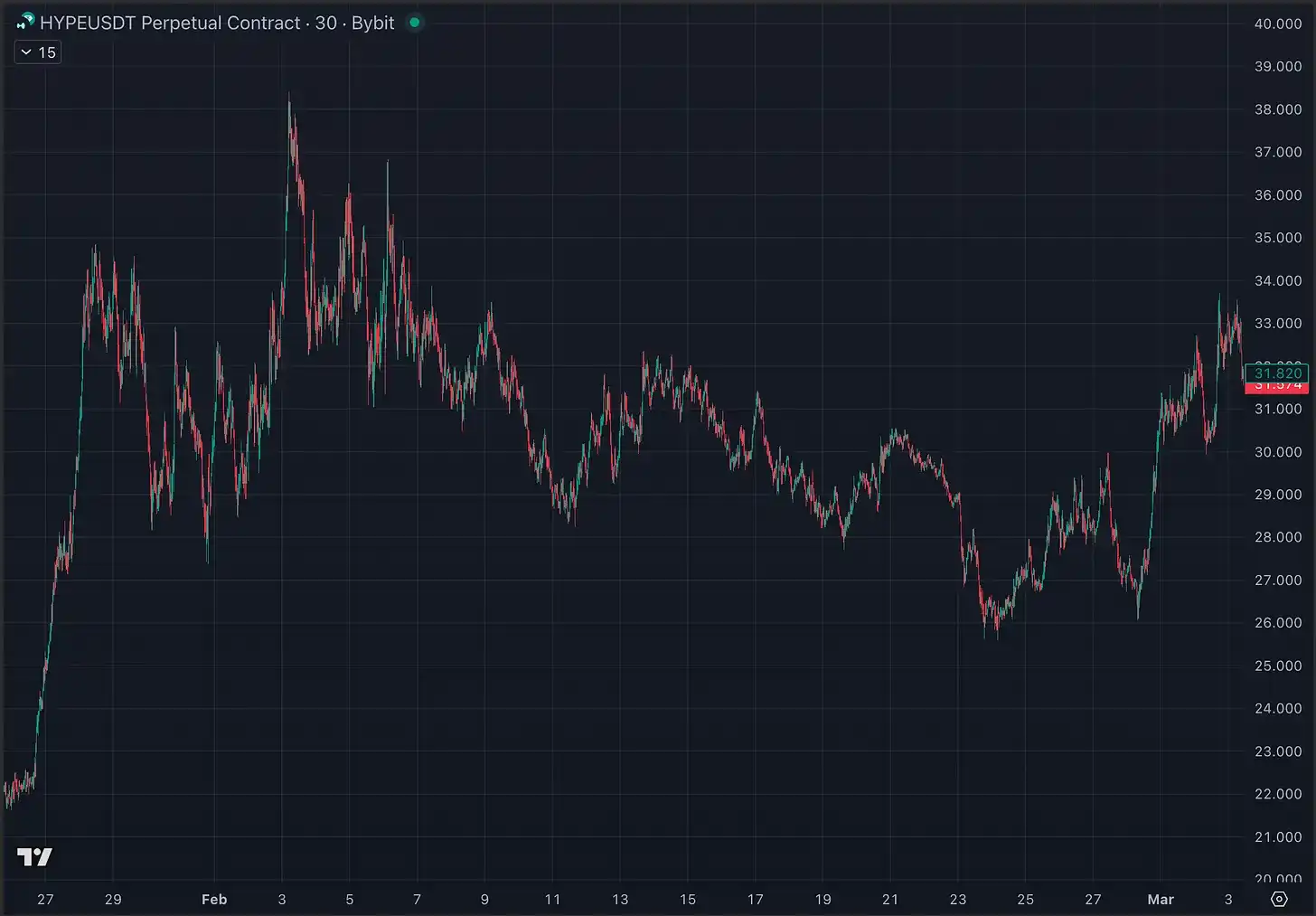
One reason for $HYPE's strength in early February was significant buying by Multicoin over several days, and HSI/PURR (HYPE's DAT) were also accumulating steadily.

In the Perp DEX sector, $LIT continued to show extreme weakness in February, finding support around $1.3, which has been tested four or five times.

$ASTER saw a strong bounce after the February 5th crash, rising from a low near $0.4 to $0.7, then strangely consolidated sideways around $0.7 for the remainder of February. It has a bullish catalyst: the launch of its own L1/blockchain in March.

Uniswap x BlackRock

On February 11th, Uniswap announced a partnership with BlackRock to provide liquidity for the latter's BUIDL product, simultaneously announcing BlackRock's direct investment in $UNI tokens (amount undisclosed). The market reaction was extremely strong, with $UNI gaining +40% in 10 minutes – quite remarkable for a token with an FDV over $30 billion. But the gains were completely erased over the next 10 hours, a classic bear market pump and dump.

Aave went through a period of controversy in February. On February 20th, BGD Labs announced its withdrawal from the Aave DAO due to disagreements over the V4 strategy, causing $AAVE to drop 8%. At the end of the month, Marc Zeller, a well-known figure in the Aave ecosystem, published a critique of Aave Labs, characterizing it as effectively an value extraction vehicle, leading to further token weakness.

Particularly unfavorable for Aave is that its main competitor, $MORPHO, has performed strongly in 2026, gaining nearly +75% in February. The FDV of the two tokens is now roughly equal, around $2bn each.

Other Important Events in February

On February 18th, Base announced it would transition from the Optimism tech stack to building its own. This was devastating for $OP, which fell 40% over 4 days. $ARB was also dragged down by correlation, now with an FDV of "only" $1bn, down 96% from its ATH ($OP is down 97%).

On February 11th, $BERA experienced a very strong short squeeze, gaining +160% in 8 hours, with a extreme discrepancy between spot and futures prices (a 15% gap). This is a weirdly trading token, mostly significantly underperforming the market but occasionally experiencing very strong random squeezes, having already seen a 2x move over 5 days last month.

On February 18th, $WLFI suddenly rose +30% for no apparent reason, simultaneously with open interest (OI) increasing by nearly $100M – this likely means a single entity pulled the price by going long $100M worth of $WLFI. The price then topped out here, has fallen about 20% from the high, and there has been no news since. This entity's move was quite strange, and I expect $WLFI to go much lower in the coming months.

At the end of February 2026, the bankruptcy estate of Terraform Labs sued Jane Street in Manhattan federal court, accusing it of using non-public information during the May 2022 Terra collapse to trade ahead of key UST liquidity events. $LUNC gained +35% in the days following the news.

$ZEC is still digesting its Q4 2025 rally, generally underperforming, but also occasionally seeing powerful squeezes, like the +45% on February 13th-14th. I think it's quite possible it falls to $150 or even $100 in the coming months.

$HNT had a strong 2x move in February. Is this a dead cat bounce for an asset suffering from excessive dilution, or has this DePIN token finally become cheap enough to be a worthwhile buy?

Like last month, $STABLE continued to trade as if its supply is locked, rising +144% from a local bottom of $1.6bn FDV to set a new high near $4bn FDV. DegenSpartan also endorsed it in an article, and given DegenSpartan's rare public commentary lately, this endorsement is quite bullish.

$BCH is a strange token. It consistently rose relative to BTC (outperforming by 40%) for 22-day stretch, then suddenly reversed, giving back all its excess returns in less than a week. Many became bullish on BCH due to the "quantum-resistant" narrative and its overall strength since early 2025, but it now looks like an entity holding a large amount of BCH decided to exit, continuously TWAP selling.

Robinhood listed two altcoins in February: $SNX (February 19th) and $CC. $CC barely reacted, but $SNX gained +42% over several days as a result. Upbit listings remain a very strong catalyst for tokens; $AZTEC (+70%), $ESP (+100%), and $SKR (+40%) all experienced this, with extremely negative funding rates within hours of listing. $BIRB also saw a 2x move after listing on Bithumb on February 3rd.

Two notable TGEs in February were $AZTEC and $ESP (Espresso). Both traded at relatively low valuations (FDV both below $500M, whereas这类 projects easily reached $1bn+ FDV a few months ago), indicating that altcoin premiums are slowly being repriced downward. However, $ESP had a stronger performance, with a +280% move from its late February low to high.

Polymarket announced a partnership with Kaito to launch an attention market. $KAITO rose +13% in 3 minutes after the news, then gave back all gains within an hour.


İlgili Sorular

QWhat was the key price range for BTC in February 2026, and what event caused a sharp drop to $60k?

ABTC's price range for most of 2026 was between $60k and $70k. A sharp drop to $60k occurred on February 5th, falling from $70k in a single day.

QHow did the market react to the US airstrike on Iran and the subsequent announcement of Khamenei's death at the end of February?

ABTC initially dropped from $68k to $65k on rumors of the airstrike, then fell further to $62k when the attack was confirmed. However, it was met with strong buying pressure and closed the day near $68k. The announcement of Khamenei's death was interpreted as a bullish signal, as it suggested the US would not heavily invest in further conflict.

QWhat was the market's reaction to the LayerZero (ZRO) conference on February 10th, and what significant partnerships were announced?

AThe market reaction was complex. A leaked video caused a 20% sell-off, but the official announcement of its own 'Zero' blockchain, along with major partnerships including Citadel Securities, Cathie Wood/ARK, DTCC, and ICE, led to a 45% pump in the following 12 hours. However, these gains were later completely erased.

QWhich 'scam coins' or heavily manipulated tokens were highlighted as having significant price action in February?

AThe article highlighted $PIPPIN, $SIREN, and $POWER as notable manipulated 'scam coins'. $PIPPIN saw a 315% pump, $SIREN had a major pump and dump, and $POWER saw a 12x increase from its bottom.

QAccording to the article, what are the characteristics of the altcoin market in this bearish environment?

AThe bear market is characterized by short-lived altcoin squeezes that quickly give up their gains. These pumps, often +50% to +100% in a single day, are typically followed by weakness over subsequent days. Most altcoin strength was limited to two brief periods: February 13-15 and February 25.

İlgili Okumalar

US Government Suddenly Halts Anthropic's Strongest Model, "Quasi-IPO Stock Price" Plunges 3.7% Overnight

U.S. Government Halts Anthropic's Top AI Models, 'Pre-IPO' Price Drops 3.7% On June 12, the U.S. government ordered Anthropic to shut down access to its two most powerful AI models, Claude Fable 5 and Claude Mythos 5, citing national security concerns. The directive, issued by the Department of Commerce, required Anthropic to block access for all foreign nationals, leading the company to disable the models globally for all users. Anthropic strongly opposed the move, arguing the government's basis was a "narrow jailbreak vulnerability" and warning that applying such a standard industry-wide would effectively halt all frontier model deployments. The news impacted Anthropic's implied valuation in speculative markets. The Anthropic perpetual contract on Hyperliquid fell approximately 3.7% to around $1,627, down from highs above $1,800 following the models' release. Unauthorized tokenized products linked to Anthropic on Solana also saw significant declines. The models, launched just days earlier on June 9, represented a major capability leap for Anthropic. Fable 5 was its first public release of a "Mythos"-tier model above its flagship Claude Opus. The shutdown creates an ironic situation for Anthropic, a company founded on "AI safety" principles, and adds uncertainty to its ongoing IPO preparations. The company is actively engaging with regulators to resolve what it calls a "misunderstanding" and restore service.

marsbit18 dk önce

US Government Suddenly Halts Anthropic's Strongest Model, "Quasi-IPO Stock Price" Plunges 3.7% Overnight

marsbit18 dk önce

SpaceX IPO Creates Trillion-Dollar Billionaire: Musk's Wealth Equals Half of Crypto Market

SpaceX's record-breaking IPO has propelled Elon Musk to become the first modern billionaire with a personal net worth exceeding $1 trillion, reaching $1.11 trillion according to Bloomberg. This staggering wealth surpasses the total market capitalization of all cryptocurrencies excluding Bitcoin and equals roughly half of the entire crypto market's value. The milestone highlights extreme wealth concentration and the significant devaluation of the altcoin market, whose total cap has nearly halved since late 2025 as capital flows into large tech stocks. SpaceX's Nasdaq debut saw its valuation hit $2.2 trillion, with shares soaring from a $135 offer price to close at $161. Its first-day trading volume of $85 billion set a new global IPO record. Musk owns 42% of the company. Despite his wealth dwarfing the altcoin sector, Musk maintains deep ties to digital assets. He personally holds Bitcoin, Ethereum, and Dogecoin, while his companies, SpaceX and Tesla, collectively hold over 30,000 Bitcoin, ranking among the top corporate BTC holders globally. His acquisition and integration of financial data tools into X (formerly Twitter) further connect his ecosystem to the markets. Ultimately, Musk's trillion-dollar status underscores the immense wealth controlled by tech founders, though this fortune remains largely tied to volatile stock prices rather than liquid assets.

Foresight News26 dk önce

SpaceX IPO Creates Trillion-Dollar Billionaire: Musk's Wealth Equals Half of Crypto Market

Foresight News26 dk önce

Hardcore First Look | Ocean Embodied Intelligence Company 'Shihang Intelligence' Secures Record-Breaking 1 Billion in Funding, Zhu Xiaohu, Temasek Place Bets

Breaking News | Ocean Embodied Intelligence company "Shihang Intelligent" secures a record-breaking 1 billion RMB (approximately 10 billion yuan) in Series A financing, with investment from Zhu Xiaohu and Temasek. Author: Qiu Xiaofen | Editor: Yuan Silai Ocean Embodied Intelligence company "Shihang Intelligent" has completed its Series A funding round, raising over 1 billion RMB. This marks the largest single funding round in the global marine robotics field to date. Investors include upstream momentum funds from chip companies "Moore Thread" and "Kunlunxin," Singapore's state-owned investment platform Vertex Growth, and listed company Dyneo, among others. Existing investors like GSR Ventures (whose founder Zhu Xiaohu has invested for the fifth time), Vertex Ventures China, Hua Ying Capital, and Long Capital also significantly increased their investments. Founder and CEO Chen Xiaobo, a 1989-born alumnus of Harbin Engineering University, is a long-time expert in underwater robotics. He received the National Defense Science and Technology Progress Award at age 28 (the youngest recipient) and led the development of China's first commercial underwater cleaning robot. The funds will be used for core technology R&D, global market expansion, and building the industry chain ecosystem to scale the application of marine robots in complex underwater scenarios. The ocean is considered one of the most challenging environments for robotics due to low light, high turbidity, complex currents, limited communication, high pressure, and corrosion. "Shihang Intelligent" focuses on developing core underlying technologies for marine robots, covering six key systems: power, control, sensing, navigation, sealing, and deployment. Its robots are capable of operating at depths from 0 to 10,000 meters with full degrees of freedom, performing complex maneuvers, autonomous navigation, and multi-robot collaboration. Applications include ship cleaning, underwater security, offshore wind power, marine ranching, and seabed inspection. The company's order value for the first half of 2026 alone has exceeded 1 billion RMB. Its "Orca Robot" is used by major shipping companies and has performed maintenance on over a thousand large vessels. In April of this year, the company launched its ocean embodied large model "Cangqiong CEORION." Unlike traditional remote-controlled or pre-programmed robots, this model integrates environmental perception, task understanding, and action generation into a single end-to-end architecture. Trained on millions of hours of commercial operation data and simulation data, it covers 12 major underwater operation scenarios. In simulations, it achieved over 90% task success rate and over 70% zero-shot adaptation capability to unseen environments. A built-in physics reasoning module reduces collision risk by 80%, enabling autonomous operation even with weak or no communication. Recently, "Shihang Intelligent" was selected as a core technology partner for Singapore's Maritime and Port Authority national hull inspection and cleaning program. These advancements indicate marine robotics is moving from pilot projects to scaled applications, with real-world operations generating valuable data to continuously improve robot capabilities. CEO Chen Xiaobo stated the company will continue investing in core marine robotics technology, the embodied intelligence model, and global application scenarios to expand into more high-risk, high-difficulty, and high-value underwater operations.

marsbit51 dk önce

Hardcore First Look | Ocean Embodied Intelligence Company 'Shihang Intelligence' Secures Record-Breaking 1 Billion in Funding, Zhu Xiaohu, Temasek Place Bets

marsbit51 dk önce

Three Months, 35 Billion Yuan: Investors Rush to Grab the OpenAI of the Physical World

Investors flock to a physical AI startup as the race for the "OpenAI of the physical world" heats up. Ji Jia Shi Jie (GigaWorld), a company dedicated to developing Artificial General Intelligence (AGI) for the physical world, has raised 3.5 billion RMB (approximately $490 million) in just three months, according to a report from investment media outlet Touzijie. The latest B2 funding round of 1 billion RMB attracted a wide range of top-tier investors, including sovereign wealth funds, industrial capital, and financial institutions. This brings the total funding for the young company, now valued over 10 billion RMB, to 3.5 billion RMB across three recent rounds. The company is led by Huang Guan, a post-90s Tsinghua University PhD with extensive experience in AI, autonomous driving, and entrepreneurship. Its core innovation is a "dual-pyramid" system comprising a five-layer data pyramid (from internet videos to real-world robot data) and a three-layer algorithm pyramid focused on world simulation, action alignment, and reinforcement learning. This system underpins its key models: the "World Action Model" (e.g., GigaBrain series for robot control) and the "World Generation Model" (e.g., GigaWorld series for simulating and understanding the physical world). Its models have reportedly achieved top rankings in global robotics benchmarks. Ji Jia Shi Jie argues that while current digital AGI excels in information processing, the next frontier is physical AGI—systems that can understand and interact with the real world. The company believes the field is approaching its "GPT-3 moment," a key inflection point in capability scaling. To achieve this, the company is pursuing a dual-market strategy. For the consumer (C) market, it launched the "SeeLight" brand and its S1 general-purpose humanoid robot, which has secured initial orders for deployment in real homes. For the business (B) market, it focuses on industrial automation with its Maker series robots, having signed agreements for large-scale deployment in factories, and its DriveDreamer world model for autonomous driving, which is already in use with over 30 automakers and tech companies. The report concludes that by bridging the gap between digital intelligence and physical action, Ji Jia Shi Jie aims to unlock a new wave of productivity, ultimately bringing physical AGI into everyday life.

marsbit1 saat önce

Three Months, 35 Billion Yuan: Investors Rush to Grab the OpenAI of the Physical World

marsbit1 saat önce

What's the Connection Between Pinduoduo's Huang Zheng and Blockchain?

This text explores the unexpected connection between Pinduoduo founder Colin Huang and blockchain, as suggested in his article *Turning Capitalism Upside Down*. Huang argues Pinduoduo's core business is about managing "uncertainty." He posits that wealth flows to the rich because they absorb life's uncertainties (e.g., illness, job loss) that devastate the poor, who pay a premium for certainty through insurance or stable prices. Pinduoduo's model attempts a "reverse insurance": by aggregating consumer demand via group-buying and flash sales, it creates a large, predictable order for manufacturers. This certainty allows factories to remove risk premiums, passing savings back as lower prices, thus partially reversing the wealth flow. The key obstacle, Huang notes, is that an individual's buying intent is an unreliable promise. He then asks if blockchain is the natural solution for this "reverse insurance." The text elaborates that blockchain, through smart contracts with binding deposits, could transform casual intent into a costly-to-break, enforceable commitment. This replaces interpersonal trust with coded rules, making promises credible, pricable, and resistant to fraud. Finally, the author draws a parallel to Bitcoin, framing two paths to creating certainty: the "Pinduoduo path" of aggregating decentralized will into scale, and the "Bitcoin path" of locking rules into immutable code. Both sacrifice something—personal freedom or system flexibility—to manufacture trust and predictability.

链捕手2 saat önce

What's the Connection Between Pinduoduo's Huang Zheng and Blockchain?

链捕手2 saat önce

İşlemler

Spot
Futures

Popüler Makaleler

BITCOIN Nedir

HarryPotterObamaSonic10Inu (ERC-20)'yu ve Kripto Alanındaki Yerini Anlamak Son yıllarda, kripto para piyasası, hem ticaret yapanların hem de topluluk etkileşimi ve eğlence değeri arayanların ilgisini çeken meme coin'lerin popülaritesinde bir artış gördü. Bu benzersiz token'lar arasında, kripto para dokusuna kültürel referansları harmanlayan ilginç bir proje olan HarryPotterObamaSonic10Inu (ERC-20) bulunmaktadır. Bu makale, HarryPotterObamaSonic10Inu'nun temel yönlerini, mekanizmalarını, topluluk odaklı ethosunu ve daha geniş kripto manzarasıyla etkileşimini incelemektedir. HarryPotterObamaSonic10Inu (ERC-20) Nedir? Adından da anlaşılacağı gibi, HarryPotterObamaSonic10Inu, Ethereum blok zinciri üzerinde inşa edilen bir meme coin'dir ve ERC-20 standardı altında sınıflandırılmaktadır. Geleneksel kripto paraların pratik kullanılabilirlik veya yatırım potansiyeline odaklandığı durumların aksine, bu token eğlence değeri ve topluluğunun gücü üzerine kuruludur. Proje, bağlı kullanıcıların bir araya gelebileceği, fikirlerini paylaşabileceği ve çeşitli kültürel fenomenlerden ilham alan etkinliklere katılabileceği bir ortam yaratmayı hedeflemektedir. HarryPotterObamaSonic10Inu'nun dikkate değer özelliklerinden biri işlemlerde sıfır vergi olmasıdır. Bu çekici unsur, küçük ölçekli yatırımcıları caydırabilecek ek ücretlerden yoksun olarak ticareti ve topluluk katılımını teşvik etmeyi amaçlamaktadır. Coin'in toplam arzı bir milyar token olarak belirlenmiştir; bu, topluluk içinde önemli bir dolaşım sağlama niyetini göstermektedir. HarryPotterObamaSonic10Inu (ERC-20) Yaratıcısı HarryPotterObamaSonic10Inu'nun kökenleri bir miktar gizemlidir; yaratıcısı hakkında spesifik bilgilerin ne olduğu bilinmemektedir. Bu token'ın geliştirilmesi, belirli bir ekip veya açık bir plan eksikliği ile gerçekleşmiştir; bu durum, meme coin sektöründe oldukça yaygındır. Proje, topluluğunun heyecanı ve katılımına dayalı olarak organik bir şekilde ortaya çıkmıştır. HarryPotterObamaSonic10Inu (ERC-20) Yatırımcıları Dış yatırımlar ve destekler söz konusu olduğunda, HarryPotterObamaSonic10Inu da belirsiz kalmaktadır. Token, bilinen herhangi bir yatırım fonunu veya önemli bir kurumsal desteği listelememektedir. Bunun yerine, projenin can damarı, kolektif eylem ve kripto alanındaki katılım yoluyla büyüme ve sürdürülebilirlik sağlayan temel topluluğudur. HarryPotterObamaSonic10Inu (ERC-20) Nasıl Çalışır? Bir meme coin olarak, HarryPotterObamaSonic10Inu, genellikle varlık değerini yöneten geleneksel çerçevelerin dışında çalışmaktadır. Projenin nasıl çalıştığını tanımlayan birkaç özelliği vardır: Sıfır Vergi İşlemleri: İşlemlerde vergi ücreti olmadan, kullanıcılar gizli maliyet endişesi olmadan token'ı serbestçe alıp satabilirler. Topluluk Etkileşimi: Proje, topluluk etkileşimi üzerine kuruludur ve sosyal medya platformlarını kullanarak heyecan yaratarak katılımı kolaylaştırır. Tartışmalar, içerik paylaşımı ve katılım, projenin erişimini genişletmeye ve destekleyiciler arasında sadakat oluşturmaya yardımcı olan kritik unsurlardır. Pratik Kullanılabilirlik Yok: HarryPotterObamaSonic10Inu'nun mali ekosistem içinde somut bir kullanılabilirlik sunmadığı belirtilmelidir. Daha ziyade, eğlence ve topluluk etkinlikleri için bir token olarak sınıflandırılmaktadır. Kültürel Referans: Token, popüler kültürden unsurları zekice harmanlayarak ilgi çekmektedir ve hem meme meraklıları hem de kripto takipçileriyle bağlantı kurmaktadır. HarryPotterObamaSonic10Inu, meme coin'lerin, daha geleneksel kripto para projelerinden nasıl farklı çalıştığını örneklendirmektedir; bu projeler, utilitarist varlıklar yerine yenilikçi sosyal yapıların bir parçası olarak piyasaya girmektedir. HarryPotterObamaSonic10Inu (ERC-20) Zaman Çizelgesi HarryPotterObamaSonic10Inu'nun tarihi, birkaç dikkate değer kilometre taşı ile işaretlenmiştir: Oluşum: Token, birçok kripto meraklısının hayal gücünü yakalayan bir viral meme'den ortaya çıkmıştır. Spesifik yaratım tarihleri mevcut değildir ve bu onun organik yükselişini vurgulamaktadır. Borsa Listelemeleri: HarryPotterObamaSonic10Inu, topluluğun daha kolay erişim ve ticaret yapabilmesini sağlamak için çeşitli borsalarda yer bulmuştur. Topluluk Katılım İnisiyatifleri: Yarışmalar, sosyal medya kampanyaları ve hayranlar ile destekçilerden içerik üretimini içeren topluluk etkileşimini artırmayı amaçlayan devam eden etkinlikler. Gelecek Genişleme Planları: Projenin yol haritası, kültürel temalarına ilişkin bir NFT koleksiyonu, ticari ürünler ve bir e-ticaret sitesi başlatılmasını içermektedir; bu da topluluğun daha fazla katılımını sağlamayı ve ekosistemine daha fazla boyut kazandırmayı hedeflemektedir. HarryPotterObamaSonic10Inu (ERC-20) Hakkında Kilit Noktalar Topluluk Odaklı Doğası: Proje, kullanıcı katılımını geliştirme önceliği taşır ve böylece kullanıcıların sürecin en önünde yer almasını sağlar. Meme Coin Sınıflandırması: Eğlenceye dayalı kripto paranın doruk noktasıdır ve geleneksel yatırım araçlarından ayrılmaktadır. Bitcoin ile Doğrudan İlişki Yok: Ticker ismindeki benzeliğe rağmen, HarryPotterObamaSonic10Inu ayırt edicidir ve Bitcoin veya diğer yerleşik kripto paralarla herhangi bir ilişkisi yoktur. İşbirliğine Odaklanma: HarryPotterObamaSonic10Inu, sahipleri arasında işbirliği ve hikaye paylaşımı için bir alan oluşturmak üzere tasarlanmıştır ve bu da yaratıcılık ve topluluk bağlarını sağlamaktadır. Gelecek Beklentileri: Başlangıçta belirlendiği temalardan NFTs ve ticari ürünlere genişleme arzusu, projenin dijital kültürde daha ana akıma girebilmesi için bir yol haritası çizmektedir. Meme coin'ler, kripto para topluluğunun hayal gücünü çalmaya devam ederken, HarryPotterObamaSonic10Inu (ERC-20), kültürel bağları ve topluluk merkezli yaklaşımıyla öne çıkmaktadır. Geleneksel bir hizmet odaklı token modeliyle uyumlu olmasa da, özünde destekçileri arasında sağlanan neşe ve dostluğu vurgulayarak, giderek dijitalleşen bir çağda kripto paraların evrilen doğasını göstermektedir. Proje gelişmeye devam ettikçe, topluluk dinamiklerinin blockchain teknolojisi dünyasındaki seyrini nasıl etkilediğini izlemek önemli olacaktır.

2.0k Toplam GörüntülenmeYayınlanma 2024.04.01Güncellenme 2024.12.03

BITCOIN Nedir

BTC Nasıl Satın Alınır

HTX.com’a hoş geldiniz! Bitcoin (BTC) satın alma işlemlerini basit ve kullanışlı bir hâle getirdik. Adım adım açıkladığımız rehberimizi takip ederek kripto yolculuğunuza başlayın. 1. Adım: HTX Hesabınızı OluşturunHTX'te ücretsiz bir hesap açmak için e-posta adresinizi veya telefon numaranızı kullanın. Sorunsuzca kaydolun ve tüm özelliklerin kilidini açın. Hesabımı Aç2. Adım: Kripto Satın Al Bölümüne Gidin ve Ödeme Yönteminizi SeçinKredi/Banka Kartı: Visa veya Mastercard'ınızı kullanarak anında Bitcoin (BTC) satın alın.Bakiye: Sorunsuz bir şekilde işlem yapmak için HTX hesap bakiyenizdeki fonları kullanın.Üçüncü Taraflar: Kullanımı kolaylaştırmak için Google Pay ve Apple Pay gibi popüler ödeme yöntemlerini ekledik.P2P: HTX'teki diğer kullanıcılarla doğrudan işlem yapın.Borsa Dışı (OTC): Yatırımcılar için kişiye özel hizmetler ve rekabetçi döviz kurları sunuyoruz.3. Adım: Bitcoin (BTC) Varlıklarınızı SaklayınBitcoin (BTC) satın aldıktan sonra HTX hesabınızda saklayın. Alternatif olarak, blok zinciri transferi yoluyla başka bir yere gönderebilir veya diğer kripto para birimlerini takas etmek için kullanabilirsiniz.4. Adım: Bitcoin (BTC) Varlıklarınızla İşlem YapınHTX'in spot piyasasında Bitcoin (BTC) ile kolayca işlemler yapın.Hesabınıza erişin, işlem çiftinizi seçin, işlemlerinizi gerçekleştirin ve gerçek zamanlı olarak izleyin. Hem yeni başlayanlar hem de deneyimli yatırımcılar için kullanıcı dostu bir deneyim sunuyoruz.

7.9k Toplam GörüntülenmeYayınlanma 2024.12.12Güncellenme 2026.06.02

BTC Nasıl Satın Alınır

$BITCOIN Nedir

DİJİTAL ALTIN ($BITCOIN): Kapsamlı Bir Analiz DİJİTAL ALTIN ($BITCOIN) Tanıtımı DİJİTAL ALTIN ($BITCOIN), geleneksel değerli metallerin özelliklerini merkeziyetsiz teknolojilerin yeniliği ile birleştirmeyi amaçlayan Solana ağı üzerinde çalışan blockchain tabanlı bir projedir. Bitcoin ile aynı isme sahip olmasına rağmen, genellikle bir değer saklama aracı olarak algılandığı için “dijital altın” olarak anılmaktadır; DİJİTAL ALTIN, Web3 ortamında benzersiz bir ekosistem yaratmak için tasarlanmış ayrı bir tokendir. Hedefi, uygulanabilir bir alternatif dijital varlık olarak kendini konumlandırmaktır, ancak uygulamaları ve işlevleri ile ilgili ayrıntılar hala gelişmektedir. DİJİTAL ALTIN ($BITCOIN) Nedir? DİJİTAL ALTIN ($BITCOIN), Solana blockchain'inde kullanılmak üzere açıkça tasarlanmış bir kripto para tokenidir. Bitcoin'in yaygın olarak tanınan bir değer saklama rolü sağlamasının aksine, bu token daha geniş uygulamalara ve özelliklere odaklanıyor gibi görünmektedir. Dikkate değer yönler şunlardır: Blockchain Altyapısı: Token, yüksek hızlı ve düşük maliyetli işlemleri yönetme kapasitesi ile bilinen Solana blockchain'inde inşa edilmiştir. Arz Dinamikleri: DİJİTAL ALTIN'ın maksimum arzı 100 katrilyon token (100P $BITCOIN) ile sınırlıdır, ancak dolaşımdaki arzı ile ilgili ayrıntılar şu anda açıklanmamıştır. Kullanım Alanı: Kesin işlevler açıkça belirtilmemiş olsa da, token'ın merkeziyetsiz uygulamalar (dApps) veya varlık tokenizasyon stratejileri ile ilgili çeşitli uygulamalar için kullanılabileceğine dair işaretler bulunmaktadır. DİJİTAL ALTIN ($BITCOIN) Yaratıcısı Kimdir? Şu anda, DİJİTAL ALTIN ($BITCOIN) arkasındaki yaratıcıların ve geliştirme ekibinin kimliği bilinmemektedir. Bu durum, merkeziyetsiz finans ve meme coin fenomenleriyle uyumlu olan birçok yenilikçi proje arasında yaygındır. Böyle bir anonimlik, topluluk odaklı bir kültürü teşvik edebilirken, yönetişim ve hesap verebilirlik konusundaki endişeleri artırmaktadır. DİJİTAL ALTIN ($BITCOIN) Yatırımcıları Kimlerdir? Mevcut bilgiler, DİJİTAL ALTIN ($BITCOIN) için bilinen herhangi bir kurumsal destekçi veya önde gelen risk sermayesi yatırımı olmadığını göstermektedir. Proje, geleneksel finansman yolları yerine topluluk desteği ve benimsemeye odaklanan bir eşler arası modelde çalışıyor gibi görünmektedir. Faaliyetleri ve likiditesi esas olarak PumpSwap gibi merkeziyetsiz borsalarda (DEX'ler) yer almakta olup, bu da onun taban hareketine vurgu yapmaktadır. DİJİTAL ALTIN ($BITCOIN) Nasıl Çalışır DİJİTAL ALTIN ($BITCOIN) 'ın operasyonel mekanikleri, blockchain tasarımı ve ağ özellikleri temelinde açıklanabilir: Konsensüs Mekanizması: Solana'nın benzersiz tarih kanıtı (PoH) ile bir hisse kanıtı (PoS) modelini birleştirerek, proje ağın yüksek performansına katkıda bulunan verimli işlem doğrulamasını sağlar. Tokenomik: Belirli deflasyonist mekanizmalar kapsamlı bir şekilde detaylandırılmamış olsa da, geniş maksimum token arzı, henüz tanımlanmamış mikro işlemler veya niş kullanım durumlarına hitap edebileceğini ima etmektedir. Etkileşim: Solana'nın daha geniş ekosistemi ile entegrasyon potansiyeli bulunmaktadır; bu, çeşitli merkeziyetsiz finans (DeFi) platformlarını içermektedir. Ancak, belirli entegrasyonlarla ilgili ayrıntılar belirtilmemiştir. Önemli Olayların Zaman Çizelgesi DİJİTAL ALTIN ($BITCOIN) ile ilgili önemli kilometre taşlarını vurgulayan bir zaman çizelgesi: 2023: Token'ın Solana blockchain'inde ilk dağıtımı, sözleşme adresi ile işaretlenmiştir. 2024: DİJİTAL ALTIN, PumpSwap gibi merkeziyetsiz borsalarda işlem görmeye başladıkça görünürlük kazanır ve kullanıcıların bunu SOL karşısında ticaret yapmasına olanak tanır. 2025: Proje, topluluk odaklı etkileşimlere yönelik potansiyel ilgi ve ara sıra ticaret faaliyetleri görür, ancak şu ana kadar dikkate değer ortaklıklar veya teknik ilerlemeler belgelenmemiştir. Kritik Analiz Güçlü Yönler Ölçeklenebilirlik: Temel Solana altyapısı, yüksek işlem hacimlerini destekleyerek $BITCOIN'in çeşitli işlem senaryolarındaki faydasını artırabilir. Erişilebilirlik: Token başına potansiyel düşük ticaret fiyatı, perakende yatırımcıları çekebilir ve parçalı mülkiyet fırsatları sayesinde daha geniş katılımı kolaylaştırabilir. Riskler Şeffaflık Eksikliği: Kamuya açık olarak bilinen destekçilerin, geliştiricilerin veya bir denetim sürecinin olmaması, projenin sürdürülebilirliği ve güvenilirliği konusunda şüpheler doğurabilir. Piyasa Volatilitesi: Ticaret faaliyeti büyük ölçüde spekülatif davranışa dayanmakta olup, bu da yatırımcılar için önemli fiyat dalgalanmalarına ve belirsizliklere yol açabilir. Sonuç DİJİTAL ALTIN ($BITCOIN), hızla gelişen Solana ekosisteminde ilginç ama belirsiz bir proje olarak ortaya çıkmaktadır. “Dijital altın” anlatısını kullanmaya çalışırken, Bitcoin'in değer saklama rolünden ayrılması, amaçlanan faydasının ve yönetişim yapısının daha net bir şekilde tanımlanması gerekliliğini vurgulamaktadır. Gelecekteki kabul ve benimseme, mevcut belirsizliklerin giderilmesine ve operasyonel ile ekonomik stratejilerinin daha açık bir şekilde tanımlanmasına bağlı olacaktır. Not: Bu rapor, Ekim 2023 itibarıyla mevcut olan sentezlenmiş bilgileri kapsamaktadır ve araştırma döneminin ötesinde gelişmeler yaşanmış olabilir.

92 Toplam GörüntülenmeYayınlanma 2025.05.13Güncellenme 2025.05.13

$BITCOIN Nedir

Tartışmalar

HTX Topluluğuna hoş geldiniz. Burada, en son platform gelişmeleri hakkında bilgi sahibi olabilir ve profesyonel piyasa görüşlerine erişebilirsiniz. Kullanıcıların BTC (BTC) fiyatı hakkındaki görüşleri aşağıda sunulmaktadır.

活动图片













