Exodus, MoonPay to roll out stablecoin in early 2026, joining gold rush

cointelegraph2025-12-17 tarihinde yayınlandı2025-12-17 tarihinde güncellendi

Özet

Digital asset platform Exodus has partnered with payments infrastructure company MoonPay to launch a U.S. dollar-backed stablecoin, planned for release in early 2026. The yet-unnamed stablecoin will be issued and managed by MoonPay using the M0 infrastructure platform. It aims to simplify digital dollar transactions for everyday consumers by integrating with Exodus Pay, allowing users to spend and send money without needing deep crypto knowledge while maintaining self-custody. This move is part of a broader industry trend, as banks and crypto firms rush to offer stablecoins following the passage of the GENIUS Act in July, which established a clear U.S. regulatory framework for fiat-backed stablecoins. The new entrant will compete in a market currently dominated by Tether (USDT), which holds a 60% market share, and Circle's USDC, which holds 25%. Together, these two stablecoins represent 85% of the total $310 billion market.

Digital asset platform Exodus has partnered with MoonPay to launch a US dollar-backed stablecoin for everyday payments.

The Exodus Movement, which is also behind a popular crypto wallet, announced on Tuesday that its fully reserved dollar stablecoin is planned for launch in early 2026. The stablecoin will be issued and managed by MoonPay and developed using M0.

M0 is a stablecoin infrastructure platform that allows companies to build, issue, and manage their own custom stablecoins, and MoonPay is a leading crypto payments platform and fiat on-ramp.

The new stablecoin, which was not named, aims to make digital dollar transactions simple for consumers without requiring crypto knowledge, as it will integrate into Exodus Pay, allowing users to spend and send money while maintaining self-custody.

“Stablecoins are quickly becoming the simplest way for people to hold and move dollars onchain, but the experience still needs to meet the expectations set by today’s consumer apps,” said JP Richardson, co-founder and CEO of Exodus.

The stablecoin gold rush continues

MoonPay launched its enterprise stablecoin business in November to issue and manage digital dollars across multiple blockchains while integrating with M0’s open infrastructure.

“Enterprises want stablecoins that are programmable, interoperable and tailored to a specific product experience,” said Luca Prosperi, co-founder and CEO of M0.

Related: US banks could soon issue stablecoins under FDIC plan to implement GENIUS Act

Banks and crypto firms have rushed to offer their own stablecoins this year, spurred by the passage of the GENIUS Act in July, which introduced a clear federal regulatory framework for fiat-backed stablecoins in the United States.

The Trump family DeFi platform, World Liberty Financial, launched the USD1 stablecoin in March, global payments platform Stripe introduced stablecoin-based accounts to clients in over 100 countries in May, and Tether announced a regulatory-compliant stablecoin called USAT in September.

Two stablecoin players dominate the sector

The new Exodus and MoonPay stablecoin is entering a crowded market still dominated by two primary players.

Tether (USDT) remains the biggest stablecoin issuer with a market share of around 60% and a circulating supply of $186 billion, while Circle’s USDC is second with a 25% share and $78 billion market cap.

These two alone comprise 85% of the total stablecoin market capitalization, which is over $310 billion, according to CoinGecko.
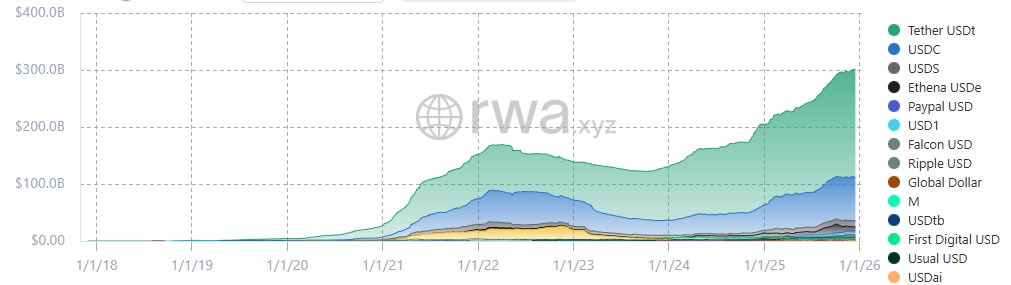
USDT and USDC still dominate stablecoin markets. Source: RWA.xyz

Magazine: Do Kwon sentenced to 15 years, Bitcoin’s ‘choppy dance’: Hodler’s Digest

İlgili Okumalar

After Memes, Solana Foundation's 'Survival Roadmap'

**Title:** After Memes, Solana Foundation's "Survival Roadmap" **Summary:** Solana Foundation's recent hiring spree for senior roles in stablecoins, AI, Asian institutional growth, and DeFi signals a strategic pivot away from its meme-driven past. This move comes as the blockchain faces a 43% quarterly drop in real economic value and declining application revenue, despite maintaining high network activity. While meme platforms like Pump.fun still dominate fee generation, new demand is emerging in tokenized equities (with $5.8B volume in Q2, a 114% increase) and institutional adoption (7 global systemically important banks are now active on Solana). The foundation's new hires aim to bridge a critical gap: transforming this growing non-speculative demand into sustainable, fee-generating activity. The stablecoin lead seeks "step-change growth" for a sector lagging behind competitors. The Asia-focused roles aim to convert institutional interest into concrete pipelines, leveraging upcoming network upgrades for millisecond settlement. The AI ecosystem role is tied to new stablecoin payment channels for AI agents, a nascent but promising revenue stream. The core challenge is clear: reduce reliance on volatile meme trading income and successfully monetize the rising institutional and real-world asset activity. The success of this "survival roadmap" will be measured by whether projects from these new focus areas can break into Solana's top revenue rankings, displacing the current meme-centric leaders.

marsbit16 dk önce

After Memes, Solana Foundation's 'Survival Roadmap'

marsbit16 dk önce

Anchorage Unveils Plan to Protect Against Quantum Threats

Regulated crypto bank Anchorage Digital has presented a strategy for preparing institutional assets for the post-quantum era, including implementing hybrid protection for internal TLS connections. The bank highlights that for cryptocurrencies, the main quantum risk lies in digital signatures, as Shor's algorithm could theoretically derive a private key from a public one. To mitigate this, Anchorage uses Bitcoin addresses based on a hash of the public key, which keeps the key hidden until a transaction is sent, and practices minimal address reuse. Internally, the company has deployed post-quantum key encapsulation for employee devices on ChromeOS and is implementing post-quantum cryptography within its hardware security modules (HSMs). A key proposal is the "Post-Quantum Turnstile" mechanism, which uses STARK zero-knowledge proofs to allow users to migrate signing rights to a post-quantum key without exposing their old private or public key. This could help secure an estimated two-thirds of circulating coins that might otherwise become inaccessible if the network phases out classical signatures. Furthermore, Anchorage open-sourced its Rust implementation of the SQIsign digital signature scheme, which it claims offers signatures about seven times smaller than the Falcon algorithm. This comes amid warnings that around 6 million BTC in addresses with exposed public keys could be vulnerable to future quantum attacks.

cryptonews.ru49 dk önce

Anchorage Unveils Plan to Protect Against Quantum Threats

cryptonews.ru49 dk önce

İşlemler

Spot
活动图片