Even Satoshi Nakamoto Would Kowtow to the God of Wealth

marsbit2025-12-25 tarihinde yayınlandı2025-12-25 tarihinde güncellendi

Özet

The article humorously explores the growing trend of integrating traditional Chinese mysticism, such as fortune-telling and feng shui, into the cryptocurrency world. It begins with the author’s visit to a temple during the Chinese New Year, where they observe well-known crypto influencers and traders—often vocal about decentralization—engaging in superstitious rituals like burning incense and praying for wealth. The piece highlights how practices like astrological analysis of Bitcoin (e.g., predicting a difficult period in 2026 based on elemental cycles) and judging founders by their facial features have become part of crypto culture. Examples include a venture capital firm considering "face reading" as due diligence and a listed company CEO whose devotion to feng shui reportedly contributed to massive Bitcoin gains. The author argues that this turn to mysticism isn’t merely superstition but a psychological response to extreme market volatility. Like ancient maritime cultures relying on deities for safety in unpredictable seas, crypto participants use these beliefs as mental anchors amid chaotic price swings influenced by tweets and macros. Ultimately, when assets can swing 50% in a day, faith in something beyond charts becomes a way to cope.

Author: Xiaobing, Deep Tide TechFlow

Every year on the fifth day of the Lunar New Year, Xiaobing wakes up early to visit the Temple of the God of Wealth at Beigao Peak in Hangzhou.

I thought I would be jostling with aunties and uncles, but when I arrived, the scene was filled with familiar faces amidst the swirling incense smoke.

To my left was a well-known爆料KOL, to my right were community builders of pyramid schemes, and a few tech elites who usually preach "decentralization" were devoutly kowtowing with loud thuds. At that moment, no algorithmic consensus or Federal Reserve moves could compare to the three sticks of incense in their hands.

Over the past two years, mysticism has become the "mainstream" in the crypto world. If you’re still looking at K-line charts, you’re a classical韭菜 (dumb money). The real veterans are now reading八字 (fortune-telling based on birth dates).

A crypto trader familiar with various indicators eventually turned to mysticism and recently calculated Bitcoin’s八字. The result was grim: Fire clashes with the wealth vault, making 2026 (the Year of the Fire Horse) Bitcoin’s darkest hour. I quickly checked my wallet—thankfully, it was already empty.
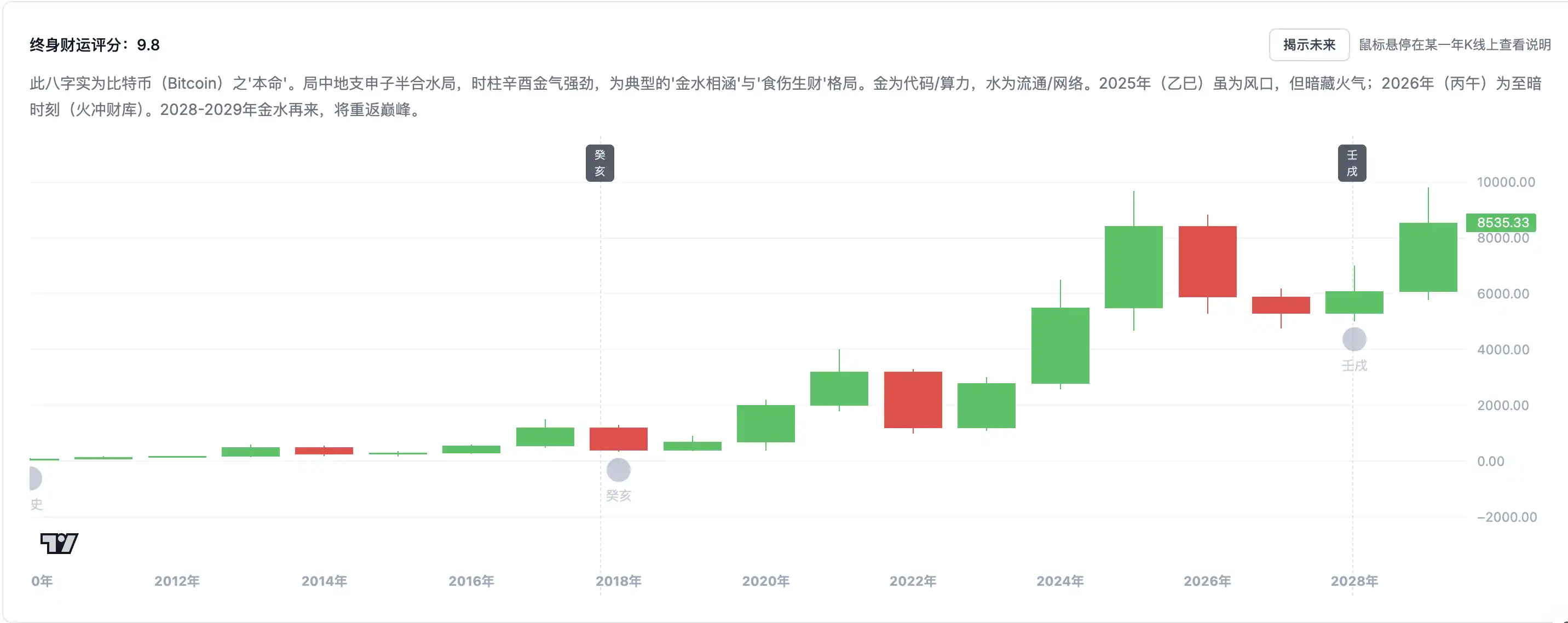
As Alen, a partner at crypto VC y2z Ventures, once bluntly stated, one of their fund’s core competencies is "reading faces." Due diligence used to focus on code audits and business models, but now it’s different. First, they check if the founder has a "wealth-draining face," then they assess whether the project’s name clashes with风水 (geomancy).

During a recent trip to Shenzhen, I noticed that traders and KOLs’ standard accessory isn’t a data terminal—it’s a "feng shui consultant" standing behind them.

Don’t laugh—this approach actually works in the crypto world. Xiaobing knows a listed company boss in Hong Kong who is a devout believer in feng shui, donating more to temples than his company spends on R&D.

And the result? Feng shui brought him noble support. He started buying Bitcoin in 2023, made hundreds of millions by hoarding it, and later rode the wave of DAT (Crypto Treasury Reserve) narratives, doubling his company’s stock price... While everyone knows this is "survivorship bias," you can’t argue with the fact that he got rich.

There are counterexamples too. A爆料KOL with a frog avatar also had a feng shui consultant who advised him not to trade recently, but he couldn’t resist playing with contracts and got liquidated neatly.

This isn’t entirely superstition.

Our traditional land-based civilization emphasizes farming—"sow one seed in spring, reap ten thousand grains in autumn"—all about certainty. But what do ocean-based civilizations face? Storms and unknown waters.

Why do people in southeastern coastal areas worship Mazu? Not because they’re ignorant, but because on the vast, unpredictable sea, besides experience and technology, you need something else.

The crypto world is essentially a modern version of the "Age of Exploration." It faces bottomless depths and sudden storms. Humans are like this: the greater the randomness and volatility, the more we seek supernatural anchors.

When K-line charts fail, and a single tweet from Elon Musk, Donald Trump, or CZ can sway the market, feng shui becomes the last psychological防线. This isn’t ignorance—it’s an instinctive应激反应 to massive wealth fluctuations.

After all, when your assets can swing 50% in a day, you need to believe in something to sleep at night. Does it matter if the God of Wealth understands blockchain?


İlgili Sorular

QWhat is the main theme of the article regarding the crypto community's behavior?

AThe article highlights that mysticism and fortune-telling, such as consulting feng shui masters and analyzing birth charts, have become prevalent in the crypto community as a psychological coping mechanism against extreme market volatility and uncertainty.

QHow does the article contrast traditional land-based civilizations with maritime civilizations in the context of belief systems?

AIt explains that land-based civilizations emphasize certainty and predictability (like farming cycles), while maritime civilizations, facing unpredictable storms and unknowns, turn to supernatural beliefs (e.g., worshipping Mazu) for psychological anchoring—similar to how crypto traders use mysticism amid market chaos.

QWhat example does the article give to show the effectiveness of feng shui in crypto success?

AIt cites a Hong Kong-listed company boss who devoutly donated to temples and followed feng shui advice, leading to massive profits from Bitcoin investments and a surge in his company's stock during the DAT narrative wave, though it acknowledges survivorship bias.

QWhat negative example is provided about ignoring mystical advice in the crypto space?

AA frog-avatar KOL ignored his feng shui advisor's warning to avoid trading and subsequently lost everything through contract trading, illustrating the consequences of disregarding such guidance.

QWhy does the article argue that crypto participants turn to superstition despite technological expertise?

ABecause the crypto market's extreme randomness, influenced by factors like celebrity tweets and unpredictable events, renders traditional analysis (e.g., charts) ineffective, leading people to seek supernatural beliefs as a mental safeguard to cope with stress and sleep better.

İlgili Okumalar

How Many Tokens Away Is Yang Zhilin from the 'Moon Chasing the Light'?

The article explores the intense competition between two leading Chinese AI companies, DeepSeek and Kimi (Moon Dark Side), and the mounting pressure on Yang Zhilin, the founder of Kimi. While DeepSeek re-emerged after 15 months of silence with its powerful V4 model—boasting 1.6 trillion parameters and low-cost, long-context capabilities—Kimi has been focusing on long-context processing and multi-agent systems with its K2.6 model. Yang faces a threefold challenge: technological rivalry, commercialization pressure, and investor expectations. Despite Kimi’s high valuation (reaching $18 billion), its revenue heavily relies on a single product with low paid conversion rates, while DeepSeek’s strategic silence and open-source influence have strengthened its market position and valuation prospects, now targeting over $20 billion. Both companies reflect broader trends in China’s AI ecosystem: Kimi aims for global influence through open-source contributions and agent-based advancements, while DeepSeek prioritizes foundational innovation and hardware independence, notably shifting to Huawei’s chips. Their competition is seen as vital for China’s AI progress, with the gap between top Chinese and U.S. models narrowing to just 2.7% on the Elo rating scale. Ultimately, the article argues that this rivalry, though anxiety-inducing for leaders like Zhilin, is essential for driving innovation and solidifying China’s role in the global AI landscape.

marsbit2 saat önce

How Many Tokens Away Is Yang Zhilin from the 'Moon Chasing the Light'?

marsbit2 saat önce

TechFlow Intelligence Bureau: ChatGPT Helps Amateur Mathematician Crack 60-Year-Old Problem, CFTC Sues New York Regulator Over Coinbase and Gemini

An amateur mathematician, with the assistance of ChatGPT, has solved a combinatorial mathematics puzzle originally proposed by Hungarian mathematician Paul Erdős in the 1960s. This marks another milestone in AI-aided mathematical research, demonstrating the evolving capabilities of large language models in formal reasoning. In other AI developments, OpenAI introduced a new privacy filter tool for enterprise API usage, automatically screening sensitive data. Meanwhile, the Qwen3.6-27B model achieved 100 tokens per second on a single RTX 5090 GPU using quantization, significantly lowering the cost barrier for local AI deployment. In crypto and Web3, the U.S. CFTC sued New York’s financial regulator, challenging its oversight of Coinbase and Gemini—a first-of-its-kind federal-state regulatory clash. Following a vulnerability, KelpDAO and major DeFi protocols established a recovery fund. Tether froze $344 million in assets linked to Iran’s central bank upon U.S. Treasury request, highlighting the centralized control risks in stablecoins. Separately, Litecoin underwent a 3-hour chain reorganization to undo a privacy-layer exploit. In the U.S., former President Trump invoked the Defense Production Act to address power grid bottlenecks affecting AI data centers and dismissed the entire National Science Board, raising concerns over research independence. A retail trader gained 250% on a $600k Intel options bet amid AI-related speculation. Xiaomi announced its first performance electric vehicle, targeting rivals like Tesla. Meanwhile, iPhone users reported devices automatically reinstalling a hidden app daily, suspected to be MDM-related. A Chinese securities report noted that A-share institutional crowding has reached its second-longest streak since 2007, signaling high valuations and potential style rotation. The day’s developments reflect a dual narrative: AI is enabling unprecedented individual breakthroughs, while centralized power structures—whether governmental or corporate—are becoming more assertive, underscoring that decentralization is as much a political-economic challenge as a technical one.

marsbit3 saat önce

TechFlow Intelligence Bureau: ChatGPT Helps Amateur Mathematician Crack 60-Year-Old Problem, CFTC Sues New York Regulator Over Coinbase and Gemini

marsbit3 saat önce

İşlemler

Spot
Futures
活动图片




