Ethereum's 'Barrier Lake' Moment: Fundamentals Up, ETH Down

marsbit2026-01-22 tarihinde yayınlandı2026-01-22 tarihinde güncellendi

Özet

Ethereum is experiencing a paradoxical "dammed lake" moment in 2026, with strong fundamental growth contrasting with stagnant ETH prices. Key metrics like staking scale, TVL, and stablecoin dominance have hit record highs, yet the token's value remains disconnected. The staking ecosystem has reached $120 billion, with 36 million ETH staked. However, centralization risks persist, as the top 5 providers control 48% of staked ETH. Vitalik Buterin has proposed a native DVT (Distributed Validator Technology) solution to enhance decentralization, security, and resilience against single points of failure. Ethereum's TVL surpassed $300 billion, reflecting a mature and diversified ecosystem. It maintains a 58% dominance in stablecoin market share, reinforcing its role as a global settlement layer. Regulatory developments like the "Genius Act" are expected to further boost institutional stablecoin adoption. Despite record-high transaction volumes (2.49 million daily average), low gas fees (0.03 Gwei) have enabled widespread "address poisoning" attacks, inflating on-chain activity without genuine demand. Additionally, L2 growth has come at the cost of mainnet revenue, with L2s paying only $10 million to Ethereum despite earning $129 million in 2025. A significant valuation disconnect exists: Ethereum hosts 59% of crypto's TVL but only 14% of its total market cap. This suggests ETH is deeply undervalued, as the network evolves into a "digital oil field" underpinning real-world asset ...

Author: Jae, PANews

In 2026, Ethereum had a magical start. On one side, there is a prosperous scene with indicators such as staking scale, TVL, and stablecoin share repeatedly hitting new highs; on the other side, there is a serious "decoupling" between the token price and the ecosystem fundamentals.

At this moment, Ethereum may be at a "barrier lake" moment. Upstream are technical dividends like native DVT, the Fusaka upgrade, and deep asset accumulation; downstream are concerns about centralization, failed value capture, and mispriced markets.

Trillion-dollar staking scale cannot hide centralization risks; Vitalik aims to counter with DVT solution

New highs in staking, empty exit queues—Ethereum's staking ecosystem recently delivered a seemingly perfect report card.

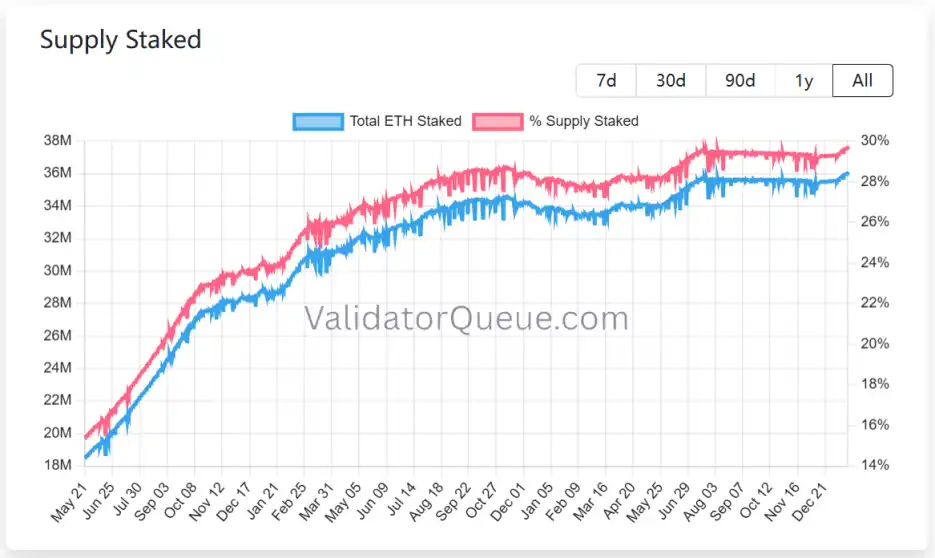
According to ValidatorQueue data, as of January 22, 2026, Ethereum's staking scale reached a historical high of nearly $1.2 trillion, with over 36 million ETH staked, accounting for about 30% of the circulating supply.
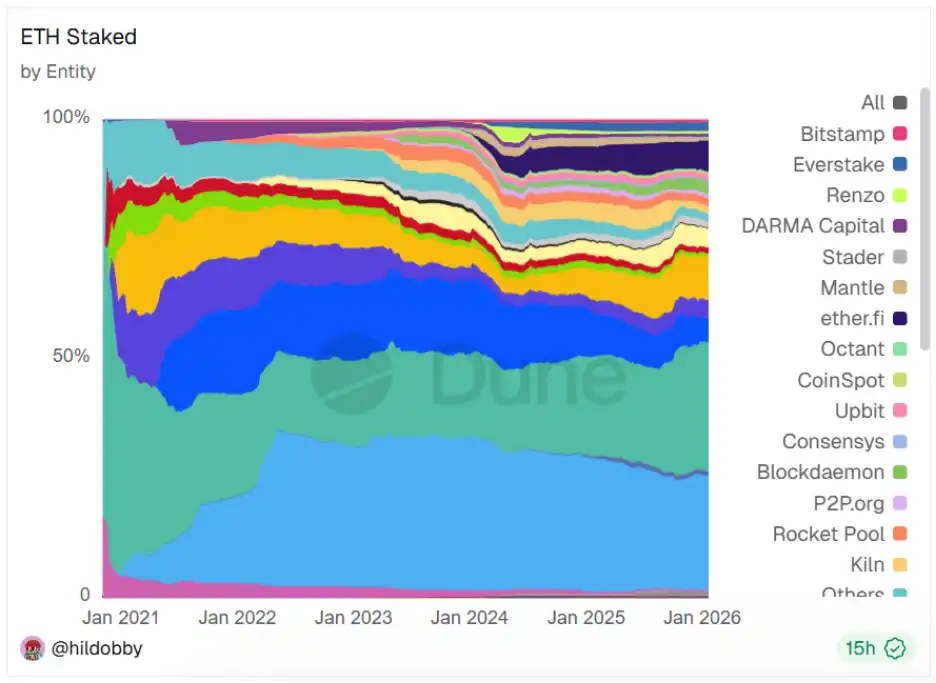
However, behind the prosperous scene lurk centralization risks. The top 5 liquid staking providers alone control nearly 18 million ETH, holding a 48% market share. This high concentration not only goes against the original intention of decentralization but also exposes the network to single points of failure and censorship risks, thereby affecting network security and the healthy development of the ecosystem.

On January 21, Vitalik formally proposed the "native DVT (Distributed Validator Technology) staking" solution on the Ethereum Research Forum, aiming to address the chronic issues of validator single points of failure and staking centralization, thereby enhancing Ethereum's security and decentralization.

First, Vitalik admitted that in the past, Ethereum, in pursuit of user growth, led to excessive centralization in node operation and block building. Native DVT will strive to eliminate reliance on single physical nodes or single cloud service providers like AWS.

Second, the high market share of liquid staking providers like Lido has always been a major concern for the community. Native DVT attempts to further lower the staking barrier, allowing small and medium validators to participate, thereby improving Ethereum's Nakamoto coefficient.
Finally, Vitalik indicated a greater focus on censorship resistance and quantum threat resistance. Native DVT allows validators to distribute nodes across different geographical locations and different clients, significantly enhancing the network's resilience to geopolitical risks or specific client vulnerabilities.

Related reading: Ethereum at a Crossroads: Quantum Threat Looms, Wall Street Capital's Dual Squeeze

The native DVT solution proposes 4 technical pillars:

  1. Multi-private key cluster management: Allows one validator identity to register up to 16 independent private keys.
  2. Threshold signature mechanism: A block proposal or attestation is only considered valid if more than 2/3 of the associated nodes (e.g., 11 out of 16) sign simultaneously.
  3. Protocol-level integration: Unlike third-party DVT solutions like SSV or Obol, native DVT runs directly at the consensus layer, eliminating the need for complex external coordination layers and lowering the operational barrier.
  4. Low performance overhead: This design only adds one round of delay during block production, has no impact on attestation speed, and is compatible with any signature scheme.

If the native DVT solution is implemented, it will have a profound impact on the validator ecosystem, reducing single points of failure risk and improving validator redundancy and fault tolerance.

For individual stakers, they will be able to team up or rent multiple inexpensive servers to achieve "non-downtime" operation at a lower cost, significantly reducing the pressure of being slashed.

For institutional validators, they will no longer need to build expensive and complex custom failover systems; native DVT will provide a standardized fault-tolerant solution, thereby reducing operational costs.

For the entire staking track, the native DVT solution may reshape the landscape of Ethereum's liquid staking market. Small service providers and independent validators will gain a more level playing field, while the advantages of large service providers may be diminished.

Although the native DVT proposal is still in the conceptual stage and requires approval from the Ethereum community to be implemented, it clearly points to Ethereum's future direction: no longer sacrificing security for short-term efficiency and adoption rates, but instead using native technical means to reclaim lost ground in sovereignty and trustlessness. This is also Vitalik's vision for this year.

TVL breaks through $300 billion, firmly holding the capital stronghold

In early 2026, Ethereum reached a historic moment as the TVL of on-chain applications broke through the $300 billion mark. This milestone is not just a numerical increase but also represents the Ethereum ecosystem structure becoming increasingly diversified.

The funds settled in the Ethereum ecosystem are no longer just speculative bubbles. According to Onchain research director Leon Waidmann, these funds are active in on-chain applications such as DeFi, stablecoins, RWA, and staking, representing real economic activity. Ethereum leads other networks in dimensions such as liquidity depth, composability, predictability, and user and capital reserves; the network effect is becoming apparent.

When the TVL scale crosses the $300 billion threshold, Ethereum is no longer just an application platform but a global settlement protocol capable of carrying sovereign-level assets. This magnitude means that any competitor trying to challenge Ethereum's position must not only compete on performance but also match Ethereum in liquidity depth.

If TVL is Ethereum's "muscle," then stablecoins are its "blood." As of January 22, Ethereum's market share in the stablecoin领域 has reached about 58%. Against the backdrop of growing global on-chain demand for dollars, Ethereum, as the primary launchpad for stablecoins, has built a deep liquidity moat for its ecosystem.
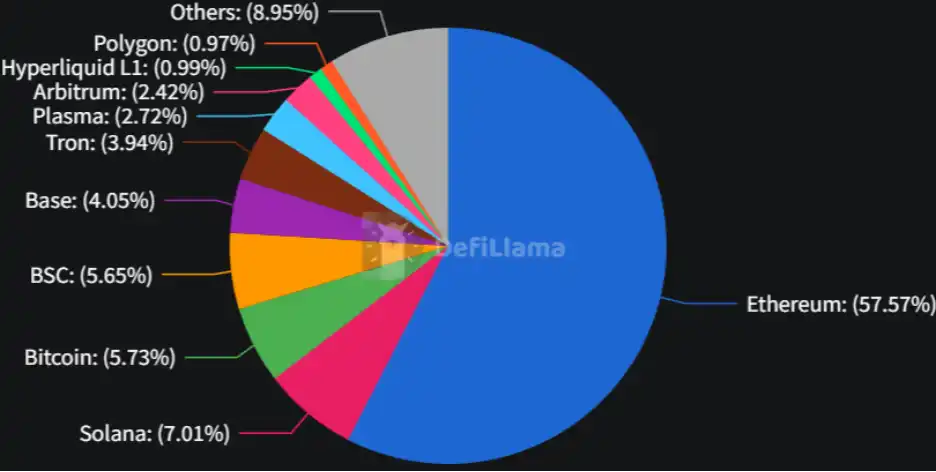
Electrical Capital emphasized in a report that stablecoins on Ethereum are not only a medium of exchange but also serve as collateral supporting DeFi loans worth over $19 billion.

The introduction of regulatory frameworks like the "Genius Act" is a further shot in the arm; adoption of stablecoins by mainstream payment companies and traditional financial institutions is set to explode.

USDC's share on Ethereum is climbing steadily, further cementing its position as a compliant "passport"; while yield-bearing stablecoin protocols like Ethena weave ETH's staking yield into the underlying returns of stablecoins, and their large-scale adoption also strengthens the deep coupling between ETH and the stablecoin ecosystem.

Although in 2025, public chains like Solana, Polygon, and Tron challenged Ethereum in the areas of small payments and high-frequency transfers, its dominance in institutional funds, large transactions, and DeFi integration remains unshakable.

As long as Ethereum maintains its position as the stablecoin "settlement hub," even if other chains have an advantage in the number of transactions, its "liquidity black hole" effect will continue to play a role.

21shares predicts that the stablecoin market size could reach $1 trillion in 2026. This means that, as the underlying settlement asset, the stablecoin liquidity settled on Ethereum will directly translate into long-term demand for ETH.

Becoming a "poison playground," L2s divert mainnet revenue

Recently, Ethereum staged a counterintuitive spectacle: its 7-day moving average number of transactions reached 2.49 million, hitting a new historical high, more than double the same period last year.
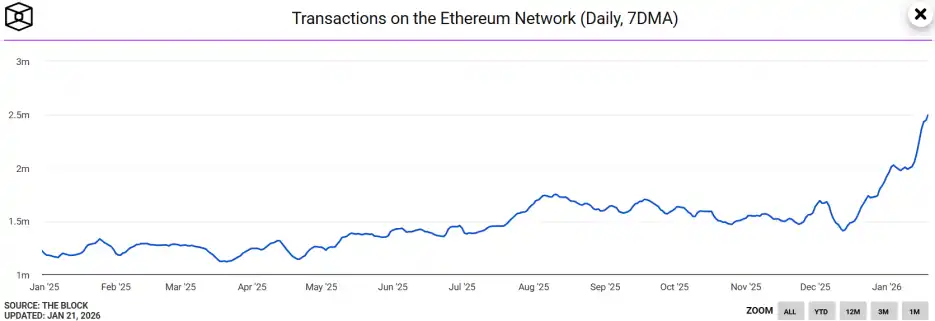
Simultaneously, Ethereum's 7-day moving average Gas fee dropped to a historical low below 0.03 Gwei, with the cost of a single transfer being only about $0.15.
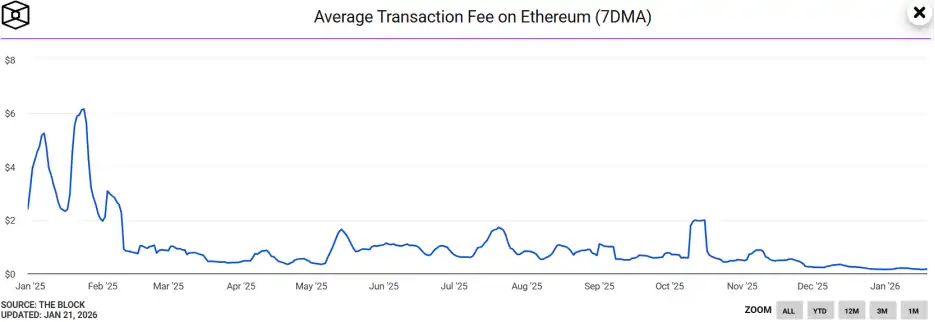
Puzzlingly, although on-chain activity on the Ethereum network surged, the price of ETH reacted tepidly. Security researcher Andrey Sergeenkov stated that this might stem from large-scale "address poisoning" attacks rather than genuine demand growth.

Research found that about 80% of the abnormal growth in new addresses on Ethereum is related to stablecoins, and about 67% of new active addresses had their first transfer worth less than $1, fitting the characteristics of a "dust attack."

This phenomenon is thanks to the arrival of the Fusaka upgrade last December.

The Fusaka upgrade is considered a "technical gift package" from Ethereum to the ecosystem. Its main innovation is the introduction of PeerDAS (Peer Data Availability Sampling), performing an effective "data reduction surgery" on the network.

PeerDAS allows nodes to verify the data availability of an entire block by sampling only part of the data, greatly enhancing the network's capacity to carry Blob data (L2 data storage space).

Related reading: Ethereum Activates Fusaka Upgrade, L2 Gas Fees Drop Another 60%

As the Fusaka upgrade significantly reduced transaction fees, low-cost attacks like dust attacks became feasible. This indicates that Ethereum's record transaction volume might be inflated by junk transactions, weakening the credibility of demand enhancement and causing the market not to view it as a catalyst for ETH price increases.

Misfortune seldom comes alone. Besides the false demand caused by "address poisoning attacks," Ethereum is also experiencing the "growing pains" of mainnet value capture.

To foster the expansion of the L2 ecosystem, the Ethereum mainnet took the initiative in 2025 to offer concessions, significantly reducing the "toll fees" L2s pay upstream.

Growthepie data pointed out that L2s' total revenue in 2025 was $129 million, but the fees paid to the mainnet plummeted to only $10 million. This means the Ethereum mainnet sacrificed over $100 million in potential revenue.

This strategy of cutting flesh to subsidize, while promoting the growth of the L2 ecosystem, has also raised questions from the community about ETH's value capture ability. If the mainnet revenue cannot grow in the long term, the amount of ETH burned will drop significantly, affecting its deflationary expectations.

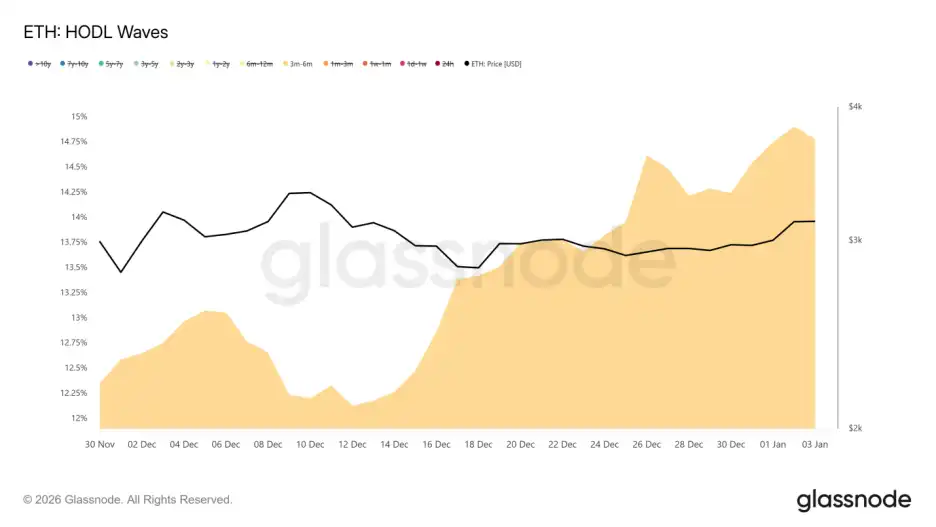
Furthermore, HODL Waves indicators show that a large amount of new holdings occurred between July and October 2025. These medium-to-long-term holders showed a significant willingness to exit at breakeven when the price approached $3,200, which also partly explains why on-chain data performance is impressive, but the ETH price faces resistance in the short term.
The "Digital Oil Field" under valuation inversion

On one side is the extreme prosperity of ecological data, on the other is the serious lag of market pricing; ETH is deeply mired in the quagmire of "valuation inversion."

In the pricing logic of the crypto market, the ratio between a public chain token's market capitalization and the scale of assets its ecosystem carries is a key metric for measuring the chain's capital efficiency and valuation rationality.

But as crypto KOL rip.eth pointed out, Ethereum currently carries 59% of the entire crypto market's TVL, but its native token ETH's market capitalization only accounts for 14% of the total crypto market cap.

This imbalance in ratio might mean that Ethereum is currently in a value洼地, the most undervalued public chain.
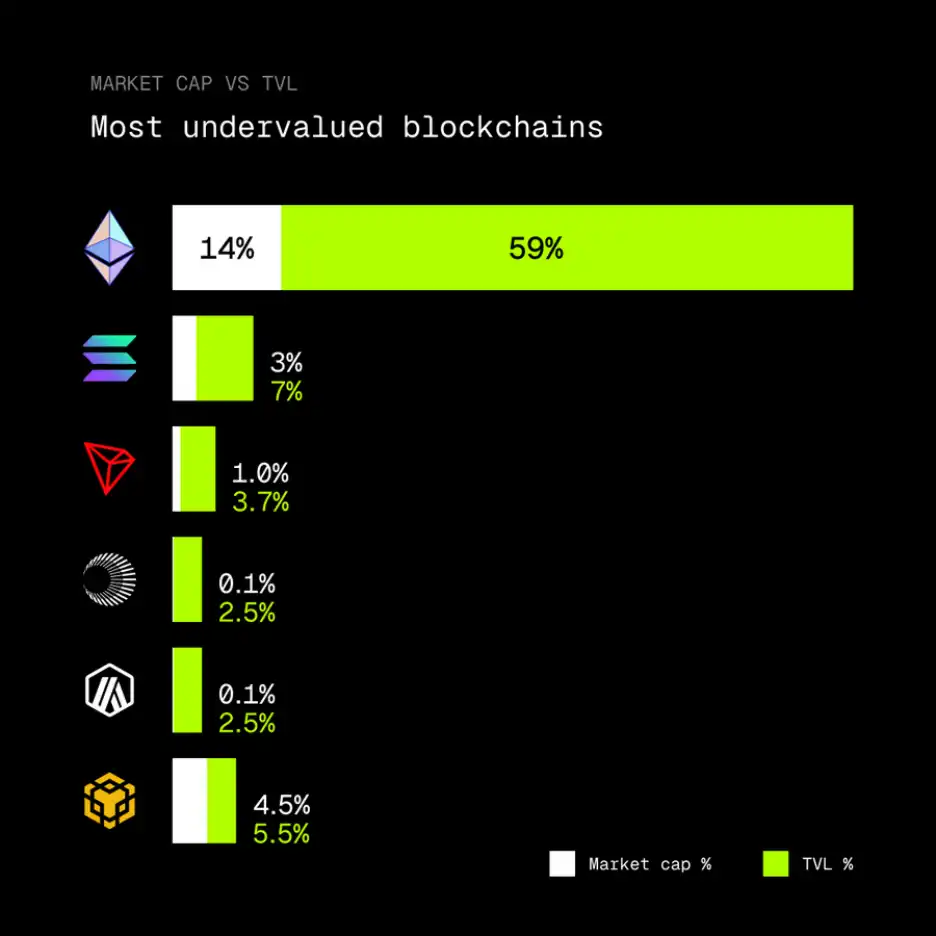
The deep-seated reason for this inversion might be that Ethereum is undergoing a profound role transformation, gradually evolving into a "digital oil field," but this is not being fully priced in.

A large amount of TVL is locked in staking protocols, DeFi contracts, and the L2 ecosystem, leading to a change in liquidity logic. Currently, market funds prefer to chase the oil (ecosystem applications) but overlook the产权 value of the oil field itself (Ethereum).

Simultaneously, with the continuous expansion of RWA, Ethereum is becoming the settlement base for traditional financial assets. This cash flow yield-generating capability will further促使 its MC/TVL ratio return to a reasonable range.

In reality, behind Ethereum's prosperity, it is walking a "tightrope": technical upgrades enhance performance but may also distort real data; ecosystem subsidies are somewhat eroding the mainnet's value capture ability; addressing the long-term risks of staking centralization, the native DVT proposal will be key to maintaining the bottom line of decentralization.

It can be said that Ethereum's challenge is no longer simply scaling but has升级 to finding a dynamic balance point in the impossible triangle of maintaining decentralization, sustaining technical advantages, and strengthening value capture. But as the market shifts its perception or enters a repair cycle driven by fundamentals, this "valuation barrier lake" may release enormous energy.

İlgili Sorular

QWhat is the 'dammed lake' moment that Ethereum is currently facing, as described in the article?

AEthereum is in a 'dammed lake' moment, characterized by a disconnect between its strong fundamentals—such as record-high staking scale, TVL, and stablecoin market share—and its stagnant or declining ETH token price. Upstream, it has technical upgrades and deep asset deposits, while downstream, it faces centralization risks, failed value capture, and market mispricing.

QWhat centralization risk exists within Ethereum's staking ecosystem despite its high total value locked?

ADespite a staking scale of nearly $120 billion, there is a high centralization risk where the top 5 liquid staking providers control nearly 18 million ETH, accounting for 48% of the market share. This concentration poses threats of single points of failure and censorship risks, contradicting Ethereum's decentralized principles.

QWhat is Vitalik Buterin's proposed 'native DVT staking' solution aimed at addressing?

AVitalik Buterin's proposed 'native DVT (Distributed Validator Technology) staking' solution aims to combat validator centralization and single points of failure. It seeks to eliminate reliance on single physical nodes or cloud providers like AWS, lower the staking barrier for smaller validators, and enhance Ethereum's Nakamoto coefficient, thereby improving network security and decentralization.

QHow has the Fusaka upgrade contributed to the phenomenon of 'address poisoning attacks' on Ethereum?

AThe Fusaka upgrade introduced PeerDAS (Peer Data Availability Sampling), which significantly reduced transaction fees by enabling nodes to verify data availability through sampling. This cost reduction made low-cost 'address poisoning attacks' (or dusting attacks) feasible, where a large volume of small, spam transactions artificially inflates on-chain activity metrics, creating a false impression of demand growth.

QWhy is Ethereum described as being in a 'valuation inversion' or undervalued despite its high TVL?

AEthereum is described as undervalued because it hosts 59% of the total value locked (TVL) in the crypto market, yet its native token ETH only accounts for 14% of the total crypto market capitalization. This imbalance suggests a 'valuation inversion,' where the market may be underpricing Ethereum's role as a foundational 'digital oil field' that generates value through its ecosystem, while investors focus more on the applications built on top of it rather than the base layer asset.

İlgili Okumalar

Fu Peng's First Public Speech in 2026: What Exactly Are Crypto Assets? Why Did I Join the Crypto Asset Industry?

Fu Peng, a renowned macroeconomist and now Chief Economist at New火 Group, delivered his first public speech of 2026 at the Hong Kong Web3 Festival. He explained his perspective on crypto assets and why he joined the industry, framing it within the context of macroeconomic trends and financial evolution. Fu emphasized that crypto assets are transitioning from an early, belief-driven phase to a mature, institutionally integrated asset class. He drew parallels to the 1970s-80s, when technological advances (like computing) revolutionized traditional finance, leading to the rise of FICC (Fixed Income, Currencies, and Commodities). Similarly, current advancements in AI, data, and blockchain are reshaping finance, with crypto assets becoming part of a new "FICC + C" (C for Crypto) framework. He noted that institutional capital, including traditional hedge funds, avoided early crypto due to its speculative nature but are now engaging as regulatory clarity emerges (e.g., stablecoin laws, CFTC classifying crypto as a commodity). Fu predicted that 2025-2026 marks a turning point where crypto becomes a standardized, financially viable asset for diversified portfolios, akin to commodities or derivatives in traditional finance. Fu defined Bitcoin not as "digital gold" in a simplistic sense but as a value-preserving, financially tradable asset. He highlighted that crypto's future lies in regulated, institutional adoption, moving away from retail-dominated trading. His entry into crypto signals this maturation, where traditional finance integrates crypto into mainstream asset management.

marsbit34 dk önce

Fu Peng's First Public Speech in 2026: What Exactly Are Crypto Assets? Why Did I Join the Crypto Asset Industry?

marsbit34 dk önce

Justin Sun Sues Trump Family: What $75 Million Bought Was Only a Blacklist

Justin Sun, founder of Tron, has filed a lawsuit in federal court against World Liberty Financial (WLF), alleging he was made the "primary target of a fraudulent scheme" after investing $75 million. Sun claims the investment secured him an advisor title and WLFI tokens, which were later frozen by WLF, causing "hundreds of millions in losses." The dispute began in late 2024 when Sun's investment helped revive WLF's struggling token sale, which ultimately raised $550 million. Shortly after, the SEC dropped its lawsuit against Sun following Donald Trump's inauguration. However, relations soured when Sun refused WLF's demands for additional funding. In August 2025, WLF added a "blacklist" function to its smart contract, allowing it to unilaterally freeze tokens. Sun's holdings, worth approximately $107 million, were frozen, and he was threatened with token destruction. The lawsuit highlights WLF's structure, which directs 75% of token sale profits to the Trump family, who had earned $1 billion by December 2025. WLF's CEO is Zach Witkoff, son of U.S. Middle East envoy Steve Witkoff. The project faces scrutiny for opaque operations, including a controversial loan arrangement on the Dolomite platform, co-founded by a WLF advisor. Despite Sun's history with the SEC, the case underscores centralization risks within DeFi, as WLF controls governance and holds powers to freeze assets arbitrarily. Sun's tokens remain frozen as legal proceedings begin.

marsbit42 dk önce

Justin Sun Sues Trump Family: What $75 Million Bought Was Only a Blacklist

marsbit42 dk önce

$500 to Buy OpenAI Stock: Silicon Valley's Most Respectable Liquidity Invitation

Silicon Valley's largest venture capital platform, AngelList, has launched a new fund called USVC, allowing U.S. retail investors to buy into high-profile AI companies like OpenAI, Anthropic, and xAI with a minimum investment of $500—no accredited investor status required. Promoted by AngelList co-founder Naval Ravikant, the fund is framed as an opportunity for ordinary people to access high-growth private tech investments traditionally reserved for VCs. However, critics argue it functions more like an exit vehicle for early insiders. USVC acquires shares not through primary rounds but largely via secondary transactions—purchasing stakes from early investors, VC funds, and employees looking to cash out at peak valuations. With companies like xAI heavily weighted in the portfolio, the fund effectively channels retail money into providing liquidity for insiders who entered at much lower valuations. The fund’s structure raises concerns: shares are illiquid, with no secondary market, and buybacks are limited and discretionary. The actual annual fee reaches 3.61%, far above the advertised 1% management fee. This model parallels the "low float, high fully diluted valuation" strategy seen in crypto, where early investors profit by selling to latecomers at inflated prices. The timing—alongside similar moves by platforms like Robinhood—suggests that Silicon Valley’s sudden interest in retail inclusion may be less about democratizing access and more about securing exits for insiders.

marsbit1 saat önce

$500 to Buy OpenAI Stock: Silicon Valley's Most Respectable Liquidity Invitation

marsbit1 saat önce

İşlemler

Spot
Futures

Popüler Makaleler

$S$ Nedir

SPERO'yu Anlamak: Kapsamlı Bir Genel Bakış SPERO'ya Giriş İnovasyonun manzarası gelişmeye devam ederken, web3 teknolojilerinin ve kripto para projelerinin ortaya çıkışı dijital geleceği şekillendirmede önemli bir rol oynamaktadır. Bu dinamik alanda dikkat çeken projelerden biri SPERO, $$s$$ olarak adlandırılmaktadır. Bu makale, SPERO hakkında ayrıntılı bilgi toplamak ve sunmak amacıyla, meraklılar ve yatırımcıların web3 ve kripto alanlarındaki temellerini, hedeflerini ve yeniliklerini anlamalarına yardımcı olmayı amaçlamaktadır. SPERO,$$s$$ Nedir? SPERO,$$s$$, kripto alanında merkeziyetsizlik ve blok zinciri teknolojisi ilkelerini kullanarak etkileşimi, faydayı ve finansal kapsayıcılığı teşvik eden bir ekosistem yaratmayı amaçlayan benzersiz bir projedir. Proje, kullanıcıların yenilikçi finansal çözümler ve hizmetler sunarak eşler arası etkileşimleri yeni yollarla kolaylaştırmayı hedeflemektedir. SPERO,$$s$$'nin temel amacı, bireyleri güçlendirmek ve kripto para alanındaki kullanıcı deneyimini artıran araçlar ve platformlar sağlamaktır. Bu, daha esnek işlem yöntemlerini mümkün kılmayı, topluluk odaklı girişimleri teşvik etmeyi ve merkeziyetsiz uygulamalar (dApp'ler) aracılığıyla finansal fırsatlar yaratmayı içermektedir. SPERO,$$s$$'nin temel vizyonu kapsayıcılık etrafında dönmekte olup, geleneksel finansal sistemlerdeki boşlukları kapatmayı ve blok zinciri teknolojisinin faydalarından yararlanmayı hedeflemektedir. SPERO,$$s$$'nin Yaratıcısı Kimdir? SPERO,$$s$$'nin yaratıcısının kimliği bir miktar belirsizdir, çünkü kurucusu(ları) hakkında ayrıntılı arka plan bilgisi sağlayan sınırlı kamuya açık kaynaklar bulunmaktadır. Bu şeffaflık eksikliği, projenin merkeziyetsizlik taahhüdünden kaynaklanabilir—birçok web3 projesinin paylaştığı bir etik anlayışı, bireysel tanınmanın yerine kolektif katkıları önceliklendirmektedir. Topluluk ve onun kolektif hedefleri etrafında tartışmaları merkezileştirerek, SPERO,$$s$$, belirli bireyleri öne çıkarmadan güçlendirme özünü taşımaktadır. Bu nedenle, SPERO'nun etik anlayışını ve misyonunu anlamak, tek bir yaratıcının kimliğini belirlemekten daha önemlidir. SPERO,$$s$$'nin Yatırımcıları Kimlerdir? SPERO,$$s$$, kripto sektöründe yeniliği teşvik etmeye adanmış girişim sermayedarlarından melek yatırımcılara kadar çeşitli yatırımcılar tarafından desteklenmektedir. Bu yatırımcıların odak noktası genellikle SPERO'nun misyonuyla uyumlu olup, toplumsal teknolojik ilerlemeyi, finansal kapsayıcılığı ve merkeziyetsiz yönetimi vaat eden projeleri önceliklendirmektedir. Bu yatırımcı temelleri, yalnızca yenilikçi ürünler sunan projelere değil, aynı zamanda blok zinciri topluluğuna ve ekosistemlerine olumlu katkılarda bulunan projelere de ilgi duymaktadır. Bu yatırımcıların desteği, SPERO,$$s$$'yi hızla gelişen kripto projeleri alanında dikkate değer bir rakip haline getirmektedir. SPERO,$$s$$ Nasıl Çalışır? SPERO,$$s$$, onu geleneksel kripto para projelerinden ayıran çok yönlü bir çerçeve kullanmaktadır. İşte benzersizliğini ve yeniliğini vurgulayan bazı temel özellikler: Merkeziyetsiz Yönetim: SPERO,$$s$$, kullanıcıların projenin geleceğiyle ilgili karar alma süreçlerine aktif olarak katılmalarını sağlayan merkeziyetsiz yönetim modellerini entegre etmektedir. Bu yaklaşım, topluluk üyeleri arasında sahiplik ve hesap verebilirlik duygusunu teşvik etmektedir. Token Kullanımı: SPERO,$$s$$, ekosistem içinde çeşitli işlevler sunmak üzere tasarlanmış kendi kripto para token'ını kullanmaktadır. Bu token'lar, işlemleri, ödülleri ve platformda sunulan hizmetlerin kolaylaştırılmasını sağlayarak genel etkileşimi ve faydayı artırmaktadır. Katmanlı Mimari: SPERO,$$s$$'nin teknik mimarisi, modülerlik ve ölçeklenebilirliği destekleyerek projenin evrimi sırasında ek özelliklerin ve uygulamaların sorunsuz bir şekilde entegrasyonuna olanak tanımaktadır. Bu uyum sağlama yeteneği, sürekli değişen kripto manzarasında geçerliliği sürdürmek için hayati öneme sahiptir. Topluluk Katılımı: Proje, işbirliği ve geri bildirim teşvik eden mekanizmalar kullanarak topluluk odaklı girişimlere vurgu yapmaktadır. Güçlü bir topluluk oluşturarak, SPERO,$$s$$, kullanıcı ihtiyaçlarını daha iyi karşılayabilir ve piyasa trendlerine uyum sağlayabilir. Kapsayıcılığa Odaklanma: Düşük işlem ücretleri ve kullanıcı dostu arayüzler sunarak, SPERO,$$s$$, daha önce kripto alanında yer almamış bireyler de dahil olmak üzere çeşitli bir kullanıcı tabanını çekmeyi hedeflemektedir. Bu kapsayıcılık taahhüdü, erişilebilirlik yoluyla güçlendirme misyonuyla uyumludur. SPERO,$$s$$ Zaman Çizelgesi Bir projenin tarihini anlamak, gelişim yolculuğu ve kilometre taşları hakkında kritik bilgiler sağlar. Aşağıda, SPERO,$$s$$'nin evriminde önemli olayları haritalayan önerilen bir zaman çizelgesi bulunmaktadır: Kavram Geliştirme ve Fikir Aşaması: SPERO,$$s$$'nin temelini oluşturan ilk fikirler, blok zinciri endüstrisindeki merkeziyetsizlik ve topluluk odaklılık ilkeleriyle yakından uyumlu olarak geliştirildi. Proje Beyaz Kağıdının Yayınlanması: Kavramsal aşamayı takiben, SPERO,$$s$$'nin vizyonunu, hedeflerini ve teknolojik altyapısını ayrıntılı bir şekilde açıklayan kapsamlı bir beyaz kağıt yayımlandı ve topluluk ilgisini ve geri bildirimini toplamak amacıyla sunuldu. Topluluk Oluşturma ve Erken Katılımlar: Projenin hedefleri etrafında tartışmalar yürüterek destek toplamak ve erken benimseyenler ile potansiyel yatırımcılar için bir topluluk oluşturmak amacıyla aktif iletişim çabaları gerçekleştirildi. Token Üretim Etkinliği: SPERO,$$s$$, yerel token'larını erken destekçilere dağıtmak ve ekosistem içinde başlangıç likiditesini sağlamak amacıyla bir token üretim etkinliği (TGE) gerçekleştirdi. İlk dApp'in Yayınlanması: SPERO,$$s$$ ile ilişkili ilk merkeziyetsiz uygulama (dApp) faaliyete geçti ve kullanıcıların platformun temel işlevleriyle etkileşimde bulunmalarını sağladı. Sürekli Gelişim ve Ortaklıklar: Projenin tekliflerine sürekli güncellemeler ve iyileştirmeler yapılmakta olup, blok zinciri alanındaki diğer oyuncularla stratejik ortaklıklar, SPERO,$$s$$'yi rekabetçi ve gelişen bir oyuncu haline getirmiştir. Sonuç SPERO,$$s$$, web3 ve kripto paranın finansal sistemleri devrim niteliğinde dönüştürme ve bireyleri güçlendirme potansiyelinin bir kanıtıdır. Merkeziyetsiz yönetime, topluluk katılımına ve yenilikçi tasarlanmış işlevselliğe olan bağlılığıyla, daha kapsayıcı bir finansal manzaraya doğru bir yol açmaktadır. Hızla gelişen kripto alanındaki herhangi bir yatırımda olduğu gibi, potansiyel yatırımcılar ve kullanıcılar, SPERO,$$s$$ içindeki devam eden gelişmelerle ilgili olarak kapsamlı bir araştırma yapmaları ve düşünceli bir şekilde katılmaları teşvik edilmektedir. Proje, kripto endüstrisinin yenilikçi ruhunu sergileyerek, sayısız olasılığını keşfetmeye davet etmektedir. SPERO,$$s$$'nin yolculuğu hala devam ederken, temel ilkeleri, teknoloji, finans ve birbirimizle etkileşim biçimimizi etkileyebilir.

89 Toplam GörüntülenmeYayınlanma 2024.12.17Güncellenme 2024.12.17

$S$ Nedir

AGENT S Nedir

Agent S: Web3'te Otonom Etkileşimin Geleceği Giriş Web3 ve kripto para dünyasında sürekli gelişen manzarada, yenilikler bireylerin dijital platformlarla etkileşim biçimlerini sürekli olarak yeniden tanımlıyor. Bu tür öncü projelerden biri olan Agent S, açık ajans çerçevesi aracılığıyla insan-bilgisayar etkileşimini devrim niteliğinde değiştirmeyi vaat ediyor. Otonom etkileşimlerin yolunu açarak, Agent S karmaşık görevleri basitleştirmeyi ve yapay zeka (AI) alanında dönüştürücü uygulamalar sunmayı hedefliyor. Bu detaylı inceleme, projenin karmaşıklıklarına, benzersiz özelliklerine ve kripto para alanındaki etkilerine dalacaktır. Agent S Nedir? Agent S, bilgisayar görevlerinin otomasyonunda üç temel zorluğu ele almak üzere özel olarak tasarlanmış çığır açıcı bir açık ajans çerçevesidir: Alan Spesifik Bilgi Edinimi: Çerçeve, çeşitli dış bilgi kaynaklarından ve iç deneyimlerden akıllıca öğrenir. Bu çift yönlü yaklaşım, alan spesifik bilgi açısından zengin bir veri havuzu oluşturmasını sağlar ve görev yürütmedeki performansını artırır. Uzun Görev Ufukları Üzerinde Planlama: Agent S, karmaşık görevlerin verimli bir şekilde parçalanmasını ve yürütülmesini kolaylaştıran deneyim artırımlı hiyerarşik planlama kullanır. Bu özellik, çoklu alt görevleri etkili ve verimli bir şekilde yönetme yeteneğini önemli ölçüde artırır. Dinamik, Homojen Olmayan Arayüzlerle Başlama: Proje, ajanlar ve kullanıcılar arasındaki etkileşimi geliştiren yenilikçi bir çözüm olan Ajan-Bilgisayar Arayüzü'ni (ACI) tanıtmaktadır. Çok Modlu Büyük Dil Modellerini (MLLM'ler) kullanarak, Agent S çeşitli grafik kullanıcı arayüzlerini sorunsuz bir şekilde gezinebilir ve manipüle edebilir. Bu öncü özellikler aracılığıyla, Agent S, makinelerle insan etkileşimini otomatikleştirmede karşılaşılan karmaşıklıkları ele alan sağlam bir çerçeve sunarak, AI ve ötesinde birçok uygulama için zemin hazırlıyor. Agent S'nin Yaratıcısı Kimdir? Agent S'nin kavramı temelde yenilikçi olsa da, yaratıcısı hakkında spesifik bilgiler belirsizliğini koruyor. Yaratıcı şu anda bilinmiyor, bu da projenin yeni aşamasını veya kurucu üyeleri gizli tutma stratejik tercihini vurguluyor. Anonimlikten bağımsız olarak, odak çerçevenin yetenekleri ve potansiyeli üzerinde kalıyor. Agent S'nin Yatırımcıları Kimlerdir? Agent S, kriptografik ekosistemde oldukça yeni olduğundan, yatırımcıları ve finansal destekçileri hakkında ayrıntılı bilgiler açıkça belgelenmemiştir. Projeyi destekleyen yatırım temelleri veya organizasyonları hakkında kamuya açık bilgilerdeki eksiklik, finansman yapısı ve gelişim yol haritası hakkında sorular doğuruyor. Destekleyicilerin anlaşılması, projenin sürdürülebilirliğini ve potansiyel pazar etkisini değerlendirmek için kritik öneme sahiptir. Agent S Nasıl Çalışır? Agent S'nin temelinde, çeşitli ortamlarda etkili bir şekilde çalışmasını sağlayan son teknoloji bir sistem yatmaktadır. İşleyiş modeli birkaç ana özellik etrafında inşa edilmiştir: İnsan Benzeri Bilgisayar Etkileşimi: Çerçeve, bilgisayarlarla etkileşimleri daha sezgisel hale getirmeyi amaçlayan gelişmiş AI planlaması sunar. Görev yürütmedeki insan davranışını taklit ederek, kullanıcı deneyimlerini yükseltmeyi vaat eder. Anlatı Belleği: Yüksek düzeyde deneyimlerden yararlanmak için kullanılan Agent S, görev geçmişlerini takip etmek amacıyla anlatı belleğini kullanarak karar verme süreçlerini geliştirir. Episodik Bellek: Bu özellik, kullanıcılara adım adım rehberlik sağlayarak, çerçevenin görevler gelişirken bağlamsal destek sunmasına olanak tanır. OpenACI Desteği: Yerel olarak çalışabilme yeteneği ile Agent S, kullanıcıların etkileşimleri ve iş akışları üzerinde kontrol sağlamasına olanak tanır ve Web3'ün merkeziyetsiz felsefesiyle uyumlu hale gelir. Dış API'lerle Kolay Entegrasyon: Çeşitli AI platformlarıyla uyumluluğu ve çok yönlülüğü, Agent S'nin mevcut teknolojik ekosistemlere sorunsuz bir şekilde entegre olmasını sağlar ve geliştiriciler ile organizasyonlar için cazip bir seçenek haline getirir. Bu işlevsellikler, Agent S'nin kripto alanındaki benzersiz konumuna katkıda bulunarak, karmaşık, çok aşamalı görevleri minimum insan müdahalesi ile otomatikleştirir. Proje geliştikçe, Web3'teki potansiyel uygulamaları dijital etkileşimlerin nasıl gelişeceğini yeniden tanımlayabilir. Agent S'nin Zaman Çizelgesi Agent S'nin gelişimi ve kilometre taşları, önemli olaylarını vurgulayan bir zaman çizelgesinde özetlenebilir: 27 Eylül 2024: Agent S'nin kavramı, “Bilgisayarları İnsan Gibi Kullanan Açık Bir Ajans Çerçevesi” başlıklı kapsamlı bir araştırma makalesi ile tanıtıldı ve projenin temelini sergiledi. 10 Ekim 2024: Araştırma makalesi arXiv'de kamuya açık olarak yayınlandı ve çerçevenin derinlemesine bir incelemesini ve OSWorld benchmark'ına dayalı performans değerlendirmesini sundu. 12 Ekim 2024: Agent S'nin yetenekleri ve özellikleri hakkında görsel bir içgörü sağlayan bir video sunumu yayımlandı ve potansiyel kullanıcılar ve yatırımcılarla daha fazla etkileşim sağlandı. Bu zaman çizelgesindeki işaretler, sadece Agent S'nin ilerlemesini değil, aynı zamanda şeffaflık ve topluluk katılımına olan bağlılığını da göstermektedir. Agent S Hakkında Ana Noktalar Agent S çerçevesi gelişmeye devam ederken, birkaç ana özellik öne çıkmakta ve yenilikçi doğasını ve potansiyelini vurgulamaktadır: Yenilikçi Çerçeve: İnsan etkileşimine benzer bir bilgisayar kullanımı sağlamak üzere tasarlanan Agent S, görev otomasyonuna yeni bir yaklaşım getiriyor. Otonom Etkileşim: GUI aracılığıyla bilgisayarlarla otonom olarak etkileşim kurabilme yeteneği, daha akıllı ve verimli hesaplama çözümlerine doğru bir sıçrama anlamına geliyor. Karmaşık Görev Otomasyonu: Sağlam metodolojisi ile karmaşık, çok aşamalı görevleri otomatikleştirerek süreçleri daha hızlı ve daha az hata payı ile gerçekleştirebilir. Sürekli İyileştirme: Öğrenme mekanizmaları, Agent S'nin geçmiş deneyimlerden öğrenmesini sağlar ve sürekli olarak performansını ve etkinliğini artırır. Çok Yönlülük: OSWorld ve WindowsAgentArena gibi farklı işletim ortamlarında uyumlu olması, geniş bir uygulama yelpazesine hizmet edebilmesini sağlar. Agent S, Web3 ve kripto alanında kendini konumlandırırken, etkileşim yeteneklerini artırma ve süreçleri otomatikleştirme potansiyeli, AI teknolojilerinde önemli bir ilerlemeyi temsil etmektedir. Yenilikçi çerçevesi aracılığıyla, Agent S dijital etkileşimlerin geleceğini örneklemekte ve çeşitli sektörlerde kullanıcılar için daha sorunsuz ve verimli bir deneyim vaat etmektedir. Sonuç Agent S, AI ve Web3'ün birleşiminde cesur bir sıçramayı temsil ediyor ve teknoloji ile etkileşim biçimimizi yeniden tanımlama kapasitesine sahip. Henüz erken aşamalarında olmasına rağmen, uygulama olanakları geniş ve çekici. Kritik zorlukları ele alan kapsamlı çerçevesi ile Agent S, otonom etkileşimleri dijital deneyimin ön plana çıkmasına taşımayı hedefliyor. Kripto para ve merkeziyetsizlik alanlarına daha derinlemesine girdikçe, Agent S gibi projelerin teknoloji ve insan-bilgisayar işbirliğinin geleceğini şekillendirmede önemli bir rol oynayacağı kesin.

430 Toplam GörüntülenmeYayınlanma 2025.01.14Güncellenme 2025.01.14

AGENT S Nedir

S Nasıl Satın Alınır

HTX.com’a hoş geldiniz! Sonic (S) satın alma işlemlerini basit ve kullanışlı bir hâle getirdik. Adım adım açıkladığımız rehberimizi takip ederek kripto yolculuğunuza başlayın. 1. Adım: HTX Hesabınızı OluşturunHTX'te ücretsiz bir hesap açmak için e-posta adresinizi veya telefon numaranızı kullanın. Sorunsuzca kaydolun ve tüm özelliklerin kilidini açın. Hesabımı Aç2. Adım: Kripto Satın Al Bölümüne Gidin ve Ödeme Yönteminizi SeçinKredi/Banka Kartı: Visa veya Mastercard'ınızı kullanarak anında Sonic (S) satın alın.Bakiye: Sorunsuz bir şekilde işlem yapmak için HTX hesap bakiyenizdeki fonları kullanın.Üçüncü Taraflar: Kullanımı kolaylaştırmak için Google Pay ve Apple Pay gibi popüler ödeme yöntemlerini ekledik.P2P: HTX'teki diğer kullanıcılarla doğrudan işlem yapın.Borsa Dışı (OTC): Yatırımcılar için kişiye özel hizmetler ve rekabetçi döviz kurları sunuyoruz.3. Adım: Sonic (S) Varlıklarınızı SaklayınSonic (S) satın aldıktan sonra HTX hesabınızda saklayın. Alternatif olarak, blok zinciri transferi yoluyla başka bir yere gönderebilir veya diğer kripto para birimlerini takas etmek için kullanabilirsiniz.4. Adım: Sonic (S) Varlıklarınızla İşlem YapınHTX'in spot piyasasında Sonic (S) ile kolayca işlemler yapın.Hesabınıza erişin, işlem çiftinizi seçin, işlemlerinizi gerçekleştirin ve gerçek zamanlı olarak izleyin. Hem yeni başlayanlar hem de deneyimli yatırımcılar için kullanıcı dostu bir deneyim sunuyoruz.

1.3k Toplam GörüntülenmeYayınlanma 2025.01.15Güncellenme 2025.03.21

S Nasıl Satın Alınır

Tartışmalar

HTX Topluluğuna hoş geldiniz. Burada, en son platform gelişmeleri hakkında bilgi sahibi olabilir ve profesyonel piyasa görüşlerine erişebilirsiniz. Kullanıcıların S (S) fiyatı hakkındaki görüşleri aşağıda sunulmaktadır.

活动图片