Ethereum's Ballmer Moment: As Everyone Is Bearish, the Circulating Supply Is Disappearing

marsbit2026-06-04 tarihinde yayınlandı2026-06-04 tarihinde güncellendi

Özet

"Ethereum's Ballmer Moment: Circulation Shrinks Amid Bearish Sentiment" Amid widespread bearish sentiment, with prominent figures like Bankless founder David Hoffman selling ETH and young developers flocking to Solana, some argue Ethereum is entering its "Ballmer era"—akin to Microsoft's perceived stagnation under Steve Ballmer. While surface-level criticisms about slow protocol development, cautious leadership, and competitive pressure are valid, underlying fundamentals tell a different story. Approximately 30% of ETH is staked, major holders like BitMine are accumulating, and spot ETFs continue to absorb supply. Regulatory clarity, including the SEC/CFTC's March ruling on staking rewards and the potential passage of the CLARITY Act, is transforming crypto from a regulatory threat into a legitimized framework. This institutionalization, alongside a shrinking circulating supply (with net issuance around 0.23% annually), creates significant buy-side pressure independent of fee-based value capture. The broader crypto total addressable market is expanding through regulated stablecoins, tokenized assets, and institutional adoption. While public chains face competition from permissioned alternatives, the winning model appears to be permissioned assets settling on public chains like Ethereum and Solana. The author advocates a non-maximalist, barbell strategy: holding ETH for its institutional role and supply squeeze, SOL for consumer/throughput trends, BTC as a macro hedge, and...

Author: Ben Lakoff

Translation: Deep Tide TechFlow

Deep Tide Guide: When Bankless founder sold all ETH and 19-year-old developers flocked to Solana, the bearish narrative for Ethereum became consensus. However, Ben Lakoff, a partner at BanklessVC, believes this is a repeat of Microsoft's "Ballmer Era"—superficially the narrative is bearish, but underlying fundamentals are steadily growing. A 30% staking rate, ETF accumulation, and clearer regulations are compressing the circulating supply. While crypto regulation is shifting from an existential threat to a legal framework, it's precisely the time to get in.

Welcome to the May trading flow summary.

This month's thesis section is a bit longer, so I've put it upfront. All financing rounds, fund raises, and hackathon results are placed afterward.

Ethereum's Ballmer Era

Last month, David Hoffman sold all his ETH at $2,070 and wrote a thoughtful article explaining why. It spread all over X (Twitter).

David subsequently joined the Chopping Block podcast, and I really enjoyed that conversation. Tarun said Ethereum is "ossifying" because no 19-year-olds want to build there. Max Resnick called the Ethereum Foundation "risk-averse." The bullish Haseeb gave the entire bearish sentiment a name: this is Ethereum's Ballmer Era. That phrase resonated with me.

This framework is too good to let go.

Yes, I'm bullish on "crypto," I'm bullish on BTC, I'm bullish on ETH... I'm bullish on the trend. But pretending the bearish thesis is weak is just self-deception, so I want to elaborate further on my position. These are my views, not necessarily representing BanklessVC's views, and certainly not investment advice.

The Bearish Thesis Has a Name, and It's Not Wrong

The substance is real. In fact, we've dropped another 10% since that article was published.

David's argument: ETH as money was always a long-term bet, and the rollup-centric roadmap makes it even longer. Ethereum is a "giver, not a taker"... it's designed to distribute block space at cost. L2s capture 98% margins on blob revenue. The gas limit is gradually increasing to 100M+. The BPO fork aggressively expands blob supply. The $30B to $163B stablecoin surge creates value for Circle and Tether, not ETH. Meanwhile, SOL, NEAR, BNB, and TRX have repriced as fee-driven comparables. He's mechanically correct. The protocol is designed for abundant block space, the exact opposite of the fee-driven value capture you want.

Tarun's "ossification" view is the cultural version of the same thing. Talent follows founder energy, and that energy is now on Solana, Monad, Hyperliquid, and whatever comes next (maybe not Ethereum, not crypto). Resnick's "risk-averse EF" is the institutional version. The foundation is devoutly focused on protecting network integrity at a moment when it needs to stay competitive.

Haseeb is right. A "Ballmer Era." Slow product cadence. Botched transitions. Sharper competitors with killer instinct. Loud critics who are right on the points.

What Microsoft Actually Did During the Ballmer Era

Ballmer ran Microsoft from 2000 to 2014. The joke: wasted 14 years. Missed mobile, missed search, missed social, shipped Vista, threw a few chairs.

That's the joke I remember, but what does the joke miss? MSFT stock went sideways for over a decade, while the enterprise franchise compounded relentlessly underneath. Dividends did most of the work. Office and Windows licenses printed money the entire "Microsoft is dead" narrative period. Then Satya took over, and MSFT went 10x.

The lesson (at least in the Microsoft version) is that deeply embedded, enterprise-loved, time-tested infrastructure tends to keep compounding through its own bearish narrative. The bearish narrative is often correct on the surface. Just not enough to short.

Ethereum is still the largest credibly neutral public chain for tokenized assets. BUIDL launched there. ~66% of USDC supply is there. The deepest DeFi liquidity is there.

But the lead is shrinking fast. BUIDL isn't just on Ethereum (~40%), down from ~85% a year ago. USDC exists on 34 chains. Western Union chose Solana over Ethereum for USDPT. The institutional default is shifting from singular "Ethereum" to plural "public chains."

Still bullish for the incumbent. Just not a monopoly anymore. Whether 19-year-olds want to build there is a real long-term concern. But it's not what decides the next two years.

Beneath the Noise: The Circulating Supply Is Collapsing

This is the part most bearish takes miss.

~30% of ETH is staked. Treasury corps hold another 6%+ and growing. BitMine alone holds 4.47% of the supply and is publicly targeting 5%. Spot ETFs keep absorbing more. The SEC/CFTC March 17 ruling classifying staking rewards as non-securities unlocked the entire staking ETF pipeline. Five other issuers (Fidelity, Franklin, Invesco, 21Shares, VanEck) have staking amendments pending Q2 decisions.

Every ETH staked through an ETF is ETH that cannot be sold on price impulse. Net issuance is ~0.23% annualized. The float is shrinking faster than that, and on most days these intake sides are bidding. The math doesn't care if ETH is boring.

So David is right, ETH won't reprice from fee burn. The roadmap chose abundance. But ETH can reprice from float compression, staking yield demand, and institutional Schelling point premium without winning the fee war. At least near-term.

Crypto's TAM Keeps Rising

Zooming out a bit from ETH. The real story of the last 12 months is crypto regulation shifting from an existential threat to a legal framework.

The GENIUS Act is now law. Payment stablecoins have a federal regime. The CLARITY Act passed the House in July, passed the Senate Banking Committee on May 14, and structurally looks likely to pass before midterms. Stablecoin circulating supply is over $2.8T and compounding. Tokenized treasuries are scaling. Spot ETFs exist for a growing list of assets.

This isn't the crypto-dies phase. This is the crypto-becomes-a-regulated-trillion-dollar-slice-of-the-financial-system phase where boring institutions are mandated to plug in.

In prior bears, we genuinely worried whether this ecosystem would exist in the future. But, with some caveats, and they matter.

First: Crypto winning vs. decentralized crypto winning are not the same thing. The truly scary bear case isn't David's fee math. It's "blockchain winning" eventually looking like Canton, JPM Onyx, DTCC's permissioned ledgers and a few Avalanche subnets, with the public crypto asset complex capturing basically none of the real value.

That world exists (and is concerning), but I'd bet on the public chain side for a few reasons. Pure permissioned chains as the institutional answer have been pitched for a decade and keep losing adoption (maybe this time is different?). The architecture actually winning is permissioned assets on public chain rails: BUIDL, BENJI, Ondo's USDY. Tokens execute KYC and transfer restrictions; settlement runs on Ethereum, Solana, and other public infrastructure. The empirical record of KYC pools coexisting with open public pools (Aave Arc, Compound Treasury) is that they fail.

That's still bullish for public chains, including ETH, as settlement layers. But it's weaker than full DeFi composability. Permissioned assets cannot freely compose with open pools, but the gated-access version is the mode winning.

Second: The question is no longer whether crypto adoption happens. It's which crypto captures it. The honest answer is, not all goes to ETH, but the institutionalized, regulated, "needs credibly neutral" giant chunk almost certainly. Because the alternative is asking tier-1 banks to settle tokenized assets on chains run like startups... unlikely.

This is where the Ballmer framework underrates the bull case. It only works if the underlying market keeps growing. Crypto's underlying market is growing fast in the most regulator-blessed, institutionalized way.

Barbell Strategy: Bullish on the Trend, Not Extremism

The bear thesis I take seriously isn't the fee analysis. It's leadership and competition. EF might indeed need its Satya moment. The killer instinct vacuum is real. Solana, Monad, and Hyperliquid aren't slowing down. ETH/BTC and ETH/SOL could go sideways or lower for a while before turning.

The way to position around this is simple: stop being an extremist.

Hold ETH for the time-tested/institutionalized/float compression trade. Hold SOL for the consumer/throughput/distribution trade. Hold BTC for macro hedge. Hold a small basket of next-gen L1s and application-layer winners where the cultural energy is actually flowing.

I know. ETH is a $250B asset, impacted by macro trends, and your capital allocation always involves trade-offs. I'm not an extremist, but I'm still bullish on ETH. Summarizing why:

The float is shrinking faster than issuance.

Q2 staking ETF approvals are a live, dated catalyst.

CLARITY Act passage broadly unleashes institutional crypto. Clearer rules let regulated capital deploy at scale across the asset class. ETH's moat is incumbent network effects plus credible neutrality, making it the default public chain settlement layer for tokenized assets, even as the lead shrinks.

The bear thesis is so loud it's now consensus. The historical hit rate of consensus bear at $2K after a 60% drawdown is low.

The optionality value of a "Satya moment" isn't priced in. If EF gets reorged, or a more aggressive entity emerges to lead protocol development, that's pure upside no bear model includes.

I see this trade as "David is partially right and ETH still works." Microsoft worked under Ballmer. Crypto adoption is winning. The assets you most want to own are the ones most deeply embedded in the part of crypto the US government just spent two years writing rules for.

Zoom out on what regulators are actually saying. The SEC and CFTC are telling you they want to rebuild finance on-chain. Bring dollars on-chain. In that world, how is this not insanely bullish? Maybe if you're a cypherpunk, this isn't the world you envisioned... gated assets, KYC rails, everything requiring permission. But for public chains as settlement infrastructure? Unquestionably bullish.

That's the crux of where we are in the cycle. AI is the center of attention, full stop. It's hot, parabolic, and as an early-stage investor, that's exactly the problem. You want to deploy capital where it's not hot. When a sector is this overheated, it's hard to put capital to work anywhere but the earliest pre-seed stage without paying a premium.

Crypto, right now, is not hot. The bear thesis is consensus. The energy is elsewhere. That's the setup you want, not the one you run from.

On a long enough timeline, everything becomes AI, everything becomes blockchain. One of these is priced like it already happened. The other just got a two-year head start written into law, and everyone is looking the other way.

Buckle up. Now turning to the rest of crypto/web3 financings :)

Top 10 Crypto Financing Rounds

Kalshi | Series F | Prediction Markets | $1B | 2026-05-07

Led by Coatue, with participation from Sequoia, a16z, IVP, Paradigm, Morgan Stanley, and ARK Invest. This $1B round values Kalshi at $22B, double the $11B valuation just five months prior. Annualized trading volume tripled in six months to $178B, with institutional volume up 800%. Kalshi is CFTC-regulated and not crypto-native, so call it the asterisk on this list, but it now has >90% of US prediction market activity, and prediction markets are one of the cleanest on-ramp stories crypto has right now.

Dunamu (Upbit) | Strategic Investment | Centralized Exchange | $408M | 2026-05-28

Three Samsung-affiliated companies (Samsung Securities, Samsung SDS, Samsung Card) agreed to purchase ~4% of Dunamu, operator of South Korea's largest crypto exchange Upbit, for ~$408M (612.8B KRW). Each buyer mentioned positioning for KRW-pegged stablecoins, tokenized securities, and on-chain settlement ahead of Korea's Digital Asset Basic Act. This is part of a May sprint transferring ~14% of Dunamu to Korean giants like Hana and Hanwha. Closing June 19.

Circle (Arc) | Token Presale | Infrastructure/Stablecoins | $222M | 2026-05-11

Circle raised $222M (FDV $3B) for Arc, its institutional L1 for stablecoin settlement and tokenized assets. a16z crypto put in $75M, with participation from BlackRock, Apollo, ICE, Standard Chartered Ventures, SBI, Janus Henderson, General Catalyst, Marshall Wace, ARK, Haun, and Bullish. This is the clearest "TradFi is picking rails" signal of 2026. A regulated stablecoin issuer is building its own chain, with the largest asset manager on the cap table.

Ripple (Ripple Prime) | Debt Financing | Infrastructure/Prime Brokerage | $200M | 2026-05-11

Ripple secured $200M in debt financing from a fund managed by Neuberger Specialty Finance to expand lending capacity for its multi-asset prime brokerage, Ripple Prime. Existing institutional loans serve as collateral. Ripple Prime revenue is up 3x YoY since Ripple acquired the platform in 2025. Traditional finance credit backing crypto prime brokerage loan books.

Elliptic | Series D | Compliance/AI x Crypto | $120M | 2026-05-12

Led by One Peak in this $120M round (valuation $670M), with participation from Nasdaq Ventures, Deutsche Bank, and British Business Bank. This is the largest pure equity VC round of the month. Elliptic is building agentic AML/compliance tooling. Reading with post-April lens: this is the ops/compliance layer DeFi keeps being reminded it needs, now with TradFi capital behind it.

Fun | Series A | Payments/Consumer | $72M | 2026-05-01

Co-led by Multicoin Capital and SignalFire, with participation from Infinity Ventures, Pharsalus Capital, and Justin Mateen. Fun is a crypto/fiat on-ramp powering financial platforms like Polymarket. Largest consumer/payments VC round of the month, a clean bet on the prediction market and consumer crypto heatwave track.

Fasset | Series B | Stablecoins/Payments | $51M | 2026-05-14

Led by SBI Group in this $51M raise, with Investcorp and Arz Portföy participating. Fasset is a stablecoin-powered neobank for emerging markets, with ~$32B annualized transaction volume. Real proof-of-concept for the stablecoin-as-payments thesis, and in the places that matter most: the corners of the world where dollar rails are genuinely life-changing.

Variational | Series A | DeFi/Derivatives/RWA | $50M | 2026-05-20

Led by Dragonfly, with participation from Bain Capital Crypto and Coinbase Ventures. Variational operates an RFQ-style platform for on-chain perpetuals on real-world assets: oil, gold, silver, copper. The team's call is that RWA perps could surpass BTC and ETH perps within a year. Most thesis-heavy small trade of the month.

OpenTrade | Strategic/Growth | Stablecoins/RWA | $17M | 2026-05-06

Mercury Fund and Notion Capital backed OpenTrade's $17M raise to scale its yield infrastructure for stablecoins backed by real-world assets. Another data point for the month's dominant theme: the interest-bearing stablecoin track with underlying RWA collateral.

Cycles | Seed | Infrastructure/Clearing | $6.4M | 2026-05-21

Led by Blockchange Ventures, with participation from Coinbase Ventures, Compound VC, and Primitive Ventures. Small in size, but this is exactly the kind of institutional-grade plumbing that must exist before the "next $10T inflow" story comes true.

Click here to view all financing rounds for May
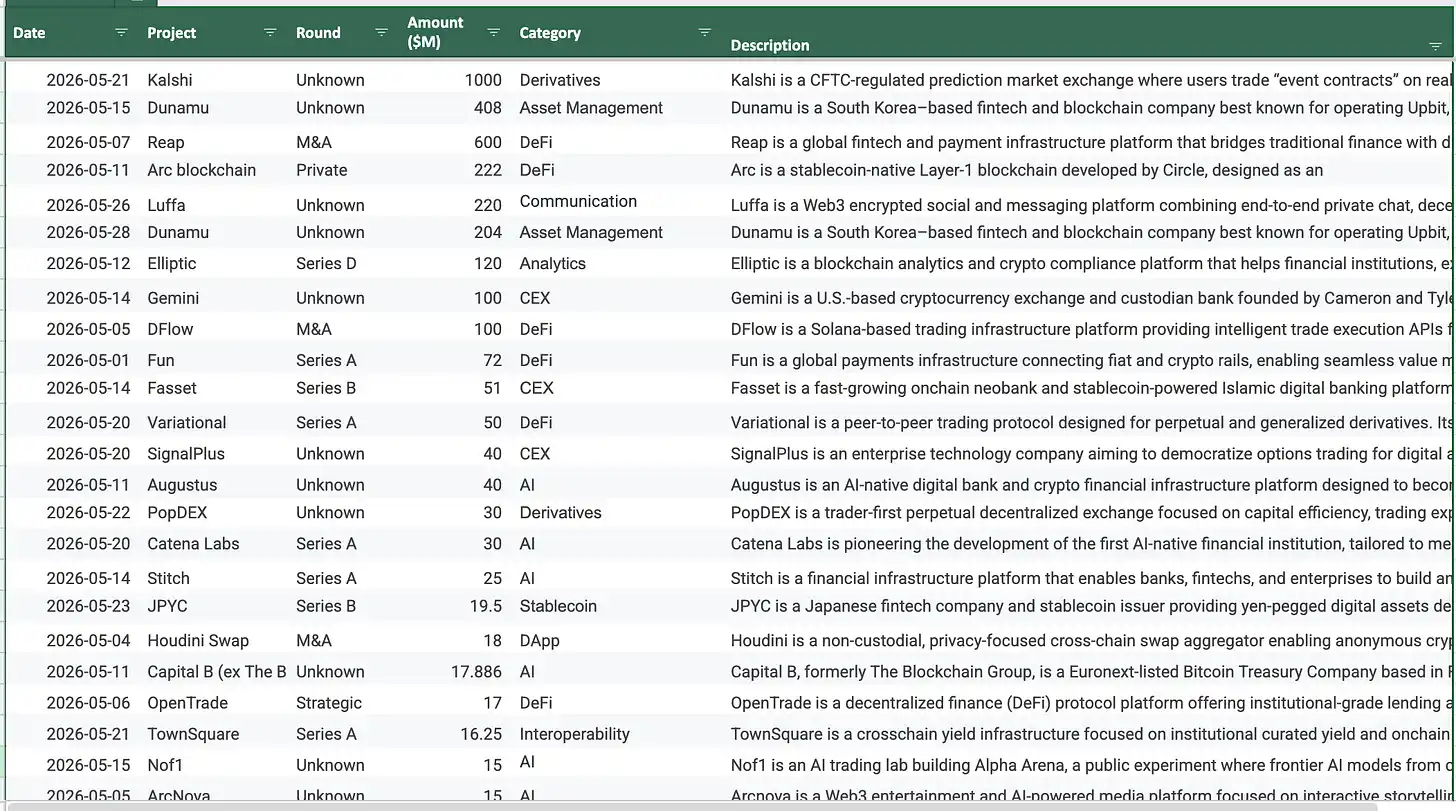
May Crypto VC Fund Raise Announcements

A quieter month for new fund announcements after a busy April, but two big moves...

Haun Ventures | Fund II $1B | May 2026

Katie Haun's firm raised $1B across an early-stage fund and a later-stage companion fund, pushing AUM above $2B. Top three priority themes: next-gen financial infrastructure, asset tokenization and new markets, and the "agent economy" where AI systems transact on behalf of humans. Capital will be deployed over the next 2-3 years.

a16z crypto | Crypto Fund V $2.2B | May 2026

The fund we flagged in March as targeting ~$2B closed officially at $2.2B. All stages, 10-year investment horizon, focused on real-world utility: stablecoins, payments, financial services, perps, lending, prediction markets, asset tokenization. a16z's framing is that crypto fundamentals are "at all-time highs."

Reminder, if you're interested in learning more about Bankless Ventures Fund II, please fill out this form and we'll be in touch!

ETHGlobal New York 2026 | June 12-14, 2026

NYC, in-person. Preceded by ETHConf NYC (June 8-10) and Pragma NYC.

Base Onchain Summer Hackathon | ~June 2026 (Date TBD)

Virtual. Base's flagship on-chain hackathon; last one attracted 7,500+ builders, sponsors included Stripe, Shopify, Farcaster, and Zora. (2026 dates not confirmed yet, please verify on Devfolio.)

ETHGlobal Lisbon 2026 | July 24-26, 2026

Lisbon, Portugal, in-person. Pragma Lisbon July 25.

Solana Frontier Hackathon | Apr 6 - May 11, 2026

Virtual. Crypto's largest startup competition, ~2,857 submissions over five weeks. Prizes: $30K grand champion, $10K each for 20 standout teams, plus $2.5M in venture funding and accelerator admission from Colosseum. Winners not announced by month-end; judging in progress, watch blog.colosseum.com early to mid-June.

ETHPrague 2026 | May 8-10, 2026

Prague, Czech Republic (City Hall). Fifth edition; conference plus hackathon, focused on Ethereum's "solarpunk" future.

Solana Mobile Hackathon | April 2026

Virtual. Concluded, 400+ app submissions from builders in 66 countries.

Solana Frontier Demo Day | June 2026 (Date TBD)

Virtual. Final demos for Frontier hackathon teams, expected after winners announcement.

ETHGlobal New York Showcase Day | June 14, 2026

NYC. Project judging and showcases on final day of hackathon.

ETHPrague 2026 Closing Showcase | May 10, 2026

Prague. Demos and judging on final day of ETHPrague hackathon.

Accelerator Applications Open

Solana Incubator (Cohort 5) | Apps Open / Early Deadline ~June 5

NYC. 3-month program starting Sept 2026; rolling review, preference for early applicants. Looking for 4-6 teams (existing Solana teams, web3 teams considering Solana, or web2 teams adding web3).

Alliance DAO (ALL18) | Apps Open / Rolling Review

Virtual + in-person retreats. ALL18 starts Sept 7, 2026; interview decisions ~2 weeks post-application. ~5% acceptance rate; median graduate raise $3.5M at $25M valuation.

a16z Crypto Startup Accelerator (CSX) | Apps Open (Please verify next cohort)

In-person, 9-week program, hosted twice annually in different cities. $500K for 7% equity; ~3% acceptance rate.

Outlier Ventures Base Camp | Rolling Applications

Virtual + in-person. 12-week accelerator, accepting early applications for 2026 DeAI, DeFi, RWA, and DePIN tracks.

Techstars Web3 | Apps Open

Virtual + in-person. Reportedly open for 2026 applications.

That's a wrap for May!

Thanks everyone, and good luck!

Ben Lakoff, CFA

https://twitter.com/benlakoff

İlgili Sorular

QWhat does the author mean by 'Ethereum's Ballmer moment'?

AThe author uses the term 'Ethereum's Ballmer moment' to draw a parallel between Microsoft's period under CEO Steve Ballmer (2000-2014) and Ethereum's current state. During Ballmer's tenure, Microsoft stock was seen as stagnant and the company was criticized for missing key trends (like mobile and search), while its core enterprise business (like Office and Windows) continued to grow steadily underneath the surface negative narrative. Similarly, despite current bearish narratives about Ethereum (e.g., slow product pace, competition, lack of young developer interest), the author argues its core fundamentals—like institutional adoption, staking, and regulatory clarity—are strengthening beneath the noise, setting the stage for potential future growth.

QWhat are the main bearish arguments against Ethereum mentioned in the article?

AThe main bearish arguments cited in the article are: 1) Ethereum's roadmap prioritizes abundant, low-cost block space over high fee capture, which limits its value accrual as a fee-driven asset. 2) Cultural 'ossification' and a lack of 'killer instinct,' with younger developers and entrepreneurial energy flowing to chains like Solana, Monad, and Hyperliquid instead. 3) The Ethereum Foundation is seen as overly cautious and risk-averse, focused on protecting network integrity rather than aggressively competing. 4) Ethereum's lead in areas like tokenized assets and stablecoins is narrowing as alternatives gain adoption.

QAccording to the author, why is Ethereum's circulating supply shrinking despite the bearish narrative?

AThe author argues that Ethereum's circulating supply is shrinking due to several factors: 1) Approximately 30% of ETH is staked and locked. 2) Treasury corporations (like BitMine) hold over 6% and are accumulating more. 3) Spot ETFs are continuously absorbing supply. 4) The SEC/CFTC ruling in March classified staking rewards as non-securities, paving the way for staking ETFs, which would lock up even more ETH (as staked ETH via ETFs cannot be sold on price impulses). With a net annual issuance of only ~0.23%, the buying pressure from these sources is causing the circulating supply to contract faster than new ETH is issued.

QHow has the regulatory landscape for crypto changed in the last 12 months, according to the article?

AThe article states that over the past 12 months, crypto regulation has shifted from being an 'existential threat' to a 'statutory framework.' Key developments include: the GENIUS Act becoming law, creating a federal regime for payment stablecoins; the CLARITY Act passing the House and advancing in the Senate; stablecoin circulation surpassing $2.8 trillion and growing; tokenized Treasury products scaling; and spot ETFs being approved for more assets. This transition signifies crypto is becoming a regulated, trillion-dollar slice of the financial system, inviting institutional capital that was previously hesitant.

QWhat is the author's recommended investment strategy regarding major crypto assets?

AThe author recommends a 'barbell strategy' of not being a maximalist for any single asset. Specifically: 1) Hold ETH for the 'timeless/institutional/circulating supply crunch' trade. 2) Hold SOL for the 'consumer/throughput/distribution' trade. 3) Hold BTC as a macro hedge. 4) Hold a small basket of next-generation L1s and application-layer winners where the cultural and entrepreneurial energy is actually flowing. This diversified approach allows investors to capture growth across different thematic trends within the expanding crypto ecosystem.

İlgili Okumalar

Ten-Thousand-Word Analysis: From $10 to $290, MRVL Wins the Entire AI Era by 'Not Making GPUs'

Marvell Technology's stock price surged from under $10 in 2016 to a record $290 in June 2026, fueled not by making GPUs, but by dominating AI infrastructure connectivity. This analysis argues the market misvalues MRVL as merely a smaller Broadcom in custom AI chips, overlooking its true, unique position. Marvell's core strength lies in enabling high-speed data flow for AI clusters through three interconnected businesses. First, it holds a commanding ~70% market share in high-speed optical DSPs (essential for data center light modules), a deep-moat business with accelerating growth. Second, its custom AI chip design business serves hyperscalers like AWS, Microsoft, and Google, with a significant revenue pipeline despite lower margins. Third, stable cash flows come from Ethernet switch chips and enterprise storage controllers. Together, they form a full-stack "AI data movement" platform. CEO Matt Murphy's transformative leadership since 2016, involving strategic divestments, key acquisitions (like Inphi for optical DSPs), and securing long-term agreements with major cloud providers, repositioned the company. A pivotal $2 billion strategic investment from NVIDIA in 2026 underscored Marvell's critical role in the AI ecosystem, particularly through collaborations like NVLink Fusion. While Marvell faces risks—including client concentration (losing the Amazon Trainium3 design), lower-margin business mix, competitive threats, insider selling, and complex supply chains—its fundamentals remain strong. The optical interconnect moat is widening with the acquisition of Celestial AI (photonics fabric), and financial metrics show accelerating revenue growth and operating leverage. With a PEG ratio suggesting undervaluation relative to its growth, the thesis is that the market undervalues Marvell's monopolistic position in AI "plumbing" while overemphasizing its competitive custom chip segment. The story transcends investing, symbolizing how in any complex system—from the internet to AI—the value of "connection" ultimately surpasses that of individual "nodes."

marsbit14 dk önce

Ten-Thousand-Word Analysis: From $10 to $290, MRVL Wins the Entire AI Era by 'Not Making GPUs'

marsbit14 dk önce

AI Relay Stations Spark Heated Debate on Zhihu: Behind Cheap Tokens, What Are Users Really Worried About?

A discussion on Zhihu about "AI relay stations" shifted the niche developer topic of "cheap tokens" into broader user awareness. Users moved beyond simply questioning the legitimacy of these services to focus on practical concerns: Where do cheap tokens truly come from? Is the model being accessed the real one? Can relay stations see prompts, code, and API keys? For occasional users, are the risks worth it? The core debate centered less on price and more on trust. A primary worry is model authenticity—the risk of "model swapping," where users paying for a premium model might be routed to a cheaper one, creating an information asymmetry. Others argued that cost comparisons matter; while cheaper than official pay-as-you-go APIs, relay stations may not be the lowest-cost option versus subscriptions, domestic models, or free tiers, making user needs assessment crucial. Speculation about token sources ranged from legitimate bulk discounts to gray-area methods like account sharing or exploiting regional pricing. This opacity makes risk assessment difficult for users. Data security emerged as a critical concern, especially for enterprise use. When processing sensitive information like code, contracts, or client data, the inability to verify a relay station's data handling, retention, or access policies poses significant compliance and confidentiality risks. The evolving consensus suggests relay stations can be used cautiously for low-sensitivity, disposable tasks (e.g., summarizing public info, simple translation). However, they should not be the default for sensitive, professional, or production workflows involving proprietary data, Agents, or automated systems. Recommendations include avoiding large prepayments, not relying on a single service, using test prompts to monitor quality, anonymizing data where possible, and keeping official channels as backups. Ultimately, the discussion framed tokens not just as a billing unit but as a measure of real cost encompassing price, model integrity, data security, and service stability. The popularity of relay stations highlights user demand for affordable access, but the debate underscores a key trade-off: the savings from cheap tokens may come at the price of trust, transparency, and control over one's data and AI experience.

marsbit44 dk önce

AI Relay Stations Spark Heated Debate on Zhihu: Behind Cheap Tokens, What Are Users Really Worried About?

marsbit44 dk önce

In-Depth Research Report on TradFi: The Convergence Wave of Crypto and Traditional Finance

In 2026, the crypto industry is undergoing a profound infrastructure-level transformation—TradFi assets are migrating on-chain at an unprecedented pace. According to CoinGecko's Q1 2026 report, the total value locked (TVL) of tokenized real-world assets (RWA) has surpassed $31 billion, a nearly 4x increase from $7.8 billion at the beginning of 2025, with the sector’s aggregate market capitalization reaching $19.3 billion. Among these, the market cap of tokenized stocks surged from $2 million to $486 million, with Q1 spot trading volume reaching $15.1 billion—a single quarter already surpassing the entire second half of 2025. RWA perpetual contract Q1 trading volume reached a staggering $524.8 billion, far exceeding the $313 billion for all of 2025. Meanwhile, BlackRock's BUIDL fund has reached $2.3 billion in scale and has filed for two new tokenized funds, signaling that the world's largest asset manager's tokenization strategy is evolving from pilot to product suite expansion. HTX, as a core participant in the crypto exchange sector, officially launched TradFi perpetual futures products including NVDA, AAPL, MSFT, META, and SPY in 2026, enabling crypto users to gain 24/7 trading access to core U.S. equities. Boston Consulting Group predicts that global tokenized asset scale could reach $16 trillion by 2030, while McKinsey offers a conservative estimate of approximately $2 trillion. The on-chain migration of TradFi assets is no longer a "future narrative" but a structural transformation unfolding in real time, as crypto exchanges evolve from single crypto asset trading platforms toward "multi-asset-class trading infrastructure."

HTX Learn46 dk önce

In-Depth Research Report on TradFi: The Convergence Wave of Crypto and Traditional Finance

HTX Learn46 dk önce

İşlemler

Spot
Futures

Popüler Makaleler

$S$ Nedir

SPERO'yu Anlamak: Kapsamlı Bir Genel Bakış SPERO'ya Giriş İnovasyonun manzarası gelişmeye devam ederken, web3 teknolojilerinin ve kripto para projelerinin ortaya çıkışı dijital geleceği şekillendirmede önemli bir rol oynamaktadır. Bu dinamik alanda dikkat çeken projelerden biri SPERO, $$s$$ olarak adlandırılmaktadır. Bu makale, SPERO hakkında ayrıntılı bilgi toplamak ve sunmak amacıyla, meraklılar ve yatırımcıların web3 ve kripto alanlarındaki temellerini, hedeflerini ve yeniliklerini anlamalarına yardımcı olmayı amaçlamaktadır. SPERO,$$s$$ Nedir? SPERO,$$s$$, kripto alanında merkeziyetsizlik ve blok zinciri teknolojisi ilkelerini kullanarak etkileşimi, faydayı ve finansal kapsayıcılığı teşvik eden bir ekosistem yaratmayı amaçlayan benzersiz bir projedir. Proje, kullanıcıların yenilikçi finansal çözümler ve hizmetler sunarak eşler arası etkileşimleri yeni yollarla kolaylaştırmayı hedeflemektedir. SPERO,$$s$$'nin temel amacı, bireyleri güçlendirmek ve kripto para alanındaki kullanıcı deneyimini artıran araçlar ve platformlar sağlamaktır. Bu, daha esnek işlem yöntemlerini mümkün kılmayı, topluluk odaklı girişimleri teşvik etmeyi ve merkeziyetsiz uygulamalar (dApp'ler) aracılığıyla finansal fırsatlar yaratmayı içermektedir. SPERO,$$s$$'nin temel vizyonu kapsayıcılık etrafında dönmekte olup, geleneksel finansal sistemlerdeki boşlukları kapatmayı ve blok zinciri teknolojisinin faydalarından yararlanmayı hedeflemektedir. SPERO,$$s$$'nin Yaratıcısı Kimdir? SPERO,$$s$$'nin yaratıcısının kimliği bir miktar belirsizdir, çünkü kurucusu(ları) hakkında ayrıntılı arka plan bilgisi sağlayan sınırlı kamuya açık kaynaklar bulunmaktadır. Bu şeffaflık eksikliği, projenin merkeziyetsizlik taahhüdünden kaynaklanabilir—birçok web3 projesinin paylaştığı bir etik anlayışı, bireysel tanınmanın yerine kolektif katkıları önceliklendirmektedir. Topluluk ve onun kolektif hedefleri etrafında tartışmaları merkezileştirerek, SPERO,$$s$$, belirli bireyleri öne çıkarmadan güçlendirme özünü taşımaktadır. Bu nedenle, SPERO'nun etik anlayışını ve misyonunu anlamak, tek bir yaratıcının kimliğini belirlemekten daha önemlidir. SPERO,$$s$$'nin Yatırımcıları Kimlerdir? SPERO,$$s$$, kripto sektöründe yeniliği teşvik etmeye adanmış girişim sermayedarlarından melek yatırımcılara kadar çeşitli yatırımcılar tarafından desteklenmektedir. Bu yatırımcıların odak noktası genellikle SPERO'nun misyonuyla uyumlu olup, toplumsal teknolojik ilerlemeyi, finansal kapsayıcılığı ve merkeziyetsiz yönetimi vaat eden projeleri önceliklendirmektedir. Bu yatırımcı temelleri, yalnızca yenilikçi ürünler sunan projelere değil, aynı zamanda blok zinciri topluluğuna ve ekosistemlerine olumlu katkılarda bulunan projelere de ilgi duymaktadır. Bu yatırımcıların desteği, SPERO,$$s$$'yi hızla gelişen kripto projeleri alanında dikkate değer bir rakip haline getirmektedir. SPERO,$$s$$ Nasıl Çalışır? SPERO,$$s$$, onu geleneksel kripto para projelerinden ayıran çok yönlü bir çerçeve kullanmaktadır. İşte benzersizliğini ve yeniliğini vurgulayan bazı temel özellikler: Merkeziyetsiz Yönetim: SPERO,$$s$$, kullanıcıların projenin geleceğiyle ilgili karar alma süreçlerine aktif olarak katılmalarını sağlayan merkeziyetsiz yönetim modellerini entegre etmektedir. Bu yaklaşım, topluluk üyeleri arasında sahiplik ve hesap verebilirlik duygusunu teşvik etmektedir. Token Kullanımı: SPERO,$$s$$, ekosistem içinde çeşitli işlevler sunmak üzere tasarlanmış kendi kripto para token'ını kullanmaktadır. Bu token'lar, işlemleri, ödülleri ve platformda sunulan hizmetlerin kolaylaştırılmasını sağlayarak genel etkileşimi ve faydayı artırmaktadır. Katmanlı Mimari: SPERO,$$s$$'nin teknik mimarisi, modülerlik ve ölçeklenebilirliği destekleyerek projenin evrimi sırasında ek özelliklerin ve uygulamaların sorunsuz bir şekilde entegrasyonuna olanak tanımaktadır. Bu uyum sağlama yeteneği, sürekli değişen kripto manzarasında geçerliliği sürdürmek için hayati öneme sahiptir. Topluluk Katılımı: Proje, işbirliği ve geri bildirim teşvik eden mekanizmalar kullanarak topluluk odaklı girişimlere vurgu yapmaktadır. Güçlü bir topluluk oluşturarak, SPERO,$$s$$, kullanıcı ihtiyaçlarını daha iyi karşılayabilir ve piyasa trendlerine uyum sağlayabilir. Kapsayıcılığa Odaklanma: Düşük işlem ücretleri ve kullanıcı dostu arayüzler sunarak, SPERO,$$s$$, daha önce kripto alanında yer almamış bireyler de dahil olmak üzere çeşitli bir kullanıcı tabanını çekmeyi hedeflemektedir. Bu kapsayıcılık taahhüdü, erişilebilirlik yoluyla güçlendirme misyonuyla uyumludur. SPERO,$$s$$ Zaman Çizelgesi Bir projenin tarihini anlamak, gelişim yolculuğu ve kilometre taşları hakkında kritik bilgiler sağlar. Aşağıda, SPERO,$$s$$'nin evriminde önemli olayları haritalayan önerilen bir zaman çizelgesi bulunmaktadır: Kavram Geliştirme ve Fikir Aşaması: SPERO,$$s$$'nin temelini oluşturan ilk fikirler, blok zinciri endüstrisindeki merkeziyetsizlik ve topluluk odaklılık ilkeleriyle yakından uyumlu olarak geliştirildi. Proje Beyaz Kağıdının Yayınlanması: Kavramsal aşamayı takiben, SPERO,$$s$$'nin vizyonunu, hedeflerini ve teknolojik altyapısını ayrıntılı bir şekilde açıklayan kapsamlı bir beyaz kağıt yayımlandı ve topluluk ilgisini ve geri bildirimini toplamak amacıyla sunuldu. Topluluk Oluşturma ve Erken Katılımlar: Projenin hedefleri etrafında tartışmalar yürüterek destek toplamak ve erken benimseyenler ile potansiyel yatırımcılar için bir topluluk oluşturmak amacıyla aktif iletişim çabaları gerçekleştirildi. Token Üretim Etkinliği: SPERO,$$s$$, yerel token'larını erken destekçilere dağıtmak ve ekosistem içinde başlangıç likiditesini sağlamak amacıyla bir token üretim etkinliği (TGE) gerçekleştirdi. İlk dApp'in Yayınlanması: SPERO,$$s$$ ile ilişkili ilk merkeziyetsiz uygulama (dApp) faaliyete geçti ve kullanıcıların platformun temel işlevleriyle etkileşimde bulunmalarını sağladı. Sürekli Gelişim ve Ortaklıklar: Projenin tekliflerine sürekli güncellemeler ve iyileştirmeler yapılmakta olup, blok zinciri alanındaki diğer oyuncularla stratejik ortaklıklar, SPERO,$$s$$'yi rekabetçi ve gelişen bir oyuncu haline getirmiştir. Sonuç SPERO,$$s$$, web3 ve kripto paranın finansal sistemleri devrim niteliğinde dönüştürme ve bireyleri güçlendirme potansiyelinin bir kanıtıdır. Merkeziyetsiz yönetime, topluluk katılımına ve yenilikçi tasarlanmış işlevselliğe olan bağlılığıyla, daha kapsayıcı bir finansal manzaraya doğru bir yol açmaktadır. Hızla gelişen kripto alanındaki herhangi bir yatırımda olduğu gibi, potansiyel yatırımcılar ve kullanıcılar, SPERO,$$s$$ içindeki devam eden gelişmelerle ilgili olarak kapsamlı bir araştırma yapmaları ve düşünceli bir şekilde katılmaları teşvik edilmektedir. Proje, kripto endüstrisinin yenilikçi ruhunu sergileyerek, sayısız olasılığını keşfetmeye davet etmektedir. SPERO,$$s$$'nin yolculuğu hala devam ederken, temel ilkeleri, teknoloji, finans ve birbirimizle etkileşim biçimimizi etkileyebilir.

89 Toplam GörüntülenmeYayınlanma 2024.12.17Güncellenme 2024.12.17

$S$ Nedir

AGENT S Nedir

Agent S: Web3'te Otonom Etkileşimin Geleceği Giriş Web3 ve kripto para dünyasında sürekli gelişen manzarada, yenilikler bireylerin dijital platformlarla etkileşim biçimlerini sürekli olarak yeniden tanımlıyor. Bu tür öncü projelerden biri olan Agent S, açık ajans çerçevesi aracılığıyla insan-bilgisayar etkileşimini devrim niteliğinde değiştirmeyi vaat ediyor. Otonom etkileşimlerin yolunu açarak, Agent S karmaşık görevleri basitleştirmeyi ve yapay zeka (AI) alanında dönüştürücü uygulamalar sunmayı hedefliyor. Bu detaylı inceleme, projenin karmaşıklıklarına, benzersiz özelliklerine ve kripto para alanındaki etkilerine dalacaktır. Agent S Nedir? Agent S, bilgisayar görevlerinin otomasyonunda üç temel zorluğu ele almak üzere özel olarak tasarlanmış çığır açıcı bir açık ajans çerçevesidir: Alan Spesifik Bilgi Edinimi: Çerçeve, çeşitli dış bilgi kaynaklarından ve iç deneyimlerden akıllıca öğrenir. Bu çift yönlü yaklaşım, alan spesifik bilgi açısından zengin bir veri havuzu oluşturmasını sağlar ve görev yürütmedeki performansını artırır. Uzun Görev Ufukları Üzerinde Planlama: Agent S, karmaşık görevlerin verimli bir şekilde parçalanmasını ve yürütülmesini kolaylaştıran deneyim artırımlı hiyerarşik planlama kullanır. Bu özellik, çoklu alt görevleri etkili ve verimli bir şekilde yönetme yeteneğini önemli ölçüde artırır. Dinamik, Homojen Olmayan Arayüzlerle Başlama: Proje, ajanlar ve kullanıcılar arasındaki etkileşimi geliştiren yenilikçi bir çözüm olan Ajan-Bilgisayar Arayüzü'ni (ACI) tanıtmaktadır. Çok Modlu Büyük Dil Modellerini (MLLM'ler) kullanarak, Agent S çeşitli grafik kullanıcı arayüzlerini sorunsuz bir şekilde gezinebilir ve manipüle edebilir. Bu öncü özellikler aracılığıyla, Agent S, makinelerle insan etkileşimini otomatikleştirmede karşılaşılan karmaşıklıkları ele alan sağlam bir çerçeve sunarak, AI ve ötesinde birçok uygulama için zemin hazırlıyor. Agent S'nin Yaratıcısı Kimdir? Agent S'nin kavramı temelde yenilikçi olsa da, yaratıcısı hakkında spesifik bilgiler belirsizliğini koruyor. Yaratıcı şu anda bilinmiyor, bu da projenin yeni aşamasını veya kurucu üyeleri gizli tutma stratejik tercihini vurguluyor. Anonimlikten bağımsız olarak, odak çerçevenin yetenekleri ve potansiyeli üzerinde kalıyor. Agent S'nin Yatırımcıları Kimlerdir? Agent S, kriptografik ekosistemde oldukça yeni olduğundan, yatırımcıları ve finansal destekçileri hakkında ayrıntılı bilgiler açıkça belgelenmemiştir. Projeyi destekleyen yatırım temelleri veya organizasyonları hakkında kamuya açık bilgilerdeki eksiklik, finansman yapısı ve gelişim yol haritası hakkında sorular doğuruyor. Destekleyicilerin anlaşılması, projenin sürdürülebilirliğini ve potansiyel pazar etkisini değerlendirmek için kritik öneme sahiptir. Agent S Nasıl Çalışır? Agent S'nin temelinde, çeşitli ortamlarda etkili bir şekilde çalışmasını sağlayan son teknoloji bir sistem yatmaktadır. İşleyiş modeli birkaç ana özellik etrafında inşa edilmiştir: İnsan Benzeri Bilgisayar Etkileşimi: Çerçeve, bilgisayarlarla etkileşimleri daha sezgisel hale getirmeyi amaçlayan gelişmiş AI planlaması sunar. Görev yürütmedeki insan davranışını taklit ederek, kullanıcı deneyimlerini yükseltmeyi vaat eder. Anlatı Belleği: Yüksek düzeyde deneyimlerden yararlanmak için kullanılan Agent S, görev geçmişlerini takip etmek amacıyla anlatı belleğini kullanarak karar verme süreçlerini geliştirir. Episodik Bellek: Bu özellik, kullanıcılara adım adım rehberlik sağlayarak, çerçevenin görevler gelişirken bağlamsal destek sunmasına olanak tanır. OpenACI Desteği: Yerel olarak çalışabilme yeteneği ile Agent S, kullanıcıların etkileşimleri ve iş akışları üzerinde kontrol sağlamasına olanak tanır ve Web3'ün merkeziyetsiz felsefesiyle uyumlu hale gelir. Dış API'lerle Kolay Entegrasyon: Çeşitli AI platformlarıyla uyumluluğu ve çok yönlülüğü, Agent S'nin mevcut teknolojik ekosistemlere sorunsuz bir şekilde entegre olmasını sağlar ve geliştiriciler ile organizasyonlar için cazip bir seçenek haline getirir. Bu işlevsellikler, Agent S'nin kripto alanındaki benzersiz konumuna katkıda bulunarak, karmaşık, çok aşamalı görevleri minimum insan müdahalesi ile otomatikleştirir. Proje geliştikçe, Web3'teki potansiyel uygulamaları dijital etkileşimlerin nasıl gelişeceğini yeniden tanımlayabilir. Agent S'nin Zaman Çizelgesi Agent S'nin gelişimi ve kilometre taşları, önemli olaylarını vurgulayan bir zaman çizelgesinde özetlenebilir: 27 Eylül 2024: Agent S'nin kavramı, “Bilgisayarları İnsan Gibi Kullanan Açık Bir Ajans Çerçevesi” başlıklı kapsamlı bir araştırma makalesi ile tanıtıldı ve projenin temelini sergiledi. 10 Ekim 2024: Araştırma makalesi arXiv'de kamuya açık olarak yayınlandı ve çerçevenin derinlemesine bir incelemesini ve OSWorld benchmark'ına dayalı performans değerlendirmesini sundu. 12 Ekim 2024: Agent S'nin yetenekleri ve özellikleri hakkında görsel bir içgörü sağlayan bir video sunumu yayımlandı ve potansiyel kullanıcılar ve yatırımcılarla daha fazla etkileşim sağlandı. Bu zaman çizelgesindeki işaretler, sadece Agent S'nin ilerlemesini değil, aynı zamanda şeffaflık ve topluluk katılımına olan bağlılığını da göstermektedir. Agent S Hakkında Ana Noktalar Agent S çerçevesi gelişmeye devam ederken, birkaç ana özellik öne çıkmakta ve yenilikçi doğasını ve potansiyelini vurgulamaktadır: Yenilikçi Çerçeve: İnsan etkileşimine benzer bir bilgisayar kullanımı sağlamak üzere tasarlanan Agent S, görev otomasyonuna yeni bir yaklaşım getiriyor. Otonom Etkileşim: GUI aracılığıyla bilgisayarlarla otonom olarak etkileşim kurabilme yeteneği, daha akıllı ve verimli hesaplama çözümlerine doğru bir sıçrama anlamına geliyor. Karmaşık Görev Otomasyonu: Sağlam metodolojisi ile karmaşık, çok aşamalı görevleri otomatikleştirerek süreçleri daha hızlı ve daha az hata payı ile gerçekleştirebilir. Sürekli İyileştirme: Öğrenme mekanizmaları, Agent S'nin geçmiş deneyimlerden öğrenmesini sağlar ve sürekli olarak performansını ve etkinliğini artırır. Çok Yönlülük: OSWorld ve WindowsAgentArena gibi farklı işletim ortamlarında uyumlu olması, geniş bir uygulama yelpazesine hizmet edebilmesini sağlar. Agent S, Web3 ve kripto alanında kendini konumlandırırken, etkileşim yeteneklerini artırma ve süreçleri otomatikleştirme potansiyeli, AI teknolojilerinde önemli bir ilerlemeyi temsil etmektedir. Yenilikçi çerçevesi aracılığıyla, Agent S dijital etkileşimlerin geleceğini örneklemekte ve çeşitli sektörlerde kullanıcılar için daha sorunsuz ve verimli bir deneyim vaat etmektedir. Sonuç Agent S, AI ve Web3'ün birleşiminde cesur bir sıçramayı temsil ediyor ve teknoloji ile etkileşim biçimimizi yeniden tanımlama kapasitesine sahip. Henüz erken aşamalarında olmasına rağmen, uygulama olanakları geniş ve çekici. Kritik zorlukları ele alan kapsamlı çerçevesi ile Agent S, otonom etkileşimleri dijital deneyimin ön plana çıkmasına taşımayı hedefliyor. Kripto para ve merkeziyetsizlik alanlarına daha derinlemesine girdikçe, Agent S gibi projelerin teknoloji ve insan-bilgisayar işbirliğinin geleceğini şekillendirmede önemli bir rol oynayacağı kesin.

528 Toplam GörüntülenmeYayınlanma 2025.01.14Güncellenme 2025.01.14

AGENT S Nedir

S Nasıl Satın Alınır

HTX.com’a hoş geldiniz! Sonic (S) satın alma işlemlerini basit ve kullanışlı bir hâle getirdik. Adım adım açıkladığımız rehberimizi takip ederek kripto yolculuğunuza başlayın. 1. Adım: HTX Hesabınızı OluşturunHTX'te ücretsiz bir hesap açmak için e-posta adresinizi veya telefon numaranızı kullanın. Sorunsuzca kaydolun ve tüm özelliklerin kilidini açın. Hesabımı Aç2. Adım: Kripto Satın Al Bölümüne Gidin ve Ödeme Yönteminizi SeçinKredi/Banka Kartı: Visa veya Mastercard'ınızı kullanarak anında Sonic (S) satın alın.Bakiye: Sorunsuz bir şekilde işlem yapmak için HTX hesap bakiyenizdeki fonları kullanın.Üçüncü Taraflar: Kullanımı kolaylaştırmak için Google Pay ve Apple Pay gibi popüler ödeme yöntemlerini ekledik.P2P: HTX'teki diğer kullanıcılarla doğrudan işlem yapın.Borsa Dışı (OTC): Yatırımcılar için kişiye özel hizmetler ve rekabetçi döviz kurları sunuyoruz.3. Adım: Sonic (S) Varlıklarınızı SaklayınSonic (S) satın aldıktan sonra HTX hesabınızda saklayın. Alternatif olarak, blok zinciri transferi yoluyla başka bir yere gönderebilir veya diğer kripto para birimlerini takas etmek için kullanabilirsiniz.4. Adım: Sonic (S) Varlıklarınızla İşlem YapınHTX'in spot piyasasında Sonic (S) ile kolayca işlemler yapın.Hesabınıza erişin, işlem çiftinizi seçin, işlemlerinizi gerçekleştirin ve gerçek zamanlı olarak izleyin. Hem yeni başlayanlar hem de deneyimli yatırımcılar için kullanıcı dostu bir deneyim sunuyoruz.

1.5k Toplam GörüntülenmeYayınlanma 2025.01.15Güncellenme 2026.06.02

S Nasıl Satın Alınır

Tartışmalar

HTX Topluluğuna hoş geldiniz. Burada, en son platform gelişmeleri hakkında bilgi sahibi olabilir ve profesyonel piyasa görüşlerine erişebilirsiniz. Kullanıcıların S (S) fiyatı hakkındaki görüşleri aşağıda sunulmaktadır.

活动图片















