Ethereum ‘smart’ whales open $426M long bets as ETH price chart eyes $4K

cointelegraph2025-12-08 tarihinde yayınlandı2025-12-08 tarihinde güncellendi

Özet

Ethereum whales have opened massive long positions totaling $426 million, signaling a strong belief that ETH's price decline has ended. Key traders, including BitcoinOG and Anti-CZ, are among those making large bets. ETH is currently trading around $3,140, having recovered from a recent low of $2,621. The price action has formed an ascending triangle pattern, with a breakout above $3,250 potentially targeting $4,030—a 28% increase. Institutional interest is also growing, with BitMine significantly increasing its ETH holdings. However, resistance levels near $3,350-$3,550 and the 200-day SMA at $3,800 could challenge further gains.

Ethereum whales have opened massive long positions on Ether (ETH), totalling $425.98 million, in what looks like a bold bet that the downside is over.

Key takeaways:

  • Ethereum whales opened leveraged long positions totaling $426 million.

  • Ether’s ascending triangle targets $4,030 ETH price.

Top traders open new ETH long positions

Data from Cointelegraph Markets Pro and TradingView showed the ETH/USD pair trading at $3,140, 20% above the $2,621 low reached on Nov. 21.

Holding above $3,000, Ether offered some cause for optimism ahead of some key volatility triggers.

Related: Vitalik Buterin floats gas futures on Ethereum to hedge fee spikes

The Fed rate cut decision is expected on Wednesday, Dec. 10, where markets are pricing in a 25-basis-point rate cut.

As market participants waited for triggers, attention has shifted to three “smart” whales with impressive track records, who have opened long positions, totaling 136,433 ETH, worth about $425.98 million, according to data from Lookonchain.

One whale, BitcoinOG (1011short), has a long position of $169 million in ETH, while Anti-CZ has a long exposure of $194 million.

A third whale, pension-usdt.eth, is long 20,000 ETH, worth approximately $62.5 million at current rates.

Besides these whales, Arkham Intelligence noted that another whale, “0xBADBB,” is using two accounts to go long for a total of $189.5 million in ETH.
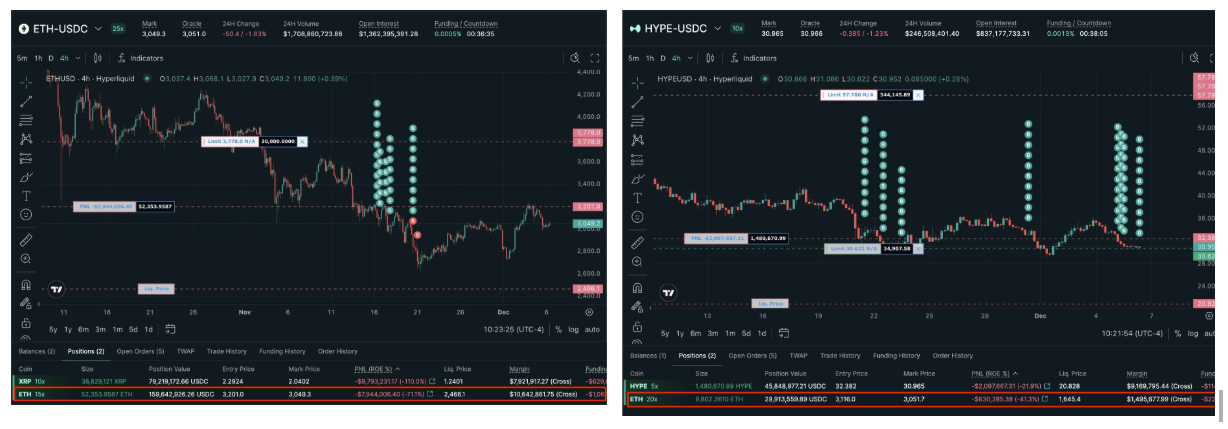
Ethereum whale’s long positions. Source: Arkham Intelligence

These moves coincide with BitMine’s continued push into Ethereum. Last week, the company added $199 million more ETH, bringing its total holdings to 3.73 million ETH ($13.3 billion), thereby cementing its position as the largest corporate holder of ETH.

This reinforces the narrative that whales and institutions view the recent ETH price rebound above $3,000 as a good entry point.

Ether’s ascending channel targets $4,000 ETH price

Ether’s price action has formed a classic ascending triangle on the daily chart, as shown below. The break above the multimonth downtrend line on Dec. 2 increased the prospects of a sustained recovery.

The pattern will resolve once the price breaks above the triangle’s resistance line at $3,250. If this happens, the price could rise by as much as the maximum distance between the triangle’s trendlines.

That puts Ether’s breakout target at about $4,020, up by more than 28% from current price levels.
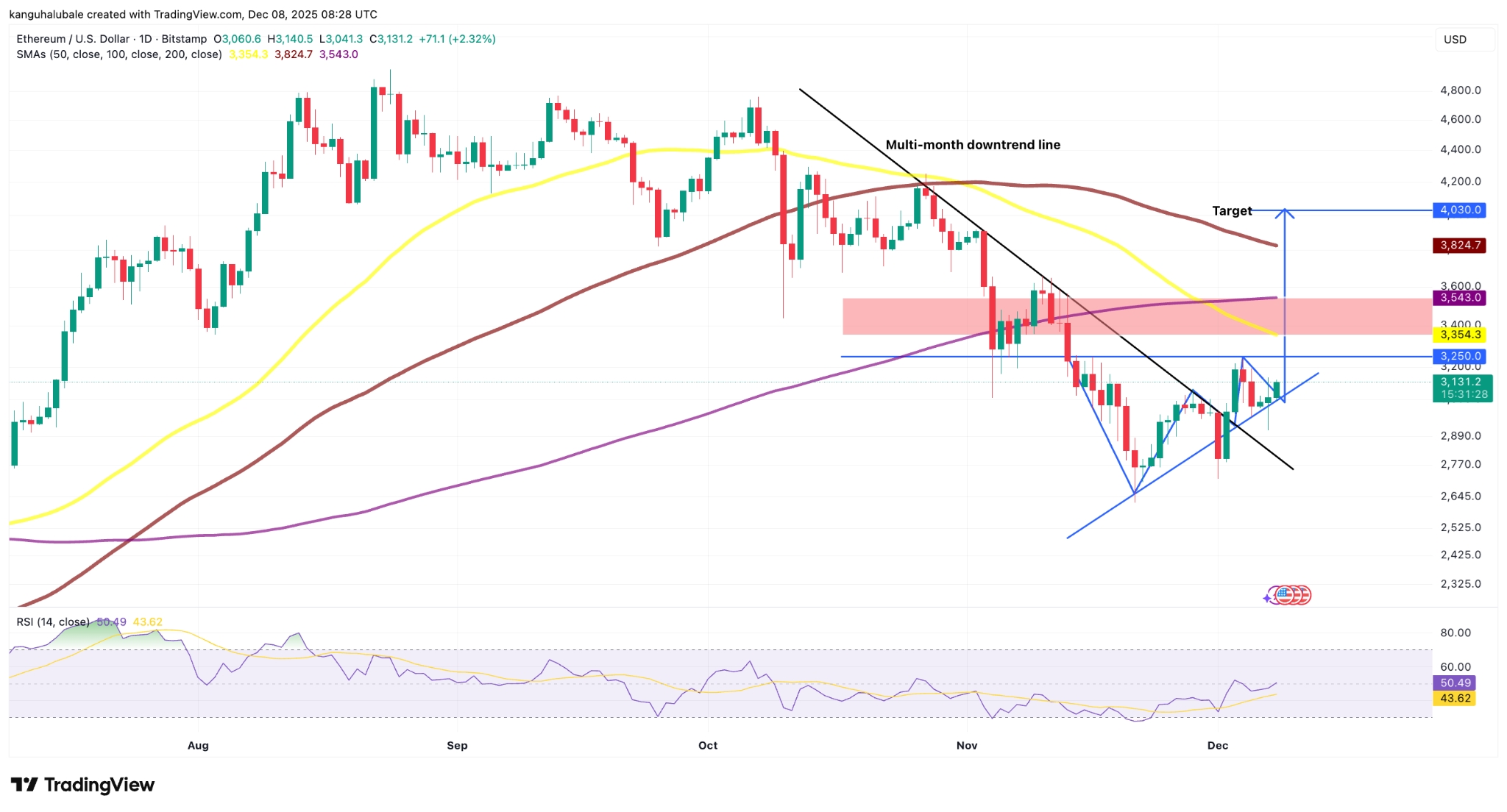
ETH/USD daily chart. Source: Cointelegraph/TradingView

The relative strength index has increased to 50, from oversold conditions at 28 on Nov. 28, suggesting increasing upward momentum.

However, the recovery could be curtailed by resistance from the $3,350-$3,550 resistance zone, where both the 50-day and 100-day SMAs currently sit. Beyond that, the next major hurdle is the 200-day SMA at $3,800.

This article does not contain investment advice or recommendations. Every investment and trading move involves risk, and readers should conduct their own research when making a decision.


İlgili Okumalar

When Nasdaq Starts 'Putting Stocks on the Chain', What Are We Really Welcoming?

Nasdaq is advancing a proposal to move U.S. stock settlement onto the blockchain, which could fundamentally reshape the infrastructure of American capital markets. This shift aims to replace the current slow, manual, and multi-layered clearing system with real-time, automated on-chain settlement. While many discussions focus on surface-level changes like 24/7 trading, the core transformation is structural: moving from outdated T+2 (or even T+1) settlement to instantaneous, programmable, and transparent ledger-based clearing. This isn’t about making stocks “more Web3” but modernizing a financial system that still relies on processes from the 1970s. The existing system—with its custodians, sub-custodians, and clearing intermediaries—creates operational friction, risk, and cost, as seen during events like the GameStop trading halts and the FTX collapse. On-chain settlement could reduce the need for traditional custodial roles, compress arbitrage opportunities built on settlement delays, and turn static securities into dynamic, composable financial instruments. The move faces significant resistance from entrenched intermediaries who profit from the current structure, but the direction of change appears inevitable. As demonstrated by Hong Kong’s recent issuance of a green bond settled in one second (versus five days), tokenization of traditional assets is becoming an operational reality—not a conceptual experiment. When stocks migrate on-chain, other assets like bonds and derivatives may follow, leading to a quiet but profound shift in how global markets function. This isn’t just a change in technology; it’s a change in the nature of finance itself.

cointelegraph_中文Şimdi

When Nasdaq Starts 'Putting Stocks on the Chain', What Are We Really Welcoming?

cointelegraph_中文Şimdi

Solana's Two Leading Lending Protocols Clash, Foundation Steps In to Mediate

Summary: Over the weekend, a public dispute erupted between Solana's two leading lending protocols, Jupiter Lend and Kamino, centered on the definition of "risk isolation." The conflict began when Kamino's co-founder, Marius Ciubotariu, accused Jupiter Lend of misleading users. He argued that Jupiter's early marketing claimed its lending pools were "risk-isolated," preventing cross-contamination between assets. However, Kamino contends that Jupiter Lend's design, which allows for the rehypothecation (re-use) of collateral across pools, creates a risk of contagion, contradicting its marketing. In response, Jupiter's COO, Kash Dhanda, admitted the initial "zero contagion risk" social media posts were inaccurate and apologized. The debate highlights a core disagreement on the definition of "risk isolation." Jupiter and its supporters argue the term has design flexibility, noting that while pools share a liquidity layer, each has independent parameters. Kamino and its allies insist that any rehypothecation negates true risk isolation. The dispute escalated when Tushar Jain, a partner at Kamino investor Multicoin Capital, strongly criticized Jupiter, accusing the team of being either incompetent or deliberately misleading. In contrast, Solana Foundation President Lily Liu urged for cooperation, emphasizing that the Solana lending market is much smaller than Ethereum's and that internal conflict only helps competitors. The clash is seen as an inevitable result of intense competition. Kamino was long the Solana lending leader, but Jupiter Lend has rapidly gained significant market share. In a tighter market with reduced liquidity and heightened safety concerns, the competition between the two protocols has become increasingly fierce.

marsbit10 dk önce

Solana's Two Leading Lending Protocols Clash, Foundation Steps In to Mediate

marsbit10 dk önce

İşlemler

Spot
Futures
活动图片