Ethereum Roadmap Could Advance Faster With AI, Vitalik Buterin Says

bitcoinist2026-03-02 tarihinde yayınlandı2026-03-02 tarihinde güncellendi

Özet

Vitalik Buterin suggests that AI could significantly accelerate Ethereum's development roadmap, citing an experiment where an AI-built client (ETH2030) was created in six days for $5,750. The prototype, covering 65 roadmap items, demonstrates potential but has limitations and bugs. Buterin emphasizes that AI should enhance both speed and security through formal verification and extensive testing. While not production-ready, the experiment highlights Ethereum's ambitious goals, including 10,000+ TPS and faster finality, and underscores that AI could help complete the roadmap faster and more securely than expected.

Ethereum’s long-range protocol roadmap may move faster than many expect as AI tools improve, according to Vitalik Buterin, who pointed to a recent experiment that used agentic coding to assemble an ambitious reference client spanning much of Ethereum’s planned 2030-era architecture.

The comment came after developer Jiayao Qi, posting as YQ via X, unveiled ETH2030, an experimental Ethereum client built to target the network’s draft “2030+” roadmap. The project weighs in at 702,000 lines of Go, covers 65 roadmap items across eight phases, passes 36,126 official Ethereum state tests, and can sync with mainnet through an integration with go-ethereum v1.17.0. Qi said the client was built in roughly six days using Claude Code at a cost of about $5,750 and 2.77 billion tokens.

AI Could Speed Up Ethereum Roadmap

Buterin called the effort “quite an impressive experiment,” while also stressing that a prototype built at that speed comes with obvious limits. “Such a thing built in two weeks without even having the EIPs has massive caveats,” he wrote. “Almost certainly lots of critical bugs, and probably in some cases ‘stub’ versions of a thing where the AI did not even try making the full version. But six months ago, even this was far outside the realm of possibility, and what matters is where the trend is going.”

That distinction mattered more to Buterin than the raw demo itself. In his view, AI is not just compressing development time. It could change how Ethereum engineers approach assurance. “Probably, the right way to use it, is to take half the gains from AI in speed, and half the gains in security,” he said. “Generate more test-cases, formally verify everything, make more multi-implementations of things.”

He tied that directly to ongoing formal verification work around Ethereum. Referring to the Lean Ethereum effort, Buterin said one collaborator had already used AI to produce a machine-verifiable proof of a complex theorem underpinning STARK security. “A core tenet of @leanethereum is to formally verify everything, and AI is greatly accelerating our ability to do that,” he wrote. “Aside from formal verification, simply being able to generate a much larger body of test cases is also important.”

ETH2030 itself was presented less as a candidate client than as a stress test for the roadmap. Qi repeatedly framed it as a rough draft, not production software, and argued that its value lies in forcing hard engineering questions into the open now rather than years from now.

The roadmap, as implemented in the project, aims at a version of Ethereum with 10,000-plus TPS on L1, finality in seconds instead of 15 minutes, solo staking for 1 ETH, stateless nodes running on a $7 Raspberry Pi, and more than 1 million TPS across L1 and L2. But the experiment also surfaced deep coupling between upgrades, from block access lists and gas repricing to PeerDAS, native rollups and fast finality.

Qi was blunt about the gaps. Pure-Go cryptographic implementations lag production code by roughly 10x to 100x, the consensus logic has not been battle-tested on a live beacon chain, and the jump from roughly 5 million gas per second today to a 1 billion gas-per-second target remains highly speculative under real-world MEV and contract dependency patterns.

Buterin did not claim AI would make those problems disappear. In fact, he cautioned against expecting a secure protocol from a single prompt. “There WILL be lots of wrestling with bugs and inconsistencies between implementations,” he wrote. “But even that wrestling can happen 5x faster and 10x more thoroughly.”

That, more than the headline numbers, is the point now in front of Ethereum researchers and client teams. If AI can speed both implementation and verification, the roadmap may not just be a distant architectural sketch. As Buterin put it, people should at least be open to the “possibility” that Ethereum’s roadmap could be completed “much faster than people expect, at a much higher standard of security than people expect.”

At press time, ETH traded at $1,956.
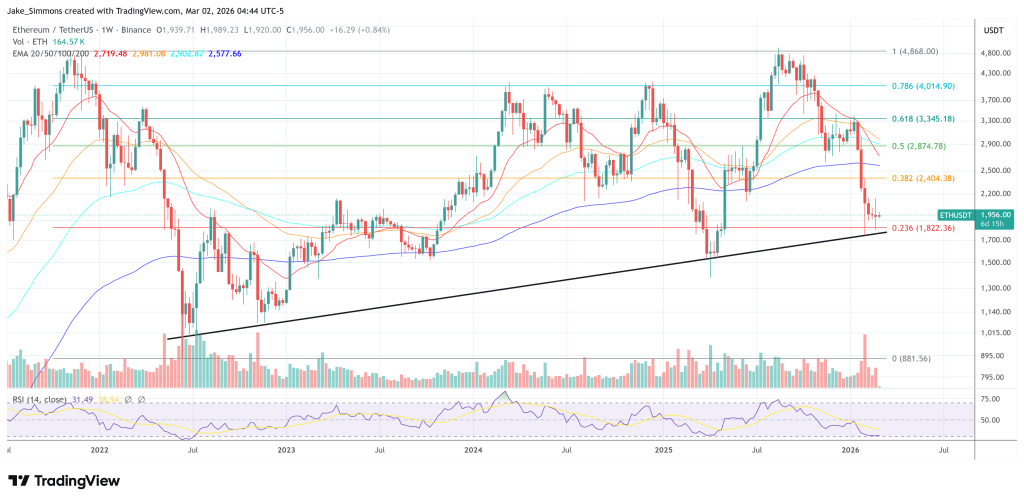
ETH remains above the black trendline, 1-week chart | Source: ETHUSDT on TradingView.com

İlgili Sorular

QWhat is the ETH2030 project and how was it created?

AETH2030 is an experimental Ethereum client built to target the network's draft '2030+' roadmap. It was created by Jiayao Qi (YQ) using Claude Code in roughly six days at a cost of about $5,750 and 2.77 billion tokens. The project consists of 702,000 lines of Go code, covers 65 roadmap items across eight phases, passes 36,126 official Ethereum state tests, and can sync with mainnet.

QAccording to Vitalik Buterin, how should AI be used to advance Ethereum's development?

AButerin suggests that the right way to use AI is to take half the gains in development speed and half the gains in security. This includes generating more test cases, formally verifying everything, and creating more multi-implementations of components to enhance both development efficiency and protocol assurance.

QWhat are some of the key goals outlined in Ethereum's 2030-era roadmap as implemented in the ETH2030 project?

AThe roadmap aims for a version of Ethereum with 10,000-plus TPS on L1, finality in seconds instead of 15 minutes, solo staking for 1 ETH, stateless nodes running on a $7 Raspberry Pi, and more than 1 million TPS across L1 and L2.

QWhat limitations and caveats did both Qi and Buterin highlight about the ETH2030 experiment?

AThey highlighted that the prototype has massive caveats, including almost certainly lots of critical bugs, 'stub' versions where the AI didn't make full implementations, untested consensus logic on a live beacon chain, and cryptographic implementations that lag production code by 10x to 100x. Buterin also cautioned that a secure protocol cannot be built from a single prompt.

QHow does Buterin view the potential impact of AI on Ethereum's development timeline and security standards?

AButerin believes AI could allow Ethereum's roadmap to be completed 'much faster than people expect, at a much higher standard of security than people expect.' He emphasizes that while wrestling with bugs and inconsistencies will still occur, AI can make this process 5x faster and 10x more thorough.

İlgili Okumalar

Hardcore First Look | Ocean Embodied Intelligence Company 'Shihang Intelligence' Secures Record-Breaking 1 Billion in Funding, Zhu Xiaohu, Temasek Place Bets

Breaking News | Ocean Embodied Intelligence company "Shihang Intelligent" secures a record-breaking 1 billion RMB (approximately 10 billion yuan) in Series A financing, with investment from Zhu Xiaohu and Temasek. Author: Qiu Xiaofen | Editor: Yuan Silai Ocean Embodied Intelligence company "Shihang Intelligent" has completed its Series A funding round, raising over 1 billion RMB. This marks the largest single funding round in the global marine robotics field to date. Investors include upstream momentum funds from chip companies "Moore Thread" and "Kunlunxin," Singapore's state-owned investment platform Vertex Growth, and listed company Dyneo, among others. Existing investors like GSR Ventures (whose founder Zhu Xiaohu has invested for the fifth time), Vertex Ventures China, Hua Ying Capital, and Long Capital also significantly increased their investments. Founder and CEO Chen Xiaobo, a 1989-born alumnus of Harbin Engineering University, is a long-time expert in underwater robotics. He received the National Defense Science and Technology Progress Award at age 28 (the youngest recipient) and led the development of China's first commercial underwater cleaning robot. The funds will be used for core technology R&D, global market expansion, and building the industry chain ecosystem to scale the application of marine robots in complex underwater scenarios. The ocean is considered one of the most challenging environments for robotics due to low light, high turbidity, complex currents, limited communication, high pressure, and corrosion. "Shihang Intelligent" focuses on developing core underlying technologies for marine robots, covering six key systems: power, control, sensing, navigation, sealing, and deployment. Its robots are capable of operating at depths from 0 to 10,000 meters with full degrees of freedom, performing complex maneuvers, autonomous navigation, and multi-robot collaboration. Applications include ship cleaning, underwater security, offshore wind power, marine ranching, and seabed inspection. The company's order value for the first half of 2026 alone has exceeded 1 billion RMB. Its "Orca Robot" is used by major shipping companies and has performed maintenance on over a thousand large vessels. In April of this year, the company launched its ocean embodied large model "Cangqiong CEORION." Unlike traditional remote-controlled or pre-programmed robots, this model integrates environmental perception, task understanding, and action generation into a single end-to-end architecture. Trained on millions of hours of commercial operation data and simulation data, it covers 12 major underwater operation scenarios. In simulations, it achieved over 90% task success rate and over 70% zero-shot adaptation capability to unseen environments. A built-in physics reasoning module reduces collision risk by 80%, enabling autonomous operation even with weak or no communication. Recently, "Shihang Intelligent" was selected as a core technology partner for Singapore's Maritime and Port Authority national hull inspection and cleaning program. These advancements indicate marine robotics is moving from pilot projects to scaled applications, with real-world operations generating valuable data to continuously improve robot capabilities. CEO Chen Xiaobo stated the company will continue investing in core marine robotics technology, the embodied intelligence model, and global application scenarios to expand into more high-risk, high-difficulty, and high-value underwater operations.

marsbit7 dk önce

Hardcore First Look | Ocean Embodied Intelligence Company 'Shihang Intelligence' Secures Record-Breaking 1 Billion in Funding, Zhu Xiaohu, Temasek Place Bets

marsbit7 dk önce

Three Months, 35 Billion Yuan: Investors Rush to Grab the OpenAI of the Physical World

Investors flock to a physical AI startup as the race for the "OpenAI of the physical world" heats up. Ji Jia Shi Jie (GigaWorld), a company dedicated to developing Artificial General Intelligence (AGI) for the physical world, has raised 3.5 billion RMB (approximately $490 million) in just three months, according to a report from investment media outlet Touzijie. The latest B2 funding round of 1 billion RMB attracted a wide range of top-tier investors, including sovereign wealth funds, industrial capital, and financial institutions. This brings the total funding for the young company, now valued over 10 billion RMB, to 3.5 billion RMB across three recent rounds. The company is led by Huang Guan, a post-90s Tsinghua University PhD with extensive experience in AI, autonomous driving, and entrepreneurship. Its core innovation is a "dual-pyramid" system comprising a five-layer data pyramid (from internet videos to real-world robot data) and a three-layer algorithm pyramid focused on world simulation, action alignment, and reinforcement learning. This system underpins its key models: the "World Action Model" (e.g., GigaBrain series for robot control) and the "World Generation Model" (e.g., GigaWorld series for simulating and understanding the physical world). Its models have reportedly achieved top rankings in global robotics benchmarks. Ji Jia Shi Jie argues that while current digital AGI excels in information processing, the next frontier is physical AGI—systems that can understand and interact with the real world. The company believes the field is approaching its "GPT-3 moment," a key inflection point in capability scaling. To achieve this, the company is pursuing a dual-market strategy. For the consumer (C) market, it launched the "SeeLight" brand and its S1 general-purpose humanoid robot, which has secured initial orders for deployment in real homes. For the business (B) market, it focuses on industrial automation with its Maker series robots, having signed agreements for large-scale deployment in factories, and its DriveDreamer world model for autonomous driving, which is already in use with over 30 automakers and tech companies. The report concludes that by bridging the gap between digital intelligence and physical action, Ji Jia Shi Jie aims to unlock a new wave of productivity, ultimately bringing physical AGI into everyday life.

marsbit34 dk önce

Three Months, 35 Billion Yuan: Investors Rush to Grab the OpenAI of the Physical World

marsbit34 dk önce

What's the Connection Between Pinduoduo's Huang Zheng and Blockchain?

This text explores the unexpected connection between Pinduoduo founder Colin Huang and blockchain, as suggested in his article *Turning Capitalism Upside Down*. Huang argues Pinduoduo's core business is about managing "uncertainty." He posits that wealth flows to the rich because they absorb life's uncertainties (e.g., illness, job loss) that devastate the poor, who pay a premium for certainty through insurance or stable prices. Pinduoduo's model attempts a "reverse insurance": by aggregating consumer demand via group-buying and flash sales, it creates a large, predictable order for manufacturers. This certainty allows factories to remove risk premiums, passing savings back as lower prices, thus partially reversing the wealth flow. The key obstacle, Huang notes, is that an individual's buying intent is an unreliable promise. He then asks if blockchain is the natural solution for this "reverse insurance." The text elaborates that blockchain, through smart contracts with binding deposits, could transform casual intent into a costly-to-break, enforceable commitment. This replaces interpersonal trust with coded rules, making promises credible, pricable, and resistant to fraud. Finally, the author draws a parallel to Bitcoin, framing two paths to creating certainty: the "Pinduoduo path" of aggregating decentralized will into scale, and the "Bitcoin path" of locking rules into immutable code. Both sacrifice something—personal freedom or system flexibility—to manufacture trust and predictability.

链捕手1 saat önce

What's the Connection Between Pinduoduo's Huang Zheng and Blockchain?

链捕手1 saat önce

The Storage Magnate Who Conquered a Trillion-Dollar Kingdom, Yet Ultimately Could Not Become the Richest

**Summary:** "The Memory Magnate Who Built a Trillion-Dollar Empire, Yet Never Became the Richest" explores the journey of Zhu Yiming, founder of GigaDevice (603986) and co-founder of the soon-to-IPO ChangXin Memory Technologies (CXMT). The article positions GigaDevice, a fabless chip designer now valued at ~¥340 billion, as a prequel to the massive IDM (Integrated Device Manufacturer) venture, CXMT. Starting in 2005 with minimal capital, Zhu strategically "picked up the pieces" by focusing on niche markets like NOR Flash and microcontrollers (MCUs), areas major players were exiting. This allowed GigaDevice to grow into a diversified semiconductor company, maintaining robust profitability even during industry downturns by controlling costs. However, the piece argues that in the highly cyclical and capital-intensive memory chip industry, the fabless model has limits. True resilience and scale require the ability for "counter-cyclical expansion" – investing heavily during downturns – a tactic only possible for IDMs like Samsung or SK Hynix. This insight led Zhu to partner with the Hefei city government in 2016 to establish CXMT, an IDM focused on DRAM. Zhu's symbolic moves, like forfeiting salary and diluting his equity, were crucial in securing the massive state and bank funding needed. CXMT's equipment base is now valued even higher than that of BYD's vast auto manufacturing empire. Despite the potential for CXMT to reach a market cap of ¥1-2 trillion upon its IPO, Zhu's indirect stake in both companies is estimated below 3%, placing his personal wealth far below that of China's top billionaires. The article concludes that his strategic vision built a trillion-yuan memory landscape, but the capital structure necessary to achieve it precluded a personal fortune of similar scale.

marsbit2 saat önce

The Storage Magnate Who Conquered a Trillion-Dollar Kingdom, Yet Ultimately Could Not Become the Richest

marsbit2 saat önce

İşlemler

Spot
Futures

Popüler Makaleler

ETH 2.0 Nedir

ETH 2.0: Ethereum için Yeni Bir Dönem Giriş ETH 2.0, Ethereum 2.0 olarak da bilinir, Ethereum blok zincirinde önemli bir yükseltmeyi işaret eder. Bu geçiş yalnızca bir yüz değiştirme değil; ağın ölçeklenebilirliğini, güvenliğini ve sürdürülebilirliğini temelinden geliştirmeyi hedeflemektedir. Enerji yoğun Proof of Work (PoW) konsensüs mekanizmasından daha verimli olan Proof of Stake (PoS) mekanizmasına geçişle birlikte, ETH 2.0 blok zinciri ekosistemine dönüştürücü bir yaklaşım vaat etmektedir. ETH 2.0 Nedir? ETH 2.0, Ethereum'un yeteneklerini ve performansını optimize etmeye odaklanmış özel, birbirine bağlı güncellemelerin bir derlemesidir. Yenileme, mevcut Ethereum mekanizmasının karşılaştığı kritik zorlukları, özellikle işlem hızı ve ağ tıkanıklığı ile ilgili sorunları ele almak üzere tasarlanmıştır. ETH 2.0'ın Amaçları ETH 2.0'ın ana amaçları, üç temel unsuru geliştirmeye odaklanmaktadır: Ölçeklenebilirlik: Ağın saniye başına işleyebileceği işlem sayısını önemli ölçüde artırmayı hedefleyen ETH 2.0, mevcut yaklaşık 15 işlem/saniye sınırlamasını aşmayı ve potansiyel olarak binlerce işleme ulaşmayı planlamaktadır. Güvenlik: Geliştirilmiş güvenlik önlemleri, özellikle siber saldırılara karşı daha iyi direnç sağlama ve Ethereum'un merkeziyetsiz görünümünü koruma açısından ETH 2.0 için hayati öneme sahiptir. Sürdürülebilirlik: Yeni PoS mekanizması, sadece verimliliği artırmakla kalmayıp aynı zamanda enerji tüketimini de önemli ölçüde azaltma hedefiyle tasarlanmış olup, Ethereum'un operasyonel çerçevesini çevresel kaygılarla uyumlu hale getirmektedir. ETH 2.0'ın Yaratıcısı Kimdir? ETH 2.0'ın yaratılması Ethereum Vakfı'na atfedilebilir. Ethereum'un gelişimini destekleme konusunda kritik bir rol oynayan bu kar amacı gütmeyen kuruluş, dikkat çekici kurucu ortağı Vitalik Buterin tarafından yönetilmektedir. Daha ölçeklenebilir ve sürdürülebilir bir Ethereum vizyonu, bu yükseltmenin arkasındaki itici güç olmuştur ve protokolü geliştirmek için kendini adamış küresel bir geliştici ve meraklı topluluğunun katkılarını içermektedir. ETH 2.0'ın Yatırımcıları Kimlerdir? ETH 2.0 yatırımcıları ile ilgili detaylar kamuoyuna açıklanmamış olsa da, Ethereum Vakfı'nın blok zinciri ve teknoloji alanında çeşitli kuruluşlar ve bireyler tarafından desteklendiği bilinmektedir. Bu ortaklar arasında merkeziyetsiz teknolojilerin ve blok zinciri altyapısının geliştirilmesine karşılıklı ilgi duyan girişim sermayesi şirketleri, teknoloji firmaları ve hayır kurumları yer almaktadır. ETH 2.0 Nasıl Çalışır? ETH 2.0, onu öncüsünden ayıran bir dizi önemli özelliği tanıtmasıyla dikkat çekmektedir. Proof of Stake (PoS) PoS konsensüs mekanizmasına geçiş, ETH 2.0'ın en belirgin değişikliklerinden biridir. İşlem doğrulama için enerji yoğun madenciliğe dayanmak yerine, PoS kullanıcıların ağa yatırdıkları ETH miktarına göre işlemleri doğrulayıp yeni bloklar oluşturmalarına olanak tanır. Bu, enerji verimliliğinin artırılmasına yol açarak tüketimi yaklaşık %99,95 oranında azaltmakta ve Ethereum 2.0'ı önemli ölçüde daha çevre dostu bir alternatif haline getirmektedir. Shard Zincirleri Shard zincirleri, ETH 2.0'ın diğer bir kritik yeniliğidir. Bu daha küçük zincirler, ana Ethereum zinciri ile paralel olarak çalışarak birden fazla işlemin aynı anda işlenmesine olanak tanır. Bu yaklaşım, ağın genel kapasitesini artırarak Ethereum'u rahatsız eden ölçeklenebilirlik sorunlarını ele alır. Beacon Zinciri ETH 2.0'ın temelinde, ağı koordine eden ve PoS protokolünü yöneten Beacon Zinciri yer almaktadır. Bu, bir tür organizatör olarak işlev görür: doğrulayıcıları denetler, shard'ların ağa bağlı kalmasını sağlar ve blok zinciri ekosisteminin genel sağlığını izler. ETH 2.0 Zaman Çizelgesi ETH 2.0'ın yolculuğu, bu önemli yükseltmenin evrimini gösteren birkaç önemli dönüm noktası ile tanımlanmıştır: Aralık 2020: Beacon Zinciri'nin başlatılması, PoS'un tanıtımını işaret etmiş ve ETH 2.0’a geçiş için sahneyi hazırlamıştır. Eylül 2022: "The Merge" tamamlanması, Ethereum ağının başarılı bir şekilde PoW'den PoS çerçevesine geçiş yaptığı kritik bir anı temsil etmekte ve Ethereum için yeni bir dönemi müjdelemektedir. 2023: Shard zincirlerinin beklenen dağıtımı, Ethereum ağının ölçeklenebilirliğini daha da artırmayı hedeflemekte ve ETH 2.0'ı merkeziyetsiz uygulamalar ve hizmetler için sağlam bir platform haline getirmeyi pekiştirmektedir. Ana Özellikler ve Faydalar Geliştirilmiş Ölçeklenebilirlik ETH 2.0'ın en önemli avantajlarından biri, geliştirilmiş ölçeklenebilirliğidir. PoS ve shard zincirlerinin kombinasyonu, ağın kapasitesini artırarak, eski sistemle kıyaslandığında çok daha fazla işlem hacmi karşılayabilmesini sağlamaktadır. Enerji Verimliliği PoS'un uygulanması, blok zinciri teknolojisinde enerji verimliliği yönünde büyük bir adım teşkil etmektedir. Enerji tüketimini ciddi şekilde azaltarak, ETH 2.0 yalnızca işletme maliyetlerini düşürmekle kalmaz, aynı zamanda küresel sürdürülebilirlik hedefleriyle daha yakın bir uyum sağlar. Geliştirilmiş Güvenlik ETH 2.0'ın güncellenmiş mekanizmaları, ağ genelinde güvenliğin artırılmasına katkıda bulunmaktadır. PoS'un uygulanması ve shard zincirleri ile Beacon Zinciri aracılığıyla geliştirilen yenilikçi kontrol önlemleri, potansiyel tehditlere karşı daha yüksek bir koruma sağlar. Kullanıcılar için Düşük Maliyetler Ölçeklenebilirlik geliştikçe, işlem maliyetleri üzerindeki etkiler de belirgin hale gelecektir. Artan kapasite ve azalan tıkanıklığın, kullanıcılar için düşük ücretler anlamına gelmesi beklenmekte ve Ethereum'u günlük işlemler için daha erişilebilir hale getirmektedir. Sonuç ETH 2.0, Ethereum blok zinciri ekosisteminde önemli bir evrimi işaret etmektedir. Ölçeklenebilirlik, enerji tüketimi, işlem verimliliği ve genel güvenlik gibi temel sorunları ele alırken, bu güncellemenin önemi abartılamaz. Proof of Stake'e geçiş, shard zincirlerinin tanıtımı ve Beacon Zinciri'nin altyapı çalışmaları, Ethereum'un merkeziyetsiz piyasalarının artan taleplerini karşılayabileceği bir geleceği göstermektedir. Yenilik ve ilerleme ile şekillenen bir sektörde, ETH 2.0, blok zinciri teknolojisinin daha sürdürülebilir ve verimli bir dijital ekonomi için yol açmadaki yeteneklerinin bir kanıtıdır.

170 Toplam GörüntülenmeYayınlanma 2024.04.04Güncellenme 2024.12.03

ETH 2.0 Nedir

ETH 3.0 Nedir

ETH3.0 ve $eth 3.0: Ethereum'un Geleceği Üzerine Derinlemesine Bir İnceleme Giriş Hızla evrilen kripto para ve blok zinciri teknolojisi ortamında, ETH3.0, sıklıkla $eth 3.0 olarak adlandırılmakta, önemli bir ilgi ve spekülasyon konusu haline gelmiştir. Bu terim, netleştirilmesi gereken iki temel kavramı kapsamaktadır: Ethereum 3.0: Bu, mevcut Ethereum blok zincirinin yeteneklerini artırmayı hedefleyen olası bir gelecekteki güncellemeyi temsil eder, özellikle ölçeklenebilirlik ve performansı iyileştirmeye odaklanmaktadır. ETH3.0 Meme Token: Bu ayrı kripto para projesi, Ethereum blok zincirini kullanarak meme merkezli bir ekosistem oluşturmayı amaçlamakta ve kripto para topluluğu içinde etkileşimi artırmaktadır. ETH3.0'ün bu yönlerini anlamak, yalnızca kripto meraklıları için değil, aynı zamanda dijital alandaki daha geniş teknolojik trendleri gözlemleyenler için de hayati öneme sahiptir. ETH3.0 Nedir? Ethereum 3.0 Ethereum 3.0, zaten kurulmuş olan Ethereum ağına önerilen bir güncelleme olarak duyurulmaktadır; bu ağ, kuruluşundan bu yana birçok merkeziyetsiz uygulamanın (dApp'ler) ve akıllı sözleşmelerin belkemiği olmuştur. Tasarlanan iyileştirmeler, esasen ölçeklenebilirlik üzerine yoğunlaşmakta – shardlama ve sıfır bilgi kanıtları (zk-proofs) gibi ileri teknolojileri entegre etmektedir. Bu teknolojik yenilikler, saniyede eşi benzeri görülmemiş sayıda işlem (TPS) gerçekleştirmeyi kolaylaştırmayı amaçlamakta olup, muhtemelen milyonlara ulaşarak mevcut blok zinciri teknolojisinin karşılaştığı en büyük sınırlamalardan birine çözüm getirmektedir. İyileştirme yalnızca teknik değil, aynı zamanda stratejiktir; Ethereum ağını, merkeziyetsiz çözümlere olan artan talep ile belirginleşen bir geleceğe hazırlamak için tasarlanmıştır. ETH3.0 Meme Token Ethereum 3.0'ın aksine, ETH3.0 Meme Token, internet meme kültürünü kripto para dinamikleriyle birleştirerek daha hafif ve eğlenceli bir alanda hareket etmektedir. Bu proje, kullanıcıların Ethereum blok zincirinde meme alım, satım ve ticaret yapmalarına izin vererek, yaratıcılık ve ortak ilgi alanları aracılığıyla topluluk etkileşimini teşvik eden bir platform sunmaktadır. ETH3.0 Meme Token, blok zinciri teknolojisinin dijital kültürle nasıl kesişebileceğini göstererek, hem eğlenceli hem de finansal olarak sürdürülebilir kullanım senaryoları oluşturmayı hedeflemektedir. ETH3.0'un Yaratıcısı Kimdir? Ethereum 3.0 Ethereum 3.0'a yönelik girişim, esas olarak Ethereum topluluğundaki bir geliştirici ve araştırmacı konsorsiyumu tarafından yönlendirilmektedir ve bunlar arasında Justin Drake de bulunmaktadır. Ethereum'un evrimine yönelik içgörüleri ve katkılarıyla tanınan Drake, Ethereum'u “Beam Chain” olarak adlandırılan yeni bir konsensüs katmanına geçirme konusundaki tartışmalarda öne çıkan bir figür olmuştur. Geliştirmeye yönelik bu iş birliği yaklaşımı, Ethereum 3.0'ın tek bir yaratıcının ürünü olmadığını, aksine blok zinciri teknolojisini ilerletmeye odaklanmış kolektif bir dehanın tezahürü olduğunu göstermektedir. ETH3.0 Meme Token ETH3.0 Meme Token'ın yaratıcısına dair detaylar şu anda izlenemez durumdadır. Meme tokenların doğası, genellikle daha merkeziyetsiz ve topluluk odaklı bir yapıya yol açmakta olup, bu da spesifik bir atıf eksikliğini açıklayabilir. Bu durum, yeniliğin genellikle iş birliği yerine bireysel çabalardan ortaya çıktığı kripto topluluğunun genel felsefesiyle uyumludur. ETH3.0 Yatırımcıları Kimlerdir? Ethereum 3.0 Ethereum 3.0'a olan destek, esasen Ethereum Vakfı ve hevesli bir geliştirici ve yatırımcı topluluğu tarafından sağlanmaktadır. Bu temel birliktelik, yıllar süren ağ operasyonlarıyla inşa edilen güven ve itibarından yararlanarak önemli bir meşruiyet sağlamaktadır. Kripto para dünyasının hızla değişen ikliminde, topluluk desteği, gelişim ve benimsemeyi yönlendirmede kritik bir rol oynamakta ve Ethereum 3.0'ı gelecekteki blok zinciri ilerlemeleri için ciddi bir rakip haline getirmektedir. ETH3.0 Meme Token Mevcut kaynaklar, ETH3.0 Meme Token'ı destekleyen yatırım temelleri veya kuruluşları hakkında net bilgiler sağlamasa da, bu durum meme tokenlar için tipik olan finansman modelini göstermektedir; bu model genellikle tabandan destek ve topluluk katılımına dayanır. Bu tür projelerdeki yatırımcılar genellikle toplum odaklı yenilik potansiyeli ve kripto topluluğunda bulunan iş birliği ruhuyla motive olmuş bireylerden oluşmaktadır. ETH3.0 Nasıl Çalışır? Ethereum 3.0 Ethereum 3.0'ın ayırt edici özellikleri, önerilen shardlama ve zk-proof teknolojisinin uygulanmasında yatmaktadır. Shardlama, blok zincirini daha küçük, yönetilebilir parçalara veya “parçalara” ayırma yöntemidir; bu parçalar işlemleri ardışık değil, eşzamanlı olarak işleyebilir. Bu işlem yükünün merkeziyetsizliği, tıkanıklığı önlemeye yardımcı olur ve ağın yoğun yük altında bile yanıt verebilir olmasını sağlar. Sıfır bilgi kanıtı (zk-proof) teknolojisi, işleme katılan temel verileri ifşa etmeden işlem doğrulaması sağlamasıyla başka bir sofistike katman ekler. Bu yön, sadece gizliliği artırmakla kalmaz, aynı zamanda ağın genel verimliliğini de artırır. Bu güncellemeye, ağın yeteneklerini ve faydasını daha da artırarak sıfır bilgi Ethereum Sanal Makinesi (zkEVM) entegrasyonunun da eklenmesi gündeme gelmektedir. ETH3.0 Meme Token ETH3.0 Meme Token, meme kültürünün popülaritesinden yararlanarak kendini farklılaştırmaktadır. Kullanıcıların sadece eğlence için değil, aynı zamanda potansiyel ekonomik kazançlar için meme ticareti yapmalarına olanak tanıyacak bir pazar yeri oluşturur. Stake etme, likidite sağlama ve yönetim mekanizmaları gibi özelliklerin entegrasyonu sayesinde, proje topluluk etkileşimini ve katılımını teşvik eden bir ortam oluşturur. Eğlence ve ekonomik fırsatların eşsiz bir karışımını sunarak, ETH3.0 Meme Token, kripto tutkunlarından gündelik meme meraklılarına kadar çeşitli bir kitleyi çekmeyi hedeflemektedir. ETH3.0 Zaman Çizelgesi Ethereum 3.0 11 Kasım 2024: Justin Drake, ölçeklenebilirlik iyileştirmeleri etrafında şekillenen yaklaşan ETH 3.0 güncellemesine işaret ediyor. Bu duyuru, Ethereum'un gelecekteki mimarisi hakkında resmi tartışmaların başlangıcını simgeliyor. 12 Kasım 2024: Ethereum 3.0'a yönelik beklenen önerinin, Bangkok'taki Devcon'da açıklanması planlanıyor ve bu, daha geniş topluluk geri bildirimi ve gelişim için olası sonraki adımların zeminini hazırlıyor. ETH3.0 Meme Token 21 Mart 2024: ETH3.0 Meme Token, CoinMarketCap'ta resmi olarak listeleniyor, bu da kamusal kripto alanına adım atarak meme merkezli ekosisteminin görünürlüğünü artırıyor. Ana Noktalar Sonuç olarak, Ethereum 3.0, gelişmiş teknolojiler aracılığıyla ölçeklenebilirlik ve performansla ilgili sınırlamaların üstesinden gelmeye odaklanan Ethereum ağındaki önemli bir evrimi temsil etmektedir. Önerilen güncellemeleri, gelecekteki talepler ve kullanılabilirlik için proaktif bir yaklaşımı yansıtmaktadır. Öte yandan, ETH3.0 Meme Token, kripto para alanındaki topluluk odaklı kültürün özünü kapsamakta, meme kültürünü kullanarak kullanıcı yaratıcılığını ve katılımını teşvik eden etkileşimli platformlar oluşturmayı hedeflemektedir. ETH3.0 ve $eth 3.0'un farklı amaçlarının ve işlevlerinin anlaşılması, kripto alanındaki gelişmeleri takip eden herkes için hayati öneme sahiptir. Her iki girişim de benzersiz yollar çizerek, blok zinciri yeniliğinin dinamik ve çok yönlü doğasını birlikte vurgulamaktadır.

171 Toplam GörüntülenmeYayınlanma 2024.04.04Güncellenme 2024.12.03

ETH 3.0 Nedir

ETH Nasıl Satın Alınır

HTX.com’a hoş geldiniz! Ethereum (ETH) satın alma işlemlerini basit ve kullanışlı bir hâle getirdik. Adım adım açıkladığımız rehberimizi takip ederek kripto yolculuğunuza başlayın. 1. Adım: HTX Hesabınızı OluşturunHTX'te ücretsiz bir hesap açmak için e-posta adresinizi veya telefon numaranızı kullanın. Sorunsuzca kaydolun ve tüm özelliklerin kilidini açın. Hesabımı Aç2. Adım: Kripto Satın Al Bölümüne Gidin ve Ödeme Yönteminizi SeçinKredi/Banka Kartı: Visa veya Mastercard'ınızı kullanarak anında Ethereum (ETH) satın alın.Bakiye: Sorunsuz bir şekilde işlem yapmak için HTX hesap bakiyenizdeki fonları kullanın.Üçüncü Taraflar: Kullanımı kolaylaştırmak için Google Pay ve Apple Pay gibi popüler ödeme yöntemlerini ekledik.P2P: HTX'teki diğer kullanıcılarla doğrudan işlem yapın.Borsa Dışı (OTC): Yatırımcılar için kişiye özel hizmetler ve rekabetçi döviz kurları sunuyoruz.3. Adım: Ethereum (ETH) Varlıklarınızı SaklayınEthereum (ETH) satın aldıktan sonra HTX hesabınızda saklayın. Alternatif olarak, blok zinciri transferi yoluyla başka bir yere gönderebilir veya diğer kripto para birimlerini takas etmek için kullanabilirsiniz.4. Adım: Ethereum (ETH) Varlıklarınızla İşlem YapınHTX'in spot piyasasında Ethereum (ETH) ile kolayca işlemler yapın.Hesabınıza erişin, işlem çiftinizi seçin, işlemlerinizi gerçekleştirin ve gerçek zamanlı olarak izleyin. Hem yeni başlayanlar hem de deneyimli yatırımcılar için kullanıcı dostu bir deneyim sunuyoruz.

3.6k Toplam GörüntülenmeYayınlanma 2024.12.10Güncellenme 2026.06.02

ETH Nasıl Satın Alınır

Tartışmalar

HTX Topluluğuna hoş geldiniz. Burada, en son platform gelişmeleri hakkında bilgi sahibi olabilir ve profesyonel piyasa görüşlerine erişebilirsiniz. Kullanıcıların ETH (ETH) fiyatı hakkındaki görüşleri aşağıda sunulmaktadır.

活动图片














