Ethereum Nearing A Turning Point? Supply-Demand Structure Suggest A Shift Is Coming In 2026

bitcoinist2025-12-31 tarihinde yayınlandı2025-12-31 tarihinde güncellendi

Özet

Ethereum is struggling to reclaim the $3,000 level amid persistent selling pressure and weak market sentiment. According to a CryptoQuant report, ETH is in a late-stage bearish phase, transitioning toward range-bound trading with slower, more methodical distribution rather than panic selling. Despite price weakness, on-chain data shows improvement: ETH is leaving exchanges at the fastest pace this cycle, likely due to increased staking and long-term holding. The validator queue now has more ETH waiting to enter staking than to exit, indicating tightening medium-to-long-term supply. While ETF flows remain negative, network activity is resilient, with record smart contract deployments and growing real-world asset value on-chain. The data suggests ongoing price pressure but gradual structural improvement, with a potential shift expected by 2026.

Ethereum is once again struggling to regain the $3,000 level, highlighting the fragile state of the market as selling pressure continues to weigh on price action. After multiple failed attempts to push higher, ETH remains locked below key resistance, reflecting broad uncertainty and a lack of conviction among both traders and long-term investors.

Market sentiment has deteriorated sharply, with apathy and fear dominating positioning as participants remain hesitant to deploy fresh capital. Rather than aggressive capitulation, the current environment points to exhaustion and indecision, a common feature of late-cycle corrective phases.

According to a recent report by XWIN Research Japan on CryptoQuant, Ethereum is now in a late-stage bearish phase that appears to be transitioning into a more range-bound structure. While bearish pressure still dominates the broader trend, the nature of selling activity is changing.

Instead of sharp, panic-driven sell-offs, the market is experiencing slower, more methodical distribution, suggesting that many weak hands may have already exited. This shift often marks a critical inflection point, where volatility compresses, and price stabilizes within a defined range.

Ethereum’s On-Chain Structure Improves As Price Weakness Persists

While Ethereum continues to struggle below key resistance levels, on-chain indicators suggest that the underlying market structure may be gradually improving. Data shows ETH leaving exchanges at the fastest pace of this cycle, a move increasingly associated with self-custody, staking, and long-term holding rather than short-term trading activity.

This shift is reinforced by validator queue dynamics: for the first time in six months, the entry queue has surpassed the exit queue, with roughly 745,000 ETH waiting to be staked versus around 360,000 ETH queued for withdrawal. The imbalance points to renewed staking participation and a tightening medium- to long-term supply profile.

Additional context comes from the 90-day Spot Taker CVD, which indicates a transition away from strongly sell-dominant conditions toward neutral to mildly positive pressure. Although this does not imply an immediate price rebound, it suggests that aggressive selling is beginning to lose intensity.
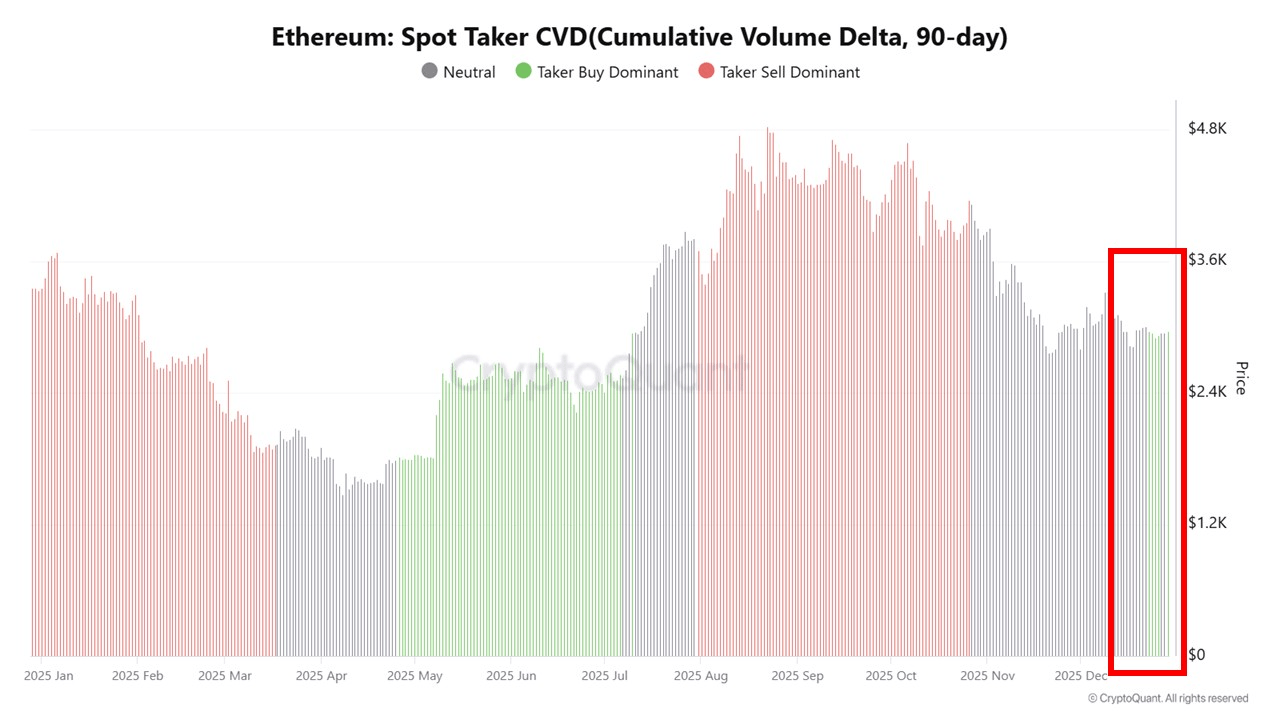
Ethereum Spot Taker CVD | Source: CryptoQuant

That said, Ethereum ETF flows remain negative on both daily and weekly timeframes, signaling that institutional demand via financial products continues to weigh on price action.

Beyond market flows, Ethereum’s network activity remains resilient. Deployed smart contracts reached a record 8.7 million in Q4 2025, while on-chain real-world asset value expanded to approximately $19 billion, led by Ethereum. These trends indicate that usage-driven demand remains intact despite weak sentiment.

The data support a scenario of ongoing price pressure alongside gradual structural improvement. This assessment would weaken if exchange balances rise again or sell-side flows regain dominance.


Trend Kriptolar

İlgili Sorular

QWhat is the current market sentiment for Ethereum according to the article?

AMarket sentiment has deteriorated sharply, with apathy and fear dominating positioning as participants remain hesitant to deploy fresh capital.

QWhich research firm's report is cited in the article, and what phase does it say Ethereum is in?

AThe report is by XWIN Research Japan on CryptoQuant, and it states that Ethereum is in a late-stage bearish phase that appears to be transitioning into a more range-bound structure.

QWhat on-chain data suggests an improvement in Ethereum's underlying market structure despite price weakness?

AData shows ETH leaving exchanges at the fastest pace of this cycle, and the validator entry queue has surpassed the exit queue for the first time in six months, indicating a shift toward self-custody, staking, and long-term holding.

QWhat does the 90-day Spot Taker CVD indicate about the current selling pressure?

AThe 90-day Spot Taker CVD indicates a transition away from strongly sell-dominant conditions toward neutral to mildly positive pressure, suggesting that aggressive selling is beginning to lose intensity.

QWhat two metrics are provided as evidence that Ethereum's network activity remains resilient?

ADeployed smart contracts reached a record 8.7 million in Q4 2025, and on-chain real-world asset value expanded to approximately $19 billion, led by Ethereum.

İlgili Okumalar

Can Japan Buy Growth with AI? Will the Bond Market Believe It?

Japan's cabinet has introduced the 2026 Basic Policy on Economic and Fiscal Management and Reform, shifting its primary fiscal target. The new framework moves away from the traditional annual primary balance goal and instead prioritizes a stable reduction of the debt-to-GDP ratio. This change is tied to a strategy of increased "responsible proactive fiscal" spending, aiming to boost long-term growth through investments in strategic sectors like AI, semiconductors, energy, and robotics. The government estimates total public and private investment in 62 key technologies could exceed 370 trillion yen by 2040. The market reaction has been mixed and cautious. While equity markets may respond to policy signals, bond markets are focused on fiscal credibility. Concerns center on whether the weakening of the clear primary balance anchor could lead to looser fiscal discipline. If investors doubt that these strategic investments will generate sufficient productivity gains, tax revenue, and nominal growth to outpace rising interest costs, they may demand higher yields on Japanese Government Bonds (JGBs). Recent volatility in the yen and JGB yields, with the 10-year yield briefly reaching 2.9%, reflects this skepticism. The success of this new framework hinges on two factors: whether Japan can achieve a nominal growth rate consistently higher than its long-term interest rates, and whether future budgets demonstrate disciplined control over bond issuance. The government's narrative is that strategic investment is essential to break Japan's cycle of low growth, aging, and labor shortages. However, the bond market will continuously assess the credibility of this plan, pricing the risk that it may represent fiscal expansion rather than a viable growth strategy.

marsbit25 dk önce

Can Japan Buy Growth with AI? Will the Bond Market Believe It?

marsbit25 dk önce

Misjudged A-Shares: Resilience, Expectations, and Confidence

China's A-share market recently faced selling pressure, especially in tech sectors, initially triggered by a global tech sell-off that began in South Korea. However, the article argues this is a case of "mistaken injury" and highlights the market's underlying resilience. This resilience stems from three main pillars: **1) Tech Sector Fundamentals:** Unlike Korea's market dominated by a few memory chip stocks, China's tech sector is diversified across computing, communications, electronics, and semiconductors, supported by dual narratives of global AI supply chains and domestic substitution. Core areas like optical modules and fiber optics continue to show strong earnings growth. **2) "National Team" Support:** State-backed institutions and large corporations have made significant market purchases and announced buybacks, providing liquidity and signaling confidence. This is seen as a stabilizing policy signal, often associated with market bottoms. **3) Broader Market Pillars:** Other major sectors are showing endogenous recovery momentum. Consumer stocks benefit from stabilizing CPI and signs of sector recovery (e.g., liquor price hikes). Cyclical sectors like aluminum have high earnings, potential price increases due to tight supply, and low valuations. The financial sector offers stable dividends and low valuations. The conclusion is that the sell-off was driven by external contagion, not a collapse in fundamentals. With strong policy support and recovering momentum across key sectors, the A-share market possesses the toughness to regain stability.

marsbit56 dk önce

Misjudged A-Shares: Resilience, Expectations, and Confidence

marsbit56 dk önce

İşlemler

Spot

Popüler Makaleler

O Nasıl Satın Alınır

HTX.com’a hoş geldiniz! O1 exchange (O) satın alma işlemlerini basit ve kullanışlı bir hâle getirdik. Adım adım açıkladığımız rehberimizi takip ederek kripto yolculuğunuza başlayın. 1. Adım: HTX Hesabınızı OluşturunHTX'te ücretsiz bir hesap açmak için e-posta adresinizi veya telefon numaranızı kullanın. Sorunsuzca kaydolun ve tüm özelliklerin kilidini açın. Hesabımı Aç2. Adım: Kripto Satın Al Bölümüne Gidin ve Ödeme Yönteminizi SeçinKredi/Banka Kartı: Visa veya Mastercard'ınızı kullanarak anında O1 exchange (O) satın alın.Bakiye: Sorunsuz bir şekilde işlem yapmak için HTX hesap bakiyenizdeki fonları kullanın.Üçüncü Taraflar: Kullanımı kolaylaştırmak için Google Pay ve Apple Pay gibi popüler ödeme yöntemlerini ekledik.P2P: HTX'teki diğer kullanıcılarla doğrudan işlem yapın.Borsa Dışı (OTC): Yatırımcılar için kişiye özel hizmetler ve rekabetçi döviz kurları sunuyoruz.3. Adım: O1 exchange (O) Varlıklarınızı SaklayınO1 exchange (O) satın aldıktan sonra HTX hesabınızda saklayın. Alternatif olarak, blok zinciri transferi yoluyla başka bir yere gönderebilir veya diğer kripto para birimlerini takas etmek için kullanabilirsiniz.4. Adım: O1 exchange (O) Varlıklarınızla İşlem YapınHTX'in spot piyasasında O1 exchange (O) ile kolayca işlemler yapın.Hesabınıza erişin, işlem çiftinizi seçin, işlemlerinizi gerçekleştirin ve gerçek zamanlı olarak izleyin. Hem yeni başlayanlar hem de deneyimli yatırımcılar için kullanıcı dostu bir deneyim sunuyoruz.

177 Toplam GörüntülenmeYayınlanma 2026.06.19Güncellenme 2026.06.29

O Nasıl Satın Alınır

PROS Nasıl Satın Alınır

HTX.com’a hoş geldiniz! Pharos (PROS) satın alma işlemlerini basit ve kullanışlı bir hâle getirdik. Adım adım açıkladığımız rehberimizi takip ederek kripto yolculuğunuza başlayın. 1. Adım: HTX Hesabınızı OluşturunHTX'te ücretsiz bir hesap açmak için e-posta adresinizi veya telefon numaranızı kullanın. Sorunsuzca kaydolun ve tüm özelliklerin kilidini açın. Hesabımı Aç2. Adım: Kripto Satın Al Bölümüne Gidin ve Ödeme Yönteminizi SeçinKredi/Banka Kartı: Visa veya Mastercard'ınızı kullanarak anında Pharos (PROS) satın alın.Bakiye: Sorunsuz bir şekilde işlem yapmak için HTX hesap bakiyenizdeki fonları kullanın.Üçüncü Taraflar: Kullanımı kolaylaştırmak için Google Pay ve Apple Pay gibi popüler ödeme yöntemlerini ekledik.P2P: HTX'teki diğer kullanıcılarla doğrudan işlem yapın.Borsa Dışı (OTC): Yatırımcılar için kişiye özel hizmetler ve rekabetçi döviz kurları sunuyoruz.3. Adım: Pharos (PROS) Varlıklarınızı SaklayınPharos (PROS) satın aldıktan sonra HTX hesabınızda saklayın. Alternatif olarak, blok zinciri transferi yoluyla başka bir yere gönderebilir veya diğer kripto para birimlerini takas etmek için kullanabilirsiniz.4. Adım: Pharos (PROS) Varlıklarınızla İşlem YapınHTX'in spot piyasasında Pharos (PROS) ile kolayca işlemler yapın.Hesabınıza erişin, işlem çiftinizi seçin, işlemlerinizi gerçekleştirin ve gerçek zamanlı olarak izleyin. Hem yeni başlayanlar hem de deneyimli yatırımcılar için kullanıcı dostu bir deneyim sunuyoruz.

182 Toplam GörüntülenmeYayınlanma 2026.06.22Güncellenme 2026.06.29

PROS Nasıl Satın Alınır

VERONA Nedir

I. Proje Tanıtımı VERONA, zincir soyutlaması aracılığıyla herkes için, her yerde inşa edilmiş bir blok zinciridir. Genel Soyutlama katmanını kullanarak, VERONA, hesaplar, imzalar ve birlikte çalışabilirlik gibi karmaşık blok zinciri işlevlerini doğrudan protokol seviyesinde entegre ederek kendini ayırt eder. Bu yaklaşım, temel teknolojileri anlamaya gerek kalmadan blok zinciri uygulamalarıyla etkileşimde bulunmayı sağlar.1) Temel Bilgiler İsim: VERONA (VERONA)III. İlgili Bağlantılar Resmi web sitesi bağlantısı: https://xion.burnt.com/ Whitepaper: https://xion.burnt.com/whitepaper.pdf Keşif Araçları: https://explorer.burnt.com/ Sosyal Medya: https://x.com/burnt_xion Not: Proje tanıtımı, resmi proje ekibi tarafından yayımlanan veya sağlanan materyallerden alınmıştır, yalnızca referans içindir ve yatırım tavsiyesi teşkil etmez. HTX, ortaya çıkan doğrudan veya dolaylı kayıplardan sorumluluk kabul etmez.

174 Toplam GörüntülenmeYayınlanma 2026.06.22Güncellenme 2026.06.22

VERONA Nedir

Tartışmalar

HTX Topluluğuna hoş geldiniz. Burada, en son platform gelişmeleri hakkında bilgi sahibi olabilir ve profesyonel piyasa görüşlerine erişebilirsiniz. Kullanıcıların A (A) fiyatı hakkındaki görüşleri aşağıda sunulmaktadır.

活动图片













