Ethereum is Building an 'Economic Special Zone', the Archipelago Era is Over

marsbit2026-03-31 tarihinde yayınlandı2026-03-31 tarihinde güncellendi

Özet

Ethereum is shifting from its fragmented "archipelago" model of Layer-2 solutions to a unified "Ethereum Economic Zone" (EEZ), a new initiative backed by the Ethereum Foundation and key protocols like Aave. This move aims to enable seamless, synchronous transactions across L2s, eliminating the delays and risks of bridges by allowing atomic cross-chain executions settled on Ethereum with ETH gas. However, this comes amid a significant decline in Ethereum’s activity and ETH price, which has dropped over 60% from its 2025 peak. While on-chain data shows Ethereum still holds the largest share of institutional capital—including $163.3B in stablecoins, 58% of real-world assets, and a $53B DeFi TVL—the economic model is struggling. With most activity moving to L2s, mainnet gas fees have collapsed, turning ETH inflationary and undermining its "ultrasound money" narrative. The article suggests Ethereum is becoming a "vault" or utility pipeline—secure and fundamental to global crypto finance, but increasingly boring and unable to capture value through fees. If Ethereum evolves into pure infrastructure like SWIFT, ETH may be revalued based on its utility as a settlement layer rather than speculative growth, challenging current investor expectations.

Author: David, Deep Tide TechFlow

Do you still care about Ethereum?

On February 3rd this year, Vitalik posted on X.

No long essay, just one sentence: The original vision of L2 and its role in Ethereum is no longer reasonable. We need a new path.

For the past five years, Ethereum's entire scaling roadmap has been built on L2. The mainnet is responsible for security and settlement, leaving all execution layer work to L2. Rollups, bridges, cross-chain messaging... The entire architecture was designed under the leadership of Vitalik himself.
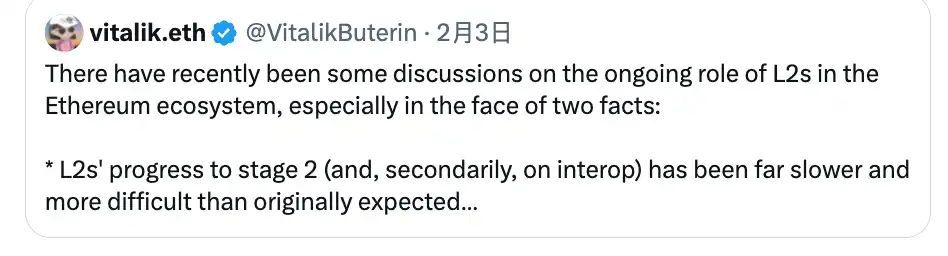
Now the designer himself says this path is wrong.

Less than two months later, at the EthCC Cannes conference on March 29th, Gnosis co-founder Friederike Ernst and zero-knowledge proof developer Jordi Baylina took the stage to announce something called EEZ:

Full name Ethereum Economic Zone.

Co-funded by the Ethereum Foundation, with protocols like Aave joining as founding members. What EEZ aims to do can be summed up in one sentence: make all L2s no longer isolated islands, but one connected continent.

The direction is certainly correct.

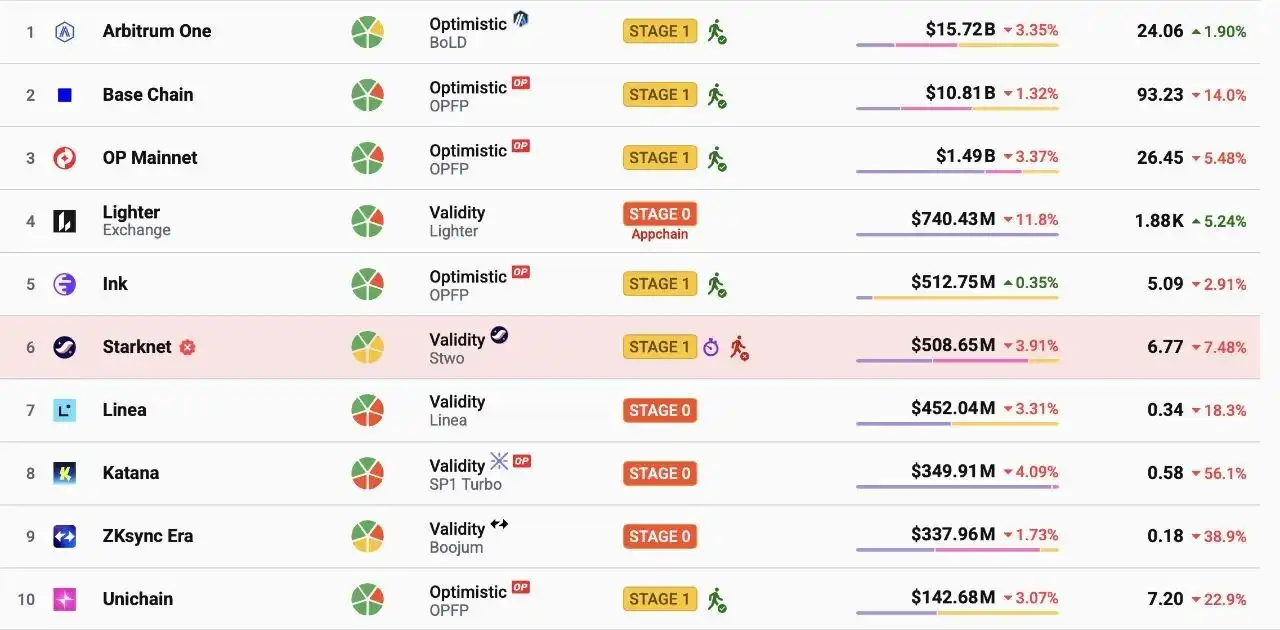
But the problem is, this archipelago has been built for five years... The islands were once prosperous, but surely no one is there now. Is it too late to start building tunnels now?

Closing the Stable Door After the Horse Has Bolted?

From the name EEZ, you can actually see what Ethereum wants to do.

The logic of an economic zone is well understood: unified rules within the zone, free flow of capital, no checkpoints. In the past, Ethereum's twenty-plus L2s were like twenty small economies, each with its own customs, currency, and clearance procedures. Moving money from Arbitrum to Base required finding a middleman to exchange currency and bridge.
What EEZ aims to do is remove tariffs, unify the currency, and dismantle customs. Your operations on any chain can directly interact with contracts on another chain, settling back to the Ethereum mainnet, with Gas uniformly paid in ETH.

Does that sound familiar?

LayerZero and Wormhole told similar stories back in the day. Connect all chains, free flow of assets... all old tricks.

The difference here is that those cross-chain protocols are asynchronous. For example, you initiate an operation on chain A, and chain B executes it after a while; there's a delay in the middle, a risk of failure, and the bridge itself is a favorite target for hackers.

This EEZ is synchronous. Contracts on two chains execute simultaneously within one transaction, either both succeed or both roll back. The technical prerequisite for this is the real-time proving of Ethereum blocks.

This wasn't possible before. For two chains to operate synchronously, they need to be able to verify each other's ledgers in real-time. But Ethereum produces a new block every 12 seconds, and the speed of verifying the previous block couldn't keep up. The accounting wasn't finished before the next block arrived.

This year, this speed was technically achieved. Synchronous operation became an engineering reality for the first time, leading to the EZZ proposal.

The direction is fine. But if you check Twitter, who is still talking about Ethereum?

It's not just Ethereum that's cold; the whole industry is quiet. Last year there was meme coin frenzy, Solana's comeback, the AI Agent hype. From the start of this year until now, no narrative has taken off.

Ethereum is just colder—ETH dropped from $4800 at the end of 2025 to just over $2000 now, evaporating over 60%. There isn't even much anger in the community, more a kind of weary silence.

From Archipelago to Treasury Era

But if you look at on-chain data, you see a completely different picture.

According to AMBCrypto, the supply of stablecoins on the Ethereum mainnet is still about $163.3 billion. In the $16.5 billion on-chain real-world asset market, Ethereum accounts for 58%. Last year, Ethereum spot ETFs saw a net inflow of $9.9 billion. DeFi TVL is still the highest in the industry, about $53 billion.

The people left, but the money remains. And it's not retail money, it's institutional money.
The Ethereum Foundation's own actions point in the same direction. It paused its public grants program in the middle of last year, reducing its burn rate to below 5% per year. But last week it completed its largest single staking event ever—22,517 ETH, worth about $46.2 million, locked into the Beacon Chain.

Cutting the budget while locking money into the treasury, and simultaneously funding an interoperability solution that's arriving last.

All these actions pieced together point to one judgment: Ethereum's archipelago era is indeed over. But what replaces it is not a bustling continent.

It's a treasury.

Quiet, sturdy, filled with institutional assets. Not many people live there, but it holds the most money in the industry.

Even Treasuries Don't Generate Tax Revenue, Ethereum Doesn't Make Money

Ethereum's economic model has a very simple cycle:

Users transact on the mainnet, transactions generate Gas fees, and a portion of the Gas fees (ETH) is permanently burned. The more users, the more burning, the more the ETH supply decreases.

When this mechanism first started running in 2022, the community gave it a name: ultrasound money. Meaning ETH is not only anti-inflation, but deflationary—harder than Bitcoin.

This narrative held for two years. Then L2 dismantled it.

When a large number of transactions moved from the mainnet to L2, the mainnet's Gas fee income collapsed. According to BitKE, Ethereum mainnet revenue has fallen by about 75% over the past two years. One week, the combined blob fees generated by L2s submitting data to the mainnet were only 3.18 ETH.

3.18 ETH, at the price then, was only about $5000.

A network locking $53 billion in TVL, with weekly blob revenue enough for a decent New Year's Eve dinner table in Shanghai.
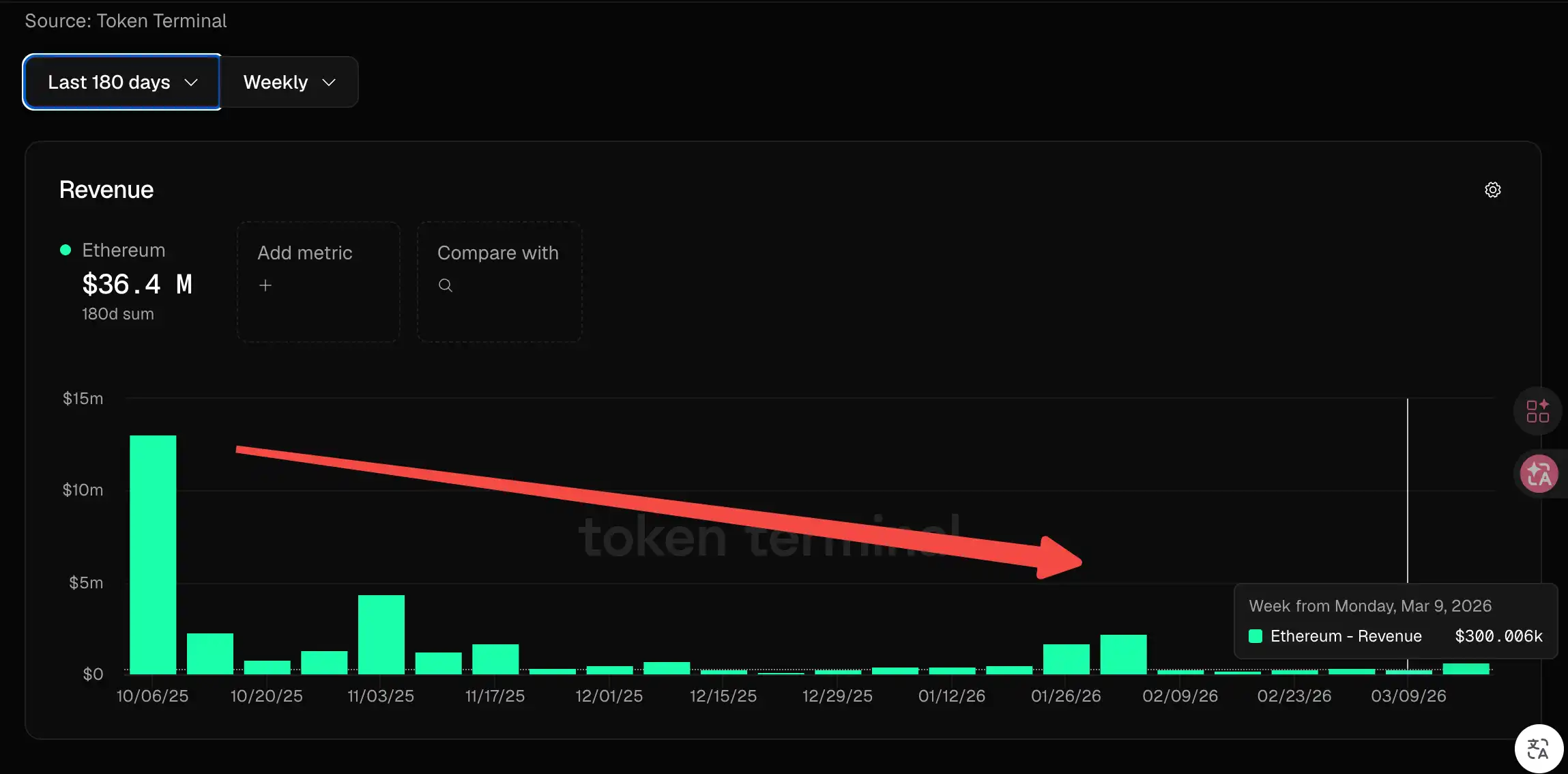
If it can't burn, the supply can't be suppressed. In February this year, ETH's supply officially turned to net growth, with an annualized inflation rate of about 0.74%. "Ultrasound money" became an expired marketing slogan.

This is the cost of the L2 roadmap. Users and transactions move to L2, L2s take the fee income, and the mainnet is left with only settlement work. Settlement is important, but settlement doesn't make money.

To use an analogy, Ethereum built an economic special zone, moved the factories and shops inside, and the zone is bustling. But the tax revenue goes to the zone itself, and the central government's fiscal revenue反而 decreases. The EEZ scheme mentioned in the previous chapter wants to reconnect the special zone to the center, but what it connects back is liquidity, not tax revenue.

The institutional money is locked in the treasury, very safe. But the treasury itself, the ETH asset, is becoming increasingly difficult to narrate because it has no income.

The price drop from $4800 to $2000 is not just an emotional issue. When an asset's core narrative shifts from "deflationary" to "actually still inflationary," the market reprices it.

The situation Ethereum faces now is:

The strongest in the industry in terms of infrastructure, the most institutional capital in the industry, but the economic model is leaking. EEZ fixes fragmentation, but it doesn't fix this.

Is an Uninhabited House Valuable?

Back to the opening question: Do you still care about Ethereum?

The honest answer for most people is probably not really. ETH isn't rising, the narrative is outdated, it's troublesome to use,还不如Solana next door.

But ask it another way: Do you care about the water pipes under your building?

No, you just turn on the tap and there's water. You don't research what purification technology the water plant uses, you don't care what material the pipes are made of, and you certainly don't post on social media because of the pipe brand.

Ethereum is becoming that water pipe.

$53 billion TVL, $163.3 billion in stablecoins, 58% of the industry's real-world assets, nearly $10 billion in annual ETF inflows... These numbers indicate one thing: most of the global crypto-financial on-chain clearing is still done on Ethereum.

Not because users like Ethereum, but because institutions can't find a second pipe as thick.

What the economic zone EEZ is doing now is essentially increasing the diameter of this pipe—allowing institutional funds to flow faster between L2s, reducing settlement friction. This is useful, even necessary.

But pipes have one characteristic: no one wants to pay a premium for a pipe.

Water companies are one of the most important infrastructures in a city, but have you ever seen a water company's P/E ratio higher than an internet company's? The global clearing giant DTCC processes over $2000 trillion in transactions annually, but almost no one discusses its stock price.

If Ethereum truly moves towards becoming a treasury, a pipe, it will become extremely important, and simultaneously extremely boring. Important enough that all institutional money passes through it, boring enough that no retail investor wants to hold ETH waiting for it to rise.

But most people holding ETH today are still pricing it according to the logic of a "city." Users will grow, the ecosystem will prosper, L2 will feed back to the mainnet, the coin price will hit new highs? This is the story the Ethereum community has been telling itself for the past five years.

The reality is, Ethereum is becoming SWIFT, not New York.

SWIFT handles over $150 trillion in cross-border payments annually, and the global financial system cannot do without it. But no one speculates on SWIFT's stock because the valuation logic of infrastructure is stability.

ETH's drop from $4800 to $2000 is not just emotion; the market is re-understanding what this asset actually is.

If Ethereum's future is a treasury, then ETH's reasonable pricing shouldn't be based on user numbers and ecosystem heat, but on how much value it can capture annually as a settlement layer. At the current level of $5000 weekly mainnet blob revenue, that answer isn't very pretty.

The archipelago era is over. EEZ is here, the institutional money remains. But for those holding ETH, there's really only one thing to figure out clearly:

Did you buy a house in a city, or the right to use a pipe.

İlgili Sorular

QWhat is the Ethereum Economic Zone (EEZ) and what problem does it aim to solve?

AThe Ethereum Economic Zone (EEZ) is a new initiative announced at EthCC Cannes, backed by the Ethereum Foundation and protocols like Aave. Its goal is to connect all Ethereum Layer 2s (L2s) into a unified economic zone, eliminating the current fragmentation where each L2 operates as an isolated 'island' with its own rules, currencies, and bridging processes. EEZ aims to enable synchronous operations across L2s, allowing transactions to interact with contracts on different chains simultaneously and settle on the Ethereum mainnet using ETH for gas, thereby improving capital efficiency and user experience.

QAccording to the article, why did Vitalik Buterin state that the original vision for L2s is 'no longer reasonable'?

AVitalik Buterin stated that the original vision for Layer 2s (L2s) and their role in Ethereum is 'no longer reasonable' because the five-year scaling roadmap, which relied on L2s for execution while the mainnet handled security and settlement, has led to significant unintended consequences. The main issue is that the economic model is 'leaking': transaction activity and fee revenue have largely moved to L2s, drastically reducing the mainnet's gas fee income and causing ETH's supply to become inflationary again, undermining its 'ultrasound money' narrative.

QWhat does the article mean by Ethereum entering a 'treasury era' or becoming a 'vault'?

AThe article uses the terms 'treasury era' and 'vault' to describe Ethereum's current state where a massive amount of institutional capital (e.g., $1633B in stablecoins, 58% of the on-chain real-world asset market, $99B ETF inflows) remains locked on the chain, but active user engagement and retail interest have significantly declined. It has become a secure, foundational settlement layer for global crypto finance—like a fortified vault storing immense value—but it is no longer a vibrant city with a growing ecosystem and users, making it 'important yet boring'.

QHow has the shift of activity to L2s impacted Ethereum's economic model and the ETH token?

AThe shift of user activity and transactions to L2s has severely damaged Ethereum's economic model. The mainnet's gas fee revenue, which was used to burn ETH and create deflationary pressure, has collapsed (e.g., reported blob fees as low as 3.18 ETH in a week). This has caused ETH's inflation rate to turn positive (approx. 0.74% annualized), ending the 'ultrasound money' narrative. Consequently, ETH's price has fallen over 60% from its peak, as the market reprices the asset based on its reduced capacity to capture value and generate fees.

QWhat is the fundamental valuation question the article poses for ETH holders?

AThe article poses a critical valuation question for ETH holders: are they investing in the potential of a growing, vibrant 'city' (with user growth, ecosystem expansion, and price appreciation) or are they merely buying a 'utility token' for a foundational financial 'pipe'? If Ethereum's future is that of a decentralized settlement infrastructure-like SWIFT or DTCC—essential but boring—then ETH should be valued based on the fees it captures as a结算层 (settlement layer), not on speculative ecosystem growth, which would imply a lower valuation multiple.

İlgili Okumalar

İşlemler

Spot
Futures

Popüler Makaleler

ETH 2.0 Nedir

ETH 2.0: Ethereum için Yeni Bir Dönem Giriş ETH 2.0, Ethereum 2.0 olarak da bilinir, Ethereum blok zincirinde önemli bir yükseltmeyi işaret eder. Bu geçiş yalnızca bir yüz değiştirme değil; ağın ölçeklenebilirliğini, güvenliğini ve sürdürülebilirliğini temelinden geliştirmeyi hedeflemektedir. Enerji yoğun Proof of Work (PoW) konsensüs mekanizmasından daha verimli olan Proof of Stake (PoS) mekanizmasına geçişle birlikte, ETH 2.0 blok zinciri ekosistemine dönüştürücü bir yaklaşım vaat etmektedir. ETH 2.0 Nedir? ETH 2.0, Ethereum'un yeteneklerini ve performansını optimize etmeye odaklanmış özel, birbirine bağlı güncellemelerin bir derlemesidir. Yenileme, mevcut Ethereum mekanizmasının karşılaştığı kritik zorlukları, özellikle işlem hızı ve ağ tıkanıklığı ile ilgili sorunları ele almak üzere tasarlanmıştır. ETH 2.0'ın Amaçları ETH 2.0'ın ana amaçları, üç temel unsuru geliştirmeye odaklanmaktadır: Ölçeklenebilirlik: Ağın saniye başına işleyebileceği işlem sayısını önemli ölçüde artırmayı hedefleyen ETH 2.0, mevcut yaklaşık 15 işlem/saniye sınırlamasını aşmayı ve potansiyel olarak binlerce işleme ulaşmayı planlamaktadır. Güvenlik: Geliştirilmiş güvenlik önlemleri, özellikle siber saldırılara karşı daha iyi direnç sağlama ve Ethereum'un merkeziyetsiz görünümünü koruma açısından ETH 2.0 için hayati öneme sahiptir. Sürdürülebilirlik: Yeni PoS mekanizması, sadece verimliliği artırmakla kalmayıp aynı zamanda enerji tüketimini de önemli ölçüde azaltma hedefiyle tasarlanmış olup, Ethereum'un operasyonel çerçevesini çevresel kaygılarla uyumlu hale getirmektedir. ETH 2.0'ın Yaratıcısı Kimdir? ETH 2.0'ın yaratılması Ethereum Vakfı'na atfedilebilir. Ethereum'un gelişimini destekleme konusunda kritik bir rol oynayan bu kar amacı gütmeyen kuruluş, dikkat çekici kurucu ortağı Vitalik Buterin tarafından yönetilmektedir. Daha ölçeklenebilir ve sürdürülebilir bir Ethereum vizyonu, bu yükseltmenin arkasındaki itici güç olmuştur ve protokolü geliştirmek için kendini adamış küresel bir geliştici ve meraklı topluluğunun katkılarını içermektedir. ETH 2.0'ın Yatırımcıları Kimlerdir? ETH 2.0 yatırımcıları ile ilgili detaylar kamuoyuna açıklanmamış olsa da, Ethereum Vakfı'nın blok zinciri ve teknoloji alanında çeşitli kuruluşlar ve bireyler tarafından desteklendiği bilinmektedir. Bu ortaklar arasında merkeziyetsiz teknolojilerin ve blok zinciri altyapısının geliştirilmesine karşılıklı ilgi duyan girişim sermayesi şirketleri, teknoloji firmaları ve hayır kurumları yer almaktadır. ETH 2.0 Nasıl Çalışır? ETH 2.0, onu öncüsünden ayıran bir dizi önemli özelliği tanıtmasıyla dikkat çekmektedir. Proof of Stake (PoS) PoS konsensüs mekanizmasına geçiş, ETH 2.0'ın en belirgin değişikliklerinden biridir. İşlem doğrulama için enerji yoğun madenciliğe dayanmak yerine, PoS kullanıcıların ağa yatırdıkları ETH miktarına göre işlemleri doğrulayıp yeni bloklar oluşturmalarına olanak tanır. Bu, enerji verimliliğinin artırılmasına yol açarak tüketimi yaklaşık %99,95 oranında azaltmakta ve Ethereum 2.0'ı önemli ölçüde daha çevre dostu bir alternatif haline getirmektedir. Shard Zincirleri Shard zincirleri, ETH 2.0'ın diğer bir kritik yeniliğidir. Bu daha küçük zincirler, ana Ethereum zinciri ile paralel olarak çalışarak birden fazla işlemin aynı anda işlenmesine olanak tanır. Bu yaklaşım, ağın genel kapasitesini artırarak Ethereum'u rahatsız eden ölçeklenebilirlik sorunlarını ele alır. Beacon Zinciri ETH 2.0'ın temelinde, ağı koordine eden ve PoS protokolünü yöneten Beacon Zinciri yer almaktadır. Bu, bir tür organizatör olarak işlev görür: doğrulayıcıları denetler, shard'ların ağa bağlı kalmasını sağlar ve blok zinciri ekosisteminin genel sağlığını izler. ETH 2.0 Zaman Çizelgesi ETH 2.0'ın yolculuğu, bu önemli yükseltmenin evrimini gösteren birkaç önemli dönüm noktası ile tanımlanmıştır: Aralık 2020: Beacon Zinciri'nin başlatılması, PoS'un tanıtımını işaret etmiş ve ETH 2.0’a geçiş için sahneyi hazırlamıştır. Eylül 2022: "The Merge" tamamlanması, Ethereum ağının başarılı bir şekilde PoW'den PoS çerçevesine geçiş yaptığı kritik bir anı temsil etmekte ve Ethereum için yeni bir dönemi müjdelemektedir. 2023: Shard zincirlerinin beklenen dağıtımı, Ethereum ağının ölçeklenebilirliğini daha da artırmayı hedeflemekte ve ETH 2.0'ı merkeziyetsiz uygulamalar ve hizmetler için sağlam bir platform haline getirmeyi pekiştirmektedir. Ana Özellikler ve Faydalar Geliştirilmiş Ölçeklenebilirlik ETH 2.0'ın en önemli avantajlarından biri, geliştirilmiş ölçeklenebilirliğidir. PoS ve shard zincirlerinin kombinasyonu, ağın kapasitesini artırarak, eski sistemle kıyaslandığında çok daha fazla işlem hacmi karşılayabilmesini sağlamaktadır. Enerji Verimliliği PoS'un uygulanması, blok zinciri teknolojisinde enerji verimliliği yönünde büyük bir adım teşkil etmektedir. Enerji tüketimini ciddi şekilde azaltarak, ETH 2.0 yalnızca işletme maliyetlerini düşürmekle kalmaz, aynı zamanda küresel sürdürülebilirlik hedefleriyle daha yakın bir uyum sağlar. Geliştirilmiş Güvenlik ETH 2.0'ın güncellenmiş mekanizmaları, ağ genelinde güvenliğin artırılmasına katkıda bulunmaktadır. PoS'un uygulanması ve shard zincirleri ile Beacon Zinciri aracılığıyla geliştirilen yenilikçi kontrol önlemleri, potansiyel tehditlere karşı daha yüksek bir koruma sağlar. Kullanıcılar için Düşük Maliyetler Ölçeklenebilirlik geliştikçe, işlem maliyetleri üzerindeki etkiler de belirgin hale gelecektir. Artan kapasite ve azalan tıkanıklığın, kullanıcılar için düşük ücretler anlamına gelmesi beklenmekte ve Ethereum'u günlük işlemler için daha erişilebilir hale getirmektedir. Sonuç ETH 2.0, Ethereum blok zinciri ekosisteminde önemli bir evrimi işaret etmektedir. Ölçeklenebilirlik, enerji tüketimi, işlem verimliliği ve genel güvenlik gibi temel sorunları ele alırken, bu güncellemenin önemi abartılamaz. Proof of Stake'e geçiş, shard zincirlerinin tanıtımı ve Beacon Zinciri'nin altyapı çalışmaları, Ethereum'un merkeziyetsiz piyasalarının artan taleplerini karşılayabileceği bir geleceği göstermektedir. Yenilik ve ilerleme ile şekillenen bir sektörde, ETH 2.0, blok zinciri teknolojisinin daha sürdürülebilir ve verimli bir dijital ekonomi için yol açmadaki yeteneklerinin bir kanıtıdır.

170 Toplam GörüntülenmeYayınlanma 2024.04.04Güncellenme 2024.12.03

ETH 2.0 Nedir

ETH 3.0 Nedir

ETH3.0 ve $eth 3.0: Ethereum'un Geleceği Üzerine Derinlemesine Bir İnceleme Giriş Hızla evrilen kripto para ve blok zinciri teknolojisi ortamında, ETH3.0, sıklıkla $eth 3.0 olarak adlandırılmakta, önemli bir ilgi ve spekülasyon konusu haline gelmiştir. Bu terim, netleştirilmesi gereken iki temel kavramı kapsamaktadır: Ethereum 3.0: Bu, mevcut Ethereum blok zincirinin yeteneklerini artırmayı hedefleyen olası bir gelecekteki güncellemeyi temsil eder, özellikle ölçeklenebilirlik ve performansı iyileştirmeye odaklanmaktadır. ETH3.0 Meme Token: Bu ayrı kripto para projesi, Ethereum blok zincirini kullanarak meme merkezli bir ekosistem oluşturmayı amaçlamakta ve kripto para topluluğu içinde etkileşimi artırmaktadır. ETH3.0'ün bu yönlerini anlamak, yalnızca kripto meraklıları için değil, aynı zamanda dijital alandaki daha geniş teknolojik trendleri gözlemleyenler için de hayati öneme sahiptir. ETH3.0 Nedir? Ethereum 3.0 Ethereum 3.0, zaten kurulmuş olan Ethereum ağına önerilen bir güncelleme olarak duyurulmaktadır; bu ağ, kuruluşundan bu yana birçok merkeziyetsiz uygulamanın (dApp'ler) ve akıllı sözleşmelerin belkemiği olmuştur. Tasarlanan iyileştirmeler, esasen ölçeklenebilirlik üzerine yoğunlaşmakta – shardlama ve sıfır bilgi kanıtları (zk-proofs) gibi ileri teknolojileri entegre etmektedir. Bu teknolojik yenilikler, saniyede eşi benzeri görülmemiş sayıda işlem (TPS) gerçekleştirmeyi kolaylaştırmayı amaçlamakta olup, muhtemelen milyonlara ulaşarak mevcut blok zinciri teknolojisinin karşılaştığı en büyük sınırlamalardan birine çözüm getirmektedir. İyileştirme yalnızca teknik değil, aynı zamanda stratejiktir; Ethereum ağını, merkeziyetsiz çözümlere olan artan talep ile belirginleşen bir geleceğe hazırlamak için tasarlanmıştır. ETH3.0 Meme Token Ethereum 3.0'ın aksine, ETH3.0 Meme Token, internet meme kültürünü kripto para dinamikleriyle birleştirerek daha hafif ve eğlenceli bir alanda hareket etmektedir. Bu proje, kullanıcıların Ethereum blok zincirinde meme alım, satım ve ticaret yapmalarına izin vererek, yaratıcılık ve ortak ilgi alanları aracılığıyla topluluk etkileşimini teşvik eden bir platform sunmaktadır. ETH3.0 Meme Token, blok zinciri teknolojisinin dijital kültürle nasıl kesişebileceğini göstererek, hem eğlenceli hem de finansal olarak sürdürülebilir kullanım senaryoları oluşturmayı hedeflemektedir. ETH3.0'un Yaratıcısı Kimdir? Ethereum 3.0 Ethereum 3.0'a yönelik girişim, esas olarak Ethereum topluluğundaki bir geliştirici ve araştırmacı konsorsiyumu tarafından yönlendirilmektedir ve bunlar arasında Justin Drake de bulunmaktadır. Ethereum'un evrimine yönelik içgörüleri ve katkılarıyla tanınan Drake, Ethereum'u “Beam Chain” olarak adlandırılan yeni bir konsensüs katmanına geçirme konusundaki tartışmalarda öne çıkan bir figür olmuştur. Geliştirmeye yönelik bu iş birliği yaklaşımı, Ethereum 3.0'ın tek bir yaratıcının ürünü olmadığını, aksine blok zinciri teknolojisini ilerletmeye odaklanmış kolektif bir dehanın tezahürü olduğunu göstermektedir. ETH3.0 Meme Token ETH3.0 Meme Token'ın yaratıcısına dair detaylar şu anda izlenemez durumdadır. Meme tokenların doğası, genellikle daha merkeziyetsiz ve topluluk odaklı bir yapıya yol açmakta olup, bu da spesifik bir atıf eksikliğini açıklayabilir. Bu durum, yeniliğin genellikle iş birliği yerine bireysel çabalardan ortaya çıktığı kripto topluluğunun genel felsefesiyle uyumludur. ETH3.0 Yatırımcıları Kimlerdir? Ethereum 3.0 Ethereum 3.0'a olan destek, esasen Ethereum Vakfı ve hevesli bir geliştirici ve yatırımcı topluluğu tarafından sağlanmaktadır. Bu temel birliktelik, yıllar süren ağ operasyonlarıyla inşa edilen güven ve itibarından yararlanarak önemli bir meşruiyet sağlamaktadır. Kripto para dünyasının hızla değişen ikliminde, topluluk desteği, gelişim ve benimsemeyi yönlendirmede kritik bir rol oynamakta ve Ethereum 3.0'ı gelecekteki blok zinciri ilerlemeleri için ciddi bir rakip haline getirmektedir. ETH3.0 Meme Token Mevcut kaynaklar, ETH3.0 Meme Token'ı destekleyen yatırım temelleri veya kuruluşları hakkında net bilgiler sağlamasa da, bu durum meme tokenlar için tipik olan finansman modelini göstermektedir; bu model genellikle tabandan destek ve topluluk katılımına dayanır. Bu tür projelerdeki yatırımcılar genellikle toplum odaklı yenilik potansiyeli ve kripto topluluğunda bulunan iş birliği ruhuyla motive olmuş bireylerden oluşmaktadır. ETH3.0 Nasıl Çalışır? Ethereum 3.0 Ethereum 3.0'ın ayırt edici özellikleri, önerilen shardlama ve zk-proof teknolojisinin uygulanmasında yatmaktadır. Shardlama, blok zincirini daha küçük, yönetilebilir parçalara veya “parçalara” ayırma yöntemidir; bu parçalar işlemleri ardışık değil, eşzamanlı olarak işleyebilir. Bu işlem yükünün merkeziyetsizliği, tıkanıklığı önlemeye yardımcı olur ve ağın yoğun yük altında bile yanıt verebilir olmasını sağlar. Sıfır bilgi kanıtı (zk-proof) teknolojisi, işleme katılan temel verileri ifşa etmeden işlem doğrulaması sağlamasıyla başka bir sofistike katman ekler. Bu yön, sadece gizliliği artırmakla kalmaz, aynı zamanda ağın genel verimliliğini de artırır. Bu güncellemeye, ağın yeteneklerini ve faydasını daha da artırarak sıfır bilgi Ethereum Sanal Makinesi (zkEVM) entegrasyonunun da eklenmesi gündeme gelmektedir. ETH3.0 Meme Token ETH3.0 Meme Token, meme kültürünün popülaritesinden yararlanarak kendini farklılaştırmaktadır. Kullanıcıların sadece eğlence için değil, aynı zamanda potansiyel ekonomik kazançlar için meme ticareti yapmalarına olanak tanıyacak bir pazar yeri oluşturur. Stake etme, likidite sağlama ve yönetim mekanizmaları gibi özelliklerin entegrasyonu sayesinde, proje topluluk etkileşimini ve katılımını teşvik eden bir ortam oluşturur. Eğlence ve ekonomik fırsatların eşsiz bir karışımını sunarak, ETH3.0 Meme Token, kripto tutkunlarından gündelik meme meraklılarına kadar çeşitli bir kitleyi çekmeyi hedeflemektedir. ETH3.0 Zaman Çizelgesi Ethereum 3.0 11 Kasım 2024: Justin Drake, ölçeklenebilirlik iyileştirmeleri etrafında şekillenen yaklaşan ETH 3.0 güncellemesine işaret ediyor. Bu duyuru, Ethereum'un gelecekteki mimarisi hakkında resmi tartışmaların başlangıcını simgeliyor. 12 Kasım 2024: Ethereum 3.0'a yönelik beklenen önerinin, Bangkok'taki Devcon'da açıklanması planlanıyor ve bu, daha geniş topluluk geri bildirimi ve gelişim için olası sonraki adımların zeminini hazırlıyor. ETH3.0 Meme Token 21 Mart 2024: ETH3.0 Meme Token, CoinMarketCap'ta resmi olarak listeleniyor, bu da kamusal kripto alanına adım atarak meme merkezli ekosisteminin görünürlüğünü artırıyor. Ana Noktalar Sonuç olarak, Ethereum 3.0, gelişmiş teknolojiler aracılığıyla ölçeklenebilirlik ve performansla ilgili sınırlamaların üstesinden gelmeye odaklanan Ethereum ağındaki önemli bir evrimi temsil etmektedir. Önerilen güncellemeleri, gelecekteki talepler ve kullanılabilirlik için proaktif bir yaklaşımı yansıtmaktadır. Öte yandan, ETH3.0 Meme Token, kripto para alanındaki topluluk odaklı kültürün özünü kapsamakta, meme kültürünü kullanarak kullanıcı yaratıcılığını ve katılımını teşvik eden etkileşimli platformlar oluşturmayı hedeflemektedir. ETH3.0 ve $eth 3.0'un farklı amaçlarının ve işlevlerinin anlaşılması, kripto alanındaki gelişmeleri takip eden herkes için hayati öneme sahiptir. Her iki girişim de benzersiz yollar çizerek, blok zinciri yeniliğinin dinamik ve çok yönlü doğasını birlikte vurgulamaktadır.

171 Toplam GörüntülenmeYayınlanma 2024.04.04Güncellenme 2024.12.03

ETH 3.0 Nedir

ETH Nasıl Satın Alınır

HTX.com’a hoş geldiniz! Ethereum (ETH) satın alma işlemlerini basit ve kullanışlı bir hâle getirdik. Adım adım açıkladığımız rehberimizi takip ederek kripto yolculuğunuza başlayın. 1. Adım: HTX Hesabınızı OluşturunHTX'te ücretsiz bir hesap açmak için e-posta adresinizi veya telefon numaranızı kullanın. Sorunsuzca kaydolun ve tüm özelliklerin kilidini açın. Hesabımı Aç2. Adım: Kripto Satın Al Bölümüne Gidin ve Ödeme Yönteminizi SeçinKredi/Banka Kartı: Visa veya Mastercard'ınızı kullanarak anında Ethereum (ETH) satın alın.Bakiye: Sorunsuz bir şekilde işlem yapmak için HTX hesap bakiyenizdeki fonları kullanın.Üçüncü Taraflar: Kullanımı kolaylaştırmak için Google Pay ve Apple Pay gibi popüler ödeme yöntemlerini ekledik.P2P: HTX'teki diğer kullanıcılarla doğrudan işlem yapın.Borsa Dışı (OTC): Yatırımcılar için kişiye özel hizmetler ve rekabetçi döviz kurları sunuyoruz.3. Adım: Ethereum (ETH) Varlıklarınızı SaklayınEthereum (ETH) satın aldıktan sonra HTX hesabınızda saklayın. Alternatif olarak, blok zinciri transferi yoluyla başka bir yere gönderebilir veya diğer kripto para birimlerini takas etmek için kullanabilirsiniz.4. Adım: Ethereum (ETH) Varlıklarınızla İşlem YapınHTX'in spot piyasasında Ethereum (ETH) ile kolayca işlemler yapın.Hesabınıza erişin, işlem çiftinizi seçin, işlemlerinizi gerçekleştirin ve gerçek zamanlı olarak izleyin. Hem yeni başlayanlar hem de deneyimli yatırımcılar için kullanıcı dostu bir deneyim sunuyoruz.

3.3k Toplam GörüntülenmeYayınlanma 2024.12.10Güncellenme 2025.03.21

ETH Nasıl Satın Alınır

Tartışmalar

HTX Topluluğuna hoş geldiniz. Burada, en son platform gelişmeleri hakkında bilgi sahibi olabilir ve profesyonel piyasa görüşlerine erişebilirsiniz. Kullanıcıların ETH (ETH) fiyatı hakkındaki görüşleri aşağıda sunulmaktadır.

活动图片