Ethereum Foundation Backs SEAL Initiative as LiquidChain L3 Protocol Gains Traction

bitcoinist2026-02-10 tarihinde yayınlandı2026-02-10 tarihinde güncellendi

Özet

The Ethereum Foundation has officially backed the Security Alliance (SEAL), a coalition of white-hat hackers and researchers, to strengthen the crypto industry’s coordinated defense against drainer attacks. SEAL’s "SEAL 911" initiative enables real-time reporting of exploits, helping intercept stolen funds before they are laundered. This move signals a shift from reactive security measures to more structural solutions that reduce complexity and risk. LiquidChain ($LIQUID), a Layer 3 protocol, is gaining traction as a architectural solution to cross-chain vulnerabilities. By unifying liquidity across Bitcoin, Ethereum, and Solana into a single execution layer, it eliminates the need for risky bridging operations—a common attack vector. The project has raised over $533K in its presale, reflecting growing institutional interest in infrastructure that abstracts away cross-chain complexity and enhances security through design rather than intervention.

Trusted Editorial content, reviewed by leading industry experts and seasoned editors. Ad Disclosure

Quick Facts:

  • ➡️ The Ethereum Foundation has officially backed the Security Alliance (SEAL), strengthening the industry’s coordinated response against crypto drainers.
  • ➡️ Market focus is shifting from reactive security measures to architectural solutions that reduce complexity.
  • ➡️ LiquidChain is capitalizing on this trend by unifying Bitcoin, Ethereum, and Solana liquidity into a single, secure L3 execution layer.
  • ➡️ Institutional support for white-hat initiatives signals a maturing market where security is treated as a public good rather than a luxury.

The decentralized finance security landscape just shifted.

By formally backing the Security Alliance (SEAL), the Ethereum Foundation is acknowledging a hard truth: code audits alone aren’t enough to stop the rising tide of sophisticated crypto drainers.

SEAL, a coalition of white-hat hackers and researchers, has quietly become the industry’s emergency response team. Their ‘SEAL 911’ initiative lets victims and protocols report active exploits in real-time, often intercepting funds before they hit mixers.

The Foundation’s backing isn’t just financial; it’s an institutional nod to coordinated defense. Previously, protocols fought threats in silos. Now, the centralization of threat intelligence creates a “herd immunity” effect that makes drainer-as-a-service operations significantly harder to scale.

But let’s be honest: while SEAL treats the symptoms (exploits), the market is hunting for a cure to the root cause: complexity. Most losses happen during the intricate dance of bridging assets and signing obscure permissions.

Ironically, for an industry built on trustless code, our security still relies heavily on human intervention. Recognizing this, investors are rotating toward architectural solutions that remove the need for risky bridging entirely.

This thesis is driving capital into LiquidChain ($LIQUID), a Layer 3 infrastructure project designed to unify liquidity across Bitcoin, Ethereum, and Solana.

Learn more about LiquidChain here.

LiquidChain Unifies Liquidity To Remove Bridge Risk

Fragmentation is the enemy of security. Every time you wrap an asset or use a third-party bridge, you introduce a new point of failure, a vector that drainers exploit with ruthless efficiency. LiquidChain ($LIQUID) positions itself as the structural antidote, fusing the liquidity of the three largest ecosystems into a single execution environment.

By operating as a Layer 3 (L3) protocol, LiquidChain allows developers to deploy applications once that access Bitcoin, Ethereum, and Solana simultaneously.

For the end-user, this means ‘single-step execution.’ Instead of the perilous multi-step process of bridging $ETH to $SOL, swapping, and then staking, actions that often require signing multiple blind approvals, LiquidChain handles the cross-chain complexity at the protocol level.

This creates a verifiable settlement layer where the friction (and risk) of interoperability is abstracted away. The project’s unique proposition isn’t building a better bridge; it’s creating an environment where bridges are rendered invisible. Developers gain access to a Cross-Chain VM, allowing them to tap into Bitcoin’s capital base while using Solana’s speed.

No more navigating the dark forest of cross-chain transfers.

$LIQUID is available here.

Smart Money Rotates Into L3 Infrastructure As Presale Crosses $533K

While the broader market reacts to security headlines, astute capital is quietly positioning itself in infrastructure plays that streamline the user experience. The data tells the story: LiquidChain ($LIQUID) has raised over $533K to date.

Currently priced at $0.0136, the token represents a bet on the ‘abstraction narrative’, the idea that the next billion users won’t care (or know) which chain they’re using.
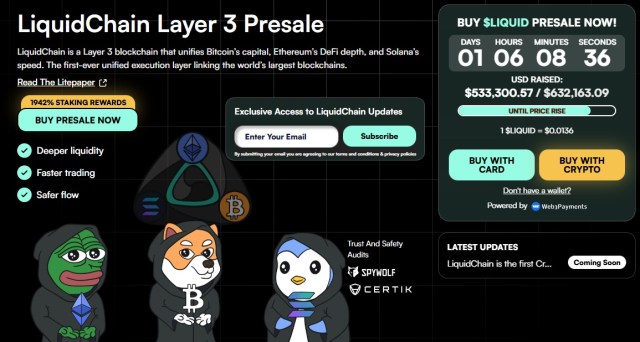
The capital inflow suggests investors are looking beyond commoditized Layer 2 scaling solutions toward Layer 3 protocols with specific interoperability use cases.

The utility of the $LIQUID token extends beyond simple governance. It functions as the transaction fuel for this cross-chain environment and facilitates liquidity staking. In a market where yield is often chased at the expense of safety, LiquidChain’s model offers a compelling alternative: rewards derived from the friction of unifying the world’s disparate blockchains.

With the presale gaining momentum, the window for early entry at these valuations is narrowing as the project approaches mainnet deployment.

Buy $LIQUID here.

Disclaimer: The content provided in this article is for informational purposes only and does not constitute financial advice. Cryptocurrency investments carry inherent risks, including high volatility and potential loss of principal. Always conduct your own research.

Editorial Process for bitcoinist is centered on delivering thoroughly researched, accurate, and unbiased content. We uphold strict sourcing standards, and each page undergoes diligent review by our team of top technology experts and seasoned editors. This process ensures the integrity, relevance, and value of our content for our readers.

patrubogdan

Follow

Full Profile

Related Posts

Crypto Exchange Backpack Targets Token Launch Soon, as BMIC Fires Up Quantum Defense

Vitalik Buterin Outlines Ethereum’s AI Future, While SUBBD Token Targets the Creator Economy

Binance Dominates Trump’s USD1 Supply as Bitcoin Hyper Breaks Records

Cathie Wood’s Ark Invest Buys More Bullish Assets Just Days After Last Purchase, While LiquidChain Turns Heads

Polymarket Sues Massachusetts Over Prediction Market Regulation – SUBBD Token Takes Advantage

Bitcoin Hyper Could Conquer 2026 if Bitcoin Regains Lost Ground

Trend Kriptolar

İlgili Sorular

QWhat is the SEAL initiative and why is the Ethereum Foundation backing it?

AThe SEAL (Security Alliance) initiative is a coalition of white-hat hackers and researchers that serves as the industry's emergency response team against crypto drainers. The Ethereum Foundation is backing it to strengthen the coordinated defense against exploits, providing both financial support and institutional validation for centralized threat intelligence to create a 'herd immunity' effect.

QHow does LiquidChain's L3 protocol address security concerns in DeFi?

ALiquidChain's Layer 3 protocol unifies liquidity from Bitcoin, Ethereum, and Solana into a single execution layer, eliminating the need for risky cross-chain bridges. It reduces complexity by allowing 'single-step execution' and abstracting away interoperability friction, thereby removing common attack vectors used by drainers.

QWhat is the current presale status and token price of LiquidChain ($LIQUID)?

ALiquidChain's presale has raised over $533,000 to date, with the $LIQUID token currently priced at $0.0136.

QHow does SEAL's 'SEAL 911' initiative work?

ASEAL's 'SEAL 911' initiative allows victims and protocols to report active exploits in real-time, enabling white-hat hackers to intercept funds before they reach mixers or are laundered.

QWhat is the core investment thesis behind capital flowing into L3 infrastructure like LiquidChain?

AThe investment thesis centers on the 'abstraction narrative' - that next-generation users won't care about underlying blockchain complexity. Investors are betting on infrastructure that streamlines user experience by unifying liquidity across chains and eliminating bridging risks, treating security as a fundamental architectural feature rather than an add-on.

İlgili Okumalar

STRC Major De-pegging's First Financial Report, How Will Strategy Repair Its Capital Flywheel?

Bitcoin treasury company Strategy released its Q2 2026 earnings report on July 31. Despite a 6.9% year-over-year revenue increase to $122 million, the company recorded a net loss of $8.22 billion, largely due to $8.32 billion in unrealized losses from Bitcoin price fluctuations. As of quarter-end, Strategy holds 843,775 BTC with an average cost of $75,000 per coin, and Bitcoin per share increased. The report highlights a critical shift in Strategy's capital model following the de-pegging of its key financing tool, STRC (Strategic Coin), which fell below its $100 target. Management's top priority is restoring STRC to its target value, aiming for a recovery by September 8. They rule out discounted STRC issuances and plan to maintain its dividend yield at 12%, instead focusing on bolstering its $3.75 billion cash reserve. Strategy has moved from a one-way "buy-and-hold" Bitcoin strategy to active capital management. This new approach, part of its "Digital Credit Capital Framework," involves flexibly managing its balance sheet across four elements: BTC, USD cash, common stock (MSTR), and digital credit securities like STRC. This allows for BTC monetization (having sold $218.4 million in BTC so far), strategic repurchases of discounted securities, and debt optimization, as seen with a $1.5 billion convertible bond buyback. The company's future hinges on two key tests: successfully re-pegging STRC to restore market confidence in its digital credit system, and a long-term recovery in Bitcoin's price to ultimately support its growth thesis.

marsbit44 dk önce

STRC Major De-pegging's First Financial Report, How Will Strategy Repair Its Capital Flywheel?

marsbit44 dk önce

STRC's First Financial Report Post-Depegging, How is Strategy Restoring the Capital Flywheel?

On July 31, 2026, Bitcoin treasury company Strategy released its Q2 financial report. Despite a 6.9% year-over-year increase in revenue to $122 million, the company recorded a substantial net loss of $8.22 billion, primarily due to $8.32 billion in unrealized losses from Bitcoin holdings. While Strategy's core Bitcoin strategy remains intact—its holdings grew 11% to 843,775 BTC—the company is undergoing a fundamental shift in its capital model. Following the de-pegging of its key financing tool, the STRCoin (STRC), from its $100 target in May, Strategy has pivoted from a one-directional "raise funds, buy Bitcoin" cycle to a more dynamic, multi-asset capital management approach. A key part of this new framework is the "Monetization Program," through which Strategy has sold approximately $218.4 million worth of BTC to bolster liquidity. The company's top priority is repairing STRC's peg, committing not to issue discounted shares until it returns to its target range. It has initiated a $1 billion buyback program for discounted digital credit securities, having repurchased $28.9 million face value of STRC so far. Management aims to restore the peg around September 8, 2026. Strategy now actively manages a matrix of assets: Bitcoin (for accumulation or strategic sales), USD cash reserves (now at $3.75 billion), common stock (MSTR), and digital credit securities like STRC. This allows for tactical moves like repurchasing discounted debt or equity to capture value. The future success of Strategy's "capital flywheel" hinges on two factors: the short-term ability to successfully re-peg STRC to restore market confidence in its digital credit system, and the long-term price trajectory of Bitcoin, upon which its entire investment thesis ultimately depends.

Odaily星球日报49 dk önce

STRC's First Financial Report Post-Depegging, How is Strategy Restoring the Capital Flywheel?

Odaily星球日报49 dk önce

With Two Consecutive Quarters of Losses, Coinbase Must Rely on Paths Beyond Trading

Coinbase posted its second consecutive quarterly net loss of $359 million on $1.22 billion in revenue for Q2, highlighting its vulnerability to crypto market cycles where weaker prices and lower volatility reduce user trading. However, the report also reveals a strategic shift in its business model. Despite a 25% quarter-over-quarter decline in global spot trading volume, Coinbase increased its market share to a company-record 10.3%. This suggests its position as a compliant U.S. on-ramp is strengthening even in a cooler market. A key development is the diversification of revenue streams. Transaction revenue fell to $599 million, nearly equaling subscription and services revenue of $555 million. Stablecoin services, generating $292 million, are becoming a crucial revenue "floor." This income, derived from interest on the $20 billion average USDC balance held on its platform, is less tied to daily trading activity. Furthermore, while spot trading volume dropped significantly, derivatives volume held steady at $1.03 trillion. Coinbase is pushing to integrate spot, stablecoin, and derivatives liquidity to create a more interconnected and sticky ecosystem for users. The GAAP net loss includes non-cash expenses like stock-based compensation and crypto asset valuation changes. Its adjusted EBITDA remained positive at $208 million for the 14th straight quarter, indicating core operations can cover ongoing costs. The company is also reducing expenses to manage the downturn. The central question moving forward is whether Coinbase's growing market share, stablecoin revenues, and expanding product integration can sufficiently offset the inherent cyclicality of its core trading business during future market contractions.

marsbit1 saat önce

With Two Consecutive Quarters of Losses, Coinbase Must Rely on Paths Beyond Trading

marsbit1 saat önce

İşlemler

Spot

Popüler Makaleler

L3 Nasıl Satın Alınır

HTX.com’a hoş geldiniz! Layer3 (L3) satın alma işlemlerini basit ve kullanışlı bir hâle getirdik. Adım adım açıkladığımız rehberimizi takip ederek kripto yolculuğunuza başlayın. 1. Adım: HTX Hesabınızı OluşturunHTX'te ücretsiz bir hesap açmak için e-posta adresinizi veya telefon numaranızı kullanın. Sorunsuzca kaydolun ve tüm özelliklerin kilidini açın. Hesabımı Aç2. Adım: Kripto Satın Al Bölümüne Gidin ve Ödeme Yönteminizi SeçinKredi/Banka Kartı: Visa veya Mastercard'ınızı kullanarak anında Layer3 (L3) satın alın.Bakiye: Sorunsuz bir şekilde işlem yapmak için HTX hesap bakiyenizdeki fonları kullanın.Üçüncü Taraflar: Kullanımı kolaylaştırmak için Google Pay ve Apple Pay gibi popüler ödeme yöntemlerini ekledik.P2P: HTX'teki diğer kullanıcılarla doğrudan işlem yapın.Borsa Dışı (OTC): Yatırımcılar için kişiye özel hizmetler ve rekabetçi döviz kurları sunuyoruz.3. Adım: Layer3 (L3) Varlıklarınızı SaklayınLayer3 (L3) satın aldıktan sonra HTX hesabınızda saklayın. Alternatif olarak, blok zinciri transferi yoluyla başka bir yere gönderebilir veya diğer kripto para birimlerini takas etmek için kullanabilirsiniz.4. Adım: Layer3 (L3) Varlıklarınızla İşlem YapınHTX'in spot piyasasında Layer3 (L3) ile kolayca işlemler yapın.Hesabınıza erişin, işlem çiftinizi seçin, işlemlerinizi gerçekleştirin ve gerçek zamanlı olarak izleyin. Hem yeni başlayanlar hem de deneyimli yatırımcılar için kullanıcı dostu bir deneyim sunuyoruz.

277 Toplam GörüntülenmeYayınlanma 2024.12.06Güncellenme 2026.06.02

L3 Nasıl Satın Alınır

Tartışmalar

HTX Topluluğuna hoş geldiniz. Burada, en son platform gelişmeleri hakkında bilgi sahibi olabilir ve profesyonel piyasa görüşlerine erişebilirsiniz. Kullanıcıların L3 (L3) fiyatı hakkındaki görüşleri aşağıda sunulmaktadır.

活动图片