Ethereum could get faster in January with gas limit rise to 80M

cointelegraph2025-12-18 tarihinde yayınlandı2025-12-18 tarihinde güncellendi

Özet

Ethereum's transaction throughput is set to increase in early January with a planned gas limit rise from 60 million to 80 million. This will be enabled by the second blob parameter-only (BPO) hard fork, scheduled for January 7, following a similar upgrade in December that also increased blob capacity by 66%. Blobs store data off-chain, reducing gas costs and improving scalability without overloading the network. While this upgrade won't match the speed of chains like Solana, it enhances Ethereum's efficiency as a secure settlement layer. Developers will confirm the final plans on January 5. Increasing the gas limit has been a key focus in 2025, with previous raises in February, July, and November. The long-term goal is to reach a gas limit of 180 million by the end of 2026.

Transaction throughput on the Ethereum network is set to be boosted again in early January with the second blob parameter-only (BPO) hard fork expected to enable the Ethereum gas limit to rise from 60 million to 80 million.

Christine Kim, vice president of the research team at Galaxy Digital, shared the news in a post Tuesday, noting the confidence Nethermind developers Ben Adams and Kamil Chodala expressed in Monday’s Ethereum All Core Developers call that all testing should be complete before the next BPO hard fork — scheduled Jan. 7 — which is expected to increase blob capacity on the Ethereum mainnet by 66%.

It would follow the first BPO hard fork on Dec. 9, which increased blob capacity by 66%.

Ethereum Foundation developer operations engineer Barnabas Busa, however, noted that two client-level optimizations are needed before another increase in the block gas limit — namely, partial blob responses on the execution layer and the max blobs flag on the consensus layer.
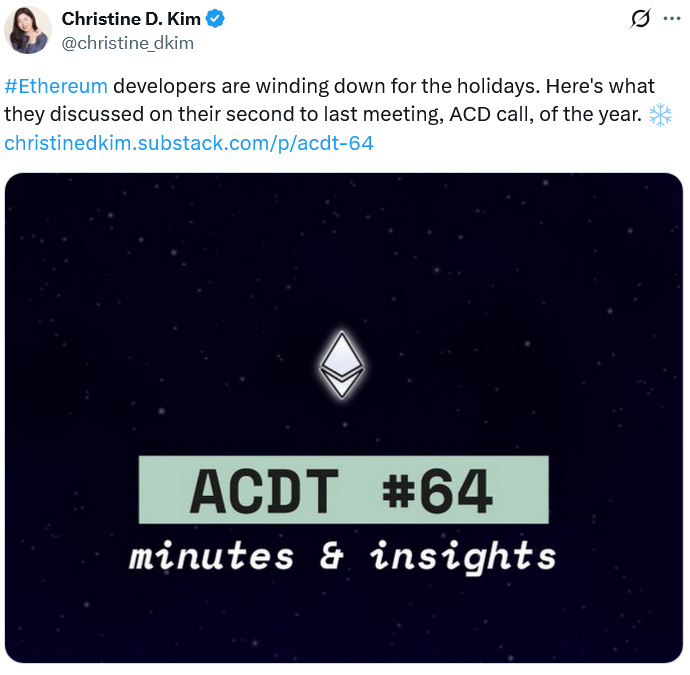
Source: Christine Kim

Blobs on Ethereum are large data chunks that store transaction and rollup data off-chain, lowering gas costs and increasing scalability without bloating the network.

Optimizing blob capacity to raise the gas limit directly increases the number of transactions and smart contract operations that can fit in each Ethereum block, boosting overall throughput while potentially lowering fees.

While raising Ethereum’s gas limit to 80 million won’t match the speed or low costs of layer 1s like Solana or Sui, it strengthens Ethereum’s appeal as a secure settlement and execution layer without significantly compromising decentralization — arguably its greatest advantage over competitors.

Ethereum devs will confirm plans early in the new year

Participants in the weekly Ethereum All Core Developers meetup will reconvene on Jan. 5 to confirm when to raise the gas limit following the second BPO hard fork.

Increasing Ethereum’s gas limit has been a priority this year

Increasing Ethereum’s gas limit to expand the network’s execution capacity has been a major focus for developers and researchers this year, with three increases.

Related: Securitize announces ‘real’ tokenized stocks, touts DeFi integration

The first occurred in early February, raising it from 30 million to 35 million, the second in July to 45 million, and the third in late November to 60 million.
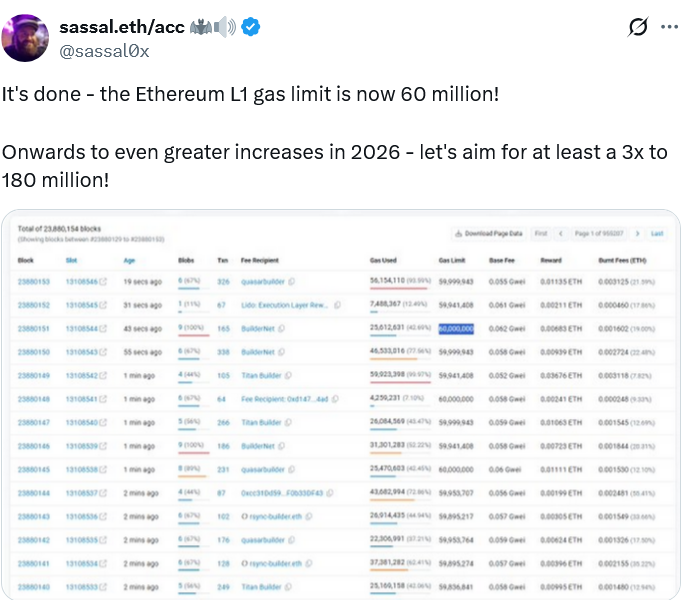
Source: Anthony Sassano

Members of the Ethereum developer and research community have expressed a common goal to raise the network’s gas limit to 180 million by the end of 2026.

Magazine: Meet the onchain crypto detectives fighting crime better than the cops

Trend Kriptolar

İlgili Okumalar

Annual Salary of Millions Competing for Electricians, Meta Rushes to Open Its Own Technical School

The AI boom is facing an unexpected bottleneck: a severe shortage of skilled construction workers and electricians. As tech giants like Meta, OpenAI, and Alphabet race to build massive data centers—such as OpenAI's $16 billion "Stargate" project—they are hitting a critical labor wall. The U.S. needs an estimated 130,000 more electricians, 240,000 construction workers, and 150,000 supervisors by 2030 for AI infrastructure alone, but tens of thousands of electrician jobs go unfilled each year. While AI companies offer high premiums, with electricians earning up to $280,000 annually, worker scarcity still causes massive losses—delays on a single project can cost $14.2 million per month. The complexity of building AI data centers, which require immense power (equivalent to powering hundreds of thousands of homes), sophisticated electrical systems, and advanced liquid cooling solutions, demands highly skilled technicians who are in short supply. To combat this, companies are investing heavily in training. Meta has committed $115 million to a free training school offering tuition, housing, and stipends, targeting 5,000 new workers. OpenAI is partnering with unions to secure skilled labor. These efforts are paying off, with a significant rise in Gen Z interest in trade schools over college. However, the power demands are staggering. AI data centers are driving a rapid surge in electricity consumption, projected to account for up to 12% of U.S. power use by 2028 and raising costs for consumers. Furthermore, the construction boom is project-based, leading to a potential future glut of trained workers once building peaks, which could depress wages industry-wide. The race for AI supremacy now depends as much on skilled hands as on advanced chips.

marsbit57 dk önce

Annual Salary of Millions Competing for Electricians, Meta Rushes to Open Its Own Technical School

marsbit57 dk önce

OpenAI No Longer Sells Its Most Expensive Model for Profit

OpenAI is shifting its business strategy away from promoting its most expensive, flagship models for every task. Recent price cuts—80% for GPT-5.6 Luna and 20% for Terra—signal a deeper change: the company now actively advises users that many tasks don't require the most powerful model. Instead, OpenAI recommends a tiered approach: use the high-end GPT-5.6 Sol for complex planning and analysis, then delegate execution to cheaper models like Luna. This mirrors moves by Anthropic, which recently launched Claude Opus 5 at half the price of its top model, Fable 5. Both companies are de-emphasizing flagship models as primary revenue drivers, using them instead for brand prestige and technological showcases. The industry is entering a "mass-market" phase, similar to automotive, where high-volume, cost-effective models handle daily operations and drive scale. OpenAI's price reductions are partly enabled by AI models themselves optimizing underlying code and infrastructure, creating a self-reinforcing cycle of efficiency gains and cost reduction. Competition is shifting from "who is smartest" to "who offers the best value." The goal is no longer selling individual models but fostering widespread API adoption and ecosystem lock-in. By making AI calls cheap and ubiquitous, companies like OpenAI aim to become the indispensable, utility-like infrastructure powering automated workflows—the "water and electricity" of software, quietly embedded everywhere.

marsbit57 dk önce

OpenAI No Longer Sells Its Most Expensive Model for Profit

marsbit57 dk önce

Will the Fed Definitely Raise Interest Rates in September? How Will Crypto and U.S. Stocks Withstand the Pressure?

The market's expectation for a September Fed rate hike surged dramatically in early August, jumping from under 50% to over 80% within a week. This shift followed a contentious July FOMC meeting, where a 9-3 vote to hold rates revealed growing dissent from hawkish members advocating for an immediate hike to combat persistent inflation. The primary catalyst for this repricing is rising oil prices, driven by renewed geopolitical tensions around the Strait of Hormuz, which threaten global supply. Energy costs directly influence inflation metrics, making the upcoming July CPI report (due August 12th) a critical data point. If it shows inflation reaccelerating, the probability of a September hike will solidify. For Bitcoin and crypto assets, this is typically bearish news. Bitcoin continues to behave as a high-beta, liquidity-sensitive risk asset. A rate hike raises the opportunity cost of holding non-yielding assets and could drive capital toward money markets, pressuring crypto prices in the short term. However, historical patterns suggest that if a hike is perceived as the end of a tightening cycle rather than the start, any negative price impact may be brief. U.S. stocks, particularly crypto-linked equities like Coinbase and growth-oriented tech stocks, are also vulnerable. Higher rates increase discount rates in valuation models, putting pressure on high-multiple companies. This coincides with a pivotal tech earnings season where investor focus has shifted from massive AI capital expenditure to tangible revenue and cash flow generation. Companies with negative cash flow and weak growth narratives could face heightened volatility if borrowing costs rise in September. In summary, a September Fed hike has evolved into a mainstream market scenario. Key factors to watch are oil prices, the July CPI report, and Fed communications, which will determine the final decision and its impact on volatile crypto and equity markets.

marsbit1 saat önce

Will the Fed Definitely Raise Interest Rates in September? How Will Crypto and U.S. Stocks Withstand the Pressure?

marsbit1 saat önce

İşlemler

Spot

Popüler Makaleler

GAS Nasıl Satın Alınır

HTX.com’a hoş geldiniz! GAS (GAS) satın alma işlemlerini basit ve kullanışlı bir hâle getirdik. Adım adım açıkladığımız rehberimizi takip ederek kripto yolculuğunuza başlayın. 1. Adım: HTX Hesabınızı OluşturunHTX'te ücretsiz bir hesap açmak için e-posta adresinizi veya telefon numaranızı kullanın. Sorunsuzca kaydolun ve tüm özelliklerin kilidini açın. Hesabımı Aç2. Adım: Kripto Satın Al Bölümüne Gidin ve Ödeme Yönteminizi SeçinKredi/Banka Kartı: Visa veya Mastercard'ınızı kullanarak anında GAS (GAS) satın alın.Bakiye: Sorunsuz bir şekilde işlem yapmak için HTX hesap bakiyenizdeki fonları kullanın.Üçüncü Taraflar: Kullanımı kolaylaştırmak için Google Pay ve Apple Pay gibi popüler ödeme yöntemlerini ekledik.P2P: HTX'teki diğer kullanıcılarla doğrudan işlem yapın.Borsa Dışı (OTC): Yatırımcılar için kişiye özel hizmetler ve rekabetçi döviz kurları sunuyoruz.3. Adım: GAS (GAS) Varlıklarınızı SaklayınGAS (GAS) satın aldıktan sonra HTX hesabınızda saklayın. Alternatif olarak, blok zinciri transferi yoluyla başka bir yere gönderebilir veya diğer kripto para birimlerini takas etmek için kullanabilirsiniz.4. Adım: GAS (GAS) Varlıklarınızla İşlem YapınHTX'in spot piyasasında GAS (GAS) ile kolayca işlemler yapın.Hesabınıza erişin, işlem çiftinizi seçin, işlemlerinizi gerçekleştirin ve gerçek zamanlı olarak izleyin. Hem yeni başlayanlar hem de deneyimli yatırımcılar için kullanıcı dostu bir deneyim sunuyoruz.

225 Toplam GörüntülenmeYayınlanma 2024.12.12Güncellenme 2026.06.02

GAS Nasıl Satın Alınır

Tartışmalar

HTX Topluluğuna hoş geldiniz. Burada, en son platform gelişmeleri hakkında bilgi sahibi olabilir ve profesyonel piyasa görüşlerine erişebilirsiniz. Kullanıcıların GAS (GAS) fiyatı hakkındaki görüşleri aşağıda sunulmaktadır.

活动图片













