Ethereum Block Space Futures Market ETHGas Aims to Become a Real-Time Execution Layer?

marsbit2026-01-03 tarihinde yayınlandı2026-01-03 tarihinde güncellendi

Özet

Ethereum block space futures market ETHGas has raised $12 million in a funding round led by Polychain Capital, with participation from several other investors. The platform aims to address Ethereum's gas fee volatility by allowing users to lock in future gas costs through futures contracts, making expenses predictable for DApps and L2 solutions. A key feature is its Blockspace auction market, where validators and block builders can auction space in upcoming blocks, ensuring transaction inclusion and execution efficiency. ETHGas ultimately envisions a "Real-Time Ethereum" by guaranteeing transaction execution in subsequent blocks. However, challenges include potential increased costs for retail users due to institutional dominance in auctions, and risks of market manipulation through futures trading. The platform plans to mitigate these issues to avoid undermining its core goals.

Author: Eric, Foresight News

On December 17, the block space futures market ETHGas announced the completion of a $12 million funding round, led by Polychain Capital, with participation from Stake Capital, BlueYard Capital, Lafayette Macro Advisors, SIG DT, and Amber Group. Founder Kevin Lepsoe revealed that ETHGas had completed an undisclosed Pre-Seed funding round of approximately $5 million in mid-2024.

Lepsoe also stated that Ethereum validators, block builders, and relay nodes have committed around $800 million to support market and product development, not in cash investments but by providing liquidity to the ETHGas market in the form of Ethereum block space.

Although the project is defined as a block space futures market, its true vision is to achieve "Real-Time Ethereum."

The Order of Blocks

Ethereum co-founder Vitalik Buterin proposed the concept of a Gas futures market earlier this month, aiming to address the issue of Ethereum Gas volatility. Similar to the logic of commodity futures in traditional markets, locking in future Gas costs through futures would make Gas expenses predictable and controllable.

This would allow DApps to lock in Gas costs before events such as users claiming token airdrops and design activities to subsidize users. L2s could also purchase futures when Gas fees are lower to stabilize the cost of bundling and submitting data to L1, making transaction costs on L2s stable and predictable. This would serve businesses that require pre-calculated costs, such as tokenized U.S. stocks.

According to the documentation, ETHGas will also launch a no-code tool called Open Gas specifically for DApps to help them provide Gas subsidy programs. This tool will allow users to claim the Gas fees they consumed on the ETHGas platform after using a DApp.

Developing a Gas futures market is not particularly challenging, as it essentially requires building a sufficiently liquid on-chain futures trading market. ETHGas's "killer feature" is its block space auction market.
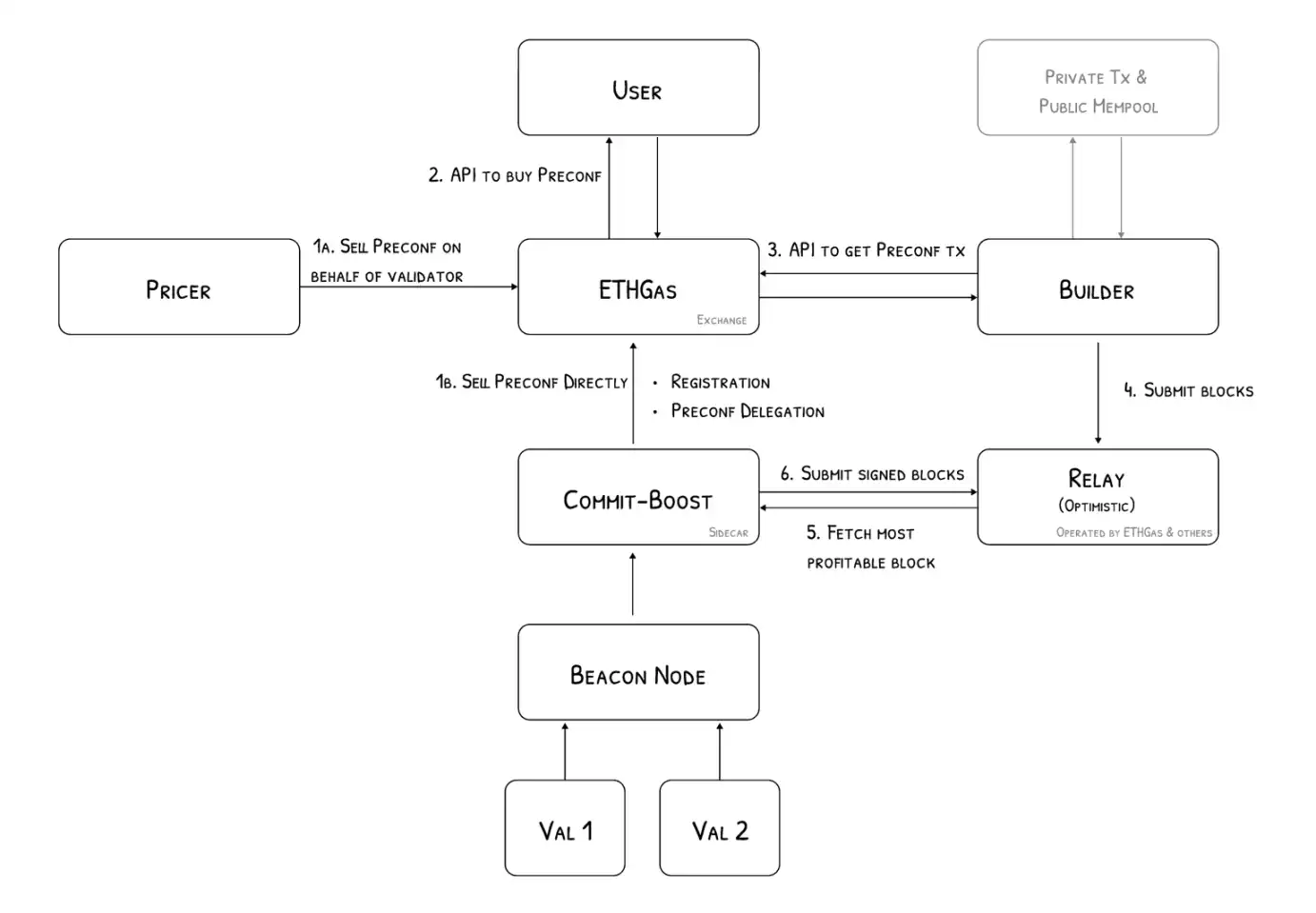
This auction market, named Blockspace, allows Ethereum validators, block builders, and relay nodes to auction space in subsequent blocks, ensuring that bidders' transactions are included in the next block and guaranteeing the execution efficiency of those transactions. Additionally, bidders can even purchase an entire block to include only their own transactions or transactions they provide for others.

Comparing transactions to packages, guaranteeing block inclusion is like ensuring a package is loaded onto a transport plane, while guaranteeing transaction execution is like ensuring the package is delivered to the intended recipient on time. Purchasing an entire block is akin to chartering an entire plane to transport one's packages, but with the option to sublet the extra space to other packages.

ETHGas's ultimate goal is to achieve "real-time transactions" on Ethereum through Blockspace. This "real-time transaction" can only be in quotes because the completion of transactions on the Ethereum mainnet must wait for the block to be finalized. However, if a transaction can be guaranteed to be included in the next block, it can, in a way, be considered "already completed." ETHGas can be understood as an execution layer on top of Ethereum, but how real-time transactions will be reflected on the front end remains to be seen as ETHGas provides answers.

ETHGas aims to create an orderly block space, as opposed to the current system of chaotic bidding for block space with numerous uncontrollable MEV transactions. By offering predictable returns to attract infrastructure operators to join Blockspace and create sufficient liquidity for real-time transactions, the resulting efficiency improvements will attract various DApps. DApps, in turn, will attract users through Open Gas, and users will bring more transaction volume into the ETHGas network, thereby increasing the returns for infrastructure operators and forming a positive cycle.

Challenges Beneath the Ideal Vision

For a DApp about to conduct a token airdrop, it could estimate the number of transactions for claiming the airdrop, pre-book n blocks after a specific time, and provide a Gas subsidy program, thereby achieving a budget-controlled and network-congestion-free token claim event.

Although such visions are ideal, allowing block space to be auctioned may lead to many foreseeable issues.

First, if institutional users can auction block space without restrictions, they might purchase entire blocks in large quantities and resell them to retail users. While this would ensure stable and predictable returns for validators, it could increase transaction costs for retail users. In this scenario, retail users lack the technical capability to compete with institutional users, and even if they could participate in auctions or use futures markets to hedge against rising Gas fees, it would essentially raise their transaction costs.

Additionally, the futures market could become a tool for market manipulation. For example, large players could deliberately create a high volume of on-chain transactions to drive up Gas fees and profit from the futures market, but this could increase transaction costs for other users on the Ethereum mainnet. Moreover, as DApp operators are aware of the specific timing of events that could cause a surge in transactions, they could profit from operations in the futures market in advance, turning the futures market into an arbitrage playground for those with informational advantages and causing unpredictable losses for ordinary users who simply use the market for hedging.

The birth of a new trading market inevitably creates arbitrage opportunities due to information asymmetry, potentially undermining the very problems the market aims to solve. For ETHGas, balancing this issue and preventing a "positive cycle" from turning into a "death spiral" may require some necessary restrictions.


Trend Kriptolar

İlgili Sorular

QWhat is the main vision of ETHGas, despite being defined as a block space futures market?

AThe main vision of ETHGas is to achieve 'Real-Time Ethereum' by creating an orderly block space and acting as an execution layer on top of Ethereum.

QWho led the $12 million funding round for ETHGas announced on December 17th?

AThe $12 million funding round was led by Polychain Capital.

QWhat is the purpose of the Blockspace auction market introduced by ETHGas?

AThe Blockspace auction market allows validators, block builders, and relay nodes to auction space in future blocks, guaranteeing that a bidder's transaction will be included in the next block and ensuring its efficiency. It can also be used to auction an entire block.

QWhat potential problem does the article identify with allowing unlimited block space auctions?

AUnlimited auctions could allow institutional users to outbid散户 (retail users) and potentially resell block space to them, ultimately increasing transaction costs for ordinary users and creating an unlevel playing field.

QWhat tool is ETHGas developing specifically for DApps, and what is its function?

AETHGas is developing a zero-code tool called Open Gas, which is designed to help DApps provide gas subsidy programs, allowing users to claim the gas fees they spent after using the DApp on the ETHGas platform.

İlgili Okumalar

Misjudged A-Shares: Resilience, Expectations, and Confidence

China's A-share market recently faced selling pressure, especially in tech sectors, initially triggered by a global tech sell-off that began in South Korea. However, the article argues this is a case of "mistaken injury" and highlights the market's underlying resilience. This resilience stems from three main pillars: **1) Tech Sector Fundamentals:** Unlike Korea's market dominated by a few memory chip stocks, China's tech sector is diversified across computing, communications, electronics, and semiconductors, supported by dual narratives of global AI supply chains and domestic substitution. Core areas like optical modules and fiber optics continue to show strong earnings growth. **2) "National Team" Support:** State-backed institutions and large corporations have made significant market purchases and announced buybacks, providing liquidity and signaling confidence. This is seen as a stabilizing policy signal, often associated with market bottoms. **3) Broader Market Pillars:** Other major sectors are showing endogenous recovery momentum. Consumer stocks benefit from stabilizing CPI and signs of sector recovery (e.g., liquor price hikes). Cyclical sectors like aluminum have high earnings, potential price increases due to tight supply, and low valuations. The financial sector offers stable dividends and low valuations. The conclusion is that the sell-off was driven by external contagion, not a collapse in fundamentals. With strong policy support and recovering momentum across key sectors, the A-share market possesses the toughness to regain stability.

marsbit27 dk önce

Misjudged A-Shares: Resilience, Expectations, and Confidence

marsbit27 dk önce

The Clarity Act's Journey Through Congress: The Thorny Path of Bipartisan Compromise in the U.S.

The U.S. Congress is struggling to advance the crypto market structure bill known as the Clarity Act, with bipartisan compromise proving difficult. Key hurdles include unresolved disputes over "yield" products and, more critically, the inclusion of strong ethics provisions for elected officials—a non-negotiable demand for many Democrats. While a compromise on yield was reached in May, securing only limited Democratic support in committee, the separate Senate Agriculture Committee version later passed with no Democratic votes due to the ethics impasse. As Republicans push for a full Senate vote in July, demands for ethics rules have expanded, and other contentious issues like developer protections and concerns from law enforcement and large banks further complicate negotiations. Despite consensus on the need for legislation, the path forward is unclear. Recent discussions between senators and White House officials aim to find acceptable ethics language. Some lawmakers question whether a compromise text can garner enough bipartisan support, with one Democrat stating the current proposal lacks the strong ethics provisions required for their vote. Potential short-term goals for the crypto community include symbolic Senate action before the August recess, a longer-term aim for passage by 2026, or establishing a detailed framework that addresses ethics and other compromises. The process remains arduous, relying on the traditional, vote-by-vote effort to build bipartisan support.

marsbit46 dk önce

The Clarity Act's Journey Through Congress: The Thorny Path of Bipartisan Compromise in the U.S.

marsbit46 dk önce

Are Kalshi and Polymarket Founders at Odds? This Business Rivalry Is More Brutal Than You Think

"The Rivalry Between Kalshi and Polymarket Founders Turns Bitter and Litigious" The intense feud between Tarek Mansour, CEO of Kalshi, and Shayne Coplan, founder of Polymarket, has escalated far beyond typical business competition into personal animosity and regulatory battles. Both lead billion-dollar prediction market platforms, but their approaches differ sharply. Kalshi positions itself as the compliant operator, securing U.S. regulatory approval before launching. In contrast, Polymarket initially operated offshore, allowing U.S. users to access its platform via VPN, which drew regulatory scrutiny. The conflict reached a peak in November 2024 when FBI agents raided Coplan's New York apartment. While Coplan publicly blamed political motives, his team privately suspected Kalshi was involved. According to sources, Kalshi's lawyers had previously reported Polymarket's operations to federal prosecutors, highlighting its accessibility to U.S. users despite a ban. This incident fueled mutual accusations and underhanded tactics, including social media smear campaigns and attempts to sabotage each other's major business deals. Their rivalry also played out in Washington, influencing regulatory debates. Kalshi actively lobbied against Polymarket's practices, framing them as illegal and unethical. Polymarket, after facing a CFTC fine and investigation, later acquired a licensed U.S. firm to launch a domestic app, regaining a foothold. Despite the hostility, both companies have seen massive growth, with combined trading volumes soaring. However, increased regulatory scrutiny, particularly around insider trading on Polymarket's platform, continues to pose challenges. The founders' deep-seated mutual disdain ensures their battle for market dominance remains as much a personal vendetta as a commercial one.

marsbit55 dk önce

Are Kalshi and Polymarket Founders at Odds? This Business Rivalry Is More Brutal Than You Think

marsbit55 dk önce

İşlemler

Spot

Popüler Makaleler

O Nasıl Satın Alınır

HTX.com’a hoş geldiniz! O1 exchange (O) satın alma işlemlerini basit ve kullanışlı bir hâle getirdik. Adım adım açıkladığımız rehberimizi takip ederek kripto yolculuğunuza başlayın. 1. Adım: HTX Hesabınızı OluşturunHTX'te ücretsiz bir hesap açmak için e-posta adresinizi veya telefon numaranızı kullanın. Sorunsuzca kaydolun ve tüm özelliklerin kilidini açın. Hesabımı Aç2. Adım: Kripto Satın Al Bölümüne Gidin ve Ödeme Yönteminizi SeçinKredi/Banka Kartı: Visa veya Mastercard'ınızı kullanarak anında O1 exchange (O) satın alın.Bakiye: Sorunsuz bir şekilde işlem yapmak için HTX hesap bakiyenizdeki fonları kullanın.Üçüncü Taraflar: Kullanımı kolaylaştırmak için Google Pay ve Apple Pay gibi popüler ödeme yöntemlerini ekledik.P2P: HTX'teki diğer kullanıcılarla doğrudan işlem yapın.Borsa Dışı (OTC): Yatırımcılar için kişiye özel hizmetler ve rekabetçi döviz kurları sunuyoruz.3. Adım: O1 exchange (O) Varlıklarınızı SaklayınO1 exchange (O) satın aldıktan sonra HTX hesabınızda saklayın. Alternatif olarak, blok zinciri transferi yoluyla başka bir yere gönderebilir veya diğer kripto para birimlerini takas etmek için kullanabilirsiniz.4. Adım: O1 exchange (O) Varlıklarınızla İşlem YapınHTX'in spot piyasasında O1 exchange (O) ile kolayca işlemler yapın.Hesabınıza erişin, işlem çiftinizi seçin, işlemlerinizi gerçekleştirin ve gerçek zamanlı olarak izleyin. Hem yeni başlayanlar hem de deneyimli yatırımcılar için kullanıcı dostu bir deneyim sunuyoruz.

177 Toplam GörüntülenmeYayınlanma 2026.06.19Güncellenme 2026.06.29

O Nasıl Satın Alınır

PROS Nasıl Satın Alınır

HTX.com’a hoş geldiniz! Pharos (PROS) satın alma işlemlerini basit ve kullanışlı bir hâle getirdik. Adım adım açıkladığımız rehberimizi takip ederek kripto yolculuğunuza başlayın. 1. Adım: HTX Hesabınızı OluşturunHTX'te ücretsiz bir hesap açmak için e-posta adresinizi veya telefon numaranızı kullanın. Sorunsuzca kaydolun ve tüm özelliklerin kilidini açın. Hesabımı Aç2. Adım: Kripto Satın Al Bölümüne Gidin ve Ödeme Yönteminizi SeçinKredi/Banka Kartı: Visa veya Mastercard'ınızı kullanarak anında Pharos (PROS) satın alın.Bakiye: Sorunsuz bir şekilde işlem yapmak için HTX hesap bakiyenizdeki fonları kullanın.Üçüncü Taraflar: Kullanımı kolaylaştırmak için Google Pay ve Apple Pay gibi popüler ödeme yöntemlerini ekledik.P2P: HTX'teki diğer kullanıcılarla doğrudan işlem yapın.Borsa Dışı (OTC): Yatırımcılar için kişiye özel hizmetler ve rekabetçi döviz kurları sunuyoruz.3. Adım: Pharos (PROS) Varlıklarınızı SaklayınPharos (PROS) satın aldıktan sonra HTX hesabınızda saklayın. Alternatif olarak, blok zinciri transferi yoluyla başka bir yere gönderebilir veya diğer kripto para birimlerini takas etmek için kullanabilirsiniz.4. Adım: Pharos (PROS) Varlıklarınızla İşlem YapınHTX'in spot piyasasında Pharos (PROS) ile kolayca işlemler yapın.Hesabınıza erişin, işlem çiftinizi seçin, işlemlerinizi gerçekleştirin ve gerçek zamanlı olarak izleyin. Hem yeni başlayanlar hem de deneyimli yatırımcılar için kullanıcı dostu bir deneyim sunuyoruz.

182 Toplam GörüntülenmeYayınlanma 2026.06.22Güncellenme 2026.06.29

PROS Nasıl Satın Alınır

VERONA Nedir

I. Proje Tanıtımı VERONA, zincir soyutlaması aracılığıyla herkes için, her yerde inşa edilmiş bir blok zinciridir. Genel Soyutlama katmanını kullanarak, VERONA, hesaplar, imzalar ve birlikte çalışabilirlik gibi karmaşık blok zinciri işlevlerini doğrudan protokol seviyesinde entegre ederek kendini ayırt eder. Bu yaklaşım, temel teknolojileri anlamaya gerek kalmadan blok zinciri uygulamalarıyla etkileşimde bulunmayı sağlar.1) Temel Bilgiler İsim: VERONA (VERONA)III. İlgili Bağlantılar Resmi web sitesi bağlantısı: https://xion.burnt.com/ Whitepaper: https://xion.burnt.com/whitepaper.pdf Keşif Araçları: https://explorer.burnt.com/ Sosyal Medya: https://x.com/burnt_xion Not: Proje tanıtımı, resmi proje ekibi tarafından yayımlanan veya sağlanan materyallerden alınmıştır, yalnızca referans içindir ve yatırım tavsiyesi teşkil etmez. HTX, ortaya çıkan doğrudan veya dolaylı kayıplardan sorumluluk kabul etmez.

174 Toplam GörüntülenmeYayınlanma 2026.06.22Güncellenme 2026.06.22

VERONA Nedir

Tartışmalar

HTX Topluluğuna hoş geldiniz. Burada, en son platform gelişmeleri hakkında bilgi sahibi olabilir ve profesyonel piyasa görüşlerine erişebilirsiniz. Kullanıcıların A (A) fiyatı hakkındaki görüşleri aşağıda sunulmaktadır.

活动图片













