ETC Olympia Development Part 1: Implementing ECIP-1111 and ECIP-1112

金色财经2025-12-12 tarihinde yayınlandı2025-12-12 tarihinde güncellendi

Özet

ETC Olympia Development Series Part 1: Implementing ECIP-1111 and ECIP-1112 This article introduces the first part of the Ethereum Classic Olympia development series, focusing on the implementation of ECIP-1111 and ECIP-1112. These two proposals are the only components within the broader Olympia framework that modify consensus behavior. ECIP-1111 modernizes the fee market by introducing an EIP-1559-style mechanism with a base fee and optional priority tip (miner tip). A key difference from Ethereum is that the base fee is not burned but is instead redirected to a treasury address defined by ECIP-1112. It also adds support for Type-2 transactions and the BASEFEE opcode (0x48), ensuring compatibility with modern EVM tooling and wallets. Crucially, it does not change miner rewards, monetary policy, or existing transaction types. ECIP-1112 defines an immutable, deterministic treasury smart contract that will receive the redirected base fees. This vault is designed to be receive-only upon activation, meaning it can accumulate value but cannot distribute funds until a separate, subsequent governance layer (defined in other ECIPs) is deployed and activated on the contract layer. The article emphasizes the modular architecture of Olympia. While the suite includes five ECIPs (1111-1115), only these two affect consensus. This separation ensures that the core protocol remains minimal and auditable, while future governance and funding mechanisms can evolve independently at the contra...

Ethereum Classic Core Developers - Olympia Development Series (Part 1)

Implementing ECIP-1111 and ECIP-1112: Base Fee Redirection and the Immutable Treasury

1. Introduction - From Concept to Code

This section provides an overview of the overall architecture of Olympia: its purpose, development history, and how ECIPs 1111-1115 fit into the modular, multi-layer upgrade path. This article will delve into the current engineering practices for two ECIPs, which together define the consensus boundaries of Olympia:

  • ECIP-1111 — EVM and Protocol Upgrades

  • ECIP-1112 — Immutable Treasury Contract

These two proposals are the only components in Olympia that modify consensus behavior. Other parts of the framework—governance (ECIP-1113), funding proposals (ECIP-1114), and the optional smoothing mechanism (ECIP-1115)—all operate at the contract layer and do not affect block validity or fork choice. On November 11, 2025, Ethereum Classic core developers initiated the implementation phase, preparing consensus logic and reference client infrastructure for a potential Mordor testnet deployment.

This article outlines:

  • What ECIP-1111 introduces

  • How ECIP-1112 defines the treasury target address

  • How these components work together

  • What is currently being prototyped in reference client development

This article only describes design proposals and implementation work and does not indicate that they will necessarily be activated or adopted in the future through the ECIP-1000 process. Before deploying the consensus layer changes of ECIP-1111 or ECIP-1112 to Mordor or the mainnet, ETC clients must first verify their stability and compatibility under baseline conditions.

2. ECIP-1111 — Modernizing the Fee Mechanism, Minimizing Network Disruption

ECIP-1111 integrates two widely adopted EVM improvements:

  • EIP-1559-style fee mechanism (Base Fee + optional tip) This mechanism introduces:

  • A dynamically adjusting base fee (BASEFEE),

  • An optional high-priority fee (tip) still paid directly to miners

  • And a more predictable fee market for modern tools.

2. Support for Type-2 (1559-style) transactions: This functionality has become standard for most wallets and infrastructure.

3. BASEFEE opcode (0x48): This exposes the current block's BASEFEE to contract logic (gas estimators, DEX routers, toolchains, etc.).

What changes for Ethereum Classic (ETC)?

Only one behavior differs from the Ethereum mainnet:

  • Ethereum Foundation (ETH): BASEFEE is burned.

  • Ethereum Classic (ETC): BASEFEE is redirected to the treasury defined by ECIP-1112. All other EIP-1559 semantics remain unchanged.

What remains the same?

  • Miner tips remain unchanged.

  • Block rewards remain unchanged.

  • Monetary policy (ECIP-1017) remains unchanged.

  • Traditional transaction types (Type-0 and Type-1) remain fully valid.

  • Existing contracts will not break; existing applications require no modifications.

  • No additional trust assumptions or permission mechanisms are introduced.

ECIP-1111 is additive, minimal, and strictly limited to modernizing the fee mechanism and enabling the BASEFEE redirection function.

3. ECIP-1112 — The Immutable Deterministic Treasury

ECIP-1112 defines the receiving address for the redirected base fees: a minimal, immutable smart contract deployed at a deterministic address. These definitions remain theoretical until client software demonstrates consistent behavior in a multi-client environment, a milestone requiring comprehensive testing to safely assess the Olympia components.

Core Features

  • Immutability: No upgrade key, no admin, no proxy pattern.

  • Deterministic address (e.g., via CREATE2): All clients agree on the same treasury destination.

  • Receive-only upon activation: The treasury can accumulate value but cannot release funds until subsequent governance is activated.

  • No internal governance logic: Purely a custody layer, not a decision-making layer.

Upon activation (testnet or mainnet):

  • The treasury can only receive funds.

  • No withdrawal mechanism is enabled until ECIP-1113 and ECIP-1114 are deployed, audited, and intentionally activated. This separation ensures predictability for consensus upgrades and makes them independent of the implementation of any governance scheme.

4. Clear Consensus Boundaries

Although Olympia comprises five ECIP proposals, only ECIP-1111 and ECIP-1112 change consensus behavior.

Consensus Boundary Summary

  • ECIP-1111 — Protocol layer. Introduces consensus changes: new base fee mechanism, Type-2 transactions, and the BASEFEE opcode.

  • ECIP-1112 — Protocol/Contract layer. Introduces consensus changes: defines the deterministic treasury receiving address for redirected base fees.

  • ECIP-1113 — Contract/Application layer. No consensus changes.
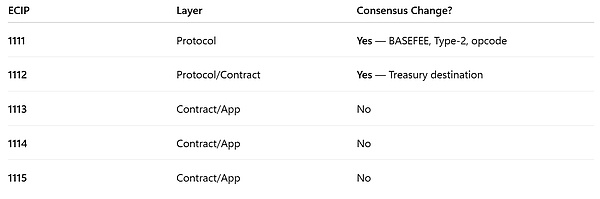
  • ECIP-1114 — Contract/Application layer. No consensus changes.

  • ECIP-1115 — Contract/Application layer. No consensus changes.

This modular structure ensures:

  • Consensus-critical logic remains lean and auditable,

  • Governance and funding mechanisms can evolve at the contract layer,

  • Improvements to ECIP-1113 to 1115 require no additional consensus changes.

If adopted, clients implementing ECIP-1111 and ECIP-1112 will maintain consensus compatibility, unaffected by subsequent governance layer deployments. Reference implementations can begin prototyping consensus logic during the draft stage, but these changes must undergo comprehensive testing (including baseline client validation such as the Gorgoroth verification described in Part II) before being merged into production clients.

5. Why Governance Activation is Delayed

If ECIP-1111 and ECIP-1112 are activated, base fees will begin flowing into the treasury—but treasury spending will remain disabled.

This phased deployment enables:

  • Independent testing of base fees

  • Comprehensive auditing of ECIP-1113 and ECIP-1114

  • Precise coordination among client implementers and infrastructure providers

  • Predictable behavior for node operators

If governance contracts are subsequently deployed and activated, the treasury will connect with authorized executors entirely at the contract layer (not the consensus layer).

6. Type-2 Transactions and Long-term EVM Interoperability

Type-2 transaction support is crucial for Ethereum Classic to maintain compatibility with:

  • Modern wallets

  • Exchanges and custody services

  • RPC infrastructure

  • Tooling frameworks (Hardhat, Foundry, etc.)

  • Block explorers

  • Cross-chain interoperability

Type-2 transactions do not alter user requirements or introduce permission mechanisms. Traditional transaction types will remain fully supported.

Type-2, as an incremental feature, ensures ETC maintains interoperability with the mainstream transaction format of the EVM ecosystem.

7. The Broader Context — Maintaining a Programmable Proof-of-Work Base Layer

Together, ECIP-1111 and ECIP-1112 constitute a foundational step for Ethereum Classic towards a sustainably funded, operational model for programmable proof-of-work—provided the community chooses to adopt these proposals.

These proposals achieve their goals without:

  • Modifying miner incentives

  • Introducing inflation

  • Changing monetary policy

  • Adding a governance layer to consensus

  • Altering Ethereum Classic's security assumptions

Their purpose is limited to:

  • Modernizing the fee market

  • Establishing a transparent protocol-level value accrual mechanism

If adopted, these changes will pave the way for the contract-layer governance and funding systems in subsequent Olympia proposals, without requiring new consensus rules.

8. Conclusion — Minimal, Secure, and Forward-Compatible

ECIP-1111 and ECIP-1112 define the consensus layer components proposed within the Olympia framework. They:

  • Add Type-2 and base fee mechanisms

  • Redirect the base fee to a deterministic treasury

  • Keep all existing user and miner behavior unchanged

  • Prepare ETC for future contract-layer components

These proposals do not introduce governance logic into the consensus mechanism, nor do they add trust assumptions on top of the existing EIP-1559/EIP-3198 semantics. Their aim is to preserve the conservatism of ETC's core protocol and EVM ecosystem compatibility, while enabling sustainable value flows at the contract layer.

9. ECIP Process Clarity

The Olympia ECIP specifications (1111–1115) are currently in the draft stage and under active discussion. Reference clients have initiated early implementation work on ECIP-1111 and ECIP-1112, which is fully consistent with the provisions of the ECIP-1000 draft stage. Reference implementations will only be considered for mainnet activation after testing on the Mordor testnet is completed. After testnet results are qualified, ECIP proposers may submit specification update proposals. Any decision to advance to "Accepted" status or schedule mainnet activation must undergo community review and the full ECIP-1000 evaluation process. This article outlines the design and implementation work being advanced during the draft stage.

10. What's Next in the Series

With the consensus design framework established, the next installment will focus on the client layer—the Fukuii alpha testing plan is about to launch, aiming to validate ETC client interoperability before Olympia integrations.

Disclaimer: The content of this article does not constitute any investment or financial advice. The content is reproduced from EthereumClassic and is for industry information reference only. If you have questions or copyright issues, please contact us for removal.


Trend Kriptolar

İlgili Sorular

QWhat are the two ECIPs that modify consensus behavior in the Olympia upgrade series?

AECIP-1111 (EVM and Protocol Upgrades) and ECIP-1112 (Immutable Vault Contract) are the two proposals that modify consensus behavior.

QHow does the handling of the BASEFEE differ between Ethereum (ETH) and Ethereum Classic (ETC) under ECIP-1111?

AOn Ethereum (ETH), the BASEFEE is burned. On Ethereum Classic (ETC), the BASEFEE is redirected to the treasury defined by ECIP-1112.

QWhat is the core purpose of the vault defined in ECIP-1112 at the time of its initial activation?

AAt activation, the vault is receive-only; it can accumulate value but has no mechanism to withdraw or release funds until governance proposals (ECIP-1113 and ECIP-1114) are deployed, audited, and intentionally activated.

QWhich components of the Olympia series operate purely at the contract/application layer without changing consensus rules?

AECIP-1113 (Governance), ECIP-1114 (Funding Proposals), and ECIP-1115 (Optional Smoothing Mechanism) operate at the contract/application layer and do not change consensus behavior.

QWhat is the stated goal of implementing Type-2 (EIP-1559-style) transactions on Ethereum Classic?

AThe goal is to ensure interoperability with the broader EVM ecosystem, including modern wallets, exchanges, RPC infrastructure, development frameworks, and block explorers, by supporting a mainstream transaction format.

İlgili Okumalar

Now the Greatest Regret Is to My Family: Crypto Experts Took a Stumble in the Stock Market

Summary: This article examines the significant losses recently suffered by cryptocurrency traders and influencers who ventured into the stock market, specifically by heavily investing in AI-related and semiconductor storage stocks. The narrative centers on the dramatic reversal in the Korean and US equity markets in late July, with stocks like SK Hynix and related leveraged ETFs experiencing historic plunges, erasing massive gains. The analysis highlights several key factors behind the "flip." Traders, accustomed to crypto's high volatility and frustrated by a stagnant market, chased the apparent momentum in AI-themed equities. Many made fatal mistakes: applying high-leverage strategies common in crypto (e.g., 2x ETFs, on-chain perpetual contracts) to stocks, and failing to understand the distinct rules of different stock markets (like Korean pre-market trading). This led to widespread liquidations, especially when a thin Korean pre-market trade triggered a cascading flash crash on a decentralized exchange. Post-crash reflections from prominent figures reveal deep regret and self-criticism. They acknowledge misjudging their expertise, overestimating their edge against sophisticated institutional players, and the dangers of leverage. The article concludes that while such setbacks are part of trading, surviving long-term requires recognizing one's limitations and the inherent risks of cross-market strategies.

marsbit46 dk önce

Now the Greatest Regret Is to My Family: Crypto Experts Took a Stumble in the Stock Market

marsbit46 dk önce

US Senate Makes Important Amendments to "Conflict of Interest" Section of Cryptocurrency Bill

The U.S. Senate has taken a key step regarding the CLARITY Act, which could shape the future of the U.S. crypto market. On July 29, Senators Tom Tillis and Ruben Gallego finalized amendments to the bill's "conflict of interest" rules, one of its most contentious aspects. The bipartisan bill aims to tighten restrictions on high-level federal officials' ties to digital assets. The new text, crafted as an alternative to a White House-endorsed ethics code, is expected to impose stricter rules limiting officials' ability to issue or directly participate in digital asset projects. However, with Congress entering an August recess and the revised text not yet reviewed by much of the Senate, the bill's timeline is uncertain. Senate Majority Leader John Thune indicated a procedural vote could occur between July 29 and August 1 but expressed doubt the full bill could pass before the break. The House-approved CLARITY Act, passed in July 2025, has been under Senate negotiation for over a year. Key goals of the CLARITY Act include clarifying jurisdictional boundaries between the SEC and CFTC, setting rules for digital commodity spot markets, and addressing topics like stablecoin yields, DeFi, and illicit financing. The stablecoin yield provisions could significantly impact U.S.-based DeFi protocols, exchanges, and issuers, affecting their global competitiveness. The outcome is being closely watched by both the U.S. and global digital asset markets.

cryptonews.ru1 saat önce

US Senate Makes Important Amendments to "Conflict of Interest" Section of Cryptocurrency Bill

cryptonews.ru1 saat önce

Pavel Durov Designated as a Terrorist in Russia. What Does This Mean for Telegram Users?

Pavel Durov, the founder of Telegram, has been added to Russia's list of terrorists and extremists by Rosfinmonitoring, as published on July 30. The entry includes his name and date of birth. The designation follows an announcement by the Russian Federal Security Service (FSB) on July 29, which charged Durov with aiding terrorist activity. The FSB alleges that a Telegram dating bot named "DaiVinchik" was used to recruit 46 individuals for attacks on police and arson, orchestrated by Ukrainian special services. The FSB also accuses Telegram's administration of failing to remove channels and bots used by Ukrainian intelligence and extremist groups. Durov is reportedly subject to an international arrest warrant. Inclusion on the Rosfinmonitoring list leads to significant restrictions: the freezing of Durov's bank accounts and assets, severe limitations on financial transactions, and a ban on election participation, media interaction, and event organization. Transfers to his accounts may be considered terrorism financing. For ordinary Russian Telegram users, purchasing Telegram Premium is not classified as financing terrorism, according to an IT expert. General use of the messenger—messaging, managing channels—does not automatically make a user a participant in extremist activity. There has been no official decision to ban Telegram itself. It is noted that French authorities are also investigating Durov over allegations of inadequate measures against criminal activity on the platform and insufficient cooperation with law enforcement. Durov denies all charges.

cryptonews.ru1 saat önce

Pavel Durov Designated as a Terrorist in Russia. What Does This Mean for Telegram Users?

cryptonews.ru1 saat önce

İşlemler

Spot

Popüler Makaleler

ETC Nasıl Satın Alınır

HTX.com’a hoş geldiniz! Ethereum Classic (ETC) satın alma işlemlerini basit ve kullanışlı bir hâle getirdik. Adım adım açıkladığımız rehberimizi takip ederek kripto yolculuğunuza başlayın. 1. Adım: HTX Hesabınızı OluşturunHTX'te ücretsiz bir hesap açmak için e-posta adresinizi veya telefon numaranızı kullanın. Sorunsuzca kaydolun ve tüm özelliklerin kilidini açın. Hesabımı Aç2. Adım: Kripto Satın Al Bölümüne Gidin ve Ödeme Yönteminizi SeçinKredi/Banka Kartı: Visa veya Mastercard'ınızı kullanarak anında Ethereum Classic (ETC) satın alın.Bakiye: Sorunsuz bir şekilde işlem yapmak için HTX hesap bakiyenizdeki fonları kullanın.Üçüncü Taraflar: Kullanımı kolaylaştırmak için Google Pay ve Apple Pay gibi popüler ödeme yöntemlerini ekledik.P2P: HTX'teki diğer kullanıcılarla doğrudan işlem yapın.Borsa Dışı (OTC): Yatırımcılar için kişiye özel hizmetler ve rekabetçi döviz kurları sunuyoruz.3. Adım: Ethereum Classic (ETC) Varlıklarınızı SaklayınEthereum Classic (ETC) satın aldıktan sonra HTX hesabınızda saklayın. Alternatif olarak, blok zinciri transferi yoluyla başka bir yere gönderebilir veya diğer kripto para birimlerini takas etmek için kullanabilirsiniz.4. Adım: Ethereum Classic (ETC) Varlıklarınızla İşlem YapınHTX'in spot piyasasında Ethereum Classic (ETC) ile kolayca işlemler yapın.Hesabınıza erişin, işlem çiftinizi seçin, işlemlerinizi gerçekleştirin ve gerçek zamanlı olarak izleyin. Hem yeni başlayanlar hem de deneyimli yatırımcılar için kullanıcı dostu bir deneyim sunuyoruz.

171 Toplam GörüntülenmeYayınlanma 2024.12.10Güncellenme 2026.06.02

ETC Nasıl Satın Alınır

Tartışmalar

HTX Topluluğuna hoş geldiniz. Burada, en son platform gelişmeleri hakkında bilgi sahibi olabilir ve profesyonel piyasa görüşlerine erişebilirsiniz. Kullanıcıların ETC (ETC) fiyatı hakkındaki görüşleri aşağıda sunulmaktadır.

活动图片