Eric Trump Sets A “Beyond Catastrophic” Bar To Sell Bitcoin — How Far Are We From That?

bitcoinist2026-05-25 tarihinde yayınlandı2026-05-25 tarihinde güncellendi

Özet

Eric Trump, Chief Strategy Officer of American Bitcoin Corp., has declared that the company would only sell its Bitcoin holdings under circumstances he describes as "beyond catastrophic." In an interview, he framed this as a strategic commitment to permanent accumulation, driven by the goal of increasing "satoshis per share" and competing in both the race for the largest Bitcoin holdings and the lowest acquisition cost. The company mines its Bitcoin at a claimed 53% below spot price and retains all coins, drawing a distinction from Michael Saylor's MicroStrategy, which has signaled some flexibility. Trump's stance sets a new benchmark for long-term commitment in the Bitcoin treasury sector. As of the report, Bitcoin trades near $82,000, with American Bitcoin's treasury holding over 7,000 BTC.

Eric Trump, co-founder and Chief Strategy Officer of American Bitcoin Corp., has revealed the conditions under which he would sell Bitcoin — and the threshold he has set is so extreme it amounts to a declaration that, under any foreseeable market scenario, he is not selling.

Speaking in an interview for the Bonnie Blockchain channel published on May 12, Trump was asked directly about the circumstances that could force American Bitcoin to liquidate its holdings. His answer was unambiguous.

Selling would require something “beyond catastrophic,” per the interview — a framing that places the sell threshold so far outside normal market volatility, regulatory pressure, or even prolonged bear markets that it functions less as a risk management policy and more as a philosophical commitment to permanent accumulation.

The Two Races — And Why Selling Bitcoin Loses Both

The broader context behind Trump’s sell-never posture is the dual competitive framework he laid out in the same interview. According to Trump, the Bitcoin treasury space is defined by two simultaneous races: one for the largest total Bitcoin holdings, and one for the lowest possible acquisition cost. American Bitcoin, he argued, is competing in both — and selling Bitcoin loses ground in the first race immediately while undermining the entire logic of the second.

The company’s north star metric, per Trump’s interview, is growing “satoshis per share” — a measurement of how much Bitcoin each outstanding share of ABTC represents. Every Bitcoin sold dilutes that figure. Every Bitcoin mined and retained compounds it. The accumulation model only works if the coins stay, which makes the “beyond catastrophic” sell threshold not a rhetorical flourish but a structural requirement of the strategy itself.

The Saylor Reference — And The Divergence

Trump acknowledged Michael Saylor’s role in building the Bitcoin treasury category, describing him as a visionary and praising Strategy’s approach, per the interview. But he drew a pointed distinction. Saylor recently suggested that Strategy could sell some Bitcoin to help fund dividend payments — a hint of flexibility in the accumulation model that Trump appears unwilling to replicate.

American Bitcoin, he made clear, is following a stricter retention framework. Where Strategy accumulates primarily through capital markets and has signaled some exit flexibility, ABTC accumulates through mining — at a cost it claims is approximately 53% below spot — and holds without exception, per the interview.

The distinction matters for how investors read both companies. A sell-never posture from a mining-integrated treasury firm is more operationally credible than the same posture from a pure accumulator, because the marginal cost of each new coin is structurally lower and the balance sheet pressure to monetize is reduced accordingly.

For the nascent sector’s growing cohort of Bitcoin treasury companies, Trump’s “beyond catastrophic” framing marks a pivotal benchmark — the most unambiguous long-term accumulation commitment any publicly listed executive has put on record this cycle. Whether the market rewards that conviction or punishes the rigidity will depend on where Bitcoin trades over the next several years.
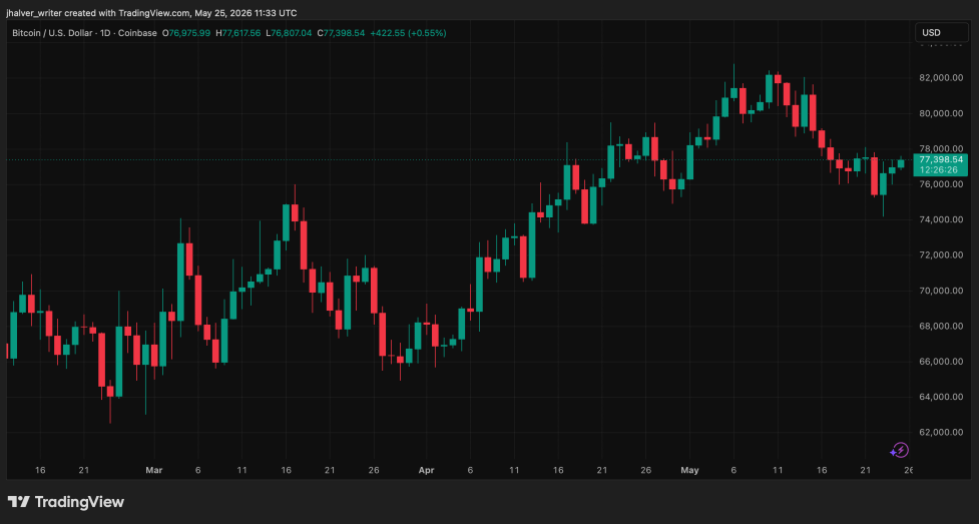
BTC's price trends to the upside, as seen on the daily chart. Source: BTCUSD on Tradingview

As of this writing, Bitcoin trades at around $82,000, with American Bitcoin’s treasury holding over 7,000 BTC as the company continues what its co-founder has now publicly described as an unconditional accumulation strategy.

Cover image from Grok, BTCUSD Chart from Tradingview

İlgili Sorular

QAccording to the article, what is the specific condition under which Eric Trump says he would sell Bitcoin?

AEric Trump would only sell Bitcoin under conditions he describes as "beyond catastrophic," a threshold so extreme it effectively amounts to a commitment to never sell under any foreseeable market scenario.

QWhat are the two key competitive races in the Bitcoin treasury space as outlined by Eric Trump in the interview?

AThe two key competitive races are: 1) the race for the largest total Bitcoin holdings, and 2) the race for the lowest possible acquisition cost for Bitcoin.

QWhat is the key metric American Bitcoin Corp. focuses on, and how does selling Bitcoin affect it?

AAmerican Bitcoin Corp.'s key metric is growing "satoshis per share," which measures how much Bitcoin each outstanding share represents. Selling Bitcoin immediately dilutes this figure.

QWhat is the main operational difference between American Bitcoin Corp.'s and MicroStrategy's Bitcoin accumulation strategies mentioned in the article?

AThe main difference is that American Bitcoin Corp. (ABTC) accumulates Bitcoin primarily through mining at a claimed low cost and follows a strict 'sell-never' policy, while MicroStrategy accumulates primarily through capital markets and has signaled some flexibility to potentially sell Bitcoin to fund dividends.

QHow does the article characterize the credibility of a 'sell-never' posture from a mining company compared to a pure accumulator?

AThe article states that a 'sell-never' posture from a mining-integrated treasury firm is more operationally credible than from a pure accumulator because the marginal cost of each new coin is structurally lower, reducing balance sheet pressure to monetize the holdings.

İlgili Okumalar

Anthropic's IPO Launch: Commercial Miracle or Valuation Bubble?

Anthropic has confidentially filed for an IPO, led by Morgan Stanley and Goldman Sachs, potentially going public by October. Following its latest $650 billion funding round, its pre-IPO valuation stands at $965 billion, with projections reaching up to $2 trillion at listing, which would make it the highest-valued private company ever. The article, written by Fu Sheng, addresses skepticism that this represents an AI bubble akin to the 2000 dot-com crash. It argues the current situation differs fundamentally. Unlike the internet bubble era, which relied on speculative narratives with little revenue, Anthropic's valuation is backed by unprecedented, measurable financial performance. Key data points include: * **Revenue Growth:** ARR skyrocketed from $10 billion in early 2025 to $470 billion by May 2026, targeting $100 billion by year-end—a growth curve unmatched in business history. * **Profitability:** It achieved operating profitability in Q2 2026 with an estimated $5.6 billion profit. * **Efficiency:** With ~3,000 employees and ~$470 billion ARR, its revenue per employee exceeds $10 million. Products like Claude Code, launched less than a year ago, already generate $25 billion in annualized revenue. * **Enterprise Adoption:** It boasts a strong enterprise client base, with 8 of the Fortune 10 and over 1,000 large firms spending over $1 million annually on Claude. The valuation is framed using a traditional SaaS model (e.g., a 10x Price-to-Sales multiple on $100 billion revenue). The author contends the core question for analysts has shifted from "How big could this be?" to "How much is it earning and will earn next quarter?" The discussion extends beyond Anthropic to a broader paradigm shift: the transition from a "carbon-based" to a "silicon-based" economy. Companies are increasingly prioritizing investment in compute and AI capabilities over human resources, as these directly scale productivity and competitive advantage. Anthropic's IPO is thus positioned not just as a corporate milestone, but as a price anchor for this new economic era.

链捕手27 dk önce

Anthropic's IPO Launch: Commercial Miracle or Valuation Bubble?

链捕手27 dk önce

Near Returns to the AI Stage: Transformation into a Public Chain Due to 'Payroll Difficulties,' Agent and Privacy Emerge as New Growth Narratives

NEAR Returns to AI Origins: From Payroll Struggles to Blockchain, Now Focusing on AI Agents and Privacy NEAR Protocol's journey began not with grand blockchain ambitions, but from a practical hurdle: its AI startup founders, including Transformer paper co-author Illia Polosukhin, couldn't efficiently pay international developers in 2017. This led them to pivot and build a high-performance, scalable blockchain. After years navigating various crypto narratives like sharding and cross-chain interoperability, NEAR is now leveraging its AI roots to re-enter the AI arena. A key driver is its "NEAR Intents" layer, which abstracts complex cross-chain transactions. Users simply state their goal (e.g., swap BTC for ETH), and a solver network finds the optimal route. This system has processed over $20B in cross-chain volume, generating significant fee revenue. A major growth area is private transactions via "Confidential Intents/Swaps," which hide trade details until settlement to protect against MEV and front-running. Remarkably, private swaps recently accounted for over 40% of NEAR's transaction volume, highlighting strong demand but also potential regulatory scrutiny. With its AI-founder pedigree, NEAR is positioning itself at the intersection of blockchain, AI agents, and privacy, aiming to become infrastructure for the emerging agent economy while navigating the challenges of its rapid adoption.

marsbit3 saat önce

Near Returns to the AI Stage: Transformation into a Public Chain Due to 'Payroll Difficulties,' Agent and Privacy Emerge as New Growth Narratives

marsbit3 saat önce

From Ethereum to AI's 'CROPS': What Exactly is This Set of 'Slow Variables' That Vitalik Repeatedly Emphasizes?

In recent discussions, Vitalik Buterin has frequently emphasized the concept of "CROPS," a framework defining core values for Ethereum's development. CROPS stands for Censorship Resistance, Capture Resistance, Open Source, Privacy, and Security. Initially outlined in the Ethereum Foundation's "EF Mandate," it represents a commitment to user sovereignty, ensuring that the network resists external control, remains open, protects privacy, and prioritizes security. The relevance of CROPS extends beyond Ethereum's foundational principles, becoming crucial in the context of AI integration. As AI agents begin handling wallet operations and automated transactions, the risk increases that users may cede control over their digital assets, privacy, and intentions to centralized AI service providers. A "CROPS AI" would therefore emphasize local execution where possible, privacy-preserving remote model calls (e.g., using zero-knowledge proofs), and transparent, verifiable processes to maintain user agency. Vitalik highlights a significant convergence between "CROPS Ethereum access layer" and "CROPS AI." Both address the same fundamental challenge: how users can access powerful services—be it blockchain data via RPCs or AI models—without exposing sensitive information or relinquishing ultimate control. This intersection points toward a future digital entry point that is more private, secure, and user-controlled. Ultimately, CROPS is not merely an abstract ideal but a practical guidepost. It steers development—from protocol resilience and wallet design to AI agent safety—towards a future where users retain self-sovereignty even as digital systems grow more complex and powerful. In an era of accelerating AI adoption, these "slow variables" of censorship resistance, openness, privacy, and security may define Ethereum's enduring value.

marsbit3 saat önce

From Ethereum to AI's 'CROPS': What Exactly is This Set of 'Slow Variables' That Vitalik Repeatedly Emphasizes?

marsbit3 saat önce

İşlemler

Spot
Futures
活动图片





