ERC-8004 Launch: Issuing ID Cards for AI, Ethereum's New Business?

marsbit2026-01-28 tarihinde yayınlandı2026-01-28 tarihinde güncellendi

Özet

Ethereum is set to launch ERC-8004, a new standard referred to as "Trustless Agents," which aims to provide on-chain digital identities for AI Agents. The initiative, backed by the Ethereum Foundation and supported by companies like Google, Coinbase, and MetaMask, introduces three core registries: an identity registry (using ERC-721 NFTs to verify AI Agents), a reputation registry (tracking historical performance), and a verification registry (for third-party audits). The goal is to establish trust between AI Agents operating on-chain, enabling them to securely interact, execute transactions, and manage assets without human intervention. This move is seen as Ethereum’s strategic response to its declining dominance in the AI Agent space, where platforms like Solana and Base currently lead in adoption due to lower fees and higher throughput. However, the immediate practical need for such a standard is questioned, as most current AI Agents operate within trusted platforms and lack the cross-protocol autonomy that ERC-8004 targets. The standard is viewed as a forward-looking effort to position Ethereum as the trust layer for future AI economies, though its broader impact remains uncertain.

Author: Deep Tide TechFlow

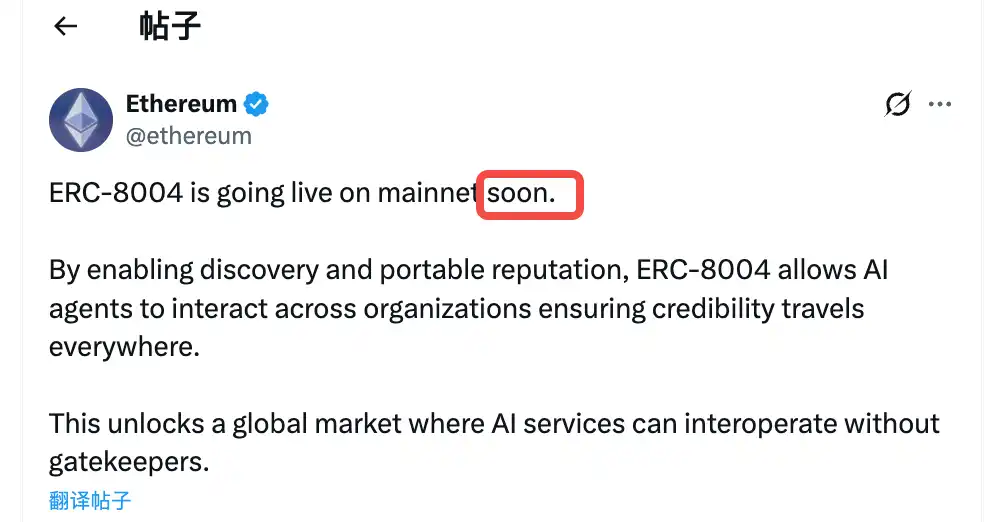
On January 28, Ethereum officially announced that the ERC-8004 protocol is about to launch on the mainnet.

We mentioned this standard in our article last October. If you are completely unfamiliar with it, you can refer here: "x402 Gradually Becoming Inward-Looking, Exploring New Asset Opportunities in ERC-8004 in Advance"

Actually, it has a formal name: "Trustless Agents." In plain language, it roughly means:

Issuing on-chain ID cards for AI Agents.

The Ethereum Foundation rarely promotes an ERC standard so vigorously. They specifically formed a team called dAI, included ERC-8004 in the 2026 strategic roadmap, collaborated with Google, Coinbase, and MetaMask to draft the proposal, and even hosted a Trustless Agents Day at DevConnect in November to build momentum.
The last time Ethereum was this serious about promoting a standard was with ERC-20 and ERC-721.

One defined tokens, the other defined NFTs.

Now it's AI's turn?

Ethereum's AI Anxiety

Why the rush?

Look at some data. According to statistics from Cookie.fun, the market cap distribution of AI Agent tokens shows that Solana and Base together account for 96%. There are only a handful of notable AI Agent projects on the Ethereum mainnet.

In April 2025, the ETH/BTC exchange rate fell to 0.017, a five-year low. Back then, everyone said Ethereum was not the future.

During the DeFi boom, Ethereum was the main stage. During the NFT boom, Ethereum was also the main stage. Now that AI Agents are heating up, the main stage has changed hands.

Solana processes 36 million transactions per day, while the Ethereum mainnet handles 1.13 million. High gas fees and slow speeds have developers voting with their feet. Virtuals Protocol launched on Base, ai16z (now ElizaOS) chose Solana, and even Coinbase's own AI project wasn't placed on the Ethereum mainnet.

Ethereum needs a new story.

ERC-8004 might be the beginning of that story.

Recapping ERC-8004

Back to the standard itself.

How exactly does ERC-8004 issue on-chain ID cards for AI Agents?

You don't need to understand the technical details; just know about three registries.

The first is the Identity Registry. Based on ERC-721, each AI Agent mints an NFT to prove "this is me."

The second is the Reputation Registry. It records the Agent's historical performance, who has used it, their reviews, and whether it has engaged in malicious activities.

The third is the Verification Registry. It allows third-party institutions to endorse the Agent, such as "this Agent has passed a certain security audit."
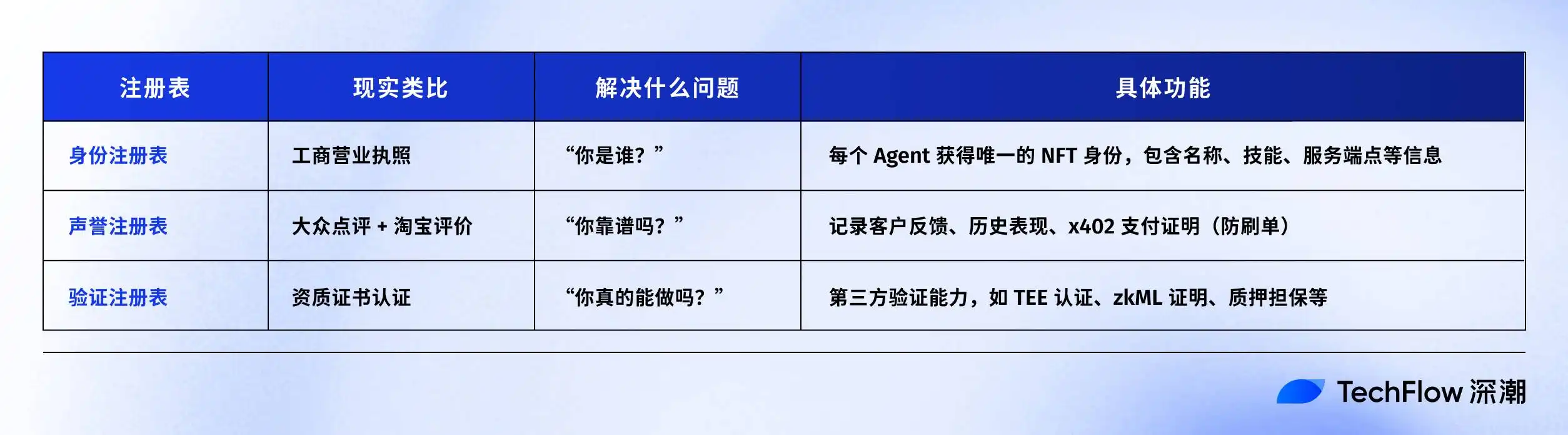
These three registries combined solve one problem: when two AI Agents meet on-chain, how do they know if the other is trustworthy?

The old answer was: they didn't know and had to rely on humans. ERC-8004's answer is: check the on-chain records.

This system wasn't entirely Ethereum's own idea.

Its underlying logic comes from the A2A (Agent-to-Agent) protocol released by Google last year, which enables AIs to communicate and call upon each other. ERC-8004 adds a layer on top of this:

Blockchain-backed trust.

Google's A2A solves the communication problem; Ethereum's ERC-8004 solves the trust problem. One manages the conversation, the other verifies identities.

Is Issuing ID Cards a Good Business?

Daring to speculate, Ethereum's logic might be this:

For AI Agents to be truly useful, they need to manage money themselves. Not just sending tweets or chatting, but directly operating on-chain assets. Signing transactions, calling contracts, cross-protocol arbitrage...

No one dares to do this on a large scale right now. The reason is simple: how do you know this Agent won't transfer your money away? The recently popular ClawdBot already has community members posting about related negative incidents.

The Web2 solution is platform endorsement. You use OpenAI's API, and the trust comes from OpenAI. If something goes wrong, you go to OpenAI.

Web3 doesn't have this. Agents are open-source, deployment is permissionless, and they run on-chain with no one overseeing them. If you call a service from an unknown Agent, you can't check who is behind it, whether the code has issues, or if it has a history of malicious acts...

Simply put, ERC-8004 essentially moves the traditional finance KYC process on-chain. Ethereum is betting that when AI Agents start handling real money, this system will become a necessity.

DeFi protocols wanting to integrate external Agents will first need to check their on-chain identity. Institutions using Agents for trade execution will need to review their historical records. Auditing firms can issue on-chain certifications for Agents, similar to security audits for smart contracts.

This is a competitive positioning move.

Ethereum knows it has lost on the execution layer, but the trust layer is still up for grabs. Institutional recognition, security audit ecosystems, TVL scale—these are Ethereum's existing assets. ERC-8004 is packaging these assets into a standard, aiming to define "what AI Agent compliance looks like" before anyone else.

The question is, does this demand exist now?

Standard Preceding Demand

After discussing Ethereum's calculations, let's talk about reality. What are on-chain AI Agents doing now?

After the AI meme wave subsided last year and the rapid advancements made by leading AI companies in the past couple of years, few people are still paying attention to on-chain AI Agents.

However, they are still making progress.

For example, ai16z has been renamed ElizaOS, evolving from a single Agent to a cross-chain platform; Virtuals Protocol is working on AI DAPPs, planning to venture into physical robots in 2026; others, like the AI Agents in Surf, can automatically execute DeFi trading strategies.

But the question arises: do they really need ERC-8004?

Luna's users trust Luna because it's made by the core Virtuals team. Agents on ElizaOS are used because they run within the ElizaOS framework; Surf executes strategies for you often because you trust the application itself.

Trust comes from the platform, not from an on-chain identity.

The scenario ERC-8004 envisions is: a陌生 (strange) Agent approaches you, with no platform endorsement or brand recognition, and you can only judge its trustworthiness through on-chain records.

When will this scenario occur?

When AI Agents truly achieve autonomous calls across protocols, platforms, and organizational boundaries. An Agent borrowing from Aave, trading on Uniswap, then generating yield in another protocol, all without human approval...

But, this scenario does not exist now.

Current AI Agents, no matter how complex their functions, essentially operate within a single platform. They don't need to prove themselves to陌生 protocols because they never knock on their doors.

Given the current hype in the crypto market, they also have no reason to knock on each other's doors, unless they can jointly create a new narrative.

Therefore, ERC-8004 solves a future problem.

If AI Agents evolve from toys to tools, Ethereum's trust infrastructure will have value. If the Agent economy grows large enough and cross-platform calls become the norm, ERC-8004 can collect tolls.

There are many "ifs."

Thus, for this future-oriented布局 (layout), institutions might be the first to act.

In late 2025, SharpLink Gaming announced investing $170 million into Ethereum restaking strategies. Around the same time, net outflows of ETH from exchanges exceeded 23,000 coins, flowing into private wallets and staking protocols.

This money might be betting on Ethereum 12 to 18 months from now.

For retail investors, however, ERC-8004 isn't a great catalyst.

Betting on ERC-8004 itself? It's an open standard with no token; you can't invest directly, only find some associated small projects. Betting on Ethereum is possible, but Ethereum's price is influenced by too many factors, with AI Agents being just one narrative.

Therefore, there is currently no clean asset that allows you to accurately bet on the proposition "AI Agents need on-chain identities."

Ethereum is not solely AI infrastructure, and Ethereum's identity anxiety won't be completely alleviated by AI. The business of issuing AI ID cards still has a long way to go.


İlgili Sorular

QWhat is the main purpose of the ERC-8004 protocol announced by Ethereum?

AThe main purpose of ERC-8004, also known as 'Trustless Agents', is to provide a chain-based identity system for AI Agents. It creates a decentralized framework for issuing and verifying digital identities, reputation, and third-party attestations for AI Agents on the blockchain, enabling trustless interactions between them.

QWhy is Ethereum heavily promoting the ERC-8004 standard according to the article?

AEthereum is promoting ERC-8004 aggressively because it aims to capture the emerging AI Agent market, where it currently lags behind chains like Solana and Base. By establishing a trust layer for AI Agents, Ethereum seeks to leverage its strengths in security, institutional recognition, and ecosystem maturity to define the standard for AI Agent compliance and trust in the blockchain space.

QWhat are the three key registries proposed in the ERC-8004 standard?

AThe three key registries in ERC-8004 are: 1) The Identity Registry, which uses ERC-721 to mint NFTs as proof of identity for each AI Agent; 2) The Reputation Registry, which records historical performance and user evaluations of Agents; and 3) The Verification Registry, which allows third-party entities to provide attestations or audits for Agents.

QDoes the current AI Agent ecosystem on blockchain have an immediate need for ERC-8004?

ANo, the current AI Agent ecosystem does not have an immediate need for ERC-8004. Most AI Agents operate within single platforms or under trusted brands, where trust is derived from the platform itself rather than decentralized identity verification. ERC-8004 addresses a future scenario where cross-protocol, autonomous AI interactions become common.

QWhat underlying protocol does ERC-8004 build upon for AI Agent communication?

AERC-8004 builds upon Google's A2A (Agent-to-Agent) protocol, which enables AI Agents to communicate and invoke each other. Ethereum's contribution adds a blockchain-based trust layer to this framework, ensuring decentralized identity verification mechanisms for secure interactions.

İlgili Okumalar

La Liga Team Bets $1 Million Against Themselves Before Match: Does Using Prediction Markets for Insurance Comply with Sports Regulations?

A Spanish La Liga club, reportedly Osasuna, purchased insurance against relegation and was linked to a transaction of over $1 million on the prediction market platform Kalshi, betting against its own victory in a crucial season-ending match. While Osasuna confirmed buying €1.2 million insurance for a potential €6 million payout in case of relegation through broker Howden, it did not confirm involvement with Kalshi. The reported trade involved intermediaries like Game Point Capital and Greenlight Commodities, with quant firm Susquehanna as the counterparty. This incident highlights the blurring line between financial hedging and gambling in prediction markets. Such markets allow trading on future event outcomes, like sports results. In the US, Kalshi operates as a regulated event contract market under the CFTC. However, Spanish authorities recently initiated penalties against Kalshi and Polymarket, considering their activities unlicensed gambling. The case raises core questions about prediction markets: who can trade, how insider information is handled, and whether participants can influence outcomes, especially in sports where results are human-driven. While leagues like La Liga and Serie A have partnered with Polymarket in North America, the regulatory clash and potential for conflicts of interest, as seen in this club's alleged transaction, present significant challenges as prediction markets evolve toward institutional risk management.

Foresight News31 dk önce

La Liga Team Bets $1 Million Against Themselves Before Match: Does Using Prediction Markets for Insurance Comply with Sports Regulations?

Foresight News31 dk önce

From Shouting 150 Dollars to Liquidating HYPE in Just Three Days, How Much Credibility Does Arthur Hayes Have Left?

How much of Arthur Hayes's market credibility remains? Recently, the "godfather of crypto perpetual swaps" and BitMEX co-founder has faced public criticism, including accusations from on-chain investigator ZachXBT about creating exit liquidity for his followers. Starting last week, Hayes executed multiple sudden sell-offs. He had repeatedly publicly predicted the HYPE token would reach $150. After a $100,000 bet defending Hyperliquid on June 1st, he announced just three days later that he had completely sold his HYPE and NEAR holdings, successfully exiting near the peak. He also sold ZEC and WLD. His sale of WLD appeared to be a classic "pump and dump" maneuver. On June 3rd, he publicly set a $10 target for WLD, causing its price to surge over 35%. By June 6th, he announced he had sold his WLD, citing "anomalous" SpaceX pre-IPO price action, which triggered a sharp price drop. On June 9th, Hayes published a lengthy article explaining his actions, citing factors like rising energy costs and a potential AI bubble burst. Consequently, his family office, Maelstrom, now holds positions in US energy producers and only core crypto assets BTC and ETH, having sold AI-related stocks and non-core cryptocurrencies. This pattern is not new. In 2025, he similarly touted HYPE before selling it at what turned out to be a cycle peak, only to repurchase it at the next cycle's low. Similar scenarios played out with tokens like ETHFI and ENA. Long-term observers have developed a strategy: ignore Hayes's public statements but closely monitor his on-chain actions—be cautious following his buys, but decisively follow his sells. If he continues these tactics, especially as seen with the WLD case, his market credibility risks being permanently damaged. As Hayes himself admitted in his latest article, "I remain an unapologetic gambler."

marsbit49 dk önce

From Shouting 150 Dollars to Liquidating HYPE in Just Three Days, How Much Credibility Does Arthur Hayes Have Left?

marsbit49 dk önce

Fundraising is Like a Strange Dance: The 'Absurd Drama' of Silicon Valley Founders' Capital Raises

The article details a series of absurd and revealing anecdotes shared by Silicon Valley founders about their venture capital fundraising experiences, sparked by Greg Isenberg's story of pitching to a sleeping a16z partner. Founders describe surreal pitch meetings: one faced a barefoot, peanut-eating investor who offered triple the requested amount after 30 seconds; another performed a pitch in a VC's parked car; a founder discovered his audience understood no English beyond "yes." These stories highlight the often irrational and performative nature of fundraising. Beyond the absurdity, darker power imbalances are exposed. Stories include investors suggesting founders fire co-founders for their equity, blatant market misjudgments, disrespectful behavior from LPs, and discriminatory remarks. A debate also emerges around "Sequoia's" practice of splitting a round into two valuations. However, the thread isn't solely critical. Positive counter-narratives celebrate supportive VCs who offered crucial advice during crises, respected founders' timelines, and showed simple gestures of respect—like a partner personally fetching coffee before a major pitch. Ultimately, the collective sharing acts as a pressure release, illustrating that fundraising is a complex dance of power, trust, and sometimes sheer theater. It underscores that beyond capital, mutual respect and integrity remain the most enduring foundations of the founder-investor relationship.

marsbit1 saat önce

Fundraising is Like a Strange Dance: The 'Absurd Drama' of Silicon Valley Founders' Capital Raises

marsbit1 saat önce

İşlemler

Spot
Futures

Popüler Makaleler

ID Nasıl Satın Alınır

HTX.com’a hoş geldiniz! SPACE ID (ID) satın alma işlemlerini basit ve kullanışlı bir hâle getirdik. Adım adım açıkladığımız rehberimizi takip ederek kripto yolculuğunuza başlayın. 1. Adım: HTX Hesabınızı OluşturunHTX'te ücretsiz bir hesap açmak için e-posta adresinizi veya telefon numaranızı kullanın. Sorunsuzca kaydolun ve tüm özelliklerin kilidini açın. Hesabımı Aç2. Adım: Kripto Satın Al Bölümüne Gidin ve Ödeme Yönteminizi SeçinKredi/Banka Kartı: Visa veya Mastercard'ınızı kullanarak anında SPACE ID (ID) satın alın.Bakiye: Sorunsuz bir şekilde işlem yapmak için HTX hesap bakiyenizdeki fonları kullanın.Üçüncü Taraflar: Kullanımı kolaylaştırmak için Google Pay ve Apple Pay gibi popüler ödeme yöntemlerini ekledik.P2P: HTX'teki diğer kullanıcılarla doğrudan işlem yapın.Borsa Dışı (OTC): Yatırımcılar için kişiye özel hizmetler ve rekabetçi döviz kurları sunuyoruz.3. Adım: SPACE ID (ID) Varlıklarınızı SaklayınSPACE ID (ID) satın aldıktan sonra HTX hesabınızda saklayın. Alternatif olarak, blok zinciri transferi yoluyla başka bir yere gönderebilir veya diğer kripto para birimlerini takas etmek için kullanabilirsiniz.4. Adım: SPACE ID (ID) Varlıklarınızla İşlem YapınHTX'in spot piyasasında SPACE ID (ID) ile kolayca işlemler yapın.Hesabınıza erişin, işlem çiftinizi seçin, işlemlerinizi gerçekleştirin ve gerçek zamanlı olarak izleyin. Hem yeni başlayanlar hem de deneyimli yatırımcılar için kullanıcı dostu bir deneyim sunuyoruz.

166 Toplam GörüntülenmeYayınlanma 2024.12.12Güncellenme 2026.06.02

ID Nasıl Satın Alınır

Tartışmalar

HTX Topluluğuna hoş geldiniz. Burada, en son platform gelişmeleri hakkında bilgi sahibi olabilir ve profesyonel piyasa görüşlerine erişebilirsiniz. Kullanıcıların ID (ID) fiyatı hakkındaki görüşleri aşağıda sunulmaktadır.

活动图片












