End Of Bitcoin Distribution? Key Data Reveals A Shift In LTH Behavior

bitcoinist2025-12-31 tarihinde yayınlandı2025-12-31 tarihinde güncellendi

Özet

Bitcoin is trading below $90,000 amid deteriorating market sentiment, with analysts warning of a potential bear market. However, on-chain data suggests a shift in long-term holder (LTH) behavior. While social media narratives claim LTHs are distributing Bitcoin at record levels, analysis shows that recent large transfers—including 800,000 BTC moved from Coinbase—skewed the data. After adjusting for this anomaly, LTH supply appears to be stabilizing or even recovering, with a reduction in selling pressure. This shift, combined with short-term holders holding positions, indicates easing sell-side pressure. Bitcoin is currently consolidating around $88K, just above the 200-day moving average—a key support level. A break below could expose the $75K–$80K range, but the current data challenges the dominant bearish narrative and may signal a move toward market balance.

Bitcoin continues to trade below the $90,000 level, struggling to regain bullish momentum as market sentiment deteriorates. A growing number of analysts are now openly calling for a broader bear market, pointing to persistent weakness, failed breakouts, and declining risk appetite across crypto. Despite this gloomy backdrop, not all market participants are convinced that Bitcoin’s next major move will be lower.

Some investors remain focused on 2026, arguing that structural conditions could begin to shift in the coming months. One of the key debates centers on long-term holders (LTHs). While social media narratives increasingly claim that LTHs are distributing Bitcoin at record levels, on-chain data suggests a more nuanced reality.

According to a report by analyst Darkfost, much of the perceived LTH selling has been distorted by large, isolated movements—particularly nearly 800,000 BTC transferred from Coinbase—which skewed traditional LTH metrics.
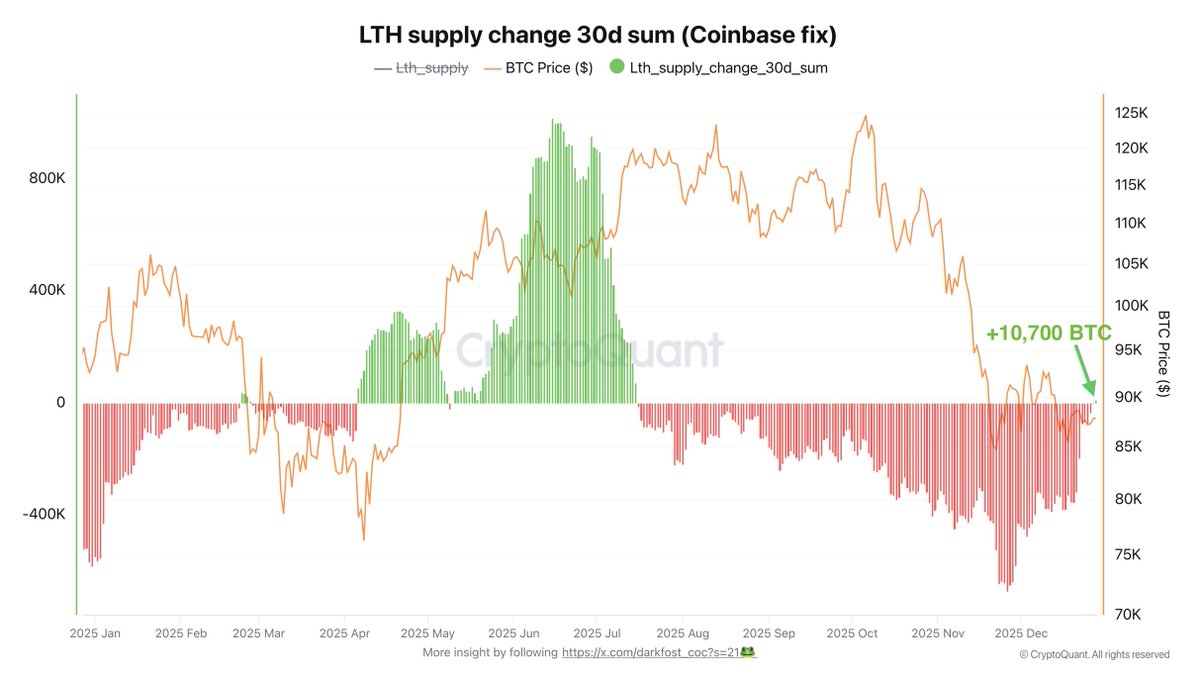
LTH Supply Change 30d sum (Coinbase) | Source: CryptoQuant

After adjusting the data to exclude this anomaly, a clear change in supply dynamics emerges. Rather than accelerating distribution, the adjusted chart shows signs that long-term holder supply is stabilizing, and in some cases beginning to recover. This challenges the dominant bearish narrative and suggests that selling pressure from seasoned holders may be fading.

As Bitcoin consolidates below key resistance, the divergence between price weakness and shifting on-chain behavior sets the stage for a critical inflection point ahead.

Long-Term Holders Reduce Selling Pressure

Darkfost adds important context to the evolving Bitcoin narrative by focusing on long-term holder (LTH) supply dynamics. According to his analysis, the monthly LTH supply change—measured as a 30-day rolling sum—had remained firmly locked in a distribution phase since July 16.

For several months, this metric consistently showed negative readings, confirming that long-term holders were gradually reducing their exposure and releasing supply into the market.

That trend has now shifted. The latest data shows the metric moving back into positive territory, with approximately 10,700 BTC transitioning into long-term held coins. While this figure is still relatively small in absolute terms, it marks a clear inflection from sustained distribution to early re-accumulation.

In practical terms, it suggests that LTHs have slowed their selling activity to the point where their aggregate supply is beginning to grow again.

This shift is particularly notable because it is occurring while short-term holders (STHs) continue to hold their positions rather than aggressively selling. The combination points to a cooling of sell-side pressure from both cohorts, even as price remains under pressure.

Historically, similar transitions in LTH supply behavior have often preceded periods of sideways consolidation or, in more constructive cases, the early stages of bullish recoveries.

While this signal alone does not guarantee an upside move, it does suggest that the market may be moving away from forced distribution and toward a more balanced phase, depending on how broader macro and price trends develop.

Bitcoin Consolidates Above Long-Term Support

Bitcoin’s price action continues to reflect a market caught between structural support and lingering downside pressure. After failing to hold above the $100K–$105K region earlier in the quarter, BTC entered a sharp corrective phase that accelerated into November. That move pushed price decisively below the 50-day and 100-day moving averages, confirming a short-term trend shift from expansion to contraction.
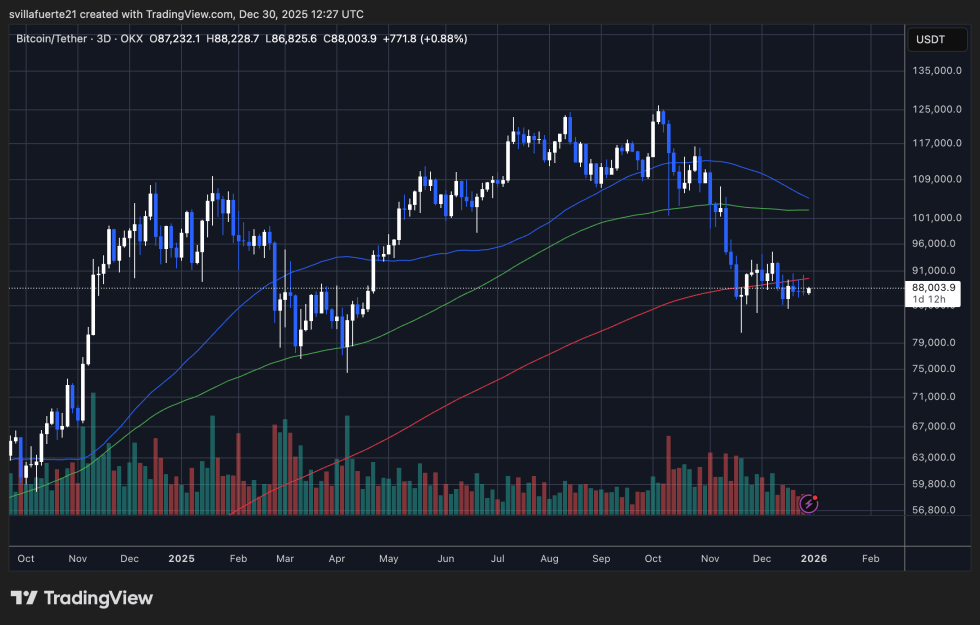
BTC price testing critical level | Source: BTCUSDT chart on TradingView

At present, Bitcoin is consolidating around the $88K zone, hovering just above the rising 200-day moving average, which sits slightly lower and continues to act as a critical long-term support.

This area has become a key battleground: repeated downside wicks suggest buyers are defending the level, but upside follow-through remains limited. The declining slope of the shorter moving averages reinforces the idea that bullish momentum has not yet returned.

Volume dynamics also support a consolidation narrative rather than active accumulation. Selling pressure has eased compared to the November breakdown, but demand has not expanded meaningfully enough to reclaim prior resistance. Structurally, the market appears to be transitioning from a high-volatility selloff into a compression phase.

As long as BTC holds above the 200-day moving average, the broader bullish structure from earlier in the cycle remains technically intact. However, a failure to defend this level would expose the $80K–$75K region as the next major support.

Featured image from ChatGPT, chart from TradingView.com

İlgili Sorular

QWhat key data suggests a shift in long-term holder (LTH) behavior according to the article?

AThe key data is the monthly LTH supply change (30-day rolling sum), which has moved back into positive territory with approximately 10,700 BTC transitioning into long-term held coins, indicating a shift from sustained selling to early re-accumulation.

QWhat event distorted the traditional LTH metrics and created a perception of record selling?

AThe perception was distorted by a large, isolated movement of nearly 800,000 BTC transferred from Coinbase, which skewed the data.

QWhat is the significance of Bitcoin's current price level in relation to the 200-day moving average?

AThe $88K zone, where Bitcoin is consolidating, is just above the rising 200-day moving average, which acts as a critical long-term support. Holding above it keeps the broader structure intact, while a break below could expose the $80K–$75K region.

QHow does the article describe the current market sentiment and the actions of short-term holders (STHs)?

AThe article describes market sentiment as deteriorating, with many analysts calling for a broader bear market. However, short-term holders (STHs) are described as continuing to hold their positions rather than aggressively selling, contributing to a cooling of sell-side pressure.

QWhat does the shift in LTH behavior historically indicate for Bitcoin's price, according to the article?

AHistorically, similar transitions in LTH supply behavior from distribution to re-accumulation have often preceded periods of sideways consolidation or the early stages of bullish recoveries.

İlgili Okumalar

Institutional Adoption of Prediction Markets Stuck at the Third Stage

Prediction markets are transitioning from niche platforms focused on elections and sports to mainstream financial tools, as highlighted at Kalshi Research's inaugural conference. While sports still dominate trading volume (around 80%), non-sports categories like macroeconomics, politics, and entertainment are growing faster, signaling a shift from entertainment-based trading to information and risk management tools. Institutions, including Wall Street firms, are increasingly using prediction markets for data reference (Stage 1 adoption), with some progressing to system integration (Stage 2). However, full-scale trading (Stage 3) is limited due to the lack of margin trading, requiring full collateral for positions—a barrier for leverage-dependent entities. Kalshi is working with regulators to introduce margin mechanisms. Key insights from participants like Goldman Sachs and CNBC emphasize the value of real-time pricing for events (e.g., Fed decisions, tariffs), providing benchmarks previously unavailable. The path to maturity mirrors historical financial instruments like options, with expectations that prediction markets will become institutional staples within five years. Political leaders, including Trump and Schumer, now cite Kalshi odds, underscoring its growing influence. The platform rewards domain expertise over traditional finance backgrounds, attracting diverse participants from fields like music and poker. Ultimately, prediction markets are evolving into critical infrastructure for pricing uncertainty.

marsbit15 dk önce

Institutional Adoption of Prediction Markets Stuck at the Third Stage

marsbit15 dk önce

The First Year of Computing Power Inflation: The Cheaper DeepSeek Gets, the Harder It Is to Stop This Round of Price Hikes

The year 2026 marks the beginning of "computing power inflation." While AI inference costs have dropped by over 80% in 18 months globally, China's three major cloud providers—Alibaba Cloud, Baidu AI Cloud, and Tencent Cloud—simultaneously announced price hikes of 20–30%. This reflects a deeper structural shift driven by Jevons Paradox: as unit costs fall (e.g., via models like DeepSeek-R1), demand explodes, especially with the rise of reasoning models and AI agents that consume 10–50x more tokens per task. Although DeepSeek open-sourced its model weights, it did not release its inference optimization stack, leaving a significant engineering efficiency gap between cloud providers and smaller players. The big three are leveraging this advantage to reposition: Alibaba focuses on high-margin premium clients, Baidu filters out low-value users, and Tencent capitalizes on ecosystem lock-in. Meanwhile, ByteDance’s Volcano Engine adopts a more moderate pricing strategy to capture displaced customers. Unexpectedly, the price surge is pushing large enterprises toward self-built computing solutions once their cloud bills exceed a certain threshold. While cloud providers aim to boost profitability, they risk driving away innovative startups and accelerating competition from GPU leasing and domestic hardware providers like Huawei. The涨价 trend is expected to persist for 2–3 years, fueled by rising token consumption from reasoning models, AI agent adoption, and NVIDIA export restrictions. The inflection point depends on whether domestic chips can match NVIDIA’s efficiency, likely around 2027–2028. Until then, cloud providers will maintain pricing power, and the key for AI companies is to optimize token usage—the real moat in this era.

marsbit1 saat önce

The First Year of Computing Power Inflation: The Cheaper DeepSeek Gets, the Harder It Is to Stop This Round of Price Hikes

marsbit1 saat önce

İşlemler

Spot
Futures

Popüler Makaleler

FRAX Nasıl Satın Alınır

HTX.com’a hoş geldiniz! FRAX (FRAX) satın alma işlemlerini basit ve kullanışlı bir hâle getirdik. Adım adım açıkladığımız rehberimizi takip ederek kripto yolculuğunuza başlayın. 1. Adım: HTX Hesabınızı OluşturunHTX'te ücretsiz bir hesap açmak için e-posta adresinizi veya telefon numaranızı kullanın. Sorunsuzca kaydolun ve tüm özelliklerin kilidini açın. Hesabımı Aç2. Adım: Kripto Satın Al Bölümüne Gidin ve Ödeme Yönteminizi SeçinKredi/Banka Kartı: Visa veya Mastercard'ınızı kullanarak anında FRAX (FRAX) satın alın.Bakiye: Sorunsuz bir şekilde işlem yapmak için HTX hesap bakiyenizdeki fonları kullanın.Üçüncü Taraflar: Kullanımı kolaylaştırmak için Google Pay ve Apple Pay gibi popüler ödeme yöntemlerini ekledik.P2P: HTX'teki diğer kullanıcılarla doğrudan işlem yapın.Borsa Dışı (OTC): Yatırımcılar için kişiye özel hizmetler ve rekabetçi döviz kurları sunuyoruz.3. Adım: FRAX (FRAX) Varlıklarınızı SaklayınFRAX (FRAX) satın aldıktan sonra HTX hesabınızda saklayın. Alternatif olarak, blok zinciri transferi yoluyla başka bir yere gönderebilir veya diğer kripto para birimlerini takas etmek için kullanabilirsiniz.4. Adım: FRAX (FRAX) Varlıklarınızla İşlem YapınHTX'in spot piyasasında FRAX (FRAX) ile kolayca işlemler yapın.Hesabınıza erişin, işlem çiftinizi seçin, işlemlerinizi gerçekleştirin ve gerçek zamanlı olarak izleyin. Hem yeni başlayanlar hem de deneyimli yatırımcılar için kullanıcı dostu bir deneyim sunuyoruz.

262 Toplam GörüntülenmeYayınlanma 2026.03.03Güncellenme 2026.03.03

FRAX Nasıl Satın Alınır

MANTRA Nedir

I. Proje TanıtımıMANTRA, gerçek dünya düzenleyici gerekliliklerine uyum sağlama ve bunları uygulama yeteneğine sahip, güvenlik odaklı bir RWA Katman 1 Blok Zinciridir. Kurumlar ve Geliştiriciler için tasarlanmış olan MANTRA, izinli uygulamalar için izin gerektirmeyen bir Blok Zinciri sunmaktadır.Ana Özellikler: * Cosmos SDK kullanılarak inşa edilmiştir, IBC uyumlu, CosmWasm destekli * Egemen bir PoS doğrulayıcı seti ile güvence altına alınmıştır * 10k TPS'ye kadar ölçeklenebilir * Düzenleyici uyumlu RW'ları oluşturmak, ticaretini yapmak ve yönetmek için yerleşik Modüller, SDK'lar ve API'ler * Yerel olmayan kullanıcıları ve kurumları Web3'e entegre etmek için geliştirilmiş Kullanıcı Deneyimi.1) Temel Bilgilerİsim:MANTRA(OM)III. İlgili BağlantılarBeyaz Kağıt:https://docs.mantrachain.io/Resmi web sitesi:https://www.mantrachain.io/Keşif Araçları:https://mintscan.io/mantraSosyal Medya:https://x.com/MANTRA_ChainNot: Proje tanıtımı, resmi proje ekibi tarafından yayımlanan veya sağlanan materyallerden alınmıştır, yalnızca referans içindir ve yatırım tavsiyesi teşkil etmez. HTX, ortaya çıkan doğrudan veya dolaylı kayıplardan sorumluluk kabul etmez.

544 Toplam GörüntülenmeYayınlanma 2026.03.04Güncellenme 2026.03.04

MANTRA Nedir

MANTRA Nasıl Satın Alınır

HTX.com’a hoş geldiniz! Mantra (MANTRA) satın alma işlemlerini basit ve kullanışlı bir hâle getirdik. Adım adım açıkladığımız rehberimizi takip ederek kripto yolculuğunuza başlayın. 1. Adım: HTX Hesabınızı OluşturunHTX'te ücretsiz bir hesap açmak için e-posta adresinizi veya telefon numaranızı kullanın. Sorunsuzca kaydolun ve tüm özelliklerin kilidini açın. Hesabımı Aç2. Adım: Kripto Satın Al Bölümüne Gidin ve Ödeme Yönteminizi SeçinKredi/Banka Kartı: Visa veya Mastercard'ınızı kullanarak anında Mantra (MANTRA) satın alın.Bakiye: Sorunsuz bir şekilde işlem yapmak için HTX hesap bakiyenizdeki fonları kullanın.Üçüncü Taraflar: Kullanımı kolaylaştırmak için Google Pay ve Apple Pay gibi popüler ödeme yöntemlerini ekledik.P2P: HTX'teki diğer kullanıcılarla doğrudan işlem yapın.Borsa Dışı (OTC): Yatırımcılar için kişiye özel hizmetler ve rekabetçi döviz kurları sunuyoruz.3. Adım: Mantra (MANTRA) Varlıklarınızı SaklayınMantra (MANTRA) satın aldıktan sonra HTX hesabınızda saklayın. Alternatif olarak, blok zinciri transferi yoluyla başka bir yere gönderebilir veya diğer kripto para birimlerini takas etmek için kullanabilirsiniz.4. Adım: Mantra (MANTRA) Varlıklarınızla İşlem YapınHTX'in spot piyasasında Mantra (MANTRA) ile kolayca işlemler yapın.Hesabınıza erişin, işlem çiftinizi seçin, işlemlerinizi gerçekleştirin ve gerçek zamanlı olarak izleyin. Hem yeni başlayanlar hem de deneyimli yatırımcılar için kullanıcı dostu bir deneyim sunuyoruz.

229 Toplam GörüntülenmeYayınlanma 2026.03.04Güncellenme 2026.03.04

MANTRA Nasıl Satın Alınır

Tartışmalar

HTX Topluluğuna hoş geldiniz. Burada, en son platform gelişmeleri hakkında bilgi sahibi olabilir ve profesyonel piyasa görüşlerine erişebilirsiniz. Kullanıcıların A (A) fiyatı hakkındaki görüşleri aşağıda sunulmaktadır.

活动图片