Encrypted Super Apps Arrive: Coinbase and Others Are Reconstructing an All-in-One Financial Ecosystem

深潮2025-12-22 tarihinde yayınlandı2025-12-22 tarihinde güncellendi

Özet

Coinbase has launched a new all-in-one financial application enabling 24/7 stock trading, crypto exchange, futures, perpetual contracts, and AI-powered financial analysis—all accessible via a single account. Similarly, Robinhood has expanded into tokenized stocks, crypto yield, and plans to introduce social trading. This shift signals a move away from fragmented financial apps toward integrated "super apps" that unify access to multiple asset classes. Key drivers include tokenization (enabling 24/7 stock trading), clearer regulations (e.g., Bitcoin ETFs, stablecoin laws), and improved mobile wallet infrastructure. By consolidating liquidity, these platforms reduce transfer delays, minimize idle capital, and improve execution efficiency. However, this recentralization raises concerns: users must trust platforms with custody and private keys, tokenized assets may not represent real ownership, and gamified interfaces could encourage impulsive trading. While these apps offer convenience and higher yields, they also reintroduce counterparty risk and may simply replace traditional banks with new centralized gatekeepers. The core question remains: Is this true financial democratization or a more efficient form of financial enclosure?

Written by: Nishil Jain

Compiled by: Luffy, Foresight News

Last week, Coinbase launched a new product touted as the "Future of Finance." A single app now offers five major functions: 24/5 stock trading, centralized exchange and on-chain cryptocurrency trading, futures and perpetual contract trading, prediction markets, and is even equipped with an AI financial analyst. All functions are accessible via mobile, and a user's single account balance can be instantly switched between different asset classes for use.

Not long ago, Robinhood had already made a preemptive move: launching tokenized stock trading in Europe, 24/5 futures trading, cryptocurrency interest-earning services, and plans to launch the social trading feature Robinhood Social in 2026.

The mainstream discourse on platform X interprets this trend as the evolution of "super apps," but a key point is being overlooked: this is far from a simple stacking of functions; it's breaking down the boundaries between financial asset categories that were created due to regulatory and technological limitations.
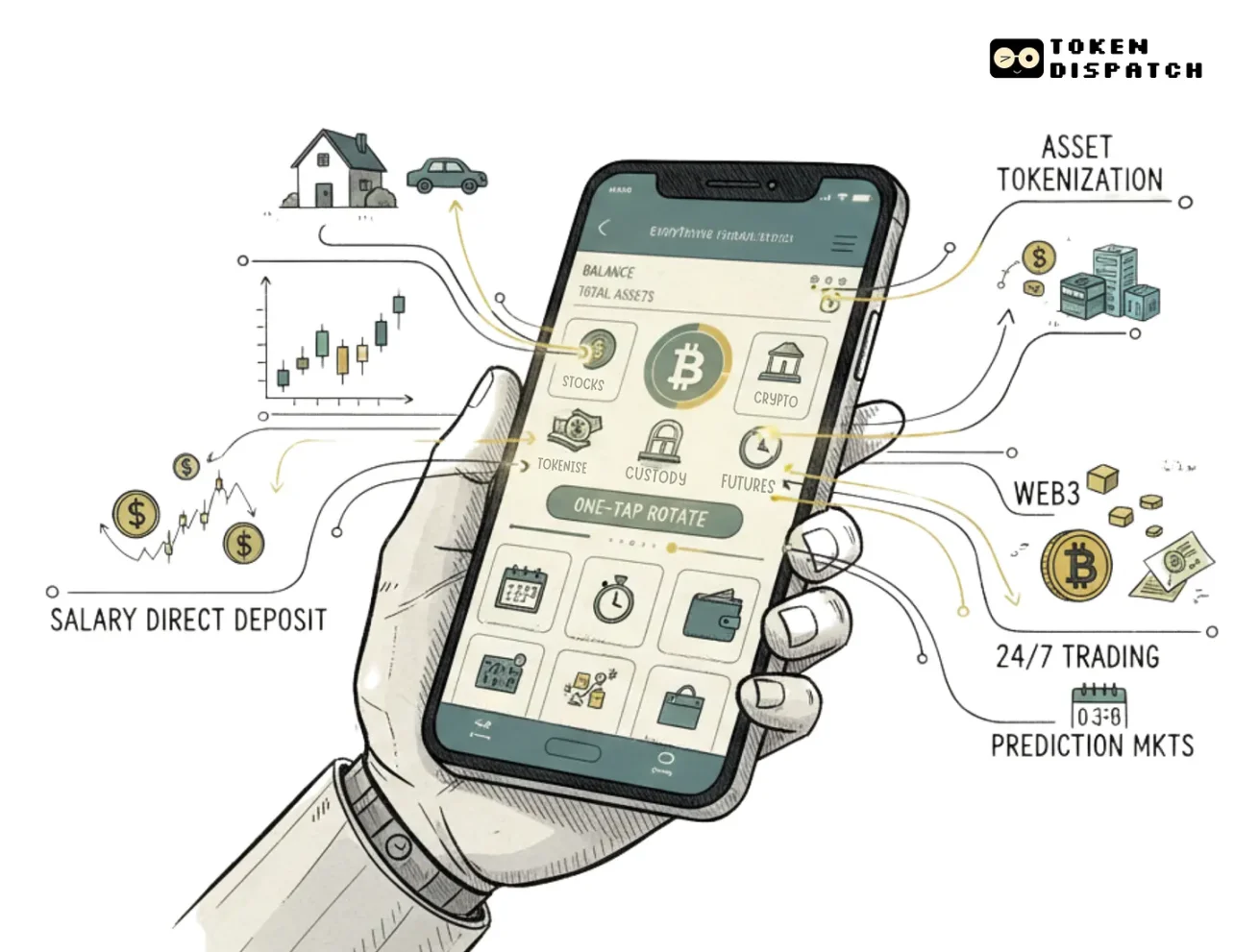
Why, after a decade of fragmented development, are financial applications now experiencing a wave of consolidation? What does this mean for the users and platforms involved? Let's now delve into the main topic.

The Pain Points of Fragmentation

Over the past decade, numerous fintech applications have emerged, yet most only cover a single aspect of financial services, with functions like stock trading, cryptocurrency, payments, and savings scattered across different apps.

While this model provided users with more choices and allowed companies to focus on refining single solutions, it proved problematic in practice.

Want to sell stocks and buy cryptocurrency? The stock trade needs to be executed on Monday, with T+1 settlement not completing until Tuesday; then initiating a withdrawal takes 2-3 days for the funds to reach your bank account; transferring the funds to Coinbase then takes another 1-2 days. From "deciding to reallocate funds" to "funds actually being available," the entire process takes about 5 days. And during those 5 days, the investment opportunity you originally spotted has likely vanished, while your capital sits idle in a cumbersome process.

For example, you might want to buy Bitcoin at $86,000 on December 18th, but end up buying it 5 days later at $90,000 due to process delays. For more volatile investment opportunities like meme coins, Initial Coin Offerings (ICOs), or Initial Public Offerings (IPOs), the losses from such delays can be even more severe.

The problem of fragmentation isn't limited to a single region. An Indian investor wanting to buy NVIDIA stock would need to complete KYC verification multiple times, open an account with a broker that supports Indian users investing in US stocks, and deposit additional funds, all just to buy this one stock.

We've all felt this operational friction, but it's only recently that the infrastructure capable of solving this problem has begun to take shape.

The Cornerstones of Change: Infrastructure Matures

Three structural changes have made the birth of integrated financial platforms possible.

Tokenization Breaks Time Barriers

Traditional stocks can only be traded during New York Stock Exchange (NYSE) hours (9:30 AM to 4:00 PM ET, 5 days a week), while cryptocurrencies enable 24/7 trading. By achieving stock tokenization on Layer 2 networks, it has been proven that, with the right technical mechanisms, stocks can theoretically be traded around the clock.

Today, Robinhood's tokenized stocks launched in Europe support 24/5 trading, and Coinbase is set to follow this model.

Regulatory Frameworks Become Clearer

In recent years, Bitcoin spot ETFs have successfully launched, stablecoin legalization has progressed, tokenization regulatory frameworks have entered deliberation stages, and prediction markets have gained approval from the U.S. Commodity Futures Trading Commission (CFTC). Although the regulatory environment isn't perfect, it is clear enough for platforms to confidently develop multi-asset products without fear of being completely shut down.

Mobile Wallet Infrastructure Matures

Embedded wallets can now seamlessly handle complex cross-chain operations. Privy, acquired by Stripe, allows users to create a wallet using an existing email address without touching seed phrases; the recently launched crypto trading app Fomo enables non-crypto users to trade tokens on Ethereum, Solana, Base, Arbitrum, and other chains without manually selecting networks, and supports Apple Pay deposits. The backend automatically handles all complex processes—the user simply clicks "Buy Token" to complete the operation.

The Core Logic of Liquidity Integration

The core driver behind this change is: funds scattered across different applications are essentially idle capital.

In an integrated model, a user only needs to maintain one account balance: after selling stocks, the funds can be instantly used to buy cryptocurrency, eliminating the wait for settlement windows, withdrawal review periods, and intermediaries like banks. The 5-day opportunity cost vanishes entirely.

Platforms that integrate liquidity are more efficient. With deeper liquidity pools, they can offer better execution speeds; since all trading pairs share the same underlying liquidity, they can support more pairs; they can provide yield on idle capital, much like banks; furthermore, reduced friction leads to increased user trading volume, generating more fee income for them.

Coinbase's Integration Blueprint

Coinbase is the most typical case study in this wave of financial integration. The company was founded in 2012, starting as a simple cryptocurrency exchange supporting only Bitcoin and Ethereum buying and selling. In the following years, Coinbase gradually added institutional custody, staking services, and cryptocurrency lending/interest-earning products, evolving into a full-service crypto platform by 2021.

Its expansion didn't stop there: it launched the Coinbase Card for crypto spending, the Coinbase Commerce payment solution for merchants, and built its own Layer 2 blockchain, Base.

The new product launch on December 17th marked the full realization of Coinbase's "super app" vision. Today, Coinbase supports 24/5 stock trading, plans to launch Coinbase Tokenize—a tokenization service for real-world assets for institutions—early next year, has integrated prediction markets through a partnership with Kalshi, launched futures and perpetual contract trading, and integrated Solana ecosystem decentralized exchange (DEX) trading functionality within the app. Additionally, the Base app has expanded to 140 countries and enhanced the social trading experience.
Coinbase is gradually becoming the operating system for on-chain finance. Through a single interface and a single account balance, it covers trading needs for all asset classes, aiming to allow users to complete all financial operations without leaving the platform.

Robinhood is following a similar development path: starting with commission-free stock trading, gradually adding cryptocurrency trading, a Gold subscription service offering 3% cashback and 3.5% deposit interest, futures trading, and subsequently launching tokenized stocks in Europe.

Both platforms are betting on the same core logic: users don't want to download different apps for stocks, crypto, and derivatives; they need a single account balance, a unified interface, and the ability to instantly reallocate funds.

Social Trading: An Emerging Differentiator

Asset integration solves the liquidity problem, but it doesn't solve the user's asset discovery challenge.

When there are millions of assets available in the market, how should users filter potential trades? How should they build their investment portfolio?

This is where social features add value. Coinbase's Base app includes a dynamic feed where users can see others' buy actions; Robinhood plans to launch Robinhood Social in 2026; eToro has offered social trading since 2007, paying copy traders a 1.5% commission on the assets they hold.

A wave of apps exploring social trading features has also emerged in the on-chain space, such as Fomo, 0xPPL, and Farcaster. These apps allow users to see what their friends are investing in, follow them, and copy their trades.

Fomo's leaderboard page

Social trading allows users to see others' trading behavior in real-time and copy it with one click. This significantly reduces decision-making friction: no need for independent research, just follow trusted trading strategies. Once a platform forms a stable community ecosystem—where users follow trading influencers and build personal reputations—it becomes very difficult for users to migrate to other platforms, creating a strong competitive moat and user stickiness for the trading app.

Centralized exchanges have offered copy trading since 2022, but usage rates have consistently remained below 2%. Mobile app platforms are betting that optimizing the user experience will increase the adoption of this feature. Whether their judgment is correct will determine if social trading becomes a true differentiator or just another commonplace feature.

A Pessimistic View: Potential Risks and Controversies

Let's be frank about the current state: the original intention of cryptocurrency was to achieve financial decentralization, remove intermediaries, and let users control their own assets.

And now, we are rebuilding centralized platforms: Coinbase controls asset custody, trade execution, and social graphs; Robinhood holds the private keys for embedded wallets; users need to trust the platform's solvency, security, and ongoing operational capability. All of this carries underlying counterparty risk.

Robinhood's tokenized stocks are essentially derivatives that track stock prices, not actual shares. If the platform collapses, what users hold is merely an IOU.

The problems caused by gamification are also becoming more severe: 24/7 trading means you might make impulsive trades at 3 AM; social feeds can induce FOMO when you see others profiting; push notifications alert you to every market swing in real-time. This is essentially scaled-up casino psychology, meticulously optimized by designers who understand how to trigger dopamine responses.

Is this progress in financial democratization, or just a repackaged system of exploitation? This is a philosophical question worth pondering.

The Essence Behind the Phenomenon

We spent a decade unbundling financial services, operating under the assumption that fragmentation would foster competition and bring more choice.

But it turned out that fragmentation also caused inefficiency: idle funds, dispersed liquidity, and users forced to hold more idle capital due to cumbersome fund transfer processes. The new era is changing this reality.

Coinbase and Robinhood are gradually becoming the new banks: they hold your salary, savings, investments, and spending patterns; they control trade execution, asset custody, and access; they intermediate every transaction. The only difference compared to traditional banks is: a prettier interface, 24/7 trading markets, and deposit rates 50 basis points higher.

Whether we are achieving financial democratization by lowering barriers and increasing efficiency, or merely changing the gatekeepers while keeping the barriers themselves, the era of fragmentation is over. In the coming years, we will witness whether financial integration based on open underlying technology can deliver better outcomes than the traditional banks we fled from, or if it just changes the logo that locks users in.


İlgili Sorular

QWhat are the three main structural changes that have enabled the emergence of integrated financial platforms like Coinbase's new product?

AThe three main structural changes are: 1) Tokenization breaking time barriers, enabling 24/7 trading of assets like stocks. 2) A clearer regulatory framework, with approvals for Bitcoin ETFs, stablecoins, and prediction markets. 3) Mature mobile wallet infrastructure, allowing seamless cross-chain operations and simplified user onboarding.

QAccording to the article, what was the core problem with the fragmented fintech landscape of the past decade?

AThe core problem was inefficiency and opportunity cost. Moving money between different apps for different asset classes (e.g., selling stocks to buy crypto) could take up to 5 days due to T+1 settlement, bank transfer delays, and platform processing times. This delay often caused users to miss out on volatile investment opportunities.

QHow does the 'super app' model fundamentally change the user experience compared to using separate apps for different financial services?

AThe 'super app' model provides a single interface and a single account balance. This allows users to instantly switch and allocate funds between different asset classes (stocks, crypto, derivatives) without waiting for transfers or settlements, eliminating the friction and opportunity cost of the fragmented model.

QWhat role does 'social trading' play in the strategy of these new integrated platforms?

ASocial trading addresses the 'asset discovery' problem by allowing users to see what others are buying and to copy their trades. This reduces decision-making friction, builds community, and creates powerful user stickiness and competitive barriers for the platforms that successfully implement it.

QWhat are some of the potential risks and philosophical concerns raised about these new integrated financial platforms?

AThe risks include reintroducing centralization and counterparty risk (users must trust the platform's solvency and security), the fact that tokenized assets may not represent real ownership, and the use of gamification and 24/7 trading that can exploit psychological triggers and encourage impulsive behavior, akin to a 'scaled-up casino psychology'.

İlgili Okumalar

Gensyn AI: Don't Let AI Repeat the Mistakes of the Internet

In recent months, the rapid growth of the AI industry has attracted significant talent from the crypto sector. A persistent question among researchers intersecting both fields is whether blockchain can become a foundational part of AI infrastructure. While many previous AI and Crypto projects focused on application layers (like AI Agents, on-chain reasoning, data markets, and compute rentals), few achieved viable commercial models. Gensyn differentiates itself by targeting the most critical and expensive layer of AI: model training. Gensyn aims to organize globally distributed GPU resources into an open AI training network. Developers can submit training tasks, nodes provide computational power, and the network verifies results while distributing incentives. The core issue addressed is not decentralization for its own sake, but the increasing centralization of compute power among tech giants. In the era of large models, access to GPUs (like the H100) has become a decisive bottleneck, dictating the pace of AI development. Major AI companies are heavily dependent on large cloud providers for compute resources. Gensyn's approach is significant for several reasons: 1) It operates at the core infrastructure layer (model training), the most resource-intensive and technically demanding part of the AI value chain. 2) It proposes a more open, collaborative model for compute, potentially increasing resource utilization by dynamically pooling idle GPUs, similar to early cloud computing logic. 3) Its technical moat lies in solving complex challenges like verifying training results, ensuring node honesty, and maintaining reliability in a distributed environment—making it more of a deep-tech infrastructure company. 4) It targets a validated, high-growth market with genuine demand, rather than pursuing blockchain integration without purpose. Ultimately, the boundaries between Crypto and AI are blurring. AI requires global resource coordination, incentive mechanisms, and collaborative systems—areas where crypto-native solutions excel. Gensyn represents a step toward making advanced training capabilities more accessible and collaborative, moving beyond a niche controlled by a few giants. If successful, it could evolve into a fundamental piece of AI infrastructure, where the most enduring value in the AI era is often created.

marsbit10 saat önce

Gensyn AI: Don't Let AI Repeat the Mistakes of the Internet

marsbit10 saat önce

Why is China's AI Developing So Fast? The Answer Lies Inside the Labs

A US researcher's visit to China's top AI labs reveals distinct cultural and organizational factors driving China's rapid AI development. While talent, data, and compute are similar to the West, Chinese labs excel through a pragmatic, execution-focused culture: less emphasis on individual stardom and conceptual debate, and more on teamwork, engineering optimization, and mastering the full tech stack. A key advantage is the integration of young students and researchers who approach model-building with fresh perspectives and low ego, prioritizing collective progress over personal credit. This contrasts with the US culture of self-promotion and "star scientist" narratives. Chinese labs also exhibit a strong "build, don't buy" mentality, preferring to develop core capabilities—like data pipelines and environments—in-house rather than relying on external services. The ecosystem feels more collaborative than tribal, with mutual respect among labs. While government support exists, its scale is unclear, and technical decisions appear driven by labs, not state mandates. Chinese companies across sectors, from platforms to consumer tech, are building their own foundational models to control their tech destiny, reflecting a broader cultural drive for technological sovereignty. Demand for AI is emerging, with spending patterns potentially mirroring cloud infrastructure more than traditional SaaS. Despite challenges like a less mature data industry and GPU shortages, Chinese labs are propelled by vast talent, rapid iteration, and deep integration with the open-source community. The competition is evolving beyond a pure model race into a contest of organizational execution, developer ecosystems, and industrial pragmatism.

marsbit11 saat önce

Why is China's AI Developing So Fast? The Answer Lies Inside the Labs

marsbit11 saat önce

3 Years, 5 Times: The Rebirth of a Century-Old Glass Factory

Corning, a 175-year-old glass company, is experiencing a dramatic revival as a key player in AI infrastructure, driven by surging demand for high-performance optical fiber in data centers. AI data centers require vastly more fiber than traditional ones—5 to 10 times as much per rack—to handle high-speed data transmission between GPUs. This structural demand shift, coupled with supply constraints from the lengthy expansion cycle for fiber preforms, has created a significant supply-demand gap. Nvidia has invested in Corning, along with Lumentum and Coherent, in a $4.5 billion total commitment to secure the optical supply chain for AI. Corning's competitive edge lies in its expertise in producing ultra-low-loss, high-density, and bend-resistant specialty fiber, which is critical for 800G+ and future 1.6T data rates. Its deep involvement in co-packaged optics (CPO) with partners like Nvidia further solidifies its position. While not the largest fiber manufacturer globally, Corning's revenue from enterprise/data center clients now exceeds 40% of its optical communications sales, and it has secured multi-year supply agreements with major hyperscalers including Meta and Nvidia. Financially, Corning's optical communications revenue has surged, doubling from $1.3 billion in 2023 to over $3 billion in 2025. Its stock price has risen nearly 6-fold since late 2023. Key future catalysts include the rollout of Nvidia's CPO products and the scale of undisclosed customer agreements. However, risks include high current valuations and potential disruption from next-generation technologies like hollow-core fiber. The company's long-term bet on light over electricity, maintained even through the telecom bubble crash, is now being validated by the AI boom.

marsbit12 saat önce

3 Years, 5 Times: The Rebirth of a Century-Old Glass Factory

marsbit12 saat önce

İşlemler

Spot
Futures

Popüler Makaleler

SUPER Nasıl Satın Alınır

HTX.com’a hoş geldiniz! SuperFarm (SUPER) satın alma işlemlerini basit ve kullanışlı bir hâle getirdik. Adım adım açıkladığımız rehberimizi takip ederek kripto yolculuğunuza başlayın. 1. Adım: HTX Hesabınızı OluşturunHTX'te ücretsiz bir hesap açmak için e-posta adresinizi veya telefon numaranızı kullanın. Sorunsuzca kaydolun ve tüm özelliklerin kilidini açın. Hesabımı Aç2. Adım: Kripto Satın Al Bölümüne Gidin ve Ödeme Yönteminizi SeçinKredi/Banka Kartı: Visa veya Mastercard'ınızı kullanarak anında SuperFarm (SUPER) satın alın.Bakiye: Sorunsuz bir şekilde işlem yapmak için HTX hesap bakiyenizdeki fonları kullanın.Üçüncü Taraflar: Kullanımı kolaylaştırmak için Google Pay ve Apple Pay gibi popüler ödeme yöntemlerini ekledik.P2P: HTX'teki diğer kullanıcılarla doğrudan işlem yapın.Borsa Dışı (OTC): Yatırımcılar için kişiye özel hizmetler ve rekabetçi döviz kurları sunuyoruz.3. Adım: SuperFarm (SUPER) Varlıklarınızı SaklayınSuperFarm (SUPER) satın aldıktan sonra HTX hesabınızda saklayın. Alternatif olarak, blok zinciri transferi yoluyla başka bir yere gönderebilir veya diğer kripto para birimlerini takas etmek için kullanabilirsiniz.4. Adım: SuperFarm (SUPER) Varlıklarınızla İşlem YapınHTX'in spot piyasasında SuperFarm (SUPER) ile kolayca işlemler yapın.Hesabınıza erişin, işlem çiftinizi seçin, işlemlerinizi gerçekleştirin ve gerçek zamanlı olarak izleyin. Hem yeni başlayanlar hem de deneyimli yatırımcılar için kullanıcı dostu bir deneyim sunuyoruz.

182 Toplam GörüntülenmeYayınlanma 2024.12.11Güncellenme 2025.03.21

SUPER Nasıl Satın Alınır

Tartışmalar

HTX Topluluğuna hoş geldiniz. Burada, en son platform gelişmeleri hakkında bilgi sahibi olabilir ve profesyonel piyasa görüşlerine erişebilirsiniz. Kullanıcıların SUPER (SUPER) fiyatı hakkındaki görüşleri aşağıda sunulmaktadır.

活动图片









