Emirates Airlines Begins Accepting Cryptocurrency for Flight Tickets

cryptonews.ru2026-07-28 tarihinde yayınlandı2026-07-28 tarihinde güncellendi

Özet

Emirates airline has launched a service for purchasing flight tickets using cryptocurrency via Crypto.com Pay. The new payment method is available to residents of the United Arab Emirates through Emirates' official website and mobile app. Transactions are settled in UAE dirhams (AED). This initiative, stemming from a July 2025 memorandum of understanding, offers two payment methods: via the Emirates app, which redirects users to their crypto wallet for confirmation, or by scanning a QR code on the Emirates website with the Crypto.com app. The integration is facilitated through Crypto.com's Dubai unit, which holds a license from the UAE Central Bank. Emirates leadership stated the move expands customer payment options and caters to digitally savvy, younger generations. It also aligns with Dubai's Cashless Strategy, aiming to digitize 90% of all financial transactions by year-end as part of the D33 economic program. The article further notes regulatory context, referencing a framework issued in April by Dubai's Virtual Assets Regulatory Authority (VARA) that categorizes token issuance, requiring full licensing and 100% reserves for fiat-backed stablecoins.

Emirates Airlines has launched the Crypto.com Pay service for purchasing flight tickets with cryptocurrency. According to a statement from Emirates management, the new payment method is now available to residents of the United Arab Emirates on the company's official website and mobile app.

Transactions are processed in UAE dirhams (AED). This step is the practical implementation of a memorandum of understanding signed by the partners in July 2025.

Transaction Mechanics

The integration operates through the Dubai subsidiary of Crypto.com, as the first structure among Virtual Asset Service Providers (VASP) to receive a Stored Value Facilities (SVF) license from the Central Bank of the UAE.
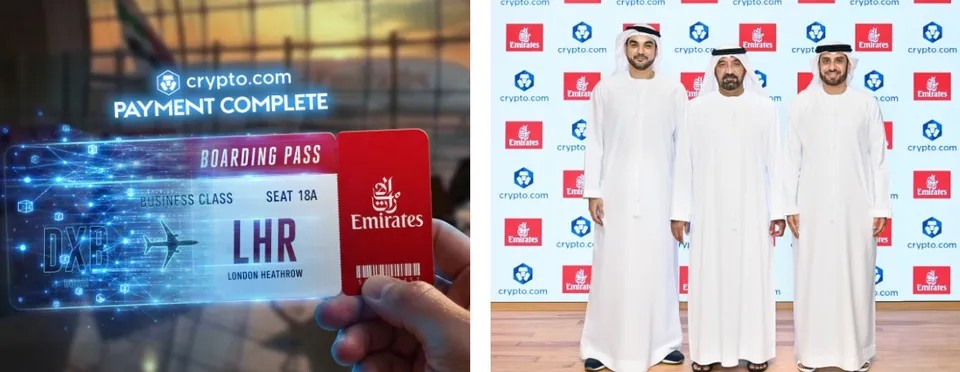
Source: Emirates.

The payment process depends on the device used:

  • Mobile devices: When booking through the Emirates app, the user selects Crypto.com Pay, is automatically redirected to the wallet app for confirmation of the debit, and returns to receive the receipt;
  • Desktop computers: The customer scans a QR code on emirates.com using the Crypto.com mobile app, confirms the transfer, and receives an e-ticket.
"The implementation of this initiative fulfills our commitment to expanding payment options for our customers' travel. It also reflects the rapidly changing preferences of a younger, digitally-savvy generation that manages their money from their phones," emphasized Adnan Kazim, Deputy President and Chief Commercial Officer of Emirates.

The introduction of the service supports the Dubai Cashless Strategy within the D33 economic program, which aims to shift 90% of all financial transactions to a digital format by the end of the year.

Related: UAE telecom giant launches pilot for integrating regulated dirham stablecoin

Regulation of Issuance

In April, the Dubai Virtual Assets Regulatory Authority (VARA) issued a roadmap regulating asset issuance.

According to VARA's guidelines, all tokens issued are divided into three categories:

  • Category 1: Fiat-referenced stablecoins (FRVA) and assets backed by physical resources or revenue (ARVA/RWA). Issuers must obtain a full VARA license and hold 100% reserves;
  • Category 2: Other virtual assets not falling into the first group. A license for issuance is not required, but sales must go through licensed distributors;
  • Excluded Assets (Exempt VAs): Non-transferable tokens and closed-loop loyalty points without a secondary market.

Related: Dubai regulator penalizes 19 crypto companies for operating without licenses

end-content

İlgili Sorular

QWhich airline has started accepting cryptocurrency for ticket payments?

AEmirates has started accepting cryptocurrency for ticket payments.

QWhat payment service did Emirates launch to enable cryptocurrency payments?

AEmirates launched the Crypto.com Pay service to enable cryptocurrency payments.

QThrough which entities is the Crypto.com Pay transaction processing facilitated in the UAE?

ATransactions are processed through Crypto.com's Dubai subsidiary, which is licensed as a Virtual Asset Service Provider (VASP) and holds a Store of Value Funds (SVF) license from the UAE Central Bank.

QWhat is the strategic goal of Dubai's Cashless Strategy mentioned in the article?

AThe strategic goal of Dubai's Cashless Strategy, part of the D33 economic program, is to convert 90% of all financial transactions into digital format by the end of the year.

QHow did Dubai's Virtual Assets Regulatory Authority (VARA) categorize tokens in its issued roadmap?

AVARA categorized tokens into three groups: Category 1 (Fiat-Referenced Virtual Assets and Asset-Referenced Virtual Assets), Category 2 (other virtual assets not in Category 1), and Exempt Virtual Assets (non-transferable tokens and closed-loop loyalty points).

İlgili Okumalar

Global Market Share Survey: Japanese Firms Lead in Semiconductor Materials

Global Market Share Survey: Japanese Firms Lead in Semiconductor Materials According to the 2025 "Major Goods and Services Market Share Survey" by Nikkei, Japanese companies maintain strong positions in semiconductor-related materials. In silicon wafers, Shin-Etsu Chemical ranks first with a 26.3% share, followed by SUMCO at 17.8%. Together, they hold 44.1% of the market, widening their lead over competitors from Taiwan, Germany, and South Korea. In photoresists, Tokyo Ohka Kogyo, JSR, and Shin-Etsu Chemical occupy the top three spots, with a combined share of 60.5%. Despite their strength in materials, Japanese firms have a weaker presence in core semiconductor segments like DRAM and NAND flash memory, where South Korean and U.S. companies dominate. For instance, SK Hynix and Samsung lead in DRAM, while China’s CXMT doubled its share to 6% in 2025. The semiconductor market is projected to grow rapidly, with WSTS forecasting a 90% increase to $1.5112 trillion by 2026. Major players like Samsung, SK Hynix, and Micron are making massive investments to expand capacity. To maintain their edge in materials, Japanese companies must similarly commit to large-scale, risk-taking investments. In contrast, Japan’s automotive sector shows stagnation. Toyota remains the global leader but with only a slight share increase to 12.3%, while Japanese brands are absent from the top five in the EV market. In shipbuilding, Imabari Shipbuilding rose to third place globally with a 7.2% share, benefiting from large container ship deliveries. However, Chinese and South Korean firms dominate the sector, holding the top two positions. Japan aims to revitalize its shipbuilding industry through government and corporate efforts, targeting a near doubling of output by 2035. Addressing labor shortages and adopting advanced technologies like physical AI will be critical for competitiveness.

marsbit14 dk önce

Global Market Share Survey: Japanese Firms Lead in Semiconductor Materials

marsbit14 dk önce

STRC Major De-pegging's First Financial Report, How Will Strategy Repair Its Capital Flywheel?

Bitcoin treasury company Strategy released its Q2 2026 earnings report on July 31. Despite a 6.9% year-over-year revenue increase to $122 million, the company recorded a net loss of $8.22 billion, largely due to $8.32 billion in unrealized losses from Bitcoin price fluctuations. As of quarter-end, Strategy holds 843,775 BTC with an average cost of $75,000 per coin, and Bitcoin per share increased. The report highlights a critical shift in Strategy's capital model following the de-pegging of its key financing tool, STRC (Strategic Coin), which fell below its $100 target. Management's top priority is restoring STRC to its target value, aiming for a recovery by September 8. They rule out discounted STRC issuances and plan to maintain its dividend yield at 12%, instead focusing on bolstering its $3.75 billion cash reserve. Strategy has moved from a one-way "buy-and-hold" Bitcoin strategy to active capital management. This new approach, part of its "Digital Credit Capital Framework," involves flexibly managing its balance sheet across four elements: BTC, USD cash, common stock (MSTR), and digital credit securities like STRC. This allows for BTC monetization (having sold $218.4 million in BTC so far), strategic repurchases of discounted securities, and debt optimization, as seen with a $1.5 billion convertible bond buyback. The company's future hinges on two key tests: successfully re-pegging STRC to restore market confidence in its digital credit system, and a long-term recovery in Bitcoin's price to ultimately support its growth thesis.

marsbit59 dk önce

STRC Major De-pegging's First Financial Report, How Will Strategy Repair Its Capital Flywheel?

marsbit59 dk önce

STRC's First Financial Report Post-Depegging, How is Strategy Restoring the Capital Flywheel?

On July 31, 2026, Bitcoin treasury company Strategy released its Q2 financial report. Despite a 6.9% year-over-year increase in revenue to $122 million, the company recorded a substantial net loss of $8.22 billion, primarily due to $8.32 billion in unrealized losses from Bitcoin holdings. While Strategy's core Bitcoin strategy remains intact—its holdings grew 11% to 843,775 BTC—the company is undergoing a fundamental shift in its capital model. Following the de-pegging of its key financing tool, the STRCoin (STRC), from its $100 target in May, Strategy has pivoted from a one-directional "raise funds, buy Bitcoin" cycle to a more dynamic, multi-asset capital management approach. A key part of this new framework is the "Monetization Program," through which Strategy has sold approximately $218.4 million worth of BTC to bolster liquidity. The company's top priority is repairing STRC's peg, committing not to issue discounted shares until it returns to its target range. It has initiated a $1 billion buyback program for discounted digital credit securities, having repurchased $28.9 million face value of STRC so far. Management aims to restore the peg around September 8, 2026. Strategy now actively manages a matrix of assets: Bitcoin (for accumulation or strategic sales), USD cash reserves (now at $3.75 billion), common stock (MSTR), and digital credit securities like STRC. This allows for tactical moves like repurchasing discounted debt or equity to capture value. The future success of Strategy's "capital flywheel" hinges on two factors: the short-term ability to successfully re-peg STRC to restore market confidence in its digital credit system, and the long-term price trajectory of Bitcoin, upon which its entire investment thesis ultimately depends.

Odaily星球日报1 saat önce

STRC's First Financial Report Post-Depegging, How is Strategy Restoring the Capital Flywheel?

Odaily星球日报1 saat önce

İşlemler

Spot
活动图片